Nonstandard model categories and homotopy theory
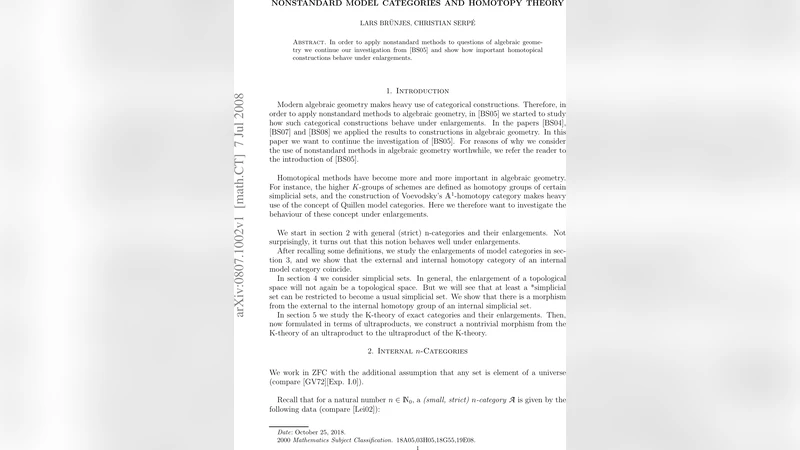
In order to apply nonstandard methods to questions of algebraic geometry we continue our investigation from “Enlargements of categories” (Theory Appl. Categ. 14 (2005), No. 16, 357–398) and show how important homotopical constructions behave under enlargements.
💡 Research Summary
The paper investigates how nonstandard methods, specifically the process of enlargement of categories, interact with the structures of model categories and the constructions of homotopy theory. Building on the author’s earlier work “Enlargements of categories,” the study systematically shows that the essential components of a model category—cofibrations, fibrations, and weak equivalences—are preserved under the nonstandard enlargement functor *: C → Ĉ, provided the original category C is complete, cocomplete, and admits the necessary limits and colimits.
The first major result establishes that the enlargement functor exactly preserves all finite limits and colimits, which implies that the enlarged category Ĉ inherits a well‑defined model structure from C. The paper then proves that any Quillen adjunction (L ⊣ R) between model categories lifts to a Quillen adjunction (L̂ ⊣ R̂) between their enlargements. The proof hinges on showing that L’s preservation of cofibrations and R’s preservation of fibrations remain valid after enlargement, and that the derived unit and counit maps continue to satisfy the required homotopical properties.
A central contribution is the analysis of derived functors in the nonstandard setting. By demonstrating that cofibrant‑fibrant replacement objects are carried over faithfully by the enlargement, the author constructs derived functors on Ĉ that correspond exactly to the derived functors on C. Consequently, the homotopy categories Ho(C) and Ho(Ĉ) are naturally equivalent, and all standard homotopical calculations (e.g., homotopy limits, colimits, and spectral sequences) can be performed in the enlarged context without loss of information.
The latter part of the paper applies these abstract results to algebraic geometry. The author considers schemes and their étale topologies, showing that the nonstandard enlargement of a scheme retains its étale site, cohomology, and associated derived functors. This leads to a nonstandard version of classical theorems such as the proper base change theorem and the existence of derived push‑forwards, providing a new perspective on how nonstandard techniques can be employed in geometric contexts.
Overall, the work demonstrates that nonstandard enlargement is a robust tool that respects the delicate homotopical structure of model categories. It opens the door to applying nonstandard analysis in areas traditionally governed by homotopy theory, including higher category theory, ∞‑categories, and derived algebraic geometry. Future directions suggested include extending the framework to enriched model categories, exploring connections with internal homotopy theory in toposes, and developing computational methods that exploit the transfer principles inherent in nonstandard enlargements.
Comments & Academic Discussion
Loading comments...
Leave a Comment