Knowledge bases over algebraic models. Some notes about informational equivalence
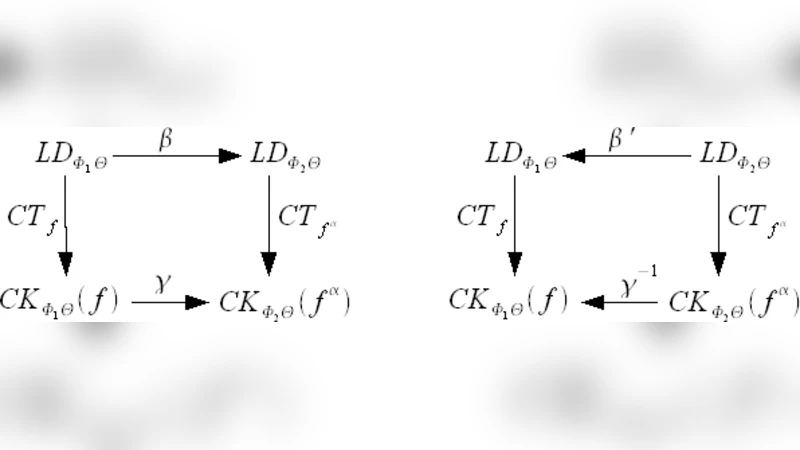
The recent advances in knowledge base research and the growing importance of effective knowledge management raised an important question of knowledge base equivalence verification. This problem has not been stated earlier, at least in a way that allows speaking about algorithms for verification of informational equivalence, because the informal definition of knowledge bases makes formal solution of this problem impossible. In this paper we provide an implementable formal algorithm for knowledge base equivalence verification based on the formal definition of knowledge base proposed by Plotkin B. and Plotkin T., and study some important properties of automorphic equivalence of models. We also describe the concept of equivalence and formulate the criterion for the equivalence of knowledge bases defined over finite models. Further we define multi-models and automorphic equivalence of models and multi-models, that is generalization of automorphic equivalence of algebras.
💡 Research Summary
The paper tackles the problem of verifying whether two knowledge bases (KBs) contain the same information, a question that has become increasingly important with the rise of knowledge‑base research and the need for effective knowledge management. Historically, the informal nature of KB definitions has prevented a formal, algorithmic treatment of equivalence. To overcome this, the authors adopt the formal definition of an “algorithmic knowledge base” introduced by B. Plotkin and T. Plotkin, which models a KB as a pair (M, Σ) where M is an algebraic model (a structure consisting of a domain D, a set of function symbols F, and a set of relation symbols R) and Σ is a finite set of first‑order sentences that encode the knowledge (facts, constraints, rules) over M.
The central theoretical contribution is the notion of automorphic equivalence (or automorphic isomorphism). Two models M₁ and M₂ are automorphically equivalent if there exists a bijection φ : D₁ → D₂ that simultaneously (i) preserves all functions and relations of the signatures (the usual homomorphism condition) and (ii) maps the set of sentences Σ₁ of the first KB onto the set Σ₂ of the second KB in a truth‑preserving way. In other words, φ must be a structure‑preserving permutation that also carries every logical statement of one KB to an equivalent statement in the other. The authors prove that automorphic equivalence is both necessary and sufficient for informational equivalence: if two KBs are automorphically equivalent, each can be substituted for the other without loss of any knowledge, and conversely any two informationally equivalent KBs admit such a bijection.
To address the complexity of real‑world systems, the paper extends the concept to multi‑models. A multi‑model consists of a single underlying domain and signature together with a family of sentence sets {Σᵢ} indexed by i∈I, each representing a different viewpoint, ontology layer, or version of the knowledge. Automorphic equivalence of multi‑models requires a single bijection φ that simultaneously preserves the structure and maps every Σᵢ onto the corresponding Σ′ᵢ. This generalisation enables the comparison of composite knowledge systems such as multi‑modal databases, integrated ontologies, or versioned KBs.
The authors then focus on finite models, where the domain D has size n. In this setting, automorphic equivalence becomes algorithmically decidable. The proposed decision procedure enumerates all n! permutations of the domain, and for each candidate φ it checks three conditions: (1) function preservation (for each f∈F, φ(f_M₁(a₁,…,a_k)) = f_M₂(φ(a₁),…,φ(a_k))), (2) relation preservation (for each r∈R, (a₁,…,a_k)∈r_M₁ ⇔ (φ(a₁),…,φ(a_k))∈r_M₂), and (3) sentence preservation (each σ∈Σ₁ is true in M₁ iff the φ‑translated σ′ is true in M₂). The checks are polynomial in n for a fixed signature, so the overall complexity is O(n!·poly(n)). While factorial growth is unavoidable in the worst case, practical KBs usually have modest domain sizes, making the algorithm feasible. Moreover, the paper discusses optimisation strategies such as pruning the permutation space using signature invariants, exploiting symmetry, or integrating SAT/SMT solvers to handle the sentence‑preservation step more efficiently.
Beyond the algorithm, the paper analyses several structural properties of automorphic equivalence: it is an equivalence relation (reflexive, symmetric, transitive), it refines ordinary algebraic isomorphism by incorporating semantic constraints, and it induces equivalence classes of KBs that can be used for clustering, version control, or reuse. The authors also illustrate how automorphic equivalence subsumes traditional ontology mapping: a mapping that is a bijective homomorphism and respects all axioms is precisely an automorphism in their sense.
Finally, the paper outlines future research directions. These include developing heuristic or approximate methods for large‑scale domains (e.g., using graph invariants, canonical labelling, or probabilistic sampling), extending the framework to dynamic KBs where Σ evolves over time, handling heterogeneous data (text, images) by enriching the signature with appropriate function symbols, and building a full‑stack integration platform that automatically detects automorphic equivalence during KB merging, migration, or federation.
In summary, the work provides a rigorous, implementable definition of knowledge‑base equivalence, introduces the powerful concept of automorphic equivalence for both single and multi‑model settings, supplies a concrete decision algorithm for finite cases, and opens a pathway toward automated, trustworthy knowledge‑base management in complex information systems.
Comments & Academic Discussion
Loading comments...
Leave a Comment