On Expanded Cyclic Codes
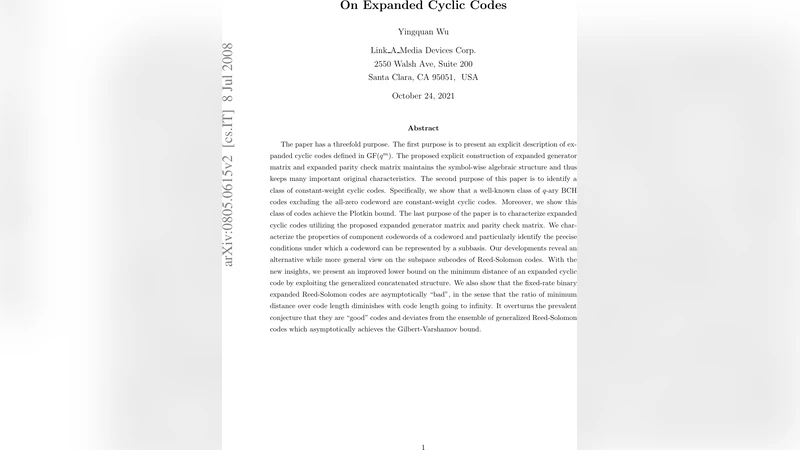
The paper has a threefold purpose. The first purpose is to present an explicit description of expanded cyclic codes defined in $\GF(q^m)$. The proposed explicit construction of expanded generator matrix and expanded parity check matrix maintains the symbol-wise algebraic structure and thus keeps many important original characteristics. The second purpose of this paper is to identify a class of constant-weight cyclic codes. Specifically, we show that a well-known class of $q$-ary BCH codes excluding the all-zero codeword are constant-weight cyclic codes. Moreover, we show this class of codes achieve the Plotkin bound. The last purpose of the paper is to characterize expanded cyclic codes utilizing the proposed expanded generator matrix and parity check matrix. We characterize the properties of component codewords of a codeword and particularly identify the precise conditions under which a codeword can be represented by a subbasis. Our developments reveal an alternative while more general view on the subspace subcodes of Reed-Solomon codes. With the new insights, we present an improved lower bound on the minimum distance of an expanded cyclic code by exploiting the generalized concatenated structure. We also show that the fixed-rate binary expanded Reed-Solomon codes are asymptotically “bad”, in the sense that the ratio of minimum distance over code length diminishes with code length going to infinity. It overturns the prevalent conjecture that they are “good” codes and deviates from the ensemble of generalized Reed-Solomon codes which asymptotically achieves the Gilbert-Varshamov bound.
💡 Research Summary
The paper presents a comprehensive study of expanded cyclic codes defined over the extension field GF(q^m). Its first contribution is an explicit construction of the expanded generator matrix and parity‑check matrix that preserves the symbol‑wise algebraic structure of the original cyclic code. By selecting a basis {β₁,…,β_m} of GF(q^m) over GF(q), each field element γ is expressed as γ=∑_{j=1}^{m} μ_j β_j with μ_j∈GF(q). Theorem 1 shows that stacking the rows β_j·g_i (where g_i are the rows of the original generator matrix) yields an m‑fold expanded generator matrix G_e of size (mK)×(mN) over GF(q). An analogous construction produces the expanded parity‑check matrix H_e. Both matrices retain full rank, guaranteeing that the expanded code has dimension mK and length mN while inheriting the original code’s distance properties.
The second major result identifies a class of constant‑weight cyclic codes. For a non‑subfield element γ∈GF(q^m) with minimal polynomial p_γ(x)=∏_{i=0}^{m_γ−1}(x−γ^{q^i}), the BCH code generated by G(x)=x^{N−1}p_γ(x) (where N=q^m−1) has all non‑zero codewords of weight q^{m−1}(q−1). Each non‑zero element of GF(q) appears exactly q^{m−1} times in any codeword. Consequently, these codes meet the Plotkin bound with equality, establishing them as optimal constant‑weight cyclic codes.
The third contribution concerns the representation of expanded codewords by sub‑bases. The authors prove that a codeword can be expressed using a subset of the basis vectors if and only if the underlying field element γ has a minimal dimension m_γ dividing m. In this case the expanded codeword consists of periodic blocks β_j·g(γ^{−q^i}) of length q^{m_γ}−1, revealing a direct link to subspace subcodes of Reed‑Solomon codes. This yields an alternative, more general formula for the dimension of such subcodes, answering several open questions from earlier work.
Building on this structural insight, the paper exploits the generalized concatenated (GC) framework to improve the lower bound on the minimum distance of expanded cyclic codes. Prior work bounded the outer code’s distance by the longest run of consecutive conjugate elements; the present analysis incorporates the basis‑dependent expansion and obtains the true minimum distance of the outer code, thereby tightening the overall distance bound.
Finally, the authors examine fixed‑rate binary expansions of Reed‑Solomon codes. By analyzing the asymptotic behavior of the distance‑to‑length ratio d/n for m→∞ while keeping the rate constant, they demonstrate that d/n → 0. This disproves the prevailing conjecture that binary expanded Reed‑Solomon codes are asymptotically good and shows that, unlike the ensemble of generalized Reed‑Solomon codes which attains the Gilbert‑Varshamov bound, these specific expansions are asymptotically “bad.” The degradation is traced to the choice of basis and the resulting generalized concatenated structure, which fails to preserve the strong distance properties of the parent RS code.
In summary, the paper delivers (i) an explicit, rank‑preserving matrix construction for expanded cyclic codes, (ii) a proof that a well‑known family of q‑ary BCH codes (excluding the zero word) are optimal constant‑weight cyclic codes achieving the Plotkin bound, (iii) precise conditions for sub‑basis representation of codewords, (iv) an improved minimum‑distance bound via generalized concatenation, and (v) a rigorous asymptotic analysis showing that fixed‑rate binary expanded Reed‑Solomon codes are asymptotically bad. These results refine the theoretical understanding of expanded cyclic codes and have practical implications for code design, especially in applications requiring binary or low‑field implementations of high‑performance algebraic codes.
Comments & Academic Discussion
Loading comments...
Leave a Comment