Path lengths in tree-child time consistent hybridization networks
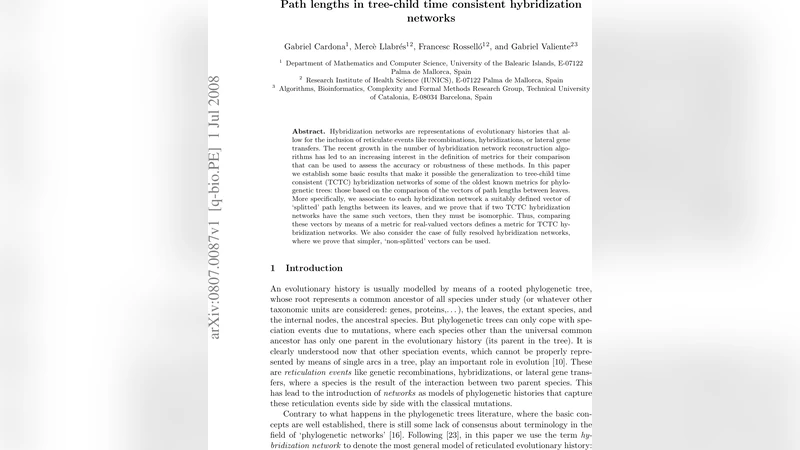
Hybridization networks are representations of evolutionary histories that allow for the inclusion of reticulate events like recombinations, hybridizations, or lateral gene transfers. The recent growth in the number of hybridization network reconstruction algorithms has led to an increasing interest in the definition of metrics for their comparison that can be used to assess the accuracy or robustness of these methods. In this paper we establish some basic results that make it possible the generalization to tree-child time consistent (TCTC) hybridization networks of some of the oldest known metrics for phylogenetic trees: those based on the comparison of the vectors of path lengths between leaves. More specifically, we associate to each hybridization network a suitably defined vector of splitted' path lengths between its leaves, and we prove that if two TCTC hybridization networks have the same such vectors, then they must be isomorphic. Thus, comparing these vectors by means of a metric for real-valued vectors defines a metric for TCTC hybridization networks. We also consider the case of fully resolved hybridization networks, where we prove that simpler, non-splitted’ vectors can be used.
💡 Research Summary
Hybridization networks have become indispensable tools for representing evolutionary histories that involve reticulation events such as recombination, hybridization, or lateral gene transfer. While a growing number of algorithms now exist for reconstructing such networks, the field lacks robust, mathematically grounded metrics for comparing the resulting structures. In this paper the authors address this gap by extending one of the oldest families of phylogenetic tree metrics—those based on leaf‑to‑leaf path‑length vectors—to the more complex setting of tree‑child time‑consistent (TCTC) hybridization networks.
The work begins with a precise formalization of hybridization networks as directed acyclic graphs (DAGs) whose leaves correspond to extant taxa and whose internal nodes represent either speciation events (tree nodes) or reticulation events (hybrid nodes). Two structural constraints are imposed: (i) the tree‑child condition, which requires every internal node to have at least one child that is a leaf, thereby preventing pathological “deep” nesting of hybrid nodes; and (ii) time‑consistency, which forces the two parental edges of each hybrid node to originate from vertices that share the same temporal label. These constraints reflect biologically plausible scenarios while preserving enough regularity to enable rigorous mathematical treatment.
The central technical contribution is the definition of a “splitted path‑length” vector for a TCTC network. For each ordered pair of leaves (i, j) the authors consider the directed path from i to j. Because a path may traverse several hybrid nodes, it is naturally partitioned at each hybrid node into sub‑paths. The length (i.e., number of edges) of each sub‑path is recorded as a separate component of the vector. Consequently, the full vector consists of all sub‑path lengths for all ordered leaf pairs, capturing not only the total distance but also the internal structure of the route, including directionality and the positions of hybrid events.
The main theorem states that two TCTC networks are isomorphic if and only if their splitted path‑length vectors coincide. The proof proceeds by induction on the number of leaves, using two reduction operations: leaf‑pruning (removing a leaf together with its incident edge) and hybrid‑reduction (collapsing a hybrid node while preserving the time‑consistent labeling). At each step the authors show that the vector of the reduced network can be uniquely recovered from the original vector, guaranteeing that identical vectors force identical reduction sequences and thus identical final (trivial) networks. This result implies that the splitted path‑length vector is a complete invariant for TCTC networks.
Because the vector lives in a Euclidean space, any standard metric on real‑valued vectors—such as L₁, L₂, Manhattan, or cosine distance—can be directly transplanted to define a distance between TCTC networks. The induced network distance inherits all metric properties (non‑negativity, symmetry, triangle inequality) and can be computed in O(n²) time where n is the number of leaves, a dramatic improvement over graph‑isomorphism based comparisons.
For the subclass of fully resolved (binary) hybridization networks, the authors prove a simplification: the “non‑splitted” path‑length vector, which records only the total number of edges between each unordered leaf pair, already uniquely determines the network. This reduction eliminates the need to store directionality or sub‑path information, making the metric even more lightweight for practical applications where the networks are binary.
The paper discusses several immediate applications. First, the metric provides a quantitative benchmark for evaluating reconstruction algorithms: the distance between a reconstructed network and a ground‑truth network (e.g., from simulated data) directly reflects reconstruction accuracy. Second, it can serve as an objective function for parameter tuning or model selection, guiding algorithms toward solutions that minimize the distance to a reference. Third, the metric enables systematic comparison of networks derived from different data sources (genomic, transcriptomic, etc.), facilitating cross‑validation of evolutionary hypotheses.
Finally, the authors acknowledge limitations and outline future work. The completeness proof relies crucially on the tree‑child and time‑consistent constraints; relaxing either condition may admit non‑isomorphic networks with identical vectors, suggesting the need for additional invariants (e.g., hybrid‑node labels). Extending the framework to dynamic networks that evolve over time, or to networks with polytomies, remains an open challenge. Moreover, while the O(n²) computation is feasible for moderate‑size datasets, scaling to thousands of taxa will require parallel algorithms or approximation schemes. Addressing these issues will broaden the applicability of path‑length based metrics in phylogenomics and evolutionary biology.
Comments & Academic Discussion
Loading comments...
Leave a Comment