The Dynamics of Probabilistic Population Protocols
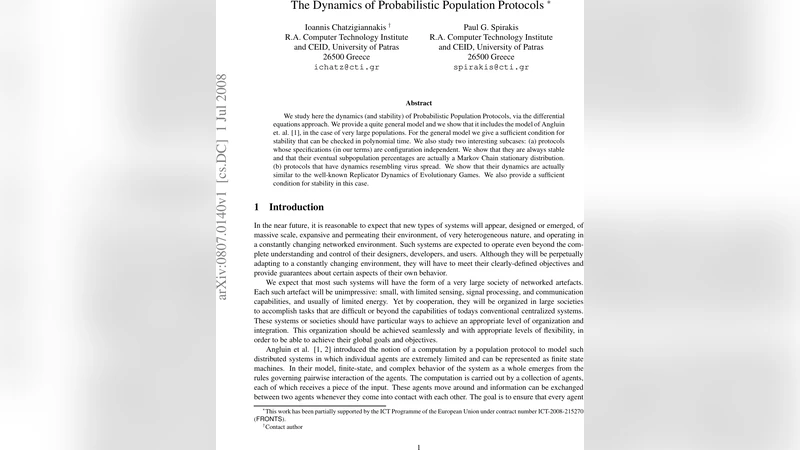
We study here the dynamics (and stability) of Probabilistic Population Protocols, via the differential equations approach. We provide a quite general model and we show that it includes the model of Angluin et. al. in the case of very large populations. For the general model we give a sufficient condition for stability that can be checked in polynomial time. We also study two interesting subcases: (a) protocols whose specifications (in our terms) are configuration independent. We show that they are always stable and that their eventual subpopulation percentages are actually a Markov Chain stationary distribution. (b) protocols that have dynamics resembling virus spread. We show that their dynamics are actually similar to the well-known Replicator Dynamics of Evolutionary Games. We also provide a sufficient condition for stability in this case.
💡 Research Summary
The paper presents a comprehensive study of the dynamics and stability of Probabilistic Population Protocols (PPPs) using a differential‑equations framework. Starting from the classic population‑protocol model of Angluin et al., the authors consider a very large population (size N) in which pairwise interactions occur uniformly at random. By scaling the interaction probabilities appropriately, the stochastic discrete‑time process converges to a deterministic continuous‑time system described by a set of ordinary differential equations (ODEs) for the fractions x_i(t) of agents in each state i. The transition rule is a function p(i,j→k,l) that gives the probability that a randomly selected ordered pair (i,j) changes to (k,l). The authors prove that the Angluin model is a special case of their general formulation when the transition probabilities are of order 1/N.
Stability analysis proceeds by constructing the Laplacian‑type matrix L that captures the net flow between states. The Jacobian of the ODE system is J = −L. The paper shows that if J is an M‑matrix—i.e., all off‑diagonal entries are non‑positive and each row sums to zero—then all eigenvalues have non‑positive real parts, guaranteeing global Lyapunov stability of the equilibrium. Importantly, checking the M‑matrix property can be done in polynomial time, providing a practical algorithm for automatic verification of protocol stability.
Two important subclasses are examined in depth. The first subclass consists of configuration‑independent protocols, where transition probabilities depend only on the states of the two interacting agents and not on the global configuration vector x(t). In this setting the dynamics reduce to a Markov chain on the state space of a single agent. The equilibrium distribution of the ODE system coincides exactly with the stationary distribution of that Markov chain. Consequently, as long as the underlying chain is irreducible and aperiodic, the protocol is guaranteed to converge to a unique stable point.
The second subclass models virus‑like spread. One state represents “infected” and another “susceptible”. When an infected agent meets a susceptible one, the susceptible becomes infected with a certain probability. The resulting ODEs have the same algebraic form as the Replicator Dynamics from evolutionary game theory. By interpreting the infection payoff as a fitness function, the authors invoke known results on replicator stability: if the payoff matrix yields a positive definite Lyapunov function (for example, when it can be expressed via a Lagrange multiplier formulation), the system converges globally to an interior equilibrium. A concrete sufficient condition for stability in this viral spread scenario is derived, mirroring the classic ESS (evolutionarily stable strategy) criteria.
The paper concludes with illustrative applications. The authors discuss how their framework can model malware propagation in peer‑to‑peer networks, cooperative behavior in biological populations, and consensus algorithms in distributed systems. The polynomial‑time stability test enables designers to embed automatic verification into the protocol synthesis pipeline. By unifying discrete‑time population protocols with continuous‑time dynamical systems, the work offers a powerful analytical toolkit that extends beyond the original Angluin model, opening avenues for rigorous design and analysis of large‑scale stochastic distributed algorithms.
Comments & Academic Discussion
Loading comments...
Leave a Comment