Splitting Polytopes
A split of a polytope $P$ is a (regular) subdivision with exactly two maximal cells. It turns out that each weight function on the vertices of $P$ admits a unique decomposition as a linear combination of weight functions corresponding to the splits o…
Authors: Sven Herrmann, Michael Joswig
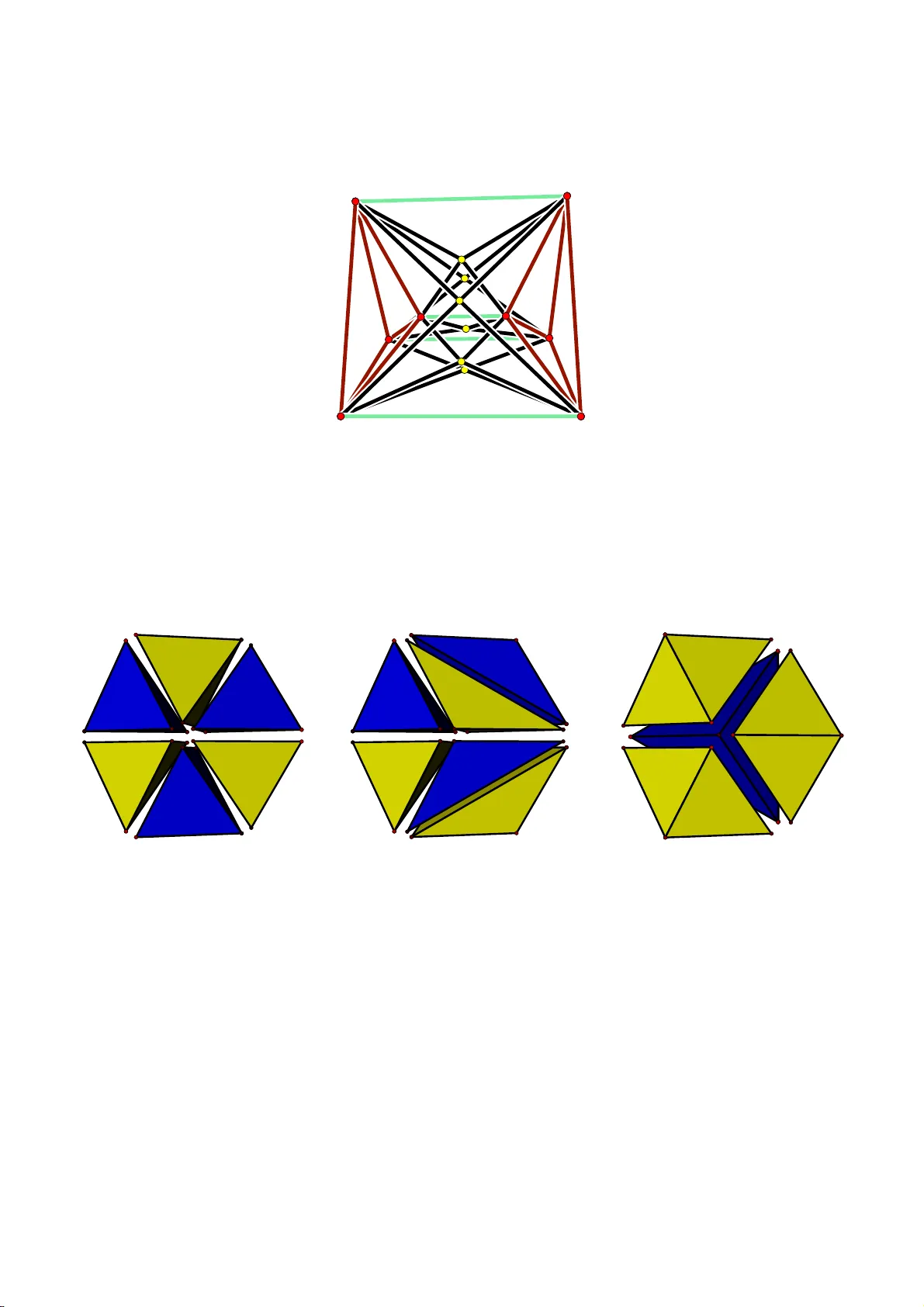
SPLITTING POL YTOPES SVEN HERRMANN AND MICHAEL JOSWIG Abstra ct. A split of a p olytop e P is a (regular) sub division with exactly tw o maximal cells. It turns out that eac h w eight function on the v ertices of P admits a unique decomposition as a linear combination of wei ght functions corresp onding to th e splits of P (with a sp lit prime remainder). This generalizes a result of Bandelt and Dress [Adv. Math. 92 (1992)] on th e decomposition of finite metric spaces. Introducing the concept of c omp atibili ty of splits gives rise to a finite simplicia l complex asso ciated with any polytop e P , the split c ompl ex of P . C omplete descriptions of the split complexes of all hyp ersimplices are obtained. Moreo ver, it is shown that these complexes arise as subcomplexes of the tropical (p re- )Grassmannians of Sp eyer and Sturmfels [Adv. Geom. 4 (2004)]. 1. Introduction A real-v alued w eigh t function w on the v ertices of a p olytop e P in R d defines a p olytopal sub division of P b y wa y of lifting to R d +1 and pr o jecting the lo we r hull bac k to R d . The set of all we igh t fu nctions on P h as the natural structure of a p olyhedral fan, the se c ondar y fan SecF an( P ). The ra ys of SecF an( P ) corresp ond to the coarsest (regular) su b divisions of P . This pap e r d eals with the coarsest s ub d ivisions with precisely t wo maximal cells. These are called splits . Hirai prov ed in [17] that an arbitrary w eigh t function on P admits a canonical d ecomp osition as a linear com bination of sp lit w eight s w ith a split prime remainder. Th is generaliz es a classical result of Bandelt and Dress [2] on the d ecomp osition of fi nite metric spaces, whic h p ro ved to b e u seful for applications in phyloge nomics; e.g., see Huson and Bryan t [19]. W e giv e a new pr o of of Hirai’s sp lit decomp osition theorem whic h establishes the connection to the theory of secondary fans dev elop ed b y Gel ′ fand, Kapr an ov, and Zelevinsky [14]. Our main con tribution is the introdu ction and the stu dy of th e split c omp lex of a p olytop e P . This comes ab out as the clique complex of the graph defin ed by a c omp atibility relation on the set of splits of P . A fi rst example is th e b oun dary complex of the p olar d ual of the ( n − 3)-dimensional asso ciahedron , whic h is isomorphic to the s p lit complex of an n -gon. A focu s of our inv estigat ion is on the h yp ersimplices ∆( k , n ) , wh ic h are the con vex hulls of the 0 / 1-v ectors of length n with exactly k ones. W e classify all splits of the h yp ersimplices toget her with th eir compatibilit y relation. Th is describ es th e sp lit complexes of the hyp ersimplices. T ropical geometry is concerned with the tr opic alization of algebraic v arieties. An imp ortan t class of examples is formed by the tr opic al Gr assma nnians G k ,n of Sp eyer an d Sturmfels [38], which are the tropicalizat ions of the ordinary Grassm annians of k -dimensional subspaces of an n -dimensional v ector space (o v er some field). It is a challe n ge to obtain a complete description of G k ,n ev en for most fixed v alues of k and n . A b etter b ehav ed close relativ e of G k ,n is the tr opic al pr e-Gr assma nnian pre − G k ,n arising fr om tropicalizing the ideal of qu adratic Pl ¨ uc ker relations. T his is a su bfan of the secondary fan of ∆( k , n ), and its r a ys corresp ond to coarsest sub divisions of ∆( k , n ) whose (maximal) cells are m atroid p olytop es; see Kapranov [24] and Sp ey er [36 ]. As one of our main results we pr o ve that the split complex of ∆( k , n ) is a sub complex of pre − G ′ k ,n , the intersect ion of the fan pr e − G k ,n with the unit sph ere in R n k . Date : December 5, 2021. Sven H errmann is supp orted by a Graduate Gran t of TU Darmstadt. Research by Michael Joswig is sup p orted by DF G Researc h Unit “Polyhedral Surfaces”. 1 2 HERRMANN AND JOSWIG Moreo v er, w e b eliev e that our approac h can b e extended further to obtain a d eep er understanding of the tropical (pr e-)Grassmannians. T o f ollo w this line, ho w ever, is b ey ond the scop e of this pap er . The pap er is organized as follo w s . W e start out with the inv estigatio n of general we igh t fu n ctions on a p olytop e P and their coherence. Tw o w eight functions are c oh er ent if there is a common refinemen t of the su b divisions that they induce on P . As an essen tial tec hnical d evice for the subsequent sectio ns we in tro duce the c oher ency index of t w o w eigh t f u nctions on P . This generalizes the definition of Ko olen and Moulton for ∆(2 , n ) [28], Section 4.1. The thir d section then deals with splits of p olytop es and the corresp ondin g we igh t fun ctions. As a first result w e giv e a concise new pro of of the split decomp osition theorems of Bandelt an d Dress [2], Theorem 3, and Hirai [17], Theorem 2.2. A split sub division of the p olytop e P is clearly determined by the affine hyperp lane spann ed by the unique interior cell of co dimens ion 1. A set of splits is c omp atible if an y t w o of the corresp onding sp lit h y p erplanes d o n ot meet in th e (r elativ e) in terior of P . The split c omp lex Split( P ) is the ab s tract simplicial complex of compatible sets of splits of P . It is an interesting fact that the su b division of P induced b y a s um of weigh ts corresp onding to a compatible system of sp lits is dual to a tree. In th is sense S plit( P ) can alw ays b e seen as a “space of trees”. In Section 5 we study the hypersimp lices ∆( k , n ) . Their splits are classified and exp licitly enumerated. Moreo v er, we c haracterize the compatible pairs of splits. The purp ose of the short Section 6 is to sp ecialize our r esults for arbitrary hyp ersimplices to the case k = 2. A metric on a finite set of n p oin ts yields a w eight fun ction on ∆(2 , n ), and hence all the previous results can b e int erpreted for finite metric spaces. This is the classical situation studied by Bandelt and Dress [1, 2]. Notice that some of th eir results had already b een obtained by Isb ell muc h earlier [20]. Section 7 bridges th e gap b et w een the sp lit theory of the h y p ersimplices and matroid theory . This w ay , as one ke y result, w e can p ro ve that the split complex of the hyp ersimplex ∆( k , n ) is a s u b complex of the tropical pr e-Grassmannian pre − G ′ k ,n . W e conclude the p ap er with a list of op en questions. 2. Coherency o f Weight Func tions Let P ⊂ R d +1 b e a p olytop e with vertices v 1 , . . . , v n . W e form the n × ( d + 1)-matrix V whose rows are th e ve rtices of P . F or tec hn ical reasons we mak e th e assu mption that P is d -dimen s ional and that the (column) vecto r 1 := (1 , . . . , 1) is contai ned in the linear span of the columns of V . In particular, this imp lies th at P is con tained in some affine hyperp lane which do es not conta in the origin. A weight function w : V er t P → R of P can b e wr itten as a ve ctor in R n . No w eac h we igh t fu n ction w of P giv es rise to the unb ounded p olyhedron E w ( P ) := n x ∈ R d +1 V x ≥ − w o , the envelop e of P with resp ect to w . W e refer to Ziegler [45 ] for details on p olytop es. If w 1 and w 2 are b oth w eight f u nctions of P , then V x ≥ − w 1 and V y ≥ − w 2 implies V ( x + y ) ≥ − ( w 1 + w 2 ). This yields th e inclusion (1) E w 1 ( P ) + E w 2 ( P ) ⊆ E w 1 + w 2 ( P ) . If equalit y h olds in (1) then ( w 1 , w 2 ) is called a c oher ent de c omp osition of w = w 1 + w 2 . (Note that this must not b e confused with the notion of “coheren t sub division” whic h is sometimes u sed instead of “regular sub division”.) Example 1. W e consider a hexagon H ⊂ R 3 whose v ertices are the columns of the matrix V T = 1 1 1 1 1 1 0 1 2 2 1 0 0 0 1 2 2 1 SPLITTING POL YTOPES 3 and three w eight functions w 1 = (0 , 0 , 1 , 1 , 0 , 0), w 2 = (0 , 0 , 0 , 1 , 1 , 0), and w 3 = (0 , 0 , 2 , 3 , 2 , 0). Again w e iden tify a matrix with th e set of its ro ws. A direct compu tation th en yields that w 1 + w 2 is not coheren t, but b oth w 1 + w 3 and w 2 + w 3 are coherent . Eac h fac e of a p olyhedr on, th at is, the in tersection with a supp orting h yp erplane, is aga in a p olyhedron, and it can b e b ound ed or not. A p olyhedron is p ointe d if it do es not con tain an affine subspace or, equiv alen tly , its linealit y space is trivial. Th is im p lies that the s et of all b ound ed faces is non-empty and forms a p olytopal complex. This p olytopal complex is alw a ys con tractible (see Hirai [16, Lemma 4.5]). The p olytopal complex of b ounded faces of the p olyhedron E w ( P ) is called th e tight sp an of P with resp ect to w , and it is denoted by T w ( P ). Lemma 2. L et w = w 1 + w 2 b e a de c omp osition of weight functions of P . Then the fol lowing statem ents ar e e quivalent. (i) The de c omp ositio n ( w 1 , w 2 ) is c oher ent, (ii) T w ( P ) ⊆ T w 1 ( P ) + T w 2 ( P ) , (iii) T w ( P ) ⊆ E w 1 ( P ) + E w 2 ( P ) , (iv) e ach vertex of T w ( P ) c an b e written as a sum of a vertex of T w 1 ( P ) and a vertex of T w 2 ( P ) . F or a similar statemen t in the sp ecial case wh er e P is a second hypers implex (see Section 5 b elo w) s ee Ko olen and Moulton [27], Lemma 1.2. Pr o of. I f ( w 1 , w 2 ) is coheren t then b y definition E w ( P ) = E w 1 ( P ) + E w 2 ( P ). Eac h face F of the Mink owski sum of t wo p olyhedra is the Minko wski sum of tw o faces F 1 , F 2 , one fr om eac h su mmand. No w F is b ound ed if and only if F 1 and F 2 are b ound ed. This pro v es that (i ) implies (ii) . Clearly , (ii) implies (iii). Moreo ver, (iii) implies (iv) b y the same argumen t on Mink o wski sums as ab o ve. T o complete the pr o of we h a ve to sho w that (i) follo ws from (iv). So assume that eac h verte x of T w ( P ) can b e written as a su m of a v ertex of T w 1 ( P ) and a v ertex of T w 2 ( P ), and let x ∈ E w ( P ). Then x can b e w ritten as x = y + r w here y ∈ T w ( P ) and r is a r a y of E w ( P ), that is, z + λr ∈ E w ( P ) for all z ∈ E w ( P ) and all λ ≥ 0. It follo ws that V r ≤ 0. By assumption there are v ertices y 1 and y 2 of T w 1 ( P ) and T w 2 ( P ) such that y = y 1 + y 2 . Setting x 1 := y 1 + r and x 2 := y 2 w e hav e x = x 1 + x 2 with x 2 ∈ E w 2 ( P ). Compu tin g V x 1 = V ( y 1 + r ) ≤ V y 1 + V r ≤ − w 1 + 0 = − w 1 , w e infer that x 1 ∈ E w 1 ( P ), and hence w 1 and w 2 are coherent . W e recall b asic f acts ab out cone p olarit y . F or an arbitrary p ointe d p olyhedron X ⊂ R d +1 there exists a unique p olyhedral cone C ( X ) ⊂ R d +2 suc h that X = x ∈ R d +1 (1 , x ) ∈ C ( P ) . If X is give n in inequalit y descrip tion X = x ∈ R d +1 Ax ≥ b one has C ( X ) = y ∈ R d +2 1 0 − b A y ≥ 0 . If X is giv en in a v ertex-ray d escription P = con v V + p os R one has C ( X ) = p os 1 V 0 R . F or any set M ⊆ R d +2 its cone p olar is defin ed as M ◦ := { y ∈ R d +2 | h x, y i ≥ 0 for all x ∈ M } . If C = p os A is a cone it is easily s een that C ◦ = { y ∈ R d +2 | Ay ≥ 0 } and that ( C ◦ ) ◦ = C . The cone C ◦ is called the p olar dual cone of C . T w o p olyhedra X and Y are p olar duals if the corr esp onding cones C ( X ) and C ( Y ) are. T he face lattices of dual cones are anti -isomorphic. F or the follo wing our tec hn ical assumptions from the b eginning come into play . Aga in let P b e a d -p olytop e in R d +1 suc h that 1 is con tained in the column span of the matrix V wh ose ro ws are the v ertices of P . T he standard basis ve ctors of R d +1 are denoted by e 1 , . . . , e d +1 . 4 HERRMANN AND JOSWIG Prop osition 3. Th e p olyhe dr on E w ( P ) is affinely e quivalent to the p olar dual of the p olyhe dr on L w ( P ) := con v { v + w ( v ) e d +1 | v ∈ V ert P } + R ≥ 0 e d +1 . Mor e over, the fac e p oset of T w ( P ) is anti-isomorphic to the fac e p oset of the interior lower fac es (with r esp e ct to the last c o or dinate) of L w ( P ) . Pr o of. Note first, th at b y our assumption that 1 is in the column span of V , up to a linear transform ation of R d +1 , we can assume that V = ( ¯ V , 1 ) for an n × d -matrix ¯ V . This yields C ( E w ( P )) = x ∈ R d +2 1 0 0 w ¯ V 1 x ≥ 0 . On the other hand we ha ve C ( L w ( P )) = p os 1 ¯ V w 0 0 1 , whic h is linearly isomorph ic to ¯ C = p os w 1 ¯ V 1 0 0 b y a co ord in ate c hange, so E w ( P ) and L w ( P ) are p olar duals, up to linear transformations. This w ay we hav e obtained an anti-iso morphism of th e face lattices of C ( E w ( P )) and C ( L w ( P )). A face F of E w ( P ) is b ounded if and only if no generator of C ( E w ( P )) with first co ordinate equal to zero is smaller then F in the face lattice. In the dual view, this means that the corresp onding face F ′ of L w ( P ) is greater th en a facet which is p arallel to the last co ord in ate axis in the face lattice of C ( L w ( P )). But this exactly means that F ′ is a lo w er face. So the lattice anti- isomorphism of C ( E w ( P )) and C ( L w ( P )) induces a p oset anti -isomorphism b et w een T w ( P ) and the interior lo wer faces of L w ( P ). The lo w er faces of L w ( P ) (with resp ect to the last co ordinate) are precisely its b oun ded faces. By pro jecting bac k to aff P in the e d +1 -direction, the p olytopal complex of b ounded f aces of L w ( P ) induces a p olytopal decomp osition Σ w ( P ) of P . Note that we only allo w the v ertices of P as v ertices of an y sub d ivision of P . A p olytopal s ub d ivision which arises in this wa y is called r e gular . T w o w eight functions are e quivalent if th ey induce the same su b division. This allo w s for one more charact erization extending Lemma 2. Corollary 4. A de c omp osition w = w 1 + w 2 of weight functions of P is c oher ent if and only if the sub division Σ w ( P ) is the c ommon r efinement of the sub divisions Σ w 1 ( P ) and Σ w 2 ( P ) . Pr o of. By Lemma 2, the decomp osition w 1 + w 2 is coherent if and only if eac h v ertex x of T w ( P ) is the sum of a v er tex x 1 of T w 1 ( P ) and a v er tex x 2 of T w 2 ( P ). In terms of the d ualit y pro v ed in Prop osition 3 the v ertex x corresp onds to th e maximal cell F w ( x ) := conv { v ∈ V ert P | h v , x i = − w } of Σ w ( P ). Similarly , x 1 and x 2 corresp onds to the cells F w 1 ( x 1 ) and F w 2 ( x 2 ) of Σ w 1 ( P ) and Σ w 2 ( P ), resp ectiv ely . In fact, we ha ve F w ( x ) = F w 1 ( x 1 ) ∩ F w 2 ( x 2 ), and so Σ w ( P ) is the common refin emen t of Σ w 1 ( P ) and Σ w 2 ( P ). The con verse follo ws similarly . Example 5. In Example 1 the tigh t spans of the thr ee w eight functions of the hexagon are line segmen ts: T w 1 ( H ) = [0 , (1 , − 1 , 0)] , T w 2 ( H ) = [0 , (1 , 0 , − 1)] , and T w 3 ( H ) = [0 , (1 , − 1 , − 1)] . Remark 6. Interesting sp ecial cases of tight spans include the follo wing. Finite metric spaces (on n p oint s) giv e r ise to weigh t f unctions on the second hyp ersimplex P = ∆(2 , n ) . In this case the tigh t span can b e int erpreted as a “space ” of trees wh ic h are candidates to fit th e give n metric. T his has b een studied by Bandelt and Dress [2], and th is is the con text in whic h th e name “tight span” w as used first. See also S ection 6 b elo w. If P is a pro du ct of t wo sim p lices, the tight sp an of a lifting f u nction give s rise to a tr opic al p olytop e in tro duced b y Dev elin and Sturmf els [9], the cells in the resulting regular decomp osition of P are the p olytr op es of [23]. If P s pans the affine hyp erplane x 1 = 1 and if we consider the we igh t function defin ed b y w ( v ) = v 2 2 + v 2 3 + · · · + v 2 d +1 for eac h v ertex v of P then the tight span T w ( P ) is isomorphic to the sub complex of SPLITTING POL YTOPES 5 b ound ed faces of the V oronoi diagram of V ert P . All maximal cells of the V oronoi diagram are u n b ound ed and hence the tigh t span is at most ( d − 1)-dimensional. The sub division Σ w ( P ) is then isomorphic to the Delone decomp osition of V ert P . Let w and w ′ b e weig h t f unctions of our p olytop e P . W e wa n t to ha v e a measure which expresses to what extent the pair of weig ht fu nctions ( w ′ , w − w ′ ) deviates f rom coherence (if at all). Th e c oher e ncy index of w with resp ect to w ′ is defined as (2) α w w ′ := min x ∈ V ert E w ( P ) max x ′ ∈ V ert E w ′ ( P ) min v ∈ V w ′ ( x ′ ) h v , x i + w ( v ) h v , x ′ i + w ′ ( v ) , where V w ′ ( x ′ ) = { v ∈ V ert P | h v , x ′ i 6 = − w ′ ( v ) } . (That is, V w ′ ( x ′ ) is the set of v ertices of P that are n ot con tained in the cell du al to x .) The name is jus tified b y the follo wing obs er v ation which generalizes Ko olen and Moulton [28, T heorem 4.1]. Prop osition 7 . L et w and w ′ b e weight functions of the p olytop e P . Mor e over, let λ ∈ R and ˜ w := w − λw ′ . Then w = ˜ w + λw ′ is c oher ent if and only if 0 ≤ λ ≤ α w w ′ . Pr o of. Ass u me that w = ˜ w + λw ′ is coheren t. By Lemma 2 for eac h v ertex x of E w ( P ) there is a vertex x ′ of E w ′ ( P ) suc h that x − λx ′ is a ve rtex of E ˜ w ( P ). W e arriv e at th e follo w ing sequence of equiv alences: x − λx ′ ∈ T ˜ w ( P ) ⇐ ⇒ − w ( v ) + λw ′ ( v ) ≤ h v , x − λx ′ i for all v ∈ V ert P ⇐ ⇒ λ ( h v , x ′ i + w ′ ( v )) ≤ h v , x i + w ( v ) for all v ∈ V ert P ⇐ ⇒ λ ≤ h v , x i + w ( v ) h v , x ′ i + w ′ ( v ) for all v ∈ V w ′ ( x ′ ) ⇐ ⇒ λ ≤ min v ∈ V w ′ ( x ′ ) h v , x i + w ( v ) h v , x ′ i + w ′ ( v ) . F or eac h v ertex x of E w ( P ) there must b e some vertex x ′ of E w ′ ( P ) such that these inequalities hold, and this gives the claim. Corollary 8. F or two weight func tion w and w ′ of P we have α w w ′ = sup λ ≥ 0 ( w − λw ′ , λw ′ ) is a c oher e nt de c omp osition of w . Corollary 9. If w and w ′ ar e weight functions then Σ w ( P ) = Σ w ′ ( P ) if and only if α w w ′ > 0 and α w ′ w > 0 . The set of all regular sub divisions of the con vex p olytop e P is kno wn to ha ve an in teresting structure (see [7, Chapter 5] for the d etails): F or a weig h t fun ction w ∈ R n of P w e consider the set S [ w ] ⊂ R n of all we igh t fu nctions that are equiv alen t to w , that is, S [ w ] := { x ∈ R n | Σ x ( P ) = Σ w ( P ) } . This set is called the se c ondary c one of P w ith resp ect to w . It can b e sho wn (for instance, see [7, Corollary 5.2.10]) that S [ w ] is ind eed a p olyhedral cone and that the set of all S [ w ] (for all w ) forms a p olyhedral fan SecF an( P ), called the se c ondary fan of P . It is easily ve rified that S [0] is the set of all (restrictions of ) affine lin ear fun ctions and th at it is th e linealit y space of every cone in the secondary fan. So this f an can b e regarded in the quotien t space R n /S [0] ∼ = R n − d − 1 . If there is no c hange for confu sion w e will identify w ∈ R n and its image in R n /S [0]. F urthermore, the secondary fan can b e cu t with the un it sph ere to get a (spherical) p olytopal complex on the set of ra ys in the fan. This complex carries the same information as the f an itself an d will also b e identified with it. It is a famous result b y Gel ′ fand, Kapranov, and Zelevinsky [14, T h eorem 1.7], that the secondary fan is the n orm al fan of a p olytop e, th e se c ondary p olytop e SecPo ly ( P ) of P . This p olytop e admits a 6 HERRMANN AND JOSWIG realizatio n as the con ve x hull of the so-called GKZ-ve ctors of all (regular) triangulations. T he GKZ- v ector x ∆ ∈ R n of a triangulation ∆ is d efined as ( x ∆ ) v := P S V ol S for all v ∈ V ert P , where th e sum ranges ov er all full-dimensional simp lices S ∈ ∆ w h ic h con tain v . A description in term s of inequalities is give n by Lee [30, S ection 17.6, Result 4]: The affin e hull of SecP oly ( P ) ⊂ R n is giv en by the d + 1 equations (3) X v ∈ V ert P x v = ( d + 1) d V ol P and X v ∈ V ert P x v v = (( d + 1) V ol P ) c P , where c P denotes the cent roid of P and V ol denotes the d -dimensional volume in the affine span of P , whic h we can ident ify with R d . The facet definin g inequalities of S ecP oly ( P ) are X v ∈ V ert P w ( v ) x v ≥ ( d + 1) X Q ∈ Σ w ( P ) V ol Q ¯ w ( c Q ) , (4) for all coarsest regular sub divisions Σ w ( P ) d efi ned b y a weig ht w . Here ¯ w : P 7→ R denotes the piecewise- linear conv ex f unction whose graph is giv en b y the lo we r f acets of L w ( P ). A weigh t function w s uc h that for all we ight functions w ′ with α w w ′ > 0 we h av e w ′ = λw (in R n /S [0]) for some λ > 0 is called prime . The set of all prime weig ht functions for a giv en p olytop e P is denoted W ( P ). By this we get d irectly: Prop osition 10. The e qui v alenc e classes of prime weig hts c orr esp ond to the extr emal r ay s of the se c- ondary fan (and henc e to the c o arsest r e gular sub divisions or, e qui valently, to the fac ets of the se c ondary p olyto p e). The f ollo wing is a reformulatio n of the fact that the set of all equiv alence classes of weigh t fu nctions forms a fan (the secondary fan). Theorem 11. E ach weight function w on a p olyto p e P c an b e de c omp ose d into a c oher ent sum of prime weight f unctions, that is, ther e ar e p 1 , . . . , p k ∈ W ( P ) such that w = p 1 + · · · + p k is a c oher ent de c omp osition. Pr o of. E ach w eight f unction w is conta ined in s ome cone of the secondary fan of P . Hence there are extremal ra ys r 1 , . . . , r k of the secondary cone and p ositiv e real n umbers λ 1 , . . . , λ k suc h that w = λ 1 r 1 + · · · + λ k r k ; b y construction, this decomp osition is coheren t by Lemma 2. F rom Prop osition 10 we kno w that p i := λ i r i is a p r ime w eigh t, and th e claim follo ws. Note that this decomp osition is usu ally n ot uniqu e. 3. Splits and the Split Decom position Theorem A split S of a p olytop e P is a decomp osition of P without new vertice s whic h has exactl y t w o maximal cells denoted b y S + and S − . As ab ov e, we assume that P ⊂ R d +1 is d -dimensional and that aff P do es not con tain the origin. Then the linear span of S + ∩ S − is a linear hyperp lane H S , the split hyp erplane of S with resp ect to P . Since S do es not induce an y n ew vertice s, in particular, H S do es not meet any edge of P in its relativ e int erior. Conv ersely , eac h hyp erplane w hic h s ep arates P and wh ic h do es not separate any edge d efines a split of P . F urthermore, it is easy to see, th at a h yp erplane d efines a split of P if and only if it defin es a split on all facets of P that it meets in the interio r. The f ollo wing observ ation is immediate. Note that it imp lies th at a hyperp lane defin es a split if and only if its do es not separate an y edge. Observ ation 12. A hyp erplane that me ets P in its interior is a split hyp erplane of P if and only if it interse cts e ach of its fac ets F in either a split hyp erp lane of F or in a fac e of F . SPLITTING POL YTOPES 7 Remark 13. S ince the n otion of facets and f aces of a p olytop e do es only dep end on th e oriente d matr oid of P it follo ws from Observ ation 12 that the set sp lits of a p olytop e only dep end on the orien ted matroid of P . This is in con trast to the fact that the set of regular triangulations (see b elo w), in general, dep ends on the s p ecific co ordinatization. The runn in g theme of this pap er is: If a p olytop e admits sufficient ly many splits then interesting things happ en. Ho w ever, one should k eep in mind that there are many p olytop es without a single split; suc h p olytop es are called unsplittable . Remark 14. If v is a v ertex of P suc h th at all neighbors of v in P are con tained in a common hyp erplane H v then H v defines a split S v of P . Su c h a split is call ed the vertex split with resp ect to v . F or instance, if P is simple then eac h vertex defin es a v er tex split. Since p olygons are simple p olytop es it follo ws, in particular, that an u nsplittable p olytop e which is not a simplex is at least 3-dimensional. An unsplittable 3-p olytop e has at least six ve rtices. An example is a 3-dimensional cross p olytop e wh ose v ertices are p erturb ed in to general p osition. Prop osition 15. Each 2 -neighb orly p olytop e is unsplittable. Pr o of. Ass u me that S is a sp lit of P , and P is 2-neigh b orly . Recall that the latter prop er ty means that an y t wo v ertices of P are joined b y an ed ge. C ho ose v er tices v ∈ S + \ S − and w ∈ S − \ S + . Then the segmen t [ v , w ] is an edge of P which is separated by the sp lit h yp erplane H S . Th is is a con tradiction to the assum p tion that S w as a split of P . It is clear that sp lits yield coarsest su b divisions; b ut the f ollo wing lemma sa ys that they ev en defin e facets of th e secondary p olytop e. Lemma 16. Splits ar e r e gular. Pr o of. L et S b e a split of P . W e hav e to sh o w that S is in duced by a weigh t fu nction. Let a b e a normal v ector of the split h y p erplane H S . W e define w S : V ert ( P ) → R by (5) w S ( v ) := ( | av | if v ∈ S + , 0 if v ∈ S − . Note that this fun ction is we ll-defined since for v ∈ H S = S + ∩ S − w e ha ve av = 0. It is n o w obvious that w induces the split S on P . Example 17. In Example 1 th e three weigh t functions w 1 , w 2 , w 3 define splits of the h exagon H . By sp ecializing Equation (4), a facet d efining inequalit y for the sp lit S is giv en by X v ∈ V ert( P ∩ S + ) | av | x v ≥ | ac P ∩ S + | ( d + 1) V ol ( P ∩ S + ) . (6) Note that a is a n ormal vecto r of the split h yp erplane H S as ab o ve, and c P ∩ S + is the cen troid of th e p olytop e P ∩ S + . By taking the inequalities (6) for all splits S of P together with the equations (3) w e get an ( n − d − 1)-dimensional p olyhed ron SplitP oly ( P ) whic h w e will call the split p olyhe dr on of P . Obviously , w e ha ve S ecP oly ( P ) ⊆ SplitP oly ( P ) so the split p olyhedron can b e s een as an outer “appro ximation” of the secondary p olytop e. In fact, by Remark 13, S p litP oly ( P ) is a common “approximat ion” for the secondary p olytop es of all p ossible co ordinatizations of th e orien ted matroid of P . If P has s ufficien tly man y splits the sp lit p olyhedron is b oun ded; in this case SplitP oly( P ) is called the split p olytop e of P . One can sho w that eac h simple p olytop e has a b ound ed sp lit p olyhedron. Here w e giv e t wo examples. Example 18. Let P b e a an n -gon for n ≥ 4. Then eac h pair of non-neigh b oring v ertices defines a split of P . Eac h triangulation is regular and, m oreo v er, a split triangulation. The secondary p olytop e of P is the asso ciahedron Asso c n − 3 , whic h is a simple p olytop e of dimension n − 3. Since the only coarsest sub d ivisions of P are the splits it follo ws that the split p olytop e of P coincides w ith its secondary p olytop e. 8 HERRMANN AND JOSWIG Example 19. Th e 74 triangulations of th e regular 3-cub e C 3 = [ − 1 , 1] 3 are all regular, and 26 of them are indu ced by splits. The total num b er of splits is 14: There are eigh t v er tex splits ( C b eing simple) and six splits defined b y parallel p airs of diagonals in an opp osite pair of cub e facets. The secondary p olytop e of C is a 4-p olytop e with f -v ector (74 , 152 , 100 , 22); see Pfeifle [32] for a complete description. The sp lit p olytop e of C 3 is n either simp licial n or simple and has the f -ve ctor (22 , 60 , 52 , 14). A Sc hlegel diagram is sh o wn in Figure 1. Example 20. There are nearly 88 m illion regular triangulations of the 4-cub e C 4 = [ − 1 , 1] 4 that come in 235 , 277 equ iv alence classes. T he 4-cub e h as four different t yp es of splits: T he v ertex splits, the sp lit obtained b y cutting with H := { x | P x i = 0 } (and its images und er the symmetry group of the cub e), and, finally , t w o k in ds of splits induced by the t w o kinds of splits of the 3-cub e. T he s plit obtained from the vertex sp lit of the 3-cub e is the one d iscussed in [18, Example 20 (The missing split)]. See also [18] for a complete discussion of the secondary p olytop e of C 4 . Examp les of triangulations of the 4-cub e that are induced by splits includ e the fir st t wo in [18, Examp le 10 & Figure 3] and the one sho wn in Figure 4. Figure 1. Schleg el d iagram of the split p olytop e of the regular 3-cub e. A w eight function w on a p olytop e P is called split prime if for all splits S of P we ha ve α w w S = 0. The follo wing can b e seen as a generaliz ation of Bandelt and Dress [2, Theorem 3], and as a r eform u lation of Hirai’s Theorem 2.2 [17]. Theorem 21 (Split Decomp osition T heorem) . Each weight f u nction w has a c oher ent de c omp osition (7) w = w 0 + X S split of P λ S w S , wher e w 0 is split prime, and this is unique among al l c oher ent de c omp ositions of w . This is called the split de c omp osition of w . Pr o of. W e firs t consider the sp ecial case wh er e the sub division Σ w ( P ) induced by w is a common refine- men t of splits. Th en eac h face F of cod imension 1 in Σ w ( P ) defines a u nique split S ( F ), namely th e one with split hyper p lane H S ( F ) = lin F . Moreo v er , w henev er S is an arbitrary s p lit of P then α w w S > 0 if and only if H S ∩ P is a face of ∆ w of codim en sion 1. This giv es a coheren t sub division w = P S α w w S w S , where the sum ranges ov er all splits S of P . Note that the uniqueness follo w s fr om the fact that for eac h co dimension-1-faces of ∆ w there is a unique sp lit whic h coarsens it. F or the general case, we let w 0 := w − X S split of P α w w S w S . SPLITTING POL YTOPES 9 By construction, w 0 is sp lit p rime, and the u niqueness of th e s plit decomp osition of w follo ws from the uniqueness of the split decomp osition of w − w 0 . In f act, the sum in (7) only runs o v er all splits in S ( w ) := { w S | α w w S > 0 } . The un iqueness part of the theorem giv es us the follo win g in teresting corollary (see also Band elt and Dress [2 , Corollary 5], and Hirai [17, Prop osition 3.6]): Corollary 22. F or a weight function w the set S ( w ) ∪ { w 0 } is line arl y indep endent. In p articular, # S ( w ) ≤ n − d − 1 , if # S ( w ) = n − d − 1 then w 0 = 0 , and if # S ( w ) = n − d − 2 then w 0 is a prime weight function. Pr o of. S upp ose the set wo u ld b e linearly d ep endent. This would yield a relation X S ∈ S λ S w S = λ 0 w 0 + X S ∈ S ( w ) \ S λ S w S with coefficients λ 0 , λ S ≥ 0 for some S ⊂ S ( w ). Ho we v er, this con tradicts the uniquen ess part of Theorem 21 for the weigh t function w ′ := P S ∈ S λ S w S . The cardinalit y constrain ts no w follo w from the fact that the weigh t f unctions liv e in R n /S [0] ∼ = R n − d − 1 . The next lemma is a sp ecializatio n of Corollary 4 to the case of splits and th eir weig h t fun ctions. Lemma 23. L et S b e a set of splits for P . Then the fol lowing statements ar e e quivalent. (i) The c orr esp ond ing de c omp ositio n w := P S ∈ S w S is c oher ent, (ii) ther e exists a c ommon r efinement of al l S ∈ S (induc e d by w ), (iii) ther e is a r e gular triangulation of P which r efines al l S ∈ S . Instead of “set of splits” w e equiv alen tly use the term split system . A split system is called we akly c omp atible if one of the prop erties of Lemma 23 is satisfied. Moreo ver, tw o splits S 1 and S 2 suc h that H S 1 ∩ H S 2 do es not meet P in its interio r are called c om p atible . This notion generalizes to arb itrary split systems in d ifferen t wa ys: A set S of splits is called compatible if any t w o of its splits are compatible. It is inc omp atible if it is n ot compatible, and it is total ly inc omp atible if an y t wo of its splits are in compat- ible. It is clear that total incompatibilit y imp lies incompatibilit y , and that compatibilit y imp lies we ak compatibilit y (bu t the con v erse d o es not h old, see Example 34). F or an arb itrary split system S w e defin e its w eigh t fun ction as w S := X S ∈ S w S . If S is w eakly compatible then Σ S ( P ) := Σ w S ( P ) is the coarsest s u b division refin ing all splits in S . W e further abbr eviate E S ( P ) := E w S ( P ) and T S ( P ) := T w S ( P ). Remark 24. The split decomp osition (7) of a weig ht fu nction w of th e d -p olytop e P can actually b e computed u s ing our formula (2). Pro vided w e already kno w the, sa y , t ve rtices of the tight s pan of w and the, sa y , s splits of P , this tak es O ( s t d n ) arithmetic op erations o ver the r eals (or the rationals), where n = # V ert P . 4. Split Complex es a nd S plit Subdivisions Let P b e a fi xed d -p olytop e, and let S ( P ) b e the set of all s p lits of P . Th e notions of compatibilit y and w eak compatibilit y of splits giv e r ise to t w o ab s tract simplicial complexes with v ertex set S ( P ). W e denote them by Split( P ) and Sp lit w ( P ), resp ectiv ely . Since compatibilit y implies wea k compatibilit y Split( P ) is a sub complex of Split w ( P ). Moreo v er, if S ⊆ S ( P ) is a split system s uc h that any t wo sp lits in S are compatible then the whole sp lit system S is compatible. This can also b e p h rased in graph 10 HERRMANN AND JOSWIG theory language: The compatibilit y relati on among the sp lits defines an undirected graph, whose cliques corresp ond to th e faces of Sp lit( P ). In particular, we ha ve the follo wing: Prop osition 25. The split c omplex Sp lit( P ) is a flag simplicial c omplex. Note that w e did not assu me that P admits an y sp lit. If P is unsp littable then the (w eak) sp lit complex of P is the vo id complex ∅ . Theorem 21 tells u s that the fan spanned by the ra ys that ind u ce s plits is a simp licial f an con tained in (the supp ort of ) SecF an ( P ). This fan w as called the split f an of P by Koic hi [26]. Denoting b y SecF an ′ ( P ) the (spherical) p olytopal complex whic h arises from SecF an ( P ) b y in tersecting with the unit sphere, this leads to th e follo win g ob s erv ation: Corollary 26. The simplicial c omplex Split( P ) is a sub c omplex of the p olytop al c omplex SecF an ′ ( P ) . Pr o of. T he tigh t span of a compatible system S of sp lits of P is a tree by Prop osition 30. This implies that the cell C in SecF an ′ ( P ) generated b y S d o es not con tain v ertices wh ose tigh t span is of dimen s ion greater than one. Thus the ve r tices of C are precisely the splits in S . Remark 27. T h e w eak s plit complex of P is usually not a sub complex of SecF an ′ ( P ); see Example 34. Ho we v er, one can sho w that S p lit w ( P ) is h omotop y equiv alen t to a sub complex of SecF an ′ ( P ). F rom C orollary 22 we can trivially derive an upp er b ound on the dimensions of the split complex and the wea k sp lit complex. This b ound is sharp f or b oth types of complexes as we will see in Example 32 b elo w. Prop osition 28. The dimensions of Sp lit( P ) and Split w ( P ) ar e b ounde d fr om ab ove by n − d − 2 . A regular sub division (triangulation) ∆ of P is called a split sub division (triangulation) if it is the common refinement of a set S of splits of P . Necessarily , the sp lit system S is w eakly compatible, and S is a face of Sp lit w ( P ). Conv ersely , all faces of Split w ( P ) arise in this wa y . Corollary 29. If S is a fac et of Split w ( P ) with # S = n − d − 1 then the split sub division Σ S ( P ) is a split triangulation. Pr o of. C orollary 22 implies that W := { w S | S ∈ S } is linearly indep end en t and h ence a basis of R n / S [0] ∼ = R n − d − 1 . So the cone sp anned by W is full-dimensional and hen ce corresp ond s to a v er tex of the secondary p olytop e. The follo wing is a characte rization of the faces of S plit( P ), and it says that split complexes are alw a ys “spaces of trees”. Prop osition 30 (Hirai [17], Pr op osition 2.9) . L et S b e a split system on P . Then the fol lowing statements ar e e quivalent. (i) S is c omp atible, (ii) T S ( P ) is 1 -dimensional, and (iii) T S ( P ) is a tr e e. Pr o of. Ass u me that Σ § ( P ) is induced by the compatible sp lit system S 6 = ∅ . By defin ition, for any t w o distinct splits S 1 , S 2 ∈ S the h yp erplanes H S 1 and H S 2 do not meet in the inte rior of P . This imp lies that there are no in terior faces in Σ § ( P ) of codimension greater than 1. By Prop osition 3, this sa ys that dim T § ( P ) ≤ 1. Since S 6 = ∅ w e hav e th at dim T § ( P ) = 1. Thus (i) implies (ii) . The statemen t (iii ) follo ws fr om (ii) as the tight span is con tractible. Supp ose that T § ( P ) is a tr ee. Then eac h edge is dual to a split h yp erplane. The system S of all these splits is clearly wea kly compatible since it is refined b y Σ § ( P ). Assume that there are sp lits S 1 , S 2 ∈ S suc h that the corresp on d ing split hyp erplanes H S 1 and H S 2 meet in the int erior of P . Then H S 1 ∩ H S 2 is an interior face in Σ § ( P ) of co d imension 2, contradicting our assump tion th at T § ( P ) is a tree. Th is pro ves (i), and hence the claim follo w s. SPLITTING POL YTOPES 11 Remark 31. A d -dimens ional p olytop e is called stacke d if it has a triangulation in which there are no in terior f aces of d im en sion less than d − 1. So it follo ws fr om Prop osition 30 that a p olytop e is stac ked if and only if ther e exists a split triangulation ind uced b y a compatible system of splits. Example 32. Let P b e a an n -gon for n ≥ 4. As already p oin ted out in Example 18, eac h pair of non-neigh b oring v ertices defi n es a split of P . Two suc h sp lits are compatible if and only if they are w eakly compatible. The secondary p olytop e of P is the asso ciahedron Asso c n − 3 , and the split complex of P is isomorp h ic to the b oundary complex of its dual. In particular, Split( P ) = Split w ( P ) is a pur e and shellable simplicial complex of dimension n − 4, whic h is homeomorphic to S n − 4 . This sho ws that the b ound in Pr op osition 28 is sharp. F r om Catalan combinatorics it is kn own that the (split) triangulations of P co rresp ond to the binary trees on n − 2 n o des; see [7 , Section 1.1]. Example 33. T h e splits of the regular cross p olytop e X d = con v {± e 1 , ± e 2 , . . . , ± e d } in R d are induced b y the d reflection h yp erplanes x i = 0. Any d − 1 of them are wea kly compatible and d efine a triangulation of X d b y Corollary 29. (Of course, this can also b e seen directly .) All triangulations of X d arise in th is w ay . Th is sho ws that S plit w ( X d ) is isomorph ic to the b ound ary complex of a ( d − 1)-dimensional s im p lex, whic h is also the secondary p olytop e and the split p olytop e of X d . An y t wo reflection hyperp lanes meet in the inte rior of X d , whence no tw o splits are compatible. T his sa ys that Split( X d ) consists of d isolated p oint s. Example 34. As we already discussed in Example 19 the regular 3-cub e C 3 = [ − 1 , 1] 3 has a total num b er of 14 splits. The split complex Sp lit( C ) is 3-dimensional b ut not pu r e; its f -ve ctor reads (14 , 40 , 32 , 2). The tw o 3-dimens ional facets corresp ond to the t wo non-un imo dular triangulations of C (arising fr om splitting ev ery other vertex) . Th e red uced homology is concen tr ated in dimension t wo, and we ha ve H 2 (Split( C 3 ); Z ) ∼ = Z 3 . The graph indicating the compatibilit y relation among the splits is sho wn in Figure 2. Figure 3 sho ws three triangulations of C 3 . The left one is generate d by a totally incompatible system of three splits; th at is, it is a f acet of Split w ( C 3 ) which is not a face of S plit( C 3 ). The r igh t one is (n ot unimo du lar and) generated b y a compatible split system (of four v ertex splits); that is, it is a facet of b oth S p lit( C 3 ) and Split w ( C 3 ). The m iddle one is not generated by s plits at all. The triangulation ∆ on the left uses only thr ee splits. This examples sho ws th at the conv erse of Corollary 29 is not true, th at is, a weakly compatible split system that defi nes a triangulation do es not ha ve to b e maximal with resp ect to cardinalit y . F urthermore, the triangulation ∆ can also b e ob tained as the common refinement of tw o non-split coarsest sub divisions. The cell in SecF an ′ ( C 3 ) corresp onding to ∆ is a bip yr amid o ver a triangle. The vertice s of this triangle (wh ic h is not a face of SecF an ′ ( C 3 )) corresp ond to the three splits, so the relev an t cell in S plit w ( C 3 ) is a triangle, and the apices corresp onds to the non -sp lit coarsest sub d ivisions mentio ned ab ov e. Since the thr ee splits are totally incompatible there do es not exist a corresp onding face in Split( C 3 ), and the in tersection with Sp lit( C 3 ) consists of three isolated p oints. A p olytopal complex is zonotop al if eac h face is zonotop e. A zonotop e is th e Minko wski sum of lin e segmen ts or, equiv alen tly , the affine p ro jection of a regular cub e. An y graph, that is, a 1-dimensional p olytopal complex, is zonotopal in a trivial w ay . So esp ecially tigh t spans of splits and, by Pr op osition 30, of compatible sp lits systems are zonotopal. In fact, this is ev en true for arbitrary weakly compatible splits sys tems. See also Bolke r [5, Th eorem 6.11] and Hir ai [17, C orollary 2.8]. Theorem 35. L et S b e a we akly c omp atible split system on P . Then the tight sp an T S ( P ) is a (not ne c essarily pur e) zonotop al c omp lex. Pr o of. L et F b e a face of T S ( P ). Since b y Lemma 23 we hav e that E S ( P ) = P S ∈ S E w S ( P ) we get (b y the same argument s used in the pro of of Lemma 2) that F = P S ∈ S F S for faces F S of T w S ( P ). The claim n ow follo ws from the fact that T w S ( P ) is a line segmen t for all S ∈ S . 12 HERRMANN AND JOSWIG Figure 2. C ompatibilit y graph of the splits of the regular 3-cub e. T he four (red) no des to the left and the four (red ) no des to the r igh t corresp ond to the v ertex splits. A triangulation of a d -p olytop e is foldable if its v ertices can b e colored with d colors such that eac h edge of the triangulatio n receiv es t w o distinct colors. This is equiv alen t to requiring that the dual graph of the triangulation is bip artite; see [22, Corollary 11]. Note th at f oldable simplicial complexes are called “balanced” in [22]. The three triangulations of the regular 3-cub e in Figure 3 are foldable. Figure 3. Thr ee foldable triangulations of the regular 3-cub e. Corollary 36. E ach split triangulation is foldable. Pr o of. L et S b e a weakly compatible split system su ch that Σ S ( P ) is a triangulation. By T heorem 35 eac h 2-dimensional face of the tigh t s pan T S ( P ) h as an ev en num b er of vertic es. This implies that Σ S ( P ) is a triangulation of P suc h that eac h of its interior co dimension-2-cell is cont ained in an ev en num b er of maximal cells. No w th e claim follo ws f rom [22, C orollary 11]. Example 37. Let C 4 b e the 4-dimensional cub e. In Fig ure 4 there is a picture of the tigh t span T S ( C 4 ) of a split sys tem S of C 4 with 10 weakl y compatible s plits. As prop osed by Theorem 35 th e complex is zonotopal. It is 3-dimensional and its f -ve ctor reads (24 , 36 , 14 , 1). The n u m b er of v ertices equals 24 = 4! whic h is the norm alized vo lume of C 4 , and h en ce Σ S ( C 4 ) is, in fact, a triangulation. By Corollary 36 this triangulation is f oldable. SPLITTING POL YTOPES 13 Figure 4. The tight span of a sp lit triangulation of the 4-cub e. 5. Hypersimplice s As a notational shorthand w e abbreviate [ n ] := { 1 , 2 , . . . , n } an d [ n ] k := { X ⊆ [ n ] | # X = k } . The k -th hyp ersimplex in R n is defined as ∆( k , n ) := ( x ∈ [0 , 1] n n X i =1 x i = k ) = con v ( X i ∈ A e i A ∈ [ n ] k ) . It is ( n − 1)-dimensional and satisfies the conditions of Section 2. Thr oughout the follo wing we assum e that n ≥ 2 and 1 ≤ k ≤ n − 1. A hyp ersimplex ∆(1 , n ) is an ( n − 1)-dimensional simplex. F or arbitrary k ≥ 1 we hav e ∆( k, n ) ∼ = ∆( n − k , n ). Moreo v er, for p ∈ [ n ] the equation x p = 0 defines a facet isomorph ic to ∆( k, n − 1). And, if k ≥ 2, the equation x p = 1 defines a facet isomorph ic to ∆( k − 1 , n ) . Th is list of facets (ind uced by the facets of [0 , 1] n ) is exhaustiv e. Since th e hyp ersimplices are n ot full-dimens ional, the facet defining (affine) h y p erplanes are not unique. F or the follo wing it will b e con v enient to work with linear hyp erplanes. This w ay x p = 1 gets r eplaced b y (8) ( k − 1) x p = X i ∈ [ n ] \{ p } x i . The triplet ( A, B ; µ ) w ith ∅ 6 = A, B ( [ n ], A ∪ B = [ n ], A ∩ B = ∅ and µ ∈ N defines the linear equation (9) µ X i ∈ A x i = ( k − µ ) X i ∈ B x i . The corresp onding (linear) hyperp lane in R n is called the ( A, B ; µ ) - hyp erpl ane . Clearly , ( A, B ; µ ) and ( B , A ; k − µ ) define the same hyp erplane. T he Equ ation (8) corresp ond s to the ( { p } , [ n ] \ { p } ; k − 1)- h y p erplane. Lemma 38. The ( A, B ; µ )-h yp erplane is a split hyp erp lane of ∆( k , n ) if and only if k − µ + 1 ≤ # A ≤ n − µ − 1 and 1 ≤ µ ≤ k − 1 . Pr o of. I t is clea r that the ( A, B ; µ )-h yp erplane do es not meet the in terior of ∆( k , n ) if µ ≤ 0 or if µ ≥ k . Esp ecially , w e ma y assum e that k ≥ 2. Supp ose n o w that # A ≤ k − µ . Then eac h p oin t x ∈ ∆( k , n ) satisfies P i ∈ A x i ≤ k − µ and P i ∈ B x i ≥ k − ( k − µ ) = µ . This implies that µ P i ∈ A x i ≤ ( k − µ ) P i ∈ B x i , which sa ys th at all p oin ts in ∆( k , n ) are con tained in one of the tw o halfspaces defined by the ( A, B ; µ )-hyp erplane. Hence it do es not define a split. A similar argum en t shows that # A ≤ n − µ − 1 is necessary in order to define a split. 14 HERRMANN AND JOSWIG Con versely , assu me that k − µ + 1 ≤ # A ≤ n − µ − 1 and 1 ≤ µ ≤ k − 1. W e defin e a p oin t x ∈ ∆( k , n ) b y setting x i := ( k − µ # A if i ∈ A µ # B if i ∈ B . Since 0 < k − µ # A < 1 and 0 < µ # B < 1 the p oin t x is con tained in the (relativ e) int erior of ∆( k , n ). Moreo v er, x satisfies the Equation (9), and so the ( A, B ; µ )-h yp erplane passes through the int erior of ∆( k , n ) . It remains to sho w that the ( A, B ; µ )-hyp erplane do es not separate an y edge. Let v and w b e t w o adjacen t vertice s. So w e hav e some { p, q } ∈ [ n ] 2 with v − w = e p − e q . Aiming at an ind irect argu m en t, w e assume that v and w are on opp osite sides of the ( A, B ; µ )-h yp erplane, that is, without loss of generali t y µ P i ∈ A v i > ( k − µ ) P i ∈ B v i and µ P i ∈ A w i < ( k − µ ) P i ∈ B w i . Th is giv es 0 < µ X i ∈ A v i − ( k − µ ) X i ∈ B v i = µ ( χ A ( p ) − χ A ( q )) and 0 < ( k − µ ) X i ∈ B w i − µ X i ∈ A w i = ( k − µ )( χ B ( p ) − χ B ( q )) , where charac teristic functions are denoted as χ · ( · ). Since µ > 0 and µ < k it f ollo ws that χ A ( q ) < χ A ( p ) and χ B ( q ) < χ B ( p ). No w the c h aracteristic functions tak e v alues in { 0 , 1 } only , and w e arrive at χ A ( q ) = χ B ( q ) = 0 and χ A ( p ) = χ B ( p ) = 1. Both these equations contradict the fact th at ( A, B ) is a partition of [ n ]. S o w e conclude that, indeed, the ( A, B ; µ )-hyperp lane defin es a split. This allo ws to c haracterize the splits of the hyp ersimplices. Prop osition 39. Each split hyp erpla ne of ∆( k , n ) i s define d by a line ar e quation of the typ e (9) . Pr o of. Usin g Observ ation 12 and exploiting the fact that facets of hyp ersimplices are h yp ersimplices w e can pr o ceed b y induction on n and k as follo ws. Our in d uction is based on the case k = 1. Since ∆(1 , n ) is an ( n − 1)-simplex, which do es not ha ve an y splits, the claim is trivially satisfied. The s ame holds f or k = n − 1 as ∆( n − 1 , n ) ∼ = ∆(1 , n ). F or the rest of the pro of w e assume th at 2 ≤ k ≤ n − 2. In particular, this imp lies that n ≥ 4. Let P i ∈ [ n ] α i x i = 0 define a split hyperp lane H of ∆( k , n ) . The facet definin g hyper p lane F p = { x | x p = 0 } is intersect ed by H , an d we ha ve F p ∩ H = x ∈ R n X i ∈ [ n ] \{ p } α i x i = 0 = x p . Three cases arise: (i) F p ∩ H is a facet of F p ∩ ∆( k , n ) ∼ = ∆( k , n − 1) defined by x q = 0 (with q 6 = p ), (ii) F p ∩ H is a facet of F p ∩ ∆( k , n ) ∼ = ∆( k , n − 1) as defin ed b y Equation (8 ), or (iii) F p ∩ H defines a split of F p ∩ ∆( k , n ) ∼ = ∆( k , n − 1). If F p ∩ H is of type (i) th en it follo ws th at α i = 0 for all i 6 = p and α p 6 = 0. As not all the α i can v anish there is at m ost one p ∈ [ n ] suc h that F p ∩ H is of type (i). S in ce w e could assume that n ≥ 4 there are at least t wo d istinct p , q ∈ [ n ] such that F p ∩ H and F q ∩ H are of t y p e (ii) or (iii). By symmetry , we can further assume that p = 1 and q = n . So w e get a partition ( A, B ) of [ n − 1] and a partition ( A ′ , B ′ ) of { 2 , 3 , . . . , n } with µ , µ ′ ∈ N suc h that F 1 ∩ H is defined by x 1 = 0 and µ X i ∈ A x i = ( k − µ ) X i ∈ B x i , SPLITTING POL YTOPES 15 while F n ∩ H is defined by x n = 0 and µ ′ X i ∈ A ′ x i = ( k − µ ′ ) X i ∈ B ′ x i . W e infer that there is a real n u m b er λ s u c h that α i = λµ for all i ∈ A , α i = λ ( k − µ ) for all i ∈ B . It remains to s ho w th at α n ∈ { λµ, λ ( k − µ ) } . Similarly , th ere is a r eal n umb er λ ′ suc h that α i = λ ′ µ ′ for all i ∈ A ′ , α i = λ ′ ( k − µ ′ ) for all i ∈ B ′ . As n ≥ 4 w e ha v e A ∩ A ′ 6 = ∅ or B ∩ B ′ 6 = ∅ . W e obtain α i = λµ = λ ′ µ ′ for i ∈ ( A ∩ A ′ ) ∪ ( B ∩ B ′ ). Finally , this sho ws that α n ∈ { λ ′ µ ′ , λ ′ ( k − µ ′ ) } = { λµ, λ ( k − µ ) } , and this completes the pro of. Theorem 40. The total numb er of splits of the hyp ersimplex ∆( k , n ) (with k ≤ n/ 2 ) e quals ( k − 1) 2 n − 1 − ( n + 1) − k − 1 X i =2 ( k − i ) n i . Pr o of. W e ha v e to count the ( A, B ; µ )-h yp erplanes with the restrictions listed in Lemma 38. So we tak e a set A ⊂ [ n ] with at least 2 and at most n − 2 elements. I f A has cardinalit y i then there are min( k − 1 , n − i − 1) − max(1 , k − i + 1) + 1 c h oices for µ . Recall that ( A, B ; µ ) and ( B , A ; k − µ ) define the same split; in this wa y we ha ve coun ted eac h s plit t wice. S o w e get 1 2 n − 2 X i =2 min( k , n − i ) − max(1 , k − i + 1) n i = 1 2 n − 2 X i =2 min( i, k , n − i ) − 1 n i splits, wh ere the equalit y h olds since k ≤ n/ 2. F or a f urther simplification w e rewrite the sum to get 1 2 k − 1 X i =2 ( i − 1) n i + 1 2 n − k X i = k ( k − 1) n i + 1 2 n − 2 X i = n − k +1 ( n − i − 1) n i = 1 2 ( k − 1) n − 2 X i =2 n i + 1 2 k − 1 X i =2 i − 1 − ( k − 1) n i + 1 2 n − 2 X i = n − k +1 n − i − 1 − ( k − 1) n i = ( k − 1) 2 n − 1 − ( n + 1) − k − 1 X i =2 ( k − i ) n i . If we h a ve t w o distinct splits ( A, B ; µ ) and ( C, D ; ν ) then either { A ∩ C , A ∩ D , B ∩ C, B ∩ D } is a partition of [ n ] in to four parts, or exactly one of the four int ersections is empt y . If, for instance, B ∩ D = ∅ then B ⊆ C and D ⊆ A . Prop osition 41. Two splits ( A, B ; µ ) and ( C, D ; ν ) of ∆( k , n ) ar e c omp atible if and only if one of the fol lowing holds: #( A ∩ C ) ≤ k − µ − ν , #( A ∩ D ) ≤ ν − µ , #( B ∩ C ) ≤ µ − ν , or #( B ∩ D ) ≤ µ + ν − k . F or an arbitrary set I ⊆ [ n ] w e abb r eviate x I := P i ∈ I x i . In p articular, x ∅ = 0 and for x ∈ ∆( k , n ) one has x [ n ] = k . Pr o of. L et x ∈ ∆( k , n ) b e in th e int ersection of the ( A, B ; µ )-h yp erplane and th e ( C, D ; ν )-hyp erplane. Our split equations tak e the form µ ( x A ∩ C + x A ∩ D ) = ( k − µ )( x B ∩ C + x B ∩ D ) and ν ( x A ∩ C + x B ∩ C ) = ( k − ν )( x A ∩ D + x B ∩ D ) . 16 HERRMANN AND JOSWIG In view of ( A ∩ C ) ∪ ( A ∩ D ) ∪ ( B ∩ C ) ∪ ( B ∩ D ) = [ n ] w e additionally ha v e x A ∩ C + x A ∩ D + x B ∩ C + x B ∩ D = k , and thus w e arriv e at th e equiv alen t system of linear equations (10) x A ∩ C = k − µ − ν + x B ∩ D , x A ∩ D = ν − x B ∩ D , a nd x B ∩ C = µ − x B ∩ D from which w e can fu rther derive (11) x A = k − µ , x B = µ , x C = k − ν , and x D = ν . No w the t wo giv en splits are inc omp atible if and only if there exists a p oin t x ∈ (0 , 1) n satisfying th e conditions (10). Supp ose first that none of the f our intersecti ons A ∩ C , A ∩ D , B ∩ C , and B ∩ D is empty . Then x ∈ (0 , 1) n satisfies the Equ ations (10) if and only if the system of inequalities in x B ∩ D 0 < x B ∩ D < #( B ∩ D ) 0 < k − µ − ν + x B ∩ D < #( A ∩ C ) 0 < µ − x B ∩ D < #( B ∩ C ) 0 < ν − x B ∩ D < #( A ∩ D ) (12) has a solution. This is equiv alen t to th e follo win g s y s tem of inequalities: 0 < x B ∩ D < #( B ∩ D ) µ + ν − k < x B ∩ D < #( A ∩ C ) + µ + ν − k µ − #( B ∩ C ) < x B ∩ D < µ ν − #( A ∩ D ) < x B ∩ D < ν . Ob viously , the latter system admits a solution if and only if eac h of the four terms on the left is smaller than eac h of the four terms on the right. Most of the resulting 16 inequalities are redu ndant. The follo wing four inequalities remain #( A ∩ C ) > k − µ − ν #( A ∩ D ) > ν − µ #( B ∩ C ) > µ − ν #( B ∩ D ) > µ + ν − k , and this completes the pro of of this case. F or the remainin g cases, we can assu m e b y symmetry that A ∩ C = ∅ . Then x ∈ (0 , 1) n satisfies the Equations (10) if and only if x B ∩ D = µ + n u = − k , x A ∩ D = k − µ , and x B ∩ C = k − ν . So the splits are not compatible if and only if 0 < k − µ < #( A ∩ D ) = # A 0 < k − ν < #( B ∩ C ) = # C 0 < µ + ν − k < #( B ∩ D ) . Since, by Lemma 38, th e fi r st tw o inequalities hold for all splits this pro ves that th e sp lits are compatible if and only if #( A ∩ C ) = 0 ≤ k − µ − ν or #( B ∩ D ) ≤ µ + nu − k . Ho we v er, again by u sing Lemma 38, one h as #( A ∩ D ) = # A > k − µ > ν − µ , so #( A ∩ D ) ≤ ν − µ and, similarly , #( B ∩ C ) ≤ µ − ν cannot b e true. This completes th e pro of. In fact, the four cases of the pr op osition are equiv alen t in the sense that, by renaming the four sets and exc h anging µ and ν or µ and k − µ in a s u itable wa y , one will alwa ys b e in th e first case. Example 42. W e consider the case k = 3 and n = 6. F or instance, the splits ( { 1 , 2 , 6 } , { 3 , 4 , 5 } ; 2) and ( { 4 , 5 , 6 } , { 1 , 2 , 3 } ; 2) are compatible since the int ersection { 3 , 4 , 5 } ∩ { 1 , 2 , 3 } = { 3 } has only on e elemen t and 2 + 2 − 3 = 1, that is, the in equalit y “#( C ∩ D ) ≤ µ + ν − k ” is satisfied. Corollary 43. Two splits ( A, B ; µ ) and ( A, B ; ν ) of ∆( k , n ) ar e always c omp atible. SPLITTING POL YTOPES 17 Pr o of. Without loss of generalit y w e can assu m e that µ ≥ ν . Then the condition “#( B ∩ C ) ≤ µ − ν ” of Prop osition 41 is satisfied. In Prop osition 56 b elo w w e will sho w that the 1-sk eleton of the we ak split complex of an y h yp ersimplex is alw ays a complete graph. In particular, the we ak split complex of ∆( k , n ) is connected. (Or it is v oid if k ∈ { 1 , n − 1 } .) 6. Finite Metr ic S p a ce s This section revisits the classical case, s tudied in the pap ers by Bandelt and Dress [1 , 2]; see also Isb ell [20]. Its pu rp ose is to s h o w how some of the key results can b e obtained as immediate corollaries to our r esults ab o v e. Let δ : [ n ] 2 → R ≥ 0 b e a metric on the finite set [ n ]; that is, δ is a symmetric dissimilarit y fun ction whic h ob eys th e triangle inequ alit y . By setting w δ ( e i + e j ) := − δ ( i, j ) eac h metric δ defin es a w eigh t function w δ on the second hyp ersimplex ∆(2 , n ). Hence the results for k = 2 fr om Section 5 can b e applied h er e. T he tight sp an of δ is the tigh t s p an T w δ (∆(2 , n ) ). Let S = ( A, B ) b e a split p artition of the set [ n ], that is, A, B ⊆ [ n ] with A ∪ B = [ n ], A ∩ B = ∅ , # A ≥ 2, and # B ≥ 2. T his giv es rise to the split metric δ S ( i, j ) := ( 0 if { i, j } ⊆ A or { i, j } ⊆ B , 1 otherwise. The we igh t function w δ S = − δ S induces a sp lit of the second hypersimp lex ∆(2 , n ), w hic h is in - duced by the ( A, B ; 1)-h yp erplane defined in Equ ation (9). Proposition 39 no w implies the follo wing c haracterization. Corollary 44. E ach split of ∆(2 , n ) is induc e d by a split metric. Sp ecializing the form ula in Theorem 40 w ith k = 2 gives the follo win g. Corollary 45. The total numb er of splits of the hyp ersimplex ∆(2 , n ) e quals 2 n − 1 − n − 1 . The follo w ing corollary and prop osition sh o ws that our notions of compatibilit y and w eak compatibilit y agree with those of Bandelt and Dress [2] f or in the sp ecial case of ∆(2 , n ). Corollary 46 (Hirai [17], P r op osition 4.16) . Two splits ( A, B ) and ( C , D ) of ∆(2 , n ) ar e c omp atible if and only i f one of the four sets A ∩ C , A ∩ D , B ∩ C , and B ∩ D is empty. Pr o of. L et ( A, B ) and ( C, D ) b e sp lits of ∆(2 , n ) . W e are in the situation of Prop osition 41 with k = 2 and µ = ν = 1. Hence all the righ t h and sides of the four inequalities in Prop osition 41 yield zero, an d this giv es th e claim. F or a sp lits S = ( A, B ) of ∆ (2 , n ) and m ∈ [ n ] we denote b y S ( m ) that of the tw o set A , B with m ∈ S ( m ). Prop osition 47. A set S of splits of ∆(2 , n ) is we akly c omp atible if and only if ther e do es not exist m 0 , m 1 , m 2 , m 3 ∈ [ n ] and S 1 , S 2 , S 3 ∈ S such that m i ∈ S j if and only if i = j . Pr o of. T his is the definition of a wea kly compatible split system ∆(2 , n ) originally giv en b y Bandelt and Dress in [2, Section 1, page 52]. Their Corollary 10 states that S is w eakly compatible in their sense if and only if P S ∈ S w S is a coheren t decomp osition. How ev er, this is our defi n ition of wea kly compatibilit y according to Lemma 23. 18 HERRMANN AND JOSWIG Example 48. T he hyp ersimplex ∆(2 , 4) is the regular o ctahedron, already stud ied in E x amp le 33. It has the thr ee sp lits ( { 1 , 2 } , { 3 , 4 } ), ( { 1 , 3 } , { 2 , 4 } ), and ( { 1 , 4 } , { 2 , 3 } ). The w eak sp lit complex is a triangle, and the split compatibilit y graph consists of three isolated p oin ts. The split compatibilit y graph of ∆(2 , 5) is isomorphic to the Petersen graph. It is sho w n in Figure 5. { 1 , 3 , 5 } { 1 , 2 , 4 } { 1 , 2 } { 1 , 2 , 3 } { 1 , 3 } { 1 , 5 } { 1 , 4 } { 1 , 2 , 5 } { 1 , 4 , 5 } { 1 , 3 , 4 } Figure 5. Split compatibilit y graph of ∆(2 , 5) ; a s p lit ( A, B ) w ith 1 ∈ A is lab eled “ A ”. By Prop osition 30 eac h compatible system of splits give s rise to a tree. On th e other h and, giv en a tree with n lab eled lea v es tak e for eac h edge E that is not connected to a lea v e the split ( A, B ) wh ere A is the set of lab els on one side of E and B the set of lab els on the other side. So eac h tree giv es rise to a system of sp lits for ∆(2 , k ) whic h is easily seen to b e compatible. Th is argument can b e augmen ted to a pro of of the follo wing theorem. Theorem 49 (Buneman [6]; Billera, Holmes, and V ogtmann [3]) . The split c omplex S plit(∆(2 , n )) is the c omplex of trivalent le af-lab ele d tr e es with n le aves. The split complex Split(∆(2 , n ) ) is equal to the link of the origin L n − 1 of the sp ac e of phylo genetic tr e es in [3]. It w as pro ve d in [42 , Th eorem 2.4] (see also Robin s on and Whitehouse [35]) that Split(∆(2 , n )) is homotop y equiv alen t to a wedge of n − 3 sp heres. By a resu lt of T rappm ann and Ziegler, Split(∆(2 , n ) ) is eve n sh ellable [41]. Markwig and Y u [31] r ecen tly identi fied the space of k tropicall y collinear p oin ts in the tropical ( d − 1)-dimensional affine sp ace as a (shellable) sub complex of Sp lit(∆(2 , k + d )). Example 50. Consider th e split system S = { ( A ij , [ n ] \ A ij ) | 1 ≤ i < j ≤ n and j − i < n − 2 } wh ere A ij := { i, i + 1 , . . . , j − 1 , j } for the hyp ersimplex ∆(2 , n ). Th e com binatorial criterion of Pr op osition 47 sho w s that this split system is w eakly compatible, and that # S = n 2 − n . Since ∆(2 , n ) has n 2 v ertices and is of dimension n − 1, Corollary 29 implies that Σ S ( P ) is a triangulation. Th is triangulation is kno wn as the thr ackle triangulation in the literature; see [8], [40, Chapter 14], and additionally [39, 2, 29, 15] for further o ccurrences of this triangulation. In fact, as one can conclud e from [11 , Th eorem 3.1] in connection with [2, Th eorem 5], this is the only split triangulation of ∆(2 , n ) , up to symmetry . 7. Ma troid Pol ytopes and Tropical Grassma nnians In the follo w ing, we copy some information f r om Sp eyer and Stu rmfels [38]; the reader is referred to this source for the details. Let Z [ p ] := Z [ p i 1 ,...,i k | 1 ≤ i 1 < i 2 < · · · < i k ≤ n ] b e the p olynomial ring in n k indeterminates with in teger co efficien ts. The indetermin ate p i 1 ,...,i k can b e ident ified w ith the k × k -minor of a k × n -matrix with columns num b ered ( i 1 , i 2 , . . . , i k ). The Pl ¨ ucker ide al I k ,n is defined as the ideal generated by the SPLITTING POL YTOPES 19 algebraic relations among these minors. It is ob viously homogeneous, and it is known to b e a pr ime ideal. F or an algebraically closed field K the pr o jectiv e v ariet y defin ed by I k ,n ⊗ Z K in the p olynomial ring K [ p ] = Z [ p ] ⊗ Z K is the Gr assma nnian G k ,n (o v er K ). It parameterizes the k -dimensional linear subspaces of th e ve ctor sp ace K n . F or instance, we can pick K as th e algebraic closure of the field C ( t ) of rational functions. Th en for an arbitrary ideal I in K [ x ] = K [ x 1 , . . . , x m ] its tr opic alization T ( I ) is the set of all v ectors w ∈ R m suc h that the initial id eal in w ( I ) w ith resp ect to the term order defined by the weig h t fu nction w d o es not con tain an y monomial. Th e tr opic al Gr assma nnian G k ,n (o v er K ) is the tropicalization of the P l ¨ uck er ideal I k ,n ⊗ Z K . The tr opical Grassmannian G k ,n is a p olyhedr al fan in R n k suc h that eac h of its m aximal cones has dimension ( n − k ) k + 1. In a wa y the f an G k ,n con tains redundant information. W e describ e the three step red uction in [38, Section 3]. Let φ b e the linear map from R n to R n k whic h sends x = ( x 1 , . . . , x n ) to ( x I | I ∈ n k ). Recall that x I is d efined as P i ∈ I x i . The map φ is injectiv e, and its image im φ coincides with the intersectio n of all maximal cones in G k ,n . Moreo ver, the v ector 1 := (1 , 1 , . . . , 1) of length n k is con tained in th e image of φ . Th is leads to the definition of the tw o quotien t fans G ′ k ,n := G k ,n / R 1 and G ′′ k ,n := G k ,n / im φ . Finally , let G ′′′ k ,n b e the (spherical) p olytopal complex arising from in tersecting G ′′ k ,n with the unit s p here in R n k / im φ . W e ha v e dim G ′′′ k ,n = n ( k − 1) − k 2 . It seems to b e common practice to us e the name “tropical Grassmann ian” inte rc hangeably for G k ,n , G ′ k ,n , G ′′ k ,n , as well as G ′′′ k ,n . It is unlik ely that it is p ossible to giv e a complete com bin atorial description of all tropical Grass- mannians. The con tribution of combinato rics here is to pr ovide kind of an “approxima tion” to the tropical Grassmannians via matroid theory . F or a backg round on matroids, see the b o oks edited by White [43, 44]. The tr opic al pr e-Gr assmannia n pre − G k ,n is the su bfan of the secondary fan of ∆( k , n ) of those w eigh t functions whic h induce matroid s ub d ivisions. A p olytopal sub d ivision Σ of ∆( k , n ) is a matr oid sub divi- sion if eac h (maximal) cell is a matroid p olytop e. I f M is a m atroid on the s et [ n ] then the corresp ondin g matr oid p olyt op e is the conv ex hull of those 0 / 1-v ectors in R n whic h are c haracteristic functions of the bases of M . A finite p oin t set X ⊂ R d (p ossibly with multiple p oin ts) giv es r ise to a matroid M ( X ) by taking as bases for M ( X ) the m aximal affinely in dep endent subsets of X . The follo win g c haracterization of matroid su b divisions is essential. Theorem 51 (Gel ′ fand, Goresky , MacPherson, and Sergano v a [13], Theorem 4.1) . L et Σ b e a p olytop al sub division of ∆ ( k , n ) . The fol lowing ar e e quivalent: (i) The maximal c el ls of Σ ar e matr oid p olyto p es, that is, Σ is a matr oid sub division, (ii) the 1 -skeleton of Σ c oincides with the 1 -skeleton of ∆( k , n ) , and (iii) the e dges in Σ ar e p ar al lel to the e dges of ∆( k , n ) . Regular matroid sub d ivisions of h yp ersimp lices are calle d “generalize d Lie co mplexes” b y Kapra- no v [24]. Th e corresp ondin g equiv alence classes of w eight fu nctions are the “tropica l Pl ¨ u c ke r v ectors” of Sp eyer [36]. The r elationship b et wee n the t w o fans pr e − G k ,n and G k ,n is the follo wing. Algebraically , pre − G k ,n is the tropicalization of the ideal of quadratic Pl ¨ uck er relations; see Sp eyer [36, S ection 2]. Conv ersely , eac h w eight f unction in th e fan G k ,n giv es rise to a matroid sub division of ∆( k , n ). How ev er, since there is no secondary fan naturally asso ciated with G k ,n it is a pr iori not clear ho w G k ,n sits insid e pr e − G k ,n . Note that, unlike G k ,n , the tropical pr e-Grassmannian do es n ot dep end on th e c haracteristic of the fi eld K . Our goal for the rest of this section is to explain how the hyp ersimplex splits are r elated to the tropical (pre-)Grassmannians. 20 HERRMANN AND JOSWIG Prop osition 52. L et Σ b e a matr oid sub division and S a split of ∆( k , n ) . Then Σ and S have a c om mon r efinement (without new vertic es). Pr o of. O f course, one can form the common refin ement Σ ′ of Σ and S b ut Σ ′ ma y con tain additional v ertices, and hence do es not ha ve to b e a p olytopal sub division of ∆( k , n ) . Ho wev er, additional v ertices can only o ccur if some ed ge of Σ is cut by the h yp erplane H S . By Th eorem 51, all edges of Σ are edges of ∆( k , n ) . But since S is a split, it do es not cut an y edges of ∆( k , n ). Th erefore Σ ′ is a common refinement of S and Σ with ou t new vertic es. In order to conti n u e, we recall some notions from linear algebra: Let V b e v ector sp ace. A set A ⊂ V is said to b e in gener al p osition if any subset S of B with # S ≤ dim V + 1 is affinely indep endent . A family A = { A i | i ∈ I } in V is said to b e in r elative gener al p os ition if for eac h affinely d ep endent set S ⊆ S i ∈ I A i with # S ≤ dim V + 1 there exists some i ∈ I suc h that S ∩ A i is affinely d ep endent. Lemma 53. L et M b e a matr oid of r ank k define d by X ⊂ R k − 1 . If ther e exists some family A = { A i | i ∈ I } of sets in gener al p osition with r e sp e ct to X := S i ∈ I A i such that e ach A i is in gene r al p osition as a subset of aff A i then the set of b ases of M is given by { B ⊂ X | # B = k and #( B ∩ A i ) ≤ dim aff A i + 1 for al l i ∈ I } . (13) Pr o of. I t is obvio u s th at for eac h b asis B of M one h as #( B ∩ A i ) ≤ dim aff A i + 1 for all i ∈ I . So it remains to sh o w that eac h set B in (13) is affinely indep en den t. Let B b e s uc h a set and sup p ose th at B is not affinely indep en d en t. Since A is in r elativ e general p osition there exists some i ∈ I suc h that B ∩ A i is affinely d ep endent. Ho w ever, sin ce #( B ∩ A i ) ≤ dim aff A i + 1, th is con tradicts the fact th at A i is in general p osition in aff A i . F rom eac h split ( A, B ; µ ) of ∆( k , n ) w e construct t w o matroid p olytop es with p oin ts lab eled by [ n ]: T ak e any ( µ − 1)-dimensional (affine) subsp ace U ⊂ R k − 1 and pu t # B p oints lab eled by B in to U such that they are in general p osition (as a subs et of U ). The remaining p oint s, lab eled by A , are placed in R k − 1 \ U su c h that they are in general p osition and in relativ e general p osition with resp ect to the set of p oin ts lab eled by B . By Lemma 53 the bases of the corresp onding matroid are all k -element su bsets of [ n ] with at most µ p oints in B . These are exactly the p oints in one side of (9). The second matroid is obtained symm etrically , that is, starting with # A p oin ts in a ( k − µ − 1)-dimensional subspace. Since splits are r egular and corresp ond to ra ys in th e secondary f an w e hav e prov ed th e follo wing lemma. Lemma 54. Each split of ∆( k , n ) defines a r e gular matr oid sub division and henc e a r ay in pr e − G k ,n . Matroids arising in this w a y are called split matr oids , and th e corresp onding matroid p olytop es are the split matr oid p olytop es . Remark 55. K im [25 ] studies the splits of general matroid p olytop es. Ho wev er, his defi nition of a split requires that it induces a matroid su b division. Lemma 54 sho ws that f or the entire hyp ersimplex these notions agree. In this case, [25, T h eorem 4.1] red uces to our Lemma 38. Prop osition 56. The 1 -skeleton of the we ak split c omplex Split w (∆( k , n ) ) of ∆( k , n ) is a c omplete gr ap h. Pr o of. W e h a ve to prov e that any t wo splits of ∆( k , n ) are wea kly compatible. Sin ce sp lits are matroid sub d ivisions b y Lemma 54 this immediately follo ws from Pr op osition 52. Example 57. W e cont in u e our Example 48, where k = 2 and n = 4. Up to symm etry , eac h split of the regular o ctahedron ∆(2 , 4) lo oks lik e ( { 1 , 2 } , { 3 , 4 } ; 1), that is, µ = 1. In this case, the affine subs p ace U is ju st a single p oint on the line R 1 . T h e only c hoice for the t wo p oint s corr esp onding to B = { 3 , 4 } is the p oin t U itself. The t wo p oints corresp ond ing to A = { 1 , 2 } are t wo arbitrary distinct p oints b oth of whic h are distinct from U . The s itu ation is display ed in Figure 6 on th e left. This d efines the first of the t w o matroids in d uced by the sp lit ( { 1 , 2 } , { 3 , 4 } ; 1) . Its bases are { 1 , 2 } , { 1 , 3 } , { 1 , 4 } , { 2 , 3 } , and { 2 , 4 } . SPLITTING POL YTOPES 21 The second matroid is obtained in a s imilar wa y . Bo th matroid p olytop es are squ are pyramids, and they are s h o wn (with their v ertices lab eled) in Figure 6 on the righ t. T h e pyramid in b old is the one corresp ondin g to the m atroid wh ose construction has b een explained in d etail ab o ve and which is sh o wn on the left. 1 2 3 4 U {2,4} {1,4} {2,4} {1,4} {2,3} {3,4} {1,3} {1,2} {2,3} {1,3} Figure 6. Matroid and matroid sub d ivision induced by a split as explained in Example 57. As in the case of the tropical Grassmann ian, we can intersect the fan pre − G k ,n with the un it s p here in R n k − n to arrive at a (spherical) p olytopal complex pre − G ′ k ,n , wh ic h w e also call the tr opic al pr e- Gr assma nnian . The follo wing is one of our main results. Theorem 58. The split c omp lex S p lit(∆( k, n ) ) is a p olytop al sub c omplex of the tr op ic al pr e-Gr assmannian pre − G ′ k ,n . Pr o of. By Prop osition 26, the split complex is a sub complex of SecF an ′ (∆( k , n ) ). F urthermore, by Lemma 54 eac h sp lit corresp onds to a r ay of pre − G k ,n . So it remains to s h o w th at all maximal cells of Σ S (∆( k , n ) ) are matroid p olytop es whenev er S is a compatible system of splits. The pro of will pro ceed b y indu ction on k and n . Note that, s ince ∆( k , n ) ∼ = ∆( n − k , n ), it is enough to h a ve as base case k = 2 and arbitrary n , which is giv en by Prop osition 61. By Th eorem 51, w e hav e to show that th ere d o not o ccur an y edges in Σ S (∆( k , n ) ) th at are not edges of ∆( k , n ). Since S is compatible n o split hyperp lanes meet in th e inte rior of ∆( k , n ), and so additional edges could only o ccur in the b oun dary . By Observ ation 12, f or eac h split S ∈ S and eac h facet F of ∆( k , n ) there are t wo p ossibilities: E ither H S do es not meet the in terior of F , or H S induces a split S ′ on F . The restriction of Σ S (∆( k , n ) ) to F equals the common refin emen t of all s u c h sp lits S ′ . So, using the induction hypothesis and again Theorem 51, it s u ffices to pro ve that the sp lit sys tems that arise in this fashion are compatible. So let S = ( A, B , µ ) ∈ S . W e hav e to consid er to types of facets of ∆ ( k , n ) indu ced b y x i = 0, x i = 1, resp ectiv ely . In the first case, the arisin g facet F is isomorphic to ∆( k , n − 1) and , if H S meets F in the in terior, the split S ′ of F equals ( A \ { i } , B ; µ ) or ( A, B \ { i } ; µ ). It is no w obvious by Prop osition 41 that the system of all such S ′ is compatible if S was. In the second case, the facet F is isomorphic to ∆ ( k − 1 , n − 1) and S ′ (again if H S meets the in terior of F at all) equals ( A \ { i } , B ; µ ) or ( A, B \ { i } ; µ − 1). T o sho w that a split system is compatible it suffices to show that any t wo of its s plits are compatible. So let S = ( A, B ; µ ) an d T = ( C, D ; ν ) b e compatible splits for ∆( k , n ) suc h that H S and H T meet the in terior of F , and S ′ = ( A ′ , B ′ ; µ ′ ), T ′ = ( C ′ , D ′ ; ν ′ ), resp ectiv ely , the corresp onding sp lits of F . By the remark after Prop osition 41, w e can supp ose that w e 22 HERRMANN AND JOSWIG are in the first case of Pr op osition 41, that is, #( A ∩ C ) ≤ k − µ − ν . W e now ha ve to consider the four cases that i is an element of either A ∩ C , A ∩ D , B ∩ C , or B ∩ D . I n the fi rst case, w e ha v e S ′ = ( A \ { i } , B ; µ ) and T ′ = ( C \ { i } , D , ν ). W e get #( A ′ ∩ C ′ ) = #( A ∩ B ) − 1 ≤ k − µ − ν − 1 = ( k − 1) − µ ′ − ν ′ , so S ′ and T ′ are compatible. Th e other cases follo w similarly , and th is completes th e pro of of the theorem. Construction 59. W e will n o w explicitly constr u ct the matroid p olytop es that o ccur in the refinemen t of t wo compatible splits. So consider t wo compatible splits of ∆( k , n ) d efined b y an ( A, B ; µ )- and a ( C, D ; ν )-hyperp lane. These tw o hyp erplanes d ivide the space in to four (closed) regions. Compatibilit y implies that the in tersection of one of these regions with ∆( k , n ) is not full-dimensional, t wo of the in tersections are s plit matroid p olytop es, and the last one is a full-dimensional p olytop e of whic h w e ha ve to sho w that it is a matroid p olytop e. It therefore suffices to s h o w that one of the four in tersections is a fu ll-dimensional matroid p olytop e that is not a sp lit matroid p olytop e. By Prop osition 41 and the remark follo w ing its pro of, w e can assume without loss of generalit y that #( B ∩ D ) ≤ µ + ν − k . Note first that th e equation P i ∈ B x i = µ also defines the ( A, B ; µ )-hyp erplane from Equation (9), since x A ∪ B = k for an y p oint x ∈ ∆( k , n ). W e will sh o w that the in tersection of ∆( k , n ) with the tw o halfspaces defined by X i ∈ B x i ≤ µ and X i ∈ D x i ≤ ν is a fu ll dimensional m atroid p olytop e whic h is not a sp lit matroid p olytop e. T o this end, w e defin e a matroid on the ground set [ n ] together with a realizatio n in R k − 1 as follo ws. Pic k a pair of (affine) sub spaces U B and U D of R k − 1 suc h that th e follo wing holds: dim U B = µ − 1, dim U D = ν − 1, and d im( U B ∩ U D ) = µ + ν − k − 1. Note that the latter expression is n on-negativ e as 0 ≤ #( B ∩ D ) ≤ µ + ν − k − 1. The dimension formula then im p lies that dim( U B + U D ) = µ − 1 + ν − 1 − µ − ν + k + 1 = k − 1, that is, U B + U D = R k − 1 . Eac h elemen t in [ n ] lab els a p oint in R k − 1 according to the follo win g restrictions. F or eac h elemen t in the intersectio n B ∩ D w e pic k a p oin t in U B ∩ U D suc h that the p oints with lab els in B ∩ D are in general p osition within U B ∩ U D . Sin ce #( B ∩ D ) ≤ µ + ν − k th e p oint s w ith lab els in B ∩ D are also in general p osition w ithin U B . Therefore, for eac h elemen t in B \ D = B ∩ C w e can pick a p oint in U B \ ( U B ∩ U D ) suc h that all the p oints w ith lab els in B are in general p osition within U B . S imilarly , w e can pic k p oin ts for the elemen ts of D ∩ A in U D \ ( U B ∩ U D ) such that the p oints w ith lab els in D are in general p osition within U D . Without loss of generalit y , we can assume that the p oin ts w ith lab els in B and the p oints with lab els in D are in r elativ e general p osition as su bsets of U B + U D = R k − 1 . F or the remaining elemen ts in A ∩ C = [ n ] \ ( B ∪ D ) we can pic k p oints in R k − 1 \ ( U B ∪ U D ) su c h that the p oints with lab els in A ∩ C are in general p osition and the f amily of sets of p oin ts with lab els in B , D , and A ∩ C , r esp ectiv ely , is in relativ e general p osition. By Lemma 53 the matroid generated b y this p oint set has the d esired prop ert y . Example 60. W e con tinue our Example 42, where k = 3 and n = 6, considering the compatible splits ( { 1 , 2 , 6 } , { 3 , 4 , 5 } ; 2) and ( { 4 , 5 , 6 } , { 1 , 2 , 3 } ; 2). In the n otation used in Construction 59 we ha v e A = { 1 , 2 , 6 } , B = { 3 , 4 , 5 } , C = { 4 , 5 , 6 } , D = { 1 , 2 , 3 } , and µ = ν = 2. Hence A ∩ C = { 6 } , A ∩ D = { 1 , 2 } , B ∩ C = { 4 , 5 } , and B ∩ D = { 3 } . The matroid from Construction 59 is d ispla yed in Figure 7. The non-split m atroid p olytop e constructed in the pr o of of Theorem 58 has the f -v ector (18 , 72 , 101 , 59 , 14). F or the sp ecial case k = 2 the structure of the tropical Grassmannian and pr e-Grassmannian is m uc h simpler. The f ollo wing prop osition follo ws fr om [38, Theorem 3.4], in connection with T heorem 49. Prop osition 61. The tr opic al Gr assma nnian G ′′′ 2 ,n e quals pre − G ′ 2 ,n , and it is a simplicial c omplex which is isomorphic to the split c omplex Sp lit(∆(2 , n ) ) . SPLITTING POL YTOPES 23 1 2 3 4 5 6 U B U D Figure 7. Non-split matroid constru cted from t w o compatible splits in ∆(3 , 6) as in Example 60. Let us r evisit the t wo smallest cases: Th e tropical Grassmann ian G ′′′ 2 , 4 consists of th ree isolat ed p oints corresp ondin g to the three sp lits of the regular o ctahedron, and G ′′′ 2 , 5 is a 1-dimensional simplicial complex isomorphic to the Pe tersen graph ; see Figure 5. Prop osition 62. The r ays in pr e − G k ,n c orr esp ond to the c o arsest r e gular matr oid sub divisions of ∆( k , n ) . Pr o of. By definition, a ra y in p re − G k ,n defines a regular matroid su b division w hic h is coarsest among the matroid su b divisions of ∆( k , n ). W e ha ve to s h o w that this is a coarsest among all sub divisions. T o the con trary , sup p ose that Σ is a coarsest matroid sub division w h ic h can b e coarsened to a sub di- vision Σ ′ . By construction th e 1-sk eleton of Σ ′ is conta in ed in the 1-skel eton of Σ. F r om Th eorem 51 it follo ws that Σ ′ is matroidal. T his is a con trad iction to Σ b eing a coarsest matroid sub division. Example 63. In view of Prop osition 61, the first example of a tropical Grassmannian that is not co ve red b y the previous r esults is th e case k = 3 and n = 6. S o we w ant to d escrib e how the sp lit complex Split(∆(3 , 6) ) is emb edded into G ′′′ 3 , 6 . W e use the notation of [38, Section 5]; see also [37, Section 4.3]. The tropical Grassmannian G ′′′ 3 , 6 is a pure 3-dimensional simplicial complex wh ic h is n ot a flag complex. Its f -v ector reads (65 , 550 , 1395 , 1035), and its h omology is concen trated in the top d imension. The only non-trivial (reduced) homology group (with in tegral co efficien ts) is H 3 ( G ′′′ 3 , 6 ; Z ) = Z 126 . The s plits with A = { 1 } ∪ A 1 , µ = 1, and A = { 1 } ∪ A 3 , µ = 2, are the 15 v ertices of t yp e “F”. The splits with A = { 1 } ∪ A 2 and µ ∈ { 1 , 2 } are the 20 vertices of t yp e “E”. Here A m is an m -elemen t subset of { 2 , 3 , . . . , n } . The remaining 30 v ertices are of t yp e “G”, and they corresp ond to coarsest su b divisions of ∆(3 , 6) in to th r ee maximal cells. Hence they do not o ccur in the split complex. See also Billera, Jia, and Reiner [4 , Example 7.13]. The 100 edges of t yp e “EE” and the 120 edges of typ e “EF” are the ones induced b y compatibilit y . Since Split(∆(3 , 6) ) do es not con tain any “FF”-edges it is not an induced sub complex of G ′′′ 3 , 6 . Th e matroid sh own in Figure 7 arises fr om an “EE”-edge. The s plit complex is 3-dimensional and not p ure; it h as the f -v ector (35 , 220 , 360 , 30). The 30 facets of dimen s ion 3 are the tetrahedra of t yp e “EEEE ”. The remaining 240 facets are “EEF”-triangles. The in tegral homology of Split(∆(3 , 6)) is concen trated in dimension t wo, and it is free of degree 144. Remark 64. Example 63 and Prop osition 61 show th at the split complex is a sub complex of G ′′′ k ,n if d = 2 or n ≤ 6. Ho wev er, this do es not hold in general: Consider the weigh t fu nctions w , w ′ defined in the pro of of [38, Th eorem 7.1]. It is easily seen from Prop osition 41 that w and w ′ are th e s u m of th e w eight functions of compatible systems of v ertex sp lits for ∆(3 , 7). Y et in the pro of of [38, T heorem 7.1], it is sho wn that w , w ′ 6∈ G ′′′ 3 , 7 for fields w ith c h aracteristic n ot equal to 2 and equal to 2, resp ectiv ely . 24 HERRMANN AND JOSWIG 8. Open Ques tions and Concluding Remarks W e sh o wed that sp ecial split complexes of p olytop es (e.g., of the p olygons and of the second hyp er- simplices) already o ccur red in the literature alb eit not und er this name. S o the follo wing is n atural to ask. Question 65. What other kn o wn simplicial complexes arise as split complexes of p olytop es? The split hyperp lanes of a p olytop e d efine an affine hyper p lane arrangemen t. F or example, the co or- dinate hyp er p lane arrangements arises as the split hyp erplane arr angemen t of the cross p olytop es; see Example 33. Question 66. Whic h h yp erplane arrangemen ts arise as sp lit hyp erplane arrangement s of some p olytop e? Jonsson [21] studies generalized triangulations of p olygons; this h as a n atural generalization to sim- plicial complexes of split systems suc h that no k + 1 sp lits in such a system are tota lly incompatible. See also [33, 10]. Question 67. Ho w d o suc h inc omp atibility c omplexes lo ok alike for other p olytop es? All computations w ith p olytop es, matroids, and simplicial complexes w ere done with polymak e [12]. The visualization also u sed JavaView [34]. W e are indebted to Bernd S tu rmfels for fruitful discussions. W e also th ank Hiroshi Hirai and an anon ymou s referee f or several useful commen ts. Referen ces 1. Hans-J ¨ urgen Bandelt and Andreas D ress, Re c onstruct ing the shap e of a tr e e fr om observe d di ssimilarity data , Adv. in Appl. Math. 7 (1986), no. 3, 309–343. MR MR858908 (87k:05060) 2. , A c anonic al de c omp osition the ory f or metrics on a finite set , Adv. Math. 92 (1992), no. 1, 47–105. MR MR 1153934 (93h:5402 2) 3. Louis J. Billera, Su san P . H olmes, and Karen V ogtmann, Ge ometry of the sp ac e of phylo genetic tr e es , Adv . in Appl. Math. 27 ( 2001), no. 4, 733–767. MR MR1867931 (2002k:05229) 4. Louis J. Billera, Ning Jia, and Victor Reiner, A quasisymmetric function for matr oids , 2006, preprint arXiv:math .CO/06066 46 . 5. Ethan D. Bolker, A class of c onvex b o dies , T rans. Amer. Math. S oc. 145 (1969), 323–345 . MR MR0256265 (41 #921) 6. Peter Buneman, A note on the metric pr op erties of tr e es , J. Com b inatorial Theory Ser. B 17 (1974), 48–50. MR MR 0363963 (51 #218) 7. Jes ´ us A. De Lo era, J¨ org Rambau, and F rancisco S anto s, T riangulations , S p ringer, t o app ear. 8. Jes ´ us A. De Lo era, Bernd Sturmfels, and Rek ha R. Thomas, Gr¨ obner b ases and triangulations of the se c ond hyp ersimplex , Com b in atorica 15 ( 1995), no. 3, 409–424. MR MR1357285 (97b:13035) 9. Mike Devel in and Bernd Stu rmfels, T r opic al c onvexity , Do c. Math. 9 (2004), 1–27 (electronic), correction: ibid., pp. 205–206 . MR MR2054977 (2005 i:52010 ) 10. A ndreas D ress, Stefan Gr¨ unew ald, Jakob Jonsson, and Vincent Moulton, The simplicial c omplex δ n,k of k c omp atible line arr angements in the hyp erb olic plane - p art 1: The structur e of δ n,k , 2007. 11. A ndreas Dress, Katharina T. Hub er, and Vincent Moulton, An exc eptional spli t ge ometry , A nn. Com b . 4 (2000), no. 1, 1–11. MR MR176394 6 (2001h:9 2005) 12. Ewgenij Ga wrilo w and Michael Joswig, polymake : a fr amework for analyzing c onvex p ol ytop es , P olytop es–combinatori cs and computation (Ob erw olfach, 1997), DMV Sem., vol. 29, Birkh ¨ auser, Basel, 2000, pp. 43–73. MR 2001f:5 2033 13. I srail M. Gel ′ fand, Mark Goresky , Rob ert D. MacPherson, and V era V. Sergano v a, Combinatorial ge ometries, c onvex p olyhe dr a, and Schub ert c el l s , Adv. in Math. 63 (1987), no. 3, 301–31 6. MR MR877789 (88f:14 045) 14. I srail M. Gel ′ fand, Mikhail M. K ap ran ov, and Andrey V. Zelevinsky , Discriminants, r esultants , and multidimensional determinants , Mathematics: Theory & Applications, Birkh¨ auser Boston I nc., Boston, MA, 1994. MR MR126441 7 (95e:1404 5) 15. S ven Herrmann and Mic hael Joswig , Bounds on the f -ve ctors of tight sp ans , Contrib. Discrete Math. 2 (2007), n o. 2, 161–184 (electronic). MR MR2358269 16. H iroshi Hirai, C har acterization of the distanc e b etwe en subtr e es of a tr e e by the asso ciate d tight sp an , A nn. Comb. 10 (2006), no. 1, 111–128. MR MR2233884 (2007f:05058) SPLITTING POL YTOPES 25 17. , A ge ometric study of the split de c omp osition , Discrete Comput. Geom. 36 (2006), no. 2, 331–361 . MR MR 2252108 (2007f :52025 ) 18. Peter Huggins, Bernd Stu rmfels, Josephine Y u, and Debbie S. Y uster, The hyp er determinant and triangulat ions of the 4-cub e , Math. Comp. 77 (2008), 1653–1679. 19. D aniel H. Huson and David Bryant, Applic ation of phylo genetic networks in evolutionary studies , Mol. Biol. Evol. 23 (2006), no. 2, 254–267. 20. J. R. Isb ell, Six the or ems ab out inj e ctive metric sp ac es , Comment. Math. Helv. 39 (1964), 65–76. MR MR0182 949 (32 #431) 21. Jakob Jonsson, Gener alize d triangulations and diagonal-fr e e subsets of stack p olyomi no es , J. Com b in. Theory Ser. A 112 (2005), n o. 1, 117– 142. MR MR2167478 (2006d:05011) 22. Michael Joswig, Pr oje ctivi ti es i n simplicial c omplexes and c olorings of simpl e p olytop es , Math. Z. 240 (2002), no. 2, 243–259 . MR MR1900311 (2003 f:0504 7) 23. Michael Joswig and K atja Ku las, T r opic al and or dinary c onvex ity c ombine d , 2008, preprint . 24. Mikh ail M. Kapranov, Chow quotients of Gr assmannians. I , I. M. Gel ′ fand Seminar, Ad v . So viet Math., vol. 16, Amer. Math. Soc., Providence, RI, 1993, pp. 29–110. MR MR1237834 (95g:14053) 25. S angw o ok Kim, Flag enumer ation of matr oid b ase p olytop es , 2008, unp u blished. 26. S hungo Koichi, The buneman index via p olyhe dr al split de c omp osition , 2006, METR 2006-57. 27. Jack H. Ko olen and Vincent Moulton, A note on the uniqueness of c oher ent de c omp osi tions , Adv. in Appl. Math. 19 (1997), no. 4, 444–449. MR MR1479012 (98j:54050) 28. Jack H. Ko olen, Vincent Moulton, and Udo T¨ onges, The c oher ency index , Discrete Math. 192 (1998), no. 1-3, 205–22 2, Discrete metric spaces (Villeurbanne, 1996). MR MR1656733 (99g:54027) 29. Thomas Lam and Alexander Pos tniko v, Alc ove d Polytop es I , 2005, preprint arXiv:math .CO/05012 46 . 30. Carl W. Lee, Sub di visions and triangulations of p olytop es , Handb ook of d iscrete and comput ational geometry , CRC Press S er. Discrete Math. Appl., CRC, Bo ca Raton, FL, 1997, pp. 271–29 0. MR MR17301 70 31. H annah Markwig and Josephine Y u, The sp ac e of tr opic al ly c ol l ine ar p oints i s shel l able , 2007, p reprint . 32. Julian Pfeifle, The se c ondary p olytop e of the 3 -cub e , Electronic Geome try M od els (2000), www.eg- models.de/ 2000.09.0 31 . 33. V incent Pilaud and F rancisco Santos, Multi-triangulations as c omplexes of star p olygons , D iscrete Comput. Geom. ( t o app ear), preprint arXiv:0706 .3121 . 34. K onrad P olthier, Klaus Hil debrandt, Eik e Preuss, and Ulrich R eitebuch, JavaView , version 3.95 , http://www .javaview .de , 2007. 35. A lan Robinson and Sarah Whitehouse, The tr e e r epr esentat ion of Σ n +1 , J. Pure Ap p l. Algebra 111 (1996), no. 1-3, 245–253 . MR MR1394355 (97g: 55010) 36. D a vid E S p eyer, T r opic al line ar sp ac es , 2004, p reprint arXiv:math. CO/041045 5 . 37. , T r opic al ge ometry , Ph.D. thesis, UC Berkeley , 2005. 38. D a vid E Sp eyer and Bernd Sturmfels, The tr opic al Gr assmannian , Ad v. Geom. 4 (2004), n o. 3, 389–411. MR MR2071813 (2005d:1408 9) 39. R ic hard P . Stanley , Eulerian p artitions of the unit hyp er cub e , Higher Combinatorics (M. Aigner, ed.), D. R eidel, 1977, p. 49. 40. Bernd Sturmfels, Gr¨ obner b ases and c onvex p olytop es , Universit y Lecture S eries, vol. 8, American Mathematical Society , Pro v idence, RI, 1996. MR MR136394 9 (97b:13034) 41. H enryk T rappmann and G¨ unter M. Ziegler, Shel lability of c omplexes of tr e es , J. Combin. Theory Ser. A 82 (1998), no. 2, 168–178. MR MR 1620865 (99f:05 122) 42. K aren V ogtmann, L o c al structur e of some O ut( F n ) -c omplexes , Pro c. Edinburgh Math. So c. (2) 33 (1990), no. 3, 367– 379. MR MR 1077791 (92d:5700 2) 43. N eil White (ed.), The ory of matr oids , Encyclop edia of Mathematics and its A pplications, vol. 26, Cam bridge Universit y Press, Cam bridge, 1986. MR MR849389 (87k:05054) 44. N eil White (ed.), Matr oid applic ations , Encyclop edia of Mathematics and its A pplications, vol . 40, Cambridge Universit y Press, Cam bridge, 1992. MR MR1165537 (92m:05004) 45. G ¨ unter M. Ziegler, L e ctur es on p olytop es , Graduate T ex t s in Mathematics, v ol. 152, Springer-V erlag, New Y ork, 1995. MR MR 1311028 (96a:5 2011) F a chbere ich Ma thema tik, TU D armst adt, 64289 Darmst adt, G ermany E-mail addr ess : { sherrmann,j oswig } @ma thematik.tu-darmstadt.de
Original Paper
Loading high-quality paper...
Comments & Academic Discussion
Loading comments...
Leave a Comment