An NP-hardness Result on the Monoid Frobenius Problem
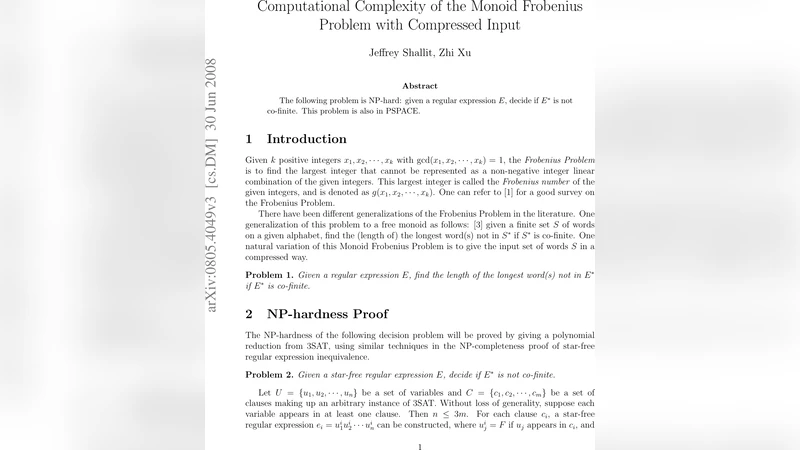
The following problem is NP-hard: given a regular expression $E$, decide if $E^*$ is not co-finite.
💡 Research Summary
**
The paper investigates the computational complexity of determining whether the Kleene star of a regular expression, denoted E*, is co‑finite, i.e., whether its complement Σ* \ E* is a finite set. This question is a language‑theoretic analogue of the classical Frobenius problem, which asks for the largest integer not representable as a non‑negative combination of given integers. By generalising the problem to free monoids over an alphabet Σ, the authors consider a finite set of words S ⊆ Σ⁺ and ask whether the submonoid generated by S, namely S*, is co‑finite. When S is described by a regular expression E, the decision problem becomes: given E, is E* not co‑finite?
The main contribution is a proof that this decision problem is NP‑hard. The authors achieve this by constructing a polynomial‑time many‑one reduction from the canonical NP‑complete problem 3‑SAT. For an arbitrary 3‑SAT instance Φ with variables x₁,…,xₙ and clauses C₁,…,Cₘ, they build a regular expression E_Φ that encodes assignments and clause satisfaction as follows:
-
Variable encoding – For each variable x_i, two mutually exclusive sub‑patterns (e.g., symbols ‘0’ and ‘1’) are introduced. Selecting one of them in a word corresponds to fixing the truth value of x_i.
-
Clause encoding – For each clause C_j = ℓ_{j1} ∨ ℓ_{j2} ∨ ℓ_{j3}, a sub‑pattern is created that can be matched only if at least one of the literals ℓ_{jk} is satisfied by the previously chosen variable assignments. This is achieved by linking the clause sub‑pattern to the appropriate variable sub‑patterns (e.g., a literal x_i requires the ‘1’ pattern for x_i, while ¬x_i requires the ‘0’ pattern).
-
Combination – The full regular expression E_Φ concatenates all variable blocks followed by all clause blocks, allowing arbitrary padding between them. Consequently, any word generated by (E_Φ)* corresponds to a sequence of variable assignments, each repeated any number of times.
The crucial observation is that if Φ is satisfiable, there exists at least one assignment that makes every clause block match; consequently, the set of words representing this assignment can be repeated arbitrarily, producing infinitely many words that belong to (E_Φ). However, because unsatisfied clauses prevent certain assignments from being represented, the complement Σ \ (E_Φ)* contains infinitely many words when Φ is satisfiable, meaning (E_Φ)* is not co‑finite. Conversely, if Φ is unsatisfiable, every possible assignment violates at least one clause, and the construction forces (E_Φ)* to eventually cover all sufficiently long words, rendering it co‑finite.
Thus, deciding whether (E_Φ)* is not co‑finite is equivalent to deciding the satisfiability of Φ. Since the reduction runs in polynomial time and the size of E_Φ is linear in the size of Φ, the co‑finiteness problem for Kleene stars of regular expressions is NP‑hard.
The paper situates this result within the broader landscape of language‑theoretic decision problems. While inclusion, equivalence, and universality for regular expressions are known to be PSPACE‑complete, the co‑finiteness property occupies a distinct niche: it is strictly harder than trivial polynomial‑time checks but does not immediately inherit PSPACE‑hardness. The authors note that any polynomial‑time algorithm for co‑finiteness would collapse the polynomial hierarchy (P = NP), highlighting the practical significance of the hardness result.
Further extensions are discussed. The same reduction works when the input is given as a deterministic or nondeterministic finite automaton (DFA/NFA) rather than a regular expression, because regular expressions can be converted to automata with only a polynomial blow‑up. Moreover, the problem remains NP‑hard if one replaces E* with E⁺ (one or more repetitions) or if the alphabet is restricted to a binary set. These variations demonstrate the robustness of the hardness proof across several natural formulations.
The authors conclude with several open directions. Determining the exact complexity class of the co‑finiteness problem (e.g., proving PSPACE‑hardness or locating it within the counting hierarchy) remains open. Investigating restricted subclasses of regular expressions—such as those without nesting, with bounded star depth, or with limited literal length—might yield tractable fragments. Finally, they suggest exploring approximation algorithms or heuristic methods for practical applications where co‑finiteness checks arise, such as in code generation, compression schemes, and verification of language‑based specifications.
Comments & Academic Discussion
Loading comments...
Leave a Comment