A constructive Borel-Cantelli Lemma. Constructing orbits with required statistical properties
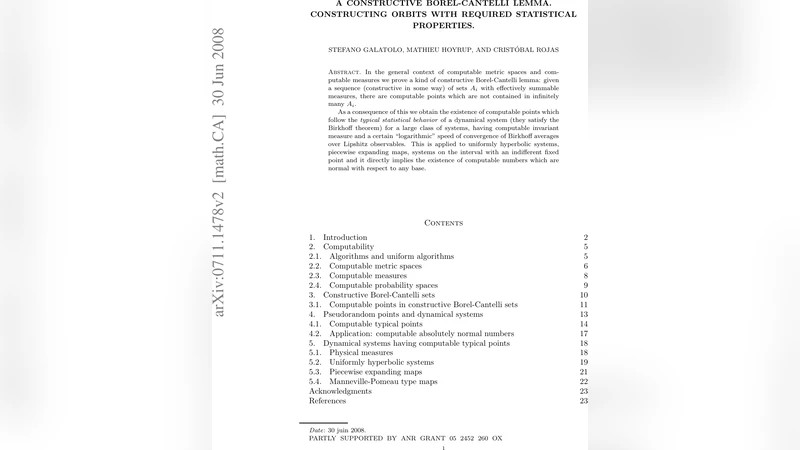
In the general context of computable metric spaces and computable measures we prove a kind of constructive Borel-Cantelli lemma: given a sequence (constructive in some way) of sets $A_{i}$ with effectively summable measures, there are computable points which are not contained in infinitely many $A_{i}$. As a consequence of this we obtain the existence of computable points which follow the \emph{typical statistical behavior} of a dynamical system (they satisfy the Birkhoff theorem) for a large class of systems, having computable invariant measure and a certain ``logarithmic’’ speed of convergence of Birkhoff averages over Lipshitz observables. This is applied to uniformly hyperbolic systems, piecewise expanding maps, systems on the interval with an indifferent fixed point and it directly implies the existence of computable numbers which are normal with respect to any base.
💡 Research Summary
The paper works at the intersection of computable analysis, probability theory, and dynamical systems. Its first contribution is a constructive version of the Borel‑Cantelli lemma in the setting of computable metric spaces equipped with a computable probability measure. The authors formalize what it means for a sequence of sets ((A_i)_{i\ge1}) to be “effectively summable”: each (A_i) is effectively open (i.e., can be enumerated by a computable list of basic balls), the measure (\mu(A_i)) is a computable real, and the series (\sum_i \mu(A_i)) converges with a computable rate. Under these hypotheses they prove that the limsup set (\limsup_i A_i) has measure zero and, crucially, that there exists a computable point (x) which belongs to only finitely many of the (A_i). The proof is algorithmic: at stage (n) one selects a basic ball that avoids the first (n) “dangerous” sets while still having positive remaining measure; the infinite intersection of the chosen balls yields the desired computable point. This result upgrades the classical, non‑constructive Borel‑Cantelli statement to a fully effective one.
The second major contribution is to apply this constructive lemma to ergodic theory. Consider a dynamical system ((X,T,\mu)) where (X) is a computable metric space, (\mu) is a computable invariant probability measure, and (T) is a computable transformation. The authors assume a logarithmic speed of convergence for Birkhoff averages of Lipschitz observables: for every Lipschitz function (f) there exists a constant (C_f) such that
\
Comments & Academic Discussion
Loading comments...
Leave a Comment