Index theory for actions of compact Lie groups on C*-algebras
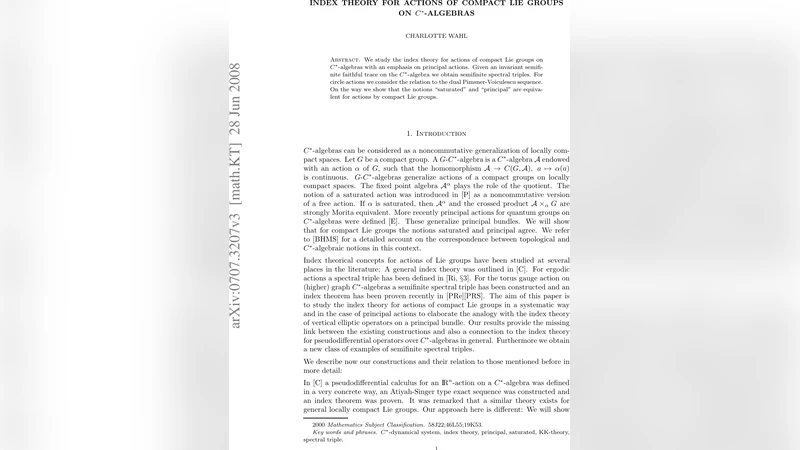
We study the index theory for actions of compact Lie groups on C*-algebras with an emphasis on principal actions. Given an invariant semifinite trace on the C*-algebra we obtain semifinite spectral triples. For circle actions we consider the relation to the dual Pimsner-Voiculescu sequence. On the way we show that the notions saturated'' and principal’’ are equivalent for actions by compact Lie groups.
💡 Research Summary
The paper develops a comprehensive index theory for actions of compact Lie groups on C*-algebras, with a particular focus on principal (free and proper) actions. Starting from a G‑invariant semifinite trace τ on a C*-algebra A, the authors construct a semifinite spectral triple (A, H, D) that encodes the dynamics of the group action in a non‑commutative geometric framework. The Hilbert space H is obtained via the GNS construction associated with τ, and the unbounded self‑adjoint operator D is defined using the infinitesimal generators of the Lie algebra of G, ensuring G‑invariance. This triple yields a τ‑weighted dimension function, which provides a pairing between K‑theory classes of the crossed product A⋊G and K‑homology classes represented by the triple, thereby extending the classical Atiyah‑Singer index pairing to the semifinite, non‑commutative setting.
For the special case of circle (S¹) actions, the authors relate their construction to the dual Pimsner‑Voiculescu exact sequence. They show that the τ‑weighted index obtained from the spectral triple coincides with the connecting map in the Pimsner‑Voiculescu sequence, thus giving an explicit formula for the index in terms of the K‑theory of A and the dynamics of the S¹‑action. This bridges the gap between abstract non‑commutative index theory and concrete computational tools used in the analysis of crossed products by ℤ.
A central technical achievement of the work is the proof that, for actions of compact Lie groups, the notions of “saturated” and “principal” are equivalent when a G‑invariant semifinite trace exists. By analyzing the averaging map onto the fixed‑point algebra A^G, the authors demonstrate that saturation (the property that the dense *‑subalgebra generated by G‑orbits coincides with the whole algebra) forces the action to be free and proper, and conversely that a principal action automatically yields saturation. This equivalence simplifies the classification of actions for which the index theory can be applied.
The paper also extends the classical finite‑dimensional index formula of Atiyah‑Singer/Connes‑Moscovici to the semifinite context. By showing that the resolvent of D belongs to the τ‑measurable operators of appropriate Schatten class, they define a τ‑trace on the compact operators generated by D and obtain a well‑defined index pairing. This provides a robust method for computing indices of operators arising from non‑commutative dynamical systems, even when the underlying Hilbert space is infinite dimensional.
In summary, the authors present a unified framework that (1) constructs semifinite spectral triples from invariant traces, (2) connects these triples to the Pimsner‑Voiculescu exact sequence for circle actions, (3) proves the equivalence of saturated and principal actions for compact Lie groups, and (4) generalizes index pairings to the semifinite, non‑commutative setting. The results have potential applications in non‑commutative geometry, quantum physics, and the study of dynamical systems with symmetry, offering new computational tools for K‑theoretic invariants of crossed‑product C*-algebras.
Comments & Academic Discussion
Loading comments...
Leave a Comment