Localized Spanners for Wireless Networks
We present a new efficient localized algorithm to construct, for any given quasi-unit disk graph G=(V,E) and any e > 0, a (1+e)-spanner for G of maximum degree O(1) and total weight O(w(MST)), where w(MST) denotes the weight of a minimum spanning tre…
Authors: Mirela Damian, Sriram V. Pemmaraju
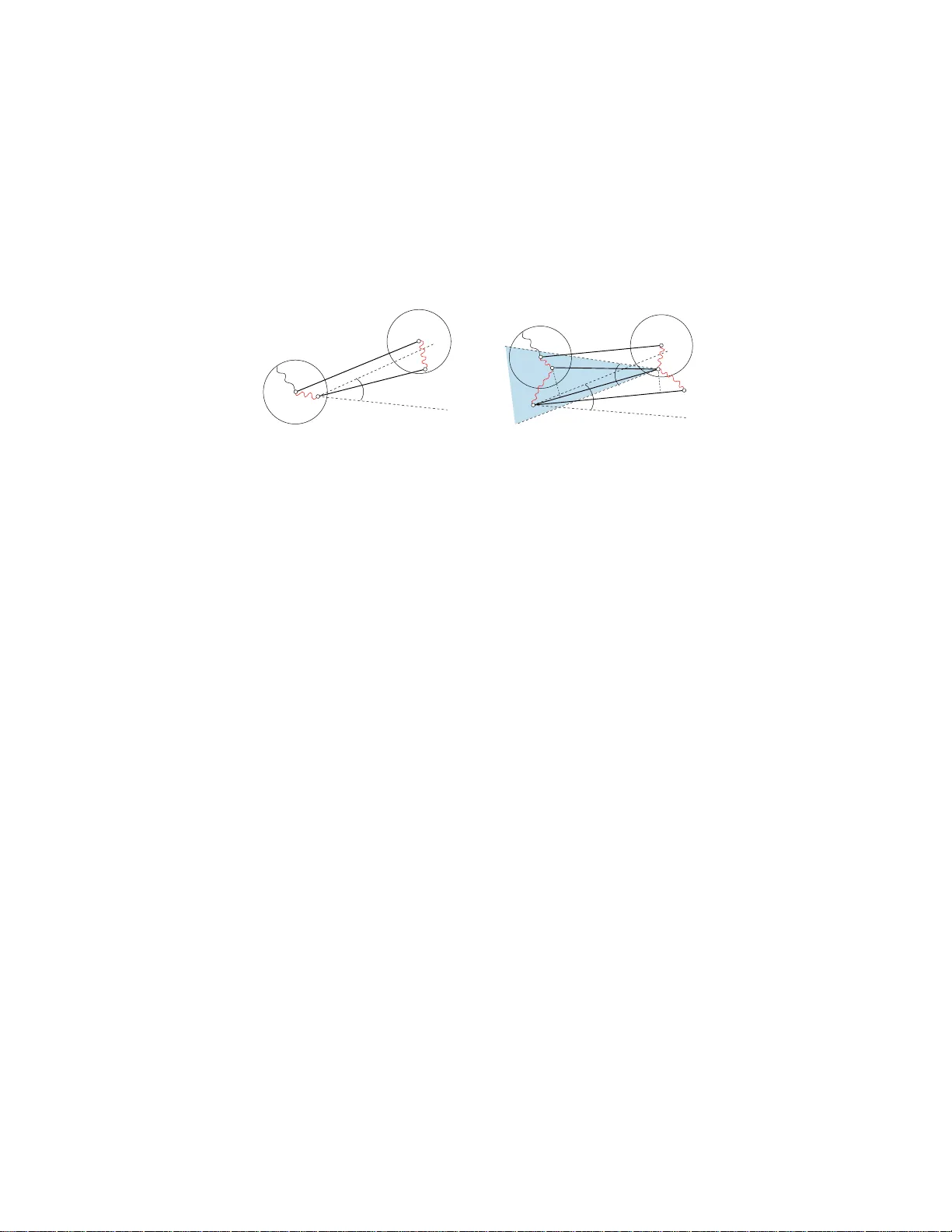
Lo calized Spanners for Wireless Net w orks Mirela Damian ⋆ 1 and Sriram V. P emmara ju 2 1 Dept. Comput. Sci., Villano v a Univ., Villanov a, P A 1908 5, USA. mirela.dam ian@villano va.edu . 2 Dept. Comput. Sci., Univ. of Iow a, Io w a City , IA 52 246, US A. sriram@cs. uiowa.edu . Abstract. W e present a new efficient localized algorithm to construct, for an y gi ven quasi-unit disk graph G = ( V , E ) and any ε > 0, a (1 + ε )- spanner for G of max imum degree O (1) and total w eight O ( ω ( M S T )), where ω ( M S T ) denotes the w eight of a minimum spann i ng tree for V . W e further show that similar lo caliz ed techniques can b e used to constru ct, for a giv en u nit disk graph G = ( V , E ), a p l anar C del (1+ ε )(1+ π 2 )-spanner for G of maximum d e gree O (1) and total w eigh t O ( ω ( M S T )). H ere C del denotes the stretc h factor of the unit Delaunay triangulation for V . Both constructions can b e completed in O (1) communication rounds, and re- quire each no de to know its o wn co ord in ates. 1 In tro duction F or any fixed α , 0 < α ≤ 1, a graph G = ( V , E ) is an α - quasi u nit disk gr aph ( α -QUDG) if there is an em b edding of V in the Euclidean plane such that, for every vertex pa ir u, v ∈ V , uv ∈ E if | uv | ≤ α , and | u v | 6∈ E if | uv | > 1. The existence of edges with length in the r ange ( α, 1] is sp ecified by an a dv ersary . If α = 1, G is called a unit disk gr aph (UDG). α -QUDGs have be e n prop osed as mo dels fo r ad-ho c wireless net works comp osed of ho mogeneous wir e less no des that co mmunicate over a wireless medium witho ut the aid of a fixed infrastruc- ture. Exp erimental studies show that the tra nsmission rang e of a wire le s s no de is not p erfectly circula r and ex hibit s a transitional region with highly unr eliable links [34] (see for example Fig. 1a, in which the shaded reg ion represents the actual transmissio n r a nge). In addition, environmental c onditions and physical obstructions adversely affect sig nal pr opagation and ultimately the transmission range of a wireless no de. The parameter α in the α -QUDG mo del attempts to take int o account such imper fections. Wireless no des ar e often powered by batterie s and have limited memory resource s. These c haracter istics make it critical to compute and maintain, at each no de, only a subset of neig hbo rs tha t the no de communicates with. This problem, referr ed to as top olo gy c ontro l , seeks to adjust the transmission p ower at each no de so as to maintain co nnectivit y , reduce co llis ions and interference, and ex t end the battery lifetime and consequently the net work lifetime. ⋆ Supp orted by NS F gran t CCF-0728909. Different topo logies optimize differe n t p erformance metrics . In this pap er we fo cus o n prop erties such as planarity , low weight , low de gr e e , and the sp anner prop ert y . Another imp o rtan t pr operty is low interfer enc e [5 , 15, 30], which we do not address in this pap er. A gra ph is planar if no tw o edges cross each other (i.e, no tw o edg es share a p oin t other than an endp oin t). Pla narit y is imp ortant to v ario us memoryless routing a lgorithms [16, 4]. A gr aph is c a lled low weight if its total edge leng t h, defined a s the sum of the lengths of all its edges, is within a constant facto r of the total edge length of the Minimum Spa nning T ree (MST). It was shown that the total energy co nsumed b y sender nodes broadcasting along the edges of a MST is within a cons tan t factor of the optimum [31 ]. L ow de gr e e (bo und ed ab o v e by a consta n t) at ea c h no de is also impo rtan t for balancing out the c omm unica tion overhead among the wireless no des. If to o many edges are eliminated from the orig ina l gra ph how ever, paths b et ween pair s of no des may beco me unacceptably long and offset the gain o f a low degree. This renders necessary a s tronger req uiremen t, demanding that the r educed top ology be a sp anner . Intuitiv ely , a structure is a spanner if it ma in tains sho rt paths b et ween pairs of no des in supp ort of fast mes sage delivery and efficien t routing. W e define this formally be low. Let G = ( V , E ) b e a connec t ed gra ph r epresen ting a wireless netw o rk. F or any pair o f no des u , v ∈ V , let sp G ( u, v ) denote a shor test path in G from u to v , and le t | s p G ( u, v ) | denote the length o f this path. Let H ⊆ G b e a connected subgraph of G . F or fixed t ≥ 1, H is called a t - sp ann er for G if, for all pairs of vertices u, v ∈ V , | sp H ( u, v ) | ≤ t · | sp G ( u, v ) | . The v alue t is called the stre tch factor of H . If t is co nstan t, then H is calle d a length sp anner , or s imply a sp anner . A triangulation o f V is a Delaunay triangulation , denoted by De l ( V ), if the cir cumcircle of each of its tria ngles is empt y of no des in V . Due to the limited resources and high mobility of the wir eless no des, it is impo rtan t to efficiently construct and ma in tain a spanner in a lo c alize d manner. A lo c alize d algorithm is a distributed alg orithm in which each no de u selects all its incident edge s based on the information from no des within a consta nt nu mber of hops from u . O ur comm unication mo del is the sta ndard synchronous message passing mo del, which ignores channel access and c o llision issues. In this commu- nication mo del, time is divided into r ounds . In a r ound, a no de is able to r e ceiv e all mes sages sent in the prev ious r ound, execute lo cal co mp utations, and send messages to neighbors. W e meas ur e the communication cost of our algorithms in terms of r ounds of c ommun i c ation . The length of messag es exchanged b et w een no des is logar ithm ic in the num b er o f no des. Our R esults. In this pap er we prese nt the first lo calized metho d to construct, for any QUDG G = ( V , E ) and any ε > 0, a (1 + ε )-spa nner for G of maximum degree O (1) and total w eight O ( ω ( M S T )), where ω ( M S T ) denotes the weigh t of a minimum spanning tree for V . W e fur ther extend o ur metho d to construct, for any UDG G = ( V , E ), a planar spanner for G of maximum degree O (1) a nd total w eight O ( ω ( M S T )). The str etc h factor of the spanner is bounded ab o ve by C del (1 + ε )(1 + π 2 ), where C del is the stretch factor of the unit Delaunay triangula- tion for V ( C del ≤ 2 . 42 [2 0]). This second result r e s olv es an op en question po sed by Li et al. in [22]. Both c onstructions can be completed in O (1 ) communication rounds, and r equire each no de to know its own co ordinates. 1.1 Related W ork Several excellent surveys on spanners exist [27, 26, 14 , 25]. In this section we restrict o ur attention to lo c alize d methods for constructing spanners for a given graph G = ( V , E ). W e pro ceed with a discussio n on non-pla nar structures for UDGs first. Existing r esults are summarized in the first four rows o f T able 1. The Y ao gr aph [3 3] with an integer parameter k ≥ 6, deno ted Y G k , is defined as follows. A t eac h node u ∈ V , a n y k equal-sepa rated rays originated at u define k cones. In each cone, pick a shortest edge uv , if there is any , and add to Y G k the directed edge − → uv . Ties ar e broken arbitr arily or b y sma lle st ID . The Y ao graph is a spanner with stretch fa ctor 1 1 − 2 sin π /k , ho wev er its deg ree can be as high as n − 1. T o ov ercome this shortcoming, Li et al. [1 8] pro posed a nother str ucture ca lled Y aoY ao gra ph Y Y k , which is cons tr ucted by applying a reverse Y a o structur e on Y G k : at each no de u in Y G k , discard all directed edges − → v u from each cone centered at u , except for a s ho rtest one (a g ain, ties can b e broken arbitrar ily or by smallest ID ). Y Y k has maximum no de deg ree 2 k , a cons tan t. Ho wev e r, the tra deoff is unclear in that the question o f whether Y Y k is a spanner or not remains op en. Both Y G k and Y Y k hav e total w eight O ( n ) · ω ( M S T ) [6 ]. L i et al. [32] further pr oposed ano ther spar se structur e, called Y aoSink Y S k , that satisfies b oth the spanner and the b ounded degree pr operties. The sink tec hnique replaces each dire c t ed star in the Y a o gra ph consisting of all links dire c t ed into a no de u , by a tr e e T ( u ) with sink u of b ounded deg ree. How e v er , neither o f these structures has low weigh t. Structure Planar? Sp a nner? Degree W eight F actor Comm. Round s YG k , k ≥ 6 [33] N Y O ( n ) O ( n ) O (1) YY k , k ≥ 6 [18] N ? O (1) O ( n ) O (1) YS k , k ≥ 6 [32] N Y O (1) O ( n ) O (1) LOS [this pap er] N Y O (1) O (1) O (1) RDG [13] Y Y O ( n ) O ( n ) O (1) LDel k , k ≥ 2 [20] Y Y O ( n ) O ( n ) O (1) PLDel [20, 1] Y Y O ( n ) O ( n ) O (1) YaoGG [18] Y N O (n) O ( n ) O (1) OrdYaoGG [28] Y N O(1) O ( n ) O (1) BPS [32, 23] Y Y O(1) O ( n ) O ( n ) RNG’ [19] Y N O(1) O (1) O (1) LMST k , k ≥ 2 [22] Y N O(1) O (1) O (1) PLOS [th i s pap er] Y Y O (1) O (1 ) O (1) T able 1. Results on lo ca lized metho ds for UDGs. W e now turn to discuss planar str uctur es for UDGs. The r elativ e neighbor - ho od gra ph (RNG) [29] and the Gabriel graph (GG) [12] can b oth b e constructed lo cally , how ever neither is a spanner [2]. O n the other hand, the Delaunay tri- angulation Del ( V ) is a plana r t -spanner o f the complete Euclidea n gr aph with vertex set V . This result was first prov ed by Dobkin, F riedman and Supowit [11 ], for t = 1+ √ 5 2 π ≈ 5 . 0 8, and was further improv ed to t = 4 √ 3 9 π ≈ 2 . 4 2 by Keil and Gut win [17 ]. Das and Jo s eph [7] gener alize these results by iden tifying tw o prop erties of planar g raphs, the go od p olygon and diamond prop erties, which imply that the stretch fa ctor is bo unded a bov e by a constant. F or a given p oin t set V , the unit Dela una y triangulation of V , denoted UDel ( V ), is the g raph obtained by removing all Delaunay edges fr o m Del ( V ) that a re long er than one unit. It was shown that UD el ( V ) is a t -spanner of the unit-disk graph UDG( V ), with t = 4 √ 3 9 π ≈ 2 . 42 [20]. Gao et al. [1 3] present a lo c alized algo r ithm to build a planar s pa nner called restricted Delaunay graph ( RDG ), which is a super graph o f UD el ( V ). Li et al. [2 0] int ro duce the notion of a k - lo c alize d Delaunay tr iangle : △ ab c is called k - lo c alize d Delaunay if the interior of its circumcircle do es not contain a ny no de in V that is a k -neigh bo r of a , b o r c , and all edges of △ abc ar e no longer than o ne unit. The a uthors describ e a lo calized metho d to constr uct, for fixed k ≥ 1, the k -localize d Delaunay graph LDel k ( V ), which contains all Gabriel edges and edges of all k -lo calized Delaunay triangles. They show that (i) LDel k ( V ) is a sup e rgraph of UD el ( V ) (and therefore a 4 √ 3 9 π -spanner), (ii) L Del k ( V ) is pla- nar, for any k ≥ 2, and (iii) LDe l 1 ( V ) may no t be planar, but a plana r s ubgraph PLDel ( V ) ⊆ LDel 1 ( V ) that retains the spanner pr o perty can be lo cally extracted from LD el 1 ( V ). Their pla nar spa nner constr uctions take 4 ro unds of co mm uni- cation and a tota l of O ( n ) messa ges ( O ( n log n ) bits). Ara ´ ujo and Ro drigues [1] improv e upon the communication time for PLDel and devise a metho d to co m- pute P LDel ( V ) in one single comm unication step. Both PLDe l ( V ) and LDel k ( V ), for k ≥ 1, may hav e arbitrar ily lar ge deg ree and w eight. T o b ound the deg ree, se v er al metho ds apply the or der e d Y ao structure on top of a n unbounded-degre e planar struc tur e. This idea was first intro duced b y Bose et al. in [3], and later refined by Li and W a ng in [32 , 2 3]. Since the order ed Y ao str uctur e is relev an t to our work in this pa per a s w ell, we pause to discuss the OrderedY ao metho d for constructing this structure. The OrderedY ao metho d is outlined in T able 2. The main idea is to define a n ordering π of the no des such that each no de u has a limited num b er of neighbors (at most 5) who are pr e decessors in π ; these pre dec essors a re us e d to define a small n umber of op en co nes centered at u , each of which will contain at most one neighbor of u in the final structur e. T o maintain the s panner prop erty of the or iginal gra ph, a short pa th connecting a ll neighbors o f u in each co ne is used to replace the edges inciden t to u that get disc a rded fro m the origina l gr aph. Thm. 1 summarizes the imp ortant pr operties of the structure c omputed by the OrderedY ao metho d. Theorem 1. If G is a planar gr aph, then t h e output G ′ obtaine d by exe cut i ng OrderedY ao ( G ) is a planar (1 + π 2 ) -sp anner for G of maximum de gr e e 25 [32] . Algorithm OrderedY ao ( G = ( V , E )) [32] { 1. Find an order π for V : } Initialize i = 1 and G i = G . Rep eat for i = 1 , 2 , . . . , | V | Remov e from G i the nod e u of smallest degree (break ties by smallest ID .) Call the remaining graph G i +1 . Set π u = n − i + 1. u C u s 1 s 2 s 3 s 4 v 1 v 2 { 2. Construct a b ounded-degree structure for G : } Mark all no des in V unpr o c esse d . In iti alize E ′ ← ∅ and G ′ = ( V , E ′ ). Rep eat | V | t i mes Let u b e the u nprocessed nod e with the smallest order π u . Let v 1 , v 2 , . . . , v h b e the b e the pro cessed neighbors of u in G ( h ≤ 5). Sho ot rays from u t hrough each v i , to define h sectors centered at u . Divide each sector into few est open cones of degree at most π / 3. F or each such op en cone C u (refer to Fig. ab o ve) Let s 1 , s 2 , . . . , s m b e the geometrically ordered neighbors of u in C u . Add to E ′ the shortest us i edge. Add to E ′ all ed g es s j s j +1 , for j = 1 , 2 , . . . , m − 1. Mark no de u pr o c esse d . Output G ′ = ( V , E ′ ) . T able 2. The OrderedY ao metho d. Song et al. [28 ] apply the ordered Y ao str ucture on top of the Ga briel g raph GG ( V ) to pro duce a planar b ounded-degree str uc tur e O rdYaoGG . Their result improv es up o n the earlier lo c alized structure YaoGG [18], which may not hav e bo unded degr ee. Both Ya oGG and OrdYao GG are pow er spanners, ho wev er neither is a length spanner . The first efficient lo calized method to constr uc t a bo un ded-degree pla nar spanner w as prop osed b y Li and W ang in [32, 23 ]. Their metho d a pplies the ordered Y ao structure on to p of LDel ( V ) to b ound the no de degr ee. The resulted structure, called B PS ( V ) (Bounded- Deg ree Planar Spanner), has deg ree b ounded ab o v e by 19 + ⌈ 2 π α ⌉ , where 0 < α < π 3 is an adjustable para meter. The total communication co mplexit y for co nstructing BPS ( V ) is O ( n ) mes sages, howev e r it may take as man y as O ( n ) rounds of co mm unicatio n for a no de to find its rank in the order ing of V (a tr iv ial example would b e n nodes lined up in incr easing order b y their I D ). The BPS s tr ucture do es not hav e low weight [1 9]. The first lo c alize d low-wei ght pla nar s tructure w as prop osed in [19 ]. This structure, called RNG’ , is based on a mo dified relative neighborho o d gr aph, and satisfies the planar it y , b ounded-degree a nd bounded- weight prop erties. A similar result has b een obtained by Li, W ang and Song [22], who prop ose a family of structures, called L o c alize d Minimum S p anning T r e es LM ST k , for k ≥ 1. The authors show that L MST k is planar , has maximum degre e 6 and total weigh t within a co nstan t factor of ω ( M S T ), for k ≥ 2. Their res ult extends an earlier result by Li, Hou and Sha [24 ], who pr opose a lo calized MST-based metho d to compute a lo cal minimum spanning tree str uctu re. Howev e r, neither of these low-w eight structur es s a tisfies the spa nner prop erty . Cons tructing low-weigh t, low-degree planar spanner s in few r ounds of communication is one of the op en problems we resolve in this pap e r . 2 Our W ork W e start with a few definitions and notation to b e used throug h the r est of the pap er. F or a n y no des u and v , let uv denote the edge with endp oin ts u and v ; − → uv is the edge directed from u to v ; and | u v | deno tes the Euclidea n distance betw een u and v . Let C u denote an arbitra ry cone with ap ex u , and let C u ( v ) denote the cone with a pex u containing v . F o r any edge set E and any cone C u , let E ∩ C u denote the subse t of e dges in E incident to u that lie in C u . W e assume that each no de u has a unique identifier ID ( u ) and k no ws its co ordinates ( x u , y u ). Define the identifier ID ( − → uv ) o f a directed edg e − → uv to b e the triplet ( | uv | , ID ( u ) , ID ( v )). F o r any pair o f directed edges − → uv and − − → u ′ v ′ , w e say that ID ( − → uv ) < ID ( − − → u ′ v ′ ) if and only if one of the following conditions holds: (1) | uv | < | u ′ v ′ | , or (2 ) | uv | = | u ′ v ′ | and ID ( u ) < I D ( u ′ ), o r (3) | uv | = | u ′ v ′ | and ID ( u ) = ID ( u ′ ) and ID ( v ) < ID ( v ′ ). F or an undirected edge uv , define ID ( uv ) = min { ID ( − → uv ) , ID ( − → v u ) } . Note that a ccording to this definition, each edge has a unique identifier. Let H = ( V , E H ) b e an ar bitrary subgraph of G = ( V , E ). A subset L u ⊂ V is an r - cluster in H with c e n ter u if, for any v ∈ L u , | sp H ( u, v ) | ≤ r . A set of disjoint r - clusters { L u 1 , L u 2 , . . . } form an r - clu ster c over for V in H if they satisfy tw o prop erties: (i) fo r i 6 = j , | sp H ( u i , u j ) | > r (the r - p acking prop ert y), and (ii) the union ∪ i L u i cov ers V (the r - c overing prop ert y). F or a ny no de s ubset U ⊆ V , let G [ U ] denote the subgra ph of G induced by U . A set of no de s ubsets V 1 , V 2 , . . . ⊆ V is a clique c over for V if the subg raph of G [ V i ] is a clique for each i , and ∪ h i =1 V i = V . The asp e ct r atio of an edg e set E is the ratio o f the leng th of a lo ng est edge in E to the leng t h of a shortest edge in E . The a spect ratio of a graph is defined as the a spect ratio of its edge set. 2.1 The LOS Algorithm In this section we describ e an a lg orithm called LOS (Lo calized Optimal Spa nner) that takes as input an α - QUDG G = ( V , E ), for fix ed 0 < α ≤ 1, a nd a v alue ε > 0, a nd computes a (1 + ε )-spanner for G of maximum degre e O (1) and total weigh t O ( ω ( M S T )). The ma in idea o f o ur alg orithm is to compute a particular clique cover V 1 , V 2 , . . . for V , constr uct a (1 + ε )-spanner for ea c h G [ V i ], then connect these smaller s panners into a (1 + ε )-spanner for G using selected Y a o edges. In the fo llo wing we discuss the details of our alg orithm. α 1 α 2 x x α 2 -2 δ δ u v s =1 s =2 s =3 s =1 s =4 s =5 s =6 s =4 s =7 s =8 s =9 s =7 s =1 s =2 s =3 s =1 (a) (b) (c) Fig. 1. (a) The α - QUDG mo del ( b ) Constructing a cliqu e cov er for V (c) Clique ordering. Let 0 < β < α √ 2 and 0 < δ < β / 4 b e small constants to be fixed later . T o compute a c lique cover fo r V , we s t art b y covering the plane with a g rid of ov erlapping square cells of size β × β , such that the distance be tw een cen ters o f adjacent cells is β − 2 δ . Note that any tw o adjacent cells define a sma ll band of width δ where they overlap. The rea son for enforcing this overlap is to ensur e that edges no t entirely co n tained within a single gr id cell a re longer than δ , i.e., they ca nnot b e arbitra rily small. W e identify each grid cell by the co ordinates ( i, j ) of its upp er left corner. Any tw o vertices that lie within the s ame gr id cell are no more than α dista nce apar t a nd therefore ar e connec ted b y an edge in G . This implies that the collectio n o f vertices in each non-empty grid cell can be use d to define a c lique element of the clique cover. W e call this par ticular clique cov er a ( β , δ )- c lique c over . Le t V 1 , V 2 , . . . b e the elements of the ( β , δ )- clique cov er for V . No te that, s ince δ < β / 4, a no de u can b elong to at mo st four subsets V i . Our LOS metho d cons ists of 4 steps. Fir s t we constr uct, for each G [ V i ], a (1 + ε )-spanner o f degre e O (1) and w eight O ( ω ( M S T ( V i )). V ario us metho ds for constructing H i exist – for insta nce, the well-known sequential greedy metho d pro duces a spanner with the desired pro perties [8]. Se c o nd, we use the Y ao metho d to gener ate (1 + ε )-spanner paths b et w een longer edges that spa n differ- ent grid cells. Third, we apply the r ev erse Y ao s tep to reduce the n umber o f Y a o edges incident to each no de. Finally , we apply a filter ing metho d to eliminate all but a constant num b er of edges incident to a g r id cell. This fourth s t ep is necessary to ensure that the output spanner has b ounded weight . Thes e steps Algorithm LOS ( G = ( V , E ) , ε ) { 1. Compute a (1 + ε ) - spanner co ver: } Fix 0 < β < α √ 2 and 0 < δ < β / 4. Compute a ( β , δ )-clique cove r V 1 , V 2 , . . . for V . F or each i , compute a (1 + ε )-spanner H i for G [ V i ] using the metho d from [8]. Initialize H = ∪ i H i . Let E 0 = { uv ∈ E | uv 6∈ G [ V i ] for any i } . { 2. Apply Y ao on E 0 : } Let k b e the smallest integer satisfying cos 2 π k − sin 2 π k ≥ δ + 1 + ε ( δ + 1 )(1+ ε ) . F or each no de u , div id e the plane into k incident equ al -size cones. Initialize E Y ← ∅ . F or each cone C u such that E 0 ∩ C u is non-emp t y Pic k the edge uv ∈ E 0 ∩ C u of smallest ID and add − → uv to E Y . { 3. Apply reverse Y ao on E Y : } Initialize E Y Y ← E Y . F or each cone C u such that E Y ∩ C u is non-empty Discard from E Y all edges − → v u ∈ E Y ∩ C u , but the one of smallest ID . { 4. Select connecting e dge s from E Y Y : } Pic k r such th a t r ≤ ( δ + 1 )(1+ ε )(cos θ − sin θ ) − ( δ +1+ ε ) 4 , where θ = 2 π / k . Compute an r -cluster cov er for V in H . Let E 1 ⊆ E Y Y conta in all Y ao edges connecting cluster centers. A dd E 1 to H . Output H = ( V , E H ) . T able 3. The LOS algorithm. are describ ed in detail in T able 3 . Note that the Y ao and reverse Y ao steps are restricted to edges in the set E 0 whose asp ect ra tio is b ounded ab o ve by 1 /δ . The next three theo rems prov e the main prop erties of the LOS algor it hm. Theorem 2. The output H gener ate d by L OS ( G, ε ) is a (1 + ε ) - s p anner for G . Pr o of. Let uv ∈ E b e arbitr ary . If uv ∈ G [ V i ] for some i , then H i ⊆ H co n tains a (1 + ε )-spa nner uv -path (since H i is a (1 + ε )-spanner for G [ V i ]). Otherwise, uv ∈ E 0 . The pro of that H contains a (1 + ε )-spanner uv -path is b y induction on the ID of edg es in E 0 . Le t uv ∈ E 0 be the edg e with the smallest ID and assume without loss of generality that ID ( uv ) = ID ( − → uv ). Since ID ( uv ) is smallest, − → uv gets added to E Y in step 2, and it stays in E Y Y in step 3. If uv ∈ H at the end of step 4 , then sp H ( u, v ) = uv . Otherwise, let ab b e the e dge selected in step 4 of the a lgorithm, suc h that u ∈ L a and v ∈ L b (see Fig. 2a). Since L a and L b are bo th r -clusters, we hav e that | sp H ( u, a ) | ≤ r and | s p H ( v , b ) | ≤ r . It follows that | ua | ≤ r and | v b | ≤ r . By the triangle ine q ualit y , | ab | < | uv | + 2 r and ther efore sp H ( u, v ) ≤ | a b | + 2 r < | uv | + 4 r ≤ (1 + ε ) | uv | , for a n y r ≤ δ ε/ 4 (satisfie d by the r v a lues res t ricted b y the a lgorithm). This concludes the ba se case. T o prov e the inductiv e step, let u v ∈ E 0 be arbitrary , and a ssume that H contains (1 + ε )-spanner pa ths betw een the endpo in ts of a n y edge whos e ID is low er than ID ( uv ). u θ a C ( v ) u v r b L a L b θ a C ( v ) u r b u 1 u θ v 1 v v 1 ’ u 1 ’ L a L b C v 1 (a) (b) Fig. 2. Thm. 2: (a) Base case. (b) sp H ( u, u 1 ) ⊕ sp H ( u 1 , a ) ⊕ ab ⊕ sp H ( b, v 1 ) ⊕ sp H ( v 1 , v ) is a (1 + ε )- spanner uv -path. Let u v 1 ∈ C u ( v ) b e the Y ao edge selected in step 2 of the alg orithm; let u 1 v 1 ∈ C v 1 ( u ) b e the Y aoY ao edge s elected in step 3 of the a lgorithm; and let ab ∈ H b e the edge added to H in step 4 of the algor ith m, such that u 1 ∈ L a and v 1 ∈ L b (see Fig. 2b). Note that u and u 1 may be dis j oint or may coincide, and similar ly fo r v a nd v 1 . In either ca se, the chains of ineq ualities ID ( u 1 v 1 ) ≤ ID ( uv 1 ) ≤ ID ( uv ) and | u 1 v 1 | ≤ | uv 1 | ≤ | uv | hold. Let u ′ 1 be the pro jection o f u 1 on u v 1 . By the tria ngle inequality , | uu 1 | ≤ | uu ′ 1 | + | u ′ 1 u 1 | = | uv 1 | − | u ′ 1 v 1 | + | u ′ 1 u 1 | ≤ | uv 1 | − | u 1 v 1 | cos θ + | u 1 v 1 | sin θ. (1) Similarly , if v ′ 1 is the pro jection of v 1 on uv , we hav e | v 1 v | ≤ | v v ′ 1 | + | v ′ 1 v 1 | = | uv | − | uv ′ 1 | + | v ′ 1 v 1 | ≤ | uv | − | uv 1 | cos θ + | uv 1 | sin θ. (2) Since | uu 1 | < | uv 1 | ≤ | uv | and | v 1 v | < | uv | , b y the inductive h ypo thesis H contains (1 + ε )-spanner pa th s sp H ( u, u 1 ) and sp H ( v 1 , v ). Let P 1 = sp H ( u, u 1 ) ⊕ sp H ( v 1 , v ). The le ng th o f P 1 is | P 1 | ≤ (1 + ε ) · ( | u u 1 | + | v 1 v | ) . Substituting inequalities (1) and (2) yields | P 1 | ≤ (1 + ε ) | uv | + (1 + ε ) | uv 1 | (1 − cos θ + s in θ ) − (1 + ε ) | u 1 v 1 | (cos θ − sin θ ) . (3) Next we show that the path P = P 1 ⊕ sp H ( u 1 , a ) ⊕ ab ⊕ sp H ( b, v 1 ) is a (1 + ε )- spanner path from u to v in H , thus proving the inductive step. Using the fact that | ab | < 2 r + | u 1 v 1 | , | sp H ( u 1 , a ) | ≤ r and | sp H ( b, v 1 ) | ≤ r , we get | P | ≤ | P 1 | + | u 1 v 1 | + 4 r. (4) Substituting further | u 1 v 1 | ≥ δ and | uv 1 | ≤ 1 in (3) a nd (4) yields | P | ≤ (1 + ε ) | uv | + (4 r + (1 + ε )(1 − cos θ + sin θ ) − δ (1 + ε )(cos θ − sin θ ) − δ ) . Note that the second term on the r igh t side of the inequality a b ov e is non-p ositiv e for any r and θ satisfying the conditions of the a lgorithm: ( r ≤ ( δ +1)(1+ ε )(c os θ − sin θ ) − ( δ +1+ ε ) 4 cos θ − sin θ > δ +1+ ε ( δ +1)(1+ ε ) . This completes the pro of. Before proving the other t wo pr operties o f H (bounded degr ee and bo unded weigh t), w e introduce an intermediate lemma . F o r fixed c > 0, call a n edge set F c - i solate d if, for ea c h no de u incident to an edge e ∈ F , the close d disk disk ( u, c ) centered a t u of radius c c o n ta ins no o t her endp oin ts of e dg es in F . This definition is a v ar ian t of the isolation pr op erty introduce d in [10]. Das et al. show that, if an edg e set F satis fie s the isolatio n pr operty , then ω ( F ) is within a c o nstan t factor of the minim um spanning tree connecting the endp oin ts of F . Here we prov e a similar r e sult. Lemma 1 . L et F b e a c -isolate d set of e dges no longer than 1. Then ω ( F ) = O (1) · ω ( T ) , wher e T is the minimum sp anning tr e e c onne cting the endp oints of e dges in F . Pr o of. Let P b e a Hamiltonian path obtained by a taking a preor der traversal of T . If each edge uv ∈ P gets asso ciated a weigh t v alue ω ( uv ) = | sp T ( u, v ) | , then it is w ell-known that ω ( P ) ≤ 2 ω ( T ). So in order to prove that w ( F ) is within a c o nstan t factor of ω ( T ), it suffices to show that ω ( F ) = O ( ω ( P )). Since F is c -is olated, the distance betw een any tw o vertices in T is gre ater than c and therefore w ( P ) ≥ ( n − 1) c . O n the other hand, no edge in F is gr eater than 1 and ther efore ω ( F ) ≤ n . It follows that ω ( F ) = O ( ω ( P )). Theorem 3. The output H gener ate d by running LOS ( G, t ) has m ax imu m de- gr e e O (1) and total weight O (1) · ω ( M S T ) . Pr o of. The fa c t that H has ma xim um degree O (1) follows immediately from three obser v atio ns: (a) each spanner H i constructed in step 1 of the alg orithm has degree O (1) [8], (b) a node u belo ngs to a t most four s ubgraphs H i , and (c) a no de u is inciden t to a cons ta n t num b er of Y ao edges (at most 2 k ) [1 8]. W e now prove that the tota l weight for H is within a constant factor of ω ( M S T ), whic h is optimal. The main idea is to par tition the edg e se t E H int o a constant n umber of subsets, each of which has low weigh t. Consider firs t the (1 + ε )-spanners constructed in s tep 1 of the algor ithm . Each (1 + ε )-spanner H ℓ corres p onds to a grid cell ( i, j ). Let F denote the set of edges in ∪ ℓ H ℓ . Define the edge set F s ⊆ F to contain a ll spanner e dg es corr esponding to those g rid cells ( i, j ) who s e indices i a nd j satisfy the co ndition ( i mo d 3) × 3 + j mod 3 = s . Int uitively , if tw o edges e 1 , e 2 ∈ F s lie in different gr id cells, then those gr id cells are separ ated by at least tw o other gr id cells (see Fig. 1c). This further implies that the clos est endp oin ts of e 1 and e 2 are distance α or mor e apart. Also no tice that it takes only 9 subse ts F 1 , F 2 , . . . , F 9 to cov er F . Next we show that ω ( F s ) = O ( ω ( T s )) for each s = 1 , 2 , . . . , 9, where T s is a minim um spanning tree connecting the endpoints in F s . T o see this, fir st o bserv e that F s combines the edges of s ev e r al low-weigh t (1 + ε )-spanners H s 1 , H s 2 , . . . with the pro perty that ω ( H s 1 ) = O ( ω ( T s 1 )), wher e T s 1 is a minimum spanning tree connecting the nodes in H s 1 . Thus, in order to prove that ω ( F s ) = O ( ω ( T s )), it suffices to s ho w P i ω ( T s i ) = O ( ω ( T s )). W e will in fact pr o v e that X i ω ( T s i ) ≤ ω ( T s ) W e prove this b y showing that, if Prim’s algorithm is emplo yed in constructing T s and T s i , then T s i ⊆ T s , for each i . Since the tre es T s i are all disjoint (sepa rated by at least 2 grid cells), the c laim follows. Recall tha t Pr im’s a lgorithm pr ocesses edges by increa sing length and adds them to T s as long as they do not close a cycle. This means that all edges shorter than α are pro cessed be f ore edges longer than α . Let e ∈ T s i be arbitrary . Then | e | ≤ α , since T s i is restricted to one gr id cell only o f diameter α . If e 6∈ T s , then it m ust b e that e closes a cycle C at the time it gets pro cessed. Note how ever that C m ust lie entirely in the g rid cell containing T s i , since C cont ains edges no longe r than α , and all edges with endp oin ts in different cells ar e longer than α . F urthermor e, C m ust contain an edg e e ′ 6∈ T s i such that | e ′ | ≤ | e | . The ca se | e ′ | = | e | cannot happ en if Prim breaks ties in the same manner in b oth T s and T s i , so it must b e that | e ′ | < | e | . B ut then we could repla ce e in T s i by e ′ , res ult ing in a sma ller spanning tree, a contradiction. It follows that e ∈ T s and therefore T s i ⊆ T s , for ea c h i . This c o ncludes the pro of that ω ( F s ) = O ( ω ( T s )), for each s . Since there a re at most 9 such sets F s that cov er F and sinc e ω ( T s ) ≤ ω ( M S T ), we get that ω ( F ) = O ( ω ( M S T )). It remains to prove that ω ( E H \ F ) = O ( ω ( M S T )). Let d ≤ 2 k be the maximum num b e r of edges in E H \ F incident to any node in H . Partition the edge set E H \ F into no more than 2 d ≤ 4 k s ubsets E 1 , E 2 , . . . , such that no tw o edges in E i share a vertex, for each i . W e now show that ω ( E i ) = O ( ω ( M S T )), for each i . Since there ar e o nly a constant nu mber of sets E i (4 k at most), it follows that ω ( E H \ F ) = O ( ω ( M S T )). The key o bserv ation to proving that ω ( E i ) = O ( ω ( M S T )) is that any tw o edges uv , ab ∈ E i hav e their closest e ndp oints – say , u and a – separ a ted by a distance of a t least r/ t . This is beca use t | ua | ≥ | sp H ( u, a ) | > r ; the fir st part of this inequality follows from the spanner pro perty of H , and the second part follows from the fact that u and a are centers of different r -clusters (a pro perty ensured by step 4 of the algorithm). This implies that E i is r /t -isolated, and by Lem. 1 we hav e that ω ( E i ) = O ( ω ( M S T )). W e ha ve established that ω ( F ) = O ( ω ( M S T )) and ω ( E H \ F ) = O ( ω ( M S T )). It follows that w ( H ) = w ( E H ) = O ( ω ( M S T )) and this completes the pro of. Theorem 4. The L OS algorithm c an b e implemente d in O (1) r ou n d s of c om- munic ation using messages that ar e O (log n ) bits e ach. Pr o of. Let x u and y u denote the co ordinates o f a no de u . At the b eginning of the algorithm, eac h no de u bro adcasts the infor m ation ( ID ( u ) , x u , y u ) to its neighbors and collects similar infor mation from its neig hbo rs. Each no de u determines the grid cell(s) ( i, j ) it belo ngs to from tw o conditions, iα/ √ 2 ≤ x u < ( i + 1) α/ √ 2 and j α/ √ 2 ≤ y u < ( j + 1) α/ √ 2. Similarly , for each neighbor v o f u , each no de u determines the grid cell(s) that v b elongs to. Thus step 1 of the algor ith m can be implemented in one round of communication: us ing the information from its neighbors, ea c h no de u computes the clique corresp onding to those ce lls ( i, j ) that u belo ngs to (at mos t 4 of them), then u computes a (1 + ε )-spanner for each such clique by perfor ming lo cal c o mput ations. Note that knowledge of no de co ordinates is critical to implemen ting step 1 efficient ly . Step 2 (the Y ao step) and step 3 (the reverse Y a o step) of the a lgorithm are inherently lo cal: each node u computes its incident Y ao and Y aoY a o edges ba sed on the infor mation gathered from its neighbors in s t ep 1. It rema ins to show tha t step 4 can also b e implemented in O (1 ) r ounds of communication. W e will in fact s ho w that eight rounds of communication suffice to co mpute an r -cluster cover for V in H . Define U s to b e the se t of vertices that lie in the grid cells ( i, j ) such that ( i mo d 2) × 2 + j mod 2 = s . This is the same as saying that tw o vertices that lie in differ e n t ce lls a re ab out one grid cell apart. Note that V = ∪ 4 s =1 U s . T o co mput e a n r - cluster cover fo r V , each no de u executes the ClusterCover metho d describ ed b elow. F or simplicity we assume that r > δ , so tha t tw o cluster ce nters that lie in different g rid cells are at lea st distance r apart. How ever, the ClusterCover method can b e easily extended to ha ndle the situation r ≤ δ as w ell. Computing a ClusterCo ver ( u, r ) Rep eat for s = 1 , 2 , 3 , 4 (A) Collect information on cluster centers from neighbors (if any). If u b elongs to U s Let V ℓ ⊆ U s b e the clique containing u (compu ted in step 1 of LOS ) . (B) Broadcast information on ex is ting cluster centers in V ℓ to all nod es in V ℓ . (C) F or each existing cluster center w ∈ V ℓ Add to C w all u nco vered nod es v ∈ V ℓ such that sp H ( w , v ) ≤ r . Mark all no des in C w co vered. (D) While V ℓ conta ins uncov ered nod es Pic k the uncov ered no d e w ∈ V ℓ of highest ID . Add to C w all u nco vered nod es v ∈ V ℓ such that sp H ( v , w ) ≤ r . Mark all no des in C w co vered. (E) Broadcast the cluster centers computed in step (C) to all neighbors. No information on existing cluster centers is av ailable in the fir s t itera t ion of the ClusterCover metho d (i.e, for s = 1). E ac h no de in U 1 skips directly to step (D), which implements the s ta ndard gr eedy metho d for computed an r -clique cov er for a given no de set ( V ℓ in our ca se). In the seco nd iteration, so me of the clusters computed during the first iteration might b e a ble to grow to inco rporate new vertices fro m U 2 . This is particularly true for cluster centers that lie in the ov erlap are a of t wo neighboring cells. Information on suc h clus ter centers is distributed to a ll relev ant no des in step (E) in the first iter a tion, then collec ted in step (A) and forwarded to all no des in V ℓ in step (B) in the s econd iteration. This guara n tees that a ll no de s in V ℓ hav e a co nsisten t view of existing cluster centers in V ℓ at the beg inning of step (C). Existing clusters grow in step (C), if po ssible, and ne w cluster s g et cr eated in step (D), if necessary . This pro cedure shows that it takes no more than 8 r ounds o f communication to implement step 4 o f the LOS algo r ithm. One final note is that informa tion on a c onstant n umber of cluster centers is communicated a mong neighbors in steps (A), (B) and (D) of the ClusterCover method. This is b ecause only a constant num b e r of r - clusters can b e pack ed into a grid cell. So each mes sage is O (log n ) bits long, necessarily so to include a constant num ber of no de ident ifiers, each of which takes O ( log n ) bits. 2.2 The PL OS Algorithm In this section we imp ose o ur spanner to b e pla nar, at the exp ense of a bigger stretch factor. This tr adeoff is unav oidable, since there are UDGs that contain no (1 + ε )-spanner planar s ubgraphs, for a r bitrarily small ε (a simple e xample would be a squa r e of unit diameter ) . Our PLOS a lgorithm consists o f 4 steps. In a first step we co nstruct the unit Delaunay triangula tion UDel ( V ) using the metho d describ ed in [21]. Remaining steps use the gr id-based idea from Sec. 2.1 to refine the Delaunay structure . Let V 1 , V 2 , . . . b e a ( β , δ )-clique cov er for V , as defined in Sec. 2.1. In step 2 of the algo rithm we apply the OrderedY ao metho d on edge s ubsets of U Del incident to each clique V i . The reason for restric ting this method to ea c h clique, as opp osed to the entire spanner U Del ( V ) as in [32], is to r educe the total of O ( n ) rounds of communication to O (1). The individual de g ree of each no de increases as a r esult of this alteration, howev e r it remains b ounded a bov e b y a constant. Steps 3 and 4 aim to reduce the total weigh t of the spanner. Step 3 uses a Greedy metho d to filer out edges with bo th endpoints in one same clique V i . Step 4 uses clustering to filter out edges spanning multiple cliques. These steps a re describ ed in detail in T able 4. The rea s on for breaking up step 3 o f the alg orithm into 4 different r ounds (for k = 1 , . . . , 4) will b ecome clear later , in our discuss io n of communication complexity (Thm. 9 ). W e now turn to proving some imp ortant prop erties of the output spanner. W e start with a pr eliminary lemma. Lemma 2 . The gra ph YDel c onstru cte d in st ep 2 of the PLOS algorithm is a planar t 1 -sp anner for G , for any t 1 > C del ( π 2 + 1) . F urthermor e, for e ach e dge ab ∈ G , YD el c ontains a t 1 -sp anner ab - p ath with al l e dges shorter than ab [32] . Algorithm PLOS ( G = ( V , E ) , ε ) { 1. Start wi t h the lo calized Delaunay structure for G : } Compute LDel = ( V , E LDel ) for G using the metho d from [21]. Fix 0 < β ≤ 1 √ 2 and 0 < δ < β 4 . Compute a ( β , δ )-clique cove r V 1 , V 2 , . . . for V . { 2. Bound the degree: } F or each clique V i do the follo wing: 2.1 Let E i ⊆ E UDel conta in all un it Delaunay edges incident to no des in V i . 2.2 Execute YDel i ← Ordered Y a o ( G i = ( V , E i )) (see T able 2). Set YDel = ( V , E YDel ) = S i YDel i . { 3. Bound the weight of e dges confined to single grid cells : } Initialize E H = ∅ and H = ( V , E H ). Rep eat for k = 1 , 2 , 3 , 4 { Use Greedy on non-adjacent grid cells: } F or each grid cell L = L ( i, j ) such th at ( i mo d 2) × 2 + j mo d 2 = k 3.1 Let E L = E YDel ∩ L contain all edges in YDel that lie in L . Let E Q = E YDel \ E L and Q = ( V , E Q ) define the query graph for E L . 3.2 Sort E L in increasing order by edge ID . F or each edge e = uv ∈ E L , resolv e a shortest path query: If sp Q ( u, v ) > (1 + ε ) | uv | th en add uv to H and Q . Otherwise, eliminate uv from YDel . { 4. Bound the weight of e dges spanning multiple grid ce lls: } Pic k r such th a t r ≤ εδ 4 and compute an r -cluster cover for YDel . Add to H those edges in YDel connecting cluster centers. Output H = ( V , E H ) . T able 4. The PLOS algorithm. Pr o of. LDel is a pla nar C del -spanner fo r G [21]. B y Thm. 1, YDel i is a planar ( π 2 + 1)-spanner for G i , for each i . These together with the fact that LDel = S i G i show that YDel is a t 1 -spanner fo r G . a b c u v a b c u v w (a) (b) Fig. 3. YDel is planar: edges ab and uv cannot cross. The fact that YDel is planar follows an obs erv a tion in [32] s ta ting tha t, if a non-Delaunay edge e ∈ YDel cross es a Delaunay edg e e ′ , then e ′ m ust b e longer than one unit and do es not belo ng to YDel . Mo re precisely , the following prop erties hold: (a) A non-Dela unay edge ab ∈ YDe l c a nnot cr o ss a Dela unay edge uv ∈ YDel . Recall that eac h non-Delaunay edge ab ∈ YDel closes a n empty triangle △ ab c whose other tw o edges ac and bc are Delaunay edges . Thus, if ab cr osses uv , then a t least one of ac and bc must cross uv , contradicting the planar it y o f LDel (see Fig 3 a). (a) No tw o non-Delaunay edg es ab, uv ∈ YDel cross . The arguments here are similar to the o nes ab o v e: if ab and uv in tersect, then a t least t wo of the incident Delaunay edges intersect, contradicting the planar it y o f LDel (see Fig. 3b). The second part o f the lemma fo llows from [3 2]. Theorem 5. The output H gener ate d by PL OS ( G, ε ) is a planar t -sp anner for G , for any c onstant t > C del (1 + ε )(1 + π 2 ) . Pr o of. Since H ⊆ Y Del , b y Lem. 2 we hav e that H is plana r . W e now show that H is a t - spanner for G . The pro of is by inductio n on the leng th of edges in H . The base case corr esponds to the edge uv ∈ G of smalles t I D . Clearly uv ∈ LDel , since uv is a Gabriel edge. Also uv ∈ YD el , since it has the smallest ID among a ll edges and therefore it b elongs to the Y ao structure for LD el . W e now distinguish t wo cases: (a) There is a grid ce ll co n taining b oth u a nd v . In this c a se uv ∈ H , since uv is the firs t edge q ue r ied by Greedy in step 3 and therefo re it gets added to H . (b) There is no g rid cell co n ta inin g b oth u a nd v . Let ab b e the edg e selec ted in step 4 of the algor it hm, such that u ∈ L a and v ∈ L b (see Fig. 2a). Then arguments similar to the ones used for the base case o f Thm. 2 show that sp H ( u, a ) ⊕ ab ⊕ sp H ( b, v ) is a (1 + ε )-spanner uv -path, for a n y r ≤ εδ / 4. This concludes the base case. T o prove the inductive step, pick an arbitrary edge uv ∈ G , a nd assume that H co n ta ins t -spa nner paths b et w een the endp oin ts of each edg e in G of s maller ID . By Lem. 2, YDel co n tains a t 1+ ε -spanner path u = u 0 , u 1 , . . . , u s = v : s X i =0 | u i u i +1 | ≤ t 1 + ε | uv | (5) F or each edge u i u i +1 ∈ YDel , one of the fo llo wing cases applies: (a) There is a grid ce ll containing b oth u i and u i +1 . In this case, the Greedy step (step 3 o f the algor ithm) guara ntees that | sp H ( u i , u i +1 ) | ≤ (1 + ε ) | u i u i +1 | . (b) There is no gr id cell containing bo th u i and u i +1 . Arg um ents similar to the ones for the bas e case show that | sp H ( u i , u i +1 ) | ≤ (1 + ε ) | u i u i +1 | . In either case, H contains a (1 + ε )-spanner u i u i +1 -path. This together with (5 ) shows tha t | sp H ( u, v ) | = s X i =0 | sp H ( u i , u i +1 ) | ≤ (1 + ε ) s X i =0 | u i u i +1 | ≤ t | uv | . This completes the pro of. Theorem 6. The output H gener ate d by PLOS has maximum de gr e e O (1) . Pr o of. Since H ⊆ YDel , it suffices to show that the graph YDel constructed in step 2 of the P LOS algorithm has degr e e bo unded ab o v e by a constant. By Thm. 1, the maximum deg ree of YDel i is 25, for each i . Also no te that unit disk centered at a no de u intersects O ( 1 β 2 ) g rid cells, meaning that u is a neighbor of no des in O ( 1 β 2 ) grid cells and therefore b elongs to a constant num b er o f g raphs YDel i . This implies that the maxim um degree of u is 25 · O ( 1 β 2 ), which is a constant. Definition 1 . [Leapfrog Prop ert y] F or any t ≥ t ′ > 1 , a set F of e dges has the ( t ′ , t ) -le apfr o g pr op ert y if, for every su bset S = { u 1 v 1 , u 2 v 2 , . . . , u m v m } of F , t ′ · | u 1 v 1 | < m X i =2 | u i v i | + t · m − 1 X i =1 | v i u i +1 | + | v m u 1 | . (6) Das and Nara simhan [9] show the following connection b et w een the leapfrog prop ert y and the weigh t of the spanner. Lemma 3 . L et t ≥ t ′ > 1 . If the line se gments F in d -dimensional sp ac e satisfy t he ( t ′ , t ) -le apfr o g pr op erty, then ω ( F ) = O ( ω ( M S T )) , wher e M S T is a minimum sp anning tr e e c onne ct i ng the endp oints of line se gments in F . Lemma 4 . At t he end of e ach iter ation k in step 3 of the PLOS algorithm, for k = 1 , . . . , 4 , Q c ontains (1 + ε ) k -sp anner p aths b etwe en the en d p oints of any YDel e dge pr o c esse d in iter ations 1 t h r ough k . Pr o of. The pro of is by induction on k . The base case corres ponds to k = 1. In this case, Greedy ensures that Q con tains a (1 + ε )-spa nner uv -path for eac h edge uv pro cessed in this itera tion. This is b ecause uv ∈ YDel either gets added to Q in step 3 .1 (and never removed thereafter), or gets queried in step 3.2. T o prov e the inductive step, consider a particular iteration k > 1, and ass ume that the lemma holds for iter ations ℓ = 1 . . . k − 1. Again Gr eedy ensures that Q co ntains a (1 + ε )-s panner uv -path for each edge uv pro cessed in iteration k . Consider no w an ar bitrary edge u v pr ocessed in iteration ℓ < k . By the inductive hypo thesis, at the end of round k − 1 , Q contains a (1 + ε ) k − 1 -spanner path p ( u, v ). Ho wev er, it is p ossible that p ( u, v ) contains edges pro cessed in round k (since Gree dy do es not restrict p ( u, v ) to lie entirely in the cell co n ta ining uv ). F or each such edge, Greedy ensures the exis tence of a (1 + ε )-s panner path in Q . It follows that, at the end of itera t ion k , Q contains a (1 + ε ) k -spanner uv -path. Theorem 7. [ L eapfrog Prop ert y] Le t L b e an arbitr ary grid c el l and let F ⊆ E L b e t h e set of e dges with b oth endp oints in L that get adde d to H in step 3 of the algorithm. The n F satisfies the (1 + ε, t ) -le apfr o g pr op erty, for t = (1 + ε ) 4 ( π 2 + 1 ) C del . Pr o of. Consider a n arbitrar y subs et S = { u 1 v 1 , u 2 v 2 , . . . , u m v m } ⊆ F . T o prove inequality (6) for S , it suffices to consider the ca se when u 1 v 1 is a long est edge in S . Define S ′ = { v m u 1 } ∪ { v ℓ u ℓ +1 | 1 ≤ ℓ < s } . Since u i and v i lie in L for each i , all edg es fro m S ′ lie entirely in L . Let ab ∈ S ′ be arbitrar y . If | ab | ≥ | u 1 v 1 | , then inequality (6) trivia lly holds, so a ssume that | ab | < | u 1 v 1 | . Next we show that Q contains an a b -path of leng th no gr e a ter than t | ab | at the time { u 1 , v 1 } gets queried. W e distinguish tw o cas e s : (i) ab ∈ YDel . In this case ab g e t s queried in s tep 3 pr ior to u 1 v 1 , meaning that Q contains a path P Q ( a, b ) of leng th | P Q ( a, b ) | ≤ (1 + ε ) 4 | ab | , a t the time u 1 v 1 gets queried (by Lem. 4). (ii) ab 6∈ YDel . By Lem. 2 , YDel contains a pa th P YDel ( a, b ) of length | P YDel ( a, b ) | ≤ t (1 + ε ) 4 | ab | (7) that contains only edges shorter than ab . F o r each edg e pq ∈ P YDel ( a, b ), Q contains a path P Q ( p, q ) of length | P Q ( p, q ) ≤ (1 + ε ) 4 | pq | , at the time u 1 v 1 gets queried (by Lem. 4). Thus w e have that | P Q ( a, b ) | = X pq ∈ P YDel ( a,b ) | P Q ( p, q ) | ≤ (1 + ε ) 4 X pq ∈ P YDel ( a,b ) | pq | ≤ t | ab | (8) This latter inequality follows from (7). F or 1 ≤ k < s , let P ℓ be a shortest v ℓ u ℓ +1 -path in Q , a nd let P m be a shortest v m u 1 -path in Q . By the ar gumen ts a bov e, suc h paths ex is ts in Q at the time u 1 v 1 gets queried, and their s tr etc h facto r do es not exceed t . Then P = P 1 ⊕ u 2 v 2 ⊕ P 2 ⊕ u 3 v 3 ⊕ . . . ⊕ P m is a path from u 1 to v 1 in Q , and ω ( P ) is no greater than the right hand side of the leapfrog inequalit y (6). F urthermore, ω ( P ) > (1 + ε ) | u 1 v 1 | , otherwise the edg e u 1 v 1 would no t hav e b een added to H (and Q ) in step 3 of the algorithm. This co ncludes the pro of. Theorem 8. The output H gener ate d by PLOS has total weight O ( ω ( M S T )) . Pr o of. The pro of is very similar to the pr oof o f Thm. 3 and uses the results o f Lem. 3 a nd Thm.7. δ β u v a b L Fig. 4. V alid ranges for | sp H ( u, v ) | ≤ ( 1 + ε ) | uv | q u eri es (step 3 of the PLOS algori thm), illustrated for ε = 1 / 2: query range for edge uv ( left), for edge ab (middle), and for t h e entire grid cell L (right). Lemma 5 . F or any ε < 2 , the shortest p ath qu ery | sp Q ( u, v ) | ≤ (1 + ε ) | uv | in step 3 of the PLOS algorithm involves only those grid c el ls incident to the c el l L c ontaining uv . Pr o of. F or a fixed edge uv , the lo cus of all p oin ts z with the pr operty that | uz | + | z v | ≤ (1 + ε ) | u v | is a closed ellipse A with fo cal p oin ts u and v . Cle arly , a po in t exterior to A canno t b elong to a (1 + ε )-spanner path p ( u, v ) fr o m u to v , so it suffices to limit the se a rc h for p ( u, v ) to the interior o f A . Fig. 4 (left a nd middle) shows the search doma ins for edges corresp onding to o ne diag o nal ( uv ) and one side ( ab ) of a grid cell. F or any grid cell L , the union of L and the s earc h ranges for the t w o diagonals and four s ides of L cov ers the search domain for an y edge that lies entirely in L (see Fig. 4 r igh t). It can be easily verified that, for ε < 2 , the sear c h domain for L fits in the union of L and its eight surrounding grid cells. Theorem 9. The P LOS algorithm c an b e implemente d in O (1) r ounds of c om- munic ation. Pr o of. Computing LDel in step 1 o f the a lgorithm takes at mo st 4 commu nication rounds [21]. As shown in the proo f of Thm. 3, co mput ing the clique cover in step 1 takes at most 8 ro unds of communication. Step 2 of the algorithm is restricted to cliques. A no de u be longs to at most 4 cliq ue s . F or ea ch such clique, u exe cutes step 2 lo cally , on the neig h b orho od co llected in step 1. In a few rounds o f comm unication, each node u is also a ble to collect the infor mation on the grid cells incident to the ones containing u . By Lem. 5, this infor mation suffices to execute step 4 of the algo rithm lo cally . 3 Conclusions W e present the first loca lized algor it hm tha t pro duces, for a ny g iv en QUDG G and a n y ε > 0 , a (1 + ε )- spanner for G o f ma xim um deg ree O (1) a nd total weigh t O ( ω ( M S T )), in O (1 ) rounds o f comm unication. W e also pr esen t the first lo calized algor ithm that pr oduces, for any given UDG G , a planar O (1)-s panner for G of ma xim um degree O (1) a nd total weigh t O ( ω ( M S T )), in O (1) rounds of communication. Both alg orithms require the use of a Globa l P ositioning Sys t em (GPS), since ea c h no de uses its own co ordinates and the co ordinates of its neigh- bo rs to ta k e lo cal decisions. Our work leaves open the question of eliminating the GPS r equiremen t without compro mising the qua lity of the res ult ing spanners. References 1. F. Ara´ ujo and L. Ro drigues. F ast localized D elaun ay triangulation. In O PODIS , pages 81–93, 2004. 2. P . Bose, L. Devroy e, W. Ev ans, an d D . Kirkp a trick. On the spann ing ratio of Gabriel graphs and b eta- s keletons. SIAM J. of Discr ete Mathematics , 20(2):412 – 427, 2006. 3. P . Bose, J. Gud mundsson, and M. Smid. Constructing p la ne spann ers of b o unded degree and lo w weig ht. In ESA ’02: Pr o c. of the 10th Annual Eur op e an Symp osi um on Algorithms , pages 234–246, London, U K , 2002. Springer-V erlag. 4. P . Bose, P . Morin, I. S t ojmenovic, and J. Urrut i a. R outing with guaranteed delivery in ad hoc wireless netw ork s . Wi r eless Networks , 7(6):609–616, 2001. 5. M. Burkhart, P . v on R i ck en bach, R. W attenhofer, and A . Zollinger. Does top ology contro l redu ce interference? In MobiHo c ’04: 5th ACM Int. Symp osium of Mobile A d Ho c Networking and Computing , pages 9–19, 2004. 6. M. Damian. A simple Yao-Yao-based spanner of b ounded degree. http://a rxiv.org/abs/0802. 4325v2, 2008. 7. G. Das and D. Joseph. Which triangulations approximate the complete graph? In Pr o c e e dings of the international symp osium on Optimal algorithms , pages 168–192, New Y ork, NY, USA, 1989. Springer-V erlag New Y ork, Inc. 8. G. Das and G. Narasimhan. A fast algorithm for constructing sparse Euclidean spanners. Int. J. Comput. Ge ometry Appl. , 7(4):297– 315, 1997. 9. G. Das and G. Narasimhan. A fast algorithm for constructing sparse Euclidean spanners. Int. Journal on Comput ational Ge ometry and Appli c ations , 7(4):297– 315, 1997. 10. G. D a s, G. Narasimhan, and J. Salo we . A new wa y to weigh malnourished Eu- clidean graphs. In SO D A ’95: Pr o c e e dings of the sixth annual ACM-SIAM symp o- sium on D iscr ete algorithms , pages 215–222, Philadelphia, P A , USA, 1995 . So ciet y for Industrial and Applied Mathematics. 11. D. P . D ob k in, S. J. F riedman, and K. J. S upowit. Delaunay graphs are almost as goo d as complete graphs. Di s cr ete and Computational Ge ometry , 5(4):399–407, 1990. 12. K.R. Gabriel and R .R. Sok al. A n ew statistical app ro ach to geographic vari ation analysis. Systematic Zo ol o gy , 18:259– 278, 1969. 13. J. Gao, L. Guibas, J. H ershb erg er, L. Zhang, and A. Zhu. Geometric spanner for routing in mobile netw orks. In M ob iHo c ’01: Pr o c. of the 2nd ACM Int. Symp osium on Mobile A d Ho c Networking and Computing , pages 45–55, 2001. 14. J. Gud m u ndsson and C. Kn a uer. D i lation and detours in geometric n et works. In T.F. Gonzalez, editor, Handb o ok on Appr oximation Algor ithms and Metaheuristics , Boca Raton, 2006. Chapman & Hall/CRC . 15. T. Johansson and L. Carr-Moty ˇ cko v´ a. R educing interference in ad ho c netw orks through topology control. In DIALM-POMC ’05: Pr o c. of the joi n t workshop on F oundations of mobile c omputing , pages 17–23, 2005. 16. B. Karp and H. T. Kun g . Greedy perimeter stateles s routing for wireles s netw orks. In MobiCom ’ 00: Pr o c. of the 6th Annual ACM/IEEE I nt . Confer enc e on Mobile Computing and Networking , p ages 243–25 4, 2000. 17. J.M. Keil and C.A. Gutwin. The Delaunay triangulation closely ap p ro ximates the complete Euclidean graph. Discr ete and Computational Ge ometry , 7:13–2 8, 1992. 18. X. Li, P . W an, Y. W ang, and O. F rieder. Sparse pow er efficien t top ology for wireless n et works. In HICSS’02: Pr o c. of the 35th Annual Hawaii Int. Confer enc e on System Scienc es , vol ume 9, page 296.2, 2002. 19. X.-Y. Li. Approximate MST for UDG locally . In COCO ON’03: Pr o c. of the 9th Ann ual Int. Conf. on Computing and Combinatorics , pages 364–373, 2003. 20. X. Y . Li, G. Calinescu, and P . W an. Distributed constru cti on of planar spanner and routing for ad ho c wireless netw orks. In InfoCom ’02: Pr o c. of the 21st Annual Joint Confer enc e of the IEEE Computer and Communic ations So cieties , volume 3, 2002. 21. X. Y . Li, G. Calinescu, P . J. W an, and Y. W ang. Lo cal ized Delauna y triangula- tion with application in ad ho c wireless netw orks. IEEE T r ans. on Par al lel and Distribute d Systems , 14(10):1035–1 047, 2003. 22. X.-Y. Li, Y. W ang, and W.-Z. Song. Applications of k-lo cal mst for topology contro l and broadcasting in wireless ad ho c netw orks. I EEE T r ans. on Par al lel and D ist ribute d Systems , 15(12):1057–106 9, 2004. 23. X.Y. Li and Y. W ang. Efficient construction of lo w we ight b ounded degree planar spanner. In COCOON ’ 04 : Pr o c. of the 9th Int. Computing and C ombinat orics Confer enc e , 2004. 24. J.C. Hou N. Li and L. Sha. Design and analysis of a MST-based top olog y control algorithm. In IEEE IN F OCOM , 200 3. 25. G. Narasimhan and M. Smid. Ge ometric Sp anner Networks . Cam bridge Universit y Press, New Y ork, N Y, USA, 2007. 26. R. R ajaraman. T op olo gy con trol and routing in ad ho c netw orks: a survey . SIGACT News , 33(2):60– 73, 2002. 27. M. Smid. Closest-point problems in computational geometry . In J.-R. Sac k and J. Urrutia, editors, Handb o ok of Computational Ge ometry , pages 877–935, Ams- terdam, 2000. Elsevier Science. 28. W. Z. Song, Y. W ang, X. Y. Li, and O. F rieder. Lo ca lized algorithms for energy efficien t top ology in wireless ad ho c netw orks. I n M o biHo c ’04: Pr o c. of the 5th ACM I nt . Symp osium on Mobile A d Ho c Networking and Computing , pages 98–108, 2004. 29. G.T. T oussaint. The relative neighborho od graph of a finite planar set. Pattern R e c o gnition , 12(4):261–268 , 1980. 30. P . von Ricken b ac h, S . S c h mi d, R . W attenh of er, and A. Zollinger. A robust inter- ference mod el for wireless ad-h oc netw orks. In IPDPS ’05: Pr o c. of the 19th IEEE Int. Par al lel and Distribute d Pr o c essing Symp osium - work shop 12 , page 239.1, 2005. 31. P .-J. W an, G. Calinescu, X.-Y. Li, and O. F rieder. Minimum energy b ro adcast routing in static ad ho c wireless netw orks. ACM Wir eless Networking (WINET) , 8(6):607–6 17, Nov em b er 2002. 32. Y. W ang and X. Y. Li. Localized construction of bound ed degree and planar span- ner for wireless ad h oc netw orks. In Pr o c. of the Joi nt Workshop on F oundations of M o bile Computing , pages 59–68, 2003. 33. A.C.-C. Y ao. On constructing minimum span n ing t re es in k - dimensio nal spaces and related problems. SI AM Journal on Computing , 11(4):721 –736, 1982. 34. M. Zuniga and B. K ri shnamachari. An an alysis of unreliabilit y and asymmetry in lo w-p o wer wireless links. ACM T r ans. of Sensor Networks , 3(2), 2007. Lo calized Spanners for Wireless Net w orks Mirela Damian ⋆ 1 and Sr iram V. Pemmara ju 2 1 Dept. Comput. Sci., Villano v a U niv., Villanov a, P A 19085, USA. mirela.dam ian@villano va.edu . 2 Dept. Comput. Sci., Univ. of Iow a, I o wa Cit y , I A 52246, USA . sriram@cs. uiowa.edu . Abstract. W e present a new efficient localized algorithm to construct, for any given quasi-unit d i sk graph G = ( V , E ) an d any ε > 0, a (1 + ε )- spanner for G of max imum degree O (1) and total w eight O ( ω ( M S T )), where ω ( M S T ) denotes the w eight of a minimum spann i ng tree for V . W e further show that similar lo caliz ed techniques can b e used to constru ct, for a giv en u nit disk graph G = ( V , E ), a p l anar C del (1+ ε )(1+ π 2 )-spanner for G of maximum d e gree O (1) and total w eigh t O ( ω ( M S T )). H ere C del denotes the stretc h factor of the unit Delaunay triangulation for V . Both constructions can b e completed in O (1) communication rounds, and re- quire each no de to know its o wn co ord in ates. 1 In tro duction F or any fixed α , 0 < α ≤ 1, a graph G = ( V , E ) is an α - quasi u nit disk gr aph ( α -QUDG) if there is an em b edding of V in the Euclidean plane such that, for every vertex pa ir u, v ∈ V , uv ∈ E if | uv | ≤ α , and | u v | 6∈ E if | uv | > 1. The existence of edges with length in the r ange ( α, 1] is sp ecified by an a dv ersary . If α = 1, G is called a unit disk gr aph (UDG). α -QUDGs have be e n prop osed as mo dels fo r ad-ho c wireless net works comp osed of ho mogeneous wir e less no des that co mmunicate over a wireless medium witho ut the aid of a fixed infrastruc- ture. Exp erimental studies show that the tra nsmission rang e of a wire le s s no de is not p erfectly circula r and ex hibit s a transitional region with highly unr eliable links [34] (see for example Fig. 1a, in which the shaded reg ion represents the actual transmissio n r a nge). In addition, environmental c onditions and physical obstructions adversely affect sig nal pr opagation and ultimately the transmission range of a wireless no de. The parameter α in the α -QUDG mo del attempts to take int o account such imper fections. Wireless no des ar e often powered by batterie s and have limited memory resource s. These c haracter istics make it critical to compute and maintain, at each no de, only a subset of neig hbo rs tha t the no de communicates with. This problem, referr ed to as top olo gy c ontro l , seeks to adjust the transmission p ower at each no de so as to maintain co nnectivit y , reduce co llis ions and interference, and ex t end the battery lifetime and consequently the net work lifetime. ⋆ Supp orted by NS F gran t CCF-0728909. Different topo logies optimize differe n t p erformance metrics . In this pap er we fo cus o n prop erties such as planarity , low weight , low de gr e e , and the sp anner prop ert y . Another imp o rtan t pr operty is low interfer enc e [5 , 15, 30], which we do not address in this pap er. A gra ph is planar if no tw o edges cross each other (i.e, no tw o edg es share a p oin t other than an endp oin t). Pla narit y is imp ortant to v ario us memoryless routing a lgorithms [16, 4]. A gr aph is c a lled low weight if its total edge leng t h, defined a s the sum of the lengths of all its edges, is within a constant facto r of the total edge length of the Minimum Spa nning T ree (MST). It was shown that the total energy co nsumed b y sender nodes broadcasting along the edges of a MST is within a cons tan t factor of the optimum [31 ]. L ow de gr e e (bo und ed ab o v e by a consta n t) at ea c h no de is also impo rtan t for balancing out the c omm unica tion overhead among the wireless no des. If to o many edges are eliminated from the orig ina l gra ph how ever, paths b et ween pair s of no des may beco me unacceptably long and offset the gain o f a low degree. This renders necessary a s tronger req uiremen t, demanding that the r educed top ology be a sp anner . Intuitiv ely , a structure is a spanner if it ma in tains sho rt paths b et ween pairs of no des in supp ort of fast mes sage delivery and efficien t routing. W e define this formally be low. Let G = ( V , E ) b e a connec t ed gra ph r epresen ting a wireless netw o rk. F or any pair o f no des u , v ∈ V , let sp G ( u, v ) denote a shor test path in G from u to v , and le t | s p G ( u, v ) | denote the length o f this path. Let H ⊆ G b e a connected subgraph of G . F or fixed t ≥ 1, H is called a t - sp ann er for G if, for all pairs of vertices u, v ∈ V , | sp H ( u, v ) | ≤ t · | sp G ( u, v ) | . The v alue t is called the stre tch factor of H . If t is co nstan t, then H is calle d a length sp anner , or s imply a sp anner . A triangulation o f V is a Delaunay triangulation , denoted by De l ( V ), if the cir cumcircle of each of its tria ngles is empt y of no des in V . Due to the limited resources and high mobility of the wir eless no des, it is impo rtan t to efficiently construct and ma in tain a spanner in a lo c alize d manner. A lo c alize d algorithm is a distributed alg orithm in which each no de u selects all its incident edge s based on the information from no des within a consta nt nu mber of hops from u . O ur comm unication mo del is the sta ndard synchronous message passing mo del, which ignores channel access and c o llision issues. In this commu- nication mo del, time is divided into r ounds . In a r ound, a no de is able to r e ceiv e all mes sages sent in the prev ious r ound, execute lo cal co mp utations, and send messages to neighbors. W e meas ur e the communication cost of our algorithms in terms of r ounds of c ommun i c ation . The length of messag es exchanged b et w een no des is logar ithm ic in the num b er o f no des. Our R esults. In this pap er we prese nt the first lo calized metho d to construct, for any QUDG G = ( V , E ) and any ε > 0, a (1 + ε )-spa nner for G of maximum degree O (1) and total w eight O ( ω ( M S T )), where ω ( M S T ) denotes the weigh t of a minimum spanning tree for V . W e fur ther extend o ur metho d to construct, for any UDG G = ( V , E ), a planar spanner for G of maximum degree O (1) a nd total w eight O ( ω ( M S T )). The str etc h factor of the spanner is bounded ab o ve by C del (1 + ε )(1 + π 2 ), where C del is the stretch factor of the unit Delaunay triangula- tion for V ( C del ≤ 2 . 42 [2 0]). This second result r e s olv es an op en question po sed by Li et al. in [22]. Both c onstructions can be completed in O (1 ) communication rounds, and r equire each no de to know its own co ordinates. 1.1 Related W ork Several excellent surveys on spanners exist [27, 26, 14 , 25]. In this section we restrict o ur attention to lo c alize d methods for constructing spanners for a given graph G = ( V , E ). W e pro ceed with a discussio n on non-pla nar structures for UDGs first. Existing r esults are summarized in the first four rows o f T able 1. The Y ao gr aph [3 3] with an integer parameter k ≥ 6, deno ted Y G k , is defined as follows. A t eac h node u ∈ V , a n y k equal-sepa rated rays originated at u define k cones. In each cone, pick a shortest edge uv , if there is any , and add to Y G k the directed edge − → uv . Ties ar e broken arbitr arily or b y sma lle st ID . The Y ao graph is a spanner with stretch fa ctor 1 1 − 2 sin π /k , ho wev er its deg ree can be as high as n − 1. T o ov ercome this shortcoming, Li et al. [1 8] pro posed a nother str ucture ca lled Y aoY ao gra ph Y Y k , which is cons tr ucted by applying a reverse Y a o structur e on Y G k : at each no de u in Y G k , discard all directed edges − → v u from each cone centered at u , except for a s ho rtest one (a g ain, ties can b e broken arbitrar ily or by smallest ID ). Y Y k has maximum no de deg ree 2 k , a cons tan t. Ho wev e r, the tra deoff is unclear in that the question o f whether Y Y k is a spanner or not remains op en. Both Y G k and Y Y k hav e total w eight O ( n ) · ω ( M S T ) [6 ]. L i et al. [32] further pr oposed ano ther spar se structur e, called Y aoSink Y S k , that satisfies b oth the spanner and the b ounded degree pr operties. The sink tec hnique replaces each dire c t ed star in the Y a o gra ph consisting of all links dire c t ed into a no de u , by a tr e e T ( u ) with sink u of b ounded deg ree. How e v er , neither o f these structures has low weigh t. Structure Planar? Sp a nner? Degree W eight F actor Comm. Round s YG k , k ≥ 6 [33] N Y O ( n ) O ( n ) O (1) YY k , k ≥ 6 [18] N ? O (1) O ( n ) O (1) YS k , k ≥ 6 [32] N Y O (1) O ( n ) O (1) LOS [this pap er] N Y O (1) O (1) O (1) RDG [13] Y Y O ( n ) O ( n ) O (1) LDel k , k ≥ 2 [20] Y Y O ( n ) O ( n ) O (1) PLDel [20, 1] Y Y O ( n ) O ( n ) O (1) YaoGG [18] Y N O (n) O ( n ) O (1) OrdYaoGG [28] Y N O(1) O ( n ) O (1) BPS [32, 23] Y Y O(1) O ( n ) O ( n ) RNG’ [19] Y N O(1) O (1) O (1) LMST k , k ≥ 2 [22] Y N O(1) O (1) O (1) PLOS [th i s pap er] Y Y O (1) O (1 ) O (1) T able 1. Results on lo ca lized metho ds for UDGs. W e now turn to discuss planar str uctur es for UDGs. The r elativ e neighbor - ho od gra ph (RNG) [29] and the Gabriel graph (GG) [12] can b oth b e constructed lo cally , how ever neither is a spanner [2]. O n the other hand, the Delaunay tri- angulation Del ( V ) is a plana r t -spanner o f the complete Euclidea n gr aph with vertex set V . This result was first prov ed by Dobkin, F riedman and Supowit [11 ], for t = 1+ √ 5 2 π ≈ 5 . 0 8, and was further improv ed to t = 4 √ 3 9 π ≈ 2 . 4 2 by Keil and Gut win [17 ]. Das and Jo s eph [7] gener alize these results by iden tifying tw o prop erties of planar g raphs, the go od p olygon and diamond prop erties, which imply that the stretch fa ctor is bo unded a bov e by a constant. F or a given p oin t set V , the unit Dela una y triangulation of V , denoted UDel ( V ), is the g raph obtained by removing all Delaunay edges fr o m Del ( V ) that a re long er than one unit. It was shown that UD el ( V ) is a t -spanner of the unit-disk graph UDG( V ), with t = 4 √ 3 9 π ≈ 2 . 42 [20]. Gao et al. [1 3] present a lo c alized algo r ithm to build a planar s pa nner called restricted Delaunay graph ( RDG ), which is a super graph o f UD el ( V ). Li et al. [2 0] int ro duce the notion of a k - lo c alize d Delaunay tr iangle : △ ab c is called k - lo c alize d Delaunay if the interior of its circumcircle do es not contain a ny no de in V that is a k -neigh bo r of a , b o r c , and all edges of △ abc ar e no longer than o ne unit. The a uthors describ e a lo calized metho d to constr uct, for fixed k ≥ 1, the k -localize d Delaunay graph LDel k ( V ), which contains all Gabriel edges and edges of all k -lo calized Delaunay triangles. They show that (i) LDel k ( V ) is a sup e rgraph of UD el ( V ) (and therefore a 4 √ 3 9 π -spanner), (ii) L Del k ( V ) is pla- nar, for any k ≥ 2, and (iii) LDe l 1 ( V ) may no t be planar, but a plana r s ubgraph PLDel ( V ) ⊆ LDel 1 ( V ) that retains the spanner pr o perty can be lo cally extracted from LD el 1 ( V ). Their pla nar spa nner constr uctions take 4 ro unds of co mm uni- cation and a tota l of O ( n ) messa ges ( O ( n log n ) bits). Ara ´ ujo and Ro drigues [1] improv e upon the communication time for PLDel and devise a metho d to co m- pute P LDel ( V ) in one single comm unication step. Both PLDe l ( V ) and LDel k ( V ), for k ≥ 1, may hav e arbitrar ily lar ge deg ree and w eight. T o b ound the deg ree, se v er al metho ds apply the or der e d Y ao structure on top of a n unbounded-degre e planar struc tur e. This idea was first intro duced b y Bose et al. in [3], and later refined by Li and W a ng in [32 , 2 3]. Since the order ed Y ao str uctur e is relev an t to our work in this pa per a s w ell, we pause to discuss the OrderedY ao metho d for constructing this structure. The OrderedY ao metho d is outlined in T able 2. The main idea is to define a n ordering π of the no des such that each no de u has a limited num b er of neighbors (at most 5) who are pr e decessors in π ; these pre dec essors a re us e d to define a small n umber of op en co nes centered at u , each of which will contain at most one neighbor of u in the final structur e. T o maintain the s panner prop erty of the or iginal gra ph, a short pa th connecting a ll neighbors o f u in each co ne is used to replace the edges inciden t to u that get disc a rded fro m the origina l gr aph. Thm. 1 summarizes the imp ortant pr operties of the structure c omputed by the OrderedY ao metho d. Theorem 1. If G is a planar gr aph, then t h e output G ′ obtaine d by exe cut i ng OrderedY ao ( G ) is a planar (1 + π 2 ) -sp anner for G of maximum de gr e e 25 [32] . Algorithm OrderedY ao ( G = ( V , E )) [32] { 1. Find an order π for V : } Initialize i = 1 and G i = G . Rep eat for i = 1 , 2 , . . . , | V | Remov e from G i the nod e u of smallest degree (break ties by smallest ID .) Call the remaining graph G i +1 . Set π u = n − i + 1. u C u s 1 s 2 s 3 s 4 v 1 v 2 { 2. Construct a b ounded-degree structure for G : } Mark all no des in V unpr o c esse d . In iti alize E ′ ← ∅ and G ′ = ( V , E ′ ). Rep eat | V | t i mes Let u b e the u nprocessed nod e with the smallest order π u . Let v 1 , v 2 , . . . , v h b e the b e the pro cessed neighbors of u in G ( h ≤ 5). Sho ot rays from u t hrough each v i , to define h sectors centered at u . Divide each sector into few est open cones of degree at most π / 3. F or each such op en cone C u (refer to Fig. ab o ve) Let s 1 , s 2 , . . . , s m b e the geometrically ordered neighbors of u in C u . Add to E ′ the shortest us i edge. Add to E ′ all ed g es s j s j +1 , for j = 1 , 2 , . . . , m − 1. Mark no de u pr o c esse d . Output G ′ = ( V , E ′ ) . T able 2. The OrderedY ao metho d. Song et al. [28 ] apply the ordered Y ao str ucture on top of the Ga briel g raph GG ( V ) to pro duce a planar b ounded-degree str uc tur e O rdYaoGG . Their result improv es up o n the earlier lo c alized structure YaoGG [18], which may not hav e bo unded degr ee. Both Ya oGG and OrdYao GG are pow er spanners, ho wev er neither is a length spanner . The first efficient lo calized method to constr uc t a bo un ded-degree pla nar spanner w as prop osed b y Li and W ang in [32, 23 ]. Their metho d a pplies the ordered Y ao structure on to p of LDel ( V ) to b ound the no de degr ee. The resulted structure, called B PS ( V ) (Bounded- Deg ree Planar Spanner), has deg ree b ounded ab o v e by 19 + ⌈ 2 π α ⌉ , where 0 < α < π 3 is an adjustable para meter. The total communication co mplexit y for co nstructing BPS ( V ) is O ( n ) mes sages, howev e r it may take as man y as O ( n ) rounds of co mm unicatio n for a no de to find its rank in the order ing of V (a tr iv ial example would b e n nodes lined up in incr easing order b y their I D ). The BPS s tr ucture do es not hav e low weight [1 9]. The first lo c alize d low-wei ght pla nar s tructure w as prop osed in [19 ]. This structure, called RNG’ , is based on a mo dified relative neighborho o d gr aph, and satisfies the planar it y , b ounded-degree a nd bounded- weight prop erties. A similar result has b een obtained by Li, W ang and Song [22], who prop ose a family of structures, called L o c alize d Minimum S p anning T r e es LM ST k , for k ≥ 1. The authors show that L MST k is planar , has maximum degre e 6 and total weigh t within a co nstan t factor of ω ( M S T ), for k ≥ 2. Their res ult extends an earlier result by Li, Hou and Sha [24 ], who pr opose a lo calized MST-based metho d to compute a lo cal minimum spanning tree str uctu re. Howev e r, neither of these low-w eight structur es s a tisfies the spa nner prop erty . Cons tructing low-weigh t, low-degree planar spanner s in few r ounds of communication is one of the op en problems we resolve in this pap e r . 2 Our W ork W e start with a few definitions and notation to b e used throug h the r est of the pap er. F or a n y no des u and v , let uv denote the edge with endp oin ts u and v ; − → uv is the edge directed from u to v ; and | u v | deno tes the Euclidea n distance betw een u and v . Let C u denote an arbitra ry cone with ap ex u , and let C u ( v ) denote the cone with a pex u containing v . F o r any edge set E and any cone C u , let E ∩ C u denote the subse t of e dges in E incident to u that lie in C u . W e assume that each no de u has a unique identifier ID ( u ) and k no ws its co ordinates ( x u , y u ). Define the identifier ID ( − → uv ) o f a directed edg e − → uv to b e the triplet ( | uv | , ID ( u ) , ID ( v )). F o r any pair o f directed edges − → uv and − − → u ′ v ′ , w e say that ID ( − → uv ) < ID ( − − → u ′ v ′ ) if and only if one of the following conditions holds: (1) | uv | < | u ′ v ′ | , or (2 ) | uv | = | u ′ v ′ | and ID ( u ) < I D ( u ′ ), o r (3) | uv | = | u ′ v ′ | and ID ( u ) = ID ( u ′ ) and ID ( v ) < ID ( v ′ ). F or an undirected edge uv , define ID ( uv ) = min { ID ( − → uv ) , ID ( − → v u ) } . Note that a ccording to this definition, each edge has a unique identifier. Let H = ( V , E H ) b e an ar bitrary subgraph of G = ( V , E ). A subset L u ⊂ V is an r - cluster in H with c e n ter u if, for any v ∈ L u , | sp H ( u, v ) | ≤ r . A set of disjoint r - clusters { L u 1 , L u 2 , . . . } form an r - clu ster c over for V in H if they satisfy tw o prop erties: (i) fo r i 6 = j , | sp H ( u i , u j ) | > r (the r - p acking prop ert y), and (ii) the union ∪ i L u i cov ers V (the r - c overing prop ert y). F or a ny no de s ubset U ⊆ V , let G [ U ] denote the subgra ph of G induced by U . A set of no de s ubsets V 1 , V 2 , . . . ⊆ V is a clique c over for V if the subg raph of G [ V i ] is a clique for each i , and ∪ h i =1 V i = V . The asp e ct r atio of an edg e set E is the ratio o f the leng th of a lo ng est edge in E to the leng t h of a shortest edge in E . The a spect ratio of a graph is defined as the a spect ratio of its edge set. 2.1 The LOS Algorithm In this section we describ e an a lg orithm called LOS (Lo calized Optimal Spa nner) that takes as input an α - QUDG G = ( V , E ), for fix ed 0 < α ≤ 1, a nd a v alue ε > 0, a nd computes a (1 + ε )-spanner for G of maximum degre e O (1) and total weigh t O ( ω ( M S T )). The ma in idea o f o ur alg orithm is to compute a particular clique cover V 1 , V 2 , . . . for V , constr uct a (1 + ε )-spanner for ea c h G [ V i ], then connect these smaller s panners into a (1 + ε )-spanner for G using selected Y a o edges. In the fo llo wing we discuss the details of our alg orithm. α 1 α 2 x x α 2 -2 δ δ u v s =1 s =2 s =3 s =1 s =4 s =5 s =6 s =4 s =7 s =8 s =9 s =7 s =1 s =2 s =3 s =1 (a) (b) (c) Fig. 1. (a) The α - QUDG mo del ( b ) Constructing a cliqu e cov er for V (c) Clique ordering. Let 0 < β < α √ 2 and 0 < δ < β / 4 b e small constants to be fixed later . T o compute a c lique cover fo r V , we s t art b y covering the plane with a g rid of ov erlapping square cells of size β × β , such that the distance be tw een cen ters o f adjacent cells is β − 2 δ . Note that any tw o adjacent cells define a sma ll band of width δ where they overlap. The rea son for enforcing this overlap is to ensur e that edges no t entirely co n tained within a single gr id cell a re longer than δ , i.e., they ca nnot b e arbitra rily small. W e identify each grid cell by the co ordinates ( i, j ) of its upp er left corner. Any tw o vertices that lie within the s ame gr id cell are no more than α dista nce apar t a nd therefore ar e connec ted b y an edge in G . This implies that the collectio n o f vertices in each non-empty grid cell can be use d to define a c lique element of the clique cover. W e call this par ticular clique cov er a ( β , δ )- c lique c over . Le t V 1 , V 2 , . . . b e the elements of the ( β , δ )- clique cov er for V . No te that, s ince δ < β / 4, a no de u can b elong to at mo st four subsets V i . Our LOS metho d cons ists of 4 steps. Fir s t we constr uct, for each G [ V i ], a (1 + ε )-spanner o f degre e O (1) and w eight O ( ω ( M S T ( V i )). V ario us metho ds for constructing H i exist – for insta nce, the well-known sequential greedy metho d pro duces a spanner with the desired pro perties [8]. Se c o nd, we use the Y ao metho d to gener ate (1 + ε )-spanner paths b et w een longer edges that spa n differ- ent grid cells. Third, we apply the r ev erse Y ao s tep to reduce the n umber o f Y a o edges incident to each no de. Finally , we apply a filter ing metho d to eliminate all but a constant num b er of edges incident to a g r id cell. This fourth s t ep is necessary to ensure that the output spanner has b ounded weight . Thes e steps Algorithm LOS ( G = ( V , E ) , ε ) { 1. Compute a (1 + ε ) - spanner co ver: } Fix 0 < β < α √ 2 and 0 < δ < β / 4. Compute a ( β , δ )-clique cove r V 1 , V 2 , . . . for V . F or each i , compute a (1 + ε )-spanner H i for G [ V i ] using the metho d from [8]. Initialize H = ∪ i H i . Let E 0 = { uv ∈ E | uv 6∈ G [ V i ] for any i } . { 2. Apply Y ao on E 0 : } Let k b e the smallest integer satisfying cos 2 π k − sin 2 π k ≥ δ + 1 + ε ( δ + 1 )(1+ ε ) . F or each no de u , div id e the plane into k incident equ al -size cones. Initialize E Y ← ∅ . F or each cone C u such that E 0 ∩ C u is non-emp t y Pic k the edge uv ∈ E 0 ∩ C u of smallest ID and add − → uv to E Y . { 3. Apply reverse Y ao on E Y : } Initialize E Y Y ← E Y . F or each cone C u such that E Y ∩ C u is non-empty Discard from E Y all edges − → v u ∈ E Y ∩ C u , but the one of smallest ID . { 4. Select connecting e dge s from E Y Y : } Pic k r such th a t r ≤ ( δ + 1 )(1+ ε )(cos θ − sin θ ) − ( δ +1+ ε ) 4 , where θ = 2 π / k . Compute an r -cluster cov er for V in H . Let E 1 ⊆ E Y Y conta in all Y ao edges connecting cluster centers. A dd E 1 to H . Output H = ( V , E H ) . T able 3. The LOS algorithm. are describ ed in detail in T able 3 . Note that the Y ao and reverse Y ao steps are restricted to edges in the set E 0 whose asp ect ra tio is b ounded ab o ve by 1 /δ . The next three theo rems prov e the main prop erties of the LOS algor it hm. Theorem 2. The output H gener ate d by L OS ( G, ε ) is a (1 + ε ) - s p anner for G . Pr o of. Let uv ∈ E b e arbitr ary . If uv ∈ G [ V i ] for some i , then H i ⊆ H co n tains a (1 + ε )-spa nner uv -path (since H i is a (1 + ε )-spanner for G [ V i ]). Otherwise, uv ∈ E 0 . The pro of that H contains a (1 + ε )-spanner uv -path is b y induction on the ID of edg es in E 0 . Le t uv ∈ E 0 be the edg e with the smallest ID and assume without loss of generality that ID ( uv ) = ID ( − → uv ). Since ID ( uv ) is smallest, − → uv gets added to E Y in step 2, and it stays in E Y Y in step 3. If uv ∈ H at the end of step 4 , then sp H ( u, v ) = uv . Otherwise, let ab b e the e dge selected in step 4 of the a lgorithm, suc h that u ∈ L a and v ∈ L b (see Fig. 2a). Since L a and L b are bo th r -clusters, we hav e that | sp H ( u, a ) | ≤ r and | s p H ( v , b ) | ≤ r . It follows that | ua | ≤ r and | v b | ≤ r . By the triangle ine q ualit y , | ab | < | uv | + 2 r and ther efore sp H ( u, v ) ≤ | a b | + 2 r < | uv | + 4 r ≤ (1 + ε ) | uv | , for a n y r ≤ δ ε/ 4 (satisfie d by the r v a lues res t ricted b y the a lgorithm). This concludes the ba se case. T o prov e the inductiv e step, let u v ∈ E 0 be arbitrary , and a ssume that H contains (1 + ε )-spanner pa ths betw een the endpo in ts of a n y edge whos e ID is low er than ID ( uv ). u θ a C ( v ) u v r b L a L b θ a C ( v ) u r b u 1 u θ v 1 v v 1 ’ u 1 ’ L a L b C v 1 (a) (b) Fig. 2. Thm. 2: (a) Base case. (b) sp H ( u, u 1 ) ⊕ sp H ( u 1 , a ) ⊕ ab ⊕ sp H ( b, v 1 ) ⊕ sp H ( v 1 , v ) is a (1 + ε )- spanner uv -path. Let u v 1 ∈ C u ( v ) b e the Y ao edge selected in step 2 of the alg orithm; let u 1 v 1 ∈ C v 1 ( u ) b e the Y aoY ao edge s elected in step 3 of the a lgorithm; and let ab ∈ H b e the edge added to H in step 4 of the algor ith m, such that u 1 ∈ L a and v 1 ∈ L b (see Fig. 2b). Note that u and u 1 may be dis j oint or may coincide, and similar ly fo r v a nd v 1 . In either ca se, the chains of ineq ualities ID ( u 1 v 1 ) ≤ ID ( uv 1 ) ≤ ID ( uv ) and | u 1 v 1 | ≤ | uv 1 | ≤ | uv | hold. Let u ′ 1 be the pro jection o f u 1 on u v 1 . By the tria ngle inequality , | uu 1 | ≤ | uu ′ 1 | + | u ′ 1 u 1 | = | uv 1 | − | u ′ 1 v 1 | + | u ′ 1 u 1 | ≤ | uv 1 | − | u 1 v 1 | cos θ + | u 1 v 1 | sin θ. (1) Similarly , if v ′ 1 is the pro jection of v 1 on uv , we hav e | v 1 v | ≤ | v v ′ 1 | + | v ′ 1 v 1 | = | uv | − | uv ′ 1 | + | v ′ 1 v 1 | ≤ | uv | − | uv 1 | cos θ + | uv 1 | sin θ. (2) Since | uu 1 | < | uv 1 | ≤ | uv | and | v 1 v | < | uv | , b y the inductive h ypo thesis H contains (1 + ε )-spanner pa th s sp H ( u, u 1 ) and sp H ( v 1 , v ). Let P 1 = sp H ( u, u 1 ) ⊕ sp H ( v 1 , v ). The le ng th o f P 1 is | P 1 | ≤ (1 + ε ) · ( | u u 1 | + | v 1 v | ) . Substituting inequalities (1) and (2) yields | P 1 | ≤ (1 + ε ) | uv | + (1 + ε ) | uv 1 | (1 − cos θ + s in θ ) − (1 + ε ) | u 1 v 1 | (cos θ − sin θ ) . (3) Next we show that the path P = P 1 ⊕ sp H ( u 1 , a ) ⊕ ab ⊕ sp H ( b, v 1 ) is a (1 + ε )- spanner path from u to v in H , thus proving the inductive step. Using the fact that | ab | < 2 r + | u 1 v 1 | , | sp H ( u 1 , a ) | ≤ r and | sp H ( b, v 1 ) | ≤ r , we get | P | ≤ | P 1 | + | u 1 v 1 | + 4 r. (4) Substituting further | u 1 v 1 | ≥ δ and | uv 1 | ≤ 1 in (3) a nd (4) yields | P | ≤ (1 + ε ) | uv | + (4 r + (1 + ε )(1 − cos θ + sin θ ) − δ (1 + ε )(cos θ − sin θ ) − δ ) . Note that the second term on the r igh t side of the inequality a b ov e is non-p ositiv e for any r and θ satisfying the conditions of the a lgorithm: ( r ≤ ( δ +1)(1+ ε )(c os θ − sin θ ) − ( δ +1+ ε ) 4 cos θ − sin θ > δ +1+ ε ( δ +1)(1+ ε ) . This completes the pro of. Before proving the other t wo pr operties o f H (bounded degr ee and bo unded weigh t), w e introduce an intermediate lemma . F o r fixed c > 0, call a n edge set F c - i solate d if, for ea c h no de u incident to an edge e ∈ F , the close d disk disk ( u, c ) centered a t u of radius c c o n ta ins no o t her endp oin ts of e dg es in F . This definition is a v ar ian t of the isolation pr op erty introduce d in [10]. Das et al. show that, if an edg e set F satis fie s the isolatio n pr operty , then ω ( F ) is within a c o nstan t factor of the minim um spanning tree connecting the endp oin ts of F . Here we prov e a similar r e sult. Lemma 3 . L et F b e a c -isolate d set of e dges no longer than 1. Then ω ( F ) = O (1) · ω ( T ) , wher e T is the minimum sp anning tr e e c onne cting the endp oints of e dges in F . Pr o of. Let P b e a Hamiltonian path obtained by a taking a preor der traversal of T . If each edge uv ∈ P gets asso ciated a weigh t v alue ω ( uv ) = | sp T ( u, v ) | , then it is w ell-known that ω ( P ) ≤ 2 ω ( T ). So in order to prove that w ( F ) is within a c o nstan t factor of ω ( T ), it suffices to show that ω ( F ) = O ( ω ( P )). Since F is c -is olated, the distance betw een any tw o vertices in T is gre ater than c and therefore w ( P ) ≥ ( n − 1) c . O n the other hand, no edge in F is gr eater than 1 and ther efore ω ( F ) ≤ n . It follows that ω ( F ) = O ( ω ( P )). Theorem 4. The output H gener ate d by running LOS ( G, t ) has m ax imu m de- gr e e O (1) and total weight O (1) · ω ( M S T ) . Pr o of. The fa c t that H has ma xim um degree O (1) follows immediately from three obser v atio ns: (a) each spanner H i constructed in step 1 of the alg orithm has degree O (1) [8], (b) a node u belo ngs to a t most four s ubgraphs H i , and (c) a no de u is inciden t to a cons ta n t num b er of Y ao edges (at most 2 k ) [1 8]. W e now prove that the tota l weight for H is within a constant factor of ω ( M S T ), whic h is optimal. The main idea is to par tition the edg e se t E H int o a constant n umber of subsets, each of which has low weigh t. Consider firs t the (1 + ε )-spanners constructed in s tep 1 of the algor ithm . Each (1 + ε )-spanner H ℓ corres p onds to a grid cell ( i, j ). Let F denote the set of edges in ∪ ℓ H ℓ . Define the edge set F s ⊆ F to contain a ll spanner e dg es corr esponding to those g rid cells ( i, j ) who s e indices i a nd j satisfy the co ndition ( i mo d 3) × 3 + j mod 3 = s . Int uitively , if tw o edges e 1 , e 2 ∈ F s lie in different gr id cells, then those gr id cells are separ ated by at least tw o other gr id cells (see Fig. 1c). This further implies that the clos est endp oin ts of e 1 and e 2 are distance α or mor e apart. Also no tice that it takes only 9 subse ts F 1 , F 2 , . . . , F 9 to cov er F . Next we show that ω ( F s ) = O ( ω ( T s )) for each s = 1 , 2 , . . . , 9, where T s is a minim um spanning tree connecting the endpoints in F s . T o see this, fir st o bserv e that F s combines the edges of s ev e r al low-weigh t (1 + ε )-spanners H s 1 , H s 2 , . . . with the pro perty that ω ( H s 1 ) = O ( ω ( T s 1 )), wher e T s 1 is a minimum spanning tree connecting the nodes in H s 1 . Thus, in order to prove that ω ( F s ) = O ( ω ( T s )), it suffices to s ho w P i ω ( T s i ) = O ( ω ( T s )). W e will in fact pr o v e that X i ω ( T s i ) ≤ ω ( T s ) W e prove this b y showing that, if Prim’s algorithm is emplo yed in constructing T s and T s i , then T s i ⊆ T s , for each i . Since the tre es T s i are all disjoint (sepa rated by at least 2 grid cells), the c laim follows. Recall tha t Pr im’s a lgorithm pr ocesses edges by increa sing length and adds them to T s as long as they do not close a cycle. This means that all edges shorter than α are pro cessed be f ore edges longer than α . Let e ∈ T s i be arbitrary . Then | e | ≤ α , since T s i is restricted to one gr id cell only o f diameter α . If e 6∈ T s , then it m ust b e that e closes a cycle C at the time it gets pro cessed. Note how ever that C m ust lie entirely in the g rid cell containing T s i , since C cont ains edges no longe r than α , and all edges with endp oin ts in different cells ar e longer than α . F urthermor e, C m ust contain an edg e e ′ 6∈ T s i such that | e ′ | ≤ | e | . The ca se | e ′ | = | e | cannot happ en if Prim breaks ties in the same manner in b oth T s and T s i , so it must b e that | e ′ | < | e | . B ut then we could repla ce e in T s i by e ′ , res ult ing in a sma ller spanning tree, a contradiction. It follows that e ∈ T s and therefore T s i ⊆ T s , for ea c h i . This c o ncludes the pro of that ω ( F s ) = O ( ω ( T s )), for each s . Since there a re at most 9 such sets F s that cov er F and sinc e ω ( T s ) ≤ ω ( M S T ), we get that ω ( F ) = O ( ω ( M S T )). It remains to prove that ω ( E H \ F ) = O ( ω ( M S T )). Let d ≤ 2 k be the maximum num b e r of edges in E H \ F incident to any node in H . Partition the edge set E H \ F into no more than 2 d ≤ 4 k s ubsets E 1 , E 2 , . . . , such that no tw o edges in E i share a vertex, for each i . W e now show that ω ( E i ) = O ( ω ( M S T )), for each i . Since there ar e o nly a constant nu mber of sets E i (4 k at most), it follows that ω ( E H \ F ) = O ( ω ( M S T )). The key o bserv ation to proving that ω ( E i ) = O ( ω ( M S T )) is that any tw o edges uv , ab ∈ E i hav e their closest e ndp oints – say , u and a – separ a ted by a distance of a t least r/ t . This is beca use t | ua | ≥ | sp H ( u, a ) | > r ; the fir st part of this inequality follows from the spanner pro perty of H , and the second part follows from the fact that u and a are centers of different r -clusters (a pro perty ensured by step 4 of the algorithm). This implies that E i is r /t -isolated, and by Lem. 3 we hav e that ω ( E i ) = O ( ω ( M S T )). W e ha ve established that ω ( F ) = O ( ω ( M S T )) and ω ( E H \ F ) = O ( ω ( M S T )). It follows that w ( H ) = w ( E H ) = O ( ω ( M S T )) and this completes the pro of. Theorem 5. The L OS algorithm c an b e implemente d in O (1) r ou n d s of c om- munic ation using messages that ar e O (log n ) bits e ach. Pr o of. Let x u and y u denote the co ordinates o f a no de u . At the b eginning of the algorithm, eac h no de u bro adcasts the infor m ation ( ID ( u ) , x u , y u ) to its neighbors and collects similar infor mation from its neig hbo rs. Each no de u determines the grid cell(s) ( i, j ) it belo ngs to from tw o conditions, iα/ √ 2 ≤ x u < ( i + 1) α/ √ 2 and j α/ √ 2 ≤ y u < ( j + 1) α/ √ 2. Similarly , for each neighbor v o f u , each no de u determines the grid cell(s) that v b elongs to. Thus step 1 of the algor ith m can be implemented in one round of communication: us ing the information from its neighbors, ea c h no de u computes the clique corresp onding to those ce lls ( i, j ) that u belo ngs to (at mos t 4 of them), then u computes a (1 + ε )-spanner for each such clique by perfor ming lo cal c o mput ations. Note that knowledge of no de co ordinates is critical to implemen ting step 1 efficient ly . Step 2 (the Y ao step) and step 3 (the reverse Y a o step) of the a lgorithm are inherently lo cal: each node u computes its incident Y ao and Y aoY a o edges ba sed on the infor mation gathered from its neighbors in s t ep 1. It rema ins to show tha t step 4 can also b e implemented in O (1 ) r ounds of communication. W e will in fact s ho w that eight rounds of communication suffice to co mpute an r -cluster cover for V in H . Define U s to b e the se t of vertices that lie in the grid cells ( i, j ) such that ( i mo d 2) × 2 + j mod 2 = s . This is the same as saying that tw o vertices that lie in differ e n t ce lls a re ab out one grid cell apart. Note that V = ∪ 4 s =1 U s . T o co mput e a n r - cluster cover fo r V , each no de u executes the ClusterCover metho d describ ed b elow. F or simplicity we assume that r > δ , so tha t tw o cluster ce nters that lie in different g rid cells are at lea st distance r apart. How ever, the ClusterCover method can b e easily extended to ha ndle the situation r ≤ δ as w ell. Computing a ClusterCo ver ( u, r ) Rep eat for s = 1 , 2 , 3 , 4 (A) Collect information on cluster centers from neighbors (if any). If u b elongs to U s Let V ℓ ⊆ U s b e the clique containing u (compu ted in step 1 of LOS ) . (B) Broadcast information on ex is ting cluster centers in V ℓ to all nod es in V ℓ . (C) F or each existing cluster center w ∈ V ℓ Add to C w all u nco vered nod es v ∈ V ℓ such that sp H ( w , v ) ≤ r . Mark all no des in C w co vered. (D) While V ℓ conta ins uncov ered nod es Pic k the uncov ered no d e w ∈ V ℓ of highest ID . Add to C w all u nco vered nod es v ∈ V ℓ such that sp H ( v , w ) ≤ r . Mark all no des in C w co vered. (E) Broadcast the cluster centers computed in step (C) to all neighbors. No information on existing cluster centers is av ailable in the fir s t itera t ion of the ClusterCover metho d (i.e, for s = 1). E ac h no de in U 1 skips directly to step (D), which implements the s ta ndard gr eedy metho d for computed an r -clique cov er for a given no de set ( V ℓ in our ca se). In the seco nd iteration, so me of the clusters computed during the first iteration might b e a ble to grow to inco rporate new vertices fro m U 2 . This is particularly true for cluster centers that lie in the ov erlap are a of t wo neighboring cells. Information on suc h clus ter centers is distributed to a ll relev ant no des in step (E) in the first iter a tion, then collec ted in step (A) and forwarded to all no des in V ℓ in step (B) in the s econd iteration. This guara n tees that a ll no de s in V ℓ hav e a co nsisten t view of existing cluster centers in V ℓ at the beg inning of step (C). Existing clusters grow in step (C), if po ssible, and ne w cluster s g et cr eated in step (D), if necessary . This pro cedure shows that it takes no more than 8 r ounds o f communication to implement step 4 o f the LOS algo r ithm. One final note is that informa tion on a c onstant n umber of cluster centers is communicated a mong neighbors in steps (A), (B) and (D) of the ClusterCover method. This is b ecause only a constant num b e r of r - clusters can b e pack ed into a grid cell. So each mes sage is O (log n ) bits long, necessarily so to include a constant num ber of no de ident ifiers, each of which takes O ( log n ) bits. 2.2 The PL OS Algorithm In this section we imp ose o ur spanner to b e pla nar, at the exp ense of a bigger stretch factor. This tr adeoff is unav oidable, since there are UDGs that contain no (1 + ε )-spanner planar s ubgraphs, for a r bitrarily small ε (a simple e xample would be a squa r e of unit diameter ) . Our PLOS a lgorithm consists o f 4 steps. In a first step we co nstruct the unit Delaunay triangula tion UDel ( V ) using the metho d describ ed in [21]. Remaining steps use the gr id-based idea from Sec. 2.1 to refine the Delaunay structure . Let V 1 , V 2 , . . . b e a ( β , δ )-clique cov er for V , as defined in Sec. 2.1. In step 2 of the algo rithm we apply the OrderedY ao metho d on edge s ubsets of U Del incident to each clique V i . The reason for restric ting this method to ea c h clique, as opp osed to the entire spanner U Del ( V ) as in [32], is to r educe the total of O ( n ) rounds of communication to O (1). The individual de g ree of each no de increases as a r esult of this alteration, howev e r it remains b ounded a bov e b y a constant. Steps 3 and 4 aim to reduce the total weigh t of the spanner. Step 3 uses a Greedy metho d to filer out edges with bo th endpoints in one same clique V i . Step 4 uses clustering to filter out edges spanning multiple cliques. These steps a re describ ed in detail in T able 4. The rea s on for breaking up step 3 o f the alg orithm into 4 different r ounds (for k = 1 , . . . , 4) will b ecome clear later , in our discuss io n of communication complexity (Thm. 15). W e now tur n to pr o ving some imp ortant prop erties of the output spanner. W e start with a pr eliminary lemma. Lemma 6 . The gra ph YDel c onstru cte d in st ep 2 of the PLOS algorithm is a planar t 1 -sp anner for G , for any t 1 > C del ( π 2 + 1) . F urthermor e, for e ach e dge ab ∈ G , YD el c ontains a t 1 -sp anner ab - p ath with al l e dges shorter than ab [32] . Algorithm PLOS ( G = ( V , E ) , ε ) { 1. Start wi t h the lo calized Delaunay structure for G : } Compute LDel = ( V , E LDel ) for G using the metho d from [21]. Fix 0 < β ≤ 1 √ 2 and 0 < δ < β 4 . Compute a ( β , δ )-clique cove r V 1 , V 2 , . . . for V . { 2. Bound the degree: } F or each clique V i do the follo wing: 2.1 Let E i ⊆ E UDel conta in all un it Delaunay edges incident to no des in V i . 2.2 Execute YDel i ← Ordered Y a o ( G i = ( V , E i )) (see T able 2). Set YDel = ( V , E YDel ) = S i YDel i . { 3. Bound the weight of e dges confined to single grid cells : } Initialize E H = ∅ and H = ( V , E H ). Rep eat for k = 1 , 2 , 3 , 4 { Use Greedy on non-adjacent grid cells: } F or each grid cell L = L ( i, j ) such th at ( i mo d 2) × 2 + j mo d 2 = k 3.1 Let E L = E YDel ∩ L contain all edges in YDel that lie in L . Let E Q = E YDel \ E L and Q = ( V , E Q ) define the query graph for E L . 3.2 Sort E L in increasing order by edge ID . F or each edge e = uv ∈ E L , resolv e a shortest path query: If sp Q ( u, v ) > (1 + ε ) | uv | th en add uv to H and Q . Otherwise, eliminate uv from YDel . { 4. Bound the weight of e dges spanning multiple grid ce lls: } Pic k r such th a t r ≤ εδ 4 and compute an r -cluster cover for YDel . Add to H those edges in YDel connecting cluster centers. Output H = ( V , E H ) . T able 4. The PLOS algorithm. Pr o of. LDel is a pla nar C del -spanner fo r G [21]. B y Thm. 1, YDel i is a planar ( π 2 + 1)-spanner for G i , for each i . These together with the fact that LDel = S i G i show that YDel is a t 1 -spanner fo r G . a b c u v a b c u v w (a) (b) Fig. 3. YDel is planar: edges ab and uv cannot cross. The fact that YDel is planar follows an obs erv a tion in [32] s ta ting tha t, if a non-Delaunay edge e ∈ YDel cross es a Delaunay edg e e ′ , then e ′ m ust b e longer than one unit and do es not belo ng to YDel . Mo re precisely , the following prop erties hold: (a) A non-Dela unay edge ab ∈ YDe l c a nnot cr o ss a Dela unay edge uv ∈ YDel . Recall that eac h non-Delaunay edge ab ∈ YDel closes a n empty triangle △ ab c whose other tw o edges ac and bc are Delaunay edges . Thus, if ab cr osses uv , then a t least one of ac and bc must cross uv , contradicting the planar it y o f LDel (see Fig 3 a). (a) No tw o non-Delaunay edg es ab, uv ∈ YDel cross . The arguments here are similar to the o nes ab o v e: if ab and uv in tersect, then a t least t wo of the incident Delaunay edges intersect, contradicting the planar it y o f LDel (see Fig. 3b). The second part o f the lemma fo llows from [3 2]. Theorem 7. The output H gener ate d by PL OS ( G, ε ) is a planar t -sp anner for G , for any c onstant t > C del (1 + ε )(1 + π 2 ) . Pr o of. Since H ⊆ Y Del , b y Lem. 6 we hav e that H is plana r . W e now show that H is a t - spanner for G . The pro of is by inductio n on the leng th of edges in H . The base case corr esponds to the edge uv ∈ G of smalles t I D . Clearly uv ∈ LDel , since uv is a Gabriel edge. Also uv ∈ YD el , since it has the smallest ID among a ll edges and therefore it b elongs to the Y ao structure for LD el . W e now distinguish t wo cases: (a) There is a grid ce ll co n taining b oth u a nd v . In this c a se uv ∈ H , since uv is the firs t edge q ue r ied by Greedy in step 3 and therefo re it gets added to H . (b) There is no g rid cell co n ta inin g b oth u a nd v . Let ab b e the edg e selec ted in step 4 of the algor it hm, such that u ∈ L a and v ∈ L b (see Fig. 2a). Then arguments similar to the ones used for the base case o f Thm. 2 show that sp H ( u, a ) ⊕ ab ⊕ sp H ( b, v ) is a (1 + ε )-spanner uv -path, for a n y r ≤ εδ / 4. This concludes the base case. T o prove the inductive step, pick an arbitrary edge uv ∈ G , a nd assume that H co n ta ins t -spa nner paths b et w een the endp oin ts of each edg e in G of s maller ID . By Lem. 6, YDel co n tains a t 1+ ε -spanner path u = u 0 , u 1 , . . . , u s = v : s X i =0 | u i u i +1 | ≤ t 1 + ε | uv | (5) F or each edge u i u i +1 ∈ YDel , one of the fo llo wing cases applies: (a) There is a grid ce ll containing b oth u i and u i +1 . In this case, the Greedy step (step 3 o f the algor ithm) guara ntees that | sp H ( u i , u i +1 ) | ≤ (1 + ε ) | u i u i +1 | . (b) There is no gr id cell containing bo th u i and u i +1 . Arg um ents similar to the ones for the bas e case show that | sp H ( u i , u i +1 ) | ≤ (1 + ε ) | u i u i +1 | . In either case, H contains a (1 + ε )-spanner u i u i +1 -path. This together with (5 ) shows tha t | sp H ( u, v ) | = s X i =0 | sp H ( u i , u i +1 ) | ≤ (1 + ε ) s X i =0 | u i u i +1 | ≤ t | uv | . This completes the pro of. Theorem 8. The output H gener ate d by PLOS has maximum de gr e e O (1) . Pr o of. Since H ⊆ YDel , it suffices to show that the graph YDel constructed in step 2 of the P LOS algorithm has degr e e bo unded ab o v e by a constant. By Thm. 1, the maximum deg ree of YDel i is 25, for each i . Also no te that unit disk centered at a no de u intersects O ( 1 β 2 ) g rid cells, meaning that u is a neighbor of no des in O ( 1 β 2 ) grid cells and therefore b elongs to a constant num b er o f g raphs YDel i . This implies that the maxim um degree of u is 25 · O ( 1 β 2 ), which is a constant. Definition 9 . [Leapfrog Prop ert y] F or any t ≥ t ′ > 1 , a set F of e dges has the ( t ′ , t ) -le apfr o g pr op ert y if, for every su bset S = { u 1 v 1 , u 2 v 2 , . . . , u m v m } of F , t ′ · | u 1 v 1 | < m X i =2 | u i v i | + t · m − 1 X i =1 | v i u i +1 | + | v m u 1 | . (6) Das and Nara simhan [9] show the following connection b et w een the leapfrog prop ert y and the weigh t of the spanner. Lemma 1 0 . L et t ≥ t ′ > 1 . If the line se gmen t s F in d -dimensional sp ac e satisfy t he ( t ′ , t ) -le apfr o g pr op erty, then ω ( F ) = O ( ω ( M S T )) , wher e M S T is a minimum sp anning tr e e c onne ct i ng the endp oints of line se gments in F . Lemma 1 1 . At the end of e ach iter ation k in s t ep 3 of t h e PLO S algorithm, for k = 1 , . . . , 4 , Q c ontains (1 + ε ) k -sp anner p aths b etwe en the en d p oints of any YDel e dge pr o c esse d in iter ations 1 t h r ough k . Pr o of. The pro of is by induction on k . The base case corres ponds to k = 1. In this case, Greedy ensures that Q con tains a (1 + ε )-spa nner uv -path for eac h edge uv pro cessed in this itera tion. This is b ecause uv ∈ YDel either gets added to Q in step 3 .1 (and never removed thereafter), or gets queried in step 3.2. T o prov e the inductive step, consider a particular iteration k > 1, and ass ume that the lemma holds for iter ations ℓ = 1 . . . k − 1. Again Gr eedy ensures that Q co ntains a (1 + ε )-s panner uv -path for each edge uv pro cessed in iteration k . Consider no w an ar bitrary edge u v pr ocessed in iteration ℓ < k . By the inductive hypo thesis, at the end of round k − 1 , Q contains a (1 + ε ) k − 1 -spanner path p ( u, v ). Ho wev er, it is p ossible that p ( u, v ) contains edges pro cessed in round k (since Gree dy do es not restrict p ( u, v ) to lie entirely in the cell co n ta ining uv ). F or each such edge, Greedy ensures the exis tence of a (1 + ε )-s panner path in Q . It follows that, at the end of itera t ion k , Q contains a (1 + ε ) k -spanner uv -path. Theorem 12. [ Lea pfrog Prope rty] L et L b e an arbitr ary grid c el l and let F ⊆ E L b e the set of e dges with b oth endp oints in L that get adde d t o H in step 3 of the algorithm. Then F satisfies the (1 + ε, t ) - l e apfr o g pr op erty, for t = (1 + ε ) 4 ( π 2 + 1 ) C del . Pr o of. Consider a n arbitrar y subs et S = { u 1 v 1 , u 2 v 2 , . . . , u m v m } ⊆ F . T o prove inequality (6) for S , it suffices to consider the ca se when u 1 v 1 is a long est edge in S . Define S ′ = { v m u 1 } ∪ { v ℓ u ℓ +1 | 1 ≤ ℓ < s } . Since u i and v i lie in L for each i , all edg es fro m S ′ lie entirely in L . Let ab ∈ S ′ be arbitrar y . If | ab | ≥ | u 1 v 1 | , then inequality (6) trivia lly holds, so a ssume that | ab | < | u 1 v 1 | . Next we show that Q contains an a b -path of leng th no gr e a ter than t | ab | at the time { u 1 , v 1 } gets queried. W e distinguish tw o cas e s : (i) ab ∈ YDel . In this case ab g e t s queried in s tep 3 pr ior to u 1 v 1 , meaning that Q contains a path P Q ( a, b ) of leng th | P Q ( a, b ) | ≤ (1 + ε ) 4 | ab | , a t the time u 1 v 1 gets queried (by Lem. 11). (ii) ab 6∈ YDel . By Lem. 6 , YDel contains a pa th P YDel ( a, b ) of length | P YDel ( a, b ) | ≤ t (1 + ε ) 4 | ab | (7) that contains only edges shorter than ab . F o r each edg e pq ∈ P YDel ( a, b ), Q contains a path P Q ( p, q ) of length | P Q ( p, q ) ≤ (1 + ε ) 4 | pq | , at the time u 1 v 1 gets queried (by Lem. 11). T hus we have that | P Q ( a, b ) | = X pq ∈ P YDel ( a,b ) | P Q ( p, q ) | ≤ (1 + ε ) 4 X pq ∈ P YDel ( a,b ) | pq | ≤ t | ab | (8) This latter inequality follows from (7). F or 1 ≤ k < s , let P ℓ be a shortest v ℓ u ℓ +1 -path in Q , a nd let P m be a shortest v m u 1 -path in Q . By the ar gumen ts a bov e, suc h paths ex is ts in Q at the time u 1 v 1 gets queried, and their s tr etc h facto r do es not exceed t . Then P = P 1 ⊕ u 2 v 2 ⊕ P 2 ⊕ u 3 v 3 ⊕ . . . ⊕ P m is a path from u 1 to v 1 in Q , and ω ( P ) is no greater than the right hand side of the leapfrog inequalit y (6). F urthermore, ω ( P ) > (1 + ε ) | u 1 v 1 | , otherwise the edg e u 1 v 1 would no t hav e b een added to H (and Q ) in step 3 of the algorithm. This co ncludes the pro of. Theorem 13. The output H gener ate d by PL OS has total weight O ( ω ( M S T )) . Pr o of. The pro of is very similar to the pr oof o f Thm. 4 and uses the results o f Lem. 10 and Thm.12 . δ β u v a b L Fig. 4. V alid ranges for | sp H ( u, v ) | ≤ ( 1 + ε ) | uv | q u eri es (step 3 of the PLOS algori thm), illustrated for ε = 1 / 2: query range for edge uv ( left), for edge ab (middle), and for t h e entire grid cell L (right). Lemma 1 4 . F or any ε < 2 , the shortest p ath query | sp Q ( u, v ) | ≤ (1 + ε ) | uv | in step 3 of the PLOS algorithm involves only those grid c el ls incident to the c el l L c ontaining uv . Pr o of. F or a fixed edge uv , the lo cus of all p oin ts z with the pr operty that | uz | + | z v | ≤ (1 + ε ) | u v | is a closed ellipse A with fo cal p oin ts u and v . Cle arly , a po in t exterior to A canno t b elong to a (1 + ε )-spanner path p ( u, v ) fr o m u to v , so it suffices to limit the se a rc h for p ( u, v ) to the interior o f A . Fig. 4 (left a nd middle) shows the search doma ins for edges corresp onding to o ne diag o nal ( uv ) and one side ( ab ) of a grid cell. F or any grid cell L , the union of L and the s earc h ranges for the t w o diagonals and four s ides of L cov ers the search domain for an y edge that lies entirely in L (see Fig. 4 r igh t). It can be easily verified that, for ε < 2 , the sear c h domain for L fits in the union of L and its eight surrounding grid cells. Theorem 15. The P LOS algorithm c an b e implemente d in O (1) ro unds of c om- munic ation. Pr o of. Computing LDel in step 1 o f the a lgorithm takes at mo st 4 commu nication rounds [21]. As shown in the proo f of Thm. 4, co mput ing the clique cover in step 1 takes at most 8 ro unds of communication. Step 2 of the algorithm is restricted to cliques. A no de u be longs to at most 4 cliq ue s . F or ea ch such clique, u exe cutes step 2 lo cally , on the neig h b orho od co llected in step 1. In a few rounds o f comm unication, each node u is also a ble to collect the infor mation on the grid cells inciden t to the ones containing u . By Lem. 1 4, this information suffices to execute step 4 of the algo rithm lo cally . 3 Conclusions W e present the first loca lized algor it hm tha t pro duces, for a ny g iv en QUDG G and a n y ε > 0 , a (1 + ε )- spanner for G o f ma xim um deg ree O (1) a nd total weigh t O ( ω ( M S T )), in O (1 ) rounds o f comm unication. W e also pr esen t the first lo calized algor ithm that pr oduces, for any given UDG G , a planar O (1)-s panner for G of ma xim um degree O (1) a nd total weigh t O ( ω ( M S T )), in O (1) rounds of communication. Both alg orithms require the use of a Globa l P ositioning Sys t em (GPS), since ea c h no de uses its own co ordinates and the co ordinates of its neigh- bo rs to ta k e lo cal decisions. Our work leaves open the question of eliminating the GPS r equiremen t without compro mising the qua lity of the res ult ing spanners. References 1. F. Ara´ ujo and L. Ro drigues. F ast localized D elaun ay triangulation. In O PODIS , pages 81–93, 2004. 2. P . Bose, L. Devroy e, W. Ev ans, an d D . Kirkp a trick. On the spann ing ratio of Gabriel graphs and b eta- s keletons. SIAM J. of Discr ete Mathematics , 20(2):412 – 427, 2006. 3. P . Bose, J. Gud mundsson, and M. Smid. Constructing p la ne spann ers of b o unded degree and lo w weig ht. In ESA ’02: Pr o c. of the 10th Annual Eur op e an Symp osi um on Algorithms , pages 234–246, London, U K , 2002. Springer-V erlag. 4. P . Bose, P . Morin, I. S t ojmenovic, and J. Urrut i a. R outing with guaranteed delivery in ad hoc wireless netw ork s . Wi r eless Networks , 7(6):609–616, 2001. 5. M. Burkhart, P . v on R i ck en bach, R. W attenhofer, and A . Zollinger. Does top ology contro l redu ce interference? In MobiHo c ’04: 5th ACM Int. Symp osium of Mobile A d Ho c Networking and Computing , pages 9–19, 2004. 6. M. Damian. A simple Yao-Yao-based spanner of b ounded degree. http://a rxiv.org/abs/0802. 4325v2, 2008. 7. G. Das and D. Joseph. Which triangulations approximate the complete graph? In Pr o c e e dings of the international symp osium on Optimal algorithms , pages 168–192, New Y ork, NY, USA, 1989. Springer-V erlag New Y ork, Inc. 8. G. Das and G. Narasimhan. A fast algorithm for constructing sparse Euclidean spanners. Int. J. Comput. Ge ometry Appl. , 7(4):297– 315, 1997. 9. G. Das and G. Narasimhan. A fast algorithm for constructing sparse Euclidean spanners. Int. Journal on Comput ational Ge ometry and Appli c ations , 7(4):297– 315, 1997. 10. G. D a s, G. Narasimhan, and J. Salo we . A new wa y to weigh malnourished Eu- clidean graphs. In SO D A ’95: Pr o c e e dings of the sixth annual ACM-SIAM symp o- sium on D iscr ete algorithms , pages 215–222, Philadelphia, P A , USA, 1995 . So ciet y for Industrial and Applied Mathematics. 11. D. P . D ob k in, S. J. F riedman, and K. J. S upowit. Delaunay graphs are almost as goo d as complete graphs. Di s cr ete and Computational Ge ometry , 5(4):399–407, 1990. 12. K.R. Gabriel and R .R. Sok al. A n ew statistical app ro ach to geographic vari ation analysis. Systematic Zo ol o gy , 18:259– 278, 1969. 13. J. Gao, L. Guibas, J. H ershb erg er, L. Zhang, and A. Zhu. Geometric spanner for routing in mobile netw orks. In M ob iHo c ’01: Pr o c. of the 2nd ACM Int. Symp osium on Mobile A d Ho c Networking and Computing , pages 45–55, 2001. 14. J. Gud m u ndsson and C. Kn a uer. D i lation and detours in geometric n et works. In T.F. Gonzalez, editor, Handb o ok on Appr oximation Algor ithms and Metaheuristics , Boca Raton, 2006. Chapman & Hall/CRC . 15. T. Johansson and L. Carr-Moty ˇ cko v´ a. R educing interference in ad ho c netw orks through topology control. In DIALM-POMC ’05: Pr o c. of the joi n t workshop on F oundations of mobile c omputing , pages 17–23, 2005. 16. B. Karp and H. T. Kun g . Greedy perimeter stateles s routing for wireles s netw orks. In MobiCom ’ 00: Pr o c. of the 6th Annual ACM/IEEE I nt . Confer enc e on Mobile Computing and Networking , p ages 243–25 4, 2000. 17. J.M. Keil and C.A. Gutwin. The Delaunay triangulation closely ap p ro ximates the complete Euclidean graph. Discr ete and Computational Ge ometry , 7:13–2 8, 1992. 18. X. Li, P . W an, Y. W ang, and O. F rieder. Sparse pow er efficien t top ology for wireless n et works. In HICSS’02: Pr o c. of the 35th Annual Hawaii Int. Confer enc e on System Scienc es , vol ume 9, page 296.2, 2002. 19. X.-Y. Li. Approximate MST for UDG locally . In COCO ON’03: Pr o c. of the 9th Ann ual Int. Conf. on Computing and Combinatorics , pages 364–373, 2003. 20. X. Y . Li, G. Calinescu, and P . W an. Distributed constru cti on of planar spanner and routing for ad ho c wireless netw orks. In InfoCom ’02: Pr o c. of the 21st Annual Joint Confer enc e of the IEEE Computer and Communic ations So cieties , volume 3, 2002. 21. X. Y . Li, G. Calinescu, P . J. W an, and Y. W ang. Lo cal ized Delauna y triangula- tion with application in ad ho c wireless netw orks. IEEE T r ans. on Par al lel and Distribute d Systems , 14(10):1035–1 047, 2003. 22. X.-Y. Li, Y. W ang, and W.-Z. Song. Applications of k-lo cal mst for topology contro l and broadcasting in wireless ad ho c netw orks. I EEE T r ans. on Par al lel and D ist ribute d Systems , 15(12):1057–106 9, 2004. 23. X.Y. Li and Y. W ang. Efficient construction of lo w we ight b ounded degree planar spanner. In COCOON ’ 04 : Pr o c. of the 9th Int. Computing and C ombinat orics Confer enc e , 2004. 24. J.C. Hou N. Li and L. Sha. Design and analysis of a MST-based top olog y control algorithm. In IEEE IN F OCOM , 200 3. 25. G. Narasimhan and M. Smid. Ge ometric Sp anner Networks . Cam bridge Universit y Press, New Y ork, N Y, USA, 2007. 26. R. R ajaraman. T op olo gy con trol and routing in ad ho c netw orks: a survey . SIGACT News , 33(2):60– 73, 2002. 27. M. Smid. Closest-point problems in computational geometry . In J.-R. Sac k and J. Urrutia, editors, Handb o ok of Computational Ge ometry , pages 877–935, Ams- terdam, 2000. Elsevier Science. 28. W. Z. Song, Y. W ang, X. Y. Li, and O. F rieder. Lo ca lized algorithms for energy efficien t top ology in wireless ad ho c netw orks. I n M o biHo c ’04: Pr o c. of the 5th ACM I nt . Symp osium on Mobile A d Ho c Networking and Computing , pages 98–108, 2004. 29. G.T. T oussaint. The relative neighborho od graph of a finite planar set. Pattern R e c o gnition , 12(4):261–268 , 1980. 30. P . von Ricken b ac h, S . S c h mi d, R . W attenh of er, and A. Zollinger. A robust inter- ference mod el for wireless ad-h oc netw orks. In IPDPS ’05: Pr o c. of the 19th IEEE Int. Par al lel and Distribute d Pr o c essing Symp osium - work shop 12 , page 239.1, 2005. 31. P .-J. W an, G. Calinescu, X.-Y. Li, and O. F rieder. Minimum energy b ro adcast routing in static ad ho c wireless netw orks. ACM Wir eless Networking (WINET) , 8(6):607–6 17, Nov em b er 2002. 32. Y. W ang and X. Y. Li. Localized construction of bound ed degree and planar span- ner for wireless ad h oc netw orks. In Pr o c. of the Joi nt Workshop on F oundations of M o bile Computing , pages 59–68, 2003. 33. A.C.-C. Y ao. On constructing minimum span n ing t re es in k - dimensio nal spaces and related problems. SI AM Journal on Computing , 11(4):721 –736, 1982. 34. M. Zuniga and B. K ri shnamachari. An an alysis of unreliabilit y and asymmetry in lo w-p o wer wireless links. ACM T r ans. of Sensor Networks , 3(2), 2007.
Original Paper
Loading high-quality paper...
Comments & Academic Discussion
Loading comments...
Leave a Comment