Finding the sum of any series from a given general term
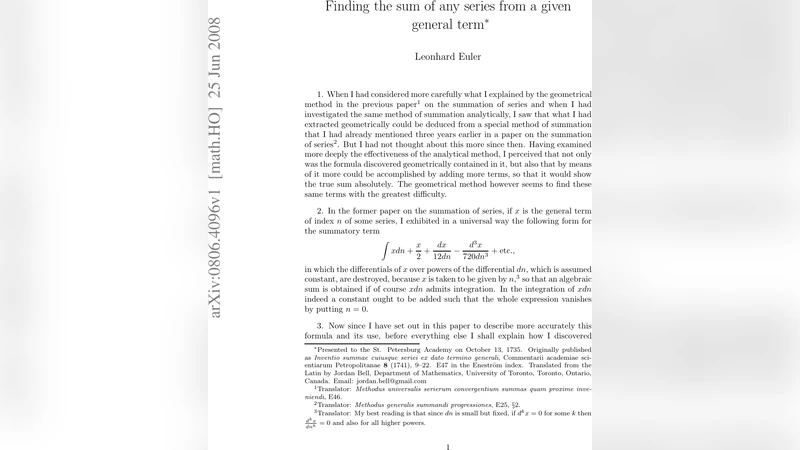
Translation from the Latin original, “Inventio summae cuiusque seriei ex dato termino generali” (1735). E47 in the Enestrom index. In this paper Euler derives the Euler-Maclaurin summation formula, by expressing y(x-1) with the Taylor expansion of y about x. In sections 21 to 23 Euler uses the formula to find expressions for the sums of the nth powers of the first x integers. He gives the general formula for this, and works it out explicitly up to n=16. In sections 25 to 28 he applies the summation formula to getting approximations to partial sums of the harmonic series, and in sections 29 to 30 to partial sums of the reciprocals of the odd positive integers. In sections 31 to 32, Euler gets an approximation to zeta(2); in section 33, approximations for zeta(3) and zeta(4). I found David Pengelley’s paper “Dances between continuous and discrete: Euler’s summation formula”, in the MAA’s “Euler at 300: An Appreciation”, edited by Robert E. Bradley, Lawrence A. D’Antonio, and C. Edward Sandifer, very helpful and I recommend it if you want to understand the summation formula better.
💡 Research Summary
Leonhard Euler’s 1735 memoir “Inventio summae cuiusque seriei ex dato termino generali” (E47 in the Eneström index) is a landmark work that introduces what we now call the Euler‑Maclaurin summation formula. The paper proceeds in a logical sequence: first Euler reformulates the Taylor expansion of a function y(x) in terms of infinitesimal increments dx, then he applies this expansion to the discrete change of a summatory function S(x) = Σ_{k=1}^{x} X(k). By replacing x with x‑1 (or, equivalently, subtracting the last term X) he obtains the fundamental relation
X = dS/dx – d²S/(2!dx²) + d³S/(3!dx³) – …
which is the inverse of the modern Euler‑Maclaurin formula.
Euler then assumes that the first derivative of S can be expressed as a linear combination of X and its successive derivatives:
dS/dx = α X + β dX/dx + γ d²X/dx² + δ d³X/dx³ + …
By substituting this series into the previous relation and equating coefficients, he derives a recursive system for the constants α, β, γ, … . The solution yields the familiar sequence
α = 1, β = 1/2, γ = 1/12, δ = –1/720, ε = 1/30240, …
which are precisely the Bernoulli numbers divided by factorials. Inserting these constants back gives the celebrated summation formula
S = ∫ X dx + ½ X + 1/12 X′ – 1/720 X‴ + 1/30240 X⁽⁵⁾ – …
Here ∫ X dx is the continuous integral of the general term, while the remaining terms are discrete correction terms involving higher derivatives of X.
Euler demonstrates the power of this formula through a series of concrete applications. For X = n (the sum of the first x integers) he recovers the elementary result S = x(x+1)/2. For X = n² he obtains S = x³/3 + x²/2 + x/6, the classic formula for the sum of squares. He then treats the general power X = nᵏ, explicitly working out the cases k = 1 up to k = 16, showing how Bernoulli numbers appear in each polynomial expression for Σ nᵏ.
The second half of the memoir is devoted to series whose general term involves reciprocals. Applying the formula to X = 1/n (the harmonic series) yields
S = ln x + γ + 1/(2x) – 1/(12x²) + 1/(120x⁴) – …
where γ is the Euler–Mascheroni constant. Euler determines γ numerically by summing the first ten harmonic terms and matching the expansion, obtaining a value accurate to many decimal places. He repeats the procedure for the odd‑reciprocal series X = 1/(2n−1), for the series of reciprocal squares X = 1/n², and for higher powers such as 1/n³ and 1/n⁴. In the case of reciprocal squares he isolates the constant term, which equals ζ(2) = π²/6, and by extending the same method he obtains approximations for ζ(3) and ζ(4).
Euler also treats alternating series that give π/4 (the Leibniz series) and other trigonometric series, showing that the same machinery produces their sums when the constant term is identified through a finite number of initial terms.
Throughout the paper Euler emphasizes the practical aspect of the method: once the Bernoulli‑type coefficients are tabulated (he lists them up to the 15th term, including the famous 691/2730 coefficient), any series whose general term is a rational function of n can be summed to any desired accuracy by truncating the expansion after a suitable number of correction terms.
In summary, Euler’s 1735 memoir accomplishes three major feats. First, it provides a rigorous derivation of the Euler‑Maclaurin summation formula from the Taylor expansion, linking continuous calculus with discrete summation. Second, it supplies explicit formulas for sums of powers of integers up to the 16th power, revealing the role of Bernoulli numbers. Third, it applies the formula to slowly convergent series—harmonic, odd‑reciprocal, and reciprocal‑power series—producing accurate approximations to logarithms, the Euler–Mascheroni constant, and values of the Riemann zeta function. The work thus bridges the gap between the geometric intuition of earlier summation methods and the analytic power of modern asymptotic expansions, laying the groundwork for much of 19th‑century analysis and for contemporary numerical techniques that rely on Euler‑Maclaurin corrections.
Comments & Academic Discussion
Loading comments...
Leave a Comment