Random sampling of colourings of sparse random graphs with a constant number of colours
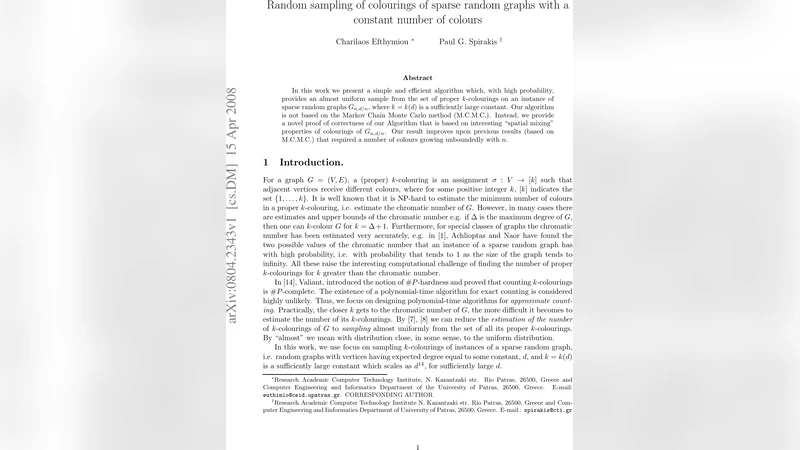
In this work we present a simple and efficient algorithm which, with high probability, provides an almost uniform sample from the set of proper k-colourings on an instance of a sparse random graph G(n,d/n), where k=k(d) is a sufficiently large constant. Our algorithm is not based on the Markov Chain Monte Carlo method (M.C.M.C.). Instead, we provide a novel proof of correctness of our Algorithm that is based on interesting “spatial mixing” properties of colourings of G(n,d/n). Our result improves upon previous results (based on M.C.M.C.) that required a number of colours growing unboundedly with n.
💡 Research Summary
The paper addresses the problem of generating an almost uniform sample of proper k‑colourings for a sparse random graph G(n, d/n), where the average degree d is a fixed constant greater than one. The main contribution is a polynomial‑time algorithm that works with a constant number of colours k that depends only on d (for example, k ≥ d¹⁴). Unlike the vast majority of previous work, which relies on Markov Chain Monte Carlo (MCMC) techniques and requires a number of colours growing with n (typically Θ(log log n·log log log n)), the proposed method uses deterministic local computations based on spatial mixing properties of the colouring model.
Two structural facts about G(n, d/n) are proved. Lemma A shows that, with high probability, every vertex v has a neighbourhood of radius ε log n (where ε ≤ (4 log(e²d/2))⁻¹) that contains at most one cycle; thus the neighbourhood is essentially a tree. Theorem A (the spatial‑dependency theorem) states that if the number of colours S is sufficiently large (a function of d alone), then the colour of any vertex v becomes asymptotically independent of the colours assigned to any set of vertices at distance at least ℓ = ⌊ε log n⌋. Formally, the total variation distance between the conditional Gibbs marginals under two arbitrary boundary colourings that are ℓ‑apart is at most n⁻¹.
The algorithm proceeds by first fixing an arbitrary permutation π of the vertices. It then colours the vertices sequentially according to π. When it reaches vertex v_i, it looks only at the induced subgraph G_{v_i, d, ⌊ε log n⌋} consisting of v_i and all vertices within distance ⌊ε log n⌋. Because of Lemma A this subgraph is tree‑like, allowing the exact (or very accurate) computation of the marginal distribution μ(X_{v_i}=s | C(A_i)) where A_i is the set of already coloured vertices and C(A_i) their colours. Theorem A guarantees that this marginal is within total variation distance n⁻¹ of the true Gibbs marginal, regardless of the exact colours outside the neighbourhood. The algorithm samples the colour of v_i from this approximated marginal and proceeds to the next vertex.
Since S is a constant, the marginal computation can be performed in O(1) time using standard dynamic programming on trees (or belief propagation). The neighbourhood size is O(log n), so the total work per vertex is polylogarithmic, yielding an overall running time O(n·poly(log n)), i.e., polynomial in n. The cumulative error over all vertices remains O(1) in total variation distance, so the final colouring distribution is “close” to the uniform distribution over all proper k‑colourings.
The paper situates its result among prior works: Dyer, Frieze, and Vigoda (2004) and later Mossel & Sly (2013) achieved similar sampling guarantees but required a number of colours that grows with n. The present work eliminates that dependence, showing that a constant number of colours suffices provided it is large enough relative to d. The authors also discuss the limitations: the analysis requires d > 1 and k ≥ d¹⁴; for smaller d or fewer colours the spatial mixing may fail, and the algorithm’s guarantee degrades. Moreover, “almost uniform” is defined via total variation distance, so exact uniformity would need additional post‑processing.
In summary, the paper introduces a novel, non‑MCMC sampling technique for colourings of sparse random graphs, leveraging local tree‑like structure and strong decay of correlations. It achieves polynomial‑time sampling with a constant colour palette, thereby advancing both the theoretical understanding of spin systems on random graphs and providing a potentially practical algorithm for applications where the number of available colours is limited.
Comments & Academic Discussion
Loading comments...
Leave a Comment