On the d-dimensional Quasi-Equally Spaced Sampling
We study a class of random matrices that appear in several communication and signal processing applications, and whose asymptotic eigenvalue distribution is closely related to the reconstruction error of an irregularly sampled bandlimited signal. We …
Authors: Aless, ro Nordio, Carla-Fabiana Chiasserini
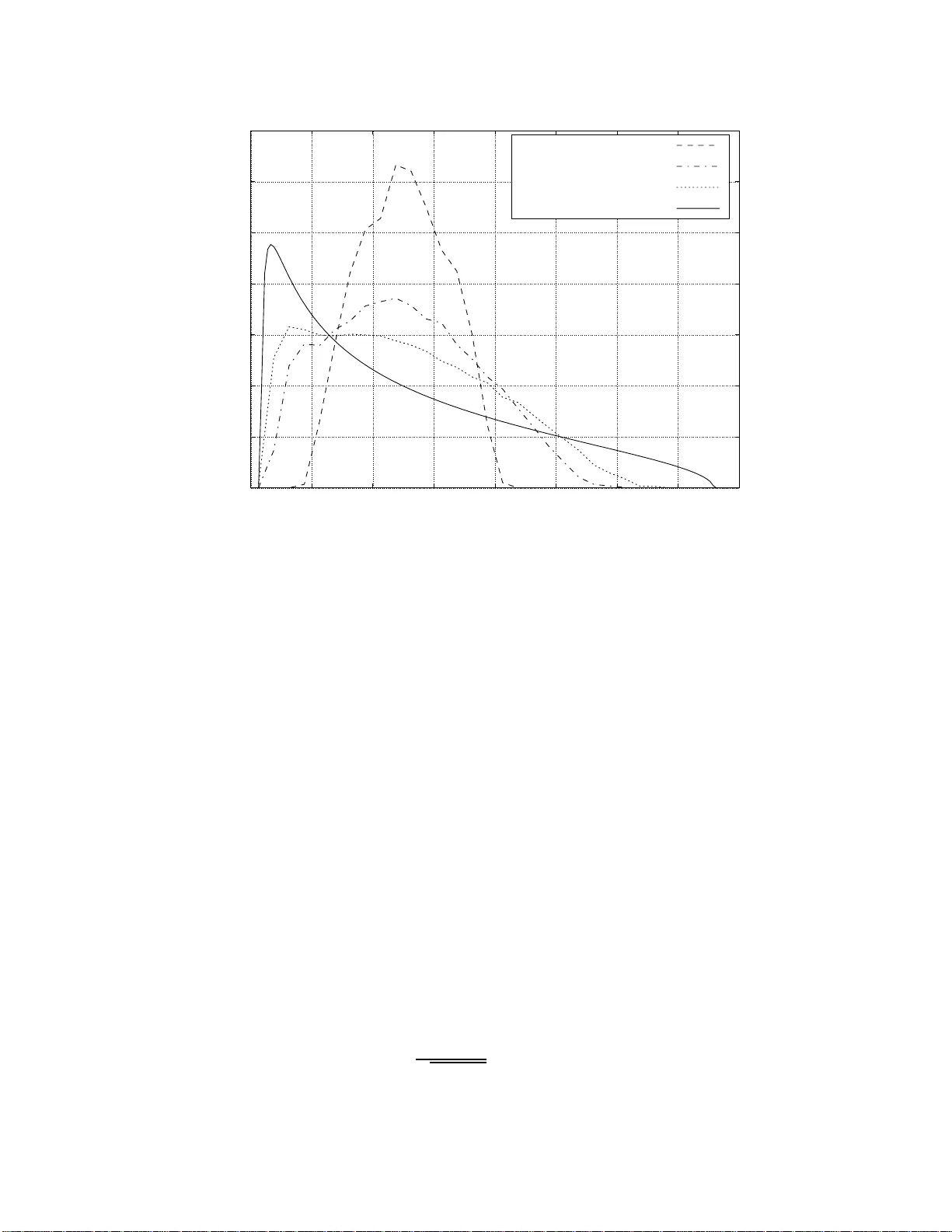
1 On the d -dimensional Quasi-Equally Spaced Sampling Alessandro Nordio ⋆ , Carla-Fa biana Chiasserini ⋆ , Emanuele V iterbo ‡ ⋆ Dipartimento di Elettronica, Politecnico di T orino C. Duca degli Abruzzi 24, I-10129 T orino, Italy Phone: +39 011 090 4226; Fax +39 0 11 09 04099 E-mail: { alessandro.nordio,chi asserini } @poli to.it ‡ DEIS, Univ ersit ` a della Calabria V ia P . Bucci, Cubo 42C, 87036 Rende (CS), Italy Phone: +39 0 984 4 94778; Fax +39 0984 494713 E-mail: vit erbo@deis.unical.it Abstract W e study a class o f rand om matrices that appear in several communicatio n and sign al processing applications, and whose asymp totic eigenv alue distribution is clo sely related to the reconstruction error of an irregularly sampled bandlimited s ignal. W e focus on the case where t he random variables characterizing these matrices are d -dimensional vectors, independent, and quasi-equally spaced, i.e., they have an arbitrary distribution a nd their av erages are vertices of a d -d imensional grid . Alth ough a clo sed f orm expression of the eigenv alue distribution is still unknown, under these c ondition s we are able ( i ) to d eriv e the distribution m oments as the matrix size grows to infinity , while its aspect ratio is kept constant, and ( ii ) to show that the eigenvalue distribution ten ds to the Mar ˇ cenko-Pastur law as d → ∞ . These r esults can find applicatio n in se veral fields, as an example we show how they can b e used fo r th e estimation of the mean squar e error p rovided by linear reconstruc tion techniqu es. EDICS: DSP -RECO Signal re construction, DSP-SAMP Samp ling, SPC-PERF Pe rformance ana lysis and b ounds. October 25, 2021 DRAFT 2 I . I N T R O D U C T IO N Consider the c lass of random matrices of size (2 M + 1) × r , with entries g i ven by G = 1 √ 2 M + 1 e − j2 π M x 1 · · · e − j2 π M x r . . . . . . 1 · · · 1 . . . . . . e +j2 π M x 1 · · · e +j2 π M x r (1) The ge neric element o f G can be written as: G ℓ,q = 1 √ 2 M +1 e j2 π ℓx q , ℓ = − M , . . . , M , q = 0 , . . . , r − 1 , where x q are independ ent random vari ables characterized by a p robability density function (pdf) f x q ( z ) , with 0 ≤ z ≤ 1 . Th ese matrices are V ande rmonde matrices with complex expon ential en tries; they ap pear in many s ignal/image process ing a pplications and have been studied in a nu mber of recent works, (se e e.g., [ 1]–[8]). More specifica lly , in the field of signa l processing for sen sor ne tworks, [1], [2] stud ied the performance of linear rec onstruction techniqu es for phy sical fields irregularly sampled by senso rs. In such sce nario, the rand om variables x q in (1) rep resent the coordina tes of the s ensor no des. The work in [3] add ressed the cas e where these coordina tes are u niformly distributed and s ubject to an un known jitter . In the field of communications, the stud y in [8] presented a number of a pplications where thes e matrices app ear , which range from mu ltiuser MIMO sys tems to multifold sca ttering. In sp ite of their numerous applications , fe w results are kn own for the V an dermonde matrices in (1). In particular , a close d form expres sion for the e igen v alue distribution of the Hermitian T oeplitz matrix GG † , as well as its asymptotic behavior , would be of great interest. As an example, in [1], [2], [6], it has been observed that the performanc e of linear techniqu es for recons tructing a sign al from a se t of irregularly- space d samples with known coo rdinates is a function of the asy mptotic e igen va lue distribution o f GG † . The as ymptotic eigen value distributi on o f GG † is de fined as the distrib ution of its eige n v alues, in the limit o f M and r gro wing to infinity while the ir ratio is kep t constant. Unfortunately , such d istrib ution is s till unkn own. In this work, we conside r a general formulation whic h extends the model in ( 1 ) to the d -dimensiona l domain. W e stud y the properties of rand om matrices of size (2 M + 1) d × r and entries given by ( G d ) ν ( ℓ ) ,q = 1 p (2 M + 1) d e − j2 π ℓ T x q (2) where the vectors x q = [ x q 1 , . . . , x q d ] T have indepe ndent e ntries, cha racterized by the p df f x qm ( z ) , October 25, 2021 DRAFT 3 q = 0 , . . . , r − 1 , m = 1 , . . . , d , and d is the numbe r of d imensions. The inv ertible function ν ( ℓ ) = d X m =1 (2 M + 1) m − 1 ℓ m (3) maps the vec tor o f integers ℓ = [ ℓ 1 , . . . , ℓ d ] T , ℓ m = − M , . . . , M onto a s calar index, i.e., the row index of the matrix G d . Notice that, when d = 1 , G d reduces to (1). For the matrix mod el in (2), we study the interes ting case where x q are inde pende nt, qu asi-equally spaced random variables in the d -dimensional hy percube [0 , 1) d . In other words, we ass ume that the av erages of x q are the vertices of a d -dimensional grid in [0 , 1) d . Th is is often the c ase arising in measureme nt sys tems aff ected by jitt er , or in senso r network dep loyments whe re the sen sors sampling the phys ical field c an only be roughly placed at e qually sp aced positions, due to terrain conditions and deployment practicality [9]. Note that the distribution of the rand om variables x can be of any kind, the only assump tion we make is o n their averages b eing equally spaced. Since an an alytic expression of the eigen v alue distrib ution of G d G † d is unknown, we deriv e a closed form express ion for its moments. This enables us to s how that, a s d → ∞ , the eigen value distrib ution ten ds to the Mar ˇ cenko-Pastur law [12]. At the end of the pa per , we present some numerica l results a nd applications whe re the moments and the asymptotic a pproximation to the e igen v alue distrib ution o f G d G † d can b e of great use. I I . P R E V I O U S R E S U L T S A N D P RO B L E M F O R M U L AT I O N As a first step, we briefly revie w previous results on the G d matrices. In a o ne-dimensiona l domain ( d = 1 ), the work in [1] considered a n irregularly sampled b andlimited s ignal, which is recons tructed using linear techniqu es a nd a ssuming the samples co ordinates to be kn own. The performance of the reconstruction s ystem was d eri ved as a func tion of the eigenv alue distribution f λ (1 , β , z ) o f the ma trix T 1 = β G 1 G † 1 , wh ere β is the aspec t ratio 1 of G 1 [1], [2]. An explicit expression of the momen ts E [ λ p 1 ,β ] = Z ∞ 0 z p f λ (1 , β , z ) d z was attained in [4], [5], for the specific case whe re x q are un iformly distributed in [0 , 1) . Also, in the case where x q are indepe ndent, quasi-equally space d ran dom vari ables, the ana lytic expression of the second moment of the eigen v alue distributi on of T , i.e., E [ λ 2 1 ,β ] , was obtained in [3]. Then, in [7] the moments f λ (1 , β , z ) were deriv ed for an arbitrary distrib ution f x q ( z ) . In [4], [5], the d -dimensiona l mo del (2) was also in vestigated. The re, the properties of the random matrices G d were studied in the ca se where the vectors x q = [ x q 1 , . . . , x q d ] T have ind epende nt entries, 1 The aspect ratio of G is the ratio between the number of ro ws and the number of columns of the matrix October 25, 2021 DRAFT 4 uniformly distribut ed in the h ypercube [0 , 1) d . Under s uch assump tions, and for gi ven d and aspect ratio β , an ana lytic expression of the mome nts o f f λ ( d, β , z ) was derived and it was shown that, as d → ∞ , f λ ( d, β , z ) tends to the Mar ˇ cenko-Pastur law [12 ], i.e., lim d →∞ f λ ( d, β , z ) = f MP ( β , z ) = p ( c 1 − z )( z − c 2 ) 2 π z β where c 1 , c 2 = (1 ± √ β ) 2 , 0 < β ≤ 1 , c 2 ≤ x ≤ c 1 . The following sections detail the problem ad dressed in this work and introduce s ome use ful notations. A. The quasi-equa lly spaced multidimension al model W e c onsider the matrix class in (2) and a ssume tha t the vectors x are inde penden t, q uasi-equa lly space d random variables in the d -dimensional hyp ercube [0 , 1) d , i.e., the averages of x are the vertices of a d -dimension al grid in [0 , 1) d . W e define ρ as the number of vertices per dimension, thus the total nu mber of vertices is r = ρ d . W e denote the coordinate of a ge neric vertex of the g rid by the vector q /ρ ∈ [0 , 1) d , where q = [ q 1 , . . . , q d ] T , is a n integer vector and q m = 0 , . . . , ρ − 1 . For notation simplicity and in ana logy with (3), we ide ntify the vertex with c oordinate q /ρ by the sc alar index µ ( q ) = d X m =1 ρ m − 1 q m (4) Notice that 0 ≤ µ ( q ) ≤ r − 1 is an in vertible function a nd allows us to write x µ ( q ) = q ρ + ˜ x µ ( q ) ρ where the average E [ x µ ( q ) ] = q ρ + 1 2 ρ is the coordina te of the sample iden tified by the sca lar label µ ( q ) an d 1 is the all on es vector . Furthermore, we ass ume that the entries of the vectors ˜ x µ ( q ) are i.i.d. with pdf f ˜ x ( z ) which does not depend on r , M , or q . By using this notation, the entries of G d are then given b y ( G d ) ν ( ℓ ) ,µ ( q ) = 1 p (2 M + 1) d e − j2 π ℓ T x µ ( q ) (5) while the aspe ct ratio is β = (2 M + 1) d r = 2 M + 1 ρ d (6) The He rmitian T oeplitz matrix T d = β G d G † d is define d as ( T d ) ν ( ℓ ) ,ν ( ℓ ′ ) = 1 ρ d X q e − j2 π x T µ ( q ) ( ℓ − ℓ ′ ) (7) October 25, 2021 DRAFT 5 where P q represents a d -dimensiona l sum over all vec tors q such that q m = 0 , . . . , ρ − 1 , m = 1 , . . . , d . Our goals are (i) to deri ve the analytic expression of the mome nts of f λ ( d, β , z ) with q uasi-equally space d vec tors x µ ( q ) (Section III), and (ii) to show tha t a s d → ∞ , f λ ( d, β , z ) tends to the Mar ˇ cenko- Pastur law (Section IV). I I I . C L O S E D F O R M E X P R E S S I O N O F T H E M O M E N T S O F T H E A S Y M P T OT I C E I G E N V A L U E P D F Follo wing the app roach adopted in [13 ], [14], in the limi t for M an d r growi ng to infin ity with c onstant aspec t ratio β and d imension d , we comp ute the closed form express ion of E [ λ p d,β ] , which can be o btained from the powers of T d as [15], E [ λ p d,β ] = lim M ,r → + ∞ β T r E X T p d (2 M + 1) d (8) In (8) the s ymbol T r identifies the matrix trace operator , and the average E X [ · ] is comp uted over the set of random variables X = { x 0 , . . . , x r − 1 } . An efficient method to c ompute (8) exploits s et partitioning . Indeed, note that the p ower T p d is the matrix product of p copies of T d . Th is o peration yields exponen tial terms, wh ose exponen ts a re given by a sum of p terms of the form x T µ ( q i ) ( ℓ i − ℓ [ i +1] ) (see also (22) in Appendix A ). The av erage of this sum depends on the numbe r of distinct vectors q i , an d all possible cases can be described as p artitions of the s et P = { 1 , . . . , p } . In p articular , the ca se wh ere in the set { q 1 , . . . , q p } there are 1 ≤ k ≤ p d istinct vectors, co rresponds to a partition of P in k subs ets. It follo ws that a funda mental s tep to calculate (8) is the co mputation o f a ll possible partitions of set P . Before p roceeding further in our analys is, we therefore introduce some u seful d efinitions related to se t partitioning. A. Definitions Let the integer p denote the moment order and let the vector µ = [ µ 1 , . . . , µ p ] be a poss ible co mbination of p integers. In our spec ific case, ea ch entry of the vector µ is given b y the expression in (4), i.e., µ i = µ ( q i ) an d, thus, can range betwee n 0 and r − 1 . W e de fine: • the sc alar integer 1 ≤ k ( µ ) ≤ p as the number of distinct e ntries o f the vector µ ; • γ ( µ ) as the vector o f integers, of length k ( µ ) , whose entries γ j ( µ ) , j = 1 , . . . , k ( µ ) , are the entries of µ without repetitions, in orde r of appe arance within µ ; • P j ( µ ) a s the set of indice s of the entries of µ w ith value γ j ( µ ) , j = 1 , . . . , k ( µ ) ; October 25, 2021 DRAFT 6 • the vector ω ( µ ) = [ ω 1 ( µ ) , . . . , ω p ( µ )] such tha t, for any given j = 1 , . . . , k ( µ ) , we hav e ω i ( µ ) = j if i ∈ P j ( µ ) , i = 1 , . . . , p . Example 1: Let µ = [1 , 5 , 2 , 8 , 5 , 3 , 2] , then k ( µ ) = 5 since the entries of µ take 5 distinct values (i.e., { 1 , 5 , 2 , 8 , 3 } ). Such values, taken in order of app earance in µ form the vector γ ( µ ) = [1 , 5 , 2 , 8 , 3] . Th e value γ 1 = 1 appears a t position 1 in µ , therefore P 1 ( µ ) = { 1 } . The value γ 2 = 5 appe ars a t p ositions 2 and 5 in µ , therefore P 2 ( µ ) = { 2 , 5 } . Similarly P 3 ( µ ) = { 3 , 7 } , P 4 ( µ ) = { 4 } , and P 5 ( µ ) = { 6 } . By using the se ts P j we build the vector , ω ( µ ) . For each j = 1 , . . . , k we assign the value j to every ω i such that i ∈ P j . For example, ω 2 = ω 5 = 2 since the integers 2 and 5 are in P 2 . In con clusion ω ( µ ) = [1 , 2 , 3 , 4 , 2 , 5 , 3] . Furthermore, we defi ne: • Ω p as the set of p artitions of P ; • Ω p,k as the set of p artitions of P in k s ubsets, 1 ≤ k ≤ p , with p ∪ k =1 Ω p,k = Ω p . Note tha t: (i) the cardinality of Ω p , denoted by B ( p ) = | Ω p | , is the p -th Bell numb er [16] an d (ii) the cardinality o f Ω p,k , d enoted by S ( p, k ) = | Ω p,k | , is a Stirling number o f the second k ind [17]. From the ab ove definitions, it follows that: 1) the vector µ induces a partiti on of the set P which is iden tified by the sub sets P j ( µ ) . Thes e subs ets have the following properties k ( µ ) ∪ j =1 P j ( µ ) = P , P j ( µ ) ∩ P j ′ ( µ ) = ∅ for j 6 = j ′ Even tho ugh the pa rtition identified by µ is often represe nted as {P 1 , . . . , P k ( µ ) } , by its de finition, an equ i valent rep resentation of such pa rtition is giv en by the vector ω ( µ ) . T herefore, from now on we will refer to ω ( µ ) as a partition of the p element set P induced by µ (for simplicity , howe ver , often we will not exp licit the de penden cy of ω on µ ); 2) k ( ω ) = k ( µ ) , since the e ntries of ω take all po ssible values in the se t { 1 , . . . , k ( µ ) } ; 3) P j ( ω ) = P j ( µ ) , for j = 1 , . . . , k ( µ ) . At last, we defin e M ( ω ) as the s et of µ inducing the same p artition ω of P . October 25, 2021 DRAFT 7 Example 2: L et r = 3 and p = 3 . Sinc e µ = [ µ 1 , . . . , µ p ] and µ i = 0 , . . . , r − 1 , i = 1 , . . . , p , we have r p = 27 possible vectors µ , name ly , { [0 , 0 , 0] , [0 , 0 , 1] , . . . , [2 , 2 , 1] , [2 , 2 , 2] } . Ea ch µ ide ntifies a partition ω ∈ Ω 3 ,k , with k = 1 , . . . , 3 , a s d escribed in Example 1. The sets of partitions Ω 3 ,k , are given by Ω 3 , 1 = { [1 , 1 , 1] } , Ω 3 , 2 = { [1 , 1 , 2] , [1 , 2 , 1] , [1 , 2 , 2] } , an d Ω 3 , 3 = { [1 , 2 , 3] } , and have cardinality S (3 , 1) = 1 , S (3 , 2) = 3 and S (3 , 3) = 1 , respectively . The s et of vectors µ identifying the pa rtition ω = [1 , 1 , 1] , i.e., M ([1 , 1 , 1]) , is g i ven by: M ([1 , 1 , 1]) = { [0 , 0 , 0] , [1 , 1 , 1] , [2 , 2 , 2] } . Similarly , M ([1 , 1 , 2]) = { [0 , 0 , 1] , [0 , 0 , 2] , [1 , 1 , 0] , [1 , 1 , 2] , [2 , 2 , 0] , [2 , 2 , 1] } M ([1 , 2 , 1]) = { [0 , 1 , 0] , [0 , 2 , 0] , [1 , 0 , 1] , [1 , 2 , 1] , [2 , 0 , 2] , [2 , 1 , 2] } M ([1 , 2 , 2]) = { [0 , 1 , 1] , [0 , 2 , 2] , [1 , 0 , 0] , [1 , 2 , 2] , [2 , 0 , 0] , [2 , 1 , 1] } M ([1 , 2 , 3]) = { [0 , 1 , 2] , [0 , 2 , 1] , [1 , 0 , 2] , [1 , 2 , 0] , [2 , 0 , 1] , [2 , 1 , 0] } B. Closed form expression of E [ λ p d,β ] By using the defin itions in S ection III- A a nd by applying set partitioning to (8), we ca n s tate the first main res ult of this work: Theorem 3 .1: Let T d be a (2 M + 1) d × (2 M + 1) d Hermitian random matrix a s defin ed in (7), where the properties o f the random vectors x µ ( q ) are des cribed in Section II-A. Then, for a ny given β and d , the p -th momen t of the a symptotic eigen value distribution of T d is given by: E [ λ p d,β ] = p X k =1 k X h =1 β p − h X ω ∈ Ω p,k X ω ′ ∈ Ω k,h u ( ω ′ ) v ( ω , ω ′ ) d (9) where u ( ω ′ ) = ( − 1) k − h h Y j ′ =1 ( |P j ′ ( ω ′ ) | − 1)! (10) v ( ω , ω ′ ) = Z H p k Y j =1 C − j2 π β 1 /d w j ( ω ) d y h = 1 Z H p k Y j =1 C − j2 π β 1 /d w j ( ω ) h Y j ′ =1 δ D X i ′ ∈P j ′ ( ω ′ ) w i ′ ( ω ) d y 1 < h < k Z H p k Y j =1 δ D ( w j ( ω )) d y h = k (11) October 25, 2021 DRAFT 8 T ABLE I P A RT I T I O N S E T S Ω n,m F O R n = 1 , 2 , 3 , A N D 1 ≤ m ≤ n . E A C H PA RT I T I O N I S R E P R E S E N T E D T H R O U G H I T S A S S O C I AT E D V E C T O R ω A N D T H E V A L U E O F u ( ω ) ω , u ( ω ) m = 1 m = 2 m = 3 n = 1 [1], 1 n = 2 [1,1], -1 [1,2], 1 n = 3 [1,1,1], 2 [1,1,2], -1 [1,2,1], -1 [1,2,2], -1 [1,2,3], 1 and v ( ω , ω ′ ) = 1 for k = 1 . In (11), w e de fined H p as the p -dimensional hypercu be [ − 1 / 2 , 1 / 2) p , C ( s ) = E ˜ x [e sz ] as the c haracteristic func tion of ˜ x , δ D ( · ) a s the Dirac’ s delta, a nd w j ( ω ) = X i ∈P j ( ω ) y i − y [ i +1] y i ∈ R , i = 1 , . . . , p , and j = 1 , . . . , k ( ω ) . Pr oof: The proof can be foun d in Append ix A. W ith the aim to give a n intuitiv e explanation of the a bove express ions, no te that the right hand side of (9) c ounts all possible partitions of the set P = { 1 , . . . , p } , C ( s ) in (11) ac counts for the gene ric distrib ution of the variables ˜ x , a nd the qua ntity w j ( ω ) represen ts the indices pa iring that a ppears in the exponent of the gen eric entry o f the power T p d . T o further c larify the mo ments c omputation, T able I rep orts an exa mple of partition s ets Ω n,m for n = 1 , . . . , 3 and 1 ≤ m ≤ n , w hile Exa mple 3 s hows the computation o f the second moment of the eigen v alue distributi on. October 25, 2021 DRAFT 9 Example 3: W e co mpute the analytic expres sion of E [ λ 2 d,β ] . Us ing (9), we get: E [ λ 2 d,β ] = 2 X k =1 k X h =1 β 2 − h X ω ∈ Ω 2 ,k X ω ′ ∈ Ω k,h u ( ω ′ ) v ( ω , ω ′ ) d By exp anding this expres sion and us ing T a ble I, we obtain E [ λ 2 d,β ] = β v ([1 , 1] , [1]) d − β v ([1 , 2] , [1 , 1]) d + v ([1 , 2] , [1 , 2]) d W e no tice that, for k = 1 , v ([1 , 1] , [1]) = 1 . The term v ([1 , 2] , [1 , 2]) refers instead to the case k = h = 2 , an d it is giv en by v ([1 , 2] , [1 , 2]) = Z H 2 2 Y j =1 δ D ( w j ([1 , 2])) d y with w 1 ([1 , 2]) = y 1 − y 2 and w 2 ([1 , 2]) = y 2 − y 1 . It follo ws that v ([1 , 2] , [1 , 2]) = Z H 2 δ D ( y 1 − y 2 ) δ D ( y 2 − y 1 ) d y = 1 Finally , v ([1 , 2] , [1 , 1]) = Z H 2 2 Y j =1 C − j2 π β 1 /d w j ([1 , 2]) d y = Z H 2 C − j2 π β 1 /d ( y 1 − y 2 ) 2 d y Thus, we write E [ λ 2 d,β ] = 1 + β − β Z H 2 C − j2 π β 1 /d ( y 1 − y 2 ) 2 d y d I V . C O N V E R G E N C E T O T H E M A R ˇ C E N K O - P A S T U R D I S T R I B U T I O N In this se ction we s how that the asymptotic e igen v alue distributi on of the ma trix T d tends to the Mar ˇ cenko-Pastur law [12], a s d → ∞ . This is e quiv alent to prove that, a s d → ∞ , the p -th moment of λ d,β tends to the p -th moment of the Mar ˇ cenko-P astur distrib ution with p arameter β , for ev ery p ≥ 1 . Theorem 4 .1: Let T d be a (2 M + 1) d × (2 M + 1) d Hermitian random matrix a s defin ed in (7), where the properties of the rando m vectors x µ ( q ) are described in Section II-A. Le t E [ λ p d,β ] be the p -th mome nt of the as ymptotic eigen v alue distributi on of T d , given by Theo rem 3.1. The n, for any given β , lim d →∞ E [ λ p d,β ] = E [ λ p ∞ ,β ] = p X k =1 β p − k N ( p, k ) (12) October 25, 2021 DRAFT 10 where N ( p, k ) are the Narayan a numbe rs [18], [19] and E [ λ p ∞ ,β ] are the N arayana polynomials , i.e., the moments o f the Mar ˇ cenko-Pastur distribution [12]. Pr oof: W e first loo k a t the expression of the p -th a symptotic moment and obs erve tha t, for h = k , the contributi on of the term in the right hand s ide of (9) reduces to p X k =1 β p − k X ω ∈ Ω p,k X ω ′ ∈ Ω k,k u ( ω ′ ) v ( ω , ω ′ ) d (13) The cardinality of Ω k ,k is S ( k , k ) = 1 and Ω k ,k = { [1 , . . . , k ] } . Thus, we only cons ider ω ′ = [1 , . . . , k ] . Moreover , u sing (10) we h av e u ([1 , . . . , k ]) = 1 sinc e e ach subset P j ′ ([1 , . . . , k ]) has cardinality 1 , j ′ = 1 , . . . , k . T herefore, the term in (13) become s p X k =1 X ω ∈ Ω p,k β p − k v ( ω , [1 , . . . , k ]) d Using (11) with h = k , we h ave: v ( ω , [1 , . . . , k ]) = Z H p k Y j =1 δ D ( w j ( ω )) d y ∆ = v ( ω ) (14) Hence, the co ntrib ution to the p -th momen t reduc es to p X k =1 β p − k X ω ∈ Ω p,k v ( ω ) d (15) In [4], [5] it is s hown that, as d → ∞ , (15) tends to the Naraya na polynomial o f order p . It follows tha t, in order to p rove the theorem, it is en ough to show that for h < k the c ontrib ution of the term in the right hand s ide of (9), to the expres sion of the p -th asymptotic mo ment, vanishes as d → ∞ . In practice we have to s how that, for each ω ∈ Ω p,k and ω ′ ∈ Ω k ,h , with h < k , lim d →∞ v ( ω , ω ′ ) d = 0 or , equ i valently , that | v ( ω , ω ′ ) | < 1 . W e first notice that for 1 < h < k | v ( ω , ω ′ ) | = Z H p k Y j =1 C − j2 π β 1 /d w j ( ω ) h Y j ′ =1 δ D X i ′ ∈P j ′ ( ω ′ ) w i ′ ( ω ) d y ≤ Z H p k Y j =1 C − j2 π β 1 /d w j ( ω ) h Y j ′ =1 δ D X i ′ ∈P j ′ ( ω ′ ) w i ′ ( ω ) d y = Z H p k Y j =1 C − j2 π β 1 /d w j ( ω ) h Y j ′ =1 δ D X i ′ ∈P j ′ ( ω ′ ) w i ′ ( ω ) d y (16) October 25, 2021 DRAFT 11 Moreover , we have: C − j2 π β 1 /d w j ( ω ) = Z + ∞ −∞ exp − j2 π β 1 /d w j ( ω ) z f ˜ x ( z ) d z ( a ) ≤ Z + ∞ −∞ exp − j2 π β 1 /d w j ( ω ) z f ˜ x ( z ) d x = Z + ∞ −∞ f ˜ x ( z ) d z = 1 (17) The equa lity ( a ) arises if the co ndition w j ( ω ) = 0 is always verified, othe rwise, if w j ( ω ) 6 = 0 , C − j2 π β 1 /d w j ( ω ) < 1 . Next, we make the following obse rv ations: ( i ) sinc e we co nsider partitions ω ′ of the form { 1 , . . . , k } in h subsets with h < k , then at least one o f the sets P j ′ ( ω ′ ) has c ardinality |P j ′ ( ω ′ ) | > 1 ; ( ii ) the term h Y j ′ =1 δ D X i ′ ∈P j ′ ( ω ′ ) w i ′ ( ω ) giv es a non-zero co ntrib ution to the integral in (16) only when P i ′ ∈P j ′ ( ω ′ ) w i ′ ( ω ) = 0 . Hence , if |P j ′ ( ω ′ ) | > 1 for some j ′ , then some w i ′ ( ω ′ ) 6 = 0 will provide a n on-zero contribution to the integral in (16). In this c ase, we can write | v ( ω , ω ′ ) | ≤ Z H p k Y j =1 C − j2 π β 1 /d w j ( ω ) h Y j ′ =1 δ D X i ′ ∈P j ′ ( ω ′ ) w i ′ ( ω ) d y < Z H p h Y j ′ =1 δ X i ′ ∈P j ′ ( ω ′ ) w i ′ ( ω ) d y ≤ 1 (18) which proves the c laim. When h = 1 , a gain, there is a meas urable subs et of H p for which w j ( ω ) 6 = 0 , h ence, | v ( ω , ω ′ ) | ≤ Z H p k Y j =1 C − j2 π β 1 /d w j ( ω ) d y < 1 i.e., the strict inequa lity holds. In Figure 1, we show the empirical e igen v alue distribution of the matrix T d for β = 0 . 55 , d = 1 , 2 , 3 , and ˜ x un iformly d istrib uted in [0 , 1] . The emp irical distribution is c ompared to the Mar ˇ cenko-Pastur distrib ution (solid line). W e obse rve that as, d increas es, the Mar ˇ cenko-Pastur distributi on law bec omes a good a pproximation of f λ ( d, β , z ) . In p articular , the two cu rves are relatively close for sma ll z , a lready for d = 3 . October 25, 2021 DRAFT 12 0 0.2 0.4 0.6 0.8 1 1.2 1.4 0 0.4 0.8 1.2 1.6 2 2.4 2.8 3.2 f λ (d, β ,z) z d=1 M=52 d=2 M=11 d=3 M=4 Marcenko-Pastur Fig. 1. Comparison between the Mar ˇ cenko -Pastur distribution and the empirical distribu tion obtained for β = 0 . 55 and d = 1 , 2 , 3 in t he quasi equally space case, and uniform f ˜ x ( z ) V . A P P L I C A T I O N S Here we prese nt some applications whe re the results d eri ved in this work c an be used . The clos ed form expression of the mome nts of f λ ( d, β , z ) , g i ven by (34), can be a use ful bas is for pe rforming d econ voluti on ope rations, a s propos ed in [8]. As for the asymptotic ap proximation, we show below how to exp loit ou r results for the e stimation of the MSE provided by linear reconstruction techniques o f irregularly sa mpled signals. Let us as sume a g eneral linear sys tem model affected by a dditi ve noise. For simplicity , cons ider a one-dimension al sign al, s ( x ) . When observed over a finite interv al, it admits a n infinite Fourier series expansion [1], [2]. W e can think of the lar gest index M of the non-negligible Fourier coefficients of the expansion as the app roximate one-side d b andwidth of the signal. W e therefore rep resent s ( x ) by using 2 M + 1 complex harmonics as s ( x ) = 1 √ 2 M + 1 M X k = − M a ℓ e j2 π ℓx (19) October 25, 2021 DRAFT 13 Now , consider that the signal is observed within o ne period interval [0 , 1) and sa mpled in r points placed at pos itions x = [ x 0 , . . . , x r − 1 ] T , x q ∈ [0 , 1) , q = 0 , . . . , r − 1 . The complex nu mbers a ℓ represent amplitudes and p hases of the harmonics in s ( x ) . The signal samp les s = [ s ( x 0 ) , . . . , s ( x r − 1 )] T can be written as s = G † a , whe re the matrix G is gi ven in (1). The signal discrete sp ectrum is gi ven by the 2 M + 1 complex vector a = [ a − M , . . . , a 0 , . . . , a M ] T . W e can now write the linea r mod el for a measureme nt sample vector p = [ p ( x 0 ) , . . . , p ( x r − 1 )] T taken at the sa mpling points x q p = s + n = G † a + n (20) where n is a random vector rep resenting measuremen t noise . Th e g eneral problem is to reconstruct s or a given the n oisy meas urements p [4], [5]. A commo nly used parameter to meas ure the quality of the estimate of the reconstructed signal is the me an square error (MSE). In [1]–[3] it ha s been shown that, when linear reconstruction techn iques are use d a nd the sa mple c oordinates are known, the asymp totic MSE (i.e., a s the number of h armonics and the number of samples tend to infin ity while their ratio is kept constan t) is a function of the asy mptotic eigen value distribution of the matrix T = β GG † , i.e. , MSE = E λ β λ S NR m + β (21) where the random variable λ has distribution f λ ( d, β , z ) and SNR m is the signal-to-noise ratio on the measure. W e therefore exploit our asymp totic approximation to f λ ( d, β , z ) to compute (21). Figure 2 shows the MSE obtained as a function of the signal-to-noise ratio SNR m . The curves with markers labeled b y “ d = 1 , 2 , 3 ” refer to the ca ses where the s ignal ha s dimens ion d a nd the sampling points are quasi-equally spac ed with jitter ˜ x , un iformly distributed over [0 , 1) , and β = 0 . 729 . The cu rve labeled by “MP” (thick line) repo rts the results deri ved through o ur asymptotic ( d → ∞ ) ap proximation to the eigenv alue distribution, w hile the curve labeled by “Equally spa ced” (dashed line) repres ents the MSE achieved under a perfec t e qually spa ced s ample placement, i.e., wh en the eigen value distributi on is giv en b y f λ ( d, β , z ) = δ D ( z − 1) . Notice tha t the MSE grows as d increases a nd tends to the MSE obtained b y a Ma r ˇ cenko-P astur eigenv alue distrib ution. Instead, a s expected, the “Equa lly spa ced” curve represents a lower bound to the system performance. Figure 3 p resents similar results but obtained for d = 2 a nd different values of β . W e obs erve that the MSE obtained through our asymp totic approximation (the curve labe led by “MP”) giv es excellent results for values of β as small as 0. 2, even whe n co mpared against the n umerical res ults derived by fixing d = 2 . For β = 0 . 6 (i.e., when the ratio of the number of sign al ha rmonics to the nu mber o f sample s increases ), the approximation b ecomes slightly loos er , an d the MSE compu ted by using the Mar ˇ cenko- Pastur distrib ution giv es an up per limit to the qua lity of the recons tructed signal. Note that the s maller October 25, 2021 DRAFT 14 10 -5 10 -4 10 -3 10 -2 10 -1 10 0 -10 0 10 20 30 40 50 MSE SNR m [dB] d=1 (M=52, r=144, β =0.729) d=2 (M=11, r=729, β =0.726) d=3 (M=4, r=1000, β =0.729) MP, β =0.729 Equally spaced, β =0.729 Fig. 2. MSE as a function of the signal-to-noise ratio for d = 1 , 2 , 3 . The curves are compared with the results obtained through our asymptotic analysis (MP) and with the equally spaced case the β , the higher the oversampling rate relative to the equally s paced minimal s ampling rate β = 1 . W e thus obs erve how o ur bound beco mes tighter a s the oversampling rate increases . T o c onclude, we de scribe s ome area s in sign al p rocessing whe re the a bove s ystem mod el a nd results find ap plication. i) Spectral e stimation with nois e. Spec tral estimation from high p recision sa mpling an d q uantization of ba ndlimited s ignals uses me asurement sys tems which a re us ually affected by jitter [20]. In s uch applications the quantization noise c orresponds to the measureme nt noise and the jitter is caused by the limit ed acc uracy o f the timing circuits. In this ca se the sampling points a re mismatched with respect to the nominal values, thus for d = 1 we have: x q = q r + ˜ x q r with some sampling rate 1 /r . Note that the exact positions o f the samp les are not k nown an d the cas e studied in this pa per (i.e., MSE with exact p ositions) gives a lower bound to the recons truction error . ii) Signal reconstruction in sen sor network s. Sensor ne tworks, whose no des sa mple a phys ical field, like air temperature, light intensity , po llution le vels or rain fall s, typically represent an example of quas i- October 25, 2021 DRAFT 15 10 -5 10 -4 10 -3 10 -2 10 -1 10 0 -10 0 10 20 30 40 50 MSE SNR m [dB] β =0.2, d=2 β =0.2, MP β =0.2, Equally spaced β =0.6, d=2 β =0.6, MP β =0.6, Equally spaced Fig. 3. MS E as a function of the si gnal-to-noise ratio for β = 0 . 2 , 0 . 6 . The curves are obtained for d = 2 and compared against both the equally spaced case and the results deri ved through our asymptotic analysis ( MP) equally spac ed sa mpling [3], [9], [21], [22]. Indeed, often sensors are not regularly deployed in the area of interest due to terrain co nditions and d eployment p racticality and, thus, the phy sical field is not regularly sampled in the s pace domain. Sens ors report the data to a common proces sing un it (or sink nod e), which is in charge of recons tructing the sens ed field, ba sed on the receiv ed samples an d on the knowledge of their coordinates. If the field ca n b e approximated as bandlimited in the spa ce domain, then an estimate of the discrete sp ectrum c an b e o btained by using linear reconstruction techniques [3], [23], ev en in p resence of additive noise. In this c ase, our ap proximation a llo ws to compute the MSE on the rec onstructed field. iii) S tochastic sa mpling in co mputer graphics and imag e pr ocessing. J ittered sampling was first examined by Balak rishnan in [24], who ana lyzed it a s an und esirable ef fect in sampling continuo us time functions. More than twenty years later , Cook [25] realized that the effect of stochastic sa mpling can be advantageo us in compu ter graphics to redu ce aliasing artifacts, and con sidered jittering a regular grid as an effecti ve sampling technique. Anothe r example of s ampling with jitter was rec ently October 25, 2021 DRAFT 16 proposed in [26], for robust authentication of images. V I . C O N C L U S I O N S W e studied the behavior of the eigen v alue distribution of a c lass of rando m matrices, which find large application in signa l a nd imag e process ing. In particular , by u sing asy mptotic ana lysis, we deriv ed a closed-form expression for the moments of the eigen v alue distribution. Using these momen ts, we showed that, as the signal dimension goes to infinity , the as ymptotic eigen value d istrib ution tends to the Mar ˇ cenko- Pastur law . T his result a llo wed us to ob tain a s imple and ac curate bound to the signa l reconstruction error , which can fin d a pplication in several fields, such as jittered sampling, sens or networks, computer graphics and image processing . A P P E N D I X A P R O O F O F T H E O R E M 3 . 1 Using (7 ), the term T r E X T p d in (8) ca n be written as : T r E X T p d = E X X ℓ 1 ( T p d ) ν ( ℓ 1 ) ,ν ( ℓ 1 ) = E X X ℓ 1 · · · X ℓ p ( T d ) ν ( ℓ 1 ) ,ν ( ℓ 2 ) · · · ( T d ) ν ( ℓ p ) ,ν ( ℓ 1 ) = 1 r p X ℓ 1 · · · X ℓ p X q 1 · · · X q p E X " exp − j2 π p X i =1 x T µ ( q i ) ( ℓ i − ℓ [ i +1] ) !# = 1 r p X L ∈L d X Q ∈Q d E X " exp − j2 π p X i =1 x T µ ( q i ) ( ℓ i − ℓ [ i +1] ) !# (22) where Q d and L d are sets of integer matrices such that Q d = Q | Q = [ q 1 , . . . , q p ] , q i = [ q i, 1 , . . . , q i,d ] T , q i,m = 0 , . . . , ρ − 1 L d = L | L = [ ℓ 1 , . . . , ℓ p ] , ℓ i = [ ℓ i, 1 , . . . , ℓ i,d ] T , ℓ i,m = − M , . . . M and [ i + 1] = i + 1 1 ≤ i < p 1 i = p October 25, 2021 DRAFT 17 A. Set partitioning W e now apply the definitions in Se ction III-A in order to re write (22) u sing set partitioning. In particular by considering the vector µ = µ ( Q ) ∆ = [ µ 1 , . . . , µ p ] T where µ i = µ ( q i ) and q i is the i -th co lumn of Q , we obs erve that: • the vector µ is uniquely de fined by Q , and a gi ven µ unique ly define s a matrix Q ∈ Q d since µ ( · ) is a n in verti ble function; • a given µ induce s a partition ω ( µ ) ; • since r is the numb er of values tha t the entries µ i can take, there exist r ! / ( r − k ( µ ))! matrices Q ∈ Q d generating a gi ven p artition of P ma de o f k ( µ ) subs ets. In other words r ! / ( r − k ( µ ))! distinct µ ’ s yield the sa me partition ω ( µ ) . Since the random vec tors x µ ( q ′ ) and x µ ( q ′′ ) are indepe ndent for q ′ 6 = q ′′ , for any giv en Q the average operator in (22) factorizes into k ( µ ) terms, i.e. , E X " exp − j2 π p X i =1 x T µ ( q i ) ( ℓ i − ℓ [ i +1] ) !# = E X " exp − j2 π p X i =1 x T µ i ( ℓ i − ℓ [ i +1] ) !# = k ( µ ) Y j =1 E x γ j exp − j2 π x T γ j X i ∈P j ( µ ) ℓ i − ℓ [ i +1] = k ( µ ) Y j =1 E x γ j h ζ ρ x T γ j ˆ w j ( µ ) i (23) indeed, for every i ∈ P j ( µ ) , we have µ i = γ j . In the last line of (23), we exploited the following two definitions ζ = exp ( − j2 π /ρ ) and ˆ w j ( µ ) = X i ∈P j ( µ ) ℓ i − ℓ [ i +1] (24) Also, note tha t, in the product in (23), ea ch factor depe nds on a single random vector , x γ j . Since x µ ( q ) = q /ρ + ˜ x µ ( q ) /ρ and µ ( · ) is in vertible then, b y defin ing ¯ x γ j = µ − 1 ( γ j ) we have x γ j = ¯ x γ j /ρ + ˜ x γ j /ρ and E x γ j h ζ ρ x T γ j ˆ w j ( µ ) i = ζ ¯ x T γ j ˆ w j ( µ ) E ˜ x γ j h ζ ˜ x T γ j ˆ w j ( µ ) i = ζ ¯ x T γ j ˆ w j ( µ ) E ˜ x h ζ ˜ x T ˆ w j ( µ ) i (25) October 25, 2021 DRAFT 18 In the last term of (25) we removed the su bscript γ j from the argument o f the average opera tor , since the d istrib ution of ˜ x γ j does n ot de pend o n γ j . Summarizing, the term T r E X T p d in (8) ca n b e written as T r E X T p d = 1 r p X Q ∈Q d X L ∈L d k ( µ ) Y j =1 ζ ¯ x T γ j ˆ w j ( µ ) E ˜ x h ζ ˜ x T ˆ w j ( µ ) i (26) Since e ach Q is uniquely identified by a vector µ , we can observe that X Q ∈Q d f ( µ ) = X ω ∈ Ω p X µ ∈M ( ω ) f ( µ ) = p X k =1 X ω ∈ Ω p,k X µ ∈M ( ω ) f ( µ ) (27) for every function f ( µ ) . Rec all that, in (27), M ( ω ) represents the se t of µ inducing a gi ven pa rtition ω . From the defin itions in Section III-A, it follo ws tha t, if µ induces ω , then k ( µ ) = k ( ω ) , P j ( µ ) = P j ( ω ) , and ˆ w j ( µ ) = ˆ w j ( ω ) , j = 1 , . . . , k ( ω ) . T herefore, T r E X T p d = 1 r p p X k =1 X ω ∈ Ω p,k X µ ∈M ( ω ) X L ∈L d k Y j =1 ζ ¯ x T γ j ˆ w j ( µ ) E ˜ x h ζ ˜ x T ˆ w j ( µ ) i = 1 r p p X k =1 X ω ∈ Ω p,k X µ ∈M ( ω ) X L ∈L d k Y j =1 ζ ¯ x T γ j ˆ w j ( ω ) E ˜ x h ζ ˜ x T ˆ w j ( ω ) i = 1 r p p X k =1 X ω ∈ Ω p,k X L ∈L d X µ ∈M ( ω ) k Y j =1 ζ ¯ x T γ j ˆ w j ( ω ) k Y j =1 E ˜ x h ζ ˜ x T ˆ w j ( ω ) i ( a ) = 1 r p p X k =1 X ω ∈ Ω p,k X L ∈L d η ( ω , L ) X µ ∈M ( ω ) k Y j =1 ζ ¯ x T γ j ˆ w j ( ω ) (28) In (28) we define d η ( ω , L ) = k Y j =1 E ˜ x h ζ ˜ x T ˆ w j ( ω ) i = k Y j =1 d Y m =1 E ˜ x m h ζ ˜ x m ˆ w jm ( ω ) i (29) where ˜ x m and ˆ w j m are the m -th entries of ˜ x and ˆ w j , respec ti vely . In the equality “(a)” we exploited the fact that the term ζ ˜ x T ˆ w j ( ω ) does not depend on µ and c an be factored from the su m over µ . As for the term P µ ∈M ( ω ) Q k j =1 ζ ¯ x T γ j ˆ w j , we have the following lemma. Lemma A. 1: Let ω ∈ Ω p,k , let ˆ w 1 , . . . , ˆ w k be vectors of size d with integer entries, de fined a s in (24). Let M ( ω ) be the se t of vec tors µ ind ucing ω . T hen X µ ∈M ( ω ) k Y j =1 ζ ¯ x T γ j ˆ w j = k X h =1 r h X ω ′ ∈ Ω k,h u ( ω ′ ) h Y j ′ =1 δ X i ′ ∈P j ′ ( ω ′ ) ˆ w i ′ ( ω ) (30) where u ( ω ′ ) = ( − 1) k − h Q h j ′ =1 ( |P j ′ ( ω ′ ) | − 1)! , γ j = γ j ( µ ) , and whe re Ω k ,h is the set of vectors ω ′ of size k , rep resenting the partitions of the set P ′ = { 1 , . . . , k } in h subse ts, namely , P ′ 1 ( ω ′ ) , . . . , P ′ h ( ω ′ ) . October 25, 2021 DRAFT 19 Pr oof: The proof can be foun d in Append ix B. By a pplying the result of Le mma A.1 to (28), we get T r E X T p d = p X k =1 k X h =1 X ω ∈ Ω p,k X ω ′ ∈ Ω k,h r h u ( ω ′ ) r p X L ∈L d η ( ω , L ) h Y j ′ =1 δ X i ′ ∈P j ′ ( ω ′ ) ˆ w i ′ ( ω ) (31) Considering that h Y j ′ =1 δ X i ′ ∈P j ′ ( ω ′ ) ˆ w i ′ ( ω ) = h Y j ′ =1 d Y m =1 δ X i ′ ∈P j ′ ( ω ′ ) ˆ w i ′ m ( ω ) and b y using (29) a nd (31), we h av e X L ∈L d η ( ω , L ) h Y j ′ =1 δ X i ′ ∈P j ′ ( ω ′ ) ˆ w i ′ ( ω ) = X ℓ 1 ∈L 1 · · · X ℓ d ∈L 1 k Y j =1 d Y m =1 E ˜ x m h ζ ˜ x m ˆ w jm ( ω ) i h Y j ′ =1 d Y m =1 δ X i ′ ∈P j ′ ( ω ′ ) ˆ w i ′ m ( ω ) = X ℓ ∈L 1 k Y j =1 E ˜ x h ζ ˜ x ˆ w j ( ω ) i h Y j ′ =1 δ X i ′ ∈P j ′ ( ω ′ ) ˆ w i ′ ( ω ) d = ψ M ( ω , ω ′ ) d (32) where the su bscript M highlights the dep endency of ℓ on M . In co nclusion, T r E X T p d = p X k =1 k X h =1 X ω ∈ Ω p,k X ω ′ ∈ Ω k,h r h u ( ω ′ ) r p ψ M ( ω , ω ′ ) d (33) T o compu te E [ λ p d,β ] , we cons ider the limit in (8). B y using the definition (6), we first notice that r h r p (2 M + 1) d = β p − h (2 M + 1) d ( p − h +1) Then, by using (33) in (8), we ob tain E [ λ p d,β ] = lim M ,r → + ∞ β p X k =1 k X h =1 β p − h (2 M + 1) d ( p − h +1) X ω ∈ Ω p,k X ω ′ ∈ Ω k,h u ( ω ′ ) ψ M ( ω , ω ′ ) d = p X k =1 k X h =1 β p − h X ω ∈ Ω p,k X ω ′ ∈ Ω k,h u ( ω ′ ) lim M →∞ ψ M ( ω , ω ′ ) (2 M + 1) p − h +1 d = p X k =1 k X h =1 β p − h X ω ∈ Ω p,k X ω ′ ∈ Ω k,h u ( ω ′ ) v ( ω , ω ′ ) d (34) The secon d equa lity in (34) holds sinc e, for a ny gi ven p , the s ums P ω ∈ Ω p,k and P ω ′ ∈ Ω k,h are over a finite number of terms, and the coefficients u ( ω ′ ) are finite and do not depend on M . Th erefore, the October 25, 2021 DRAFT 20 limit o perator can be swapped with the summa tions. The c oefficient v ( ω , ω ′ ) is defin ed as v ( ω , ω ′ ) = lim M →∞ ψ M ( ω , ω ′ ) (2 M + 1) p − h +1 = lim M →∞ 1 (2 M + 1) p − h +1 X ℓ ∈L 1 k Y j =1 E ˜ x h ζ ˜ x ˆ w j ( ω ) i h Y j ′ =1 δ X i ′ ∈P j ′ ( ω ′ ) ˆ w i ′ ( ω ) ( a ) = lim M →∞ 1 (2 M + 1) p − h +1 X ℓ ∈L 1 k Y j =1 C ( − j2 π ˆ w j ( ω ) /ρ ) h Y j ′ =1 δ X i ′ ∈P j ′ ( ω ′ ) ˆ w i ′ ( ω ) (35) where, in the equality ( a ) , we introduced the charac teristic fun ction of ˜ x , de fined as C ( s ) = E ˜ x [e sz ] . W e now consider three possible c ases: • if h = 1 , then Ω k , 1 = { [1 , . . . , 1 | {z } k ] } , thus we only conside r ω ′ = [1 , . . . , 1 | {z } k ] . Then, P 1 ( ω ′ ) = { 1 , . . . , k } and X i ′ ∈P 1 ( ω ′ ) ˆ w i ′ ( ω ) = X i ′ ∈{ 1 ,...,k } ˆ w i ′ ( ω ) = k X i ′ =1 ˆ w i ′ ( ω ) = k X i ′ =1 X i ∈P i ′ ( ω ) ℓ i − ℓ [ i +1] = p X i =1 ℓ i − ℓ [ i +1] = 0 (36) and b y c onsequ ence δ P i ′ ∈P j ′ ( ω ′ ) ˆ w i ′ ( ω ) = 1 . Hence, v ( ω , ω ′ ) = Z H p k Y j =1 C − j2 π β 1 /d w j ( ω ) d y (37) where, in ana logy with (24), we defin ed w j = X i ∈P j ( ω ) y i − y [ i +1] y i ∈ R , i = 1 , . . . , p . W e d enote by y the vector y = [ y 1 , . . . , y p ] T ; • if 1 < h < k , the a r gument of the δ ( · ) function in (35) is always a function o f the indice s ℓ i . Thus Z H p k Y j =1 C − j2 π β 1 /d w j ( ω ) h Y j ′ =1 δ D X i ′ ∈P j ′ ( ω ′ ) w i ′ ( ω ) d y where δ D ( · ) d enotes the Dirac’ s delta; October 25, 2021 DRAFT 21 • if h = k , the cardinality of Ω k ,h = Ω k ,k is S ( k , k ) = 1 and Ω k ,k = { [1 , . . . , k ] } . Thus, we only consider ω ′ = [1 , . . . , k ] . It follo ws that: v ( ω , ω ′ ) = Z H p k Y j =1 C − j2 π β 1 /d w j ( ω ) k Y j ′ =1 δ D X i ′ ∈P j ′ ([1 ,...,k ] ) w i ′ ( ω ) d y = Z H p k Y j =1 C − j2 π β 1 /d w j ( ω ) δ D X i ′ ∈P j ([1 ,...,k ]) w i ′ ( ω ) d y (38) Since P j ([1 , . . . , k ]) = { j } an d C (0) = 1 , we have v ( ω , [1 , . . . , k ]) = Z H p k Y j =1 C − j2 π β 1 /d w j ( ω ) δ D ( w j ( ω )) d y = Z H p k Y j =1 C (0) δ D ( w j ( ω )) d y = Z H p k Y j =1 δ D ( w j ( ω )) d y (39) As a las t remark, if k = 1 , we have h = 1 and Ω p,k = Ω p, 1 = { [1 , . . . , 1 | {z } p ] } . Then w j ( ω ) = P p i =1 w i = 0 . Using (37), we obtain v ( ω , ω ′ ) = Z H p k Y j =1 C − j2 π β 1 /d w j ( ω ) d y = Z H p k Y j =1 C (0) d y = 1 A P P E N D I X B P R O O F O F L E M M A A . 1 Recall that M ( ω ) deno tes the set of vectors µ = [ µ 1 , . . . , µ p ] induc ing the same partit ion ω . As define d in Section III-A, if ω ∈ Ω p,k , then eac h µ ∈ M ( ω ) con tains k distinct values, namely , γ = [ γ 1 , . . . , γ k ] where 0 ≤ γ j < r , j = 1 , . . . , k a nd γ j 6 = γ j ′ for each j, j ′ = 1 , . . . , k a nd j 6 = j ′ . Therefore, from (A.1) we can write X µ ∈M ( ω ) k Y j =1 ζ ¯ x T γ j ˆ w j = X γ 1 ,...,γ k 6 = k Y j =1 ζ ¯ x T γ j ˆ w j where the symbol P γ 1 ,...,γ k 6 = indicates a s um over the v ariables γ 1 , . . . , γ k with the constraint that γ j 6 = γ j ′ for every j, j ′ = 1 , . . . , k and j 6 = j ′ . Notice that the values γ j ( j = 1 , . . . , k ) are the sc alar counterparts of the integer v ectors v 1 , . . . , v k , v j = [ v j 1 , . . . , v j d ] T , 0 ≤ v j m < ρ , m = 1 , . . . , d , through the inv ertible function µ ( · ) , i.e., γ j = µ ( v j ) , j = 1 , . . . , k . Henc e, by de finition of ¯ x , we have ¯ x γ j = ¯ x µ ( v j ) = v j and October 25, 2021 DRAFT 22 in co nclusion X µ ∈M ( ω ) k Y j =1 ζ ¯ x T γ j ˆ w j = X v 1 ,..., v k 6 = k Y j =1 ζ v T j ˆ w j = X v 1 ,..., v k 6 = ζ v T 1 ˆ w 1 + ··· + v T k ˆ w k (40) W e now c ompute the last term of (40) b y summing over on e vari able at a time. W e first no tice that, for every set v 1 , . . . , v n of distinct vectors X v 6 = v 1 ,..., v n ζ v T ˆ w = r − n ˆ w = 0 − P n j =1 ζ v T j ˆ w ˆ w 6 = 0 In pa rticular when w 6 = 0 , P v ζ v T ˆ w = 0 . Let us arbitrarily choos e the variable v k . If by hypo thesis w k 6 = 0 , then by summing (40) over v k we get X v 1 ,..., v k 6 = ζ v T 1 ˆ w 1 + ··· + v T k ˆ w k = − k − 1 X j =1 X v 1 ,..., v k − 1 6 = ζ v T 1 ˆ w 1 + ··· + v T k − 1 ˆ w k − 1 ζ v T j ˆ w k (41) W e c ompute separately each of the k − 1 contributions in (41). In particular , the ge neric j ′ -th term ( j = j ′ ) is given by − X v 1 ,..., v k − 1 6 = ζ v T 1 ˆ w 1 + ··· + v T k − 1 ˆ w k − 1 ζ v T j ′ ˆ w k = − X v 1 ,..., v k − 1 6 = ζ v T 1 ˆ w 1 + ··· + v T j ′ ( ˆ w j ′ + ˆ w k )+ v T k − 1 ˆ w k − 1 W e now procee d b y summing over the variable v j ′ . If by hypothes is ˆ w j ′ + ˆ w k 6 = 0 , this su mmation produces k − 2 terms. Ag ain, we con sider each term s eparately . This procedure repeats un til a su bset S of { 1 , . . . , k } is found, such that s = P i ∈S ˆ w i = 0 . In this case, the contributi on of the n -th sum is gi ven by r − ( k − n ) whe re n = |S | is the cardinality of S . Overall, a fter n sums the total contribution is ( − 1) n − 1 ( n − 1)!( r − ( k − n )) X v j ,j ∈{ 1 ,...,k }−S 6 = Y j ∈{ 1 ,...,k }−S ζ v T j ˆ w j The factor ( n − 1)! accoun ts for the n umber o f pe rmutations of the e lements in S , once the first eleme nt is fixed (remember that we arbitrarily chos e the fi rst v ariable o f the summa tion). The factor ( − 1) n − 1 takes into acco unt that we su mmed n − 1 times with the co ndition ˆ w 6 = 0 , which implies n − 1 sign chan ges. Eventually , the term P v j ,j ∈{ 1 ,...,k }−S 6 = Q j ∈{ 1 ,...,k }−S ζ v T j ˆ w j is s imilar to the last term in (40) where only k − n variables v a re in v olved. This proce dure repeats until we sum over all variables v . T his is equiv alent to che ck if for all pos sible partitions of { 1 , . . . , k } in h su bsets P 1 , . . . , P h , h = 1 , . . . , k the condition s 1 = s 2 = · · · = s h = 0 October 25, 2021 DRAFT 23 holds, with s j = P i ∈P j ˆ w i , n j = |P j | , and P j n j = k . In this c ase, the con trib ution is gi ven by h Y j =1 ( − 1) n j − 1 ( n j − 1)! p r ( n 1 , . . . , n h ) and it is 0 otherwise. Here p r ( n 1 , . . . , n h ) = ( r − ( k − n 1 ))( r − ( k − n 1 − n 2)) · · · ( r − ( k − n 1 − n 2 − · · · − n h − 1 )) . In co nclusion, we can write X v 1 ,..., v k 6 = ζ v T 1 ˆ w 1 + ··· + v T k ˆ w k = k X h =1 X ω ′ ∈ Ω k,h u ( ω ′ ) p r ( ω ′ ) h Y j ′ =1 δ X i ′ ∈P j ′ ( ω ′ ) ˆ w i ′ ( ω ) where u ( ω ′ ) = ( − 1) k − h Q h j ′ =1 ( |P j ′ ( ω ′ ) | − 1)! and p r ( ω ′ ) is a polynomial in r of degree h . For lar ge r , p r ( ω ′ ) ≃ r h , thu s proving the lemma. R E F E R E N C E S [1] A. Nordio, C.-F . Chiasserini, and E. V iterbo “Quality of field reconstruction in sensor networks , ” IEEE INFOC OM Mini- Symposium , Anchorage, AK, May 2007. [2] A. Nordio, C. -F . Chiasserini, and E. Viterbo , “Performance of linear field reconstruction techniques with noise and uncertain sensor locations, ” IEE E T ran sactions on Signal Pr oce ssing, to appear , 2008. [3] A. Nordio, C .-F . Chiasserini, and E . V i terbo, “The impact of quasi-equ ally spaced sensor layouts on field reconstruction, ” International Sympo sium on Information Pr ocessing in Senso r Networks (IP SN 2007) , Cambridge, MA, Apr . 2007. [4] A. Nordio, C.-F . C hiasserini, and E . V iterbo, “Signal reconstruction in multidimensional sensor fields, ” 2008 International Zurich Seminar on Communications (IZS), Zurich, 2008. [5] A. Nordio, C.-F . Chiasserini, and E . V it erbo, “Recon struction of multidimensional signals from i rregular noisy samples, ” IEEE Tr ansaction s on Signal Pr ocessing , to appear , 2008. [6] A. Nordio, A. Muscariello, and C.-F . Chiasserini, “S ignal Compression and Reconstruction in Clustered Sensor Networks, ” ICC 2008, Beijing, China, 2008. [7] Ø. Ryan and M. Debbah, “Random V andermonde Matrices-Part I: Fundamental results”, http://arxiv .org/abs/08 02.3570v1 [8] Ø. Ryan and M. Debbah, “Random V andermonde Matrices-Part II: Applications”, http://arxi v .org/abs/080 2.3572v1 [9] D. Ganesan, S. R atnasamy , H. W ang, and D. Estrin, “Coping wit h irregular spatio-temporal sampling in sensor network s, ” ACM SIGCOMM, pp. 125–130, Jan. 20 04. [10] K. Abed-Meraim, P . Loubaton, P . Moline’ s, “ A subspace algorithm for certain blind identification problems, ” IEEE T rans. on Information Theory , vo l. 43, pp. 499-511, Mar . 1997. [11] Ø. Ryan and M. Debbah, “Free decon vo lution for signal processing applications, ” htt p://arxiv .org/abs/cs.IT/0701025. [12] V . A. Mar ˇ cenko and L. A. Pastur , “Distri bution of eigen v alues for some sets of random matrices, ” USSR Sbornik , V ol. 1, pp. 457–4 83, 1967. [13] P . Billingsley , P r obab ility and measur e (3r d edition) , John Wiley and Sons Inc, New Y ork, 1995. [14] L. Li, A. M. T ulino and S. V erd ` u, “ Asymptotic eigen v alue moments for linear multiuser detection, ” Communications in Information and Systems, V ol. 1, N o. 3, pp. 273–3 04, Sept. 2001. October 25, 2021 DRAFT 24 [15] A. T ulino, S. V erd ´ u, “Random matrix t heory and wireless communication s, ” F ounda tions and T r ends in Communications and Information Theory , v ol. 1, no. 1, 2004. [16] E. W . W eisstein, “Bell number , ” from MathW orld – A W olfram W eb Resour ce , http://mathworld.wo lfram.com/BellNumber .html . [17] E. W . W eisstein, “Stirling number of the second kind, ” from MathW orld – A W olfra m W eb Resourc e , http://mathworld.wo lfram.com/StirlingNumberoftheSecondKind.h tml . [18] “The on-line encycloped ia of integer sequences, ” http://www .research.att.com/ ∼ njas/sequences/A0 01263 . [19] I. Dumitri u and E. Rassart, “Path counting and random matrix theory , ” T he Electr onic Journ al of Combinatorics, V ol. 10, No. 1, 2003. [20] Y ih-Chyun Jenq, “Perfect reconstruction of digital spectrum from non -uniformly sampled signals, ” IEEE T ransa ctions on Instrumentation and Measur ements , v ol. 46, no. 3, pp. 649–652, June 1997. [21] P . Zhao, C. Zhao, P . G. Casazza, “Perturbation of regular sampling in shift-in v ariant spaces for frames, ” IEE E T ransactions on Information Theory , vo l. 52, no. 10, pp. 46 43–464 8, Oct. 2006. [22] D. S. E arly and D. G. Long, “Image reconstruction and enhanced resolution imaging from irregular samples, ” IEEE T r ansactions on Geoscience and Remote Sensing , vol. 39, no 2, pp. 291–302 , F eb . 2001. [23] H. G. Feichtinger , K. Gr ¨ ochenig, T . Strohmer, “Efficient numerical methods in non-uniform sampling theory , ” N umerische Mathematik , vol. 69, pp. 423–440, 1995. [24] A. V . Balakrishnan, “On the problem of time jitter in sampling, ” IR E T ran sactions on I nformation Theory , Apr . 1962, pp. 226-236. [25] R. L. Cook, “Stochastic sampling in computer graphics, ” ACM T ransa ctions on Grap hics, vol. 5, no. 1, pp. 51-72, Jan. 1986. [26] Xunzhan Zhu, A. T . S. Ho, P . Marziliano, “Image authentication and r estoration using irregular sampling for traffic enforcement applications, ” F irst International Confer ence Inno vative Computing, Information and Contr ol, ICICIC 2006 , Aug. 2006, pp. 62–65. October 25, 2021 DRAFT
Original Paper
Loading high-quality paper...
Comments & Academic Discussion
Loading comments...
Leave a Comment