Comparative Study of Open-loop Transmit Diversity Schemes for Four Transmit Antennas in Coded OFDM Systems
We compare four open-loop transmit diversity schemes in a coded Orthogonal Frequency Division Multiplexing (OFDM) system with four transmit antennas, namely cyclic delay diversity (CDD), Space-Time Block Code (STBC, Alamouti code is used) with CDD, Q…
Authors: Chau Yuen, Yan Wu, Sumei Sun
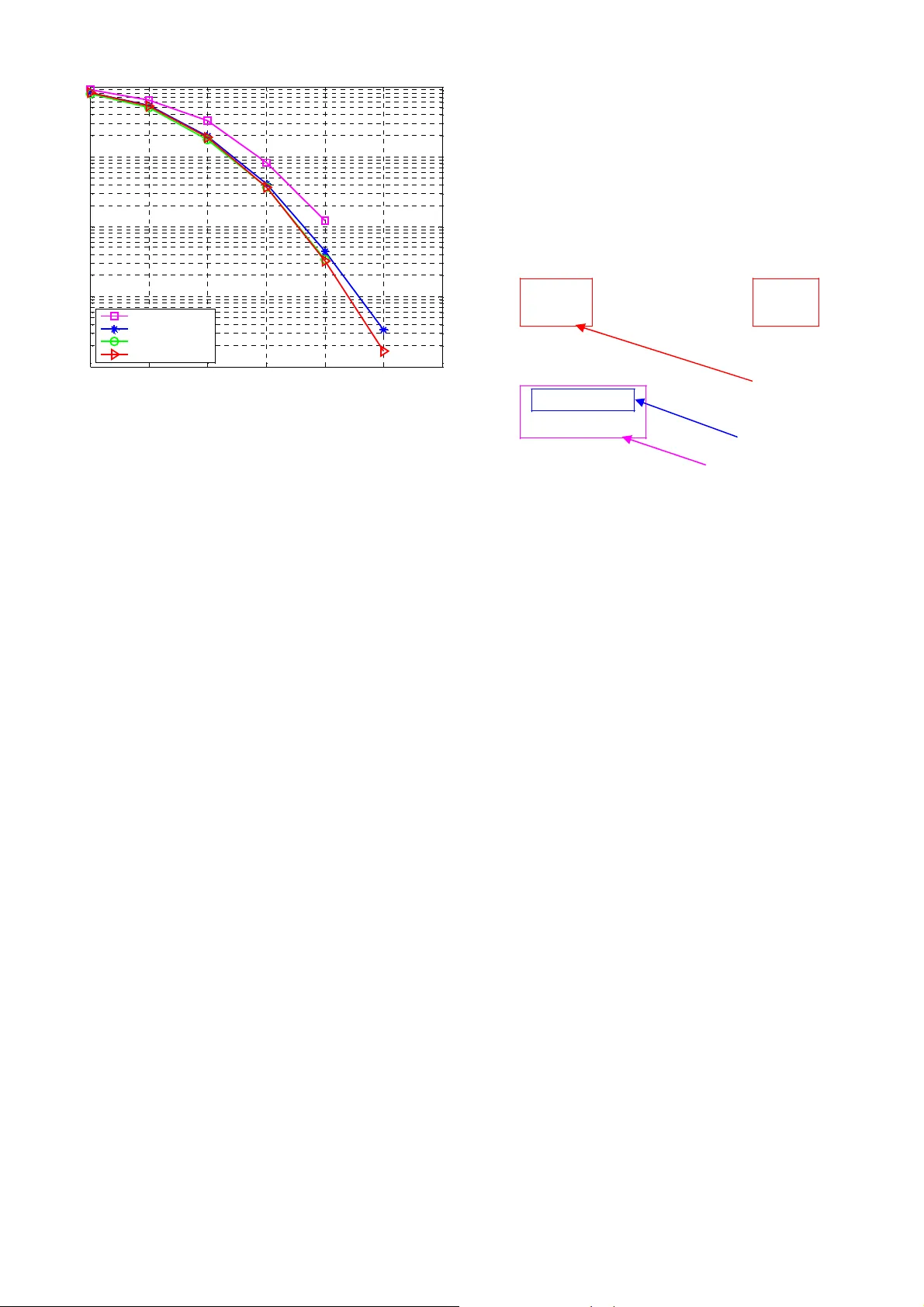
Comparative Study of Open-loop Transmit Diversit y Schem es for Four Tra nsmit Antennas in Coded OF DM S y stems C hau Yu en, Ya n Wu , a nd S ume i Su n In sti tu te for In focom m Resea r ch (I 2 R), S in gap ore { c yu e n , wu ya n , s un s m } @ i 2r . a - s t ar . e d u. s g Abst ract: W e co mpare four o pen-lo op transmi t div ersity schem es i n a cod ed Or th ogon al F r equ enc y Di vi si on Mu lt iple x ing (OF DM) sy stem w ith fo ur tra nsm it an ten nas , na me ly c ycli c de lay div ersi ty (CDD) , Space- Time Block Code ( STBC, Ala mo uti code is used) wi th CD D , Q uasi-O rthog o n al STBC (QO -STBC) and Mi n i mum- Decoding - Co mplexity QOST B C ( MDC -QOSTBC ) . W e s ho w that in a co ded syst em wit h low co de rate , a s cheme w ith sp atial transm it d ivers it y o f seco nd ord er can ach ieve simil ar perfo rm an ce to th at w ith spa tial tran smi t div ers ity of fo urth order due to the additiona l di v er s ity prov ided by the phas e sh i f t divers ity w ith chan nel coding . In add itio n, we al so co mpare t he decoding com pl e xity and o the r feature s of the abo ve four men ti o ned schem es, such as the req uirem ent for th e tra ini ng signal s, hybrid au tom atic re transm i s sion req ues t (HARQ ), etc. The discuss i o ns i n this paper can be re ad ily applied t o fut u re wire less com munica tion sy stem s, su ch as mo bile systems bey ond 3G, IEEE 802 . 11 wirel e s s LAN, or IEEE 802. 16 WiMA X, that e mpl oy mor e t h an two t r ans mit a nt en nas a nd O FDM. Keyw ords: ope n loop tr an sm it diver si t y , cod ed O FDM . I. I NTRODUCTION We consider a mult ipl e -input mu ltiple-output (MIMO) sy ste m w ith f our tra n s mit a nte nnas a t the b ase s tation . Sinc e th e wir eless chan n e l s exper ien ce fad in g, tran smit di vers ity play s an impor tant role . In this pape r, w e compa re fo ur simp le transmit div ersity schemes in a co ded Ort h o gonal F r eque ncy Divisi o n Multipl exing (OFDM) system. The first s cheme is cy clic delay dive r s ity (CDD ) [1], als o know n as c y c lic shif t div ersity C SD. S ince it ca n b e trea ted as phase div ersit y in f r eque n c y d o ma i n, i t does n o t p r o vide a ny sp atial d ive rsity , a n d relie s muc h o n t he cap ab ility of the ch ann el cod ing. Th e secon d sch eme i s th e com bina ti o n of Spa ce-T im e Block C o d e ( STBC) w i th CD D [2]. We use t h e rate -1 o rtho go n al S TBC, name ly Alamo uti STB C, w hic h is o r igi nal ly de signed f or tw o tra nsm it a ntenn as, a nd c omb ine it w it h CDD to suppo r t f our tra n sm it ant e nnas. I n this c a s e, it ca n pr ovi de a sp at i al di ver si t y of t wo a n d yet a ch i eve max imum- likel iho od d ete ctio n (ML D) w it h line ar c omp lexi ty . As n o or thog ona l d esign can a c h i eve ful l ra te wh en th er e ar e four tr an smit an t e n na s, we con si der two r at e-1 n on- or th og on al ST BCs t ha t can pr ovi d e sp ati al tr an smi t d ive r sit y of lev el fou r , they ar e Quas i-O rtho go n al S TBC (QO- STB C) [3] and M inimum-D eco din g-Co m ple xity QO-STB C (MDC- QOST BC) [ 4]. Th ese ST B C s a r e select ed a s th e y a re “q ua si- o r t hogo n a l” and hence h av e a lo wer de cod in g co mplex ity th a n oth er S TBC sch em es for four tr an smit an t e nn a s . Th e MLD deco din g sea r c h space for the above me n tio n e d schemes is gi ven i n Ta bl e 1. As show n i n Tab le 1, fo r a c onste llatio n of size- M , an or th og on al des ign on ly r eq uir es a se ar ch sp a ce of sq r t( M ), whil e QO-STBC r equires a sear c h space o f M 2 and MD C- QOSTBC r equir e s a sear ch space o f M . Al th ou gh MDC - QO STB C has a s lig htly highe r co mple xity than t he o r t hogo nal de sign, b ut su ch comp lexity is still m anage ab le in prac tic al s y st em. An d thi s i s th e advan ta ge of MDC -QOST BC over QO-STBC. Tabl e 1 ML D searc h space fo r QO -STB C an d MD C-Q OSTB C De codi ng s ear ch s pace QO- STBC MDC - QOSTBC Ala mou t i, CDD or A lam ou ti+CD D QPSK 16 4 2 16QA M 256 16 4 M points M 2 M sqr t ( M ) In the rest o f the p aper, w e w ill f ir s t disc uss th e so ft deci sion dec odi ng of MDC -QOST BC in a coded syst em. We th en compar e th e decodi n g per form an ce of t h e four tran smi t diver sity sc h emes in a coded OFDM system, and d i sc u ss o n th e feat ures an d m e ri ts of th e sch em es r esp ecti vely. II. MDC-QO ST B C IN C ODED S YSTEM Th e coded p erf orman ce o f QO-ST BC in an OFDM s y st em h as been r epor ted in [5] [6]. However , th e cod ed per for man ce of MDC -QOS TBC h as yet been r epor t ed in th e lite ratu re. C ons ide r the MD C-QO STB C as s h o wn b elow : 1234 ** ** 21 4 3 3412 ** ** 43 21 x xxx x xx x x xx x x xx x C −− = −− ( 1 ) wher e RR 11 3 , x cj c =+ RR 22 4 , x cj c =+ II 31 3 , x cj c =− + II 42 4 x cj c =− + , a n d RI ii i cc j c =+ (1 ≤ i ≤ 4) ar e the tra n s mitte d dat a sy mbo ls, w h ile c i R and c i I ar e th e r eal an d imag ina ry parts of a c omple x sy mbo l. Th e r eceived si gn al s can be wri tten as: eq r= C h + n =H c + n ( 2 ) wher e H eq is the equiv alent cha nn e l as desc r ib ed in [10], and c is the r eal- v a lu ed tran smit ted signa l, i. e., T RIRIRI RI 11 22 33 44 cc cc cc c c c = . By apply in g the li nea r matc h e d f ilter H eq * a nd w hi te ni ng f ilter H w to (2) as de scrib ed in [9], w e get: * ** we q we q we q fi na l HH r =H H H c + H H n =H c + n ( 3 ) wher e n is w hite nois e. It can be easi ly sho wn th at H fi nal i s a bl ock di ag ona l ma tr i x, w it h fo ur 2-by -2 sub mat ric es. That is , th e four tran s m i tted sy mbols ar e separated into four orthogo na l g r o ups, eac h of th em can be decod ed i n depen dent ly. We ca n r epr esent the fir st group as follo ws: R 11 1 1 2 1 1 I 22 1 2 2 2 1 yh h c v yh h v c =+ ⇒ =+ yH c v (4) wher e v 1 and v 2 ar e AG WN n oise, an d y 1 an d y 2 ar e th e output of the matc hed a n d wh ite n i ng f ilte r . S o t he ML D c an b e perfo r med s y mbol-by-sy m bo l independently . Let’ s as sum e that each of th e symb o l s i s QPSK, h e n ce th e r eal and ima ginar y pa r t can o n l y be t h e val ue of 1 or -1 . The log -like liho o d ratio fo r data bit b 1 can be compu ted a s: () () () () () ( ) () ( ) RR R 11 1 1 RR R 11 1 RI RI 11 11 RI RI 11 11 1| | 1 ( 1 ) log log 1| | 1 ( 1 ) |1 , 1 |1 , 1 log |1 , 1 | 1 , 1 pc p c p c b pc p c p c pc c pc c pc c pc c == = == =− =− =− == + == − = =− = + =− =− yy yy yy yy (5) if w e ass ume e qual a priori pro bab ility fo r bits R 1 1 c = , and R 1 1 c =− . Like w ise th e sof t de cis i o n met ric f o r the s ec o n d b it can be compu ted a ccor din gly . III. S IMULATION R ESULTS In thi s sect ion , w e p res ent our per for mance e val ua tion resu lts o f the fo ur tra nsmit d ive r s ity sc h e mes . We conside r a MIM O system wi th four tran smi t and two r eceive a n tennas . For err or co n tr o l codi ng, we empl oy th e t urbo c o d es fr om t h e U MTS standard w ith f ee d fo r w ar d po l y n o mi a l 1+ D + D 3 , a n d feed back pol y n omi al 1+ D 2 + D 3 . I n f ormatio n co de b lock length is 594 bits f or r a te-1/2 and 1056 b its fo r rate-8/9 . F or deco din g, M ax-Lo g-Map with 8 ite rati o n s i s impleme nt e d. W e use t h e TU6 ch ann el an d assu me that th e c h ann el i s spat ially- un corr ela ted an d perfect l y kn own at the r ecei ver. Th e cycl ic delay values are [0 64 128 192] respe ctively fo r e ach o f the tr an s m it an tenn as for CDD sc h emes . Th e r e ar e 512 su bcarr ier s pe r O FDM sy mbo l. We w ill co mpare th e fo llow in g f our tra n s mit d iv ersity sc h e mes , all fo r f o ur t ra n s mit ante nnas : - CDD - Alam o u t i + CDD - QO-STBC - MD C-QOSTBC For th e decodi ng , LM MSE r eceiver is u sed with QO S T BC whi le MLD f or the r est of th e schem e. -2 0 2 4 6 8 10 10 -4 10 -3 10 -2 10 -1 10 0 SN R ( d B) FE R c oded CS D QO-ST BC LMMS E A lamout i + CS D MD C- Q OST BC ML D Figure 1 Simulate d FER f or 4tx- 2rx, QPSK with t u rbo c ode rate- 8/9 -4 -3 -2 -1 0 1 2 10 -4 10 -3 10 -2 10 -1 10 0 SN R (d B ) FE R c o ded CSD QO- S T BC L MMSE A lamouti + CS D M DC -QOS T B C MLD Figure 2 Simulate d FER f or 4tx- 2rx, QPSK with t u rbo c ode rate- 1/2 Th e simu lat ions r esul ts wi th four tran sm it and t w o r ecei ve ante nn as sy stem w ith QPS K mo dulatio n are s h o w n in Fi gur e 1 for rate-8/9 and Fi gur e 2 f o r rate /1/2 tu r b o co de, re spe ctiv ely . Ob serv ations c an b e s umma rize d as f ollow s: • MDC- QOSTBC and Alam o ut i+CDD outperform CDD by at least 0. 5 dB (at co ded FER 10 -1 or bel ow) in a ll cas es. Th e ga p with C DD i s l ar ge r w h en the cod e rat e is hi gh, as CDD main l y obt ain th e diver sit y from the ch ann el codi ng, h ence wh en th e co d e r ate i s h i g h (e. g . fo r the data c h a nnel) , CD D w ill pe r f orm p oo rly . • MD C-QO STBC p er f or m s th e b es t w h en th e code r at e is hig h. T his is ma i n ly bec aus e MDC- QOS TBC ob tains mo st of the t rans mit div e r s ity f rom its c o de s tr uc tu r e in stea d of fr om th e ch ann el codin g. • MDC -QOS TBC w ith MLD has a b ette r perf ormanc e tha n QO -STB C with L MMS E. T h e low searc h spac e fe ature of MD C-QO STB C mak es M LD po ssib le, and t his is t h e a dvan t ag e over QO -S TBC . • Tho ugh it is not s h o wn i n t he f igu r e , MD C-QO STB C h as th e sam e per for man ce as QO -ST B C wh en LM MSE i s used [9]. To su mmar iz e, in term s of per form an ce, A lam o u ti+ CDD an d MDC -QOS TBC ar e th e two best s chem es. A n d M D C - QO STB C pe r fo r ms t he b es t in all s orts o f condit ions t hat we hav e s tudie d. I n t h e ne xt se ctio n, w e w ill disc uss addit ion al f eatures of MDC -QOS TBC t o make it mo r e inte resti ng f o r pr act ical usage. IV. A DDITIONAL F EATURES By rew riting t he c odew ord o f MDC- QOS TBC in (1) into (6 ), t he M DC -Q O ST B C c o ns is ts o f many o the r sc hem e s a s a specia l case, su c h as: - a ra t e-2 tr ans mit diver sit y -2 cod e f or f our tr an s m it antennas DS TTD [8] - a rate- 4 spat ial mu lt iplexi ng SM for f ou r tr an smit antennas [1] - a rate- 2 fu ll tra nsmit div ersity cod e for tw o tr a nsmi t antennas XTD [7] II RR 2 ** ** 2 4 RR II 241 3 RR I I 13 2 4 II II RR RR 13 24 1 3 2 4 II I I R R R R 2 4 1 3 24 13 3412 ** * 43 1 1234 13 II RR 13 2 2 43 4 cj c cj c cj c c j c c j c c j c cj ccj c c jc c jc c j c c jc xx xx x x cj x xxx c xx cj c cj c cc x j xx C + −+ −+ = − − +− + + + +− − − + − = − −+ + − − − − − + * 1 x (6) This f eatu r e ca n be usef ul i n H AR Q [8] and may lead to si mpli fied recei ver des ign . F irs t of al l, in ord er to ach ieve ma xim um thr ough put, th e system can u se SM s che me by tr an s m itt ing th e fir st r o w of C . If such tr a n smissi o n l eads to de tec tion er r o r, the 2 nd row of C c an b e tra n s mitte d, a nd t h e r eceiver ca n th en co m bin e t his recei ved sig nal with th e on e r eceived p r eviousl y a nd decode t h em as DSTTD c ode. By do ing so , a tra nsm it div e r s ity o f lev el tw o can b e ac hiev ed. I f suc h tra nsmis sio n s till has e rro r , the 3 rd and 4 th row of C can b e transm itte d, an d this is e quiv ale n t to tr ansmi tti n g t he rate -1 MDC-QO ST B C , and th e recei ver can th en co m bin e all the r eceived s ign a ls, an d per fo r m a ML d ecodin g. This r esul ts in a tra n s missio n sc heme with trans mit di ve r s ity of level fo ur. He nce s uch H AR Q s cheme has the abil ity to in c r e ase th e t r a n s mit div ersity by low ering t h e tr ansm issi on ra te, a nd at t h e same time , m akes fu ll use of the prev ious tr a nsmis sio n rath er th an di scard th em . It can be n oti ced th a t XTD i s a specia l case for MDC- QOSTB C, which sugges t pos sible simplificatio n i n the r eceiver des ign . In ad diti on, i t al so post s an in teres tin g ar ea in ante nna se lec tio n, w hich w e le av e it f or f utu r e st udy . By pr oper l y d esi gn ing th e r efer en ce sign a ling, CDD an d Al am outi+ CDD can appear t o be tr an s p aren t to th e recei ver , i. e. the r ecei ver s ees a sin g le st r eam or Alam out i tran smi ssion w ithout k now in g e xiste nce o f CD D. Unf ortu n a tely , such f eature is not avail ab le f o r M DC-Q OSTB C. A s ummary on the c ompar iso n s of CD D, Alamo uti+CDD and MD C-QOSTBC is s h o wn in T a b le 2. SM D-S TTD XTD Ta ble 2 Compa rison bt w di ffere nt trans mit dive rsit y s cheme s CDD Al a mou t i + CDD MDC - QOSTBC Dec oding perf ormanc e X √ √ Tr ans par ent to th e rece i ver ( de pen din g on t he re f. si gn al ) √ √ X No t sen sit ive to c o de rates a nd channel mu l t ipath c onditio n X X √ Oth e r s: • P art o f th e H AR Q s che me a s descri bed in [ 8]. • I n cl u de othe r ST BC, e .g. XTD as a sp eci al cas e. X X √ V. C ONCLUSION We fir st pres ent the d eco d in g of MDC -QOS TBC i n a cod ed s ystem . We sh ow th at in a coded OF DM s y s tem , a tra n s mit div ersi ty scheme w ith only spatia l tr ans mit div ersi ty of lev el two can perf orm as w ell as a s cheme w ith spa tial tra n s mit div e r s ity of lev el fo ur . T his is due to t he add itio nal dive r sity provide d by th e c h annel co ding. He n ce w h e n the ch ann el codi ng i s str o n g (for exa mple for th e case of c o n t rol ch ann el), Alam o u ti w i th CD D seems to be th e best ca n di d a tes; whi le wh en th e chan n e l codin g i s weak (for exa mp le for t he cas e of da ta chan n el), MDC-Q S T BC seem s to be th e best can di dates . In a ddi tion, CDD s cheme h as th e ad vanta ge of bein g tr an spar ent to t he r ecei ver b y pr oper ly des ign t h e r eferen ce si gna l (i. e. pil ot), MDC- QOST BC h as th e advan tage of be pa r t of an in t e r e st in g h ybr i d ARQ . R EFERENC ES [1] S. Kais er, ‘ ‘Spa tial t ra n s mit div ers ity tec h ni ques fo r broadb an d OFD M sy stems,’’ in IEEE G loba l TeleCommuni cations Conferen ce , vo l . 3, pp. 1824--1828 , Nov . 2000 [2] E TRI, “Combin ed STBC/C DD transmissi o n sch eme f or multiple a ntennas”, R1-060438 , 3G PP LTE , Feb 2006. [3] H. Jaf ar kha n i , “ A quasi-o r thogo nal space -time b lock cod e”, IEEE Trans . on Communi c a tions, v ol. 49, pp. 1-4, Jan. 2001 . [4] C. Yuen, Y. L. Gu an , and T. T. T j h ung, “ Qu asi- o r t hogo nal S TBC w ith m inimu m dec od in g c o mplexity ”, IEEE Trans. Wirele ss Comms . , v ol. 4, Se pt. 2005, pp. 2089 – 20 94. [5] C. K. Su n g , J. K im, and I . L ee, “Q uasi-orth o gonal S TBC w ith iter ative deco din g in bit i nte rleav ed coded modulatio n”, IEEE VTC 2004 , p p. 1323 -1327. [6] J. Ki m a nd I. Le e, “ Spac e-time co de d OF DM sy stems w ith fo ur tra nsmit a nte nn as ”, IEEE VT C 2004 , pp. 2434 - 2438. [7] LG E lect r onics , “Hig h-r at e STC f or open -l oop MIM O w it h 2tx ante nn as ”, R1-060967 , 3GPP L TE , Marc h 2006. [8] Nor tel, “QO-ST FB C / Do u b l e-STTD based H-A R Q f o r four tra n sm it antennas” , R 1-060149, 3 GPP LTE , J an 2006. [9] C. Yue n; Y. L . Gu an; T. T. Tj hung , "De co din g Of Quas i- Ortho go nal Spac e- Time Blo ck C o de W ith N ois e Wh iten ing ", IE EE PI M R C , B eijin g , China, Se pt 2 003. Vo lum e 3, pp. 2 166 – 2 170. [10] B . H assib i and B. M . H ochw ald, “H igh-rate co des that ar e lin ear in spa ce an d tim e”, I EEE Trans. o n Infor mat ion Theor y , vo l. 48, pp. 1804 –18 24, Jul. 2002.
Original Paper
Loading high-quality paper...
Comments & Academic Discussion
Loading comments...
Leave a Comment