Comparative Study of SVD and QRS in Closed-Loop Beamforming Systems
We compare two closed-loop beamforming algorithms, one based on singular value decomposition (SVD) and the other based on equal diagonal QR decomposition (QRS). SVD has the advantage of parallelizing the MIMO channel, but each of the sub-channels has…
Authors: Chau Yuen, Sumei Sun, Jian-Kang Zhang
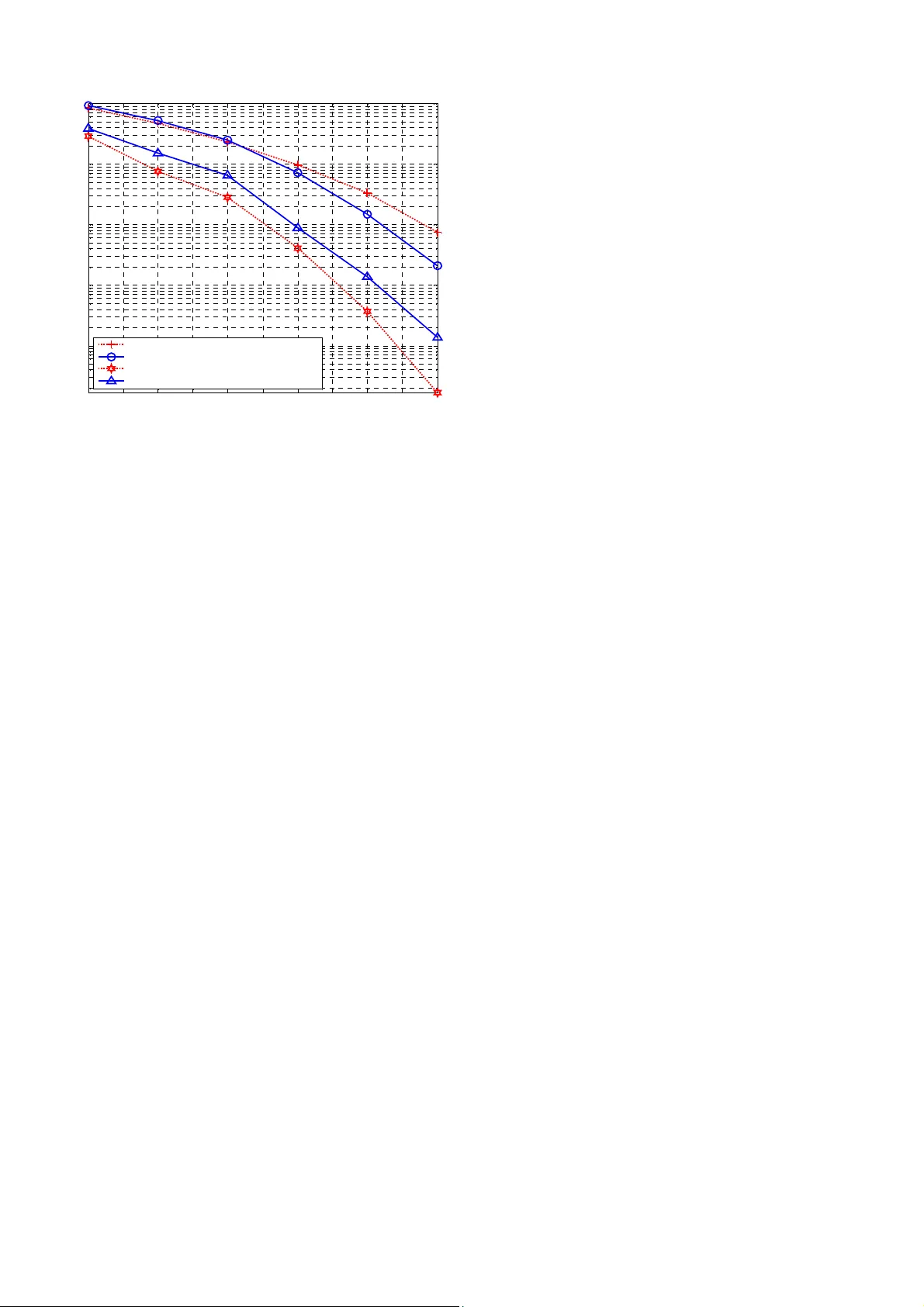
1-4244- 1513-06 /07/$ 25.00 ©200 7 IEE E 1 of 4 COMPARATIVE STUDY OF SVD AND QRS IN CLOSED-L OOP BEAMFORMING SYSTE MS Ch au Y ue n , Sume i Sun Ji an- Kan g Zh ang In sti tute fo r In fo com m Re se arch (I 2 R), Sing a po r e McMaste r Un ive rs ity , Canad a {c y u en , sun sm }@i 2r.a-s ta r.e du .sg jk zhan g @m a il . e ce . mcm aste r.ca Abstract: We co mpa r e two clos ed -lo op b ea m f or min g algo rithms, one based on sing u lar val u e decom p osition (S V D) and the other based on equal diagon al QR decom position ( QRS). S V D has the adv antage of par alle lizing the MIMO ch annel, but ea c h of th e su b - c ha nn e ls ha s di f f er ent ga i n. QR S ha s the advantage o f having eq ual di agonal v a lue fo r the decom p osed ch a nnel, but the subc hannel s ar e no t fully pa ra ll eliz ed, h e nc e r e quir i n g s u cc ess i v e i nt er f er enc e can cellation or othe r techniq ues to p erform decoding . We co ns ider a cl os ed-l oop s yst em wh er e th e f eedbac k i nf or ma t ion is a un it a r y b ea mf or min g mat r ix . Du e t o the discrete and limi t ed mod u lation se t, SVD m a y ha v e i nf er i or p er f or ma nc e t o Q R S wh e n n o mo dulation set sele ct ion i s p erfo r me d . Howeve r, if the sele ction of mod u lation set i s pe rf o r med optim a lly, we sho w th at SV D can o utp e rform QRS. Keywords: c losed -loop beam for ming , singular value decom p osition , equal diagon al decom p osition , geom etry m e a n dec om p osition . I. I NTRODUCTIO N W e c o nsi d er a mult ip l e-t r a ns mit a n d mu lt ip l e- re ceiv e an ten n as w i rele ss co mm unic atio n s sys tem (deno t ed as MIMO). Such syst em is well-known f or ach ieving a highe r capa ci ty t han tradition a l single - tran s m it single -r e ceive an t enn a system s [1]. It has been ado pted in m a ny wirele ss c omm unication stand ar ds, w hich incl u de IEEE 802.11n fo r wi r eless loc al area ne twork (LA N) applic ation , 3GPP Long T er m E v olu t i on (L T E) for ce l lu la r c ommu n ic a t i o ns . De pending on the channel condi tion, the f irst gene r ation MIMO techniq u e aims at achieving a hi gh er da t a ra t e, s uc h a s s p a t ia l mu lt ip l ex i n g [2 ], or a high e r diversity , such as space- t ime codi ng [3]. These te chnique s do no t req u ire the knowledge of ch a nnel state in f o r m ation ( CSI) at th e tr ansm i tt e r. Due to t h e a dvanc ement i n t he c o mmun icat io n te chnique , limi t ed f eedback inform ation i s possi ble in the future wirele ss c omm unication s sy st em . It has been s hown in [ 4] t hat the feed ba ck of info r m ation on t h e CS I c a n gr ea t l y i mp r o v e t h e s ys t em p er f or ma nc e. In addition , closed-loop be a mfo r ming can a lso achie v e lowe r decoding comple x ity, as we will s how in the paper. A strai gh tfo rw ard be a m form ing algo ri th m is based on singular value dec omposition (SVD) t hat fully diagon alizes the channel. Howeve r, e ach of th e paralle l sub- channel s has di ffe r ent g a in. In o r de r to achiev e b ett er p erf or mance, d iffer ent modu la tion ca n be applied to diffe r en t stream of d ata, but th is req uir e s addi tion al feedback in f orm ation. Un fortun at ely , this solu t i o n is not op t i mal as th e modu la t i ons a r e “ dis cr et e” ( i. e. mo du la t io n s iz e is i n t h e f or m of p ow er of t w o). Moreove r, assigning the “a ppropriate” mo dul ation fo r e ach of the data stre a m in re al time is al so a ch alle ngin g task . In t his pape r, we conside r a no t her b e a m for ming algo rit hm bas ed on equal-diagonal Q R decom position (QRS) from [5] (also known a s geometry mean deco mposition , GMD, in [6]). Unlike S VD, QRS does no t fully diagonalize t he channel, but conve rts th e eq u ivalen t channel in t o an upper trian g ular matrix. C o mpa r e d wit h S VD, Q R S ha s t he a d va nt a g e of h aving eq ua l di agonal e lem ents for its eq u ivalen t ch a nne l. Thi s im plies th a t the sa me mod ulation ca n be applie d to all the data stream s. H ence it elimin a t e s the trouble of assignin g dif ferent mod u lation for di ffe r ent s t r ea m of da t a . It h as b een shown in [7] t hat by using a simple an d ef fi cie n t clo sed -loo p fe ed back , the pe rfo rm an ce of the MIMO- OFDM system f or wi rele ss L AN can b e g r eatl y improved . The e xtra cost is sim ply f ed back the un itary precode rs fr om S VD or QRS. Howeve r , no compa r ison b etween the S VD a nd QRS b e a m for ming al go rithm s can be fo und in t he li te ratu re . In t h i s pa pe r, we will provide a comparat ive study on SVD and QRS, w ith an d wi thout mo du lation set sele ct ion . The organization of this paper i s as follow s: w e fir s t int r o du c e t h e S VD a n d Q R S d ec o mp os it i on i n se ct i o n II , t h e de c o mp os it i o n w h en t h e nu mb er o f stre am s i s le ss th an the num be r o f tran smi t and re ce ive antenn a s for QRS scheme will al s o be di scussed. Ne xt, we w ill pe rfor m simul ation to com par e the two decom p osition sc heme s in Sec t ion I II. I n the first co mp a r is o n, we do n ot p er for m modu la t i o n s et sele ction , wh ile in the s e cond com parison , we perform 2 of 4 mod u lation s e t sele ction . We show t hat wi thout mod u lation s e t sele ction , beamfo r mi ng system bas ed on QRS can o utp erfo r m t he one based on SV D, a nd vice ve rsa if with mo dul ation se t s ele ction . Finally w e concl u de the pape r in Section IV. II. SVD AND QR S D ECOM POSITION Co nside r a poin t-to-point MI MO sy stem with M tran sm it and N re ceive ante nn as. Th e N –by–1 r eceive sign a l y can be modele d as foll ows: y= H x + n (1) w h er e H is th e N –by– M cha nn el co eff ici ent a nd x is the M –by–1 transmi t t ed s ignal with n being the A WGN noise. In this paper, we conside r Ra yleigh fading channel , so H c o ns is t s of z er o- mea n c o mp l e x Gaussian random variable s. To ach ie ve a b e tt e r de codin g pe rform ance and lowe r decoding com plexity, be a m for ming can be applied . We f irst de c ompose the channel m atrix H by SVD or QRS as follows: * * SVD: QRS : H = UDV H= Q R S (2) w h er e U , V , Q , S ar e all u n it a r y mat r ic es, D is a diagon al m atr ix with singular val u e s a s its eleme nts, while R is an uppe r tr ian g ular m atr ix w ith identic al diagon al ele me nts. Supe rscript * deno t e s con j u gate tran spose . T h e D and R are both of dime nsion N -by- M , and t h e r a nk, d , is li mit ed b y t he mi n i mu m nu mb er of M a nd N, i. e. () min , dM N ≤ (3) and for SVD, the diagonal m atrix D co ns is t s of t h e sing u lar value s of the channel: () 12 , , .. ., , 0, 0 d dia g δδ δ = D (4) w h er e δ 1 , δ 2 , … δ d are the singular v alues. W hile for QRS, the diagon al value, r , in R is t h e geomet r ic mea n of t h e s i ngu la r va lu e: () 1/ , 1 d k rk d δ =≤ ≤ ∏ (5) We con side r the clo sed-loop be a m forming system whe r e only a uni tar y m a trix, i.e . V in SVD and S in QR S , a nd t h e s e l ec t i o n of t h e mo du la t i on s et ca n b e fed back from t he re c eive r to the tr ansm i tt e r. A) SVD Beamform ing First c o ns ide r SVD beam forming , the transm i tt ed sig na l is : x=V u (6) w h er e V is t h e u nit a r y b ea mf or mi n g ma t r ix ob t a in e d fr om S VD d ec o mp os it i o n, a nd u is the intended d ata si gn al . The re cei ve r of the S V D be a m fo rm in g sy stem c an pe rfo r m th e fo llo wi ng : () =+ ** * * U y = U UDV Vu + U n Du n (7) Wh er e t h e n o i s e n is s t il l AGW N a s U is u nit a r y. Hence simple decoding can be ac h ieved , as D is a diagon al m a trix. Howeve r , each o f the sub-ch a nnel ha s a dif f er e nt ga i n i n t h is c a s e, a s t he d ia g o na l va lu e of D is r ela t e d t o t h e ei g en va lu e of t h e cha nn e l mat r ix H . As a re sult, to achie ve optim a l pe rform a nce , dif ferent d ata stre a m s sho uld use a diffe r en t modu la t i on, h ow e ver t h is w ou l d r equ ir e ext r a feed ba ck inform ation, i .e., in formatio n on D needs to be fed back to the transm itte r on to p o f V . Wh e n t h er e a r e f e w er nu mb er o f da t a st r ea ms t ha n th e max i mu m al l o wa b l e, i. e. th e mi n i mu m nu mb er of tr an sm it and rece iv e ante nn as, we can pe rf o rm the SVD de composi t ion based on the first few principle eigenve ctors. Fo r exam ple , in a fo ur tra nsm i t four re ceiv e an tenn a sy stem , i f we are only r eq ui red t o tran sm it n stream s, whe r e n < d , we can perfo rm SV D with V n , w h er e V n con s ists o f the first n pr in ic ip l e eigvenve cto rs of H . B) QRS Beamf orming N ext c o ns i d er Q R S b ea mf or mi n g, s i mi la r ly t h e t ra ns mitt ed s i g na l is : x=S u (8) w h er e S is t he u n it a r y b ea mf or mi n g mat r ix obt a in e d fr om QR S d ec omp os it i o n, a nd u i s th e in te n d e d d at a s i g na l . T h e r ec e i v er of t h e Q R S b ea mf o r mi n g s ys t e m c an pe rfo r m th e fo llo wi ng : () =+ ** * * Qy = Q Q R S S u + Q n Ru n (9) Si n ce R is a n u p p er t r ia ngu la r mat r ix, su c cess i v e in t e rf e rence c anc ell ation (SIC) o r othe r a lgorithm ca n be perfo r med at the receive r t o decode data. The adv antage of QRS is th e diagonal elem ents o f R are iden tical; thi s im p lies th a t we ca n apply t he same mo dulation to all the data stre a m s. When we only need to tr a ns mit n stre a m s, whe r e 3 of 4 n < d , we ca n p er for m t h e Q R S de c o mp os it i o n b a s e d on the required eigen subchannels, H n , wh e r e H n is defined a s: nn = HH V (10) a nd V n consi sts of the fi rst n pr in iciple eigvenve ctors of H . III. S IMULATION R ESULTS We con side r a Ray leig h fl at fad ing u nco ded MIMO sy stem with f our transm it an d four re ceive ante nnas. In addi t i on, th r ougho ut the s imulation , it i s assu m ed th at th e chan ne l is e stim ated corre ctly , and the beamform ing m a trix is perfectly known at the t ra ns mit t er w it h out a ny d ela y. S I C w il l b e emp l oy e d fo r system with Q RS-based be a m forming. The tra ns mi ss io n is fix ed a t s pect r a l e ff ici enc y of 8 bps/Hz, w hich m a y be realized wit h two, th r ee or four da t a s tr ea ms. T he a va ila b l e mo du la t i o n s et s f or S VD a nd Q R S a r e a s fol l o ws : Modulation for SVD w ith 8bps/Hz: Two stream s: {QAM64- QPSK} Two stream s: {QA M16-QAM16} Thre e s tre am s: { QA M16 -Q PSK- QPSK } Th ree stre am s: { QAM 8- QA M8 -Q PSK} Modulation for QRS w ith 8bps /Hz: Two stream s: {QA M16-QAM16} Thre e s tre am s: { QA M16 -Q PSK- QPSK } Th ree stre am s: {QA M8 -QA M8 - QP SK } Fo ur st ream s: {QPSK - QPSK -Q PS K- QP SK} Due t o the uneven natur e on the diagon al values of t he e ff ec t ive channel on SV D, we have a two stream s u neven mod ulation QA M64-QPSK fo r SVD . In contrast, due t o the equal v alue on the diagon al val u e s of the effective ch a nnel on QRS, we h ave a fou r s t r ea ms equa l mo du la t i o n Q P S K for QR S. We com pare the BE R pe rf o rm ance in Fi g ure 1 when t he selec tion of mod ulation se t is no t allowed , i.e. same modul ation is used thro ughout the sim u latio n. For SV D, mod ulation se t with {16QA M- 16QA M} and {16QAM-QPSK-QPSK} g ive the best BE R p er for manc e. F or Q R S , modu la t i o n s et w it h {16QA M-16QAM} give the b e st BER p erfo r m a nce . S o fr o m Fi gu r e 1, we ca n c o nc lu de t ha t wit hout t h e modu la t i o n s et s e l ect i on, Q R S gr ea t ly ou t p er for ms S VD a t hig h S N R r egi o n, a b ou t 1 dB a t BE R of 1 0 -3 . 4 5 6 7 8 9 10 11 12 13 14 10 -4 10 -3 10 -2 10 -1 10 0 SN R BER SVD QA M64- QPSK SVD QA M16- QAM 16 SVD QA M16- QPSK -QPSK SVD QA M8- Q AM8 - Q PSK QRS QA M1 6-QA M 1 6 QRS QA M1 6-QP S K -QP S K QRS QA M8 - QA M 8 -QP S K Q R S Q PSK-Q PSK-Q PSK- QPSK Fig ur e 1 Sim u lated BER for 4tx-4 r x at 8bps /Hz wi tho ut mod ulation s et se lec tion We the n com pare BE R pe rfo r m an ce in Fig ure 2 whe n the s elec tion of mod u lation s et i s a llow ed . The sele ction is optim a l, as the selection is pe rf orm ed “of fline” , i.e. we p ick t he mod ulation se t th at gives the be st B ER. H ence th i s se rve s as a l owe r bo und for t he actual B ER perfo r m a nce wi t h “online ” mod u latio n set sele ction . F r o m F i g u r e 2 , w e o b s e r v e t h a t b y a l l o w i n g t h e sele ction of mod u lati on se t, SV D give s a bette r ove rall pe rfo rm an ce , abo ut 1d B at B ER o f 10 -3 . The gap be tween the sele ction of mod u lati on s e t versus the fi xed single mod ulation se t {Q AM16- QAM16} i s 4. 5 dB f or S VD a t BE R 10 -3 , while t he gap is 2.5d B fo r QRS at BER 10 -3 . T h is sug gests th a t the p e rfor m a nce o f SVD relie s heavily on the sele ction of the modu la t i on s et , w hic h r e qu ir es a dd it i o na l f ee db a c k in for m a tion . In addition , it stil l r em a ins un c le ar on th e o ptim a l w ay to selec t mod ulation se t in a pra cti cal MIMO O FDM syste m when i t involve s a large nu mb er of s u b -c a r r ier s . T he ga i n t ha t is d emo ns t r a t e d in Fig ur e 2 i s based on o ptim a l sele ct ion, the actual g ain would be r educed due t o non-o pt im a l s ele ction a nd d ela y i n f e edb a c k. 4 of 4 4 5 6 7 8 9 10 11 12 13 14 10 -5 10 -4 10 -3 10 -2 10 -1 SN R BER S V D QA M1 6-Q A M16 (repe at f rom p reviuos f igu re) QRS Q A M 16 -Q AM 16 ( repe at fro m pr eviuos figure ) S V D s ele c t in g t h e be s t mo dul at i o n s et QRS s el e c t i n g t he bes t mo dul at i o n s e t Fig ur e 2 Sim u lated BER for 4tx-4 r x at 8bps /Hz wi th mo dul ation se t s e lec t ion Fo r SVD , a te chnique called “powe r loading ” c a n hel p t o m i t igate the di sadvan tages o f disc r e t e modu la t i on, b ut it r equ ir es a ddit i o na l c o mpu t a t i o na l comp l exity a nd feedba c k over hea d. IV. C O NCLUSION W e ha v e s h ow n t ha t c l os ed- l oop M I M O s ys t e m with E qual-Diagon al QR decom pos ition (QRS ) m a y ou tp e rform the one based on SVD decom p osition . T his is du e t o fa ct t ha t t h er e is o n l y a l i mit e d c h oi c e o f modu la t i on s et s , a nd t h e a va ila b l e mo du la t io n s ets a r e disc rete , hence ge tt ing the optim a l m od u lation s e t m a tched to the ch annel gain provided by S V D m a y not be alway s p ossi ble. Howeve r , when the sele ct ion of mo du la t i o n s et is a l l o w ed, S VD ma y a c hi e v e a be tter pe rf orm ance . We f urther show th at the pe rfor m a nce of SV D r elie s he avily on the selec tion of the appropriate m odulati on s e t. In [8], pse u do-inve rs e i s pr oposed to achieve b ette r decoding p erforman ce . It would b e interesting t o look a t t he c ha n n e l dec o mp os it i o n of t h e equ i va l ent pse udo-i nve rse channel, for bo t h SV D and QRS. The coded pe rform anc e of thes e t wo s ystem s will be an in t e re stin g to pic fo r fu tu re wo rk. R EF ERENCES [1] E. Te l atar , “C ap ac i ty of m ul ti -a n ten n a Gauss i an cha nnels ”, European T ransactions on Teleco mmunications, v ol. 10, pp. 585-595, Nov./De c. 1999. [2] A . Paulraj and T . Kailath , “Inc re asing c apacity in wirele ss br o adcast system s using distributed tran s m ission/di r ec tion al reception (DTDR)”, Tech. Rep. U.S . Pate nt #5345599 , Sept 1994. [3] V. T ar ok h, N . S es ha dr i, a nd A. R . C a ld er b a nk, “Space -time code s fo r high data rate wirele ss co m mu n ica t i o ns : P er for manc e c r it er i o n a n d c o d e concstructi on ”, IEEE T rans. Information Theory , vol. 44, n o. 2, pp. 744-765, May 1998. [4] D. J. L ov e, R . W. H ea t h J r . , W. Sa nt ip a c h, a nd M . L. Ho ni g, “ Wha t is t he Va lu e o f L i mit ed Feedba c k f or M IMO C han nels ?, ” IEEE Communications Magazi ne , vol . 42, pp. 54-59, Oct. 2004. [5] J -K . Z ha ng, A. Ka vc i c, a nd K . M . W on g, “ E qu a l- diagon al qr decompo s ition and its appli cation to precode r design fo r successive-cancell ation de tection ”, IEEE Trans. on Information Theory , vol. 51, J a n 2005, pp. 154-172 . [6] Y. J ia n g, J . L i, a nd W. W. Ha ger , “ J oi nt transce iver design for MIMO c ommunic ation s using geometri c me an de com position” , IEEE Trans. on Signal P rocessing , vol. 53, Oc t 2005 , pp. 3791-3803. [7] X. Zh e n g, Y. Ji a n g, a n d J . L i, "Ef f ic i e nt C l os e d - Loo p Schem es for MIMO W LA N", Thirty-N inth Asilomar Confe rence on Signals , Sys tems and Computers , pp .: 1603- 1607 , 2005. [8] S . Su n , Y . D ai , Z . L e i , H . K en i ch i , an d H . K aw a i , "Pse u do-Inve rs e MMSE Based QRD-M Algorithm for MIMO OFDM", IEEE Vehicular Technology Conference - Spring , Vol: 3, pp .: 1545- 1549 , 2006.
Original Paper
Loading high-quality paper...
Comments & Academic Discussion
Loading comments...
Leave a Comment