Chromogeometry
Chromogeometry brings together Euclidean geometry (called blue) and two relativistic geometries (called red and green), in a surprising three-fold symmetry. We show how the red and green `Euler lines' and `nine-point circles' of a triangle interact w…
Authors: N. J. Wildberger
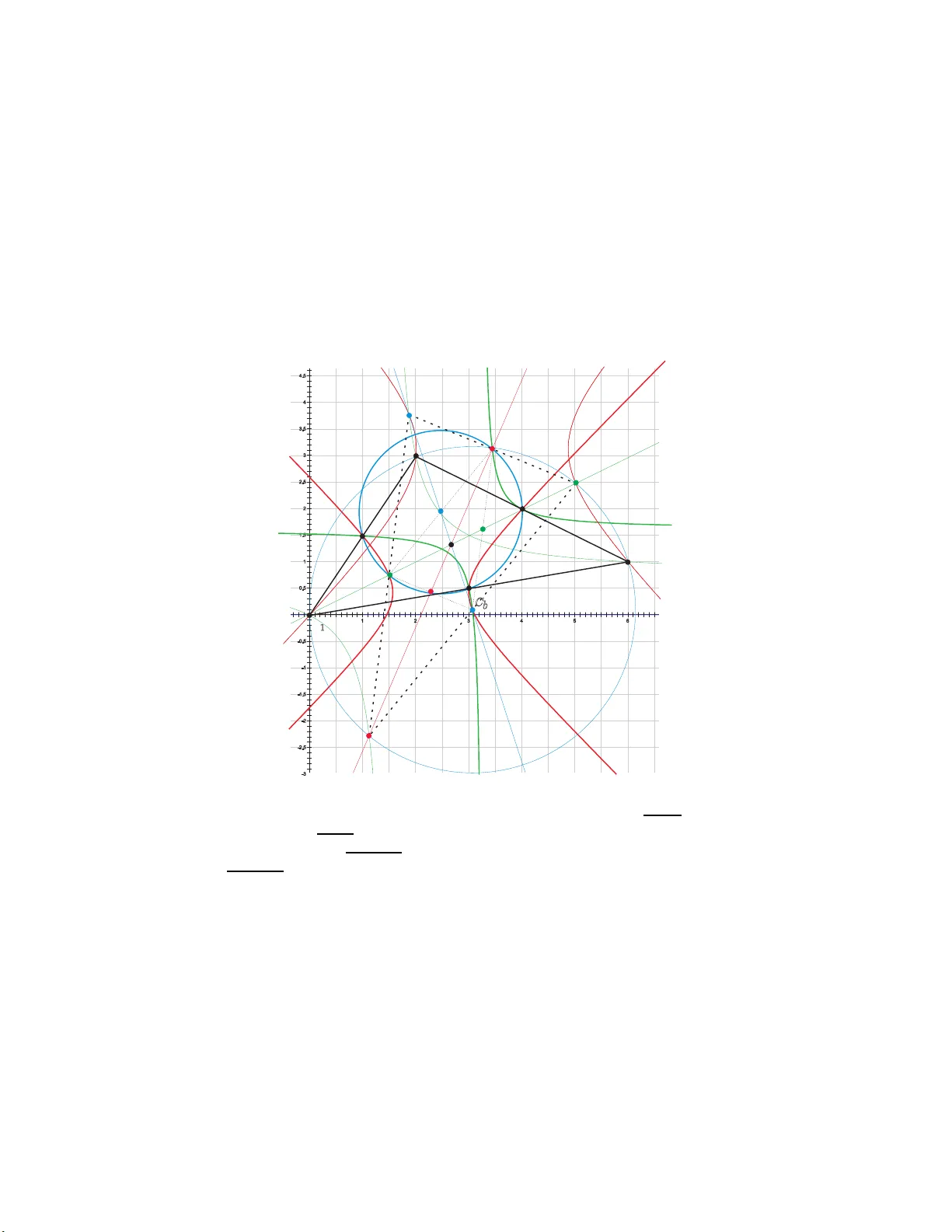
Chromogeometry N J Wildb erger Sc ho ol of Mathematics and Statistics UNSW Sydney 2052 Australia Ma y 31, 2018 Abstract Chromogeometry brings together Euclidean geometry (ca lled bl ue ) and tw o relativistic geometries (called r e d and gr e en ), in a surprising three-fold symmetry . W e sho w ho w the red and green ‘Euler lines’ and ‘nine-p oint circles’ of a t riangle in teract with the usual blu e on es, and ho w the three orthocenters form an associated triangle with in teresting collinearities. This is developed in the framew ork of rational trigonometry using quad- r anc e and spr e ad instead of distanc e and angle . The former are more suitable for relati vistic geometries. In tro duction Three-fold symmetry is a t the he a rt of a lot of interesting mathematics and ph ysics . This paper sho ws t hat it also pla ys an unexpected role in pla nar ge o m- etry , in that the familiar Euclidean geometry is only one o f a trio o f in terlo cking metrical geometrie s . W e refer to Euclidean geometry here as blue geometr y ; the other tw o g e ometries, called r e d and gr e en, are re lativistic in nature a nd a re asso ciated with the names of Lo rentz, Einstein and Minko wski. The three g eometries supp ort each other and in tera ct in a rich w ay . This transcends Klein’s Erlangen progra m, since there are now thr e e gr oups acting on a s pace. Remark able a lgebraic iden tities lie at the heart of the expla nations. The res ults des crib ed her e ar e just the tip of an ice ber g, leading to many rich gener alizations o f results of Euclidean geometr y , with mu ch waiting to b e discov ered and explor ed, see for example [4] for a pplications to conic s and [3] for connectio ns with one dimensional metr ical geometr y . The bas ic structure o f all thr e e ge o metries are the same—they are r uled by the laws of r ational trigonometry a s developed re cen tly in [1], which hold ov er a genera l field not of characteristic tw o. Although over the r ational num b ers (or the ‘real num b ers’) ther e are sig nifica n t differences b etw een the Euclidean (blue) v ersio n and the other tw o (red and green), it is the inter action of all three which yields the big gest surprises. T o start the ball r olling, this pap er first introduces the phenomenon in the context o f the c la ssical Euler line and nine-p oint cir cle of a tria ngle. Then we 1 recall t he main la ws of r ational tr igonometry , in tro duce the basic facts about the three geometries and state some explicit for m ulas, and then show ho w chromo- geometry allows us to enlarge our understanding of the g eometry of a tr iangle. In pa rticular we asso ciate to ea c h tr iangle A 1 A 2 A 3 in the Cartesian plane a second interesting triang le which we call the Ω -triangle o f A 1 A 2 A 3 . The results are v erified by ro utine but sometimes length y computation, and they inevitably r educe to algebra ic identities, s ome of which are quite lov ely . The developmen t takes plac e in the fr amework o f un iversal ge ometry , so that we ar e int eres ted primarily in what happ ens ov er arbitr ary fields . The pap er ([2]) shows that universal geometr y als o extends to a rbitrary q uadratic forms, and embraces both spherical and hype rbo lic geometries in a pro jective v ersion. Euler lines and nine-p oin t circles in relativistic settings Recall that for a triangle A 1 A 2 A 3 the intersection of the medians is t he cen troi d G, the intersection of the altitudes is the ortho cen ter O a nd the intersection of the perp endicular bisecto rs of the s ides is the circumcen ter C , which is the center o f the cir cumcircle o f the tria ngle. Remark ably , it was left to E ule r to discov er that thes e three p o in ts are collinea r, and that G divides OC in the (affine) prop ortion 2 : 1 . F urthermore the c e nter N of the circ umcir cle of the triangle M 1 M 2 M 3 of midp oints of the sides of A 1 A 2 A 3 (called the nine- p oin t circle of A 1 A 2 A 3 ) also lies o n the Euler line, and is the midp oint of OC . 1 2 3 4 5 6 4.5 4 3.5 3 2.5 2 1.5 1 0.5 -0.5 -1 -1.5 -2 -2.5 -3 e C G b b A 2 M M 1 3 O N b b A 1 A 3 M 2 2 This is ab ov e shown for the tria ngle A 1 A 2 A 3 with p oints A 1 ≡ [0 , 0] A 2 ≡ [6 , 1] A 3 ≡ [2 , 3] . The triang le A 1 A 2 A 3 is in black, while the circumcircle a nd nine-p oint circle are in blue (the la tter more b oldly), as are the Euler line and the p oints O, C and N , which ar e given the subscript b for blue, and henceforth r eferred to a s the blue Euler li ne , the bl ue ortho cen ter etc. Planar Euclidean geometr y r e sts on the blue quadratic fo rm x 2 + y 2 (or if you prefer the c orresp onding symmetric bilinear form, or dot pro duct). It is also interesting to co nsider the red quadratic form x 2 − y 2 which figur es prominently in t wo dimensional special relativity . In this ca se, t w o lines are red per pendicula r precisely when one can b e obta ined fr om the other by o rdinary Euclidean reflection in a red n ull line, which is red p erp endicular to itself, and has usual slop e ± 1 . It turns out that for any triangle A 1 A 2 A 3 the three red altitudes also inter- sect, now in a point calle d the red ortho center and denoted O r , a nd the three per pendicula r bisectors also int ers e ct in a p oint called the red circumcenter and denoted C r . This latter po in t is the cen ter of the u nique red circle through the three p oints of the triangle, where a red circle is given by an equa tion of the form ( x − x 0 ) 2 − ( y − y 0 ) 2 = K . This is wha t we would usua lly call a rectangula r hyper bo la, with axes in the red null directions. 1 2 3 4 5 6 4.5 4 3.5 3 2.5 2 1.5 1 0.5 -0.5 -1 -1.5 -2 -2.5 -3 G C r A 2 M M 1 3 O e N r r r A 1 A 3 M 2 3 This diagr am sho ws the same tr iangle A 1 A 2 A 3 , as well as the red c ircumcircle, the red nin e-p oint circ le and the red ortho center, circumcenter, nine- point center and centroid G , the latter b eing indep endent of colo ur. Note that these p oints all lie on a line—the red Eule r line , and the affine relationships b etw een thes e po ints is exactly the sa me as for the blue Euler line, so that for ex a mple N r is the midpo int of O r C r . In the classica l framework, there are s ome difficulties in setting up this rel- ativistic g eometry , a s ‘distance’ and ‘angle ’ are pr oblematic. In universal ge- ometry one r egards the quadr atic form as primary , not its squar e ro ot , and by expressing everything in terms o f the algebra ic concepts of quadr anc e and spr e ad , E uc lide a n geometry c an b e built up so as to allow gener alization to the relativistic framework, and indeed to geometries built from other quadratic forms. This approa ch was intro duced re cen tly in [1], see als o [5], and works over a general field with characteristic tw o excluded for technical reasons, as sho wn in [2]. The possibility of relativistic geometries ov er other fields seems particular ly attractive. There is a thir d g eometry , tha t a sso ciated to the green qua dratic f orm 2 xy . Tw o lines are green perp endicular whe n one is the o rdinary Euclidean reflection of the other in a line pa rallel to the axes, the latter b eing a green n ull l ine . Since x 2 − y 2 and 2 xy are co njugate by a s imple c hange of v ariable, it should be no s urprise that the corr espo nding relations b et ween the g r een ortho center O g , green circumcen ter C g , green nine-point cen ter N g and the cen troid G hold as well. Here is the relev ant diagram for our triangle A 1 A 2 A 3 . 1 2 3 5 6 4.5 4 4 3.5 3 2.5 2 1.5 1 0.5 -0.5 -1 -1.5 -2 -2.5 -3 G O e N g g g A 2 M M 1 3 C g A 1 A 3 M 2 4 I conjecture that most the or ems of planar Euclide an ge ometry, when formu- late d algebr aic al ly in t he c ont ext of universal ge ometry, ext en d to the r e d and gr e en sit u ations . How ever there are exceptions . F or example, ov er the ‘real nu mbers’ there ar e no eq uilateral triang les in the red o r green g eometries, so Nap o leon’s theor e m and Morley ’s theo r em will no t hav e direct analog s. Much could b e said further to supp or t this conjecture, but this is not what I wish to pursue her e. Instead, let’s c o nsider a completely new phenomenon. Observe what happ ens when the three diagr ams are put together! 1 2 3 4 5 6 4.5 4 3.5 3 2.5 2 1.5 1 0.5 -0.5 -1 -1.5 -2 -2.5 -3 e C G O e N C b b g g g r A 2 M M 1 3 O N C O e N b b g r r r A 1 A 3 M 2 W e get r emark a ble collinearities , for example be tw een O b , C r and O g , and betw een C b , N r and C g , with further more C r the midp oint of O b O g , and N r the midpoint of C b C g . Also we observe that, for example, O r and O g lie on the blue circumcircle of A 1 A 2 A 3 , while C r and C g lie on the blue nine-p oint c ir cle of A 1 A 2 A 3 . The three colo ur s generally interact sy mmetr ically , so the sa me relations hold if we p ermute colours. How ever there are some as pects of c hromog eometry in which this symmetry is broken. The blue geometry as we shall see behav es somewhat differently from the red and the g reen in c e r tain contexts, and when we co me to explicit formulas we will see that the gre en geo metr y is o ften simpler . The red g eometry seems less inclined to distinguish itself. 5 Rational trigonometry Let’s now pr o ceed more formally , beg inning with the main definitions and laws of ra tional tr igonometry . W e work ov er a fixed field, no t of characteristic tw o , whose elements will be called n umbers . The plane will consis t of the standa rd vector space o f dimension t wo ov er this field. A p oin t , or v ector , is a n or dered pair A ≡ [ x, y ] of num b ers. T he or igin is denoted O ≡ [0 , 0]. A l ine is a pro por tion l ≡ h a : b : c i where a and b a re not b oth zero. T he po in t A ≡ [ x, y ] li es on the line l ≡ h a : b : c i , or equiv alently the line l passes through the p oint A , precisely whe n ax + by + c = 0 . This is not the o nly po ssible conven tion, and the reader should b e aw are that it is pre judiced tow ards the usual E uclidean (blue) geometr y . F or a n y tw o po in ts A 1 ≡ [ x 1 , y 1 ] and A 2 ≡ [ x 2 , y 2 ] there is a unique line l ≡ A 1 A 2 which passes through them b oth. Sp ecifically we ha ve A 1 A 2 = h y 1 − y 2 : x 2 − x 1 : x 1 y 2 − x 2 y 1 i . Three p oints [ x 1 , y 1 ], [ x 2 , y 2 ] and [ x 3 , y 3 ] ar e collinear pre c isely when they lie on the same line, which amoun ts to the condition x 1 y 2 − x 1 y 3 + x 2 y 3 − x 3 y 2 + x 3 y 1 − x 2 y 1 = 0 . (1) Three lines h a 1 : b 1 : c 1 i , h a 2 : b 2 : c 2 i and h a 3 : b 3 : c 3 i a r e concurren t precisely when they pass thro ug h the sa me p o in t, which amoun ts to the condition a 1 b 2 c 3 − a 1 b 3 c 2 + a 2 b 3 c 1 − a 3 b 2 c 1 + a 3 b 1 c 2 − a 2 b 1 c 3 = 0 . Fix a s ymmetric bilinea r fo rm, denoted by the dot pr o duct A 1 · A 2 . In practise we will ta k e this bilinear for m to b e non-degener ate. The line A 1 A 2 is p erp endicular to the line B 1 B 2 precisely when ( A 2 − A 1 ) · ( B 2 − B 1 ) = 0 . A p oint A is a n ull p oi n t or n ull v ector precisely when A · A = 0 . The origin O is alwa ys a null p oint, but there may b e others. A line A 1 A 2 is a n ull line precisely when the vector A 2 − A 1 is a null vector. A s et { A 1 , A 2 , A 3 } o f three distinct non-collinear p oints is a triangle and is denoted A 1 A 2 A 3 . The lines o f the tr iangle are l 3 ≡ A 1 A 2 , l 2 ≡ A 1 A 3 and l 1 ≡ A 2 A 3 . A tria ng le is no n-n ull pre cisely when e a ch of its lines is non-null. A si de of the triangle is a subset of { A 1 , A 2 , A 3 } with tw o elements, and is denoted A 1 A 2 etc. A v ertex of the tria ngle is a subset of { l 1 , l 2 , l 3 } with tw o elements, and is denoted l 1 l 2 etc. The quadrance b et ween the po in ts A 1 and A 2 is the num be r Q ( A 1 , A 2 ) ≡ ( A 2 − A 1 ) · ( A 2 − A 1 ) . 6 The line A 1 A 2 is a null line precisely when Q ( A 1 , A 2 ) = 0. The spread b etw een the no n- n ull lines A 1 A 2 and B 1 B 2 is the num be r s ( A 1 A 2 , B 1 B 2 ) ≡ 1 − (( A 2 − A 1 ) · ( B 2 − B 1 )) 2 Q ( A 1 , A 2 ) Q ( B 1 , B 2 ) . This is indep endent of the c hoice of p oints lying on the t wo lines. Two no n- n ull lines are p erp endicular precis ely when the sprea d betw een them is 1 . Here are the five main laws of pla nar r ational trig onometry in this g eneral setting, replacing the usual Sine law, Cosine law etc. Pro o fs can b e found in [2]. Aside from giving new directions to geo metry , these laws hav e the po ten tial to change the teaching of high school mathematics, b ecaus e they ar e simpler, and allo w faster and more accurate calculations in prac tica l problems. But the adv a n tage for us here is that they hold for gener al quadr atic forms , and in particular for each of the blue, red and gr een geometrie s . Theorem 1 (T riple quad formula) The p oints A 1 , A 2 and A 3 ar e c ol line ar pr e cisely when t he qu adr anc es Q 1 ≡ Q ( A 2 , A 3 ) , Q 2 ≡ Q ( A 1 , A 3 ) and Q 3 ≡ Q ( A 1 , A 2 ) satisfy ( Q 1 + Q 2 + Q 3 ) 2 = 2 Q 2 1 + Q 2 2 + Q 2 3 . Theorem 2 (Pythagoras’ theorem) F or A 1 , A 2 and A 3 thr e e distinct p oints, A 1 A 3 is p erp endicular to A 2 A 3 pr e cisely when the quadr anc es Q 1 ≡ Q ( A 2 , A 3 ) , Q 2 ≡ Q ( A 1 , A 3 ) and Q 3 ≡ Q ( A 1 , A 2 ) satisfy Q 1 + Q 2 = Q 3 . Theorem 3 (Spread law) Supp ose t he non-nul l triangle A 1 A 2 A 3 has quad- r anc es Q 1 ≡ Q ( A 2 , A 3 ) , Q 2 ≡ Q ( A 1 , A 3 ) and Q 3 ≡ Q ( A 1 , A 2 ) , and spr e ads s 1 ≡ s ( A 1 A 2 , A 1 A 3 ) , s 2 ≡ s ( A 2 A 1 , A 2 A 3 ) and s 3 ≡ s ( A 3 A 1 , A 3 A 2 ) . Then s 1 Q 1 = s 2 Q 2 = s 3 Q 3 . Theorem 4 (Cross law) Supp ose the non-nu l l t riangle A 1 A 2 A 3 has quad- r anc es Q 1 ≡ Q ( A 2 , A 3 ) , Q 2 ≡ Q ( A 1 , A 3 ) and Q 3 ≡ Q ( A 1 , A 2 ) , and spr e ads s 1 ≡ s ( A 1 A 2 , A 1 A 3 ) , s 2 ≡ s ( A 2 A 1 , A 2 A 3 ) and s 3 ≡ s ( A 3 A 1 , A 3 A 2 ) . Then ( Q 1 + Q 2 − Q 3 ) 2 = 4 Q 1 Q 2 (1 − s 3 ) . Note that the Cr oss law includes as s pecia l cases b oth the T riple qua d fo r - m ula and Pythago ras’ theor em. The next result is the algebra ic ana lo g to the sum of the ang les in a triangle for m ula. Theorem 5 (T riple spread formula) Supp ose the non-nul l t riangle A 1 A 2 A 3 has spr e ads s 1 ≡ s ( A 1 A 2 , A 1 A 3 ) , s 2 ≡ s ( A 2 A 1 , A 2 A 3 ) and s 3 ≡ s ( A 3 A 1 , A 3 A 2 ) . Then ( s 1 + s 2 + s 3 ) 2 = 2 s 2 1 + s 2 2 + s 2 3 + 4 s 1 s 2 s 3 . A useful observ ation is that the T r iple s pread for m ula shows that s 3 = 1 implies that s 1 + s 2 = 1 . 7 Three fold sy mmetry The vectors A 1 ≡ [ x 1 , y 1 ] and A 2 ≡ [ x 2 , y 2 ] ar e parallel pr ecisely when x 1 y 2 − x 2 y 1 = 0 . W e will b e interested in three ma in examples of s y mmetric bilinear forms. Define the blue dot pro duct [ x 1 , y 1 ] · b [ x 2 , y 2 ] ≡ x 1 x 2 + y 1 y 2 , the red dot pro duct [ x 1 , y 1 ] · r [ x 2 , y 2 ] ≡ x 1 x 2 − y 1 y 2 and the green dot pro duct [ x 1 , y 1 ] · g [ x 2 , y 2 ] = x 1 y 2 + x 2 y 1 . Note that betw een them thes e four expr e ssions give a ll p ossible bilinear expressions in the tw o v ectors that in volv e only co efficients ± 1 , up to sign. Two lines l 1 and l 2 are bl ue , red and green p erp endicular r esp e c tiv ely pr ecisely when they ar e p erp endicular with r espe ct t o the blue, red and green forms. F o r lines l 1 ≡ h a 1 : b 1 : c 1 i a nd l 2 ≡ h a 2 : b 2 : c 2 i these conditions amo un t to the resp ective conditions a 1 a 2 + b 1 b 2 = 0 [blue] a 1 a 2 − b 1 b 2 = 0 [red] and a 1 b 2 + b 1 a 2 = 0 [gr e en] . In terms of co or dinates, the formulas for the blue , red and gree n quad- rances b etw een p oints A 1 ≡ [ x 1 , y 1 ] and A 2 ≡ [ x 2 , y 2 ] ar e Q b ( A 1 , A 2 ) = ( x 2 − x 1 ) 2 + ( y 2 − y 1 ) 2 Q r ( A 1 , A 2 ) = ( x 2 − x 1 ) 2 − ( y 2 − y 1 ) 2 Q g ( A 1 , A 2 ) = 2 ( x 2 − x 1 ) ( y 2 − y 1 ) . Theorem 6 (Coloured quadrances) F or any p oints A 1 and A 2 let Q b , Q r and Q g b e t he blue, r e d and gr e en qu adr anc es b etwe en A 1 and A 2 r esp e ctively. Then Q 2 b = Q 2 r + Q 2 g . Pro of. This is a conseque nc e of the identit y r 2 + s 2 2 = r 2 − s 2 2 + (2 r s ) 2 . 8 The formulas for the blue , red and green spreads b etw een lines l 1 ≡ h a 1 : b 1 : c 1 i and l 2 ≡ h a 2 : b 2 : c 2 i are s b ( l 1 , l 2 ) = 1 − ( a 1 a 2 + b 1 b 2 ) 2 ( a 2 1 + b 2 1 ) ( a 2 2 + b 2 2 ) = ( a 1 b 2 − a 2 b 1 ) 2 ( a 2 2 + b 2 2 ) ( a 2 1 + b 2 1 ) s r ( l 1 , l 2 ) = 1 − ( b 1 b 2 − a 1 a 2 ) 2 ( b 2 1 − a 2 1 ) ( b 2 2 − a 2 2 ) = − ( a 1 b 2 − a 2 b 1 ) 2 ( a 2 2 − b 2 2 ) ( a 2 1 − b 2 1 ) s g ( l 1 , l 2 ) = 1 − ( − a 1 b 2 − a 2 b 1 ) 2 4 a 1 a 2 b 1 b 2 = − ( a 1 b 2 − a 2 b 1 ) 2 4 a 1 a 2 b 1 b 2 . Note carefully the minus signs that precede t he final expressions in the red and green cases. Theorem 7 (Coloured spreads) F or any lines l 1 and l 2 let s b , s r and s g b e the blue, re d and gr e en spr e ads b etwe en l 1 and l 2 r esp e ctively. Then 1 s b + 1 s r + 1 s g = 2 . Pro of. This is a co nsequence of the identit y a 2 1 + b 2 1 a 2 2 + b 2 2 − a 2 1 − b 2 1 a 2 2 − b 2 2 − 4 a 1 a 2 b 1 b 2 = 2 ( a 1 b 2 − a 2 b 1 ) 2 . Quadrances The mo st imp o rtant single quantit y asso ciated to a triangle A 1 A 2 A 3 with quad- rances Q 1 , Q 2 and Q 3 is the quadrea A defined by A ≡ ( Q 1 + Q 2 + Q 3 ) 2 − 2 Q 2 1 + Q 2 2 + Q 2 3 . By the T riple quad formula this is a meas ur e o f the non-collinearity of the po in ts A 1 , A 2 and A 3 . W e denote by A b , A r and A g the resp ective blue , red and green quadreas of a tria ngle A 1 A 2 A 3 . Theorem 8 (Quadrea ) F or thr e e p oints A 1 ≡ [ x 1 , y 1 ] , A 2 ≡ [ x 2 , y 2 ] and A 3 ≡ [ x 3 , y 3 ] , the t hr e e quadr e as A b , A r and A g satisfy A b = −A r = −A g = 4 ( x 1 y 2 − x 1 y 3 + x 2 y 3 − x 3 y 2 + x 3 y 1 − x 2 y 1 ) 2 . Pro of. A calculatio n. So each quadrea of a triangle is ± 16 times the squa re of its signed area, the latter b eing defined pur ely in an affine setting, without a n y need for metrical choices. W e now a do pt the conv ention that if no pr o of is given, ‘a calculatio n’ is to be as s umed. 9 Altitudes Theorem 9 (Altitudes to a l ine) F or any p oint A and any line l, ther e ex ist unique lines n b , n r and n g thr ough A which ar e r esp e ctively blu e, r e d and gr e en p erp endicular t o l . If A ≡ [ x 0 , y 0 ] and l ≡ h a : b : c i then n b = h b : − a : − b x 0 + ay 0 i n r = h b : a : − bx 0 − ay 0 i n g = h a : − b : − a x 0 + by 0 i . The line s n b , n r , n g are r esp ectively the blue , red and green alti tudes from A to l , a nd they intersect l at the feet, provided that l is non- n ull. Theorem 10 (Perpendicul arit y of altitudes) F or any p oint A and any line l , let n b , n r , n g b e the blue, r e d and gr e en altitudes fr om A t o l r esp e ctively. Then n b and n r ar e gr e en p erp endicular, n r and n g ar e blue p erp endicular, and n g and n b ar e r e d p erp endicular. - 5 5 1 0 1 5 20 25 1 8 1 6 14 1 2 1 0 8 6 4 2 - 2 -4 F l F g r F b A The figure sho ws an example of the three colour altitudes from a p oint A to a line l , and their feet F b , F r and F g . Theorem 11 (Pythagorean m eans) L et l ≡ h a : b : c i b e a line which is non- nul l in e ach of the thr e e ge ometries. If A is a p oint and F b , F r and F g ar e the r esp e ctive fe et of the altitudes n b , n r and n g fr om A to l , then we have the affine r elation F b = a 2 − b 2 2 ( a 2 + b 2 ) 2 F r + 4 b 2 a 2 ( a 2 + b 2 ) 2 F g . Pro of. Supp ose that A ≡ [ x 0 , y 0 ] and l ≡ h a : b : c i . Elimination yields F b = b 2 x 0 − aby 0 − ac a 2 + b 2 , − abx 0 + a 2 y 0 − bc a 2 + b 2 F r = − b 2 x 0 − aby 0 − ca a 2 − b 2 , abx 0 + a 2 y 0 + bc a 2 − b 2 F g = ax 0 − by 0 − c 2 a , − ax 0 + by 0 − c 2 b from which we deduce the res ult. Note a g ain the connectio n with P y thagorean triples. 10 An ti-symmetric p olynomials W e use n otatio n for anti-symmetric p oly no mials introduce d in [1 , page 28]. If m is a mono mial in the v aria ble s x 1 , x 2 , x 3 , y 1 , y 2 , y 3 , z 1 , z 2 , z 3 , · · · with all indices in the range 1 , 2 a nd 3, then we define [ m ] − to b e the anti-symmet ric p olyno- mial consisting o f the sum of all mono mials obtained from m by performing all six p ermutations of the indices and multiplying each ter m by the s ign of the corres p onding p ermutation. W e often write such p olyno mials in the order descr ibed by the successive transp ositions (23) , (12 ) , (23) , (12) , (23 ) . F or example [ x 1 y 2 ] − ≡ x 1 y 2 − x 1 y 3 + x 2 y 3 − x 3 y 2 + x 3 y 1 − x 2 y 1 x 2 1 x 2 y 2 − ≡ x 2 1 x 2 y 2 − x 2 1 x 3 y 3 + x 2 2 x 3 y 3 − x 2 3 x 2 y 2 + x 2 3 x 1 y 1 − x 2 2 x 1 y 1 x 3 1 y 1 − ≡ x 3 1 y 1 − x 3 1 y 1 + x 3 2 y 2 − x 3 3 y 3 + x 3 3 y 3 − x 3 2 y 2 = 0 . The po lynomial [ x 1 y 2 ] − is of particular imp or tance, s ince it o ccurs in (1), is t wice the signed area of the tr iangle A 1 A 2 A 3 , app ears in the Q uadrea theorem, and is often a denominator in formulas in the sub ject. Ortho cen ters Given a triangle A 1 A 2 A 3 , for each po in t A m , m = 1 , 2 and 3 we ma y constr uct the blue, r ed and gr een altitudes a b m , a r m and a g m resp ectively to the opp osite side. Theorem 12 (Ortho cen ter formulas) The t hr e e blue altitudes a b 1 , a b 2 and a b 3 me et in a p oint O b c al le d the blue ortho c enter . The thr e e r e d altitudes a r 1 , a r 2 and a r 3 me et in a p oint O r c al le d the r e d ortho c enter . The thr e e gr e en altitu des a g 1 , a g 2 and a g 3 me et in a p oint O g c al le d the gr e en or tho c enter . F or A 1 ≡ [ x 1 , y 1 ] , A 2 ≡ [ x 2 , y 2 ] and A 3 ≡ [ x 3 , y 3 ] these p oints ar e given by O b = " [ x 1 x 2 y 2 ] − + y 1 y 2 2 − [ x 1 y 2 ] − , [ x 1 y 1 y 2 ] − + x 2 1 x 2 − [ x 1 y 2 ] − # O r = " [ x 1 x 2 y 2 ] − − y 1 y 2 2 − [ x 1 y 2 ] − , [ x 1 y 1 y 2 ] − − x 2 1 x 2 − [ x 1 y 2 ] − # O g = " x 2 1 y 2 − + [ x 1 x 2 y 1 ] − [ x 1 y 2 ] − , x 1 y 2 2 − − [ x 1 y 1 y 2 ] − [ x 1 y 2 ] − # . 11 Circumcen ters When A 1 and A 2 are distinct p oints with l = A 1 A 2 , and A is the midp oint of A 1 and A 2 , then the blue, r ed and g reen altitudes fro m A to l ar e res pectively called the blue , red and green p erp endi cular bisectors o f the side A 1 A 2 . Theorem 13 (Perpendicul ar bise ctors) If A 1 ≡ [ x 1 , y 1 ] and A 2 ≡ [ x 2 , y 2 ] ar e distinct p oints then the blue, r e d and gr e en p erp endicular bise ctors of A 1 A 2 have r esp e ctive e quations ( x 1 − x 2 ) x + ( y 1 − y 2 ) y = x 2 1 − x 2 2 + y 2 1 − y 2 2 2 ( x 1 − x 2 ) x − ( y 1 − y 2 ) y = x 2 1 − x 2 2 − y 2 1 + y 2 2 2 ( y 2 − y 1 ) x + ( x 2 − x 1 ) y = y 2 x 2 − x 1 y 1 . Given a tr ia ngle A 1 A 2 A 3 we may construct the blue, red and green perp en- dicular bisectors of the three sides, de no ted by b b m , b r m and b g m resp ectively for m = 1 , 2 and 3 , wher e b b 1 for example is the blue p erp endicular bisector of the side A 2 A 3 and so o n. Theorem 14 (Circumcenter formulas) T he t hr e e blue p erp en dicular bise c- tors b b 1 , b b 2 and b b 3 me et in a p oint C b c al le d the blu e cir cumc enter . The thr e e r e d p erp endicular bise ctors b r 1 , b r 2 and b r 3 me et in a p oint C r c al le d the r e d cir- cumc enter . The t hr e e gr e en p erp endicular bise ctors b g 1 , b g 2 and b g 3 me et in a p oint C g c al le d the gr e en cir cumc enter . F or A 1 ≡ [ x 1 , y 1 ] , A 2 ≡ [ x 2 , y 2 ] and A 3 ≡ [ x 3 , y 3 ] , these p oints ar e given by C b = " x 2 1 y 2 − + y 2 1 y 2 − 2 [ x 1 y 2 ] − , x 1 y 2 2 − + x 1 x 2 2 − 2 [ x 1 y 2 ] − # C r = " x 2 1 y 2 − − y 2 1 y 2 − 2 [ x 1 y 2 ] − , x 1 y 2 2 − − x 1 x 2 2 − 2 [ x 1 y 2 ] − # C g = " [ x 1 x 2 y 2 ] − [ x 1 y 2 ] − , [ x 1 y 1 y 2 ] − [ x 1 y 2 ] − # . Theorem 15 (Circumcenters as midp oi n ts) F or any triangle a c olour e d cir- cumc enter is the midp oint of the two ortho c enters of the other t wo c olours. Pro of. This follows from the Orthocenter formulas and Circumcenter formulas. Nine-p oin t cen tres Suppo se tha t the res pective midp oints of a tr iangle A 1 A 2 A 3 are M m for m = 1 , 2 and 3, w he r e M 1 is the midpo in t of the side A 2 A 3 and so on. W e let N b , N r 12 and N g be the blue, red a nd g reen cir c umcen ters resp ectively of the tria ngle M 1 M 2 M 3 , and call these th e blue , red and green ni ne-p oint cen ters of the original tria ngle A 1 A 2 A 3 . Theorem 16 (Ni ne-p oint cen ter formulas) F or A 1 ≡ [ x 1 , y 1 ] , A 2 ≡ [ x 2 , y 2 ] and A 3 ≡ [ x 3 , y 3 ] , the blu e, r e d and gr e en nine-p oint c enters of A 1 A 2 A 3 ar e N b = " x 2 1 y 2 − − y 2 1 y 2 − + 2 [ x 1 x 2 y 2 ] − 4 [ x 1 y 2 ] − , x 1 y 2 2 − − x 1 x 2 2 − + 2 [ x 1 y 1 y 2 ] − 4 [ x 1 y 2 ] − # N r = " x 2 1 y 2 − + y 2 1 y 2 − + 2 [ x 1 x 2 y 2 ] − 4 [ x 1 y 2 ] − , x 1 y 2 2 − + x 1 x 2 2 − + 2 [ x 1 y 1 y 2 ] − 4 [ x 1 y 2 ] − # N g = " x 2 1 y 2 − 2 [ x 1 y 2 ] − , x 1 y 2 2 − 2 [ x 1 y 2 ] − # . Theorem 17 (Ni ne-p oint cen ters as mi dp oints) In any triangle a c olour e d nine-p oint c ent er is the midp oint of the two cir cumc enters of the other two c olours. Pro of. This fo llows from the Circumcenter formulas and Nine- point center formulas. The Ω -triangle and the Euler lines The Ω -triangl e of a tria ngle A 1 A 2 A 3 is the triangle Ω ≡ Ω A 1 A 2 A 3 ≡ O b O r O g of or tho centers o f A 1 A 2 A 3 . F rom the theorems of the last tw o sec- tions, the corresp onding m idp oints of the sides of Ω a re C b , C r and C g , with C b the midpo in t of O r and O g etc., and the midpo in ts of the triang le C b C r C g are N b , N r and N g , with N b the midpoint of C r and C g etc. W e also kno w that the centroid of Ω is the sa me as the centroid G of the orig inal triangle A 1 A 2 A 3 . Theorem 18 (Blue Eul er l ine) The p oints O b , N b , G and C b lie on a line c al le d the blu e Euler line . F urt hermor e N b is the midp oint of O b and C b , and we have the affine re lations G = 1 3 O b + 2 3 C b = 1 3 C b + 2 3 N b . Pro of. This follo ws fro m the Or tho cen ter, Circumcen ter and Nine-p oint center formulas. Theorem 19 (Re d Euler l ine) The p oints O r , N r , G and C r lie on a line c al le d the r e d Eul er line . F urthermor e N r is the midp oint of O r and C r , and G = 1 3 O r + 2 3 C r = 1 3 C r + 2 3 N r . 13 Pro of. Likewise. Theorem 20 (Green Euler line) The p oints O g , N g , G and C g lie on a line c al le d the gr e en Euler l ine . F u rthermor e N g is t he midp oint of O g and C g , and G = 1 3 O g + 2 3 C g = 1 3 C g + 2 3 N g . Pro of. Likewise. The geo metry of the Ω-triang le clar ifie s the v arious ratio s o ccurr ing alo ng po in ts o n the Euler lines, since these are just the media ns o f Ω. The lines joining the circumcenters a re the lines o f the medial tria ngle of Ω , and so are parallel to the line s o f Ω. Circles A blue, red or green circle is a n equation c in x and y o f the form ( x − x 0 ) 2 + ( y − y 0 ) 2 = K ( x − x 0 ) 2 − ( y − y 0 ) 2 = K 2 ( x − x 0 ) ( y − y 0 ) = K resp ectively , where the p oint [ x 0 , y 0 ] is then unique a nd called the centr e of c , and K is the q uadrance o f c . A blue circle is an ordina ry Euclidea n circle. Red and g r een circles are more usua lly descr ibed as rectang ular hyperb olas. A red circle has asymptotes pa rallel to the lines with equations y = ± x, and a gr een circle has asymptotes parallel to the co ordina te axes. Theorem 21 (Circumcircles ) If A 1 , A 2 and A 3 ar e thr e e distinct non-c ol line ar p oints, then t her e ar e un ique blue, r e d and gr e en cir cles p assing thr ough A 1 , A 2 and A 3 . The circles a bove will b e called res pectively the blue , red a nd green cir- cumcircles of the triangle A 1 A 2 A 3 , while the circumcircles of the triangle of midpo in ts M 1 , M 2 , M 3 of the tr ia ngle A 1 A 2 A 3 will b e calle d r esp e ctiv ely the blue , red and green nine-p oin t ci rcles of the triang le A 1 A 2 A 3 . Theorem 22 (Ortho cen ters on circumcircles) Any c olour e d ortho c enter of a triangle A 1 A 2 A 3 lies on t he cir cu m cir cles of the other two c olours. Theorem 23 (Ni ne-p oint circles) Any c olour e d nine-p oint cir cle of a trian- gle A 1 A 2 A 3 p asses t hr ough the fe et of the altitudes of that c olour, as wel l as the midp oints of the se gments fr om the same c olour e d ortho c enter to the p oints A 1 , A 2 and A 3 . In addition it p asses thr ough the cir cumc enters of A 1 A 2 A 3 of the other t wo c olours. The follo wing fig ure shows some of the other p oints on the nine-p oint circles of different colours. O thers are off the page. 14 5 10 15 20 25 30 35 26 24 22 20 18 16 14 12 10 8 6 4 2 O e C N G O e N C O e N C b b b b g g g g r r r r A A 1 2 A 3 M M M 1 2 3 Hop e fully this tas te of chromoge o metry will encour a ge other s to explo re this rich new realm. See [3] a nd [4] for mor e in this directio n. References [1] N. J . Wildb erger, Divine Pr op ortions: R ational T rigonometry to Un iversal Ge ometry , Wild E gg Bo oks (http://wildegg.com), Sydney , 2 0 05. [2] N. J. Wildberger, ‘Affine and Pro jectiv e Univ ers al Geometry’, arXiv:math/06 12499 [3] N. J. Wildbe rger, O ne dimensio nal metrical ge o metry , Ge ometriae De dic ata , 128 , no.1 , 145- 166, 2007. [4] N. J. Wildber ger, ‘Chromogeometry and relativistic conics’ arXiv:0806 .2789 [5] N. J. Wildb erge r , ‘A Rational Approach to T rigonometr y’, Math Horizons , Nov. 2007, 16-2 0, 2007. 15
Original Paper
Loading high-quality paper...
Comments & Academic Discussion
Loading comments...
Leave a Comment