On Information Rates of the Fading Wyner Cellular Model via the Thouless Formula for the Strip
We apply the theory of random Schr\"odinger operators to the analysis of multi-users communication channels similar to the Wyner model, that are characterized by short-range intra-cell broadcasting. With $H$ the channel transfer matrix, $HH^\dagger$ …
Authors: Nathan Levy, Ofer Zeitouni, Shlomo Shamai (Shitz)
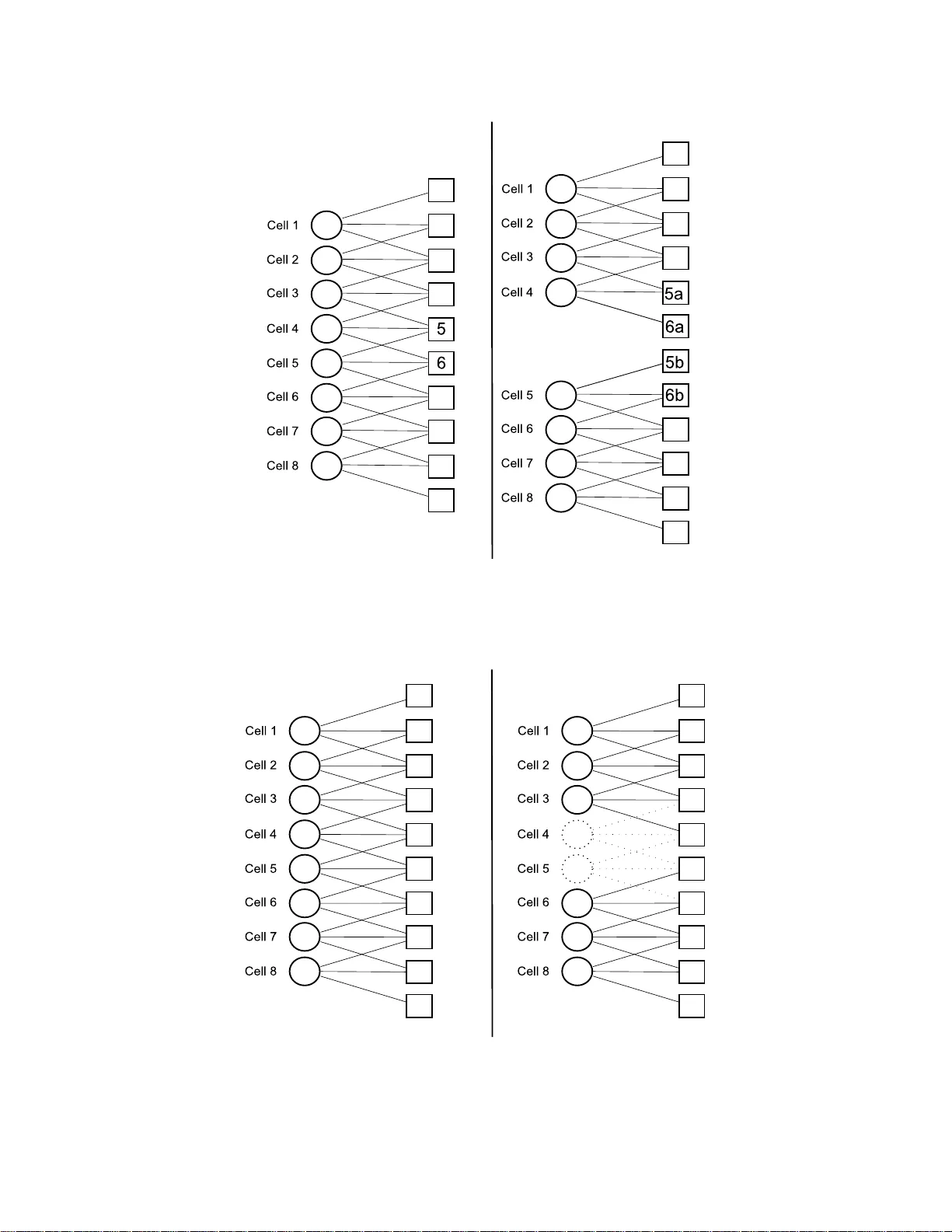
1 On Information Rates of the F ading Wyn er Cellular Mo del v ia the Thouless F orm ula for the Strip Nathan Levy ∗ † , Ofer Zeitouni ‡§ and Shlomo Shamai (Shitz) † ∗ D ´ epartement de Math ´ ematiques et Applications, Ecole Normale Sup ´ erieure, P aris 75005, F rance † Department of Electric a l Engineeri ng , T echnion, Haifa 32000, Israel ‡ Department of Mathematic s, W eizmann Institute of Sci ence, Re ho vot 76100, Israel § Sc ho ol of Mathema ti cs, Univ ersity of Minnesota, Minneap ol is, MN 55455, USA Abstract W e apply the theory o f ra ndom Schr ¨ odinger op era tors to the analysis of multi-users commu- nication channels similar to the Wyner mo del, that a re characterized b y short-r ange in tra-cell broadcas ting. With H the channel transfer matrix, H H † is a narrow-band matrix and in man y asp ects is similar to a r andom Schr ¨ odinger op erator . W e rela te the p er-cell sum- rate capacity of the c hannel to the integrated density of states of a rando m Schr ¨ odinger op erator ; the latter is related to the top Ly apunov exp onent of a random sequence of matrices via a version of the Thouless formula. Unlike r elated results in classica l r andom matrix theor y , limiting re sults do depe nd on the under lying fading distributions. W e also derive several b ounds on the limiting per -cell sum-rate ca pacity , some based on the theor y of random Schr ¨ odinger op erator s, and some derived from informatio n theor etical co nsiderations. Finally , w e get explicit results in the hig h- SNR regime for some particular cases. Nov em b er 10, 2018 DRAFT 2 I. Intr oduction The gro wing demand for ubiquitous access to high-data rate services , has pro duced a h uge amoun t of rese arch analyzing the p erfo rmance of wireless commu nications systems. T ec hniques for pro viding b etter service and co v erage in cellular mobile comm unications are curren tly b eing in ve stigated b y industry and academia. In particular, the use of joint m ulti-cell pro cessin g (MCP), which allo ws the base-stations (BSts) to jointly pro cess their signals, equiv alen tly creating a distributed an tenna array , has b een iden tified a s a key to o l for enhancing system p erformance (see [1][2] and references therein for surve ys of recen t results on m ulti-cell pro cessing). Motiv ated b y the fact that mobile users in a cellular system “see” only a small n um b er of BSts, and by t he desire t o provide analytical results, an attractive analytically tractable mo del for a m ulti-cell s ystem was suggested b y Wyner in [3] ( see also [4] f o r an earlier relev ant w ork). In this mo del, the system’s cells are ordered in either a n infinite linear arra y , or in the familiar tw o-dimensional hexagonal pattern (also infinite). It is assumed that only adjacen t-cell interferenc e is presen t and characterize d by a single parameter, a scaling factor α ∈ [0 , 1]. Considering non-fading channels and a “wideband” (WB) tra nsmission sc heme, where all bandwidth is a v ailable for c o ding (as opp osed to random spreading), the throughputs obtained with optimum and linear MMSE jo in t pro cessing of t he receiv ed signals from all cell-sites are deriv ed in [3 ]. Since it w as first presen ted, “Wy ner-like ” models ha v e pro vided a framew ork for man y works analyzing v arious transmission sc hemes in b o t h the up-link and do wn-link c hannels ( see [1][5] and references therein). In this pa p er w e consider a generalized “Wyner-lik e” cellular setup and study its p er-cell sum-rate capacit y . According to Wyner’s setup, the cells are arranged on a circle ( or a line), and the mobile users “see” only a fixed n um b er of BSts whic h are lo cated close to their cell’s b oundaries. All the BSts are assumed to b e connected through an ideal bac k-haul net w ork to a cen tral m ulti-cell pro cessor (MCP), that can joi n tly pro cess the up-link receiv ed signals of all ce ll- sites, as w ell as pre-pro cess the signals to b e transmitted b y all cell-sites in the do wn-link c hannel. The mo del is c haracterized b y short-range in tra-cell broadcasting. Th us, if w e denote by H the ch annel transfer matr ix, then H H † is in man y asp ects similar to a random Sc hr ¨ odinger op erato r . More s p ecifically , the p er-cell sum-rate capacity of the channel Nov em b er 10, 2018 DRAFT 3 is a function o f the in tegrat ed densit y of state of H H † , which in turn is related to t he top Ly apuno v expo nent of a random sequence of ma t rices via a v ersion of the Thouless formula. Unlik e asso ciated results in classical random matrix theory , limiting results do dep end on the underlying fading distributions. As a n applicatio n of o ur result and motiv ated by the fact that future cellular systems implicitly assume hig h-SNR configurat io ns mandatory for high data rate services, w e get explicit results in the high-SNR regime fo r some pa rticular cases. The rest of the paper is organized as follow s. In Section I I, we pres ent the problem statemen t. In Section I I I, w e prov e the conv ergence o f the p er-cell sum-rate capacit y when the num ber of cells and BSts go es to infinit y and w e express the limit in terms o f t he Ly apuno v exp onen t of a sequence of random matrices (Theorem 2). In Section IV, w e giv e sev eral reformulations of this result tha t yields a particularly simple expression in the high- SNR regime. In Section V, w e giv e different b ounds on the p er-cell sum-rate capacit y , some of whic h are based on the theory of pro duct of random matr ices, a nd some on information theoretical considerations. In Section VI, w e sp ecialize the results and mak e them explicit in some pa r t icular cases. Finally in Section VII w e discuss some op en problems using n umerical sim ulations. The relev ant ba c kground on the theory of Ly a puno v exp o nen ts is giv en in App endix A.1, and the r elev an t bac kground on exte rior pro ducts is given in Appendix C. Sev eral pro of s are po stp oned t o App endices A.2, A.3 and B. The p er-cell sum-ra t e capacity of the non-fading c hannels is deriv ed in App endix D. I I. Problem st a tement In this pap er w e consider t he follow ing setup. m + d cells with K single antenna users p er cell are a rranged o n a line, whe re the m sin gle antenna BSts are lo cated in the cells. Starting with the WB transmission sc heme where all ba ndwidth is dev o t ed for co ding and all K users are transmitting simultaneously eac h with av erage p ow er ρ , and assuming sy nch ronized comm unication, a v ector baseband represen tation of the signals receiv ed at the system’s BSts is giv en for an arbitrary time index i b y y ( i ) = H m ( i ) x ( i ) + n ( i ) , where x ( i ) is the ( m + d ) K complex Ga ussian sym b ols v ector, z ( i ) is the unitary complex Gaussian additiv e noise v ector. Note that the SNR is ρ . F rom now on, w e o mit the time Nov em b er 10, 2018 DRAFT 4 index i . H m is the follow ing m × K ( m + d ) channel tra nsfer mat r ix, which is a d + 1 blo c k diagonal matrix defined b y H m = ζ 1 , 1 ζ 1 , 2 · · · ζ 1 ,d +1 0 · · · 0 0 ζ 2 , 2 · · · ζ 2 ,d +1 ζ 2 ,d +2 . . . . . . . . . . . . . . . 0 0 · · · 0 ζ m,m ζ m,m +1 · · · ζ m,d + m , where ζ i,j are 1 × K ro w v ectors. F or s ∈ N ∗ , w e will denote by ζ s the v ector ( ζ s − d,s , . . . , ζ s,s ) and w e denote by π it distribution. W e assume in the rest of the pap er that for n ∈ N ∗ and 0 ≤ i ≤ d the v ectors ( ζ n − i,n ) are distributed according to π i . W e define Ω = ( ζ n ) n ∈ N ∗ and P , the probability distribution o n Ω asso ciated to the ab o v e problem. W e denote b y E the asso ciated exp ectation. W e also use the 2 norm fo r v ectors and matrices. F or matrices, it is the F ro eb enius norm, whic h is a sub-m ultiplicativ e norm. Throughout t his pap er, we assume a subset of the following hy p o theses. (H1) The v ectors ( ζ j ) j ∈ N ∗ form a stationary ergo dic sequen ce. (H2) There exists ε > 0 suc h tha t fo r 0 ≤ i ≤ d , E π i | log | x || 1+ ε < ∞ . (H3) If ( x 0 , . . . , x d ) is distributed according to π , then almost surely , x 0 x † d 6 = 0. F or m ∈ N ∗ and λ > 0 , w e set G m = H m H † m + λ Id m , where Id m is the m × m iden tit y matrix. Altho ug h G m dep ends on λ , w e will no t write that dependence unless there is an am biguity . Under the assumption that H m ( i ) is ergo dic with resp ect to the time index i , that the Channel State Information (CSI) is known at the receiv er whereas the users kno w the statistics of the CSI, and that the c hannel v aries fast enough so as to allow eac h transmitted co dew ord to exp erience a large n um b er of fading states, w e follow [1] and study the p er-cell sum-rate capacit y that is giv en by t he fo llo wing form ula ([6]) C ap m ( ρ ) = 1 m E log det Id + ρH m H † m = log ρ + 1 m E (log det G m ( λ )) , (1) where λ = 1 /ρ . Nov em b er 10, 2018 DRAFT 5 I I I. M ain re sul t W e set for i ∈ N ∗ C i = ζ d ( i − 1)+1 ,d ( i − 1) +1 ζ d ( i − 1)+1 ,d ( i − 1) +2 · · · ζ d ( i − 1)+1 ,di 0 ζ d ( i − 1)+2 ,d ( i − 1) +2 · · · ζ d ( i − 1)+2 ,di . . . . . . . . . . . . 0 · · · 0 ζ di,di and D i = ζ d ( i − 2)+1 ,d ( i − 1) +1 † ζ d ( i − 2)+2 ,d ( i − 1) +1 † · · · ζ d ( i − 1) ,d ( i − 1)+1 † 0 ζ d ( i − 2)+2 ,d ( i − 1) +2 † · · · ζ d ( i − 1) ,d ( i − 1)+2 † . . . . . . . . . . . . 0 · · · 0 ζ d ( i − 1) ,di † . F or all i ∈ N ∗ , C i are d × dK matrices and D i are dK × d matrices. W e fix ζ i,j with i ≤ 0 or j ≤ 0 so that C 1 D 1 = Id d,d . W e thereb y get the following blo c k description of H H dn = C 1 D † 2 0 d,dK · · · 0 d,dK 0 d,dK C 2 D † 3 . . . . . . . . . . . . . . . . . . 0 d,dK 0 d,dK · · · 0 d,dK C n D † n +1 , where 0 d,dK is the d × d K zero matrix. Under the h yp othesis (H2), in order to study the limit in m of C ap m ( ρ ), it is enough to study C ap nd ( ρ ) (see Remark 32 followin g the pro of o f Lemma 25 ) . W e get the following blo c k represen tation of G dn : G dn = C 1 C † 1 + D † 2 D 2 + λ Id d ( C 2 D 2 ) † 0 d 0 d C 2 D 2 . . . . . . 0 d 0 d . . . . . . ( C n D n ) † 0 d 0 d C n D n C n C † n + D † n +1 D n +1 + λ Id d . Note that under (H3) , for all i ∈ N ∗ , C i D i is a d × d inv ertible matrix. Nov em b er 10, 2018 DRAFT 6 F or i ∈ N ∗ , w e denote b y M i the follo wing matrix 0 d Id d − ( C i +1 D i +1 ) − 1 † C i D i − ( C i +1 D i +1 ) − 1 † C i C † i + D † i +1 D i +1 + λ Id d and denote N i = V d M i . Moreo v er, γ ( N ) denotes the top Ly apunov exp onen t asso ciat ed with { N i } , i.e. γ ( N ) , lim n →∞ 1 n log k N n · · · N 1 k . Note that b y Theorem 20, γ ( N ) is deterministic. See App endix A.1 for the definitions concerning the Lyapuno v exp onents and App endix C fo r t he relev an t bac kground on exte rio r pro ducts. Recall that ( M i ) i ∈ N ∗ and ( N i ) i ∈ N ∗ dep end on λ . Theorem 2 Assume (H1), (H2) and (H3), and set λ = 1 /ρ . 1. We have C ap m ( ρ ) − − − → m →∞ log ρ + E π log ζ 0 ζ † d + 1 d γ ( N ) , C ap ( ρ ) , wher e the exp e ctation is taken such that ( ζ 0 , . . . , ζ d ) is distribute d ac c or din g to π . 2. As ρ g o e s to infinity, C ap ( ρ ) = log ρ + E π log ζ 0 ζ † d + 1 d γ ( N ( λ = 0)) + o (1) . The theorem is pro v ed in App endix A. As an alternative to deriving exact a nalytical results w e will also b e in terested in extracting parameters that c haracterize the c hannel rate in the high-SNR regime [7]; suc h par a meters are the high-SNR slop e (also referred to as the “m ultiplexing gain” ) S ∞ , lim ρ →∞ C ap ( ρ ) log( K ρ ) , and the high-SNR p o w er offset L ∞ , lim ρ →∞ 1 log 2 log( K ρ ) − C ap ( ρ ) S ∞ , yielding the follow ing affine capacity approx imation C ap ( ρ ) ≈ S ∞ log 2 3 | dB ( K ρ | dB − 3 | dB L ∞ ) . A direct conseque nce of Theorem 2 is the following high-SNR c haracterization. Corollary 3 Assume (H1), (H2) and (H3). Then S ∞ = 1 and L ∞ = 1 log 2 log K − E π log ζ 0 ζ † d − 1 d γ ( N ( λ = 0)) . Nov em b er 10, 2018 DRAFT 7 IV. Reformu la tions W e now deriv e a lt ernat iv e fo rm ulations for γ ( N ) in Subsection IV-A and for γ ( N ( λ = 0)) (whic h c haracterizes the hign-SNR regime), in Subsection IV-B. A. Non-asymptotic r esults In order to study γ ( N ), we express it as the Lyapuno v exp onen t of simpler matrices. F or i ≥ d + 1, w e define the follow ing random matrices. m i = 0 1 0 0 . . . . . . . . . 0 0 · · · 0 1 − e ζ i,i − d e ζ i,i + d · · · · · · − e ζ i,i + d − 1 e ζ i,i + d , where e ζ i,l is the co efficien t in p osition ( i, l ) in G dn , and set n i = d ^ m i . Note that ( m i ) i ≥ d +1 and ( n i ) i ≥ d +1 dep end on λ . W e get the follow ing prop osition, whose pro of is giv en in App endix B.1. Prop osition 4 Assume (H1), (H2) a n d (H3). Then, N i = n id · · · n ( i − 1) d +1 . Ther efor e, for every λ ≥ 0 , γ ( N ) = dγ ( n ) , henc e, C ap ( ρ ) = log ρ + E π 0 ,π d log ζ 0 ζ † d + γ ( n ) . Note that for a given i ∈ N , N i dep ends on ζ d ( i − 1)+1 , . . . , ζ ( d +1) i , that is , t he fading co efficien ts of 2 d differen t cells. W e now w an t to reduce the pro duct of the N i to a pro duct of random matrices (that we denote b y Ξ i ) depending on the fading co efficien ts of o nly d cells. Then w e reduce it further to a pro duct of r andom matrices (that we denote by ξ i ) dep ending on the fading co efficien ts of only one cell. By doing so, w e ach iev e tw o goals: first, w e exp ress γ ( N ) as the L y apuno v exp onen t of simpler matrices. Second, if the fa ding co efficien ts are i.i.d for differen t cells, then the Ξ i and t he ξ i are i.i.d. Pro ducts of i.i.d random matrices ha v e b een studied extensiv ely (see for example [8 ]) , moreov er, their study can b e reduced to the study of a Mark ov c hain on an Nov em b er 10, 2018 DRAFT 8 appropriate space, whic h can lead to actual analytic expressions ( see [5] for an example o f study of suc h a Mark ov chain). F or i ∈ N ∗ , w e denote b y ∆ i the follo wing matrix − C i C † i + λ Id d ( C i D i ) − 1 † − C i D i + C i C † i + λ Id d ( C i D i ) − 1 † D † i D i ( C i D i ) − 1 † − ( C i D i ) − 1 † D † i D i and define Ξ i = V d ∆ i . F or i ≥ d + 1, w e denote b y δ i the following matrix − ζ i − d +1 ,i ζ i − d,i . . . − ζ i − 1 ,i ζ i − d,i Id d − 1 0 d − 1 ,d − λ + | ζ i,i | 2 ζ i − d,i ζ † i,i 0 1 ,d − 1 λ ζ † i − d,i ζ † i,i · · · λ ζ † i − 1 ,i ζ † i,i 0 d − 1 , 1 0 d − 1 ,d − 1 0 d − 1 , 1 Id d − 1 1 ζ i − d,i ζ † i,i 0 1 ,d − 1 − ζ † i − d,i ζ † i,i · · · − ζ † i − 1 ,i ζ † i,i and define ξ i = V d δ i . Note that (∆ i ) i ∈ N ∗ , (Ξ i ) i ∈ N ∗ , ( δ i ) i ∈ N ∗ and ( ξ i ) i ∈ N ∗ dep end on λ . Prop osition 5 Assume (H1), (H2) and (H3). 1. F or e very λ ≥ 0 , γ (Ξ) = γ ( N ) , henc e, C ap ( ρ ) = log ρ + E π 0 ,π d log ζ 0 ζ † d + 1 d γ ( Ξ) . 2. Assume K = 1 . Then, ∆ i = δ id · · · δ ( i − 1) d +1 . Ther efor e, for every λ ≥ 0 , γ ( N ) = dγ ( ξ ) , henc e, C ap ( ρ ) = log ρ + E π 0 ,π d log ζ 0 ζ † d + γ ( ξ ) . Remark 6 Note that for K = 1 , for al l i ∈ N ∗ , ( C i D i ) − 1 † = C − 1 † i D − 1 † i , Nov em b er 10, 2018 DRAFT 9 and ther efor e, ∆ i = − C i D − 1 † i − λ ( C i D i ) − 1 † λC − 1 † i D i ( C i D i ) − 1 † − C − 1 † i D i . Pr o of: [Pro of of Prop osition 5] Let us start by pro ving p oin t 1. W e define for i ∈ N ∗ , P 1 ( i ) = − C i D i − C i C † i − λ Id d 0 d Id d and P 2 ( i ) = 0 d Id d ( C i D i ) − 1 † − ( C i D i ) − 1 † D † i D i , so that for all i ∈ N ∗ , M i = P 2 ( i + 1) P 1 ( i ). F or i ∈ N ∗ , ∆ i is defined so that ∆ i = P 1 ( i ) P 2 ( i ). Then, for all n ∈ N ∗ , M n . . . M 1 = P 2 ( n + 1) P 1 ( n ) P 2 ( n ) P 1 ( n − 1 ) · · · P 2 (2) P 1 (1) = P 2 ( n + 1)∆ n · · · ∆ 2 P 1 (1) . and k N n . . . N 1 k = d ^ P 2 ( n + 1)Ξ n · · · Ξ 2 d ^ P 1 (1) ≤ d ^ P 2 ( n + 1) k Ξ n · · · Ξ 2 k d ^ P 1 (1) . Therefore, γ ( N ) ≤ γ (Ξ). Since P 1 (1) and P 2 ( n + 1) are in v ertible, we get t he opp osite inequalit y and p oint 1 is pro ve d. The pro of o f p oin t 2 is p ostp oned to App endix B.2. B. R esults in high -SNR r e gime Prop osition 7 Assume (H1), (H2) and (H3). Assume mor e over that K = 1 . 1. F or i ∈ N ∗ , we set Ψ 1 i = C i D − 1 † i and Ψ 2 i = C − 1 † i D i . Then L ∞ = − 1 log 2 " E π log ζ 0 ζ † d + 1 d max 0 ≤ i ≤ d γ i ^ Ψ 1 ! + γ d − i ^ Ψ 2 !!# . Nov em b er 10, 2018 DRAFT 10 2. F or i ≥ d + 1 , we set ψ 1 i = − ζ i − d +1 ,i ζ i − d,i . . . − ζ i,i ζ i − d,i Id d − 1 0 1 ,d − 1 and ψ 2 i = − ζ i − 1 ,i ζ i,i . . . − ζ i − d,i ζ i,i Id d − 1 0 1 ,d − 1 † . Then, L ∞ = − 1 log 2 " E π log ζ 0 ζ † d + max 0 ≤ i ≤ d γ i ^ ψ 1 ! + γ d − i ^ ψ 2 !!# . Remark 8 1. R e c al l that for a s tationary er go di c se quenc e of c omplex r andom matric es ( X i ) i ∈ N ∗ of size d , γ 0 ^ X ! = 0 and γ d ^ X ! = E log | det X 1 | . 2. Note that if for 0 ≤ i ≤ d , π i = π d − i and the ve ctors ( ζ i ) i ∈ N ∗ ar e i.i.d, then ( ψ 1 i ) i ≥ d +1 and (( ψ 2 i ) † ) i ≥ d +1 have the sam e distribution and ( ψ 2 i ) i ≥ d +1 and (( ψ 2 i ) † ) i ≥ d +1 have the same Lyapunov exp onents. Ther efor e, as ρ go es to infinity, L ∞ = − 1 log 2 E π log ζ 0 ζ † d + γ ⌈ d/ 2 ⌉ ^ ψ 1 + γ ⌊ d/ 2 ⌋ ^ ψ 1 . Pr o of: [Pro of of Prop osition 7] Using Corolla r y 3 and Prop osition 5, in order to prov e p oin t 1, w e only ha v e to pro ve that γ (Ξ( λ = 0)) = max 0 ≤ i ≤ d γ i ^ Ψ 1 ! + γ d − i ^ Ψ 2 !! . (9) Recall that γ (Ξ) = γ 1 (∆) + · · · + γ d (∆) and that ∆ i ( λ = 0) = − Ψ 1 i 0 d,d ( C i D i ) − 1 † − Ψ 2 i . By Prop o sition 24, the sequence γ 1 (∆( λ = 0)) , . . . , γ 2 d (∆( λ = 0 )) is equal up to the order to t he sequence γ 1 (Ψ 1 ) , . . . , γ d (Ψ 1 ) , γ 1 (Ψ 2 ) , . . . , γ d (Ψ 2 ) . Therefore, (9) is a direct consequence of γ (Ξ( λ = 0)) = γ 1 (∆( λ = 0)) + · · · + γ d (∆( λ = 0)) and γ V i Ψ 1 , 2 = γ 1 (Ψ 1 , 2 ) + · · · + γ i (Ψ 1 , 2 ). Nov em b er 10, 2018 DRAFT 11 The pro of o f p oin t 2 go es along the same lines using the fact that δ i ( λ = 0) = − ψ 1 i 0 d,d ψ 3 i − e ψ 2 i , where e ψ 2 i = 0 0 1 0 . . . 0 1 0 0 ψ 2 i 0 0 1 0 . . . 0 1 0 0 and ˜ ψ 3 i = 0 d − 1 , 1 0 d − 1 ,d − 1 1 ζ i − d,i ζ † i,i 0 1 ,d − 1 , therefore, the Ly apuno v exp onents of e ψ 2 and ψ 2 are the same. V. B ounds on the cap a city A. Bounds o n the top Lyapunov exp onent W e use the F r ¨ ob enius norm on the matrices, it is a sub-m ultiplicativ e norm, therefore, w e can apply (22) to the differen t formulations of the capacit y to get the follo wing prop osition. Prop osition 10 Assume (H1), (H2) and (H3). 1. F or λ = 1 /ρ a nd p ≥ 1 , C ap ( ρ ) ≤ log ρ + E π 0 ,π d log ζ 0 ζ † d + 1 dp E log k N p ( λ ) · · · N 1 ( λ ) k . 2. F or λ = 1 /ρ a nd p ≥ 1 , C ap ( ρ ) ≤ log ρ + E π 0 ,π d log ζ 0 ζ † d + 1 p E log k n p ( λ ) · · · n 1 ( λ ) k . 3. F or λ = 1 /ρ a nd p ≥ 1 , C ap ( ρ ) ≤ log ρ + E π 0 ,π d log ζ 0 ζ † d + 1 dp E log k Ξ p ( λ ) · · · Ξ 1 ( λ ) k . 4. Assume K = 1 . F or λ = 1 /ρ and p ≥ 1 , C ap ( ρ ) ≤ log ρ + E π 0 ,π d log ζ 0 ζ † d + 1 p E log k ξ p ( λ ) · · · ξ 1 ( λ ) k . Mor e over, the b ounds ar e tight as p go es to in finity. The b ound of p oin t 2 with p = 1 can b e refor mulated as follows. Corollary 11 F or λ = 1 /ρ , C ap ( ρ ) ≤ log ρ + Nov em b er 10, 2018 DRAFT 12 1 2 E log " 2 d − 2 d − 1 2 d X l =2 ( l − 1) ∧ d X t =( l − d − 1) ∨ 0 ζ d +1 ,d + t +1 ζ † l,d + t +1 + λ 1 ( l = d +1) 2 + 2 d − 1 d ζ d +1 ,d +1 ζ † 1 ,d +1 2 + ζ d +1 , 2 d +1 ζ † 2 d +1 , 2 d +1 2 # . The pro of is p ostp oned to App endix B.3. B. Other b ounds Prop osition 12 Assume (H1) and (H2). F or λ = 1 /ρ , max E π 0 log λ + | ζ 0 | 2 , E π d log λ + | ζ d | 2 ≤ C ap ( ρ ) − log ρ ≤ E log λ + | ζ 1 , 1 | 2 + · · · + | ζ 1 ,d +1 | 2 . Pr o of: The upp er bound is a consequence of Hadamard’s inequality for semi-p ositive definite Hermitian matrices. Indeed, 1 m log det G m ( λ ) ≤ 1 m m X i =1 log λ + | ζ i,i | 2 + · · · + | ζ i,i + d | 2 . Let us sho w the lo we r b ound of p oint 12 using the to ols of [9]. C ap m ( ρ ) = 1 m I ( x , y | ( ζ i,i ) 1 ≤ i ≤ m , . . . , ( ζ i,i + d ) 1 ≤ i ≤ m ) = 1 m m X j =1 I ( x j , y | ( x i ) 1 ≤ i 1, it is the o pp osite. Nov em b er 10, 2018 DRAFT 15 W e see that in the case d = 2, for K = 4 a nd K = 10, the upper-b ound of Prop osition 12 is v ery close to the capacity and the upp er-b ounds of Prop osition 10.1 are getting tigh t v ery rapidly . In the case d = 2 , w e w an t to compare the random-fading c hannel with the non-fading c hannel. See App endix D for the p er-cell sum-rate capacity of the non- f ading c hannel. The comparison is done in Figure 5; in the eigh t cases that w e c onsider, the random-fading c hannel is b etter than the non random one. VI. Resul ts for p ar ticular cases in the high-SNR re gime A. Case d = 1 As a direct a pplication of Prop o sition 7 in the case d = 1 and K = 1, w e get the follo wing result. Prop osition 14 Assume (H1), (H2) and (H3). Then L ∞ = − 1 log 2 [2 max ( E π 0 log | ζ 0 | ; E π 1 log | ζ 1 | )] . Note tha t a similar resu lt w as already pro v ed b y other tec hniques in [5] unde r m uc h stronger h yp othesis, in particular, indep endence of the fading co efficien ts w as assumed there. In con trary , our result dep ends only on the marginal distributions of the fading co efficien ts and is v alid for a larg er class of joint distributions. W e w an t to compare the p er-cell sum-rate capacit y of the random-fading and non-f ading c hannels. F or a random v ariable ζ , b y Jensen’s inequalit y , E log | ζ | 2 ≤ log E | ζ | 2 . Therefore, under the constrain ts E π 0 | ζ 0 | 2 ≤ 1 and E π 1 | ζ 1 | 2 ≤ 1, the non-fading c hannel ac hiev es the b est p er-cell sum-rate capacit y in the high SNR regime. B. Case d = 2 W e now assume that d = 2 a nd K = 1 and that the fading co efficien ts ha ve the follo wing form; for i ∈ N ∗ , ζ i − 2 ,i = αa i , ζ i − 1 ,i = β b i and ζ i,i = c i , Nov em b er 10, 2018 DRAFT 16 where a i , b i and c i are random v a riable distributed according to π a , π b and π c resp ectiv ely and α and β are parameters suc h that α > 0 and β ≥ 0. Moreo ve r, tak e the follow ing normalization that can alw ay s b e ac hiev ed by mo difying α and β . E π a log | a 1 | = E π b log | b 1 | = E π c log | c 1 | . W e use the notation of Prop o sition 7. Prop osition 15 Assume that ( a i , b i , c i ) i ∈ N ∗ is a stationary er go dic se quenc e such that for al l i ∈ N ∗ , almost sur ely, a i and c i ar e n o n zer o and that their exi s t ε > 0 such that E π a (log | a 1 | ) 1+ ε , E π b (log | b 1 | ) 1+ ε and E π c (log | c 1 | ) 1+ ε ar e fin i te. Then, ther e exist a domain D ⊂ (0 , 1] × [0 , 1] s uch that for al l ( x, y ) ∈ D , (0 , x ) × [0 , y ) ⊂ D and for al l ( α , β ) ∈ D , as ρ go es to infinity, L ∞ = − 2 log 2 E π a log | a | . (16) The pro of is p ostp oned to App endix B.4. Remark 17 1. The se t D is n ot maxim a l in the sense that ( 16) may hold for c ouple s ( α, β ) / ∈ D . 2. Note that f o r ( α, β ) ∈ D , in the high-SNR r e gime, the lower b ound of Pr op osition 12 is tight. 3. The pr o of wil l yield an effectiv e c onstruction of D , which al lo w s us to find m any p o i n ts in D . Inde e d , we c onstruct ( f p ) p ∈ N ∗ a family of functions on ( 0 , 1] × [0 , 1] with the fol lowing pr op erty: if ther e ex ists p ∈ N ∗ such that f p ( α, β ) ≤ 0 , then (16) holds. 4. Note that (16) do es not hold whe n α > 1 , inde e d, as it wil l app e ar in the c o urse of the pr o of, as ρ go es to infi n ity, C ap ( ρ ) ≥ log ρ + 2 E π a log | a | + log α. We c onje ctur e that (16) do es not hold when β > 1 ei ther. Let us apply Prop osition 15 to the case where ( a i , b i , c i ) i ∈ N ∗ are indep enden t Rayleigh distributed co efficien ts. In Figure 6, w e plot p o in ts fo r whic h f 20 is less o r equal to -0.05 Nov em b er 10, 2018 DRAFT 17 (Mon te Carlo simulations realized with 10 5 samples). Therefore, (16) holds for ( α , β ) in the stripp ed region and in particular for α, β ≤ 0 . 4. Note that in this case, the p o w er offset is L ∞ = γ log 2 , where γ is t he Euler constan t. C. A rtificial fading In the f rame of non- fading c hannels, w e consider artificial f ading, that is, ev ery user uses a pseudo-random fading and m ultiplies its signal b y this artificial fading. The fading co efficien ts then ha v e the following fo r m, for i ∈ N ∗ and 0 ≤ s ≤ d , ζ i,i + s = α s P i + s , where α 0 , . . . α d are non random p ositiv e n um b ers and P i , i ∈ N ∗ are statio nary ergo dic pseudo-random complex row v ectors of size K distributed according to a la w denoted b y π P . W e moreov er assume that for all i ∈ N ∗ , almost surely , the co efficien ts o f P i are non zero and that E π P k P 1 k 2 = 1. In [11], it is prov ed that in the case d = 2 , the p er-cell sum-rate capacity is smaller with artificial fading. Indeed, had suc h a pro cedure help ed, then it would b e used in non-fading situations to enhance capacity . It is eviden t then that it is deleterious, as the express ion in Prop osition 18 exhibits. W e consider the high-SNR regime and deriv e the explicit influence of the artificial fading. Prop osition 18 Deno te by L 0 ∞ the p ower off-set without art ifici a l fading (that is, P i = (1 , . . . , 1) alm ost sur ely) and by L ∞ the p ower off-set with artificial fading. Then, L ∞ = L 0 ∞ − 1 log 2 E π P log k P 1 k 2 . Remark 19 By Jensen ’s in e q uality, we get that L ∞ ≥ L 0 ∞ , ther efor e, in t he high -SNR r e gime, the p er-c el l sum-r ate c ap acity i s smal ler with artifici a l fad i n g. Pr o of: [Pro of o f Prop osition 18] W e set un til t he end of the pro of λ = 0. Using Corollary 3 and Prop osition 5, L ∞ = 1 log 2 log K − E π log α 0 α † d − E π P log k P 1 k 2 − 1 d γ (∆) , Nov em b er 10, 2018 DRAFT 18 whereas L 0 ∞ = 1 log 2 log K − E π log α 0 α † d − 1 d γ e ∆ , where e ∆ i i ∈ N ∗ denote the matrices without artificial f a ding. Therefore, w e only hav e to pro v e that for i ∈ N ∗ , ∆ i do es not dep end on ( P i ) i ∈ N ∗ . In the case K = 1, ∆ i = δ id · · · δ ( i − 1) d +1 and f or i ≥ d + 1, δ i do es no t dep end on ( P i ) i ∈ N ∗ , therefore, ∆ i do es not dep end on ( P i ) i ∈ N ∗ . Let us assume K > 1. Using Prop osition 5, w e only hav e to prov e that for i ∈ N ∗ , ∆ i do es not dep end on ( P i ) i ∈ N ∗ . C i = α 0 P d ( i − 1)+1 α 1 P d ( i − 1)+2 · · · α d − 1 P di 0 α 0 P d ( i − 1)+2 · · · α d − 2 P di . . . . . . . . . . . . 0 · · · 0 α 0 P di and D i = α d P d ( i − 1)+1 † α d − 1 P d ( i − 1)+1 † · · · α 1 P d ( i − 1)+1 † 0 α d P d ( i − 1)+2 † · · · α 2 P d ( i − 1)+2 † . . . . . . . . . . . . 0 · · · 0 α d P di † . Let us define another c ha nnel transfer matrix e H m b y e K = 1 and for i ∈ N ∗ and 0 ≤ s ≤ d , e ζ i,i + s = α s k P i + s k . In the same manner, w e define e C i , e D i and f ∆ i . A straigh t forw ard v erification show s that for i ∈ N ∗ C i C † i = e C i e C † i , C i D i = e C i e D i and D † i D i = e D † i e D i . Moreo v er, since ∆ i is a function of C i C † i , C i D i and D † i D i , ∆ i = e ∆ i . How eve r, since e K = 1, w e ha ve alr eady prov ed that e ∆ i do es not dep end on ( P i ) i ∈ N ∗ , therefore, ∆ i do es not dep end on ( P i ) i ∈ N ∗ . Nov em b er 10, 2018 DRAFT 19 VI I. Numerical simula tions A. Influenc e of the c orr elation W e assume that the fading co efficien ts are Rayleigh distributed ( r eal and imaginary parts are indep enden t Gaussian random v a riables with zero mean and v ariance 1 / √ 2) and indep enden t for differen t users. W e are interes ted in the f o llo wing question, w hich o f the non- fading c hannel and the Ray leigh fading c hannel giv es a hig her p er-cell sum-rate capacit y . In the case d = 2, λ = 0 . 1 , 1 and K = 1 , 2 , 4 , 1 0 , with all fading co efficien ts indep enden t, it is sho wn in Subsection V-C that the Ra yleigh f ading is b eneficial. In the case d = 1 if we assume indep endence b etw een the ζ i,j , it is kno wn that Ra yleigh fading is b eneficial o ver non-fading c hannels in the high- SNR region already for K = 2 ([5]). If w e assume that for i ∈ N ∗ , ζ i − 1 ,i = ζ i,i , then, the sum-rat e per- cell capacit y is less than the one of a no n- fading c hannel (see Subsection VI-C and [11]). W e inv estigate the follow ing question: what is the maximal lev el of correlation b etw een ζ i − 1 ,i and ζ i,i that still provide s b enefit o v er the non-f ading c hannel. See App endix D for the deriv ation o f t he capacit y of the non-f a ding c hannels. W e denote b y c the correlation b et w een the real (resp. imaginary) part of ζ i,i and the real (resp. imaginary) part of ζ i − 1 ,i In Figure 7 w e presen t the b ounds of Prop osition 10.1 and Prop osition 13 in the sp ecial case of Rayle igh fa ding . In F igure 8 we presen t the b ounds of Prop osition 10.1 and Prop o- sition 13 in the follo wing special case: ζ i,i is Ra yleigh distributed, ζ i − 1 ,i is α ∈ [0 , 1 ] t imes a Ra yleigh distributed random v ariable. In b oth cases, the curv es are pro duced b y Mon te Carlo sim ulation with 10 5 samples. W e see that ev en with a correlation close to 1, fading still provide s a n adv an tage ov er non-fading c hannel. Moreov er, note that K large, high SNR and α close to 1 are conditions in whic h the adv an tage of the fading is larger. B. The asymm etric Wyner mo del With the following sp ecification, the mo del studied is the Rayleigh-fading Wyner mo del ([3]). W e tak e d = 2 and the ζ i,j indep enden t with t he follo wing distributions. F or i ∈ N ∗ , ζ i,i +1 is Ra yleigh distributed (real and imaginary parts are indep enden t Gaussian random v aria bles with zero mean and v a riance 1 / √ 2) and ζ i,i (resp. ζ i,i +2 ) is α ∈ [0 , 1] times a Nov em b er 10, 2018 DRAFT 20 Ra yleigh distributed random v ariable. The asymmetric (Rayleigh-fading) Wyner mo del is similar to Rayleigh-fading Wyner with a sligh t mo dification. F or i ∈ N ∗ , ζ i,i is Rayleigh distributed and ζ i,i +1 (resp. ζ i,i +2 ) is α times a Rayleigh distributed random v ariable. Note that in Subsection VI-B we pro v e that in the asymmetric case, t he p ow er offset for α ≤ 0 . 4 is γ / log 2. The t wo mo dels a r e v ery similar and yet, in the non- fading case, the p er-cell sum-rate capacit y is notably different (see App endix D for the deriv ation o f the capacity of the non- fading c hannels). In Figure 9 w e presen t the capacit y of the tw o mo dels without fading and the b ounds of Prop osition 13 for the t w o mo dels with Rayle igh fading. W e study one case in mo derate SNR ( λ = 1) and one case in hig h SNR ( λ = 10 − 4 ). The curv es are pro duced b y Monte Carlo sim ulation with 10 5 samples. Note that in the high- SNR region, for the non-f a ding c hannel, the p er-cell sum-rate capacit y is v ery differen t for symmetric and the asymmetric mo dels, whereas the p er-cell sum-rate capacities for the symmetric and asymmetric Ra yleigh-fading models are very close (but not equal as sho wn in Figure 10 for λ = 10 − 4 and α = 0 . 5). T o understand b etter the influence of fa ding on the difference b et w een the t w o mo dels, w e presen t in Figure 11 the b ounds of Prop osition 13 for the capacity of the t wo mo dels (symmetric and asymmetric) with the following fading: the mo dulus is unifo r mly distributed b et w een 1 − ε and 1 + ε and the phase is uniformly distributed b etw een 0 a nd 2 επ , where ε is a parameter b et w een 0 and 1. Note that f o r ε = 0 , there is no f a ding and for ε = 1, the fading is uniformly distributed o n the disc of cen ter 0 and of radius 2 . The curv es are pro duced b y Mon te Carlo sim ulatio n with 10 5 samples. W e notice that the difference b etw een the t wo mo dels decreases b et we en ε = 0 and ε = 0 . 5 and that in high-SNR, it increases sligh tly b et w een ε = 0 . 5 and ε = 1. VI I I. Concluding Re marks In this pap er, w e study the p er- cell sum-rate capacity of a c hannel communic ation with m ultiple cell pro cessing. The main to ols is a v ersion of the Thouless formu la for the strip whic h w e pro ve in the article. It allows us to pro v e that the p er- cell sum-rate capa city con v erges as the n umber of cells and an tennas go es to infinit y . W e giv e sev eral exp ressions of the limiting capacit y in terms of Ly apunov expo nents and sev eral b ounds o n the p er-cell Nov em b er 10, 2018 DRAFT 21 sum-rate capacit y . W e apply those results to sev eral examples of comm unication c hannels and get insight on t he ev olution of the capacit y as a function of the k ey para meters of the problem. In particular, in t he high-SNR regime, some explicit form ulas are deriv ed. Note that the mo del here applies verbatim to ra ndo mly v arying intersy mbol in terference c hannels. Some of the to ols of t his article can b e used to deriv e CL T-ty p e results on the capacit y in order to study the outage-probability . Details will app ear elsewhere [12]. A cknowledgments W e thank Oren Somekh for his help with the deriv at io n of the capacit y of the non-fading c hannels. This researc h w as partially supp orted b y T echnion Researc h F unds, the REMON Consor- tium, a gran t from the Israel Science F oundat ion and NSF g ran t DMS-05037 75. Appendix A. R ando m Sc hr ¨ odinger op er ators te chn i q ues 1) Lyapunov exp onents the ory: W e use the theory of pro duct of random matrices. F or a general intro duction to the asp ects of the theory w e use here, the reader may consult [8], [13], [14], [15], [16] or [17]. See a pp endix C for the relev an t bac kground on exterior pro ducts. Theorem 20 (F ursten b erg H ., K esten H. (1960)) Consider a stationary er go dic se- quenc e o f c omplex r andom matric es ( X i ) i ∈ N ∗ of size p and any norm on the matric es. Assume mor e over that E log + k X 1 k < ∞ , then a.s, n − 1 log k X n · · · X 1 k c onver ge s to a c onstant: lim n →∞ 1 n log k X n · · · X 1 k , γ ( X ) . W e define p constan ts γ 1 ( X ) , . . . , γ p ( X ) suc h that for 1 ≤ i ≤ p , γ i ^ X ! = γ 1 ( X ) + · · · + γ i ( X ) . Nov em b er 10, 2018 DRAFT 22 Prop osition 21 γ 1 ( X ) ≥ · · · ≥ γ p ( X ) . The constan ts γ 1 ( X ) ≥ · · · ≥ γ p ( X ) are called the Ly apunov exp onen ts and γ ( X ) = γ 1 ( X ) is called the top L yapuno v exp onen t. W e will also use the three follo wing prop erties: 1. F or any sub-m ultiplicativ e norm, for p ∈ N ∗ γ ( X ) ≤ 1 p E log k X p · · · X 1 k , (22) and the limit of the R HS a s p go es to infinit y is γ ( X ). 2. 1 p E log | det X 1 | ≤ γ ( X ) . (23) 3. Assume that the matrices ( X i ) i ∈ N ∗ are i.i.d, then for all 1 ≤ i ≤ p , γ i ( X ) = γ i ( X † ). Finally , w e quote the f o llo wing prop osition [18, Prop osition 1]. Prop osition 24 Consi d er a stationary er go dic se quenc e of c om p l e x r andom matric es ( X i ) i ∈ N ∗ of size p and any norm on the m a tric es. Assume mor e ove r that E log + k X 1 k < ∞ . Final ly, assume that ther e exist thr e e se quenc e s of r andom matric es ( X 1 i ) i ∈ N ∗ , ( X 2 i ) i ∈ N ∗ , ( X 3 i ) i ∈ N ∗ , of r esp e ctive sizes k × k , ( p − k ) × k and ( p − k ) × ( p − k ) , for 1 ≤ k ≤ p − 1 , such that almost sur e ly, for al l i X i = X 1 i 0 k ,p − k X 2 i X 3 i . Then, γ 1 ( X ) , . . . , γ p ( X ) is e qual up to the or der to the se quenc e γ 1 ( X 1 ) , . . . , γ k ( X 1 ) , γ 1 ( X 3 ) , . . . , γ p − k ( X 3 ) . Nov em b er 10, 2018 DRAFT 23 2) Pr o of of The or em 2.1: In o rder to prov e p oint 1 of Theorem 2, w e first prov e a sligh tly more general lemma. Lemma 25 Assume (H1), (H2) and (H3). F or al l λ ∈ C such that λ / ∈ R − , almost sur ely, 1 dn log | det G dn | − − − → n →∞ 1 d E log | det( C 2 D 2 ) | + 1 d γ ( N ) . Pr o of: F or i ∈ N ∗ , set B i = C i C † i + D † i +1 D i +1 + λ Id d and A i = C i D i . Note that the eigen v a lues of G dn are b ounded a w a y from zero. T o compu te log | det G dn | , w e write the follo wing decomp osition: G dn U dn = L dn , where U dn is the upp er tr iangular b y blo ck matrix U dn = X 1 X 1 · · · X 1 0 d X 2 · · · X 2 . . . . . . . . . . . . 0 d · · · 0 d X n , the X i are d × d matrices suc h that X 0 = 0 d , X 1 = Id d , and for i ≥ 1, A i X i − 1 + B i X i + A † i +1 X i +1 = 0 d . (26) L dn is the lo we r tria ngular by blo c k matrix − A † 2 X 2 0 d · · · 0 d A 2 X 1 − A † 3 X 3 . . . . . . 0 d . . . . . . 0 d 0 d 0 d A n X n − 1 − A † n +1 X n +1 , That decomp o sition allo ws us to write log | det G dn | as a determinan t by blo ck, log | det G dn | = n X i =1 log | det A i +1 | + n X i =1 log | det X i +1 | − n X i =1 log | det X i | = n X i =1 log | det A i +1 | + lo g | det X n +1 | . Therefore 1 dn log | det G dn | = 1 dn n X i =1 log | det A i +1 | + 1 dn log | det X n +1 | . (27) 1 n P n i =1 log | det A i +1 | con v erges b y ergo dicit y to ward E log | det A 2 | . Note that the c hoice of A n +1 is arbitrary , indeed, if we tak e another v alue, say e A n +1 , t hen e A † n +1 e X n +1 = A † n +1 X n +1 and (27) sta ys unc hanged. Nov em b er 10, 2018 DRAFT 24 W e emphasize that the deriv a t io n of ( 27) is inspired by Narula’s thesis ( [19]). The X i are defined b y (26). W e can r efo r m ulate it in the follo wing w a y . Set V i = X i − 1 X i , then (26) is equiv alen t to V i +1 = M i V i and moreo v er, X n +1 = 0 d Id d M n · · · M 1 0 d Id d . Denote f = V 0 d Id d . F or the relev an t back ground on exterior pro ducts, see Appendix C. W e get N n N n − 1 . . . N 1 v 1 1 ∧ · · · ∧ v d 1 . Ho w ev er, v 1 1 ∧ · · · ∧ v d 1 = f . Therefore, det X n +1 = d ^ X n +1 = d ^ 0 d Id d M n · · · M 1 0 d Id d = f † N n N n − 1 . . . N 1 f . (28) T aking the canonical basis of V d C 2 d , f is the last v ector of the basis and det X n +1 gro ws lik e the b ottom-r ig h t co efficien t of t he pro duct of the N i , therefore, its gro wth ra te is b ounded ab ov e by the Lyapuno v expo nent of the N i . lim sup n →∞ 1 n E log | det X n +1 | ≤ γ ( N ) . (29) Using (27), it is enough to prov e the opp o site inequality to conclude the pro of . The end of the pro of is inspired b y [20]. Lemma 30 If ther e exist a b asis of V d C 2 d , say ( g i ) i ∈ I , such that for al l i, j ∈ I , almost sur ely, lim inf n →∞ 1 n log g † j N n · · · N 1 g i ≤ lim inf n →∞ 1 n log | det X n +1 | , (31) then, almost sur ely, γ ( N ) ≤ lim inf n →∞ 1 n log | det X n +1 | . Let us first prov e the lemma. Nov em b er 10, 2018 DRAFT 25 Pr o of: F or an y finite basis S 1 and S 2 in a vec tor space, w e ha v e for all A sup α ∈ S 1 ,β ∈ S 2 α † Aβ ≥ c k A k for some univ ersal c . Th us, (3 1) shows that, a lmost surely , γ ( N ) ≤ lim inf n →∞ 1 n log | det X n +1 | . T o finish the pro of of Lemma 25, w e denote b y { e 1 , . . . , e 2 d } the canonical basis of C 2 d and w e apply the lemma with the following spanning system of V d C 2 d S , { ( e 1 + e e 1 ) ∧ · · · ∧ ( e d + e e d ) , e e 1 , . . . , e e d ∈ v ect( e d +1 , . . . , e 2 d ) } . F or a c hoice of e # 1 , . . . , e # d , such that for 1 ≤ j ≤ d , e # j = P d i =1 α i,j e d + i , we define E # the d × d mat r ix o f the α i,j . W e get g 1 , ( e 1 + e # 1 ) ∧ · · · ∧ ( e d + e # d ) = d ^ I d d E # . In the same w a y , for a c hoice of e b 1 . . . , e b d ∈ v ect( e d +1 , . . . , e 2 d ), we define E b , a d × d mat r ix, suc h that g 2 , ( e 1 + e b 1 ) ∧ · · · ∧ ( e d + e b d ) = d ^ I d d E b . W e define tw o new sequences ( e A i ) and ( e B i ) suc h that • F o r 2 ≤ i ≤ n − 1, e B i = B i , • F o r 1 ≤ i ≤ n , e A i = A i , • e B 1 = − A † 2 E # , • e B n = A n E b † , • e A n +1 = − A † n . W e also define e G dn , f M i , e N i and e X i using e A i i ∈ N ∗ and e B i i ∈ N ∗ . Then, f † e N n e N n − 1 . . . e N 1 f = f † d ^ 0 d Id d Id d E b † e N n − 1 . . . e N 2 d ^ 0 d Id d − T 1 T − 1 † 2 E # f = g † 2 e N n − 1 . . . e N 2 g 1 . Nov em b er 10, 2018 DRAFT 26 Therefore, to pro v e t he condition (3 1), it is enough to prov e that, almost surely , lim sup n →∞ 1 n log det e G dn − 1 n log | det G dn | ≤ 0 . W e no w use p erturbation theory t echniq ues. Indeed , we denote b y ρ the sp ectral r adius of a matrix, i.e. its largest eigen v alue in absolute v alue. Recall tha t for a matrix S , ρ ( S ) ≤ p ρ ( S S † ) and that p ρ ( S S † ) is a sub-multiplic ative norm. As a consequence, for p ositiv e Hermitian mat r ices, the sp ectral radius is sub-multiplicativ e. Moreov er, we denote by k·k F the F r ¨ ob enius norm. Recall that p ρ ( S S † ) ≤ k S k F . W e w ill also use the fa ct that the eigen v a lues of G dn are b ounded aw a y fr o m 0 by µ = λ if λ > 0 or µ = |ℑ λ | if λ / ∈ R . Moreo v er, we define U dn = e G dn − G dn , whic h has rank less than or equal to 2 d . 1 n log det e G dn − 1 n log | det G dn | = 1 n log | det( G dn + U dn ) | − 1 n log | det G dn | = 1 n log det(Id dn + G − 1 dn U dn ) . G − 1 dn U dn has rank at most 2d, t herefore, 1 n log det e G dn − 1 n log | det G dn | ≤ 2 d n log 1 + ρ ( G − 1 dn U dn ) ≤ 2 d n log 1 + q ρ ( G − 1 dn U dn U † dn G − 1 † dn ) ≤ 2 d n log 1 + q ρ ( G − 1 † dn G − 1 dn ) q ρ ( U dn U † dn ) ≤ 2 d n log 1 + 1 µ q ρ ( U dn U † dn ) ≤ 2 d n log 1 + 1 µ k U dn k F . Moreo v er, k U dn k 2 F = S 1 + λ Id d + T † 2 E # 2 F + S n + λ Id d + T † n E b 2 F , hence, with the in tegrability condition, sup n E log 1 + 1 µ k U dn k F 1+ ε < ∞ . By Tc hebic heff inequalit y , for a giv en η > 0, P 1 n log 1 + 1 µ k U dn k F > η ≤ sup n E log 1 + 1 µ k U dn k F 1+ ε ( η n ) 1+ ε . The RHS is a summable series, therefore, b y Borel-Can telli Lemma, almost surely , lim sup n →∞ 1 n log det e G dn − 1 n log | det G dn | ≤ 0 . Nov em b er 10, 2018 DRAFT 27 This finishes the pro of of Lemma 25. Remark 32 By the same kind of p e rturb ation the ory te chniques, we c an show that in or de r to study the li m it in m of C ap m ( ρ ) , it is enough to study the se quenc e every d steps. F or a hermitian matrix h whose o rdered eigen v alues are α 1 , . . . , α n , w e denote b y the sp e ctr al dis tribution of h , the measure 1 n n X i =1 δ α i , where δ x is a Dirac measure at x . The follo wing tec hnical lemma will be used sev eral times to prov e domination prop erties. Lemma 33 Denote by µ n the sp e ctr al distribution of H dn H † dn . Consider the fol lowing diag- onal by blo c ks m a trix: F dn , 2 B 1 0 d · · · 0 d 0 d 2 B 2 . . . . . . . . . . . . . . . 0 d 0 d · · · 0 d 2 B n , and denote by ˜ µ n its sp e ctr al distribution. T h en, f o r any non-de cr e asing function f , Z f dµ n ≤ Z f d ˜ µ n . Pr o of: Denote ˜ H dn = C 1 − D † 2 0 d,dK · · · 0 d,dK 0 d,dK C 2 − D † 3 . . . . . . . . . . . . . . . . . . 0 d,dK 0 d,dK · · · 0 d,dK C n − D † n +1 , then F dn = H dn H † dn + ˜ H dn ˜ H † dn . Since ˜ H dn ˜ H † dn is a non-nega t ive Hermitian matrix, by W eyl’s inequalities, for all 1 ≤ i ≤ dn , the i -th eigen v alue of H dn H † dn is less or equal than the i -th eigen v a lue of F dn . Nov em b er 10, 2018 DRAFT 28 First note that (1 /d ) E log | det( C 2 D 2 ) | = E π log ζ 0 ζ † d . F rom Lemma 33, w e deduce t ha t for λ > 0, 1 dn log | det G dn | ≤ log 2 + 1 n n X i =1 log | det B i | . Therefore b y (H2) and Hadamard’s inequality , (1 /dn ) log | det G dn | is a uniformly in tegrable sequence and the almost sure con v ergence o f Lemma 25 implies p oin t 1 of Theorem 2. 3) Pr o of of The or em 2.2: W e b egin b y a few notations. F or λ / ∈ R , set f ( λ ) = lim n →∞ 1 dn log det H dn H † dn + λ Id dn , whic h exists b y Lemma 2 5. The existence of the w eak limit of µ n and t he fact that it is non random is a classical f act of the ra ndom Sc hr ¨ odinger op erators theory , see for example [1 6, Theorem 4.4]. F or λ ∈ C , w e set ( if it exists) g ( λ ) = Z log | x + λ | d µ ( x ) . W e emphasize that since log is not a b ounded function, w e cannot directly deduce from Lemma 25 a nd the w eak conv ergence of the µ n to µ that for λ / ∈ R , f ( λ ) = g ( λ ). Finally , for λ ∈ C , define h ( λ ) = E π log ζ 0 ζ † d + 1 d γ ( N ) . The f ollo wing lemma is a generalization of the Thouless form ula for the strip prov ed in [20]. Lemma 34 Assume (H1), (H2) and (H3). F or al l λ ∈ C , g ( λ ) = h ( λ ) . The pro of of t his result is done in the f rame of channe l transfer matrices but o ne do es not need to assume that the A i and the B i are upp er t riangular b y blo c ks, one j ust need instead of (H3) the h yp othesis that almost surely , A i B i is in v ertible. Pr o of: The pro of go es along the f o llo wing lines, w e first prov e that f or λ / ∈ R , g ( λ ) exists and equals to h ( λ ), then, f o llo wing [2 1 ] w e a rgue that g and h are tw o subh armo nic functions equal ev erywhere except a set of 0 measure, therefore they are equal ev erywhere. Step 1: Let us first pro ve that for λ / ∈ R , g ( λ ) is w ell defined. log | x + λ | is b ounded a w ay from −∞ , t herefore, g ( λ ) exists although it may b e ∞ . F or R ≥ 0, let us denote b y log R the function t → log ( t ) ∧ R . By mo no tone con v ergence, it is enough to prov e Nov em b er 10, 2018 DRAFT 29 that R log R | x + λ | dµ ( x ) is b ounded uniformly in R . Since x → log R | x + λ | is a b ounded con tin uous function, Z log R | x + λ | dµ ( x ) = lim n →∞ Z log R | x + λ | dµ n ( x ) . By Lemma 33, and using that R log R | x + λ | dµ n ( x ) ≤ R log | x + λ | d µ n ( x ), lim n →∞ Z log R | x + λ | dµ n ( x ) ≤ lim n →∞ Z log | x + λ | d ˜ µ n ( x ) = E log | det B 1 | < ∞ , where the last inequalit y comes from (H2) a nd Hada mard’s inequalit y . Finally , we get that for λ / ∈ R , g ( λ ) ≤ E log | det B 1 | < ∞ . Step 2: Let us prov e that for λ / ∈ R , f ( λ ) = g ( λ ). Applying Lemma 33 o ne sho ws that for λ / ∈ C , the sequence R log | x + λ | d µ n ( x ) n ∈ N ∗ is uniformly in tegrable and therefore, f ( λ ) = lim n →∞ E Z log | x + λ | d µ n ( x ) . By Lemma 33, for R ≥ 0, E Z x ≥ R log | x + λ | d µ n ( x ) ≤ E Z x ≥ R log | x + λ | d ˜ µ n ( x ) = E Z x ≥ R log | x + λ | d ˜ µ 1 ( x ) . Therefore, for n ∈ N ∗ and R ≥ 0, E Z log | x + λ | d µ n ( x ) − g ( λ ) ≤ E Z x ≥ R log | x + λ | d ˜ µ 1 ( x ) + E Z log R | x + λ | dµ n ( x ) − E Z log R | x + λ | dµ ( x ) + E Z x ≥ R log | x + λ | d µ ( x ) . W e first fix R ≥ 0 suc h that the first a nd the third terms are arbitrary small and then, by w eak con v ergence, the second term go es to 0 as n go es to infinit y . Therefore, for λ / ∈ R , f ( λ ) = g ( λ ) and b y L emma 2 5, g ( λ ) = h ( λ ). Step 3 : Let us pro v e that g and h are subharmonic on C . See [21] for the relev ant definitions. Since for i ∈ N ∗ , N i ( λ ) is an en tire function of λ , h is subharmonic ([21]). Let us pro v e that g is subharmonic. F or R ≥ 0, set g R ( λ ) , Z (log | x + λ | ∨ − R ) d µ ( x ) . Nov em b er 10, 2018 DRAFT 30 By Lemma 33, g R a contin uous function. As R go es to infinit y , g R is a decreasing sequence of functions con v erging p o in t wise to g , t herefore, g is subharmonic. The functions g and h are subharmonic on C and equal o n C − R , t herefore, g and h are equal on C . T o finish the pro of of p oin t 2 of Theorem 2, let us prov e that h ( λ ) con v erges to h (0) when λ go es to 0 in R + . Note that E log | det M 1 | = 0, therefore, E log | det N 1 | = 0. By (23), h (0) ≥ E π log ζ 0 ζ † d , therefore, using Lemma 33 and the fact that for λ, x ∈ R + , log | x + λ | ≥ log | x | , w e get the desired result. B. Other pr o ofs 1) Pr o of of Pr op osition 4: W e use the notation of Subsection A.2 . W e define x i j for i ∈ N and 1 ≤ j ≤ d suc h that the the elemen t at the p osition ( s, t ) of X i is x ( i − 1) d + s t . Recall that G dn U dn = L dn . Therefore, for a giv en j suc h that 1 ≤ j ≤ d , w e get the follo wing c haracterization of the seq uence ( x i j ) i . x i j = 0 for − d + 1 ≤ i ≤ 0, x i j = δ i,j for 1 ≤ i ≤ d and for i ≥ d + 1, i + d X l = i − d e ζ i,l x l j = 0 . (35) Therefore, x i − d +1 j . . . x i + d j = m i x i − d j . . . x i + d − 1 j . Moreo v er, V i +1 = x ( i − 1) d +1 1 · · · x ( i − 1) d +1 d . . . . . . x ( i +1) d 1 · · · x ( i +1) d d = m id · · · m ( i − 1) d +1 x ( i − 2) d +1 1 · · · x ( i − 2) d +1 d . . . . . . x id 1 · · · x id d = m id · · · m ( i − 1) d +1 V i . Therefore, together with 26, it pro v es Prop osition 4. Nov em b er 10, 2018 DRAFT 31 2) Pr o of of Pr op osition 5.2: In order to prov e p oin t 2 of Prop osition 5 , we first prov e the follo wing lemma: Lemma 36 F or al l i ≥ d + 1 , ther e exi st ma tric es p s 1 ( i ) , p s 2 ( i ) for 1 ≤ s ≤ d and δ s ( i ) for 1 ≤ s ≤ d + 1 such that δ 1 ( i ) = µ ( i ) , δ s ( i ) = δ s ( ζ i , . . . , ζ i + d − s +1 ) , p s 1 ( i ) = p s 1 ( ζ i , . . . , ζ i + d − s ) and p s 2 ( i ) = p s 2 ( ζ i + d − s ) , wher e δ s , p s 1 and p s 2 ar e determinis tic function s. We h ave mor e ove r the two r elationships δ s ( i ) = p s 2 ( i + 1) p s 1 ( i ) . (37) δ s +1 ( i ) = p s 1 ( i ) p s 2 ( i ) . (38) Final ly, for i ≥ d + 1 , δ i = δ d +1 ( i ) Pr o of: F or i ≥ d + 1 a nd 1 ≤ s ≤ d , define • for s ≤ l ≤ 2 d , a i,s l = − λ 1 ( l = d + s ) − ( l − s ) ∧ ( d − s ) X t =( l − s − d ) ∨ 0 ζ i,i + t ζ † i + l − d − s,i + t , • for 1 ≤ l ≤ d , α i − s l = − ζ † i − s + l − 1 ,i + d − s /ζ † i + d − s,i + d − s , • for 1 ≤ l ≤ s , b i − s l = − ζ i − s + l,i + d − s /ζ i − s,i + d − s , • β i − s = 1 /ζ i − s,i + d − s ζ † i + d − s,i + d − s . Then p s 1 ( i ) = Id s − 1 0 s − 1 , 2 d − s +1 0 1 ,s − 1 a i,s s · · · a i,s 2 d 0 2 d − s,s Id 2 d − s and Nov em b er 10, 2018 DRAFT 32 p s 2 ( i ) = b i − s 1 . . . b i − s s − 1 0 2 d − s, 1 Id 2 d − 1 β i − s 0 1 ,d − 1 α i − s 1 · · · α i − s d . Finally , for 2 ≤ s ≤ d , δ s ( i ) = b i − s +1 1 . . . b i − s +1 s − 1 0 2 d − s, 1 β i − s +1 Id s − 2 0 s − 2 , 2 d − s +1 0 2 d − s +2 ,s − 2 a i,s s · · · · · · · · · · · · · · · · · · a i,s 2 d 0 2 d − s, 1 Id 2 d − s 0 1 ,d − s +1 α i − s +1 1 · · · α i − s +1 d . A (straigh t forw ard yet tedious) ve rification sho ws that (37) and (38) are satisfied. Note that in the pro o f, w e mak e a c hoice of particular p s 1 , p s 2 and δ s . Poin t 2 o f Prop osition 5 is a direct consequence of the follow ing lemma Lemma 39 F or a l l i ∈ N ∗ , ∆ i = δ id · · · δ ( i − 1) d +1 . Ther efor e, Ξ i = ξ id · · · ξ ( i − 1) d +1 . Nov em b er 10, 2018 DRAFT 33 Pr o of: With the matrices of Lemma 3 6, w e can transform the pro duct of the µ i using alternativ ely (37) and (38). M i = P 2 ( i + 1) P 1 ( i ) = P 2 ( i + 1)∆( i ) ( P 2 ( i )) − 1 , µ id · · · µ ( i − 1) d +1 = δ 1 ( id ) · · · δ 1 (( i − 1) d + 1) = p 1 2 ( id + 1 ) p 1 1 ( id ) p 1 2 ( id ) p 1 1 ( id − 1) · · · p 1 2 (( i − 1) d + 2) p 1 1 (( i − 1) d + 1) = p 1 2 ( id + 1 ) δ 2 ( id ) · · · δ 2 (( i − 1) d + 1) p 1 2 (( i − 1) d + 1) − 1 = p 1 2 ( id + 1 ) · · · p d 2 ( id + 1 ) δ d +1 ( id ) · · · δ d +1 (( i − 1) d + 1) p 1 2 (( i − 1) d + 1) · · · p d 2 (( i − 1) d + 1) − 1 , where the last equalit y is pro ve d b y induction. Therefore P 2 ( i + 1)∆( i ) ( P 2 ( i )) − 1 = p 1 2 ( id + 1 ) · · · p d 2 (( id + 1 )) δ id · · · δ ( i − 1) d +1 p 1 2 (( i − 1) d + 1) · · · p d 2 (( i − 1) d + 1) − 1 and p 1 2 ( id + 1 ) · · · p d 2 (( id + 1 )) − 1 P 2 ( i + 1) = δ id · · · δ ( i − 1) d +1 p 1 2 (( i − 1) d + 1) · · · p d 2 (( i − 1) d + 1) − 1 P 2 ( i ) (∆( i )) − 1 (40) A t this p oin t, w e emp hasize that their exis t a deterministic matr ix v a lued function ∆ suc h that for all i ∈ N ∗ , ∆ i = ∆ ζ d ( i − 1)+1 , . . . , ζ di . In the same w ay , we define P 1 and P 2 . The RHS of (40) is a function of ζ ( i − 1) d +1 , . . . , ζ id whereas the LHS is a matrix v alued function of ζ id +1 , . . . , ζ d ( i +1) , t h us, b oth functions are constan t. There for e, there exist a matr ix I suc h that for all i ∈ N ∗ P 2 ( i + 1) = p 1 2 ( id + 1 ) · · · p d 2 (( id + 1 )) I . (41) Therefore ∆ i = I − 1 δ id · · · δ ( i − 1) d +1 I . Nov em b er 10, 2018 DRAFT 34 Note that (41) can b e rephrased in the following w a y . P 2 and p 1 2 · · · p d 2 are equal up to m ultiplication b y a constan t to I . Therefore, to pro v e that I = Id 2 d for the c hoice for p s 1 , p s 2 and δ s that w e hav e made in Lemma 36, it is enough to pro v e that for one give n v alue of ζ 1 , . . . , ζ d , P 2 ζ 1 , . . . , ζ d = p 1 2 ( ζ d ) · · · p d 2 ( ζ 1 ) . W e will prov e it for ζ 1 = · · · = ζ d = (1 , 0 , . . . , 0 , 1). Indeed, P 2 ((1 , 0 , . . . , 0 , 1) , . . . , (1 , 0 , . . . , 0 , 1)) = 0 d Id d Id d − Id d . F or 1 ≤ s ≤ d , p s 2 ((1 , 0 , . . . , 0 , 1)) = 0 2 d − 1 , 1 Id 2 d − 1 1 0 1 ,d − 1 − 1 0 1 ,d − 1 , Hence, b y induction on 1 ≤ t ≤ d , p 1 2 ((1 , 0 , . . . , 0 , 1)) · · · p t 2 ((1 , 0 , . . . , 0 , 1)) = 0 2 d − t,t Id 2 d − t Id t 0 t,d − t − Id t 0 t,d − t . Therefore, I = Id 2 d . 3) Pr o of of Cor ol lary 11: Let us compute E log k n d +1 k . T o that exten t, w e define ( e 1 , . . . , e 2 d ) the canonical basis of C 2 d and w e ta k e ( e i 1 ∧ · · · ∧ e i d | 1 ≤ i 1 < · · · < i d ≤ 2 d ) as a basis of C ( 2 d d ) . F o r g iv en 1 ≤ i 1 < · · · < i d ≤ 2 d and 1 ≤ j 1 < · · · < j d ≤ 2 d the co efficien t of n d +1 ( e i 1 ∧ · · · ∧ e i d ) in e j 1 ∧ · · · ∧ e j d (w e denote by a its absolute v alue) is the determinan t of the d × d sub-matrix of µ d +1 obtained b y taking the lines 1 ≤ j 1 < · · · < j d ≤ 2 d and the columns 1 ≤ i 1 < · · · < i d ≤ 2 d ; we denote the latter sub-matrix b y D . Denote b y e ζ i,l the co efficien t at p osition ( i, l ) of G dn . • If 1 ≤ j 1 < · · · < j d ≤ 2 d − 1, – if for all 1 ≤ s ≤ d , i s = j s + 1, t hen a = 1; – otherwise, there exists a line of zeros in D , therefore, a = 0. Nov em b er 10, 2018 DRAFT 35 • If 1 ≤ j 1 < · · · < j d − 1 ≤ 2 d − 1, and j d = 2 d , – if there exists 1 ≤ s 0 ≤ d − 1 suc h that for all 1 ≤ s < s 0 , i s = j s + 1, for all s 0 < s ≤ d , i s = j s − 1 + 1 a nd j s 0 = l 6∈ { j 1 , . . . , j d − 1 } , then a = e ζ d +1 ,l / e ζ d +1 , 2 d +1 ; – otherwise, there exists a line of zeros in D , therefore, a = 0. W e no w coun t how man y times eac h v alue app ears as the absolute v alue of a co efficien t of n d +1 . • T o pick 1, one needs to pic k d lines among the first 2 d − 1 lines of µ d +1 and then, one has no c hoice for the columns: 2 d − 1 d c hoices. • T o pick e ζ d +1 , 1 / e ζ d +1 , 2 d +1 , one nee ds to pick d − 1 lines among the first 2 d − 1 lines of µ d +1 and then, one has no choic e for the remaining line and the columns: 2 d − 1 d − 1 = 2 d − 1 d c hoices. • T o pic k e ζ d +1 ,l / e ζ d +1 , 2 d +1 for a giv en 2 ≤ l ≤ 2 d , o ne needs to pic k d − 1 lines a mong the first 2 d − 1 lines of µ d +1 and one cannot pic k the ( k − 1)-th line. Then one has no c hoice for the remaining line and the columns: 2 d − 2 d − 1 c hoices. W e facto r ize the term 1 / e ζ d +1 , 2 d +1 , whose log -exp ectation cancels o ut with E π 0 ,π d log ζ 0 ζ † d and get the claimed b ound. 4) Pr o of of Pr op osition 15: According to Prop osition 7, L ∞ = − 1 log 2 h log ρ + E log ζ 0 ζ † d + max E log det ψ 1 1 ; E log det ψ 2 1 ; γ ( ψ 1 ) + γ ( ψ 2 ) i , where ψ 1 i = − β b i αa i 1 − c i αa i 0 and ψ 2 i = − β b † i c † i − αa † i c † i 1 0 . Therefore, L ∞ = − 1 log 2 max 2 E log | a 1 | ; 2 E log | a 1 | + 2 log α ; 2 E log | a 1 | + lo g α + γ ( ψ 1 ) + γ ( ψ 2 ) . Since α ≤ 1, log α ≤ 0, therefore L ∞ = − 1 log 2 max 2 E log | a 1 | ; 2 E log | a 1 | + γ e ψ 1 + γ ( ψ 2 ) , (42) Nov em b er 10, 2018 DRAFT 36 where e ψ 1 i = α ψ 1 i = − β b i a i α − c i a i 0 . In order to finish the pro of, w e will construct of family of functions ( f p ) p ∈ N ∗ from (0 , 1] × [0 , 1] to R suc h that for all p ∈ N ∗ , f p ( α, β ) is non-decreasing in α and in β and such that fo r all p ∈ N ∗ and for all ( α, β ) ∈ (0 , 1] × [0 , 1], γ e ψ 1 + γ ( ψ 2 ) ≤ f p ( α, β ) . W e define D in t he fo llowing w ay: D , [ p ∈ N ∗ { ( α, β ) ∈ (0 , 1 ] × [0 , 1] ; f p ( α, β ) ≤ 0 } . Since fo r all p ∈ N ∗ , f p ( α, β ) is non-decreasing in α and in β , w e g et that for all ( x, y ) ∈ D , (0 , x ) × [0 , y ) ⊂ D . Moreov er, b y (42), if ( α , β ) ∈ D , then (16) is v erified. Fix p ∈ N ∗ . Fir st not e that by (22), γ e ψ 1 + γ ( ψ 2 ) ≤ 1 p E log e ψ 1 p · · · e ψ 1 1 + E log ψ 2 p · · · ψ 2 1 . Recall that w e use the F r ¨ ob enius norm on matrices. Denote φ 1 ( α, β ) = e ψ 1 p · · · e ψ 1 1 and φ 2 ( α, β ) = ψ 2 p · · · ψ 2 1 . Note tha t the co efficien ts of φ 1 ( α, β ) a nd φ 2 ( α, β ) are polynomials in α and β . The function 1 /p ( E log k φ 1 ( α, β ) k + E log k φ 2 ( α, β ) k ) w ould b e a go o d candidate for f p but it is not non- decreasing in α and β , therefore, w e hav e to mo dify it sligh tly . Consider P a p olynomial in α and β , P ( α , β ) = n X i,j =1 θ i,j α i β j . Define the p olynomial | P | in the f o llo wing w a y | P | ( α , β ) = n X i,j =1 | θ i,j | α i β j . By the triangle inequalit y , for a ll ( α, β ) ∈ (0 , 1] × [0 , 1], | P ( α, β ) | ≤ | P | ( α, β ). Moreo v er, | P | ( α , β ) is non decreasing for ( α, β ) ∈ ( 0 , 1] × [0 , 1 ]. Define the matrices | φ 1 | ( α, β ) and | φ 2 | ( α, β ) in the follow ing wa y . F or i, j, k = 1 , 2, set φ k i,j = φ k i,j . Then, φ 1 ( α, β ) ≤ φ 1 ( α, β ) and φ 2 ( α, β ) ≤ φ 2 ( α, β ) . Nov em b er 10, 2018 DRAFT 37 Moreo v er k | φ 1 | ( α, β ) k and k | φ 2 | ( α, β ) k are non decreasing for ( α , β ) ∈ (0 , 1] × [0 , 1]. Th us, w e conclude the pro o f by defining f p = 1 p E log φ 1 ( α, β ) + E log φ 2 ( α, β ) . Remark 43 Note that if we define e ψ 1 i = β | b i | | a i | α | c i | | a i | 0 and ψ 2 i = β | b i | | c i | α | a i | | c i | 1 0 , then f p = 1 /p E log e ψ 1 p · · · e ψ 1 1 + E log ψ 2 p · · · ψ 2 1 . We use that fact in the n ume ric a l c omputation of the functions f p . C. Exterior p r o duct In this section we giv e the material o n exterior pro ducts. W e provide only the pro p erties relev ant to the article, see [22, Chapter XVI.6-7] and [13, Chapter A.I I I.5] for more details. Prop osition 44 F or 0 ≤ k ≤ p , the exterior pr o duct of k ve ctors in C p , v 1 , . . . , v k is denote d by v 1 ∧ · · · ∧ v k . Is is a ve c tor of the exterior pr o duct of de gr e e k of C p that we denote by V k C p . V k C p is a C -ve ctor sp ac e of di m ension k p . The exterior pr o duct v 1 , . . . , v k is a multi-line ar (i.e. line ar in every v i , 1 ≤ i ≤ k ) and anti-symmetric (i.e. v σ (1) ∧ · · · v σ ( k ) = ε ( σ ) for σ p ermutation of { 1 , . . . , k } and ε ( σ ) its signatur e ) function. If e 1 , . . . , e p is a b as is o f C p , then ( e i 1 ∧ · · · ∧ e i k | 1 ≤ i 1 < · · · < i k ≤ p ) is a b asis of V k C p . The later is c al le d the canonical basis of V k C p if e 1 , . . . , e p is the c anonic al b asis of C p . If M is a matrix of size p × q , the exterior pr o duct of M that we denote by V k M is a m ap fr o m V k C q to V k C p such that k ^ M ( v 1 ∧ · · · ∧ v k ) = M v 1 ∧ · · · ∧ M v k . Final ly, for two m a tric es M and N , V k ( M N ) = V k ( M ) V k ( N ) . Prop osition 45 If X is a squar e matrix of s i z e p , then p ^ X = det X . Nov em b er 10, 2018 DRAFT 38 Mor e over det p ^ X = (det X ) p D. Cap a c ity of the non-f a ding chann e ls In this Section, w e giv e expressions of the limiting sum-rate p er-cell capacit y f or the Soft- Handoff mo del and the Wyner mo del ( b oth symmetric and asymmetric) for the non-fading c hannels. Those expressions a r e consequ ences of results on T o eplitz matrices [23]. See [3] f o r an example of deriv ation. 1) The Soft-Handoff mo del: W e assume that d = 1, and for i ∈ N ∗ , ζ i,i +1 = α ∈ [0 , 1] and ζ i,i = 1. Then, the limiting p er-cell sum-rate capacity is C ap ( ρ ) = log 1 + K ρ (1 + α 2 ) + q 1 + 2 K ρ (1 + α 2 ) + K 2 ρ 2 (1 − α 2 ) 2 2 . 2) The Wyner mo del: The symmetric setting: W e assume that d = 2 , and for i ∈ N ∗ , ζ i,i +2 = ζ i,i = α ∈ [0 , 1] and ζ i,i +1 = 1. Then, the limiting p er-cell sum-rate capacity is C ap ( ρ ) = Z 1 0 log 1 + K ρ (1 + 2 α cos(2 π f )) 2 d f . The asymm etric setting: W e assume that d = 2, and for i ∈ N ∗ , ζ i,i +2 = ζ i,i +1 = α ∈ [0 , 1] and ζ i,i = 1. Then, the limiting p er-cell sum-rate capacity is C ap ( ρ ) = Z 1 0 log 1 + K ρ 1 + 2 α 2 + 2 α (1 + α ) cos(2 π f ) + 2 α cos(4 π f ) d f . Reference s [1] O. Somekh, O. Simeone, Y. Bar-Ness, A. M. Haimovic h, U . Spagnolini, an d S. Shamai (Shitz), “An information theoretic view of distributed antenna pro cessing in cellular systems,” in Distribute d Ant enna Systems: Op en Ar chite ctur e for F utur e Wir eless Comm unic ations (H . Hu, Y . Zhang, and J. Luo, eds.), Auerbach Publications, CRC Press, May 2007. [2] S. S h amai ( Shitz), O. Somekh, and B. M. Zaidel, “Multi-cell comm unications: An information theoretic p erspective,” in Pr o c e e dings of the Joint W orkshop on Communic ations and Co ding (JWCC’04) , (Donnini, Florence, Italy), Oct.14–17, 200 4. [3] A. D. Wyner, “Shannon- theoretic approach to a Gaussian cell ular m ultiple-access channel,” IEEE T r ansact ions on Information The ory , v ol. 40, pp . 1713–172 7, Nov. 1994. [4] S. V. H anly and P . A. Whiting, “Information-theoretic capacit y of multi-receiv er netw orks,” T ele c ommun. Syst. , vol . 1, pp . 1–42, 1993. Nov em b er 10, 2018 DRAFT 39 [5] N. Levy , O. Somekh , S. Sh amai, and O. Zeitouni, “On certain large jacobi matrices with applications to wireless comm un ications,” Submi tte d to the IEEE T r ansactions on Inf ormation The ory , 2007. [6] E. T elatar, “Capaci ty of multi-an tenna Gaussian c hannels,” Eur op e an T r ansact i ons on T ele c ommunic ations , vol . 10, pp. 585 ˝ U–598, No v. 1999. [7] A. Lozano, A. T ulino, and S . V erd ´ u, “High-snr p ow er offset in multi-an tenna communications,” IEEE T r ansac- tions on Inf ormation The ory , vol. 51, pp. 4134–41 51, Dec. 2005. [8] R. Carmona and J. Lacroix, Sp e ctr al the ory on r andom Schr ¨ odinger op er ators . Probability and its Applications, Boston, MA: Birkh ¨ auser Boston Inc., 1990. [9] S. Shamai (Shitz), L. H. Ozarow , and A. D. Wyner, “Information rates for a discrete-time gaussian channel with inters y mb ol interference and stationary inputs,” IEEE T r ans. Inform. The ory , vol. 37, pp. 1527–1539, Nov. 1991. [10] A. M. T ulino, A. Lozano, and S . V erd´ u, “Capacity-ac hieving inp ut cov ariance for single-user multi-antenna channels, ” IEEE T r ans. Wir eless C om mun. , vol . 5, no. 3, pp . 662–671, 2006 . [11] O. Somekh and S . Sh amai (Shitz), “Shannon-theoretic approach to a Gaussian cellular multi-access channel with fading,” IEEE T r ansactions on Inf ormation The ory , vol. 46, pp. 1401–14 25, July 2000. [12] N. Levy , Ph.D. Thesis, forth c oming . T echnion. [13] P . Bougerol and J. Lacroix, Pr o ducts of r andom matric es with applic ations to Schr ¨ odinger Op er ators , vol. 8 of Pr o gr ess in Pr ob ability and Statistics . Boston, MA: Birkh ¨ auser Boston Inc., 1985. [14] J. E. Cohen, H. Kesten, and C. M. Newman, “Oseledec’s multiplica tive ergodic theorem: a proof,” in Rand om matric es and their applic ations (Brunswick, Maine, 1984) , vol. 50 of Contemp. Math. , pp. 23–30, Pro vidence, RI: Amer. Math. Soc., 1986. [15] F. Ledrap p ier, “Quelques propri´ et´ es des exposants caract´ eristiques,” in ´ Ec ole d’´ et´ e de pr ob abilit´ es de Saint-Flour, XII—1982 , vol. 1097 of L e ctur e Notes i n Math. , pp. 305–396, Be rlin: Springer, 1984. [16] L. P astur and A. Figotin, Sp e ctr a of r andom and almost-p erio di c op er ators , vol. 297 of Grund lehr en der Mathematischen Wissenschaften [F undamental Principl es of Mathematic al Scienc es] . Berlin: Springer-V erlag, 1992. [17] J. C. W atkins, “Limit theorems for p rod u cts of random matrices: a comparison of tw o p oints of view, ” in R andom matric es and their applic ations (Brunswick, Maine, 1984) , vol. 50 of Contemp. Math. , pp. 5–22, Pro viden ce, RI : Amer. Math. S oc., 1986 . [18] H. Hennion, “Loi des grands nombres et p erturb ations p our d es pro duits r´ eductibles de matrices al´ eatoires ind´ ep endantes,” Z. Wahrsch. V erw. Gebiete , vol. 67, no. 3, pp. 265–278, 1984. [19] A. N aru la, Information The or etic A nalysis of M ultiple-An tenna T r ansmission Diversity . PhD thesis, Mas- sac husetts Institute of T ec hnology (MIT), Boston, MA, June 1997. [20] W. Craig and B. Simon, “Log H ¨ older contin uity of the integrated d ensit y of states for sto chas tic Jacobi matrices,” Comm. Math. Phys. , v ol. 90, no. 2, pp. 207–218, 1983. [21] W. Craig and B. Simon, “Subharmonicity of the Ly ap onov index,” Duke Math. J. , vol. 50, no. 2, pp. 551–560, 1983. [22] S. Mac Lane and G. Birkhoff, A lgebr a . New Y ork: The Macmil lan Co., 1967. [23] R. M. Gray , “On the asymptotic eigenv alue distribution of To eplitz matrices,” I EEE T r ansactions on Information The ory , vol. IT-18, pp. 725–730, No v. 1972. Nov em b er 10, 2018 DRAFT 40 Fig. 1. Pro of of Proposition 13, up p er b oun d Fig. 2. Pro of of Proposition 13, low er b oun d Nov em b er 10, 2018 DRAFT 41 0 2 4 6 8 10 0 1 2 3 4 5 6 7 8 9 λ =1 function of d d bound 0 2 4 6 8 10 2 3 4 5 6 7 8 9 10 11 λ =0.1 function of d d bound P S f r a g r e p la c e m e n t s Prop osition 12 (LB) Prop osition 12 (UB) Corollary 11 Fig. 3. Comparison of th e b ounds of Corollary 11 and Prop osition 12 fo r λ = 0 . 1 , 1, in fun ct ion of d . 1 2 3 4 5 6 0 0.2 0.4 0.6 0.8 1 1.2 1.4 1.6 1.8 d=3 K=1 λ =1 function of p and n p, n/10 bound 1 2 3 4 5 6 2 2.2 2.4 2.6 2.8 3 3.2 3.4 3.6 3.8 d=3 K=1 λ =0.1 function of p and n p, n/10 bound P S f r a g r e p la c e m e n t s Prop osition 12 (LB) Prop osition 12 (UB) Prop osition 10.1 Prop osition 10.3 Prop osition 13 (LB) Prop osition 13 (UB) Fig. 4. Comparison of th e different b oun ds for λ = 0 . 1 , 1 and d = 3. Nov em b er 10, 2018 DRAFT 42 1 2 3 4 5 6 0.4 0.6 0.8 1 1.2 1.4 d=2 K=1 λ =1 function of p and n p, n/10 bound 1 2 3 4 5 6 2 2.5 3 3.5 d=2 K=1 λ =0.1 function of p and n p, n/10 bound 1 2 3 4 5 6 1 1.2 1.4 1.6 1.8 2 2.2 2.4 d=2 λ =1 K=2 function of p and n p, n/10 bound 1 2 3 4 5 6 2.8 3 3.2 3.4 3.6 3.8 4 4.2 d=2 λ =0.1 K=2 function of p and n p, n/10 bound 1 2 3 4 5 6 1.5 2 2.5 3 3.5 d=2 λ =1 K=4 function of p and n p, n/10 bound 1 2 3 4 5 6 3.5 4 4.5 5 5.5 d=2 λ =0.1 K=4 function of p and n p, n/10 bound 1 2 3 4 5 6 2 2.5 3 3.5 4 4.5 5 5.5 d=2 λ =1 K=10 function of p and n p, n/10 bound 1 2 3 4 5 6 4.5 5 5.5 6 6.5 7 7.5 d=2 λ =0.1 K=10 function of p and n p, n/10 bound P S f r a g r e p la c e m e n t s Prop osition 12 (LB) Prop osition 12 (UB) Prop osition 10.1 Prop osition 10.3 Prop osition 13 (LB) Prop osition 13 (UB) Fig. 5. Comparis on of the different b ounds for λ = 0 . 1 , 1 and K = 1 , 2 , 4 , 10. The v alues for the n on random c hannel with λ = 1 (resp. λ = 0 . 1) and K = 1 , 2 , 4 , 10 are respectively 1 . 06 , 1 . 47 , 1 . 95 , 2 . 66 ( resp. 2 , 66 , 3 . 25 , 3 . 8 7 , 4 . 72). Nov em b er 10, 2018 DRAFT 43 Fig. 6. R egion where (16) holds for Rayleig h fading. Nov em b er 10, 2018 DRAFT 44 0 0.2 0.4 0.6 0.8 1 1.25 1.3 1.35 1.4 1.45 1.5 correlation d=1 λ =1 K=2 p=8 n=20 function of c correlation bound 0 0.2 0.4 0.6 0.8 1 3 3.1 3.2 3.3 3.4 3.5 3.6 3.7 correlation d=1 λ =0.1 K=2 p=8 n=20 function of c correlation bound 0 0.2 0.4 0.6 0.8 1 1.75 1.8 1.85 1.9 1.95 2 2.05 2.1 2.15 correlation d=1 λ =1 K=4 p=20 n=50 function of c correlation bound 0 0.2 0.4 0.6 0.8 1 3.7 3.8 3.9 4 4.1 4.2 4.3 4.4 4.5 correlation d=1 λ =0.1 K=4 p=20 n=50 function of c p bound P S f r a g r e p la c e m e n t s Prop osition 10.1 No fading Prop osition 13 (LB) Prop osition 13 (UB) Fig. 7. I nfluence of th e correlation on the capacity in function of the SNR and K . Bo un ds of Prop osition 13. Nov em b er 10, 2018 DRAFT 45 0 0.2 0.4 0.6 0.8 1 0.9 1 1.1 1.2 1.3 1.4 1.5 d=1 λ =1 c=0 K=2 p=8 n=20 function of α α bound 0 0.2 0.4 0.6 0.8 1 9 9.2 9.4 9.6 9.8 10 10.2 d=1 λ =0.001 c=0 K=10 p=8 n=50 function of α α bound P S f r a g r e p la c e m e n t s Prop osition 10.1 No fading Prop osition 13 (LB) Prop osition 13 (UB) Fig. 8. I nfluence of th e correlation on the capacity in function of α . Bounds of Proposition 13. 0 0.2 0.4 0.6 0.8 1 0.5 0.6 0.7 0.8 0.9 1 1.1 1.2 1.3 d=2 λ =1 n=20 function of α α bound 0 0.2 0.4 0.6 0.8 1 8 8.5 9 9.5 d=2 λ =0.0001 n=50 function of α α bound P S f r a g r e p la c e m e n t s Symmetric (UB) Symmetric (LB) Asymmetric (UB) Asymmetric (LB) Symmetric non-fading Asymmetric non-fading Fig. 9. Comparison of the symmetric and asymmetric channels with and without Raylei gh fading for λ = 1 , 10 − 4 in function of α . Bounds of Proposition 13 . Nov em b er 10, 2018 DRAFT 46 50 100 150 200 250 8.4 8.45 8.5 8.55 8.6 8.65 8.7 8.75 8.8 8.85 d=2 α =0.5 λ =0.0001 function of n n bound P S f r a g r e p la c e m e n t s Symmetric (UB) Symmetric (LB) Asymmetric (UB) Asymmetric (LB) Fig. 10. Comparison of the symmetric and asymmetric channels with Ra yleigh fading for λ = 10 − 4 and α = 0 . 5. Bounds of Prop osition 13 . 0 0.2 0.4 0.6 0.8 1 0.72 0.74 0.76 0.78 0.8 0.82 0.84 0.86 0.88 0.9 0.92 d=2 λ =1 n=40 α =0.5 function of ε ε bound 0 0.2 0.4 0.6 0.8 1 7.8 8 8.2 8.4 8.6 8.8 9 9.2 9.4 d=2 λ =0.0001 n=60 α =0.5 function of ε ε bound P S f r a g r e p la c e m e n t s Symmetric (UB) Symmetric (LB) Asymmetric (UB) Asymmetric (LB) Fig. 11. Comparison of the symmetric and asymmetric channels with uniform fading for λ = 1 , 10 − 4 and α = 0 . 5 in function of ε . Bounds of Proposition 13. Nov em b er 10, 2018 DRAFT
Original Paper
Loading high-quality paper...
Comments & Academic Discussion
Loading comments...
Leave a Comment