Regression estimation from an individual stable sequence
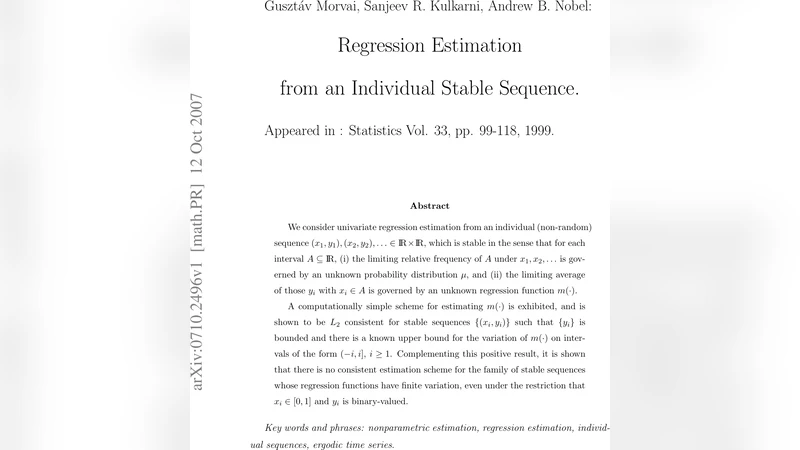
We consider univariate regression estimation from an individual (non-random) sequence $(x_1,y_1),(x_2,y_2), … \in \real \times \real$, which is stable in the sense that for each interval $A \subseteq \real$, (i) the limiting relative frequency of $A$ under $x_1, x_2, …$ is governed by an unknown probability distribution $\mu$, and (ii) the limiting average of those $y_i$ with $x_i \in A$ is governed by an unknown regression function $m(\cdot)$. A computationally simple scheme for estimating $m(\cdot)$ is exhibited, and is shown to be $L_2$ consistent for stable sequences ${(x_i,y_i)}$ such that ${y_i}$ is bounded and there is a known upper bound for the variation of $m(\cdot)$ on intervals of the form $(-i,i]$, $i \geq 1$. Complementing this positive result, it is shown that there is no consistent estimation scheme for the family of stable sequences whose regression functions have finite variation, even under the restriction that $x_i \in [0,1]$ and $y_i$ is binary-valued.
💡 Research Summary
The paper introduces a non‑probabilistic framework for univariate regression based on a single deterministic sequence of observations ((x_1,y_1),(x_2,y_2),\dots). The authors define a “stable sequence” as one for which, for every interval (A\subset\mathbb R), (i) the empirical relative frequency of the inputs (x_i) in (A) converges to a value prescribed by an unknown probability measure (\mu), and (ii) the empirical average of the corresponding responses (y_i) converges to the (\mu)-weighted average of an unknown regression function (m) over the same interval. In symbols, \
Comments & Academic Discussion
Loading comments...
Leave a Comment