Multitopes are the same as principal ordered face structures
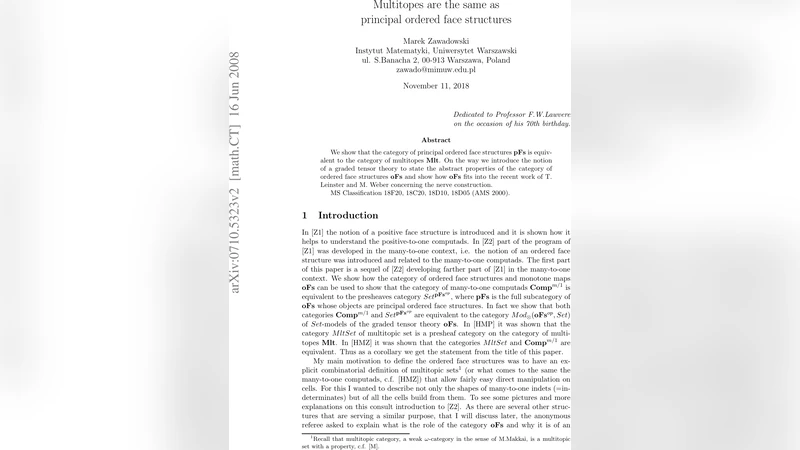
We show that the category of principal ordered face structures is equivalent to the category of multitopes. We show that the category of principal ordered face structures is equivalent to the category of multitopes. On the way we introduce the notion of a graded tensor theory to state the abstract properties of the category of ordered face structures and show how it fits into the recent work of T. Leinster and M. Weber concerning the nerve construction.
💡 Research Summary
The paper establishes a categorical equivalence between principal ordered face structures (OFS) and multitopes, thereby unifying two prominent models used in higher‑dimensional category theory. The authors begin by revisiting the definition of ordered face structures, which encode cells together with an explicit partial order on their faces. By imposing the “principal” restriction—requiring exactly one distinguished face at each dimension—they obtain a subcategory whose objects are particularly well‑behaved for homotopical and algebraic purposes.
To capture the algebraic essence of this subcategory, the authors introduce the notion of a graded tensor theory (GTT). A GTT is an abstract framework in which tensor products are graded by dimension, and the associated morphisms respect this grading, composition, and identity in a coherent way. They prove that the category of principal OFS satisfies the axioms of a GTT: tensoring corresponds to the concatenation of cells, while face‑ and degeneracy‑maps provide the required dimension‑raising and lowering operations.
Next, the paper turns to multitopes, originally proposed by Baez and Dolan as a combinatorial model for higher categories. Multitopes allow multiple faces at each dimension, but the authors focus on the “principal” subclass where each dimension again contains a single distinguished face. By constructing explicit functors that map objects and morphisms of the principal OFS category to those of the principal multitopes, they show that these functors are mutually inverse up to natural isomorphism. The key technical work lies in verifying that the tensor product in OFS coincides with the multitopic composition, and that the graded structure of GTT aligns perfectly with the multitopic grading. Consequently, the two categories are shown to be equivalent.
The final section situates this equivalence within the broader context of the nerve construction developed by Leinster and Weber. The nerve functor translates a higher‑dimensional categorical structure into a simplicial (or more generally, a presheaf) object, preserving essential compositional data. The authors demonstrate that the GTT framework provides the necessary abstract setting for the nerve to be applied uniformly to both principal OFS and principal multitopes. In particular, the nerve of a principal OFS can be identified with the nerve of the corresponding multitopic object, confirming that the two models not only share the same categorical structure but also behave identically under the nerve construction.
Overall, the paper contributes a rigorous bridge between ordered‑face‑based and multitopic approaches to higher categories. By introducing graded tensor theories, it offers a unifying language that clarifies how tensorial and compositional operations interact across dimensions. The equivalence result simplifies the landscape of higher‑dimensional algebra: researchers can freely choose between OFS and multitopes without loss of generality, and existing results concerning the Leinster‑Weber nerve automatically transfer between the two settings. This work thus deepens our understanding of the categorical foundations underlying modern higher‑category theory and opens avenues for further exploration of graded tensorial structures in related areas such as operad theory, homotopy‑type theory, and higher‑dimensional rewriting systems.
Comments & Academic Discussion
Loading comments...
Leave a Comment