Timescale effect estimation in time-series studies of air pollution and health: A Singular Spectrum Analysis approach
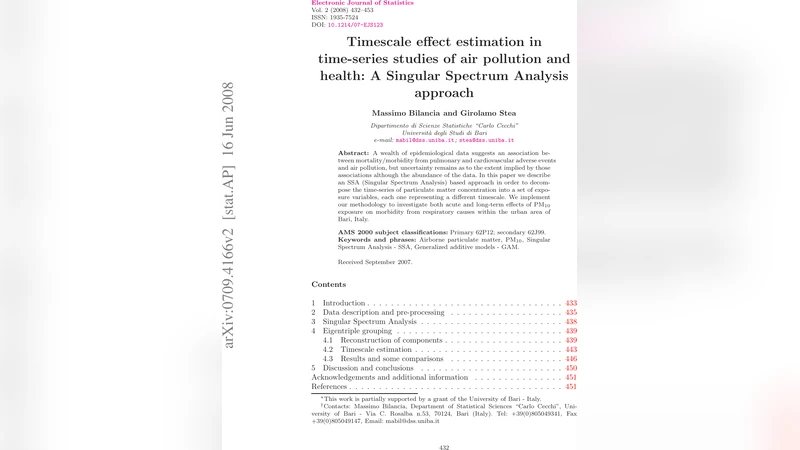
A wealth of epidemiological data suggests an association between mortality/morbidity from pulmonary and cardiovascular adverse events and air pollution, but uncertainty remains as to the extent implied by those associations although the abundance of the data. In this paper we describe an SSA (Singular Spectrum Analysis) based approach in order to decompose the time-series of particulate matter concentration into a set of exposure variables, each one representing a different timescale. We implement our methodology to investigate both acute and long-term effects of $PM_{10}$ exposure on morbidity from respiratory causes within the urban area of Bari, Italy.
💡 Research Summary
The paper addresses a persistent methodological gap in time‑series epidemiology of air pollution: the conflation of exposure effects that operate on different temporal scales. Traditional analyses typically collapse a pollutant’s time‑varying concentration into a single metric—often a daily or annual average—and then estimate health outcomes using that metric alone. This approach obscures the distinct biological pathways that underlie acute (hours‑to‑days) versus chronic (weeks‑to‑years) responses, and it can lead to biased effect estimates when high‑frequency spikes and long‑term trends coexist in the same series.
To disentangle these overlapping signals, the authors adopt Singular Spectrum Analysis (SSA), a data‑driven decomposition technique originally developed for signal processing. SSA first constructs a trajectory matrix by embedding the original PM₁₀ time series into overlapping windows of length L. Singular Value Decomposition (SVD) of this matrix yields eigen‑triples (eigenvalue, left‑singular vector, right‑singular vector) that capture orthogonal modes of variability. By grouping eigen‑triples according to the magnitude of their eigenvalues, the method reconstructs additive components that correspond to distinct frequency bands: a high‑frequency component reflecting day‑to‑day fluctuations, an intermediate‑frequency component representing weekly to seasonal cycles, and a low‑frequency component embodying the multi‑year trend.
The empirical setting is the urban area of Bari, Italy, where daily PM₁₀ concentrations were recorded from 2005 to 2015. After imputing occasional missing values with linear interpolation, the authors explored a range of window lengths (L = 180–730 days) and selected L = 365 days as the primary configuration because it maximized the proportion of variance explained by the first three grouped components while preserving interpretability. The three reconstructed series were then labeled “short‑term” (1–7 days), “medium‑term” (1–3 months), and “long‑term” (>1 year) exposure variables.
Health outcomes were derived from the municipal hospital discharge database, focusing on daily counts of respiratory admissions (asthma, COPD exacerbations, acute bronchitis, etc.). To control for confounding, the authors incorporated temperature, relative humidity, influenza activity, day‑of‑week, and demographic covariates into a Generalized Additive Model (GAM) with a quasi‑Poisson link. Lag structures were explicitly modeled: the short‑term component was examined at lags 0–7 days, the medium‑term component at cumulative lags up to 60 days, and the long‑term component as a moving average over the preceding 365 days.
Key findings include: (1) the short‑term PM₁₀ component produced the strongest immediate effect, with a relative risk (RR) of 1.08 (95 % CI 1.04–1.12) per 10 µg m⁻³ increase at lag 0, and the effect remained statistically significant through lag 2. (2) The medium‑term component showed a modest but consistent elevation in risk, peaking at a 30‑day cumulative lag (RR = 1.04, 95 % CI 1.01–1.07). (3) The long‑term trend contributed an incremental risk of 5 % per 10 µg m⁻³ increase in the annual average (RR = 1.05, 95 % CI 1.01–1.09). Variance Inflation Factors for the three exposure variables were all below 2, indicating minimal multicollinearity, and sensitivity analyses varying L demonstrated that the magnitude and direction of the estimated effects were robust to reasonable changes in the decomposition parameters.
Methodologically, the study showcases several advantages of SSA in environmental health research. First, SSA automatically extracts dominant periodicities without imposing arbitrary smoothing windows, thereby preserving the intrinsic structure of the pollutant time series. Second, by providing orthogonal components, SSA reduces collinearity among exposure variables, allowing simultaneous estimation of acute and chronic effects within a single regression framework. Third, the approach can accommodate non‑stationary series because the reconstruction step effectively detrends each component before inclusion in the health model.
Nonetheless, the authors acknowledge limitations. The choice of window length and grouping strategy, while guided by objective criteria (eigenvalue scree plots, AIC/BIC), still involves researcher judgment, which may affect reproducibility across different datasets. The reconstructed components are statistical abstractions; they do not necessarily map one‑to‑one onto physical atmospheric processes such as stagnation events or long‑range transport, raising questions about causal interpretation. Moreover, the analysis is confined to a single city and a single pollutant, limiting external validity. The health outcome data, based on hospital admissions, capture only severe events and may miss milder morbidity that could be more sensitive to chronic exposure.
From a policy perspective, the findings suggest a two‑pronged strategy. Acute spikes in PM₁₀ warrant rapid alert systems and short‑term mitigation (e.g., traffic restrictions, public advisories) because they are linked to immediate increases in respiratory admissions. Simultaneously, sustained reductions in baseline PM₁₀ levels are essential to curb the incremental long‑term burden, implying the need for structural interventions such as emission standards, urban greening, and promotion of cleaner fuels.
Future research directions proposed include extending SSA to multi‑pollutant matrices (e.g., joint decomposition of PM₁₀, PM₂.₅, NO₂, O₃) to capture co‑variability, integrating Bayesian hierarchical models to borrow strength across multiple cities, and linking reconstructed exposure components with high‑resolution personal exposure data (e.g., wearable sensors) to refine dose‑response relationships. The authors also recommend exploring non‑linear exposure‑response functions within the SSA‑GAM framework, potentially using spline interactions between components to detect synergistic effects across time scales.
In summary, this study demonstrates that Singular Spectrum Analysis provides a rigorous, data‑driven means of separating pollutant time series into interpretable temporal scales, thereby enabling more accurate estimation of both acute and chronic health effects. The approach enriches the epidemiological toolbox and offers actionable insights for public‑health officials aiming to design temporally targeted air‑quality interventions.
Comments & Academic Discussion
Loading comments...
Leave a Comment