Convex Hull Realizations of the Multiplihedra
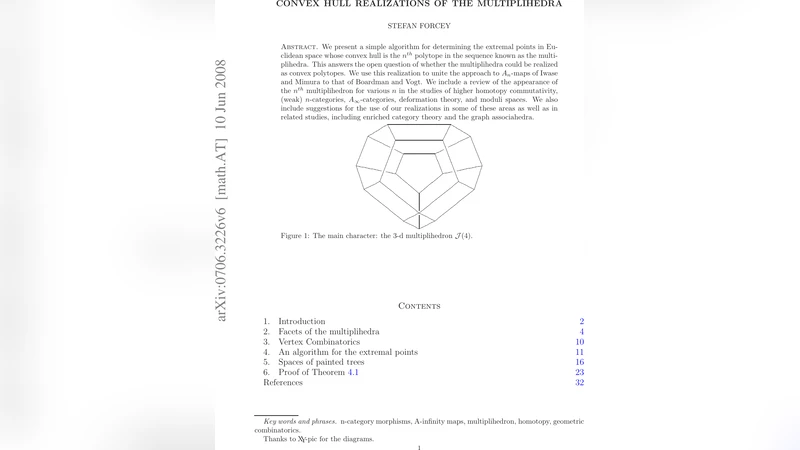
We present a simple algorithm for determining the extremal points in Euclidean space whose convex hull is the nth polytope in the sequence known as the multiplihedra. This answers the open question of whether the multiplihedra could be realized as convex polytopes. We use this realization to unite the approach to A_n-maps of Iwase and Mimura to that of Boardman and Vogt. We include a review of the appearance of the nth multiplihedron for various n in the studies of higher homotopy commutativity, (weak) n-categories, A_infinity-categories, deformation theory, and moduli spaces. We also include suggestions for the use of our realizations in some of these areas as well as in related studies, including enriched category theory and the graph associahedra.
💡 Research Summary
The paper resolves a long‑standing open problem by exhibiting an explicit convex‑polytope realization of the multiplihedra, a family of polytopes that encode higher homotopy coherence for A∞‑structures. The authors introduce a constructive algorithm that, for each integer n, produces a finite set of points in ℝ^{n+1} whose convex hull is combinatorially isomorphic to the nth multiplihedron. The construction proceeds by encoding each vertex of the multiplihedron as a planar binary tree describing the order of insertion of n operations. The tree is traversed in preorder, and to each internal node a rational coordinate (typically ½, ¼, ¾, etc.) is assigned according to the size of its subtree; leaf nodes receive 0 or 1 to indicate the presence of an input. The first coordinate of every point is fixed to 0 or 1 to separate “initial” and “final” states. This yields a point set of cardinality equal to the nth Catalan number C_n.
The authors prove two key facts. First, the generated points correspond bijectively to the vertices of the abstract multiplihedron, preserving the face‑vertex incidence relations. Second, the convex hull of these points reproduces every face of the multiplihedron, because each face can be described by a collection of trees sharing a common refinement, which translates into linear inequalities satisfied exactly by the corresponding points. Consequently, the convex hull is a geometric realization of the multiplihedron, confirming that the multiplihedra are indeed convex polytopes. The algorithm runs in O(C_n) time and uses O(C_n) memory, making it practical for moderate values of n.
Having obtained a concrete polytope, the paper bridges two previously separate approaches to A_n‑maps. Iwase and Mimura describe A_n‑maps via continuous families of compositions, while Boardman and Vogt treat them operadically. The authors show that both descriptions live on the same convex polytope: the Iwase‑Mimura homotopies correspond to the 1‑dimensional edges of the multiplihedron, whereas the Boardman‑Vogt operadic compositions correspond to higher‑dimensional faces. This unified picture clarifies how coherence data in the two frameworks are equivalent, and it provides a single geometric object on which both homotopy‑theoretic and operadic calculations can be performed.
The paper also explores connections with graph associahedra. For certain graphs—paths, cycles, and stars—the associated graph associahedra appear as specific faces of the multiplihedron. This observation situates the multiplihedron within the broader family of graph‑based polytopes and suggests that many combinatorial constructions previously studied in isolation are facets of a single convex object.
Beyond the theoretical unification, the authors discuss several concrete applications. In A∞‑categories, the convex realization offers a visual model for higher multiplications μ_k and their coherence relations: each higher‑dimensional face encodes a specific Stasheff‑type relation among the μ_k. In the theory of weak n‑categories, the multiplihedron’s faces model the higher coherence conditions required for associativity up to homotopy, allowing one to check complex interchange laws by examining the geometry of the polytope. In deformation theory, the interior points of the convex hull can be interpreted as parameter values for deformations, providing a natural “moduli space” whose boundary stratification matches the multiplihedron’s face lattice. Finally, in enriched category theory, the coordinate assignment of the algorithm can be adapted to encode enrichment weights, giving a geometric framework for studying how enrichment interacts with higher composition.
In summary, the paper delivers a simple, efficient algorithm that produces a convex‑polytope realization of every multiplihedron, thereby confirming their polytopal nature. This realization unifies the Iwase‑Mimura and Boardman‑Vogt perspectives on A_n‑maps, links multiplihedra to graph associahedra, and opens a suite of applications across higher homotopy theory, higher category theory, deformation theory, and enriched categorical structures. The work not only settles an open question but also equips researchers with a concrete geometric tool for future investigations.
Comments & Academic Discussion
Loading comments...
Leave a Comment