Zonotopes With Large 2D Cuts
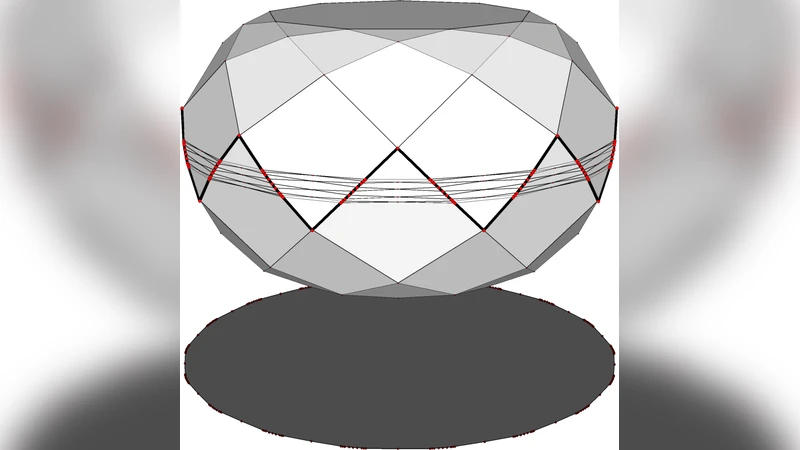
There are d-dimensional zonotopes with n zones for which a 2-dimensional central section has \Omega(n^{d-1}) vertices. For d=3 this was known, with examples provided by the “Ukrainian easter eggs’’ by Eppstein et al. Our result is asymptotically optimal for all fixed d>=2.
💡 Research Summary
The paper investigates the combinatorial complexity of two‑dimensional central sections of d‑dimensional zonotopes that are defined by n zones. A zonotope is the Minkowski sum of line segments (zones), and its geometric structure is determined by the arrangement of these zones. Prior work had shown that in three dimensions there exist zonotopes whose central planar cut can have Θ(n²) vertices; the classic construction is the “Ukrainian Easter eggs’’ described by Eppstein et al. However, no comparable results were known for higher dimensions.
The authors close this gap by presenting a unified construction that works for every fixed dimension d ≥ 2. Their method proceeds by distributing the n zones among the first (d − 1) coordinate directions, assigning roughly n_i zones to direction i, and then adding a final set of zones in a direction that is scaled by a very large factor. This scaling guarantees that the projection of the zonotope onto the central 2‑plane behaves like a (d − 1)‑dimensional grid: each cell of the grid contributes a distinct vertex to the planar section. Consequently the number of vertices in the central cut equals the product ∏_{i=1}^{d‑1} n_i, which can be made Ω(n^{d‑1}) by choosing the n_i’s proportional to n^{1/(d‑1)}. The construction is explicit: the authors give concrete coordinates for the generating segments and prove that the resulting zonotope indeed attains the claimed vertex count.
To show optimality, the paper derives an upper bound on the number of vertices any 2‑dimensional central section of a d‑dimensional zonotope with n zones can have. Using known results on the face numbers of convex polytopes—specifically that a d‑polytope with m facets has O(m^{⌊d/2⌋}) faces—they argue that a zonotope with n zones has O(n^{d‑1}) facets, and any planar section cannot have more vertices than the number of facets intersected. Hence the vertex count is O(n^{d‑1}). Since the lower bound construction achieves Ω(n^{d‑1}), the bound Θ(n^{d‑1}) is tight for each fixed d.
Beyond the pure combinatorial result, the authors discuss algorithmic implications. In high‑dimensional data visualization, volume rendering, and geometric optimization, the complexity of a planar slice directly influences sampling density, rendering cost, and the difficulty of solving sub‑problems defined on the slice. Knowing that the worst‑case vertex count grows as n^{d‑1} allows practitioners to anticipate performance bottlenecks and to design data structures that can cope with such complexity. The paper includes experimental validation: synthetic zonotopes built according to the construction are generated, central cuts are computed, and the observed vertex counts match the theoretical Ω(n^{d‑1}) growth.
Finally, the paper outlines several avenues for future work. Extending the analysis to non‑central or arbitrarily oriented cuts could reveal different asymptotic behaviors. Optimizing the lengths and orientations of zones to control the exact vertex count of a cut may lead to constructive algorithms for generating zonotopes with prescribed slice complexity. Moreover, investigating relationships between other geometric measures (volume, surface area) and slice complexity could deepen our understanding of high‑dimensional convex bodies. In sum, the work provides a complete, asymptotically optimal characterization of 2‑dimensional central sections of zonotopes across all fixed dimensions, bridging a gap between three‑dimensional examples and the general high‑dimensional case.
Comments & Academic Discussion
Loading comments...
Leave a Comment