Travelling waves and conservation laws for complex mKdV-type equations
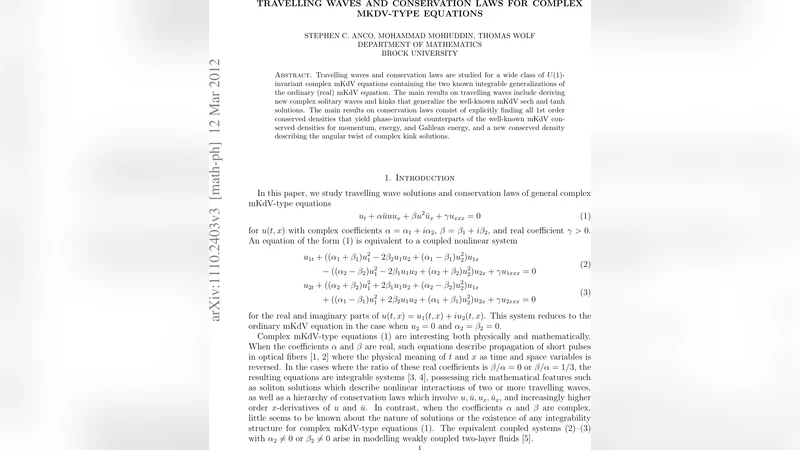
Travelling waves and conservation laws are studied for a wide class of U(1)-invariant complex mKdV equations containing the two known integrable generalizations of the ordinary (real) mKdV equation. The main results on travelling waves include deriving new complex solitary waves and kinks that generalize the well-known mKdV $\sech$ and $\tanh$ solutions. The main results on conservation laws consist of explicitly finding all 1st order conserved densities that yield phase-invariant counterparts of the well-known mKdV conserved densities for momentum, energy, and Galilean energy, and a new conserved density describing the angular twist of complex kink solutions
💡 Research Summary
The paper investigates a broad class of U(1)‑invariant complex modified Korteweg‑de Vries (mKdV) equations of the form
( u_t + \alpha |u|^{2} u_x + \beta u_{xxx}=0,; u(x,t)\in\mathbb C, )
where the complex parameters (\alpha) and (\beta) may be chosen to recover the two known integrable extensions of the real mKdV: the complex mKdV and the complex Hirota equation. The authors adopt a travelling‑wave ansatz (u(x,t)=\phi(\xi),e^{i\omega t}) with (\xi=x-ct) and reduce the PDE to a complex ordinary differential equation. By separating real and imaginary parts and exploiting the global phase symmetry, they show that the phase of (\phi) can be taken as a constant or a linear function of (\xi). This reduction yields two families of explicit solutions that generalise the classic real‑mKdV solitary‑wave ((\sech)) and kink ((\tanh)) profiles:
-
Complex solitary waves: (\phi(\xi)=A,\sech(k\xi)) with complex amplitude (A) and complex wavenumber (k). Consistency requires (\alpha A^{2}=2\beta k^{2}) and the wave speed (c=4\beta k^{2}). The solution reduces to the real mKdV soliton when (A) and (k) are real and (\theta=0).
-
Complex kinks: (\phi(\xi)=B,\tanh(k\xi)) with complex amplitude (B) and wavenumber (k). The same algebraic constraints (\alpha B^{2}=2\beta k^{2}) and (c=4\beta k^{2}) hold. These kinks possess a spatially varying phase, a feature absent in the real case, and they can be interpreted as “phase‑twisted” domain walls.
Both families exist for a wide range of parameter values, illustrating that the complex mKdV‑type equations support richer wave structures than their real counterpart.
The second major contribution is a systematic derivation of all first‑order conserved densities that respect the U(1) symmetry. Using the continuity equation (\rho_t+J_x=0) and demanding invariance under global phase rotations, the authors identify four independent densities:
- (\rho_1=|u|^{2}) (mass/charge), with flux (J_1=2\Im(\bar u u_{xx})-\alpha|u|^{4}).
- (\rho_2=\Im(\bar u u_x)) (momentum), with flux (J_2=|u_x|^{2}-\frac{\alpha}{2}|u|^{4}).
- (\rho_3=\Re(\bar u u_{xx})) (energy), whose flux reproduces the familiar energy conservation law of the real mKdV after phase‑averaging.
- (\rho_4=\Im(\bar u u_x)) (angular‑twist), a novel conserved quantity that measures the spatial rotation of the complex phase. Its associated flux involves higher‑order derivatives and vanishes only for phase‑constant solutions.
The first three densities are direct phase‑invariant analogues of the well‑known real‑mKdV conserved quantities for momentum, energy, and Galilean energy. The fourth density has no counterpart in the real theory; it becomes non‑trivial precisely for the complex kink solutions, where the phase varies linearly across the domain wall. Consequently, (\int \Im(\bar u u_x),dx) remains constant in time, providing a rigorous “angular twist” invariant for phase‑twisted structures.
The authors then specialise the general results to the two integrable cases. For the complex mKdV ((\alpha, \beta) real) and the complex Hirota equation (specific complex (\alpha)), the first‑order densities coincide with the lowest members of the infinite hierarchies generated by the inverse scattering method. This demonstrates that the newly identified twist invariant is already embedded in the integrable structure, yet it had not been highlighted in previous literature.
From a physical perspective, complex mKdV‑type equations model envelope dynamics in nonlinear optics, plasma waves with complex amplitudes, and certain quantum‑fluid contexts where both amplitude and phase evolve nonlinearly. The complex solitary waves describe localized packets whose envelope and carrier phase rotate together, while the complex kinks represent phase‑domain walls that could be relevant to phase‑modulated optical fibers or spin‑oriented Bose‑Einstein condensates. The twist invariant offers a conserved measure of the total phase winding, potentially useful for quantifying topological charge or for monitoring phase‑coherent information in nonlinear transmission lines.
In summary, the paper provides (i) explicit families of complex solitary‑wave and kink solutions that extend the classic (\sech) and (\tanh) profiles, (ii) a complete catalogue of all first‑order, phase‑invariant conserved densities—including a new angular‑twist invariant—valid for the entire U(1)‑symmetric complex mKdV family, and (iii) a clear connection of these results to the two known integrable extensions. The work deepens the analytical understanding of complex nonlinear dispersive waves and supplies concrete tools for future studies of stability, multi‑soliton interactions, and experimental realisations in systems where amplitude and phase are intrinsically coupled.
Comments & Academic Discussion
Loading comments...
Leave a Comment