On Secure Distributed Implementations of Dynamic Access Control
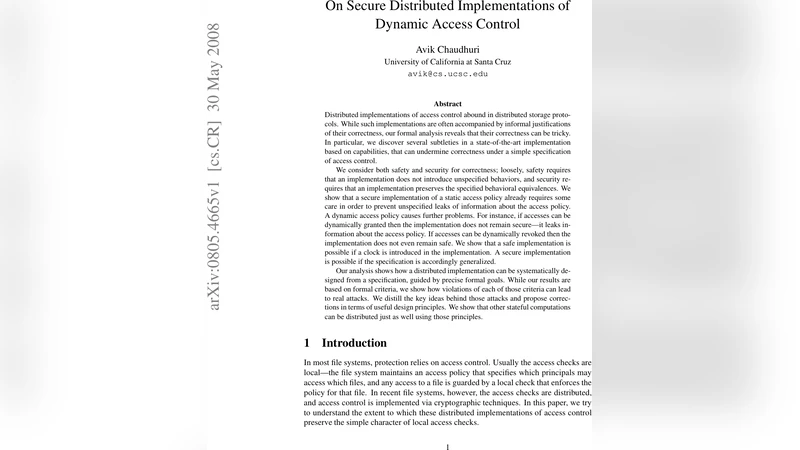
Distributed implementations of access control abound in distributed storage protocols. While such implementations are often accompanied by informal justifications of their correctness, our formal analysis reveals that their correctness can be tricky. In particular, we discover several subtleties in a standard protocol based on capabilities, that can break security under a simple specification of access control. At the same time, we show a sensible refinement of the specification for which a secure implementation of access control is possible. Our models and proofs are formalized in the applied pi calculus, following some new techniques that may be of independent interest. Finally, we indicate how our principles can be applied to securely distribute other state machines.
💡 Research Summary
The paper presents a rigorous formal analysis of capability‑based access control protocols used in distributed file systems, focusing on both static and dynamic access policies. The authors model the interaction between an access‑control server (A) and a storage server (S) using the applied π‑calculus, where A holds a static policy F and issues unforgeable MAC‑protected capabilities to users. A simple ideal protocol (IS) that directly checks the policy without cryptography serves as the specification against which the real protocol (NS) is evaluated.
For static policies, the authors identify two subtle leaks. First, the mere presence or absence of a capability reveals whether a user is authorized (R3). Second, capabilities issued to different users for the same operation can be compared, allowing an adversary to infer policy differences (R4). To mitigate these, they propose that A always returns a capability—real for authorized users, fake otherwise—and that each capability embed the requester’s identifier (h_U) together with the operation. This ensures that capabilities are indistinguishable to unauthorized parties and that no two users receive identical tokens. With these modifications, they prove (Theorem 1) that NS securely implements IS, satisfying both safety (no extra behaviours) and security (preservation of behavioural equivalences) under a may‑testing congruence.
When the policy becomes dynamic, additional messages allow administrators to modify F via operations θ. The naïve extension (NS_d) fails both safety and security. A user can acquire a capability before a revocation, then still use it after the policy change, violating safety. Moreover, the timing of policy changes can be inferred from the presence or absence of capabilities, breaking security. The authors first note that forbidding revocation (assumption A1) restores safety, but this is unrealistic.
To address the dynamic case, they introduce a logical clock shared by A and S. Capabilities now carry a timestamp (Clk_i) and are valid only until the next clock tick (R5). Administrative operations are delayed to the next tick, ensuring that policy updates and capability expirations are synchronized (R6). This “midnight‑shift” scheme guarantees that a capability issued under an old policy cannot be used after the policy changes, because it expires before the new policy takes effect. To keep the specification consistent, the ideal protocol IS_d is also extended with clock messages, so that time information is observable in both the implementation and the specification (R7). With these changes, they prove (Theorem 2) that NS_d safely implements IS_d under A1, and (Theorem 3) that NS_d⁺ securely implements IS_d⁺ without the revocation restriction, provided the clock mechanism is in place.
The paper distills a set of design principles (R1‑R7) that guide the construction of secure distributed access control: (R1) capabilities must not be shared with dishonest users; (R2) capabilities should not be examined or compared; (R3) fake capabilities must be issued to hide authorization status; (R4) capabilities must be user‑specific; (R5‑R7) incorporate time into tokens and policy updates. These principles are enforced through type‑checking and careful protocol design.
Methodologically, the authors develop a novel proof technique that combines simulation relations, refinement maps, and may‑testing congruence to achieve full abstraction between the implementation and the specification. This technique is highlighted as a contribution of independent interest.
Finally, the authors argue that the same principles apply to other stateful distributed computations, such as secure query processing or authentication services, suggesting a broader impact of their work on the design of provably secure distributed systems.
In conclusion, the paper demonstrates that capability‑based distributed access control is vulnerable to subtle information leaks unless capabilities are carefully constructed to embed user identity and temporal validity. By formalizing safety and security, exposing concrete attacks, and providing provably correct protocol refinements, the authors offer a solid foundation for building safe and secure distributed file systems and related services.
Comments & Academic Discussion
Loading comments...
Leave a Comment