Postnikov towers, k-invariants and obstruction theory for DG categories
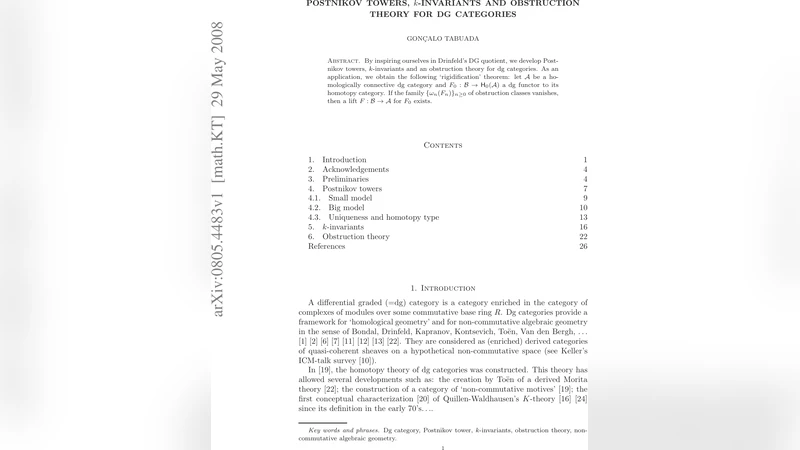
By inspiring ourselves in Drinfeld’s DG quotient, we develop Postnikov towers, k-invariants and an obstruction theory for dg categories. As an application, we obtain the following `rigidification’ theorem: let A be a homologically connective dg category and F:B -> H0(A) a dg functor to its homotopy category. If the family of obstruction classes vanishes, then a lift for F exists.
💡 Research Summary
The paper develops a systematic framework for constructing Postnikov towers, defining k‑invariants, and establishing an obstruction theory for differential graded (DG) categories, extending classical homotopical tools from spaces and spectra to the non‑commutative algebraic setting. Inspired by Drinfeld’s DG quotient, the authors first introduce a truncation process: for a given DG category 𝒜 and each integer n≥0 they define a “n‑th Postnikov stage” 𝒜ₙ by killing all homology above degree n while preserving the lower homology groups πᵢ(𝒜) for i≤n. This is achieved by applying a suitable DG quotient that respects the Quillen model structure on DG categories, ensuring that the natural map 𝒜→𝒜ₙ is a fibration and that the tower 𝒜→…→𝒜ₙ→𝒜ₙ₋₁→… is homotopy equivalent to 𝒜.
The key novelty lies in the definition of k‑invariants for DG categories. In the classical setting a k‑invariant is a cohomology class that measures the obstruction to extending a Postnikov stage one step further. Analogously, the authors construct a class kₙ∈Hⁿ⁺¹(𝒜ₙ₋₁,πₙ₊₁(𝒜)) using the DG quotient’s canonical triangle and a Bousfield–Kan type fibrant replacement. This class encodes the higher differential and higher composition data that are invisible at lower stages, and it completely determines the extension 𝒜ₙ₋₁→𝒜ₙ.
With the tower and k‑invariants in place, the paper develops an obstruction theory for lifting a DG functor F:ℬ→H₀(𝒜) (where H₀(𝒜) is the homotopy category of 𝒜) to an actual DG functor ℬ→𝒜. For each stage n one defines an obstruction class oₙ(F)∈Hⁿ⁺¹(ℬ,πₙ₊₁(𝒜)) obtained by pulling back the k‑invariant along the partial lift of F to 𝒜ₙ₋₁. The vanishing of oₙ(F) is necessary and sufficient for extending the lift to the next stage. Consequently, if all obstruction classes vanish, an inductive construction yields a genuine DG functor \tilde F:ℬ→𝒜 that realizes the original map on homotopy categories.
The central result, called the “rigidification theorem,” states: let 𝒜 be a homologically connective DG category (i.e., πᵢ(𝒜)=0 for i<0) and let F:ℬ→H₀(𝒜) be any DG functor to its homotopy category. If the entire family of obstruction classes {oₙ(F)}ₙ≥0 vanishes, then there exists a lift \tilde F:ℬ→𝒜. The proof proceeds by constructing the Postnikov tower of 𝒜, using the model‑category lifting properties at each stage, and applying the vanishing of the obstruction classes to guarantee the existence of the required extensions.
The paper concludes with several applications. It shows that A∞‑categories, which can be modeled by suitable DG categories, admit strictifications under the same vanishing conditions, thereby recovering known results on the rigidification of A∞‑functors. It also treats DG module categories, demonstrating that morphisms between their homotopy categories can be lifted to genuine DG functors when the obstruction classes disappear. These examples illustrate the broad relevance of the theory to non‑commutative geometry, derived algebraic geometry, and higher category theory.
Finally, the authors discuss future directions, suggesting that the framework may be adapted to DG stacks, to the study of descent for DG sheaves, and to the development of spectral sequences that compute the obstruction groups in concrete situations. The work thus provides a powerful new toolbox for handling higher homotopical phenomena in the realm of DG categories.
Comments & Academic Discussion
Loading comments...
Leave a Comment