The Origin of Semiconductor Physics in Italy: 1945 - 1965
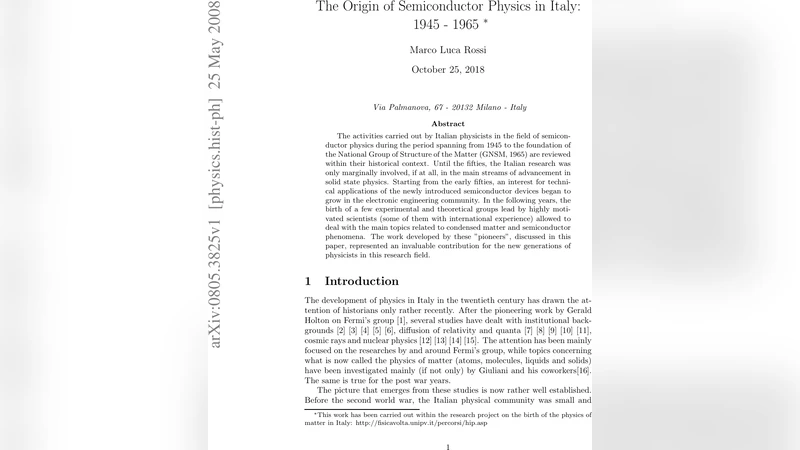
The activities carried out by Italian physicists in the field of semiconductor physics during the period spanning from 1945 to the foundation of the National Group of Structure of the Matter (GNSM, 1965) are reviewed within their historical context. Until the fifties, the Italian research was only marginally involved, if at all, in the main streams of advancement in solid state physics. Starting from the early fifties, an interest for technical applications of the newly introduced semiconductor devices began to grow in the electronic engineering community. In the following years, the birth of a few experimental and theoretical groups lead by highly motivated scientists (some of them with international experience) allowed to deal with the main topics related to condensed matter and semiconductor phenomena. The work developed by these “pioneers”, discussed in this paper, represented an invaluable contribution for the new generations of physicists in this research field.
💡 Research Summary
The paper provides a comprehensive historical review of the emergence and development of semiconductor physics in Italy from the end of World War II until the establishment of the National Group of Structure of the Matter (GNSM) in 1965. In the immediate post‑war period Italian research was dominated by nuclear and particle physics, reflecting the legacy of Enrico Fermi and Bruno Rossi. The university curricula remained largely classical; quantum mechanics was only introduced in a few institutions in the early 1960s, creating a generational knowledge gap of about twenty‑five years for condensed‑matter topics.
During the 1940s and early 1950s, Italian scientific meetings (e.g., the SIF conferences) barely mentioned the transistor, and funding was heavily skewed toward elementary‑particle research. Consequently, solid‑state and semiconductor studies lagged behind the international community. Nonetheless, the early 1950s saw a growing interest among electronic engineers, who published practical notes on transistors in technical magazines such as “Poste e Telecomunicazioni”. This engineering‑driven curiosity sparked the formation of a few experimental groups, notably at the Istituto Ugo Bordoni (established 1952) under Daniele Sette, and later at the newly created semiconductor firms SGS (Milan) and ATE S (Catania).
Key Italian physicists—Franco Bassani, Daniele Sette, Giampaolo Bolognesi, and others—began publishing theoretical and experimental work on band‑structure calculations, free‑electron models, and device characteristics. Table 2 of the article quantifies this output, showing a steady increase in papers appearing in journals such as Alta Frequenza, Journal of Applied Physics, and Physical Review between 1956 and 1966.
The paper highlights structural impediments: national research budgets amounted to only 0.2 % of GDP, and less than 4 % of CNR’s allocation went to solid‑state physics. Industry and academia operated largely in isolation; semiconductor firms focused on device production while universities lacked dedicated curricula and research lines. By 1963 only 9 % of physics graduates entered industry, the rest remaining in academia or other sectors.
In response to these challenges, the community organized the “Gruppi Italiani di Struttura della Materia” (GISM) in 1963, which was formally recognized by CNR in 1965 as GNSM. The group unified 24 research teams, launched a bulletin to disseminate advances in condensed‑matter physics, and fostered collaboration with international specialists. The establishment of GNSM, together with the introduction of a “Structure of Matter” course in university curricula, marked a turning point, providing the institutional backbone for subsequent generations of Italian condensed‑matter researchers.
Overall, the article argues that despite early marginalization, limited funding, and a weak link between industry and academia, a small cadre of motivated scientists—often with overseas experience—gradually built the foundations of Italian semiconductor physics. Their efforts, culminating in the formation of GNSM, transformed a fragmented, under‑resourced field into a coherent research community that would later contribute significantly to both national technology development and the global solid‑state physics enterprise.
Comments & Academic Discussion
Loading comments...
Leave a Comment