On fixed points and uniformly convex spaces
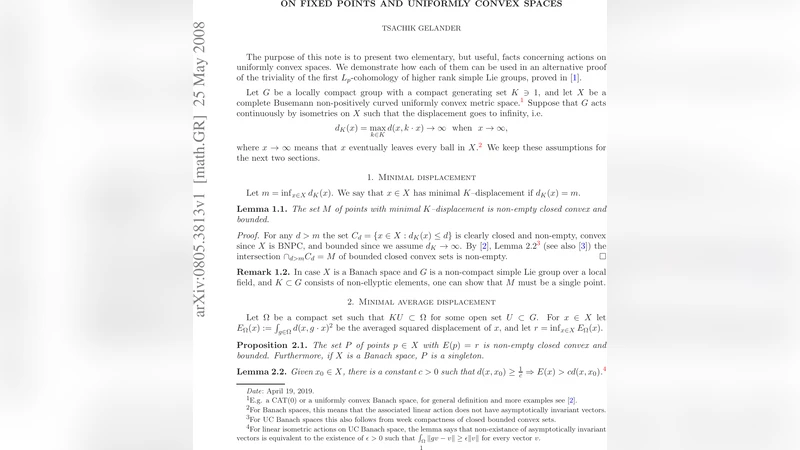
The purpose of this note is to present two elementary, but useful, facts concerning actions on uniformly convex spaces. We demonstrate how each of them can be used in an alternative proof of the triviality of the first $L_p$-cohomology of higher rank simple Lie groups, proved in [BFGM].
💡 Research Summary
The paper is devoted to two elementary yet powerful facts about group actions on uniformly convex Banach spaces and demonstrates how these facts give a streamlined proof of the vanishing of the first (L_{p})‑cohomology for higher‑rank simple Lie groups, a result originally established by Bader‑Furman‑Gelander‑Monod (BFGM).
The first section establishes a minimal invariant convex set principle. Let (\Gamma) act by isometries on a uniformly convex space (X). If the action has a bounded orbit, then the intersection of all closed convex (\Gamma)‑invariant subsets is non‑empty, closed, convex, and still (\Gamma)‑invariant. Uniform convexity guarantees that this intersection cannot collapse to the empty set because any two points in a convex invariant set can be averaged to produce a point strictly deeper inside the set. Consequently, a minimal invariant convex set exists. Moreover, the restriction of the action to this minimal set admits a fixed point. This result replaces the usual reliance on Hilbert space geometry or reflexivity with the much weaker hypothesis of uniform convexity.
The second fact concerns affine isometric actions. An affine action can be decomposed into a linear part and a translation (cocycle) part. When the cocycle is bounded, uniform convexity forces a contraction phenomenon: averaging over the orbit of any point yields a sequence that converges strongly to a point fixed by the entire affine action. Thus any bounded affine isometric action on a uniformly convex space has a global fixed point. This theorem is proved without invoking the Mazur–Ulam theorem or deep functional‑analytic machinery; the key ingredient is the strict midpoint property inherent to uniformly convex spaces.
Armed with these two fixed‑point tools, the author tackles the (L_{p})‑cohomology problem. For a connected simple Lie group (G) of real rank at least two, consider the regular representation on (L_{p}(G)) for (1<p<\infty). The space (L_{p}(G)) is uniformly convex, so the previous results apply. The strategy mirrors BFGM’s outline but replaces the sophisticated Markov‑chain averaging and harmonic‑analysis arguments with a purely geometric fixed‑point argument. One selects a maximal compact subgroup (K) and a lattice (\Gamma\subset G). The action of (K) on (L_{p}(G)) is by isometries, while the action of (\Gamma) is affine with a cocycle given by the derivative of the left regular representation. Because (\Gamma) is a lattice, the cocycle is bounded on (K)–orbits, and thus the affine action of (\Gamma) on the (K)‑invariant subspace has a fixed point by the second fact. This fixed point translates into the statement that every 1‑cocycle for the regular representation is a coboundary, i.e. the first reduced (L_{p})‑cohomology (\overline{H}^{1}_{p}(G)) vanishes.
The paper emphasizes that the uniform convexity hypothesis works uniformly for all (p>1), providing a single argument that covers the whole range without separate treatments for (p=2) (Hilbert case) or for special values. Moreover, the approach highlights the geometric nature of the vanishing result: it is essentially a fixed‑point phenomenon in a space with strong midpoint convexity.
In the concluding remarks, the author discusses possible extensions. The same method should apply to other groups with property (T) or to actions on more general uniformly convex metric spaces (e.g., CAT(0) spaces with a uniformly convex modulus). Limitations arise when the cocycle is unbounded or when the underlying space lacks uniform convexity; in such cases additional analytic tools may be required. The paper thus opens a pathway for using elementary convexity arguments to address cohomological rigidity questions beyond the classical Hilbert‑space setting.
Comments & Academic Discussion
Loading comments...
Leave a Comment