Analysis of hydrocyclone performance based on information granulation theory
This paper describes application of information granulation theory, on the analysis of hydrocyclone perforamance. In this manner, using a combining of Self Organizing Map (SOM) and Neuro-Fuzzy Inference System (NFIS), crisp and fuzzy granules are obt…
Authors: Hamed Owladeghaffari, Majid Ejtemaei, Mehdi Irannajad
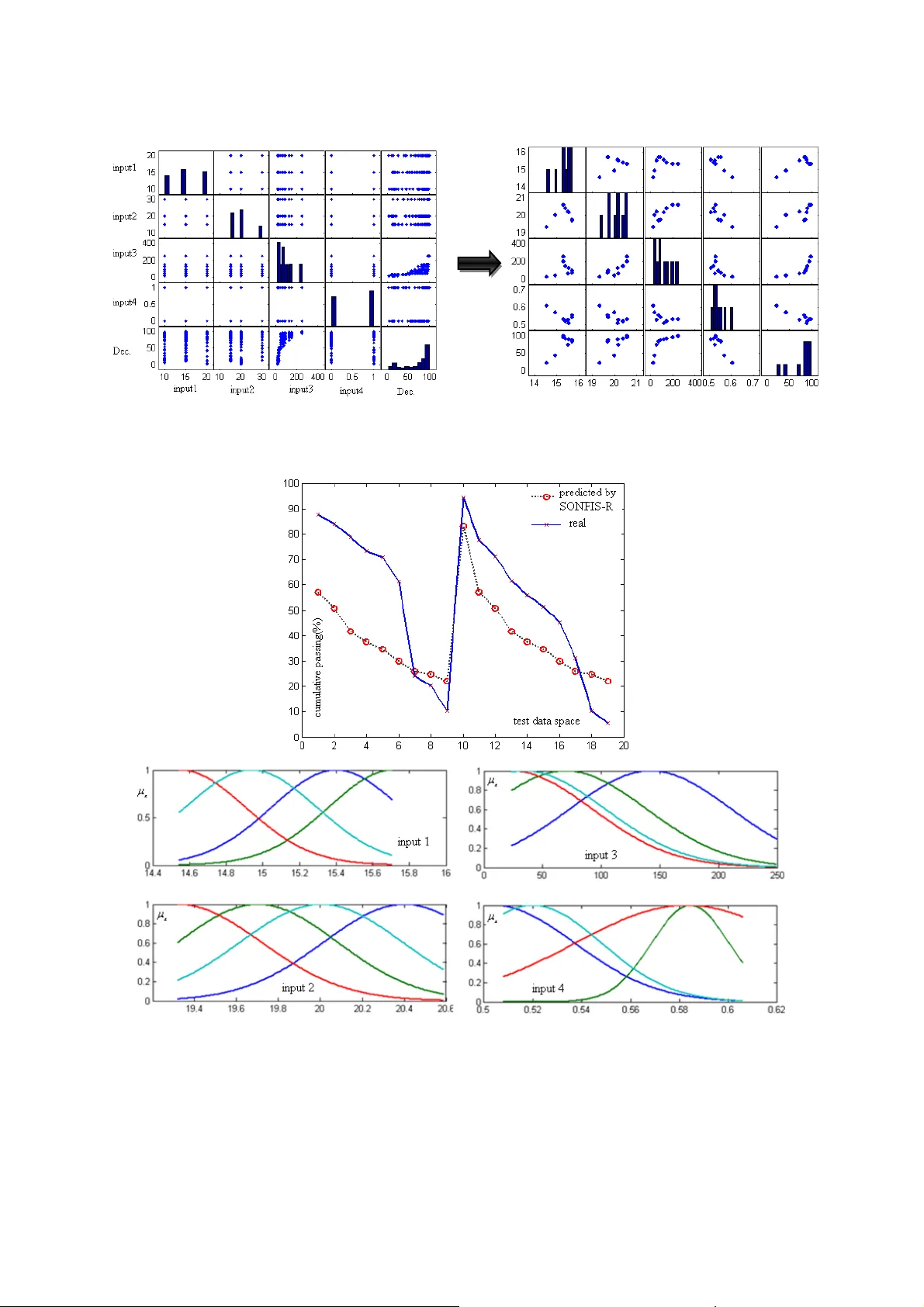
8th. World Congress on Computational Mechanics (WCCM8) 5th. European Congress on Computational Methods in Applied Sciences and Engineering (ECCOMAS 2008) June 30 – July 5, 2008 Venice, Italy Analysis of hydrocyclone perf ormance based on information granulation theory Hamed Owladeghaffari ¹, Majid Ejtemaei* ² an d Mehdi Irannaj ad ³ ¹ Dept.mining & metallurgical engineering,Teharn,Iran h.o.ghaffari@gmail.com ² Dept.mining & metallurgical engineering,Teharn,Iran majidejtemaei@gm ail.com ³ Dept.mining & metallurgical engineering,Teharn,Iran irannajad@aut.ac.ir Key Words: Information granulation theory, SOM, NFIS, hydrocyclon e. ABSTRACT . This paper describes application of inform ation granulation theory, on the analysis of hydrocyclone perforamance. In this manner, using a combining of Self Organizing Map (SOM) and Neuro-Fuzzy Inference System (NFIS), crisp and fuzzy granules are obtained(briefly called SONFIS). Balancing of crisp granules and sub fuzzy granules, within non fuzzy information (initial granulation), is re ndered in an open-close iteration. Using two criteria, "simplicity of rules "and "adaptive th reoshold error level", stability of algorithm is guaranteed. Validation of the proposed method, on the data set of the hydrocyclone is rendered. 1. Introduction In the design of mineral processing cycle, one of the m ost important issues is the selection of hydrocyclone in different part s of the site. However, prediction of hydrocyclone performance using direct or indirect m odeling has an own difficulties. Apart from analytical, numerical, or experim ental modeling, modeling based on intelligent systems can be supposed as an ex cellent situation, which is ensued by data engineering, machine learning, and stochastic learning theorems. In recent years employment of these m ethods, whether in data analysis or control process in mineral engineering, has extended. As instance, Karr et all (2000), have applied genetic algorithm to optimize the design and perform ance of hydrocyclones. The used genetic algorithm pursued two objects: tune a fuzzy logic and deriving a genetic algorithm seeking to optimize of hydrocyclone circuit perform ance by incorporating of the fuzzy model. The main disadvantages of such model, is th at did not take in to account the superfluous and abnormal data set (because of inseparabl e feature of uncertainty and vagueness in pilot plant or laboratory monitoring (or testing)). Employing of similar m odels of fuzzy logic (fuzzy inference system) and neural network, in cone crusher control (Moshghbar et al 1995) and control of flotation column (Carvalho et al 2002 & Viehia et al 2005) have been pointed. With advancing and extension of intellig ent knowledge discovery (Data mining), in different applied sciences, selection of be st features, accounting of the vagueness and roughness of the monitored data, are the main challenges of the m ost sciences. Because of being the uncertainty featur e of the monitored data, accounting of uncertainty approaches such probability, fuzzy set and rough set theories to knowledge acquisition, extraction of rules and pr ediction of unknown cases, have been distinguished, more than the past. For exam ple, Zadeh (2005) has pointed the role of fuzzy set theory in system theory (especially in control) will be increased during future years. The granulation of information theory (Zadeh, 1997) covers the m entioned approaches in two formats: crisp inform ation granulation and fuzzy inform ation granulation. There are two reasons w hy we propose this concept to tackle uncertainty in the monitored mineral processing data. The first one is hum an instinct. As human beings, we have developed a granular view of the world. When describing a problem , we tend to shy away from numbers and use aggregates to ponder the question instead. This is especially true when a problem involves incomplete, uncertain, or vague information. It may be som etimes difficult to differentiate distinct elements, and so one is force consider “information granules (IG) which one collection of entities arranged together due to their similarity, functi onal adjacency, and indistinguishability (Yo &Yao, 2002). The process of constructing IGs is refe rred to as information granulation and emphasized the fact that a plethora of deta ils doesn’t necessity am ount to knowledge. This was first pointed out in the pioneering work of Zadeh(1979). Granulation serves as an abstraction mechanism for reducing an entire conceptual burden. By changing the size of the IGS, we can hide, or reveal more or less details (Bargiela & Pedrycz, 2003). The second reason is about the behavior of data. In many practical data sets, such as mineral processing engineering, the normal group and abnormal group are considered separate populations. If we construct IGs by the similarity of num erical data, the amount of IGs in normal group will be remarkably smaller than the size of norm al numerical data. In other words, if we consider IGs inst ead of numerical data, it might increase the proportion of abnormal data (Su et al, 2006). In this study, using two computational inte lligence (CI) theories, neural networks, and fuzzy inference system, based on informa tion granulation theory, an algorithm to analyses hydrocyclone data will be presented. In this model, self-organizing feature map, Neuro-Fuzzy Inference System is utilized to construct IGs. To determine suitable granulation level, the two criteria, "simplic ity of rules "and "suitable error level", are supposed. Reset of paper has been organized as fo llow: section 2 covers a brief review on construction of information granules. Next section, describes proposed method. Finally, in section 4, the actual case comes from a hydrocyclone in laboratory scale. 2. Construction of information granules Information granules are collect ions of entities that are arra nged due to their sim ilarity, functional adjacency, or indiscernibility re lation. The process of forming information granules is referred to as IG. There are m a ny approaches to c onstruction of IG, for example SOM, Fuzzy C-Means (FCM), and RS T. The granulation level depends on the requirements of the project. The smaller IGs co me from more deta iled processing. On the other hand, because of complex innate feat ure of information in real world and to deal with vagueness, adopting of fuzzy and rough analysis or the combination form of them is necessary. In this study, the main aim is to develop a hierarchical extraction of IGs using three main steps: 1-Random selection of initial crisp granules: this step can be set as “Close World” Assumption .But in many applications, the as sumption of complete inf ormation is not feasible (CWA), and only cannot be used. In such cases, an Open World Assumption (OWA), where information not known by an agent is assumed to be unknown, is often accepted (Dohert et al, 2007). 2- Fuzzy granulation of initial granules: sub fuzzy granules inside p recise granules and extraction of if-then rules. 3- The close-open iteration: th is process is a gu ideline to balancing of crisp and sub fuzzy granules by some random selection of in itial granules or othe r optimal structures and increment of supporting rules, gra dually. This paper employed two m ain approaches on constructing of IGs: self orga nizing feature map as initial granulation, and NFIS as secondary granulation. We called briefly our system SONFIS. 2.1.Self Organizing Map-neural network (SOM) Kohonen self-organizing netw orks (Kohonen feature maps or topology-preserving maps) are competition- based network paradigm f or data clustering. The learn ing procedure of Kohonen feature maps is simila r to the competitive learn ing networks. The main idea behind competitive learni ng is simp le; the winner takes all. The com petitive transfer function returns neur al outputs of 0 for all neur ons except for the winner which receives the highest net input with output 1. SOM changes all weight vectors of neurons in the near vicinity of the winner neuron towards the input vector. Due to this property SOM, are used to reduce the dimensionality of com plex data (data clustering). Com petitive layers will autom atically learn to classify input vectors, the classe s that the competitive layer finds are depend only on the distances between input vectors (Kohonen, 1990). 2.2.Neuro-Fuzzy Inference System (NFIS) There are different solutions of fuzzy inference systems. Two well-known fuzzy modeling methods are the Tsukamoto fuzzy model and Takagi– Sugeno–Kang (TSK) model. In the present work, only the TSK mo del has been considered. A typical fuzzy rule in this model is as th e following form (equation 1): where f (x) is crisp function in the consequent. The function y=f(x) is a polynomial in the input variables x 1 , x 2 , …,x n .We will apply here the linear form of this function. For M fuzzy rules of the equation 1, we have M such membership functions µ 1 , µ 2 ,…, µ M We assume that each antecedent is followed by the consequent of the linear form as the equation 2: The algebraic product aggregation of the input variables, at the existence of M rules, the Neuro–fuzzy TSK system output signal y(x) upon excitation by the vector x is described by the equation 1. The adjusted parameters of the system are the nonlinear param eters ( ) k ( j ) k ( j ) k ( j b , , c σ ) for j = 1, 2,..., n and k = 1, 2, ..., M of the fuzzi fi er functions and the linear parameters (weights P kj ) of TSK functions. In contrary to th e Mamdani fuzzy inference system , the TSK model generates a cris p output value instead of a fuzzy one. The defuzzi fi er is not necessary. The TSK fuzzy inference systems describ ed by equation 3 can be easily implanted in the form of a so called Neur o-fuzzy network structure. ) ( 2 2 1 x f y then A is x and A is x and A is x if n n i = (1) n j and M i x P P n j j ij i ..., , 2 , 1 ..., , 2 , 1 1 0 = = + = ∑ = (2) Figure 1 presents the 5-layer structure of a Neuro-fuzzy network, realizing the TSK model of the fuzzy system. It is assumed that the functions y i , y i = f i (x) are linear of the form (as equation 4) The adaptable parameters of the networks ar e th e variables of the membership functio ns ( ) ( ) ( ) ( , , k j k j k j b c σ ) for j = 1, 2,..., n and k = 1, 2, ..., M and the coefficients (linear weights) ij p for i =1,2,...,M and j =0,1,2,...,n of the linear Takagi–Sugeno functions. The network in figure 1 has a multilayer form , in which any inputs( x,y), as condition attributes, has two MFs. The details of the procedure can be found in(Jang et al, 1997). Figure 1. A typical ANFIS (TSK) with tw o inputs and two MF for any input (J ang et al, 1997) 3. The proposed methodology In our algorithm, we use four basic ax iom s upon the balancing of the successive granules assumption: Step (1): dividing the monitored data in to groups of traini ng and testing data Step (2): first granulation (crisp) by SOM or other crisp granulation methods Step (2-1): selecting the level of gra nularity random ly or depend on the obtained error from the NFIS or RST (regular neuron growth) Step (2-2): constructio n of the granul es (crisp). Step (3): second granulation (fuzzy or rough IGs) by NFIS or RST Step (3-1): crisp granules as a new data. Step (3-2): selecting the level of granul arity; (Error level, numbe r of rules, strength threshold...) Step (3-3): checking the suitability. (Clo se-o pen iteration: referring to the re al data and reinspect closed world) Step (3-4): construc tion of fuzzy/rough granules. Step (4): extraction of knowledge rules Balancing assumption is satisfied by the close-open iterations: this process is a guideline to balancing of crisp and sub fuzzy/rough gra nules by some random/regular selection of initial granules or other optim al structures and increment of supporting rules (fuzzy partitions or increasing of lower /upper approximations ), gradually. The overall schematic of Self Organizing Neuro-Fuzzy Inference System -Random and Regular neuron growth-: SONFIS-R, SONF IS-AR; has been shown in figure2. In first regular granulation, we us e a linear relation is given by: 1 ; tt t t t NN E α βγ + =+ ∆ ∆ = + (5) Where 12 1 2 ;. t Nn n n n M i n =× − = is number of neurons in SOM; t E is the obtained error (measured error) from second granulation on the test data and coefficients must be () () 0 11 1 1 1 1 y( x ) = n Mn kj k k j j M kj J rj r j x pp x x µ µ == = = = ⎛⎞ ⎛⎞ ⎡⎤ ×+ ⎜⎟ ⎜⎟ ⎢⎥ ⎜⎟ ⎡⎤ ⎣⎦ ⎝⎠ ⎝⎠ ⎢⎥ ⎣⎦ ∑∑ ∏ ∑ ∏ (3) () 0 1 n iii j j j f xp p x = =+ ∑ (4) determined, depend on the used data set. Obviously, one can employ like m anipulation in the rule (second granulation) gene ration part, i.e., number of rules. Determination of granulation level is controll ed with three m ain parameters: range of neuron growth, number of rules and error level. The m ain benefit of this algorithm is to looking for best structure and rules for two known intelligent system, while in independent situations each of them has some appropriate problems such: finding of spurious patterns for the large data se ts, extra-time training of NFIS or SOM. Monitored da ta sets SOM1 SOM2 SOM 3 SOMn NFIS1 NFI S2 NFI S3 NFI Sn Fuzzy p a rtition : MAX. MF s =n .r For i=1: n For j =2: n.r For j =1: k % { Se l e c t best N FI S wi th mi n RM SE o n the te st data } cl ose open ite r a tions κ =− se le ct ne w random 1,2,.. .,n {n m} × fo r S O M(s ); 12 n nn ≤ ≤ & 12 m mm ≤≤ Figure.2. Self Organizing Neuro- Fuzzy Inference System (SONFIS) Next section, investigates the validation of the proposed algorithm on the monitored available hydrocyclone data, in laboratory scale. 4. An example on the hydrocyclone performance This part of paper investigates applicability and validation of the highlighted methods. For this reason, the following laboratory test on a hydrocyclone has been achieved. 4.1. Hydrocyclone This is a continuously operating classifyi ng device that utilizes centrifugal force to accelerate the settling rate of particles. Its main use in mineral processing is as a classifier, which has proved extremely efficient at fine separation sizes. The feed enters tangentially into the cy lindrical section of the hydrocyclone and follows a circulating path with a net inward flow of fluid from th e outside to the vortex finder on the axis. The high circulating velocities generate large centrifugal fields inside the hydrocyclone. The centrifugal felids usually high enough to create an air core on the axis that usually extends from the spigot (apex) opening at the bottom of the conical section through the vortex finder to the overflow at the top. In order from this to occur the centrifugal force field must be many tim es larger than the gravitational field. Coarse or high-density particles move rapidl y through the fluid tithe outside of the hydrocyclone where they are caught in a downward flow and are removed through the underflow port at the bottom of the hydrocycl one. Fine or low-density particles move more slowly and do not reach the outside of the hydrocyclone. These fine particles are caught in an upward flowing vortex that en ters the vortex finder and exit through the overflow port. There have been numerous efforts to mode l hydrocyclone. Plitt developed a statistical model to predict the split size, d 50 , of the hydrocyclone .the split size is that particle size that has a 50% chance of exiting in either the overflow or the underflow. Plitt's model has proven to be quite accurate and is often cited in the literature other effective models have been developed but none has been uni versally adopted, because most of the models are applicable to a limited range of hydrocyclone designs ( W ills,1985 ). 4.2. Experimental Experimental were conducted with the hydr ocyclone Test Rig C705 (figure3a).The verification data is divided into hydrocyc lone operations according to the different pressure drop (psi) and solid percent, as the tests run with constant geometrical parameters (diameters of the hydrocyclone=50.8 cm , overflow=30m, underflow=7mm ). The sample that used in this study were collected from Qara A ğ ac kaolin mining of Iran, where the special weight of our sample is 2.17 gr/cm 3 . The process has four manipulating variables: Pressure drop (psi), solid percent (%), size fraction (µm) and overflow or underflow stat e (in 0,1codes). The main output of this model is cumulate passing percent (%) that used to control of the split size (d 50 ) and, as a direct result, calculation of Imperfection coefficient in the hydrocyclone operations, can be evaluated (figure3b). Figure3.a)The hydrocyclone that used in this study. b) T he overall results of the tes t on the sample (a) (b) 4.3. Results Analysis of first situation is started o ff by setting num ber of close-open iteration and maximum number of rules equal to 10 and 4 in SONFIS-R, respectiv ely. The error measure criteria in SONFIS are Root Mean Square Error (RMSE), given as below: *2 1 () m ii i tt RMSE m = − = ∑ ; Where i t is output of SONFIS and * i t is real answer; m is the number of test data(test objects). In the rest of paper, let m=19 and number of training data set =150. Figures 4 indicates the results of the af oresaid system. The indicated po sition in figure 4a,b states minimum RMSE over the iterations . figure 5 shows the best crisp granules among 10 itearions for each rule. It is worth noting th at upon this b alancing criteria ,we may loose the general dominant distribution on the da ta space. The performance of the obtin ed fyzzy rules on the test data has been portr ayed in figure 6(a). So, the membership functions of each inputs can be compared by thr real training di stribution(figure 6b). By employing of (5) in SONFIS-AR, and α =1.01 ; β =.0001 and γ =.5 (n.r=2); the general pattern of RMSE vs. neuron growth (in first layer of algor ithm) can be observed (figure8a). So,under α =1.001 ; β =.001 and γ =.5 (n.r=3) the same trends on our system is emerged. It is worth noting that by α =.9 , β =.0001 , γ =.5 and n.r=2 SONFIS-AR reveals a general chaos form (figur e 7). The main reason of this can be followed in the first layer property: regulat ion of neurons in SOM may get in to the “dead station” and because of random selection of weights in such la yer. Other reason is about the range of error vaci llation. In fact in this case our system has a low sensiv ity to the error ( solid SONFIS-AR), and then to the neuron growth. In this case, we can determine two new ba lance measures: durability of neurons an d distribution of points in a neuron-error space. First measure gets lesser th an 20 neurons while in second measure system after 50 iter ations falls in the “balance hole” with nearly 65 neurons size. Figure4.a) obtanined results by SONFIS-R and th e minimum RMSE in 30 it eration (10 for each rule). b) the successive RMSE for any rul e (2,3 &4) (b) (a) Figure5.a) Re al matrix pot of attri butes(traini ng part). b) Reduced crisp atributes using 9*1 SOM- as the best reduced struc ture by SONFIS-R Figure6.a)the real and predicted decision on the te sting data set with sub-fuzzy granulation; b) fuzzy granulation of inputs ;vert ical axises are memebership degree( x µ ) of any input. (a) (b) (a) (b) Figure7 .SONFIS-AR: neuron growth & error fluctuations vs. iteration; .9 α = - number of rules =2-a) RMSE-iteration & ne uron growth-iteration ; b ) RMSE- neuron fluctuation: congestion of points can be used as a “bal ance trap” Figure8. SONFIS-AR: neuron growth & error fluc tuations vs. iteration; a) number of rules ( n.r ) =2 , 1.01 α = ; b) n.r =3 1.001 , .001 α β == 5. Conclusion This paper has presented a re-granulation method for knowledge discovery, with emphasis on the crisp-sub fuzzy granules extraction. This approach has been applied to aid pr ediction of hydrocyclone performance and extraction of simple rules, which are agents to control of the split size. The main idea, behind the proposed methodologies, is based on the com plexity of information and construction of humanity worl d cognition by using, as m ost as, simple rules (in overall structure and number).The competitive between close and open worlds, in a parallel road of the men tioned features, is the additiona l situation to balancing of the granules and to gain a stable answer. A collected of granules space, associated with the algorithm’s variables, can be supposed as an off-line training of the genetic algorithm, which may find best structure and param eters , in complementary vein on the employed method. The results proved the a pplicability of this m ethod in reducing of data set and elicitation of best simple rules, so that, had a relative good answer on the test data. Authors are developing such algorithms under rough set theory, heuristic optimization methods, balancing and collaborative approaches (owladeghaffari&Babaei,2008) . (a) (b) (b) (a) REFERENCES [1] A. Bargiela and W. Pedrycz, “Granular Computing: An Introduction, Kluwer Academi c Publishers”, Boston , 2003. [2] M.T Carvalho and F.Durao, “Control of flotation column using fuzzy logic inference ,Fuzzy sets and systems”, 125, pp:121-133, (2002). [3] S. L.Chiu, “Fuzzy model identification based on cluster estimation”, Journal of intelligent and fuzzy systems, 2 (3),1994. [4] P.Doherty and J.Kachniarz and A.Szatas, “Using c ontextually closed queries for local closed-world reasoning in rough knowledge data base”, In rough-neural computing techniques for co mparing with words, eds. Pal, S. K., Polkowski, L., Skowron, A., Pp . 219-250, (2004). [5] D.Dubois and H.Prade, “Rough fuzzy sets and fuzzy rough sets”, International journal of general systems.17(2-3), Pp:191-209,( 1990). [6] J.Jang and S. R., Sun, C. T and E.Mizutani, “Neuro-fuzzy and soft computing”, Newjersy, Prentice Hall, 1997. [7] C.L.Karr and D.A.Stanley and B. Mcwhorter, “Opti mization of hydrocyclone operation using a geno-fuzzy Algorithm”, Computer methods in applied mechanics and eng ineering, pp:517-530,( 2000). [8] King, Peter, R., “Modeling and simulation of mine ral processing systems”, Butterworth-Heinemann, pp:111-125( 2001). [9] T.Kohonen, “Self-organization and associate me mory”, 2nd edn. Springer – Verlag, Berlin,1987. [10] M.Moshgbar and R. Parkin and R.A. Bear man, “Application of fuzzy logic and neural network technologies in cone crusher control”, Minerals egineering.vol.8, pp:41-50,(1995). [11] D.Nauk and F.Klawoon and R.Kruse, “Foundation s of Neuro-Fuzzy Systems”, John Wiley and Sons 13,1997. [12] K.Shahriar and H.Owladeghaffari, “Permeability Analysis using BPF, SOM&ANFIS”, 1st Can ada- U.S. Rock Mechanics Symposium (in print), 2007. [13] H.Owlad eghaffari and H.A ghababei, “B ack Analysis based on SOM -RST”, accepted in the 10th International Symposium on Landslides and Enginee ring and E ngineered Slope s, Xi’an, China, 2008 . [14] C. T.Su and L. S.Chen and Y.Yih, “Knowledge acquisition through information granulation for Imbalanced data”, Expert systems with applications, Pp: 531-541,(2006). [15] S.M.Vieira and S J.M.C.ousa a nd F.O.Durao,”Fuzzy modeling strategies applied to column flotation Process”, Mineral Engin eering 18, pp: 725-729,(2005). [16] B.A.Wills, “Mineral processin g technology”, Pergamon, pp:278-299,(1985). [17] Y. Y.Yao and J. T.Yao, “Granular computing as a basis for classification proble ms”, Proceedings of PAKDD 02 workshop on toward the foundation of data mining”, Pp.101-106,(2002). [18] L. A.Zadeh, “Fuzzy sets and information granul arity” .In M. M. Guyta, R. K. Ragade & R. R. Yager (Eds), Advance in Fuzzy Set Theory and Applications, Amsterdam: North Holland, Pp:3-18,(1979). [19] L. A.Zadeh, “Toward a theory of fuzzy in formation granulation and its centrality in human reasoning and fuzzy logic .Fuzzy sets and syst ems 90”, Pp:111-127,(1997). [20] L. A.Zadeh, “From Search Engines to Qu estion-Answering Systems-The Problems of World Knowledge, Relevance and Deduction”, W SEAS Fuzzy Systems, Lisbon, Portugal, Pp. 111-127,(2005).
Original Paper
Loading high-quality paper...
Comments & Academic Discussion
Loading comments...
Leave a Comment