Green Codes: Energy-Efficient Short-Range Communication
A green code attempts to minimize the total energy per-bit required to communicate across a noisy channel. The classical information-theoretic approach neglects the energy expended in processing the data at the encoder and the decoder and only minimi…
Authors: Pulkit Grover, Anant Sahai
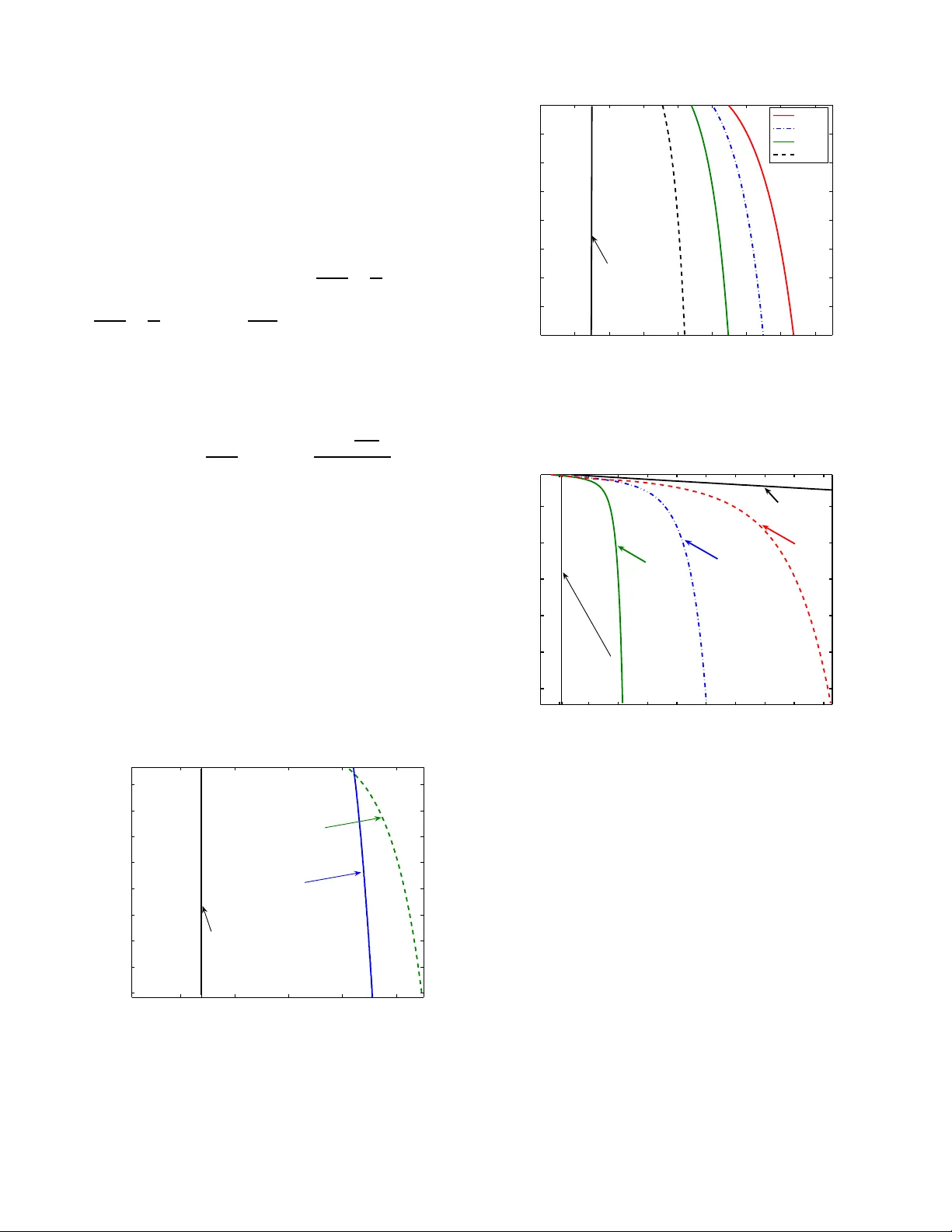
Green Codes: Ener gy-Ef fici ent Sh ort-Range Communication Pulkit Grover and Anant Sahai W ireless Foun dations, Depa rtment of EECS Univ ersity o f California at Berkeley , CA-94 720, USA { pulkit, sah ai } @eecs.berkeley .ed u Abstract — A green code attempts to minimize the total en- ergy per -bit r equired to communicate acr oss a noisy channel. The classical inf ormation-theoretic appro ach neglects the energy expended in p roce ssing th e data at th e encoder and th e decoder and only minimizes the energy r equired f or transmissions. Since there is no cost associated with using more degr ees of fr eedom, the tr aditionally optimal strategy is to communicate at r ate zero. In thi s work, we use our recently proposed model for th e power consumed by iterative message passing. Using generalized sphere-packing b ounds on the decoding power , we find lower bounds on the total energy consumed in the transmissions and the decoding, allowing for freedom in the choice of the rate. W e show that contrary to the classical in tuition, the rate for green codes is bound ed away from zero f or any given error probability . In fact, as the d esired bit-error probability goes to zero, th e optimizing ra te for our bounds conv erges to 1 . I . I N T R O D U C T I O N W ith the d ev elopmen t of b illion transistor c hips, the ran ge of com munication has come d own dramatically from hund reds of kilom eters (e.g. deep space co mmunication ) to a f ew meters (e.g. ad-hoc wireless networks) o r a fe w m illimeters o r even less (e.g. on chip communication ). T o communicate over smaller distances, the transmit power required is much smaller . At these d istances, the energy used in tran smissions can be compara ble to that expended by the system pro cesses. The small size limits the ability o f these chips to dissipate heat. Further, the chip migh t be battery operated , imposing stringent constraints on its energy usage. It is theref ore of interest to desig n coding techn iques that m inimize the total energy consumed , which includes the transmission ene rgy as well as the processing energy . W e refer to the co ding techniques that minimize the total energy as green co des . The classical in formation theoretic app roach fin ds the mini- mum transmission energy req uired to comm unicate r eliably across the channel. The appr oach is m otiv ated by lon g- range commun ication, that corresp onds to power con strained channels. Shan non [1] fir st char acterized th e minimu m energy required to com municate acr oss a chann el with fixed rate. Th e resulting boun ds are expressed u sing ‘ waterfall’ curves th at conv ey th e rev olution ary id ea that unbo undedly low pr oba- bilities of bit- error are attain able using only finite tr ansmit power . This characte rization r aises a natural q uestion: what is the minim um energy requir ed for co mmunicatio n that is free of a r ate constraint? The classical ap proach [2] [3] gives the min imum tr ansmission energy requ ired (o n average) to commun icate one bit reliably across the chan nel. For example, for a n A WGN channel o f noise variance 1, th is minim um energy is lim P T → 0 P T C ( P T ) = 2 ln(2) Joules . (1) Since there is no penalty associated with lower rates, it is g ood to use as many degrees o f freed om as are available, and the optimal transmission rate is zero. The problem of minimizin g comb ined tran smission an d processing energy is well studied in n etworks. The co mmon thread in [4], [5], [6], [7], [8], [9] is that the energy consum ed in proc essing th e signals can b e a substantial f raction of the total power . In [7], an info rmation-th eoretic for mulation is considered . The au thors m odel the processing energy by a constant ǫ per u nit time when the transmitter is transmitting (and hence, is in the ‘on ’ state). A total of r chan nel uses are allowed, and th e to tal ene rgy available is r E , where E is a constant. Le t P i be the transmit power at i -th time instant, and let C ( P i ) be the cap acity of the co rrespond ing chann el. T hen the problem is to transmit maximum number of bits with the total power less than r E . That is, max r X i =1 1 i C ( P i ) (2) subject to r X i =1 1 i ( P i + ǫ ) ≤ r E (3) where 1 i = 1 if a symb ol is transmitted in the i -th channe l use, and is 0 o therwise. This is eq uiv alent to dividing th e channel into r sub-chan nels, with ind ependen t coding on each sub- channel. Since the cap acity f unction C ( P ) is concave in its argument, for m aximizing the total numb er of in formation bits commun icated, the transm ission energy P i should be equ al for all i whe re 1 i = 1 . Without acco unting for the ene rgy consumed by the sy stem pro cesses, the optim al strategy would be to u se all the r pa rallel channels, an d share the en ergy equally amo ngst them. Howev er, the ene rgy co nsumed by th e system p rocesses imposes a fixed pen alty on e ach chann el use. The au thors qu antify this tension by measurin g ‘burstiness’ Θ of signaling defined as Θ = 1 r P r i =1 1 i . The tran smissions should n ot be too bursty because of the law o f diminishing retur ns a ssociated with the log ( · ) function . On the other hand, th e tran smission strategy sho uld no t make use of all degrees of freed om either, since th ere is an ǫ cost associated with the use of each degree of freedo m. The authors conclud e th at for minimum total en ergy , 0 < Θ < 1 . Contrar y to conventional infor mation theoretic wisdom, it is n o longer optimal to u se all available degrees of fr eedom. Co nsequently , the optimal rate that minimizes the total en ergy consumption is bounded away from zero . Tha t is, if pr ocessing ener gy is taken in to a ccount, gr een code s may no t commun icate at zer o rate! The objective in [7] [5] [9] is to reduce the energy consump- tion for wir eless devices that consum e energy co ntinuou sly when o perating e.g . h and-held com puters, high -end laptop s, etc. Ene rgy con sumption p er unit time for such devices is indeed well modeled by a constant possibly indepen dent of the coding strategy be ing used. In this paper , we ar e interested in the energy expen ded by the dec oding p rocess itself. The decoding circuit requires some non-zero energy to perfor m each o peration. As oppo sed to energy consu med by system pro cesses in [7], [5] , [9], th e d ecoding energy depen ds significantly on the co de con struction, th e r ate and the desired error probability , and therefo re n eeds more careful modeling. In this work, we study explicit models of energy expended at the d ecoder . Owing to their low im plementation co mplexity , and h ence low energy consum ption, we con centrate on the message passing decoder . For this decoder, we d eriv e lower bound s on the com bined transmission a nd decod ing energy , with n o co nstraint on the rate. W e show that th e op timizing rate for gr een codes based o n message passing decoding is indeed bo unded away f rom zero. As the error p robability decreases to zero, the optimizing rate in creases. In a result that is qu alitati vely different f rom th ose in [7], we sho w th at there is no advantage in increasing the rate b eyond 1 . T herefor e, as the error probab ility co n verges to zero, the optimizin g rate conv erges to 1! The organization o f the paper is as follows : In Sectio n II, we introdu ce the c hannel model, the deco der mo del, and the energy mod el. I n Section III, we summ arize some of our results in [1 0]. I n Section IV, we build on the results in [10] to fin d bounds on the m inimum total energy required to commun icate across a channel, with no rate constraint, tak ing into accoun t the decodin g energy as well. W e conclud e in Section V. I I . S Y S T E M M O D E L Consider a point-to-poin t commu nication link. An infor ma- tion sequence B k 1 is encode d into 2 mR codeword X m 1 , using a possibly r andomized enco der . Th e observed ch annel outpu t is Y m 1 . The info rmation sequ ences are assumed to consist o f iid fair coin to sses and hence the rate o f the code is R = k / m . The chan nel model consider ed is an average power co n- strained A WGN ch annel of noise variance σ 2 P . W e also obtain some results for th e BSC arising fr om performin g har d- decision o n BPSK sym bols tran smitted over an A WGN chan- nel. T he true channe l is d enoted by P . Th e chan nel capacity is denoted b y C σ 2 ( P T ) , where σ 2 is the no ise variance, and P T is th e average power constraint. W e drop σ 2 from th is notation when no ambiguity is created in doing so . For maximu m generality , we do not impo se any a priori structure on the code itself. Instead , inspired by [11], [12], [13], we focus on the parallelism of the decoder and the energy consumed within it. W e a ssume that th e decod er is physically made of co mputation al nodes that pass m essages to each other in p arallel along p hysical (an d hen ce unch anging) wires. A subset of n odes are design ated ‘ message nodes’ in that e ach is responsible fo r decodin g the v alue o f a particu lar message bit. Ano ther subset of nod es (not nec essarily disjoint), called the ‘observation nod es’ ha s members that are each initialized with at most one observation of the r eceiv ed chann el output symbols. There may b e ad ditional co mputation al n odes to merely help in decoding. The implementation techno logy is assumed to dictate that each compu tational no de is c onnected to at most α + 1 > 2 other nod es 1 with bidirec tional wires. No other r estriction is assumed on the topology of the decoder . In each iteration, each node sends (possibly different) message s to all its neigh boring nodes. No restriction is placed o n the size o r content of these messag es except for the fact that they must depend only on the inf ormat ion that has r eached the computational node in pre vious iteratio ns. If a no de wants to communicate with a mor e distant no de, it has to h av e its message rela yed throug h other nod es. T he neighborh ood size at the end of l iterations is denoted by n ≤ α l +1 . E ach computatio nal nod e is assumed to co nsume a fixed E node joules of energy at each iteration. Let the average p robability of b it e rror of a co de b e den oted by h P e i when it is u sed over channel P . Th e m ain tool is a lower bound on the neighborh ood size n as a fun ction o f h P e i and R . This then translates into a lower bound on th e number of iteratio ns that can in turn be u sed to lower bound the required decoding po wer . Throu ghout this p aper, we allow th e e ncoding an d decoding to be rando mized with all c omputation al no des a llowed to share a pool of common randomness. W e use the term ‘a verage probab ility o f err or’ to refer to the p robab ility of bit er ror av eraged over the channel r ealizations, the m essages, th e encodin g, and the decodin g. I I I . L OW E R B O U N D S O N T H E D E C O D I N G C O M P L E X I T Y A N D T OTA L E N E R G Y In this section we summa rize our results f or lower bounds on deco ding comp lexity for an A WGN ch annel f rom [10]. The main boun ds are given by theorems that captur e a lo cal sphere-p acking effect. Th ese can be tur ned ar ound to give a family of lower boun ds on the n eighbor hood size n as a function of h P e i and R . Usin g a simple lower bound on the number of iterations, l ≥ log( n ) log( α ) − 1 , we get a lo wer bound 2 on complexity . Th e family of lower bounds is indexed by the choice of a hyp othetical ch annel G and the bou nds can be optimized numerically for any desired set of parameters. 1 In practic e, thi s li mit could come from the number of metal layers on a chip. α = 1 wo uld ju st corre spond to a big ring of nodes and is therefore uninter esting. 2 W e approximate this by l ≥ log( n ) log( α ) for the rest of the paper . Theorem 3.1: For the A WGN chan nel a nd the decoder model in Section II, let n be the maximum size of the decoding neighbo rhood of any individual message bit. T he following lower bo und holds on the average p robab ility of bit erro r . h P e i ≥ sup σ 2 G : C σ 2 G ( P T ) 0 . 1 mm (and path loss 1 for smaller d ). E node is 1 p J, α = 4 , ξ D = 1 , and σ 2 P = 4 × 10 − 21 J. The energ y pe r bit is normalized by σ 2 P . W e thus o btain the following expression for the minim um normalized total energy , E per bit = min P T ,R 1 R P T σ 2 P + 1 R γ max 1 R , 1 log( n ) . (9) Observe that in (9), the dec oding energy increases as th e error probab ility decr eases for constant tran smit p ower and rate. This behavior is not r eflected by using the model inspired from [7] for d ecoding en ergy . Th e bou nds in [7] are for er ror probab ility converging to zero. T o compare ou r bou nds with the black -box model of [ 7], in Appen dix I we derive bou nds for non -zero e rror pro bability b ased on the mod el in [7]. W e p lot the two bound s against each other in Fig ure 2 for k = 1 0 , 00 0 bits. W e choo se ǫ = 4 , fo r which the total energy per bit fo r the black -box model eq uals the en ergy per bit f or γ = 0 . 2 for our bound for h P e i = 10 − 13 . The figure shows that fo r 5 The energ y cost of one iteration at one node E node ≈ 1 pJ is arri ved at by an optimistic extrapola tion from the reported v alues in [14], [15], thermal noise energ y pe r sample σ 2 P ≈ 4 × 10 − 21 J from k T with T around room temperat ure. h P e i smaller than this thresho ld, the model inspired from [7] undere stimates th e total en ergy . I t is bec ause this model treats the d ecoder as a black -box where ǫ does n ot chang e with error probab ility or rate. It is interesting to observe what v alues o f R optimize ( 9). Under the small h P e i appro ximation in (5), we now h euristi- cally argue that the optimal rate R opt should conv erge to 1 as h P e i → 0 . Observe th at for R < 1 , E per bit = P T σ 2 P R + γ R log 2 ( n ) = P T σ 2 P R + γ R log 2 log 2 1 h P e i − log 2 D ( σ ∗ 2 G || σ 2 P ) As h P e i → 0 , n → ∞ . T herefor e, th e decod ing en ergy increases to infinity . In creasing the rate R at the cost of increasing P T offsets th e in creasing decod ing costs. Howe ver , for R ≥ 1 , E per bit & P T σ 2 P R + γ log 2 log 2 1 h P e i D ( σ ∗ 2 G || σ 2 P ) , (10) which indicates there is no advantage in in creasing rate be yon d R = 1 , since it no longer decreases the dec oding energy . Evidently , for finite h P e i , the re exists an op timal rate R opt > 0 that minimizes th e comb ined energy consum ed. Using nu merical evaluation of the boun d ( 9), we plot the behavior o f the optimal rate with h P e i in Figure 5. The plots demonstra te that the optimal rate indeed conv erges to 1 . Figure 3 shows the behavior of our lower bound on sum energy with h P e i fo r various values of γ . Figure 4 shows that similar behavior also h olds f or a BSC arising fro m pe rformin g hard-d ecision on BPSK symb ols tran smitted over an A WGN channel. The optim al ra te fo r th is channel also converges to 1 as h P e i → 0 . Due to lack of space, we o mit the plots. 1 1.38 2 3 4 5 −55 −50 −45 −40 −35 −30 −25 −20 −15 Energy per bit log 10 ( 〈 P e 〉 ) black−box bounds ε = 4 Our bounds γ = 0.2 Limiting value of optimal transmit power neglecting procecssing energy Fig. 2. The plot sho ws the co mparison of lo wer boun ds on the minimum normaliz ed ener gy for k = 10 , 000 bits. The ‘black-box bounds’ plot is based on the model in [7], wher e the details of the processor are ignored. Our bounds tak e into account the decoder structure as well. 0 1 2 3 4 5 6 7 8 −55 −50 −45 −40 −35 −30 −25 −20 −15 Energy per bit log 10 ( 〈 P e 〉 ) γ = 0.4 γ = 0.3 γ = 0.2 γ = 0.1 Limiting value of optimal transmit power neglecting procecssing energy Fig. 3. The plot shows the behavi or of lower bound on the normalize d sum ener gy with h P e i for v arious value s of γ . The sum energy goes to infinity as h P e i → 0 . 2 4 6 8 10 12 14 16 18 20 −60 −50 −40 −30 −20 −10 Energy per bit log 10 ( 〈 P e 〉 ) Limiting value of optimal transmit power neglecting the proessing energy γ = 0.4 γ = 0.1 γ = 1 Uncoded transmission Fig. 4. The plot sho ws the behavi or of lower bound on no rmalized sum ener gy with h P e i for various value s of γ fo r a BSC arising from performing hard-dec ision on BPSK symbols transmitted over an A WGN channe l. The optimizi ng rate con ver ges to 1 as h P e i → 0 . E ven so, th is plot shows that the optimal strate gy is not uncoded transmission at lo w h P e i since coded transmission outperfo rms uncoded transmission at small h P e i . V . D I S C U S S I O N S A N D C O N C L U S I O N S In this work, we de riv ed lower bou nds o n the combine d transmission and decoding energy for iterati ve d ecoding with uncon strained rates. I t is impo rtant to note that the se ar e lower bound s, and the actua l en ergy consump tion would only be higher . An interesting feature of the our bound s is that th e optimizing rate for green c odes is b ounded away from zer o, and, in fact, con verges to 1 as the e rror p robability co n verges to z ero. This is qualitatively different from a pure black -box modeling o f the deco ding pro cess, where energy con sumption is indepen dent of the desired er ror p robability an d th e rate. In that case, as o bserved in [7], the op timal rate is a co nstant th at can be greater than 1 . 0 0.2 0.4 0.6 0.8 1 −500 −450 −400 −350 −300 −250 −200 −150 −100 −50 0 R opt log 10 ( 〈 P e 〉 ) γ = 0.4 γ = 0.3 γ = 0.2 γ = 0.1 Fig. 5. Optimal v alue of rate vs error probability : As h P e i con ve rges to 0 , the optimizing rate conv erg es extremel y slowly to 1 . For an A WGN chann el, the value 1 for op timal rate is a result of a b it-wise r epresentation o f th e inf ormation at th e decoder . If, h owe ver , the message n odes r epresent the infor- mation in b ase M th en th e optimizin g rate would converge to log 2 ( M ) . For the BSC arising fro m perfo rming hard-d ecision on BPSK sy mbols transmitted over an A WGN channel, the opti- mal rate still conv erges to 1 . The rate is uppe r bounded by 1 because the channel has bin ary input alphab et, an d thus th is case mig ht seem somewhat unin teresting. Howev er, uncod ed transmission over BSC also correspo nds to rate 1 , which might falsely sug gest that uncod ed transmission is asym ptotically optimal for minimizing the total en ergy . W e o bserve th at despite the o ptimal r ate appr oaching 1 , co ded tr ansmission attains th e same error pro bability with m uch smaller to tal energy tha n uncoded transmission. W e note that the to tal energy p er-bit required to commu- nicate at a rbitrarily low error p robability increases to infinity for the me ssage passing decod er . This is in contra st to the classical informa tion-theor etic result for transmit power , which shows that the transmit power is boun ded e ven as h P e i → 0 . Based on results in [1 0], the total energy per bit in creases to infin ity for most kn own codes and d ecoding algor ithms. It would be interesting to extend this result to a ll po ssible codes and deco ding algo rithms. An appr oach based on la ws of ph ysics is su ggested in [10] f or the fixed rate pr oblem. The approa ch migh t yield r esults here as well. A P P E N D I X I B O U N D S I N [ 7 ] F O R N O N - Z E R O E R RO R P R O B A B I L I T Y Observe that the results in [7] are for h P e i → 0 and infinitely many information bits. Parallel to our analysis for message passing decodin g, in this appen dix, we build on the analysis in [7] to deri ve bou nds on the minimum ene rgy required for co mmunicatin g with a non-zero err or probability h P e i and finite information bits. Assume k bits are to b e transmitted acr oss the chan- nel, with desired error pro bability h P e i . In [ 7], the auth ors maximize the in formation bits commun icated und er a total energy constrain t. T urn ing aroun d the problem in [7], we can instead min imize the total energy consumed given th e numb er of bits transmitted. Now we can add an erro r pro bability constraint to the bits tra nsmitted. Assume th at a block cod e is used to commu nicate a cross the channel. T he co rrespond ing error exponent is bound ed by the sphere-packin g b ound [16]. Assuming optimistically that the cod e ac tually achieves the sphere-p acking bou nd in the expo nent, h P e i ≤ P e,block ≈ e − mE sp ( P T ,R ) where E sp ( P T , R ) is the sphere-pa cking b ound at rate R and transmit power P T . The objectiv e, therefore, is min P T ,m m × ( P T + ǫ ) subject to m × E sp P T , k m = ln 1 h P e i . ( 11) R E F E R E N C E S [1] C. E. Shannon, “ A mathemat ical theory of communication, ” Bell System T echni cal J ournal , vol. 27, pp. 379–423, 623–656, Jul./Oct. 1948. [2] J. Pierce, “Optical channel s: Practi cal limits with phot on counting, ” IEEE Tr ansactions on Communicat ions , pp. 1819–1821, Dec. 1978. [3] S. V erdu, “On chan nel capa city per unit cost, ” IEEE T rans. Inf orm. Theory , vol. 36, pp. 1019–1030, 1990. [4] P . Agraw al, “Energy efficie nt prot ocols for w irele ss syste ms, ” in IEEE Internati onal Symposium on P er sonal, Indoor , Mobile R adio Communi- cation , 1998, pp. 564–569. [5] S Cui, AJ Goldsmith and A Bahai , “Energy Constrained Modulation Optimiza tion, ” IEEE T r ans. W ir eless Commun. , vol. 4, no. 5, pp. 1–11, 2005. [6] A. J. Goldsmith and S. B. Wic ker , “Design challenge s for ener gy constrai ned ad hoc wirele ss networks, ” IEE E Tr ans. W ire less Commun. , pp. 8–27, 2002. [7] P . Massaad, M. Medard, and L. Zheng, “I mpact of Proc essing Energy on the Capacit y of Wire less Channels, ” in International Symposium on Informatio n Theory and its Applicatio ns (ISIT A) , 2004. [8] S. V asude v an, C. Zhang, D. Goeckel , and D. T o wsley , “Optimal po wer allocat ion in wire less networks with tr ansmitter -recei ve r po wer tradeof fs, ” Proce edings of the 25th IEE E Internation al Confere nce on Computer Communicat ions INFOCOM , pp. 1–11, Apr . 2006. [9] R. Krave rtz and P . Krishnan, “Power management techniques for mobile communicat ions, ” The F ourth A nnual ACM/I EEE Internation al Confer- ence on Mobile Computing and Networking , 1998. [10] A. Sahai and P . Grov er , “The pri ce of certa inty : “wa terslide curves” and the gap to capacit y , ” Submitted to IEE E T r ansactions on Information Theory , available online at http://arXiv . or g/abs/0801.0352v 1 , Dec. 2007. [11] P . P . Sotiriadi s, V . T arokh, and A. P . Chandrakasa n, “Energy reduction in VLSI computation modules: an information-the oretic approach, ” IEEE T ran s. Inform. Theory , vol. 49, no. 4, pp. 790–808, Apr . 2003. [12] N. Shanbhag, “ A mathemat ical basis for power -reduct ion in digital VLSI systems, ” IEEE T rans. Circui ts Syst. II , vol . 44, no. 11, pp. 935–95 1, Nov . 1997. [13] T . Koch, A. L apidoth , and P . P . Sotiria dis, “ A channel that heats up, ” in Pr oceeding s of the 2007 IEEE Symposium on Information Theory , Nice, France, 2007. [14] M. Bhardwaj and A. Chandrakasan, “Coding under observ ation con- straints, ” in Proc eedings of the Allerton Confere nce on Communicatio n, Contr ol, and Computing , Monticello, IL , Sep. 2007. [15] S. L. How ard, C. Schlegel , and K. Iniewski , “Error contro l coding in lo w-po wer wireless sensor networks: when is ECC energy-ef ficien t?” EURASIP Journal on W ir eless Communica tions and Networking , pp. 1–14, 2006. [16] C. E. Shannon, “Probabili ty of error for optimal codes in a gaussian channe l, ” Bell System T echnica l Journa l , vol. 38, pp. 611–656, 1959.
Original Paper
Loading high-quality paper...
Comments & Academic Discussion
Loading comments...
Leave a Comment