Toward Fuzzy block theory
This study, fundamentals of fuzzy block theory, and its application in assessment of stability in underground openings, has surveyed. Using fuzzy topics and inserting them in to key block theory, in two ways, fundamentals of fuzzy block theory has be…
Authors: ** - 저자 정보가 논문 본문에 명시되어 있지 않음 (예: Owladeghaffari 등 언급은 있으나 정확한 저자 리스트는 확인 불가). **
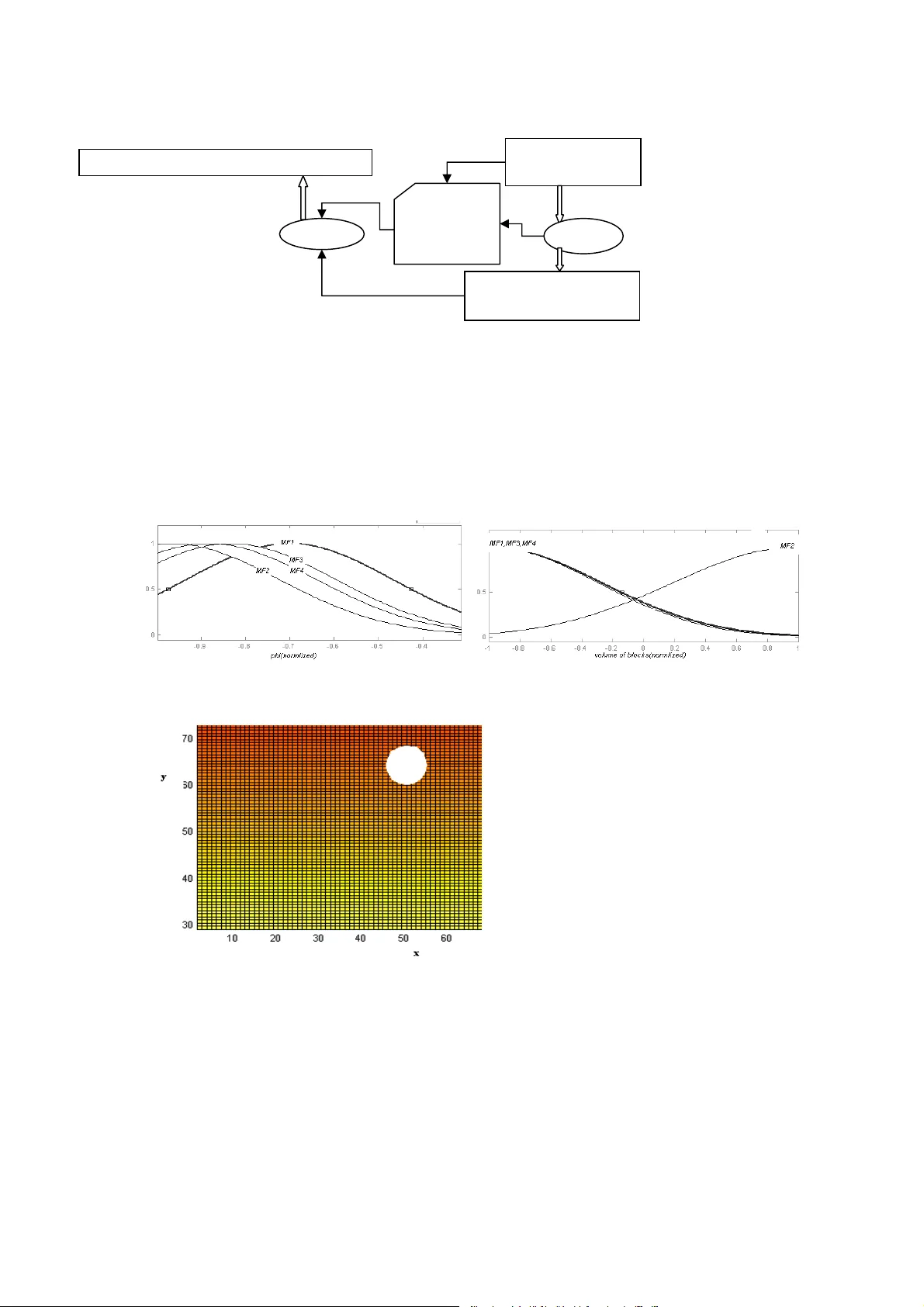
1 INTROUDUCTION The block th eory or the key blo ck method has been widely, used over th e past 30 years for quick analysis of ro ck ma media stability. The underlyin g axiom of block theory is th at failure of an excavation begins at the boundary with the movement of a block in to the excavated space. These in itial bl ocks a re cal led key-bl ocks. These bl ocks a re em erge d in diff erent face ts: (1) In contact with excavation (active block) (2) finite (3) m ovable (4) significant to other block movem ent. Base on this event “Goodman and Sh i” proposed “b lock theory” (Good ma&shi, 1985). In this theory, analy sis of key blocks in stability and identifications of key blocks are argued. Asso- ciated with this theory , different extensions, has been emerged such: probability analysis (Mul- don, 19 94), linear programming (Mauldon etal , 1997), key group method (Yarahmadi&Verdel, 2003). In th is study, the blocks and key block method, from different view has been evaluated. Deter- mination of blocks in fuzzy geometry and by possibility th eory, can introduced di rect and indi- rect combining between fuzzy theory and block theory. Background of this new combining can be induced fro m analyzing of following terms in fuzzy set theory: “approximation of blocks by linguistic variables”, “non-crisp boundary of blocks or vagueness in shape of blocks”, “modern uncertainty theories on analysis of key blo cks”. In completing of static analysis on the fuzzy blocks, contact of blocks can be added. For exam- ple let minimum distance of two blocks is impression. Expression of distance in fuzzy numbers and using possibility th eory can be lead to “possi bility of blocks’ con tact” (Owladeghaffari, un- publishe d). Parallelization of key block theory by Neur o Fuzzy Inference System (NFIS) may give a com- pressive view in possibility distribution of input s and outputs. This procedure, in limit case, will be desc ribed in s ection2 . In sectio n 3, brief ly, possibility theory and fuzzy geometry will be ex- plained. Direct method, in section4, will be rendered. Toward Fuzzy block theory H. Owladeghaffa ri Departm ent of mining and me tall urgical engin eering, Amirk abir uni versi ty of techn ology ( Tehran polyt echnic) , Tehr an, Iran ABSTRACT: This study, fund amentals of fuzzy block theory, and its application in assessment of stability in underground opening s, has surveyed. Using fuzzy to pics and inserting them in to key block theory , in two ways, fundamentals of fuzzy block theory has been presented. In indi- rect combining, by cou pling of adaptive Neuro Fuzzy In ference System (NFIS) and classic block theory , we could extract possib le damage parts around a tunnel. In d irect solution, some principles of block theory, by means of different fu zzy facets theory, were rewritten. 2 INDIRECT METHOD: PARRLILIZA TON OF KEY BLOCK THEORY Figure (1) summaries two branches of uncertainty .Mod ern uncertainty theory has been ex- tended by Lotfi..A.Zadeh (Zadeh.1 965):”fuzzy set theory ”. Fuzzy logic (FL) is essentially coextension with fuzzy set theory and in narrow sense; fuzzy log- ic is logical system which is aimed at a formalization of modes of reasoning which are approx- imate rather than exact. FL in wide sense has four principal facets: The logical facet, FL/L; the set-theoretic facet (FL/S), the relational facet (FL/R) and the epis- temic facet FL/E. (Dubois&Prade.2000) Figure1.schamatizatio of the uncertainty theory (Ayyub& Gupta, 1994-Zadeh , 2005) 2.1 An algorithm to combining KBT &FIS Figure 3 shows a combining of KBT (key block theory ) and TSK type inference system. One way to extension of this algorithm, can be carried out using multiple in puts/outputs systems, for example, CANFIS or MANFIS: coactive neuro- fuzzy inference systems; m ultiple ANFIS (Adaptive Neuro Fuzzy Inference System), respectively. (Jang etal.1997). In this study inp ut parameters were dived in two facets :( 1) Fixed parameters (2) changeable pa- rameters . Fixed parameters can be tak en in such as shape of tun nel, unit weight o f rock, some properties of joints....Changeable param eters m ust be inserted in different values, namely, in random data set, for example: joint properties, in situ stre sses…After producing of KBT ou tput, input data (changeable) and outputs of KBT must be rearranged. So these data sets must be normalized in defined range (for example in [-1, 1] -Step 1). Then normalized S.F, obtain ed from KBT, and mentioned data sets are gotten in ANFIS algo- rithm. In this step (2), the rules in if-then shape between inpu t and output variables are ob- tained. Thus new predictions on S.F for new inpu t can be performed. Uncertainty theory Classic 1. set theory (inter- val analysis) 2. Probability theor y Modern 1. Fuzzy set theory 2. Possibility theory 3. Evidence theory ... 4-generlized un certainty theory (Zadeh, 2005) Figure3. A combined algorithm on KBT, TSK Some results of the proposed algorithm can be highlighted as follows: 1-Detection of membership functions (MFs) for any inpu t and output (figure 4) 2-The dominated rules in if-then fo rmat betwee n inputs an d output (sa fety facto r for any block) 3-Possible damage parts aroun d tunnel. In similar conditions; a compression between DDA (discontinuous deformation analy sis)-MacLaughl in&Sitar.1995- and results of mentioned al- gorithm has been accomplished. See figure5. Figure4. MFs for phi ( φ ) and volume of blocks, vertical axis sho w MFs degree. (a) Input para met ers KBT S.F for created b locks TSK Rearranged inputs for TSK Predic tion of new unkn owns& Extrac tion (b) Figure5 (a).possib le damage parts around a tunnel, hot colors pr esent low safety factor.-5(b) DDA performance on a same tunnel, without in situ stress, φ =20 and random joint se t. In this analysis, inputs were joint an d tunnel properties (such: dip, dip directions-trend, plunge, φ ) and volume of block (all of random data sets were 283).Because of small samples (data sets), applying of results in p ractical may not be correct, but mentioned results give an overview about stability of possible blocks around tunnel. 3 REMARKS ON POSSIBILTY THEORY AND FUZZY GEOMETRY 3.1 Possibility theory (epistemic facet of fuzzy logic) The concept of po ssibility pro posed by Zadeh forms o ne of the most u seful foundations in fuzzy set theory. Possibility measure can be defined eith er based on confidence measure or based on fuzzy set. The former gives the connection bet ween po ssibility measure and evidence theory and the later gives the connection between possibility and fuzzy membership function. Evidence theory is known as upp er and lower probability . The advantage based on fuzzy set is that the approach offers easy means to obtain numerical values o f the representation while the confidence approach is b ased on a set of basic axioms. One of the central concepts in possibility theory is possibility distribution, wh ich serves the sa me purp ose in pos sibility t heory as prob a- bility distributio n in probability theory. Let F be a fuzzy subset of universe of discourse U, which is characterized by its membership function F µ , with the grade of mem bership () F u µ . Let X be a variable taking on values in U and let F act as a fuzzy restriction, R(x),associated with X. then the proposition “x is F”(R(x)=F),ass ociates a possibility distrib ution function asso- ciated with X , x Π ,can be defined to be numerically equal to the membership function of F ,that is, xF π µ ≡ where x π repres ents the poss ibility dis tributio n functio n of x Π .mathematically, Poss(X is u X is F) = F µ (u),u ∈ U, which is conditiona l possibility ex- pression parallel to the conditional p robability expressio n. Now, let A be a non-fuzzy subset of U and x π be the possib ility di stribution functio n of x Π . Then the possibility measure, () A Π , of A is defined as a number in the interval [0,1] and is giv- en by: () A Π = sup ( ) uA x u π .The possibility measure can also be interpreted as the possibility that th e valu e of X bel ongs to A, or, Poss(x ∈ A) = () A Π = sup ( ) uA x u π = sup ( ) uA F u µ ∈ . If, A is a fuzzy subset of U, then th e possibility measure of A is defined by: Poss{x is A} = () A Π = min ( ), ( ) sup uu Ax uU µπ ⎡⎤ ⎣⎦ ∈ A good discussion abou t possibility and prob ability can be found in (Dubois & Prade (edit).2000).in section (4 ), we will u se the ranking or compression of fuzzy n umbers, based on the possibility concept. The Dubois and Prade theory (Dubois & Prade. 19 88) on the strict ex- ceedence possibility with trapezoidal fuzzy n umber can be summ ered as below: Let 12 3 4 (, , , ) B bb b b = % and 12 3 4 (, , , ) R rr r r = % are tw o trape zoida l fuzzy nu mbers , then: 34 34 43 43 1 [] , 0 if b r Poss B R i f br b r if b r δ ≥⎫ ⎧ ⎪⎪ ≥= ≤ ≤ ⎨⎬ ⎪⎪ ≤ ⎩ ⎭ %% ; 43 43 4 3 () ( ) br br r r δ − = − +− (See figure 6) Figure6. Two trapezo idal fuzzy numbers. 3.2 Fuzzy geometry theories: revie w Certain ideas in fuzzy g eometry have been introduced and studied in a series of paper. See (Ro- senfeld, 1998; Rosenfeld, 1990 ; Buckley &Eslami.1997a, b; Zhang 2002) In a few of these papers, the authors considered the area, height, diameter and perimeter of fuzzy subset of the plane. But in other view fuzzy planes and fuzzy polygons have a real fuzzy numbers (Buckley &Eslami.1997a, b). In new defin itions of fuzzy geometry, aim is to link gen- eral projective geometry to fuzzy set theory . (Kuijken. & VanMald eghem.2003). From solid modeling view, base on CAD, some methods to representation of fuzzy shapes with insertin g of” linguistic variables “, in definition of solid shap e, has been highlighted. (Zhang etl, 2002) In this study, we use fuzzy plane geometry base on Buckley and Eslami, associated with new extensions on half-p lanes, base on possibility theory . This combined theory, introduced deter- mination of” possibility of block ’s removability ”. Following lines describes some required co n- cepts for next section. Let ,, A BC %% % be fuzzy nu mbers such that ( ) 1 A a µ = , () 1 B b µ = and we assume that a, b are not both zero. Let () () () { } 11 (, ) : , , , ( ) x y ax by c a A b B c C α αα α Ω= + = ∈ ∈ ∈ %% % ; 01 α ≤ ≤ The fuzzy line 11 L % is defined by its membership function: () () () { } 11 11 ,s u p ( : ( , ) xy L xy µ αα =∈ Ω % Or given , M B %% and () ( ) ( ) { } 12 (, ) : , , xy y m x b m M b B α αα Ω= = + ∈ ∈ %% .defin ition of 12 L % can be given by: () () () { } 12 12 ,s u p ( : ( , ) xy L xy µ αα =∈ Ω % . Other sense of fuzzy line, so, can be written. In fact by this definition fuzzy line is a real fuzzy number. By applying fu zzy line segments, from a fuzzy point to other point, an N-sided (convex) fuzzy poly gon is determined. Let P % and Q % be two distinct fuzzy points. Defin e ( ) l α Ω = {line segments: from a point in () P α % to point a po int in () Q α % }.The fuzzy line segment p q L % is: () () () { } ,s u p ( : ( , ) pq l xy L xy µ αα =∈ Ω % .now let 1 ,. . . , n L L %% be fuzzy line segments from 12 , , ..., n PP P %% % to 1 P % , respectively. An N-sided fu zzy polygon p % is: () () () { } 1 1 ,m a x , n ii in i L xy xy L µµ ≤≤ = =⇒ = pp %% %% U Mentioned definitions on fuzzy poly gons may be as solution to detection of distances of blocks and determination of real fuzzy area and perimeter of blocks. Fuzzy distance between two blocks, and using possibility theory, as a real brain’s perception, can be summ arized in “new contact detection algorithm”. See (Owladeghaffa ri, unpublished). Fuzzy half spaces by applying fuzzy line and possibility ranking eliminate diffi culty in definition of half planes and spaces. 4 DIRECT FUZZY BLOCK THEORY Let Inequality equations system, { } 1, ..., ii in LD = ≥ %% present set of fuzzy half planes or non crisp boundary of blocks in 2-D. by referring to fuzzy line (section 3.2) and the strict exceedence pos- sibility (se ction 3.1): Poss { } 1, ..., ii in LD = ≥ %% = () () 11 1 1 0 . . . 1 0 ii i Po ss L D Po ss L D δ δ ⎧⎫ ⎧ ⎪⎪ ⎪ ⎪⎪ ⎨ ⎪⎪ ⎪ ⎩ ⎪⎪ ⎪⎪ ⎪⎪ ⎪⎪ ⎨⎬ ⎪⎪ ⎪⎪ ⎪⎪ ⎧ ⎪⎪ ⎪ ⎪⎪ ⎨ ⎪⎪ ⎪ ⎪⎪ ⎩ ⎩⎭ ≥= ≥= %% %% ; with conditions In witch, i L % and i D % are real fuzzy line and fuzzy number, respectively . For a block obtained from intersection of half-plans: fuzzy joint block = { } 1, ..., ii in LD = ≥ %% .so, () {} () {} () {} 1, ... ii ii ii n in Poss L D Min Poss L D Min Poss L D = ≥≤ ≥⇒ ≈ ≥ %% %% %% I = possibility of joint block (PJB). In fact, we select upper lim itation in inequality. (See chapter 7 , in Dubois &Prade, 2000). In Goodman-Shi terminology, and associated with mentioned theories, b lock pyramid has b een defined as: () ( ) 0 1 . . . 0 12 1 0 1 . . . 0 L f uzz y j i ont pyr amid L n Pos s JP Pos s EP M i n L n fu zz y exc ava tion p yr a m id L nk λλ λ ⎧⎫ ⎧⎫ ≥ ⎪⎪ ⎪⎪ ⎪⎪ ⎪⎪ ⎪⎪ ⎪⎪ ⎪⎪ → ⎪⎪ ⎨⎬ ⎪⎪ ⎪⎪ ⎪⎪ ⎪⎪ ⎪⎪ ⎪⎪ ≥ ≈ ⎪⎪ ⎪⎪ ⎩⎭ ⎪⎪ →⇒ ⎨⎬ ⎧⎫ ≥ ⎪⎪ + ⎪⎪ ⎪⎪ ⎪⎪ ⎪⎪ ⎪⎪ ⎪⎪ ⎪⎪ → ⎨⎬ ⎪⎪ ⎪⎪ ⎪⎪ ⎪⎪ ⎪⎪ ⎪⎪ ≥ ⎪⎪ + ⎪⎪ ⎩⎭ ⎪⎪ ⎩⎭ % % % % 64 4 744 86 4 4 74 4 8 I % % % % () ,( ) 2 P oss i bi l it y of BP bl ock pyramid PBP λ == In non-fuzzy format if BP= φ , then block is finite. Figure 7 shows ex tension of this theo rem, in fuzzy shape: b etween two evident cases, other mo des in linguistic variable can be exp ressed such” not so very finite, quasi finite”. Figure7.fro m crisp to indistinguishably finite- infinite blo ck In removability of block, and possibility of block’s removability (PBR), we can write :( Shi’s theorem on block’s moveability) { If PBP=1&PJB=0 → block is crisp irremovable… If PBP=0& PJB=1 → block is crisp re- mova ble. } . So, let () 1, M in PBP PJ B PBR −= ’. With former description on PBR, analysis of imprecise variables can be eme rged PBR only is based on geometry and don’t consid er force effects. By fuzzy vectorial key block analysis or possibility (or fuzzy) p rogramming on blocks, generalized possibility of b lock’s re- movability can be hig hlighted. (GPBR).So, re lationships between P BR and GPBR, may be ex- pressed as theorems. 5 CONCLUSION AN D FUTURE WORK This study, briefly, employ ed some fuzzy facets with key block theory. The role of uncertainty in geomechanic, and advan cing of new uncertainty theories may give new id eas in assessment of vagueness or” gran ule” of information. This idea was innate feature of this pap er. New terms such “PBR or PBC” in evolution of S hi’s theorem was added to main version of KBT, in two PBP=0 Crisp finite block PBP=1 Cris p in fini te block Not certainly finite- infin ite block methods: direct and in direct combining. To com pleting direct method, possibility programming and GPBR can be added. So, different ran king theories between fuzzy numbers may be em - ployed instead o f possibility rankin g. Contacts of blocks or surfaces in fuzzy mode (control o r detection) may have some benefits. 6 REFERENCES Ayyub,BM&Gupta,MM(ed itors).1994. Uncertainty modeling and analysis:theo ry and applica- tios.Elsevierscience,pp:3-1 9 Buckley,j.j &Eslami,E.1997a. Fuzzy plane geometry Ι : points and line s. Fuzzy sets and sy stem s .86(2), pp179-187 Buckley,j.j &Eslami,E.1997b. Fuzzy plane geometry ΙΙ : circl es and pol ygons. F uzzy set s and sy stem s.87 (1).pp79-85 Dubois,D & Prade,H. 1988. Po ssibility theory. Plenum press Dubois,D & Prade,H(edi).20 00. Fundamental s of fu zzy sets. Kluwer academic Goodman , RE&Shi , GH.1985. Block theo ry and i ts appl icati on to roc k engine ering. Pr entic e hall Goodman , RE.1995.Bl ock the ory and it s appl icati on.35th U.S symp osium on rock m echani cs. Bal kema Jang.J.S.R,S un.C.T &M izutani .E.1997.Neu ro-fuzzy a nd soft com putin g. Nejwersy . Prentic e Hall. Kuijken.L &VanMaldeghem.H.2 003.On the definition and some conjectures of fuzzy pro jective planes by Gupta an d Ray. Fu zzy se ts and sy stem .138.pp667-68 5 MacLa ughlin,M .M&Sit ar,N.199 5.DDA for windows universi ty of C alifor nia: http:/ /www.ber kely.e du/program s/g eotech/ DDA. Mauldon, M.1 994.Intersection probabilities of impesistent joints. Inter national journal of ro ck mechanics and mi ning sc ience. 31 (2):pp1 07-116 Mauldon, M ; Chou.k& Wu.Y.1997.Line r program mi ng analys is of key block st abili ty. In C omput er me - thods and adv ances in geomechanics. Balkema Nauk.D,Kla woonF.&Kruse R.1997.found ations of Neuro-Fu zzy sy stem s, john Wi ley a nd sons Owladegha ffari, H.2007. Fuzz y anal ysis on contac ts in bl ock sys tem . Unpublis hed Rosenfeld, A.199 8.Fuzzy geometry: an updated ov erview. Information sciences 11 0.pp127-13 3 Rosenfeld, A.1990. Fuzzy rect angles. Pattern recognitions letter 11.pp677-679 Yarahm adi, A.R &Verdel , T.2003.The ke y-group me thod .i nternat ional j ournal for numer ical and anal yti- cal m ethods in geom echani cs 27, pp 495 -511 Zhang,J.Pham,B& Chen,P.2002.Model i ng and indexing of fuzzy comple x shapes. In proceedi ngs 6th IFIP worki ng confere nce on vi sual da tabas e syst em .pp :401-415 Zadeh.L.A. 1965. fuzzy sets. Contro l 8.pp 338-353 Zadeh.L.A. 2005.Towar d a general ized t heory of unc ertai nty (G TU)-an o verview . Zadeh hom epag e inte r- net: http://www-bisc.cs.berkeley.edu /zadeh/papers
Original Paper
Loading high-quality paper...
Comments & Academic Discussion
Loading comments...
Leave a Comment