Approximate formulation of the probability that the Determinant or Permanent of a matrix undergoes the least change under perturbation of a single element
In an earlier paper, we discussed the probability that the determinant of a matrix undergoes the least change upon perturbation of one of its elements, provided that most or all of the elements of the matrix are chosen at random and that the randomly…
Authors: Genta Ito
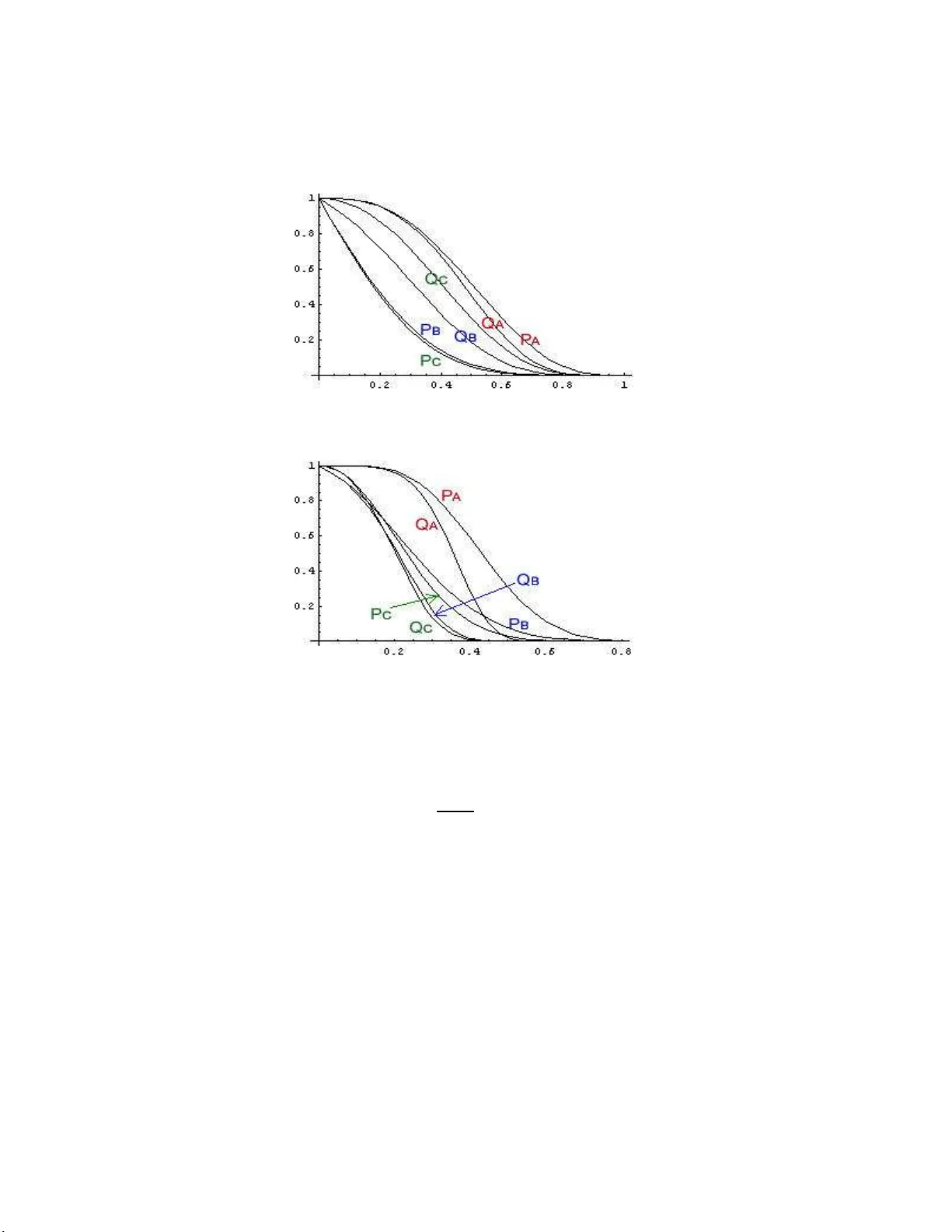
Approximate formulation of t he pr obabi lity that the Deter minant or Permanent of a m atri x underg o es the l east change under p ert urbati on of a sing le el ement Gen ta Ito ∗ Maruo L ab., 500 El Camino R e al #302, Burlingame, CA 94010, United States. SUMMAR Y In an earlier pap er, w e discussed t h e probability that the determinant of a matrix undergo es the least change up on p erturbation of one of its elemen ts, provided that most or all of the elements of the matrix are c hosen at random and that the randomly c hosen elemen ts hav e a fixed probabilit y of b eing non-zero. I n this pap er, w e derive approximate form ulas for that probabilit y by assuming that the terms in the p ermanent of a matrix are indep end ent of one another, and we apply that assumption to sev eral classes of matrices. In th e course of deriving those form ulas, we identified several integer sequences t hat a re not listed on Sloane’s W eb site. Preprint submitted to Numer. Linear Algebra Appl. on June 28, 2007 Pr ep ar e d using nlaauth.cls key wo rds: Determinant; Permanen t; Perm utation; Sloane’s sequ ences 1. Intro duction In an earlier pap er [1], we discussed the problem of finding the probability t hat the determinant of a ma trix undergo es the least change under per turbation of one of its elements. In this pa p e r, we consider only the case where the randomly chosen matr ix elemen ts are v alues o f a contin uous (real) random v ariable, and we derive appr oximate fo r mulas for that pr obability by assuming that the terms in the p erma nent of a matrix are mutually indep endent. Denote the determina nt of any matrix A b y det A . F o r an ( n + 1) × ( n + 1) matr ix M n +1 , the ex pa nsion of de t M n +1 via row i is det M n +1 = m i 1 M i 1 + · · · + m ij M ij + · · · + m in +1 M in +1 , (1) where m ij is the element of M n +1 at the intersection of r ow i a nd column j , and M ij is the cofactor of m ij . M ij can b e written as ( − 1) i + j det S n , where S n is the n × n submatrix o f M n +1 which is obtained by deleting row i and co lumn j . Thus the probability that det M n +1 undergo es the lea s t change up on p erturba tion of element m ij is equal to the pr obability that ∗ Corresp ondence to: M aruo Lab., 500 El Camino R eal #302, Burlingame, CA 94010, United States. (Email: gito@maruolab.com) Preprint submitted to N umer. Linear Algebra Appl. on June 28, 2007 Pr ep ar e d using nlaauth.cls 2 G. ITO | det S n | is as small as p ossible. As in the earlier pap er, we treat the following thr e e cla sses of n × n matrices S n : (i) Matrices A n in which all the elements are v a lues of m utually independent random v aria ble s each o f which has probability r of be ing non-zer o and probability 1 − r of being 0 , where 0 < r < 1 . (ii) Matrices B n in which all but one o f the diag onal elements ar e set to 1 (i.e., b ii = 1 for i 6 = 1, where b 11 is the sp ecia l diagonal element), and b 11 and all the off-diago nal elements are as in (i). Thus B n = b 11 b 12 b 13 · · · b 1 n b 21 1 b 23 · · · b 2 n b 31 b 32 1 · · · b 3 n . . . . . . . . . . . . . . . b n 1 b n 2 b n 3 · · · 1 (2) (iii) Matrices C n in which all the diag o nal elements are s et to 1 a nd all the off-dia gonal elements are as in (i). Thus C n = 1 c 12 c 13 · · · c 1 n c 21 1 c 23 · · · c 2 n c 31 c 32 1 · · · c 3 n . . . . . . . . . . . . . . . c n 1 c n 2 c n 3 · · · 1 The matrice s S n describ ed in (i), (ii), and (iii) ab ove will be said to be matrices of t yp e A n , B n , and C n , resp ectively . Every randomly chosen element of a matrix of any of these types (i.e., every element of a matrix of t yp e A n , e very off-diago na l element of a matr ix of type B n or C n , and the sp ecial diagona l element b 11 of a matr ix of type B n ) will b e called a variable e le ment ; the rema ining elements will b e called fi xe d e lements. If X is a contin uous set such that 0 ∈ X (as is assumed here ), and X is a ra ndom v ar iable whose v alues ar e selected fro m X , then the probability function P for X is defined by P ( X = 0) = 1 − r P ( X 6 = 0) = r (3) Since X is contin uous, P ca n be expressed in terms of a density function q as D ⊆ X ⇒ P ( X ∈ D ) = Z D q ( x ) dx , (4) where 0 ≦ q ( x ) ≦ 1 , Z { 0 } q ( x ) dx = 1 − r , Z X −{ 0 } q ( x ) dx = r If q is contin uous on X − { 0 } (a s is assumed here), then P ( X = x ) = 1 − r , x = 0 0 , x ∈ X − { 0 } (5) 2 APPRO X IMA TE FORMULA TION OF THE PROBABILITY 3 As found in [1], the probability that det M n +1 undergo es the least change up o n p ertur bation of e lement m ij is equal to the probability that det S n = u , where u = 0 if S n is of type A n or B n , and u = 1 if S n is of t yp e C n . In [1], the pr obability that det S n = u was fo r mulated in terms o f binary matr ic es (matrices of 0 ’s and 1’s ), as follows: F or a matrix S n of type A n , B n , or C n , ˜ S n is the n × n binary matrix with ˜ s ij = 1 if s ij 6 = 0, and ˜ s ij = 0 if s ij = 0. Moreov er, ˜ s ij is a variable (resp. fixe d ) element of ˜ S n if s ij is a v ariable (resp. fixed) element o f S n , and ˜ S n is o f type ˜ A n (resp. ˜ B n , ˜ C n ) if S n is o f type A n (resp. B n , C n ). Every v aria ble element of ˜ S n has pro ba bility r o f b eing 1, and probability 1 − r of b eing 0. Deno te the p ermanent of any matrix A by p er A . The expansion of the p erma nent of ˜ S n via the per mutation g roup S n on the set { 1 , 2 , 3 , . . . , n } is per ˜ S n = X σ ∈ S n ˜ s σ (1)1 ˜ s σ (2)2 · · · ˜ s σ ( n ) n (6) Since ˜ S n is a binar y matrix, every ter m in this expansion is either 0 or 1, so the v alue of p er ˜ S n is a non-neg ative integer. In [1], it was sho wn that the probability that det S n = u is equal to the probability that p er ˜ S n = u , and that ˜ S n has non-ze r o (p ositive) pro bability of having per manent u if and only if every term in the expansio n o f p er ˜ S n via S n that contains at leas t one v aria ble element is 0. Thus if S n is of t yp e A n or B n , then S n has non-zer o probability of having determinant 0 if and only if every term in the expansion of p er ˜ S n is 0; and if S n is of t yp e C n , then S n has non-zer o probability of having determinant 1 if and o nly if the only non- zero term in the expansio n of p er ˜ S n is the “diago na l” ter m, ˜ c 11 ˜ c 22 ˜ c 33 · · · ˜ c nn . A matrix of t yp e ˜ A n can b e conv e r ted to a matrix of type ˜ B n by repla cing all but o ne of the dia gonal elements with a fixed element 1. The latter matrix can in tur n b e converted to a matrix of type ˜ C n by replacing the sole v ariable elemen t on the main diagonal (element ˜ b 11 ) with a fixed element 1. Therefore, we migh t exp ect to find that there exist analytic formulas for P p er ˜ B n =0 ( r ) in terms of P p er ˜ A n =0 ( r ), and P p er ˜ C n =1 ( r ) in terms of P p er ˜ B n =0 ( r ), where P p er ˜ S n = u ( r ) denotes the proba bility that per ˜ S n = u . In [1], the exact probability P p er ˜ S n = u ( r ) fo r a sp ecific t yp e of matrix ( ˜ A n , ˜ B n , or ˜ C n ) was formulated in terms of the num b er s of matrices ˜ S n of tha t type which have i v aria ble elements with a v alue o f 1 in the expansio n of their p ermanent (where i ranged from 0 to some i max that dep ended on the type of matrix). In this pap er , we will derive an approximate proba bility Q p er ˜ S n = u ( r ) that p er ˜ S n = u , by assuming tha t all the terms in the expansion of per ˜ S n via S n are indep endent of one another . F o r example, the expansion of the per manent of a ma trix of t yp e ˜ A 3 is per ˜ A 3 = ˜ a 11 ˜ a 22 ˜ c 33 + ˜ a 13 ˜ a 32 ˜ a 21 + ˜ a 12 ˜ a 23 ˜ a 31 + ˜ a 13 ˜ a 31 ˜ a 22 +˜ a 11 ˜ a 23 ˜ a 32 + ˜ a 12 ˜ a 21 ˜ a 33 If ˜ a 23 = 0, the terms ˜ a 12 ˜ a 23 ˜ a 31 and ˜ a 11 ˜ a 23 ˜ a 32 m ust b oth b e zero, but we will ignore that relationship. Ins tead, for every m ≤ n and ea ch of the three types of matrices ( ˜ A n , ˜ B n , and ˜ C n ), we will cons ider o nly the num b er of terms in the expans ion o f the p er manent of a matrix of that type which have m v ariable elements, regar dless of the v alues of those v ariable elements or the connections b etw een differen t terms in the ex pansion. 3 4 G. ITO 2. F ormulation of Q p er ˜ S n = u ( r ) There a re n ! terms ˜ s σ (1)1 ˜ s σ (2)2 · · · ˜ s σ ( n ) n in (6 ), beca use the num b er o f elements σ ∈ S n is n !. F or each term, let m b e the n umber of v ar iable elemen ts it con tains, and let E n ( m ) be the nu mber of terms with m v ariable elements. Then Q p er ˜ S n = u ( r ) = n Y m =1 (1 − r m ) E n ( m ) , where r m is the proba bility that a ll the v aria ble e lements in a term with m v a r iable ele ment s are non-zero, 1 − r m is the pro bability that at least one v ariable elemen t in a term with m v aria ble e le ment s is 0, and (1 − r m ) E n ( m ) is the proba bilit y that a ll the terms with m v ar iable elements are 0. What remains to b e done is to determine E n ( m ) for every m ≤ n and each of the three types of matrices. 2.1. T yp e ˜ A n F or type ˜ A n , every term in the expa nsion of per ˜ A n has n v ariable element s, so E n ( m ) = 0 for every m < n . Since there are n ! terms, w e obtain Q p er ˜ A n =0 ( r ) = (1 − r n ) n ! (7) 2.2. T yp e ˜ C n F or type ˜ C n , let W n ( m ) denote E n ( m ), so that Q p er ˜ C n =1 ( r ) = n Y m =1 (1 − r m ) W n ( m ) (8) Prop ositi on 2.1. W n ( n − 1) = n · W n − 1 ( n − 1) (9) Pro of Ev ery ter m in the expansion of p er ˜ C n that ha s n − 1 v aria ble elements contains just one fixed (diag onal) element (namely , ˜ c ii for some i with 1 ≤ i ≤ n ). F or every i , there exists Figure 1. Cross shapes deleted from ˜ C n to create the ( n − 1) × ( n − 1) submatrices ˜ C i n of ˜ C n a na tural one-to-one corresp ondence betw een the set T 1 i of terms in the expans ion of p er ˜ C n that con tain elemen t ˜ c ii (and ha ve n − 1 v ariable elemen ts of ˜ C n apiece) and the set T 2 i of terms in the ex pansion of pe r ˜ C i n that hav e n − 1 v a riable ele ments each, where ˜ C i n is the ( n − 1 ) × ( n − 1) submatrix of ˜ C n which is formed by deleting the “ cross shap e” that consists 4 APPRO X IMA TE FORMULA TION OF THE PROBABILITY 5 of row i a nd column i . There are n s uch c r oss shap es (one for each dia gonal element of ˜ C n ), as shown in Fig. 1; moreover, for every i, til deC i n is a matrix of type ˜ C n − 1 . Thus we obtain (9). Prop ositi on 2.2. F or every m with 1 ≦ m ≦ n − 1 , W n ( m ) = n P m m ! · W m ( m ) (10) Pro of Let m, k b e such that 1 ≤ m ≤ n − 1 and k = n − m . A term in the expansion of per ˜ C n has m v a riable elemen ts if and only if it has k fixed (diagonal) elemen ts (namely , ˜ c i 1 i 1 , . . . , ˜ c i k i k for some i 1 , . . . , i k with 1 ≤ i 1 < i 2 < · · · < i k ≤ n ). F or every k -tuple ( i 1 , . . . , i k ) with 1 ≤ i 1 < i 2 < · · · < i k ≤ n , ther e exists a natura l one-to-o ne cor resp ondence b etw een the set T 1 , { i 1 ,...,i k } of terms in the expansion of p er ˜ C n that contain element s ˜ c i 1 i 1 , . . . , ˜ c i k i k (and hav e m v ariable elemen ts of ˜ C n apiece) and the s et T 2 , { i 1 ,...,i k } of terms in the expansion of per ˜ C { i 1 ,...,i k } n that have m v a riable e le ment s eac h, where ˜ C { i 1 ,...,i k } n is the m × m submatrix of ˜ C n which is formed b y deleting the cross sha pe s that corresp o nd to i 1 , . . . , i k (i.e., the submatrix of ˜ C n which is formed by deleting rows i 1 , . . . , i k and co lumns i 1 , . . . , i k ). The nu mber of k -tuples ( i 1 , . . . , i k ) with 1 ≤ i 1 < i 2 < · · · < i k ≤ n is n C k ; mor e over, for each such k -tuple, til deC { i 1 ,...,i k } n is a matrix of type ˜ C m . Also, n C k = n P m m ! , since k = n − m and n C n − m = n ! ( n − m )! m ! = n P m m ! . Thus we obtain (10 ). Prop ositi on 2.3. F or n ≥ 1 , W n ( n ) = n − 1 X j =1 ( − 1) n − j +1 · n P j − 1 (11) Pro of W n ( n ) is the num b er of p ermutations of the num b ers 1 , 2 , 3 , . . . , n with no fixed p o int s (i.e., the n umber of p er mutations that hav e no cycles of length one). Such p ermutations are called der angements . In 1713, Pierre de Mont mort [2] pr ov ed that W n ( n ) = n · W n − 1 ( n − 1 ) + ( − 1) n (12) 5 6 G. ITO Thu s we obtain (1 1) recursively as follows: W n ( n ) = n · W n − 1 ( n − 1) + ( − 1) n (13) = n P 1 · W n − 1 ( n − 1 ) + ( − 1) n · n P 0 = n · ( n − 1 ) W n − 2 ( n − 2) + ( − 1) n − 1 + ( − 1) n = n ( n − 1 ) · W n − 2 ( n − 2 ) + n · ( − 1) n − 1 + ( − 1) n = n P 2 · W n − 2 ( n − 2 ) + 2 X j =1 ( − 1) n − j +1 · n P j − 1 = · · · = n P k · W n − k ( n − k ) + k X j =1 ( − 1) n − j +1 · n P j − 1 = · · · = n P n − 1 · W 1 (1) + n − 1 X j =1 ( − 1) n − j +1 · n P j − 1 = n − 1 X j =1 ( − 1) n − j +1 · n P j − 1 The last step follows from the fact tha t W 1 (1) = 0. Prop ositi on 2.4. F or every m with 0 ≤ m ≤ n , W n ( m ) = n P m · m X l =0 ( − 1) l l ! (14) Pro of The only term in the expansion of p er ˜ C n that ha s no v a riable elements is ˜ c 11 · · · ˜ c nn , so W n (0) = 1 = n P 0 · ( − 1) 0 0! . This prov es that (14) ho lds for m = 0. By (1 1), W n ( n ) = n − 1 X j =1 ( − 1) n − j +1 · n P j − 1 = n − 1 X j =1 ( − 1) n − j +1 · n ! ( n − j + 1 )! = n ! · n − 1 X j =1 ( − 1) n − j +1 ( n − j + 1 )! = n P n · n X l =2 ( − 1) l l ! = n P n · n X l =0 ( − 1) l l ! 6 APPRO X IMA TE FORMULA TION OF THE PROBABILITY 7 This proves that (14) holds for m = n (t he last step follows from the fact that 1 X l =0 ( − 1) l l ! = 1 − 1 = 0), so we can as s ume tha t 1 ≤ m ≤ n − 1. By (10) and (11 ), W n ( m ) = n P m m ! · W m ( m ) = h n ! ( n − m )! i m ! · m − 1 X j =1 ( − 1) m − j +1 · m P j − 1 = h n ! ( n − m )! i m ! · m − 1 X j =1 ( − 1) m − j +1 · m ! ( m − j + 1 )! = n ! ( n − m )! · m − 1 X j =1 ( − 1) m − j +1 ( m − j + 1 )! = n P m · m X l =2 ( − 1) l l ! = n P m · m X l =0 ( − 1) l l ! The v a lues of W n ( m ) fo r n = 1 , . . . , 6 (and m = 0 , . . . , n ) ar e given in T able I. The T able I . V alues of W n ( m ) for n = 1 , . . . , 6 ( an d m = 0 , . . . , n ) n \ m 0 1 2 3 4 5 6 1 1 − 1 − → 0 ↓ × 2 2 ↓ × 2 2 1 0 +1 − → 1 ↓ × 3 3 ↓ × 3 2 ↓ × 3 3 1 0 3 − 1 − → 2 ↓ × 4 4 ↓ × 4 3 ↓ × 4 2 ↓ × 4 4 1 0 6 8 +1 − → 9 ↓ × 5 5 ↓ × 5 4 ↓ × 5 3 ↓ × 5 2 ↓ × 5 5 1 0 10 20 45 − 1 − → 44 ↓ × 6 5 ↓ × 6 5 ↓ × 6 4 ↓ × 6 3 ↓ × 6 2 ↓ × 6 6 1 0 15 40 135 264 +1 − → 265 ↓ × 7 7 ↓ × 7 6 ↓ × 7 5 ↓ × 7 4 ↓ × 7 3 ↓ × 7 2 ↓ × 7 sequence { W n ( n ) } n ≥ 0 is num b er A00 0166 in Sloane’s list [3]. The fir st ( n = 0) term, which has no meaning for o ur purp os es, is given there as 1. F or n ≥ 1, W n ( n ) is not only the n umber o f dera ngements o f the num b ers 1 , 2 , 3 , . . . , n , but a lso the p ermanent of the n × n binary matrix with 0’s on the main diagonal and 1 ’s ev erywher e else. The sequences { W n (2) } n ≥ 2 , { W n (3) } n ≥ 3 , { W n (4) } n ≥ 4 , and { W n (5) } n ≥ 5 are given in Sloane’s list (num b ers A00217 , A0072 90, A060 0 08, and A06083 6, re sp ectively). There is no m > 5 for which the sequence { W n ( m ) } n ≥ m is given in that list. An alter native metho d of determining the v alue of W n ( m ) is to use the cycle structure of the p er mutation group S n . F or n = 5, t he types and num b ers of cy c le s asso ciated with elements of S 5 that are applica ble to each v alue of m are listed in T able I I, together with the v alues of W 5 ( m ) computed from them. F or m = 4 and m = 5, there are tw o different t yp es of cycles each. The p ermutations tha t corre s p ond to 7 8 G. ITO m = 4 (which index the ter ms in the expans ion of p er ˜ S n that hav e 4 v ar iable e lements) ar e those tha t can b e expressed as a 4 -cycle (such as (1234)) and those that can b e expressed as a pro duct of tw o 2-cycles (such as (12)(34)). Similarly , the permutations that corresp ond to m = 5 (whic h index the terms with 5 v ariable elemen ts) are the o ne that ca n b e expressed as the 5-cy cle (123 45) and those t hat can b e expressed as a product of o ne 2 -cycle and one 3-cycle (such as (12)(34 5)). T able I I. Computation of W 5 ( m ) from group table for S 5 m cycle rep. No. of cycles W 5 ( m ) 0 1 5 e 5! / ` 1 5 · 5! ´ = 1 1 2 2 1 · 1 3 (12) 5! / ` 2 1 · 1! · 1 3 · 3! ´ = 10 10 3 3 1 · 1 2 (123) 5! / ` 3 1 · 1! · 1 2 · 2! ´ = 20 20 4 4 1 · 1 1 (1234) 5! / ` 4 1 · 1! · 1 1 · 1! ´ = 30 30 + 15 2 2 · 1 1 (12)(3 4) 5! / ` 2 2 · 2! · 1! · 1 1 ´ = 15 = 45 5 5 1 (12345) 5! / ` 5 1 · 1! ´ = 24 24 + 20 2 1 · 3 1 (12)(3 45) 5! / ` 2 1 · 1! · 3 1 · 1! ´ = 20 = 44 2.3. T yp e ˜ B n F or type ˜ B n , let V n ( m ) denote E n ( m ), so that Q p er ˜ B n =0 = n Y m =1 (1 − r m ) V n ( m ) (15) Prop ositi on 2.5. F or every m with 1 ≤ m ≤ n , V n ( m ) = n P m n · (" ( m + 1) · m X l =0 ( − 1) l l ! # − ( − 1) m m ! ) (16) Pro of Let ˜ b 11 be the sole v ar iable element on the main diago nal of a matrix of t yp e ˜ B n . If we delete the L-shap e tha t consists of r ow 1 and column 1 , w e obtain a matrix of type ˜ C n − 1 . Therefore, V n ( m ) − W n − 1 ( m − 1) = W n ( m ) − W n − 1 ( m ) (17) By (14), V n ( m ) = W n ( m ) − W n − 1 ( m ) + W n − 1 ( m − 1) = " n P m · m X l =0 ( − 1) l l ! # − " n − 1 P m · m X l =0 ( − 1) l l ! # + " n − 1 P m − 1 · m − 1 X l =0 ( − 1) l l ! # = n P m n · (" ( m + 1) · m X l =0 ( − 1) l l ! # − ( − 1) m m ! ) The v alues of V n ( m ) for n = 1 , . . . , 8 (a nd m = 0 , . . . , n ) are given in T able I I I. The sequence { V n } n ≥ 0 is num b er A00025 5 in Slo ane’s list [3]. The first ( n = 0) term, whic h has no meaning for our purp oses, is given there as 1. F or n ≥ 1 , V n ( n ) is the num b er of p ermutations of the 8 APPRO X IMA TE FORMULA TION OF THE PROBABILITY 9 T able I I I . V alues of V n ( m ) for n = 1 , . . . , 8 ( an d m = 0 , . . . , n ) n \ m 0 1 2 3 4 5 6 7 8 1 0 1 2 0 1 1 3 0 1 2 3 4 0 1 3 9 11 5 0 1 4 18 44 5 3 6 0 1 5 30 110 265 309 7 0 1 6 45 220 795 1854 2119 8 0 1 7 63 385 1855 6489 14 833 1 6687 nu mbers 1 , 2 , 3 , . . . , n + 1 such that there is no ele ment k which is mapp ed to k + 1 ; it is also the per manent of the n × n binary ma trix that has 0’s in a ll but one of the elements on the main diagonal, and 1’s everywhere e ls e. The only v alue of m for which the sequence { V n ( m ) } n ≥ m is given in Sloane’s list is 3 (wher e the sequence { V n (3) } n ≥ 3 is n umber A04 5943 ). 3. Co mparison of F ormulas F or n = 3, the formulas for the approximate pro ba bilities Q p er ˜ S 3 = u ( r ) are Q p er ˜ A 3 =0 ( r ) = ( 1 − r 3 ) 3! = (1 − r 3 ) 6 Q p er ˜ B 3 =0 ( r ) = 3 Y m =1 (1 − r m ) V 3 ( m ) = (1 − r 1 ) 1 (1 − r 2 ) 2 (1 − r 3 ) 3 Q p er ˜ C 3 =1 ( r ) = 3 Y m =1 (1 − r m ) W 3 ( m ) = (1 − r 1 ) 0 (1 − r 2 ) 3 (1 − r 3 ) 2 The formulas for the exac t pr obabilities P p er ˜ S 3 = u ( r ) derived in [1] are P p er ˜ A 3 =0 ( r ) = (1 − r ) 9 + 9 r (1 − r ) 8 + 36 r 2 (1 − r ) 7 + 78 r 3 (1 − r ) 6 +90 r 4 (1 − r ) 5 + 45 r 5 (1 − r ) 4 + 6 r 6 (1 − r ) 3 P p er ˜ B 3 =0 ( r ) = (1 − r ) 7 + 6 r (1 − r ) 6 + 13 r 2 (1 − r ) 5 + 10 r 3 (1 − r ) 4 +2 r 4 (1 − r ) 3 P p er ˜ C 3 =1 ( r ) = (1 − r ) 6 + 6 r (1 − r ) 5 + 12 r 2 (1 − r ) 4 + 6 r 3 (1 − r ) 3 All six o f the functions given ab ove (for n = 3) are gra phed v s . r in Fig. 2. Also, Fig. 3 shows the six curves for n = 5 vs . r . F or every n ≥ 1 and all three types of matrices ( ˜ A n , til de B n , and ˜ C n ), n X m =0 E n ( m ) = n ! (18) Thu s the differences in the v a lues of E n ( m ) for the different t yp es of matrices s tem entirely from differences in the distribution of n ! ov e r the individual v alue s of m . F or type ˜ A n , that 9 10 G. ITO Figure 2. Graphs of Q p er ˜ S 3 = u ( r ) and P p er ˜ S 3 = u ( r ) vs. r Figure 3. Graphs of Q p er ˜ S 5 = u ( r ) and P p er ˜ S 5 = u ( r ) vs. r distribution is trivial (namely , E n ( n ) = n !, and E n ( m ) = 0 for m < n ). In t he case of t yp e ˜ C n , we found an analytic formula for the distribution: W n ( m ) = n P m · m X l =0 ( − 1) l l ! , m = 0 , 1 , 2 , . . . , n As illustra ted earlier , the distribution for type ˜ C n can a lso b e de r ived fro m the cyc le structure of the per mutation group S n . Moreover, we hav e shown that the distribution for type ˜ B n can b e derived from that for type ˜ C n , by using the relation V n ( m ) − W n − 1 ( m − 1) = W n ( m ) − W n − 1 ( m ). As es ta blished in [1], there is an analytic formula for the co e fficients in P p er ˜ C n =1 ( r ), s ince they ca n b e derived from c hara c ter istics of acy clic digraphs with vertex set { 1 , 2 , 3 , . . . , n } . F or several v alues of n , the co efficients in P p er ˜ A n =0 ( r ) and P p er ˜ B n =0 ( r ) were also presen ted in that pa p er , but they were determined by c o mputer, using an a lgorithm that too k a binary matrix o f a given type as input and computed its p ermanent. It rema ins to b e seen whether t here are explicit formulas for the co efficient s in P p er ˜ A n =0 ( r ) a nd P p er ˜ B n =0 ( r ), and whether there is an analytic formula that relates one set of co efficients to the other. REFERENCES 10 APPRO X IMA TE FORMULA TION OF THE PROBABILITY 11 1. Ito, G., Least change in the Determinant or Pe rmanent of a matrix under p erturbation of a single element: con tinu ous and discrete cases, Numeric al Line ar Algebr a wit h Applic ations (submitted). 2. de Mon tmort, P .R. Essay D ’ analyse Sur L es J eux De Hasar d (3rd edn). AMS/Chelsea Pub. Co.: New Y or k, 1980; 131–138. 3. Sl oane, N.J.A. The O n-Line Encyclop e dia of Inte ger Se quenc es (published electronically at h ttp://www.research.at t.com/ g njas/sequences/) . 1996–2007. 11
Original Paper
Loading high-quality paper...
Comments & Academic Discussion
Loading comments...
Leave a Comment