Tuplix Calculus Specifications of Financial Transfer Networks
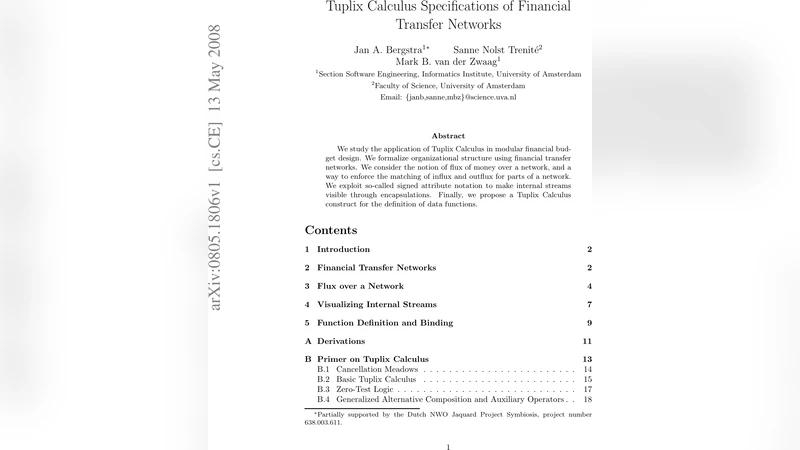
We study the application of Tuplix Calculus in modular financial budget design. We formalize organizational structure using financial transfer networks. We consider the notion of flux of money over a network, and a way to enforce the matching of influx and outflux for parts of a network. We exploit so-called signed attribute notation to make internal streams visible through encapsulations. Finally, we propose a Tuplix Calculus construct for the definition of data functions.
💡 Research Summary
The paper presents a novel application of Tuplix Calculus (TC) to the formal modelling of financial transfer networks (FTNs), which capture the organisational structure of budgets and monetary flows. An FTN is defined by a set of attributes (Attr), a set of units (Unit), and two functions, in and out, that assign to each unit the attributes of incoming and outgoing channels respectively. Each attribute may label at most one internal channel, ensuring a clear one‑to‑one correspondence between attributes and directed links. Internal channels connect two units, while external channels link a unit to the outside world.
The authors introduce the notion of “flux” over a channel: a unit g has an out‑flux a(t) and a unit h has an in‑flux a(‑s). When t = s the channel carries a real monetary flow; otherwise the flow is absent. In TC this is captured by the encapsulation operator ∂ which synchronises matching attributes and hides them. Successful encapsulation yields a test γ(t = s); failure yields the null tuplix δ.
To enforce flux balance for selected units, the paper defines a unary flux‑constraint operator Kₜ. Kₜ(X) adds a constraint that the total net flux of X equals t. The operator is defined recursively over the TC syntax (null, empty, tests, attribute entries, parallel composition, alternative composition, and summation). For example, Kₜ(a(x) ⊕ X) = a(x) ⊕ K_{t+x}(X) accumulates the contribution of each attribute entry to the overall balance. This operator is used in a “reserve buffer” example where each period a fixed percentage of income is saved and the remainder is transferred forward, demonstrating how complex temporal cash‑flow policies can be expressed and verified.
A major contribution is the introduction of signed attribute notation. In the standard flat notation an entry a(t) is neutral: it represents an inflow of ‑t if a belongs to in(g) or an outflow of t if a belongs to out(g). The signed notation replaces these with + a(t) (for outflows) and ‑ a(t) (for inflows). The transformation ζ_{g,H} adds signed copies of all internal entries of unit g that belong to a set H. After encapsulation, the signed copies survive, allowing the analyst to “see” internal transactions that would otherwise be hidden. The Select operator then filters the resulting tuplix to the signed attributes of a particular unit, making its internal cash‑flow traceable even in a fully encapsulated composition.
Finally, the paper sketches an extension of TC with data‑level functions. By adding λ‑abstraction and application to the data domain, functions can be defined inside a tuplix using the construct Γ(f, λ x.t(x)). An axiom scheme (FD) equates Γ(f, λ x.t(x)) with Γ(f, λ x.t(x)) ⊕ γ(f(s) ‑ t(s)) for any argument tuple s, thereby enforcing that the function’s definition matches its use. Moreover, a summation operator over function variables P_f allows a “let‑like” binding: P_f(Γ(f, λ x.t(x)) ⊕ P) means “let f be defined as λ x.t(x) in P”. This mechanism enables compact specification of parameterised budget allocations, such as university faculty funding functions that depend on faculty‑specific data.
Overall, the paper contributes four interrelated techniques: (1) a precise algebraic model of FTNs, (2) the flux‑balancing operator K, (3) signed attribute notation together with ζ and Select to expose hidden internal streams, and (4) a functional extension of TC for modular definition of data‑driven calculations. These tools together provide a rigorous foundation for modular, verifiable financial budget design, extending the applicability of Tuplix Calculus from abstract process algebra to concrete financial engineering contexts.
Comments & Academic Discussion
Loading comments...
Leave a Comment