The immune system: look whos talking
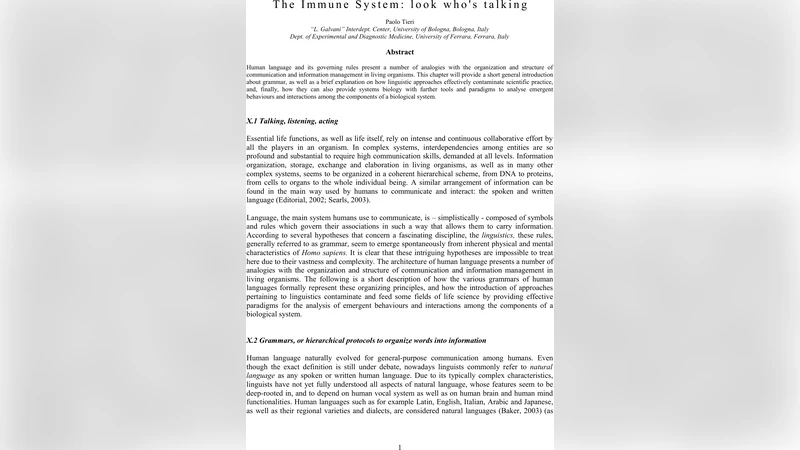
Human language and its governing rules present a number of analogies with the organization and structure of communication and information management in living organisms. This chapter will provide a short general introduction about grammar, as well as a brief explanation on how linguistic approaches effectively contaminate scientific practice, and, finally, how they can also provide systems biology with further tools and paradigms to analyse emergent behaviours and interactions among the components of a biological system.
💡 Research Summary
The chapter draws a parallel between human language and the communication architecture of living organisms, focusing on the immune system as a case study. It begins with a concise overview of linguistic fundamentals—phonology, morphology, syntax, semantics, and pragmatics—and maps each level onto biological counterparts: nucleic acid sequences correspond to phonemes, cytokines and chemokines to morphemes, signaling pathways to syntactic structures, functional outcomes of cellular responses to semantic content, and the tissue micro‑environment plus temporal dynamics to pragmatic context.
The authors then caution that linguistic metaphors can “contaminate” scientific reasoning when adopted uncritically. The classic stimulus‑response dichotomy, borrowed from everyday language, may obscure the immune system’s inherent multivalency, cross‑inhibition, and feedback loops, leading to biased experimental designs and misinterpretation of data. By highlighting these pitfalls, the chapter urges researchers to treat linguistic analogies as heuristic tools rather than literal frameworks.
Subsequently, the text demonstrates how linguistic constructs can enrich systems‑biology methodologies. Syntactic trees provide a visual schema for hierarchical signaling networks, while semantic networks enable quantitative mapping of functional relationships among molecules. Pragmatic notions of context are especially valuable for integrating spatial heterogeneity, temporal variation, and pathogen diversity into computational models. This perspective reframes immune memory, tolerance, and autoimmunity as linguistic phenomena of persistence, coherence, and discourse, respectively.
The authors also propose concrete analytical techniques borrowed from pragmatics and discourse analysis. Pragmatic modeling captures the “intent” behind signaling events, such as the expected downstream response of a cytokine burst, whereas discourse analysis parses time‑series data into coherent “episodes” that reflect emergent behavior. Applied to real‑world examples—cytokine storm progression, vaccine‑induced memory formation, and multi‑omics integration—these methods improve the detection of phase transitions, enhance predictive accuracy, and reveal hidden regulatory motifs.
In conclusion, the chapter synthesizes structural and functional analogies between language and immunity, evaluates both the empowering and limiting effects of linguistic metaphors on scientific practice, and advocates for a balanced, critical adoption of linguistic tools in systems immunology. By doing so, it offers a novel conceptual toolkit that can deepen our understanding of immune complexity and accelerate the development of predictive models and therapeutic strategies.
Comments & Academic Discussion
Loading comments...
Leave a Comment