A.D. Alexandrovs problem for Busemann non-positively curved spaces
The paper is the last in the cycle devoted to the solution of Alexandrov's problem for non-positively curved spaces. Here we study non-positively curved spaces in the sense of Busemann. We prove that if $X$ is geodesically complete connected at infin…
Authors: P.D. Andreev
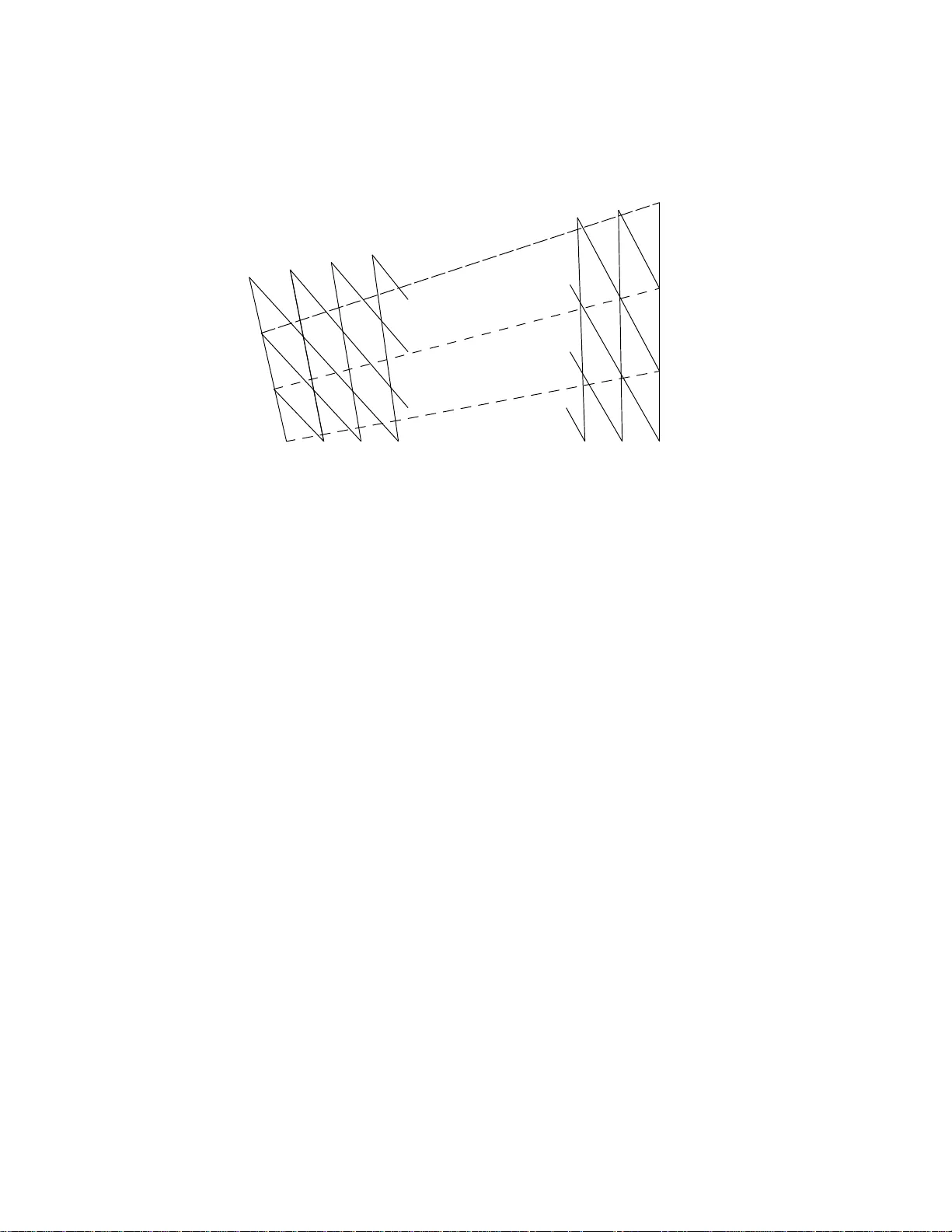
A. D. ALEXANDR O V’S PROBLEM F OR BUSEMANN NON-POSITIVEL Y CUR VED SP A CES P . D. ANDREEV Abstract. The paper is the last in th e cycle dev oted to the solution of Alexandro v’s problem for n on- posi tively curv ed spaces. Here we study non-p ositive ly curved spaces i n the sense of Busemann. W e prov e that if X is geodesically complete connected at infinit y prop er Busemann space, then i t has the following c haracterization of isometri es. F or any bijection f : X → X , if f and f − 1 preserve the distance 1, then f is an is ometry . Keywords. Alexandro v’s problem, Busemann non-p ositiv e curv ature, isometry , r -sequence, geo desic boundary , horofunction b oundary Contents 1. In t ro duction 2 2. Preliminaries 2 2.1. Busemann non-p ositiv ely curv ed spaces 2 2.2. Normed strip Lemma 3 2.3. Compactifications of Busemann space 4 2.4. Virtual prop erties 6 2.5. Plan of the pro of of Theorem 1.2 6 2.6. The space of distances b etw een asymptotic straigh t lines 7 3. Equalit y of metrics along the geo desic of higher ra nk 9 4. Equalit y of metrics along singular straight line 15 4.1. Double spherical transfer 15 5. Equalit y of metrics on strictly regular straigh t line strictly of ra nk one 18 5.1. Tits relatio ns on the b oundary ∂ g X 18 5.2. Scissors 20 5.3. Shado ws 21 5.4. Existence theorem fo r scissors 22 5.5. Con tin uit y o f the shift function 24 6. Finish o f the pro of of ma in Theorem 25 7. Some counterex amples 26 7.1. T rivial counterexample s 26 7.2. Grasshopp er metric 26 7.3. Maxim um pro ducts 28 References 28 Supported by RFBR, grant 04-01-00315a. 1 1. Introduction The pap er completes the cycle [1]–[3], studying A. D . Alexandro v’s problem for spaces with non- p ositiv e curv ature. Previous pa p ers w ere dev o ted to Alexandro v non-p ositive ly curv ed spaces. Here w e deal with Busemann spaces defined in [4], see also [5]–[7]). The main result of the pap er is the follo wing theorem. Theorem 1.1. L et ( X , d X ) and ( Y , d Y ) b e pr op er ge o desic al ly c omplete c on ne cte d at in- finity Busemann sp ac es, and f : X → Y b e a bije ction . Then the fol lowing statements ar e e quivalent. (1) The e quality d X ( x, y ) = 1 holds for p oints x, y ∈ X iff d Y ( f ( x ) , f ( y ) ) = 1 ; (2) The ine quality d X ( x, y ) ≤ 1 holds for p o i n ts x, y ∈ X iff d Y ( f ( x ) , f ( y ) ) ≤ 1 ; (3) The ine quality d X ( x, y ) < 1 holds for p oints x, y ∈ X iff d Y ( f ( x ) , f ( y ) ) < 1 ; (4) The map f is an isometry of the sp ac e ( X , d X ) o n to ( Y , d Y ) . The trivial part of the theorem is the fact that statemen ts (1)–(3 ) follows from (4). It is easy to observ e that Theorem 1.1 has an equiv alen t for mulation. Theorem 1.2. L et the set X is e quipp e d w ith metrics d 1 and d 2 , s uch that b oth sp ac es ( X , d 1 ) , i = 1 , 2 satisfy the c onditions of The or em 1 .1. Then the fol lowing statements ar e e quivalent. (1) The e quality d 1 ( x, y ) = 1 holds for p oints x, y ∈ X iff d 2 ( f ( x ) , f ( y ) ) = 1 ; (2) The ine quality d 1 ( x, y ) ≤ 1 holds for p o i n ts x, y ∈ X iff d 2 ( f ( x ) , f ( y ) ) ≤ 1 ; (3) The ine quality d 1 ( x, y ) < 1 holds for p oints x, y ∈ X iff d 2 ( f ( x ) , f ( y ) ) < 1 ; (4) The metrics d 1 and d 2 on the set X c oincide. Busemann curv a ture non-p ositivit y condition is w eak er than Alexandrov’s o ne. Hence the class of Busemann spaces includes the sub class of C AT (0)-spaces. Some prop erties of C AT (0)-spaces are inherited in the considered class, the others undergone definite mo difications in g eneral. The pap er is organized as fo llowing. In Section 2 we g ive formulations of necessary basic definitions and facts. The main part of the pap er con tains the pro of of Theorem 1.2. W e use ideas and to o ls dev elop ed in earliest pap ers, adapted to the case of Busemann space. The pro of is based on consideration of metrics d 1 and d 2 restricted to arbitra ry straigh t line in t he space X . There are sev eral types of straight lines b eha vior. In Section 3 w e study the case of straig h t lines of higher rank and virtually higher ra nk, in Section 4 the case of singular and virtually singular straight lines, and finally , in Section 5 the case of strictly regular straight lines of strictly rank one. In the la st section w e presen t sev eral coun terexamples to the p ositiv e solution of A.D. Alexandro v’s problem. 2. Preliminaries 2.1. Busemann non-p ositiv ely curv ed spaces. Let ( X , d ) b e a metric space. The ball with radius ρ and cen t er x ∈ X is denoted B ( x, ρ ), the corresp onding sphere S ( x, ρ ). Definition 2.1. A ge o desic in the space ( X , d ) is b y definition a lo cally homot hetic map c : I → X where I ⊂ R is an interv al or segmen t. The image of I under the map c is also called geo desic. The lo cal homothety with a co efficien t λ > 0 means that for a ny neigh b ourho o d U of arbitrary p oin t t ∈ I the equalit y d ( c ( s 1 ) , c ( s 2 )) = λ | s 1 − s 2 | ho lds for all s 1 , s 2 ∈ U . The map c presen ts natur al p ar ame terization of the geo desic if λ = 1 and affin e p ar ameterization or p ar ameterization pr op ortional to natur al in general case. If 2 I = R , the geo desic c is called c omplete ge o desic . If the map c is a homothety on the whole domain I , geo desic c is called minimizer . In particular, minimizer defined on the segmen t I = [ a, b ] ⊂ R is called se gment in the space X . It connects its ends x = c ( a ) and y = c ( b ). The not ation f o r the segmen t connecting p oin ts x, y ∈ X is [ xy ]. The str aight line is b y definition a complete minimizer in X . The space ( X , d ) is called ge o desic if an y t w o its p oin ts can b e connected b y a segmen t. Geo desic space X is called ge o d e sic al ly c omplete , if an y geo desic in X a dmits a con tinuation to a complete geo desic (no t necessarily unique). Definition 2.2. The g eo desic space X is called B usemann non-p ositively curve d (or shortly Busem ann sp ac e ) if its metric is conv ex. This means the follow ing. F o r any t w o segmen ts [ xy ] and [ x ′ y ′ ] with corresp onding affine para meterizations γ : [ a, b ] → X , γ ′ : [ a ′ , b ′ ] → X , the function D γ ,γ ′ : [ a, b ] × [ a ′ , b ′ ] → R defined by D γ ,γ ′ ( t, t ′ ) = | γ ( t ) γ ′ ( t ′ ) | is con v ex. Equiv a len tly , the geo desic space X is Busemann space if for an y three p oints x, y , z ∈ X , the midp o in t m b et w een x and y and the midp oint n b et w een x and z satisfy the inequality | mn | ≤ 1 2 | y z | . (2.1) Here the midp oin t m ∈ X b et w een p oin ts x, y satisfies equalities d ( x, m ) = d ( m, y ) = 1 2 d ( x, y ). Busemann pr o p ert y of curv ature non-p ositivity has a num b er o f another equiv alen t form ulations. The statemen ts equiv alen t to Definition 2.2 are listed in [5, Prop osition 8.1.2]. The simplest examples o f Busemann spaces are C AT (0)-spaces and strictly con v ex normed spaces. F rom no w on the space X satisfies to conditions of Theorem 1.2. The distance b et wee n p oin ts x, y ∈ X will b e denoted | xy | . 2.2. Normed strip Lemma. Giv en a subset A ⊂ X and ǫ > 0 , the set N ǫ ( A ) := { x ∈ X | | xa | < ǫ for some a ∈ A } is ǫ -neighbourho o d of A . Definition 2.3. Hausdorff distanc e b et w een closed subsets A, B ⊂ X is b y definition d H ( A, B ) := inf { ǫ | A ⊂ N ǫ ( B ) , B ⊂ N ǫ ( A ) } . In particular, if the v alue ǫ > 0 suc h t ha t A ⊂ N ǫ ( B ) and B ⊂ N ǫ ( A ) do es not exist, then d H ( A, B ) = ∞ . Tw o straight lines a, b : R → X are called p ar al lel , if Hausdorff distance b et w een them is finite: d H ( a, b ) < ∞ . Norme d s trip ( Minkowski strip ) in the space ( X , d ) is b y definition a subset L ⊂ X iso- metric to a strip b etw een tw o stra ig h t lines in normed plane. The straig h t lines b o unding the nor med strip in X are pa rallel. The con v erse statemen t is also true. It is kno wn as Rinow ’s normed strip lemma. W e form ulate the normed strip lemma as follo wing. Lemma 2.1 (W. R ino w, [8], pp. 432, 463, [9], Lemma 1.1 and r emarks) . Every two p ar al lel str aight lines in Busem a nn sp ac e X b ound the norme d strip in X . 3 R emark 2 .1 . It is clear that Mincow ski plane con taining the strip isometric to normed strip in Busemann space is strictly con v ex. Definition 2.4. W e say that a straight line a : R → X is of higher r an k if it has parallel straigh t lines in X . 2.3. Compactifications of B usemann space. The geometry at infinit y o f Busemann spaces hav e an essen tial difference from C AT (0)-spaces case. Tw o na tural approaches t o ideal compactification give s the same result in C AT (0) case and can b e different in the case of Busemann space. W e refer for relations b et w een t w o compactifications to [10]. Here we only giv e necess ary definitions and form ulations. Definition 2.5. The rays c, d : [0 , + ∞ ) → X are called asymptotic if Hausdorff distance b et w een them is finite: Hd( c, d ) < + ∞ . The asymptoticity is an equiv alence on the set of rays in X . The factor set ∂ g X forms so called ge o desic ide a l b oundary o f X and the union X g = X ∪ ∂ g X its ge o desic ide al c omp actific ation of X . The top olo gy on X g called c one top olo gy can b e describ ed as follo wing. Giv en a basep oin t o ∈ X a nd a p oin t x ∈ X g w e denote [ ox ] a segmen t b et w een them if x ∈ X , or a ray from o to x if x ∈ ∂ g X . By definition, the sequence { x n } + ∞ n =1 ⊂ X g con v erges to the p oint x ∈ X g in the sense of t he cone top ology , if the sequence of natural patameterizations of segmen ts (ra ys) { [ ox n ] } + ∞ n =1 con v erges to the natural pa r a meterization of [ ox ]. In that case the conv ergence of par ameterizations is uniform on common b ounded sub domains of the parameter. Suc h defined cone t o p ology on X g do es no t dep end on the c ho ice of the basep oin t o . Induced top olo g y on the b o undary ∂ g X is a lso called c one . The iden tit y map Id X = i g : X → X g is an em b edding of X to X g as op en dense subset X = i g ( X ) ⊂ X g . W e refer for the more complicated information ab out geometry of the b oundary ∂ g X to [6] and [7]. Here w e need some tec hnical statemen t relat ed to the cone top ology on ∂ g X . Giv en a closed subset V ⊂ ∂ g X , p oin t o ∈ X and num b ers K , ε > 0 we define ( o, K , ε ) - neighb ourho o d of V as a set N o,K, ε ( V ) := { ζ ∈ ∂ ∞ X | ∃ ξ ∈ V , ζ ∈ U ( ξ , o, K , ε ) } , where U ( ξ , o, K, ε ) := { η ∈ ∂ ∞ X | | c ( K ) d ( K ) | < ε , c = [ o, ξ ]; d = [ o, η ] } . Lemma 2.2. Fix a p oint o ∈ X and a numb er ε > 0 . F or any n eighb ourho o d U of close d set V in the sense of the c one top olo gy, ther e exists a numb er K such that V ⊂ N o,K, ε ( V ) ⊂ U . Pr o of. Assume to the con trary that for any K > 0 U ξ K ,o,K ,ε 6⊂ U for some ξ K ∈ V . Fix a sequence K n → + ∞ a nd con v erging sequence { ξ K n } ⊂ V of corresp onding ideal p oin ts with neigh b ourho o ds U ξ K n ,o,K n ,ε 6⊂ U . W e can do that b ecause V is compact. Denote ζ = lim n →∞ ξ n 4 and K ′ > 0 the n um b er suc h that U ζ ,o,K ′ ,ε ⊂ U . Then U ξ K n ,o, 2 K ′ ,ε ⊂ U ζ ,o, 2 K ′ , 2 ε ⊂ U for all but finitely man y n . A con tradiction to the c hoice of the sequence ξ K n . Definition 2.6. Let ( X , d ) b e a metric space X and C ( X ) b e the space of con t inuous functions o n X with the top ology of uniform conv ergence on b ounded sets. Kur atowsk i emb e ddin g X → C ( X ) is defined as follow ing. Let o ∈ X b e a basep oin t. An y p o in t x ∈ X is iden tified with dis tanc e function d x whic h acts by the form ula d x ( y ) = | xy | − | ox | . Let C ∗ ( X ) = C ( X ) / { consts } b e a quotien t space of C ( X ) b y the subspace of constan ts. Then the pro jection p : C ( X ) → C ∗ ( X ) generates embedding ν : X → C ∗ ( X ) indep en- den t o n the choice of the basep oin t o . It is con v enien t to identify the space X with its image ν ( X ). Let the space X b e prop er and non-compact. Hor ofunction c omp actific a tion of the space X is by definition the closure of the image ν ( X ) ⊂ C ∗ ( X ). The horofunction compactification is denoted X h , the hor ofunction b oundary is ∂ h X = X h \ X . The map ν : X → X h is em b edding of X to its horofunction compactification. F unctions gener- ating the horofunction b oundary are called ho r ofunctions . W e think eac h horofunction as a limit of distance functions in the sense of the top ology of uniform conv ergence on b ounded sets. Giv en the horofunction Φ, the corresp onding p oint in the ho r o function b oundary is denoted [Φ] ∈ ∂ g X . The imp ortant class o f horo f unctions in the Busemann space X consists of B usemann functions . Ev ery ra y c : R + → X generates corresp onding Busemann function β c b y the equalit y β c ( y ) = lim t → + ∞ ( | y c (0) | − t ) . Lev el sets of horofunctions are called h or ospher es , sublev els — hor o b al ls . The horo sphere defined within t he horofunction Φ b y t he equalit y Φ( x ) = Φ( x 0 ) where x 0 ∈ X is denoted HS (Φ , x 0 ), the corresp onding horoba ll is HB ( Φ , x 0 ). In [11] M. Rieffel defined metric compactification of the space X . It is show n that metric compactification is equiv alen t to ho rofunction one. The following theorem is prov en in [10]. Theorem 2.1. L et X b e a pr op er non-c om p act Busemann sp ac e. The n ther e exists c on- tinuous surje c tion π hg : X h → X g which c oincide with the id e ntific ation on X . If β c is Busemann function gener ate d by the r ay c : R + → X , then π hg ([ β c ]) is a cla s s of r ays asymptotic to c c onsid e r e d as a p oin t in ∂ g X . If X is C AT (0), the ma p π hg is a homeomorphism. F rom the other hand, the surjection π hg is not injectiv e if X is Mink owsk i space with singular norm. The preimage π − 1 hg ( ξ ) consists of more than one p oin t if ξ corresp onds to the singular direction of the nor m. Definition 2.7. The p oin t ξ ∈ ∂ g X of geo desic ideal b oundary is called r e gular if its preimage π hg ( ξ ) ⊂ ∂ m X is one-p oin t set. Otherwise the p oint ξ is sing ular . The straigh t line a : R → X is called r e gular if b oth endp oints a ( −∞ ) and a (+ ∞ ) a r e regular. Otherwise a is called singular . 5 It easily f ollo ws from the compactness of the space X h and Hausdorffness of X g that the map π hg is closed: the image of a rbitrary closed subset in X m is closed in X g . As a corollary , π hg satisfies to t he following ”w eak op enness” prop ert y . Lemma 2.3. F or any p oin t ξ ∈ ∂ g X and any neighb ourho o d U of its pr eim a ge π − 1 hg ( ξ ) ⊂ ∂ m X ther e exists a neighb ourho o d V of ξ in ∂ g X such that V ⊂ π hg ( U ) . Pr o of. The image π hg ( ∂ g X \ U ) is closed, so op en subset V = ∂ g X \ π hg ( ∂ g X \ U ) is demanded neighbourho o d of ξ . 2.4. Virt ual prop erties. Definition 2.8. The finite collection o f straig h t lines a := a 0 , a 1 , . . . , a n := b is called asymptotic cha in if for all i = 1 , n lines a i − 1 and a i are asymptotic in one of their directions. In that case w e sa y that straigh t lines a and b are connected b y the a symptotic c hain. By definition, the straigh t line b : R → X satisfies some prop ert y virtual ly if it is connected b y asymptotic chain with the straigh t line a which satisfies men tioned prop erty . In further w e need to consider virtually singular straigh t lines and straigh t lines virtually of higher rank. If the straight line a is no t a straigh t line virtually of hig her rank (virtually singular), w e sa y that a is strictly o f r ank one ( strictly r e gular ). 2.5. Plan of the pro of of Theorem 1.2. The equiv alence of statemen ts (1)–(3) in Theorem (1.2) in the case of C AT (0)-space w as prov en in [3]. W eak ening the curv at ure conditions do es not lead to c hang es in the pro o f. So we assume that the equiv alence of statemen ts (1)–( 3 ) is prov en. Our purp ose is to show t ha t these three claims imply the statemen t (4). Consider a pair x, y ∈ X . By geo desic completeness of the space X the segmen t [ xy ] in the sense of the metric d 1 is con tained in a straigh t line a (not necessarily unique). W e will pro v e that a is a straight line in the sense o f the metric d 2 as w ell, a nd metrics d 1 and d 2 are equal along a . W e need to study the fo llo wing situations. The straigh t line a can b e of higher rank, virtually of higher rank or strictly of ra nk one. In the last case it can b e singular, virtually singular or strictly regular. W e pro v e the equality d 1 = d 2 along a in all cases. The main tec hnique w as dev elop ed in [1]–[3]. W e use the notion of r -sequence intro- duced by V. Beresto vski ˇ ı in [1] and horospherical metric tra nsfer from the straigh t line to its a symptotic straig h t line. Recall the definition of r - sequenc e following [3]. Definition 2.9. The homot hety with co efficien t r > 0 Z → X of integers Z to the space X is called r -se quenc e . W e only consider the case r = 1 when the homothety b ecomes isometry , but w e ke ep the term r -sequence for con v enience. The segmen t of r -sequence { x z } z ∈ Z b et w een x z 1 and x z 2 will b e denoted [ x z 1 , x z 1 +1 , . . . , x z 2 ] r . Tw o r -sequences { x z } z ∈ Z and { y z } z ∈ Z are called p ar a l lely e quival e nt if Hausdorff distance b et w een them is finite: Hd( { x z } , { y z } ) < + ∞ . 6 The follo wing result of V. Beresto vski ˇ ıplay s the crucial role in the pro of in the case of C AT (0)-spaces ([1], Prop osition 3.5). Let X b e C AT (0)-space that satisfies t o conditions of Theorem 1.2. Then the metric top ology τ m on X is equal to the initial top o logy τ f relativ e to t he family of all Busemann functions on X . W e form ulate corresp onding prop osition for the case of Busemann spaces as following. Prop osition 2.1. L et X b e ge o desi c al ly c omplete c onne cte d at infinity pr op er Busemann sp ac e. Then the set of op en hor o b al ls c orr esp onding to Busema n n functions is a s ubb ase for the metric top olo gy on X . Pr o of. G iven any ra y c = [ x 0 ξ ], the supplemen t X \ H B ( β c , x 0 ) of the closed horoball HB ( β c , x 0 ) is the union of op en horoba lls generated b y Busemann functions. Indeed, X \ HB ( β c , x 0 ) = [ x ∈HS ( β c ,x 0 [ d ∈ r x hb ( β d , x ) . Here r x denotes the set of rays d : R + → X complemen t to the ray [ xξ ]. The rest of the pro of rep eats the arguments of V. Beresto vski ˇ ı from [1]. The horospherical metric transfer is the pro cedure based on the following lemma. Its pro of in [3] do es not c hange essen tially after weak ening the curv ature conditions from C AT (0) to Busemann spaces case. Lemma 2.4. L et the sp ac es ( X , d ) , ( X , d ′ ) sa tisfy c ond i tion s o f the o r em 1.2. L et ima g es of maps a, b : R → X b e str aight line s in X with r esp e ct to b oth metrics d a n d d ′ and these str aight line s ar e asymp totic in the dir e ction of ide al p oint ξ ∈ ∂ g X in the sens e of metric d . If the e quality d = d ′ holds alon g a , then d = d ′ along b as wel l. 2.6. The space of distances b et w een asymptotic st raigh t lines. Fix an ideal p o in t ξ ∈ ∂ g X in the geo desic b oundary of the space X . It defines the following pseudometric ρ ξ on X . F or the p oin ts x, y ∈ X put ρ ξ ( x, y ) = dist([ xξ ] , [ y , ξ ]) . This means that ρ ξ ( x, y ) = inf s,t ≥ 0 | c ( s ) , d ( t ) | , where c, d : R + → X are natural parameterizations of ray s [ x ξ ] and [ y ξ ] corresp ondingly . The pro o f of the f ollo wing claim is by direct c heck ing of pseudometric axioms. Lemma 2.5. The function ρ ξ is a pseudometric on X . Denote X ξ the metric space obt a ined from X within pseudometric ρ ξ . The elemen ts of X ξ are classes of p oin ts for whic h ρ ξ = 0. W e k eep the notation ρ ξ for the metric on X ξ . In par ticular, if the rays c, d : R + → X are asymptotic in the direction ξ , the distance ρ ξ b et w een their p oin ts is constan t , and we denote this distance ρ ξ ( c, d ). In particular, the metric space X ξ ma y b e one-p oint. Lemma 2.6. L et the r ays c, d : R + → X b e a s ymp totic, c (+ ∞ ) = d (+ ∞ ) = ξ , β c and β d b e c orr esp o n ding Busemann functions. Th e n 0 ≤ β c ( d (0)) + β d ( c (0)) ≤ 2 ρ ξ ( c, d ) . 7 Pr o of. Supp ose that the ra y d ′ : R + → X in the direction of ideal p oint ξ has common part with t he ray d . W e sho w the equality β c ( d (0)) + β d ( c (0)) = β c ( d ′ (0)) + β d ′ ( c (0)) . (2.2) In f a ct, if d ′ ( s ) = d ( t ) f or some s, t ≥ 0, then β d ( x ) = β d ′ ( x ) + t − s for all x ∈ X and β c ( d (0)) = β c ( d ′ (0)) − t + s. Substitute c ( 0) instead of x in the first equality . Then adding of inequalities giv es (2.2). In view of (2.2) w e ma y assume that β c ( d (0)) = 0. W e claim that β d ( c (0)) ≥ 0 in this case. Indeed, for any ε > 0 there exists T > 0 suc h that fo r all t > T | d (0) c ( τ ) | < τ + ε and t τ < ε | c (0) d (0) | for some τ = τ ( t ) > t . Let p b e the p oin t of the segmen t [ d ( 0) c ( τ )] on distance | d (0) p | = t τ · | d (0 ) c ( τ ) | from d ( 0 ). W e hav e | pd ( t ) | ≤ t τ · | c ( τ ) d ( τ ) | < ε and | pc ( τ ) | < τ − t + ε . Consequen tly , fro m the triangle inequalit y | c (0) p | > t − ε. Hence | c (0) d ( t ) | ≥ | c (0 ) p | − | pd ( t ) | > t − 2 ε. T aking into a ccount arbitrariness o f the c hoice of ε and enlarg ing t to infinit y we obtain demanded estimation for β d ( c (0)) a nd fo r the sum β c ( d (0)) + β d ( c (0)) f rom b elo w. F rom the other hand, under suppo sing β c ( d (0)) = 0 tak e a n arbitr a ry ε > 0 and n umbers s, t > 0 suc h that | c ( s ) d ( t ) | < ρ ξ ( c, d ) + ε 4 , || c ( s ) d (0) | − s | < ε 4 and || c (∆) d ( t ) | − t | < ε 4 . where ∆ = β d ( c (0)). Then triangle inequalit y giv es ∆ + t − ε 4 < ∆ + | c (∆) d ( t ) | ≤ s + | c ( s ) d ( t ) | < s + ρ ξ ( c, d ) + ε 4 and s − ε 4 < | d (0) c ( s ) | ≤ t + | c ( s ) d ( t ) | < t + ρ ξ ( c, d ) + ε 4 . Addition of the tw o inequalities giv es ∆ = β c ( d (0)) + β d ( c (0)) < 2 ρ ξ ( c, d ) + ε. 8 Since ε > 0 was ta k en arbit r a rily , w e hav e necessary estimation from ab ov e for the sum β c ( d (0)) + β d ( c (0)). Let a : R → X b e a straight lines with a (+ ∞ ) = ξ and Y ⊂ X b e a subset con taining all p o in ts of straigh t lines parallel to a . Consider metric subspace Y ξ in the space X ξ obtained from Y . Lemma 2.7. The sp ac e Y ξ is Busemann non-p ositivel y curve d sp ac e. It is one-p o i n t sp ac e iff a is of r ank one . Pr o of. Let b and c b e t w o straight lines par allel to a . Then b parallel c and they b ound a normed strip F ⊂ Y . The strip F is foliat ed b y straight lines parallel to a and it pro j ects to a segmen t in the space Y ξ . Conse quen tly Y ξ is geo desic space. Let b ξ , c ξ , d ξ ∈ Y ξ b e three p oin ts obta ined as pro jections to Y ξ of straight lines b , c and d corresp ondingly . Cho ose p oin ts y ∈ c and z ∈ d suc h that | y z | = ρ ξ ( c ξ , d ξ ). Also choose a p oin t x 1 ∈ b for whic h | x 1 y | = ρ ξ ( b, c ) and a p oin t x 2 ∈ b , for whic h | x 2 z | = ρ ξ ( b, d ). x x y z n n m b c d p q 1 2 1 2 Fig. 1. Let m b e the midp oin t of the segmen t [ x 1 y ], n 1 the midp o int of the segmen t [ x 1 z ] and n 2 the midp oin t of the segmen t [ x 2 z ], p and q b e straig ht lines parallel to a passing throw p oin ts m and n 2 corresp ondingly , and p ξ and q ξ b e their pro jections to Y ξ . Then the straigh t line q also passes throw the p oint n 1 . Hence ρ ξ ( p ξ , q ξ ) ≤ | mn 1 | ≤ 1 2 | y z | . Since p ξ are q ξ the midp oin ts of the segmen ts [ b ξ c ξ ] and [ b ξ d ξ ] in the space Y ξ , the first claim o f Lemma is prov en. The second claim is obvious . 3. Equality of metrics along the geodesic of highe r rank The main idea in consideration of straight lines o f higher rank is inherited from the pa- p ers [2] and [3]. W e study the construction of tap es in tro duced there. The only alteration is t hat w e consider normed strips in the space X instead of fla t strips in C AT (0) case. Suc h an alterat ion do es not lead to essen tial c hanges in the pro ofs. Recall t he definition of p -tap e. 9 Definition 3.1. W e sa y that t he collection of 4 p ( p ∈ N ) parallely equiv alen t r -sequences { x i,j ; z } z ∈ Z , i = 0 , 3 , j = 1 , p (3.1) forms a p -tap e , if the follo wing 4 p + 4 p o in ts x i, 1 , 0 , . . . , x i, p, 0 , i = 0 , 3 x 0 , 1 , 2 p − 1 , x 2 , p, 1 − 2 p , x 3 , p − 1 , 1 − 2 p , x 3 , p, 1 − 2 p generates in addition the system of segmen ts of r -sequences : [ x 0 , 1 , 0 , x 1 , 1 , 0 , x 2 , 1 , 0 , x 3 , 1 , 0 ] r . . . [ x 0 , p, 0 , x 1 , p, 0 , x 2 , p, 0 , x 3 , p, 0 ] r [ x 0 , 2 , 0 , x 1 , 1 , 0 , x 2 , p, 1 − 2 p , x 3 , p − 1 , 1 − 2 p ] r [ x 0 , 3 , 0 , x 1 , 2 , 0 , x 2 , 1 , 0 , x 3 , p, 1 − 2 p ] r [ x 0 , 4 , 0 , x 1 , 3 , 0 , x 2 , 2 , 0 , x 3 , 1 , 0 ] r . . . [ x 0 , p, 0 , x 1 , p − 1 , 0 , x 2 , p − 2 , 0 , x 3 , p − 3 , 0 ] r [ x 0 , 1 , 2 p − 1 , x 1 , p , 0 , x 2 , p − 1 , 0 , x 3 , p − 2 , 0 ] r (2) ✥ ✥ ✥ ✥ ✥ ✥ ✥ ✥ ✥ ✥ ✥ ✥ ✥ ✥ ✥ ✥ ✥ ✥ ✥ ✥ ✥ ✥ ✥ ✥ ✥ ✥ ✥ ✥ ✥ ✥ ✥ ✥ ✥ ✥ ✥ ✥ ❵ ❵ ❵ ❵ ❵ ❵ ❵ ❵ ❵ ❵ ❵ ❵ ❵ ❵ ❵ ❵ ❵ ❵ ❵ ❵ ❵ ❵ ❵ ❵ ❵ ❵ ❵ ❵ ❵ ❵ ❵ ❵ ❵ ❵ ❵ ❵ ❵ ❵ ❵ ❵ ❵ ❵ ❵ ❵ ✥ ✥ ✥ ✥ ✥ ✥ ✥ ✥ ✥ ✥ ✥ ✥ ❵ ❵ ❵ ❵ r r r r r r r r r r r r r r r r r r x 0 , 1 , 0 x 3 , 1 , 0 x 0 , p, 0 x 0 , 1 , 2 p − 1 x 3 , p, 1 − 2 p x 0 , 2 , 0 x 2 , 1 , 0 x 1 , 1 , 0 x 3 , p − 1 , 0 x 1 , p , 0 Fig. 2. p -tap e. W e need the follo wing tec hnical statemen t. The notation p − m − n − q means that p oin ts m a nd n b elong to the segmen t [ pq ] and divide this segmen t b y three equal parts: | pm | = | mn | = | nq | = 1 3 | pq | . Lemma 3.1. L et 4 p p oints y ij , i = 0 , 3 , j = 1 , p (not ne c essarily differ en t) b e given in Busemann sp ac e Y . Supp ose that the fol lowing r e lations ho ld (se e Fig. 3 ): y 01 − y 11 − y 21 − y 31 . . . y 0 p − y 1 p − y 2 p − y 3 p y 02 − y 11 − y 2 p − y 3( p − 1) y 03 − y 12 − y 21 − y 3 p y 04 − y 13 − y 22 − y 31 . . . y 0 p − y 1( p − 1) − y 2( p − 2) − y 3( p − 3) y 01 − y 1 p − y 2( p − 1) − y 3( p − 2) Then al l p o ints y 1 j c oincide. The same is true for al l p oints y 2 j . Pr o of. Let M b e the maxim um of distances | y 11 y 12 | , | y 12 y 13 | , . . . , | y 1( p − 1) y 1 p | , | y 1 p y 11 | , | y 21 y 22 | , | y 22 y 23 | , . . . , | y 2( p − 1) y 2 p | , | y 2 p y 21 | . After a ren umeraton, if necessary , we ma y 10 y 01 y 02 y 03 y 04 y 0p y 0p-2 y 0p-1 y 11 y 21 y 31 y 32 y 33 y 34 y 3p y 3p-1 y 3p-2 y 1p y 2p y 14 y 24 y 1p-2 y 2p-2 Fig. 3. assume that | y 11 y 12 | = M . Then curv ature no n- p ositivit y prop erty with respect to the triangle y 02 y 22 y 2 p giv es | y 2 p y 22 | ≥ 2 M . F rom the other hand, | y 2 p y 22 | ≤ | y 2 p y 21 | + | y 21 y 22 | ≤ 2 M , from where | y 2 p y 22 | = 2 M and | y 2 p y 21 | = | y 21 y 22 | = M . Moreo v er, men tioned equalities mean that p o in ts y 2 p , y 21 and y 22 b elong to a straight line. Con tinuing in similar wa y , w e get that all considering distances are M , all p o ints y 1 j b elong to a straight line and all p oints y 2 j also b elong t o another straight line. Such a configuratio n is p ossible only for M = 0. Corollary 3.1. Al l r -se q uen c es x 1 ,j,z in D efinition 3.1 b elong to one s tr a i g ht line. A l l r -se quenc e s x 2 ,j,z b elong to one str aigh t line as wel l. Pr o of. Consider the set Y formed by p oin ts of straigh t lines pa rallel to lines con taining r -sequences of the tap e. By L emma 2.7 t he space Y ξ is Busemann non-p ositiv ely curv ed. Denote y ij the pro jection o f r -sequence { x i,j,z } z ∈ Z to Y ξ . Then p oin ts y ij form exactly the configuration describ ed in Lemma 3.1. It f ollo ws that p oints y 1 j coincide. This p oin t is the pro jection o f one straight line containing r -sequences { x 1 ,j,z } z ∈ Z . Analo g ously , all r -sequences { x 2 ,j,z } z ∈ Z lie in one straight line. Let r -sequences (3 .1) form a p - t a p e in Busemann space ( X , d ). Consider the segmen ts [ x 1 , 1 , 0 x 3 , 1 , 0 ] and [ x 0 , 2 , 0 x 2 , 2 , 0 ]. Their midp oin ts are x 2 , 1 , 0 and x 1 , 2 , 0 corresp ondingly and | x 2 , 1 , 0 x 1 , 2 , 0 | = 1 = | x 1 , 1 , 0 x 0 , 2 , 0 | = | x 3 , 1 , 0 x 2 , 2 , 0 | . Hence, giv en t ∈ [0 , 2], if x t ∈ [ x 1 , 1 , 0 x 3 , 1 , 0 ] is a p oin t with | x 1 , 1 , 0 x t | = t and y t ∈ [ x 0 , 2 , 0 x 2 , 2 , 0 ] is a p oint with | x 0 , 2 , 0 y t | = t , then | x t y t | = 1. 11 ❅ ❅ ❅ ❅ ❅ ❅ ❅ ❅ ❅ ❅ ❅ ❅ ❅ ❅ ❅ ✟ ✟ ✟ ✟ ✟ ✟ ✟ r r r r r r r r r r r r r r r x 1 , 1 , 0 x 0 , 2 , 0 x 2 , 1 , 0 x 1 , 2 , 0 x 3 , 1 , 0 x 0 , 2 , 0 p ( s 1 ,t 1 ) p ( s 2 ,t 2 ) x t 1 y t 1 m λ x t 2 y t 2 x (1 − λ ) t 1 + λt 2 y (1 − λ ) t 1 + λt 2 Fig. 4. Lemma 3.2. The union U of the se gm ents [ x t y t ] is c on v ex subset in X isom etric to the p ar al lelo gr am in the norme d plane. Pr o of. F o r t ∈ [0 , 2] and s ∈ [0 , 1 ] denote p ( s,t ) the p oint of the segmen t [ x t y t ] suc h that | x t p ( s,t ) | = s . Fix p oints p ( s 1 ,t 1 ) and p ( s 2 ,t 2 ) ; see Fig 4. F or λ ∈ [0 , 1] denote m λ the p oint of the segmen t [ p ( s 1 ,t 1 ) p ( s 2 ,t 2 ) ] suc h tha t | p ( s 1 ,t 1 ) m λ | = λ | p ( s 1 ,t 1 ) p ( s 2 ,t 2 ) | . It follows from the con vex ity o f the metric d that 1 = | x (1 − λ ) t 1 + λt 2 y (1 − λ ) t 1 + λt 2 | ≤ | x (1 − λ ) t 1 + λt 2 m λ | + | m λ y (1 − λ ) t 1 + λt 2 | ≤ ≤ (1 − λ ) | x t 1 p ( s 1 ,t 1 ) | + λ | x t 2 p ( s 2 ,t 2 ) | + (1 − λ ) | p ( s 1 ,t 1 ) y t 1 | + λ | p ( s 2 ,t 2 ) y t 2 | ≤ ≤ (1 − λ ) | x t 1 y t 1 | + λ | x t 2 y t 2 | = 1 . Since the left and righ t sides of the inequalit y ab o v e coincide, all the inequalities must b e equalities. It follows that m λ is p ((1 − λ ) s 1 + λs 2 , (1 − λ ) t 1 + λt 2 ) . Hence the subset U is con v ex. Moreo v er, all the maps λ → p ((1 − λ ) s 1 + λs 2 , (1 − λ ) t 1 + λt 2 ) represen t the affine parameterizations of the segmen ts [ p ( s 1 ,t 1 ) p ( s 2 ,t 2 ) ]. Giv en arbitra ry δ ∈ ( − 2 , 2) and σ ∈ ( − 1 , 1), consider the function ρ δ,σ defined in the appropriate part o f the rectangle [0 , 1] × [0 , 2] b y the equality ρ δ,σ ( s, t ) = d ( p ( s,t ) , p ( s + δ,t + σ ) ) . r r r r ❍ ❍ ❍ ❍ ❍ ❍ ❍ ❍ ❍ ❍ ❍ ❍ ❍ ❍ ❍ ❍ ✘ ✘ ✘ ✘ ✘ ✘ ✘ ✘ ✘ ✘ ✘ ✘ ✘ ✘ ✘ ✘ r r r r p (2 s 0 − s,t 0 ) p ( s 0 ,t 0 ) p ( s,t 0 ) p (2 s − s 0 ,t 0 ) p ( s 0 + δ,t 0 + σ ) p ( s + δ,t 0 + σ ) Fig. 5. 12 W e claim that the function ρ δ,σ is constant on its domain of represen tation D δ,σ ⊂ [0 , 2] × [0 , 1] and ρ λδ,λσ ( s, t ) = λρ δ,σ ( s, t ) (3.2) for all λ ∈ [0 , 1]. It is sufficien t to prov e the claim for a small neighbourho o d o f the arbitrary in terior p oint ( s 0 , t 0 ) ∈ D δ,σ ∩ (0 , 2 ) × (0 , 1). W e prov e that if (2 s − s 0 , t 0 ) , (2 s 0 − s, t 0 ) ∈ D δ,σ , then ρ δ,σ ( s, t 0 ) = ρ δ,σ ( s 0 , t 0 ). Indeed, the Busemann inequality fo r the triangle p (2 s − s 0 ,t 0 ) p ( s 0 ,t 0 ) p ( s 0 + δ,t 0 + σ ) giv es (see Fig. 5 ) | p ( s,t ) p ( s + 1 2 δ,t 0 + 1 2 σ ) | ≤ 1 2 | p ( s 0 ,t 0 ) p ( s 0 + δ,t 0 + σ ) | and consequen tly ρ δσ ( s, t 0 ) ≤ ρ δσ ( s 0 , t 0 ) . F rom the other hand, the Busemann inequalit y for the triangle p (2 s 0 − s,t 0 ) p ( s,t ) p ( s + δ,t 0 + σ ) giv es | p ( s 0 ,t 0 ) p ( s 0 + 1 2 δ,t 0 + 1 2 σ ) | ≤ 1 2 | p ( s,t 0 p ( s + δ,t 0 + σ ) | and ρ δσ ( s 0 , t 0 ) ≤ ρ δσ ( s, t 0 ) . Hence the equality holds ρ δσ ( s 0 , t 0 ) = ρ δσ ( s, t 0 ) . Similarly w e o btain ρ δσ ( s 0 , t 0 ) = ρ δσ ( s 0 , t ) for all t ∈ [0 , 1] suc h that ( s 0 , 2 t − t 0 ) , ( s 0 , t − 2 t 0 ) ∈ D δ,σ . As a corollary , the equalit y holds ρ δσ ( s 1 , t 1 ) = ρ δσ ( s 2 , t 2 ) for all pair s ( s 1 , t 1 ) , ( s 2 , t 2 ) ∈ D δ,σ . The equalit y ( 3 .2) is ob vious. No w, define the norm N in the affine plane A 2 with co o rdinates ( α , β ) by the equalit y N ( α, β ) = 1 λ ρ | λα | , | λβ | ( p st ) , where λ > 0, | λα | ≤ 2, | λβ | ≤ 1 and ( s, t ) ∈ D | λα | , | λβ | are tak en arbitrarily . The previous consideration sho ws that the norm N do es not dep end o n t he choice of λ and ( s, t ) satisfying mentioned conditions. It follow s from the con v exit y of the metric in X that t he normed space ( A 2 , N ) is strictly con v ex. By the definition of the norm N , the parallelogram [0 , 2] × [0 , 1] ⊂ A 2 is isometric to U . Lemma 3.3. L et r -se q uen c es (3.1) form a p -tap e and the str aight line a : R → X c ontains p oints x 1 ,j,z for 1 ≤ j ≤ p and z ∈ Z . Then x 1 ,j,z = a ( j − 1)(2 p − 1) p + z (3.3) for a l l j ∈ { 1 , . . . , p } and z ∈ Z . 13 Pr o of. It follows from t he previous lemma that | x 1 , 1 , 0 x 1 , 2 , 0 | = | x 2 , 1 , 0 x 2 , 2 , 0 | . Analogously , the equalities hold | x 1 ,j − 1 , 0 x 1 ,j, 0 | = | x 2 ,j − 1 , 0 x 2 ,j, 0 | for all j ∈ { 2 , . . . , p } , | x 2 ,j, 0 x 2 ,j + 1 , 0 | = | x 1 ,j + 1 , 0 x 1 ,j + 2 , 0 | for all j ∈ { 1 , . . . , p − 2 } and | x 2 ,p − 1 , 0 x 2 ,p, 0 | = | x 1 ,p, 0 x 1 , 1 , 2 p − 1 | . Since fro m the Corollary 3.1 the p oin ts x 1 ,j, 0 b elong to one straigh t line containing also x 1 , 1 , 2 p − 1 , these p oin ts divide the segmen t [ x 1 , 1 , 0 x 1 , 1 , 2 p − 1 ] to p equal parts. The rest of the pro of is obvious. No w supp ose that the map a : R → X represen ts a straight line of higher rank in the metric space ( X , d 1 ). Then the image a ( R ) can lie in t he interior of some normed strip or in the ot her case a ( R ) is b oundary line of a n y normed strip con taining it. Supp ose t he first o pt io n. L et F b e a no rmed strip containing a ( R ) in its interior. Lemma 3.4. Ther e exists a numb er P > 0 such that for al l natur al p > P the norme d strip F c ontain s a p -tap e as in De fi nition 3.1 w ith x 1 ,j,z = a ( j − 1)(2 p − 1) p + z . Pr o of. Let a num b er L > 0 b e suc h that the strip F con tains a substrip of width 3 L with b oundary lines on the distances L and 2 L fr o m a . Fix a p o in t q ∈ F with | a (0) q | = 1 a nd 0 < dist( q , a ) < min { 1 , L } . then there exists num b er t with 0 < | t | < 2 suc h that | a ( t ) q | = 1. Since the metric of F is strictly con v ex, the num b er t and the p oin t a ( t ) a re defined uniquely . T a ke a n um b er P > 0 suc h that 2 /P < 2 − | t | . It is easy to see that P satisfies the claim. Lemma 3.5. L et the c ol le ction of r -se quenc es (3.1) forms p -tap e in the se nse of metric d 1 . Then it also forms p -tap e in the sense of the metric d 2 . Pr o of. F o llo ws immediately f rom conditions on metrics d 1 and d 2 and Definition 3.1. No w we are ready to prov e the equalit y of metrics a long the straigh t line a of higher rank in the case when a passes in the in t erior o f some normed strip F . Lemma 3.6. L et the ma p a : R → X r epr esent a str aight line the sens e of the metric d 1 , and a p asses in the interior of the norme d strip F . Then the map a r epr esents a str aight line in the sense of the metric d 2 and we have e quality d 1 = d 2 along it. Pr o of. By Lemma 3.4 there exists a n um b er P > 0 suc h that for all natura l p > P the normed strip F con tains p -t ap e defined b y the collection (3.1) with a k p = x 1 ,j,z , where j = 1 − p · k p , 14 n k p o denotes fractional pa r t of k /p , and z = k − ( j − 1)(2 p − 1 ) p . By Lemma 3.5 , ev ery such p - tap e is also p -tap e in the sense of the metric d 2 . By Corol- lary 3.1 p oints x 1 ,j,z b elong to the image of the map a ′ : R → X represen ting natur a l parameterization of a straigh t line in the sense of the metric d 2 , and by Lemma 3.3 they satisfy equalities (3.3). T aking different natural v alues p , we obtain that a ′ ( q ) = a ( q ) for all r ational q . Since metrics d 1 and d 2 are equiv alen t, t he equality a ′ ( t ) = a ( t ) holds fo r all t ∈ R . Hence the claim. Corollary 3.2. L et the m a p a : R → X b e the natur al p ar am e teriza tion of a str aight line of h igher r ank in the sens e of the m etric d 1 . T hen the map a is also natur al p ar a meteri- zation of a str aight line in the sense of the metric d 2 . Pr o of. If the image a ( R ) passes in the interior of a normed strip, the result is pro v en in Lemma 3.6. If a ( R ) is b oundary straigh t line of normed strip F , it is the limit of naturally parameterized straigh t lines. Since the metrics d 1 and d 2 are equiv a len t, a ( R ) is the limit of naturally parameterized straight lines in the sense of the metric d 2 as well. Hence the claim. Finally w e hav e the result. Theorem 3.1. L et a b e a str aight line virtual ly of higher r ank in the sense of metric d 1 . Then a is str aight line virtual ly of higher r ank in the sense of the metric d 2 and metrics c oincide along it: d 1 ( x, y ) = d 2 ( x, y ) for a l l x, y ∈ a . Pr o of. F o llo ws immediately f rom Corollary 3.2 and Lemma 2 .4. 4. Equality of metrics along singular s traight line 4.1. Double spherical transfer. In t his section, w e prov e that metrics d 1 and d 2 coin- cide alo ng singular straig ht line of rank o ne. The singularit y of the straigh t line a : R → X means that at least one of enp oin ts a (+ ∞ ) or a ( −∞ ) is singular p oin t of the geo desic ideal b oundary ∂ g X . Since a is of rank o ne in the sense of metric d 1 , it follo ws that the image a ( R ) is also stra ig h t line of rank one in the sense of the metric d 2 (see [3] for details). Hence w e o nly need to prov e the equalit y d 1 = d 2 . W e assume that the singular ideal p oin t is ξ = a (+ ∞ ) ∈ ∂ g X . W e need to discuss some pro p erties of horofunctions and Busemann functions no w. Lemma 4.1. L et c = [ oξ ] b e the r ay and β c b e c orr esp o n ding Busemann function. L et Φ b e a hor of unction with Φ( o ) = 0 and π hg ([Φ]) = ξ . Th e n β c ≥ Φ : β c ( x ) ≥ Φ( x ) for a l l x ∈ X . Pr o of. It is sufficien t to sho w that if Φ( y ) = 0, then β c ( y ) ≥ 0. Fix a p oint y ∈ X with Φ( y ) = 0 a nd a rbitrarily small num b er ε > 0. Represen t the horofunction Φ as a limit 15 function for t he sequence o f distance functions d x n . Here x n → ξ in the sense of the cone top ology on ∂ g X . Let the n um b er K b e suc h that | β c ( y ) − ( | y c ( t ) | − t ) | < ε 4 for all t ≥ K and the n um b er N b e suc h that | d x n ( y ) | < ε 2 and | c ( K ) σ n ( K ) | < ε 4 for all n ≥ N . Here σ n : [0 , | ox n | ] → X denotes the natura l pa rameterization of the segmen t [ ox n ]. No w from the tr ia ngle inequalit y we obtain | y x n | ≤ | y c ( K ) | + | c ( K ) σ n ( K ) | + | σ n ( K ) x n | < β c ( y ) + K + ε 2 + ( | ox n | − K ) < < β c ( y ) + | ox n | + ε 2 . Hence 0 = Φ( y ) < | y x n | − | ox n | + ε 2 < β c ( y ) + ε. Since ε is tak en arbitra r ily small, it f o llo ws the claim. Lemma 4.2. L et ξ ∈ ∂ g X b e a sing ular p oint of the b oundary ∂ g X . Then the s et π − 1 hg ( ξ ) ⊂ ∂ m X c ontains mor e than one Busemann function. Pr o of. Consider Busemann function β c generated b y the ra y c = [ oξ ] and the horof unction Φ 6 = β c with Φ( o ) = 0 a nd π hg ([Φ]) = ξ . T ak e a p oin t y where Φ( y ) = 0 < β c ( y ) . Consider the ray d = [ y ξ ] and corr esponding Busemann function β d . W e hav e β d ( y ) = Φ( y ) = 0. Consequen tly β d ( x ) ≥ Φ( x ) = 0 , β c ( x ) − β d ( x ) ≤ 0 and β c ( y ) − β d ( y ) ≥ 0 . Hence the difference β c − β d is not constan t and p oin ts [ β c ] , [ β d ] ∈ ∂ h X a re different. Corollary 4.1. Given a r ay a : R + → X with a (+ ∞ ) = ξ ∈ ∂ g X , whe r e ξ is a singular p oint of ge o desic ide al b ound a ry ∂ g X , ther e exists a r ay b : [0 , + ∞ ) → X asymptotic to a , s uch that the differ en c e of Busemann func tion s β a − β b is non-c onstant. Mor e over, the r ay b c an b e chosen so that β a ( a (0)) = β a ( b (0)) and β b ( a (0)) 6 = β b ( b (0)) . Pr o of. The first claim follow s immediately fro m Lemma 4.2 and the second claim from the first one. Definition 4.1. Let a, b : R → X b e a symptotic straigh t lines with common endp oin t at infinity ξ = a (+ ∞ ) = b (+ ∞ ) ∈ ∂ g X . Let β a (corresp ondingly , β b ) b e Busemann function defined fr om the ray a | R + (corresp ondingly b | R + ). Double horospherical transfer T a ↔ b : a → a is defined b y t he condition: T a ↔ b ( x ) = x ′ ∈ a if β b ( x ′ ) = β b ( y ) , where y ∈ b is a p oint suc h that β a ( y ) = β a ( x ). In o t her words, if x = a ( t ), then x ′ = a ( t ′ ), where t ′ − t = β a ( b (0)) + β b ( a (0)). It follow s from Lemma 2.6 tha t t − t ′ ≥ 0. 16 R emark 4.1 . It is clear tha t T a ↔ b is isometric translation of straight line a . If T a ↔ b ( x ) = x for some p oint x ∈ a , then T a ↔ b = Id( a ). In particular, this holds when the p oint ξ ∈ ∂ g X is regular . Theorem 4.1. L et a : R → X b e a singular str aight line in metric sp ac e ( X , d 1 ) . Then the map a r epr esents singular str aight line in metric sp ac e ( X , d 2 ) as wel l, a n d d 1 ( x, y ) = d 2 ( x, y ) for any p air of p oin ts x, y ∈ a . Pr o of. The case of the straight line virtually of higher rank w a s studied in previous section. So w e may think the straight line a to b e strictly of rank one. Also w e ma y think the ideal p oin t ξ = a (+ ∞ ) to b e singular. Since the straight line a is singular, it admits asymptotic straigh t line b with b (+ ∞ ) = a (+ ∞ ) = ξ suc h that the difference of Busemann functions β a and β b defined by ra ys a | R + and b | R + corresp ondingly is non-constant. Since horospheres corresp onding to Busemann functions in the sense of metric d 1 are also horospheres in the sense o f metric d 2 , it follo ws that the straight line a is singular in the metric d 2 as we ll. By the corollary 4.1 w e can choose naturally parameterized line b so that β a ( b (0)) = 0 and β b ( a (0)) > 0. Consider a segmen t [ a (0) b (0)]. When the p oint x mo v es by this segmen t con tin uously from b (0) to a (0), the function β a ( x ) is non- p ositiv e by the conv exit y of the horoball H B ( β a , a (0)). Define the follow ing function B ( x ). Let c x = [ xξ ] : R → X b e a ra y from c x (0) = x in the direction of the p o in t c x (+ ∞ ) = ξ . Denote β c x corresp onding Busemann function. The function B ( x ) is defined by the equalit y B ( x ) = β c x ( a (0)) . By Lemma 2.6 t he v alue B dep ends contin uously on the p oin t of the segmen t [ a (0) b (0)]. Hence the sum β a ( x ) + B ( x ) is con tinu ous when x mov es in the segmen t from b (0) to a (0) and it take s v alues from β b ( a (0)) > 0 to 0. In particular, there exists a natural num b er N ∈ N , suc h that for a ll natur a l n > N β a ( x n ) + B ( x n ) = 1 n for some p oint x n ∈ [ a (0) b (0)]. W e denote arbitrary straight line con taining the ra y c x b y the same sym b ol c x . The double horospherical transfer T a ↔ c x n maps the p oint a (0) to a (1 /n ). So ( T a ↔ c x n ) n ( a (0)) = a (1) (4.1) and the equality ( 4 .1) holds in the sense of b ot h metrics d 1 and d 2 . Consequen tly , d 1 ( a (0) , a ( t )) = d 2 ( a (0) , a ( t )) for any rational t ∈ Q . Moreov er, d 1 ( a ( t 1 ) , a ( t 2 )) = d 2 ( a ( t 1 ) , a ( t 2 )) (4.2) for an y t 1 , t 2 ∈ R with t 2 − t 1 ∈ Q . Since metrics d 1 and d 2 are to p ologically equiv alen t and ha v e common the incidence r elation on straight lines of higher r ank, w e conclude that the equality (4.2) is true fo r any v a lues t 1 , t 2 ∈ R . Corollary 4.2. L et a b e v i rtual ly singular str aigh t line in metric sp ac e ( X , d 1 ) . T hen it is v irtual ly singular in m etric sp ac e ( X , d 2 ) and d 1 ( x, y ) = d 2 ( x, y ) for any x, y ∈ a . 17 5. Equality of metrics on s trictl y regular straight line strictl y of rank one 5.1. Tits relations on the b oundary ∂ g X . The main to ol f or t he pro of of equalit y for metrics d 1 and d 2 along the straigh t line a in the case when a is strictly regular and strictly of rank one is scissors defined in [3]. The principle of the pro of also do es no t c ha nge essen tially . But in addition, w e need to study metric prop erties of the b oundary at infinit y in the case of Busemann space. In particular, w e can not use Tits metric Td on ∂ g X b ecause this metric admits no general definition with prop erties of Tits metric in the case of C AT (0)-space. In [1 2], w e intro duced a collection o f binary relations that can b e considered as substi- tute of Tits distance. There are tw o key v a lues o f Tits distance: π and π / 2. The most of geometric applications of Tits metric is based o n the comparison of Tits distance b etw een ideal p oints with these key v alues. But inequalities of t yp e Td ( ξ , η ) > π etc. hav e purely geometric description without using Tits metric itself. This a llo ws to in tro duce the fol- lo wing tric k. W e define t he collection of binary r elatio ns on ideal b oundaries ∂ g X a nd ∂ h X corresp onding t o comparison of Tits distance with π and π / 2. Here w e o nly need relations o f t yp e Td( ξ , η ) > π a nd Td( ξ , η ) ≤ π . Recall the definition ([12], Definition 3.2). Definition 5.1. Let ( X , o ) b e a p ointe d prop er Busemann space. Let rays c, d : R + → X with common b eginning c (0) = d (0) = o represen t p oin ts ξ = c (+ ∞ ) and η = d (+ ∞ ) in the b oundary ∂ g X . The function δ o : ∂ g X × ∂ g X → [0 , π ] is w ell-defined by the equalit y δ o ( ξ , η ) = lim t → + ∞ δ o,ξ ,η ( t ) , where δ o,ξ ,η ( t ) = | c ( t ) d ( t ) | 2 t . Giv en ideal p o ints ξ , η ∈ ∂ g X we define the f ollo wing binary relat io ns: • Td( ξ , η ) < π if δ o ( ξ , η ) < π • Td( ξ , η ) ≤ π , if fo r an y neigh b ourho o ds U ( ξ ) and V ( η ) of this p oints in the sens e of cone to p ology on ∂ g X there exist p oints ξ ′ ∈ U ( ξ ) and η ′ ∈ V ( η ) with Td( ξ ′ , η ′ ) < π ; • Td( ξ , η ) ≥ π , if Td( ξ , η ) < π do es not hold; • Td( ξ , η ) > π if Td( ξ , η ) ≤ π do es no t hold; • Td( ξ , η ) = π if Td( ξ , η ) ≥ π and Td( ξ , η ) ≤ π hold sim ultaneously . One o f the main consequenc e of the definition a b o v e is the following theorem. Theorem 5.1 ([12], Theorem 3.1) . L et X b e a pr op er Buseman n sp ac e. If Td( ξ , η ) > π , then ther e e x ists a ge o desic a : R → X with end s a ( −∞ ) = ξ and a (+ ∞ ) = η . Corollary 5.1. Given a str aigh t line a : R → X of r ank one , end p oints ξ = a (+ ∞ ) and η = a ( −∞ ) have c one neigh b ourho o ds U + = U ( ξ ) and U − = U ( η ) such that for any p a i r of i d e al p oin ts ζ ∈ U + and θ ∈ U − Td( ζ , θ ) > π and ther e exists a s tr aight line b : R → X with endp oints b (+ ∞ ) = ζ and b ( −∞ ) = θ . 18 Another application of D efinition 5.1 is the following criterion for the existence o f normed half pla nes with giv en b oundary . Definition 5.2. Normed half plane in t he space X is by definition the subspace isometric to a half plane in Mink ows ki plane. Theorem 5.2 ([12 ], Theorem 3.2) . L et X b e a pr op er Busemann s p ac e. Given a g e o desic a : R → X with endp oints ξ = a (+ ∞ ) and η = a ( −∞ ) p as sing thr ow a (0) = o , the fol lowing c on d itions ar e e quivalen t. (1) Td( ξ , η ) = π ; (2) ther e exist hor ofunctions Φ c en ter e d in ξ and Ψ c e n ter e d in η , for which the inter- se ction of hor ob al ls HB (Φ , o ) ∩ HB (Ψ , o ) (5.1) is unb ounde d; (3) a b ounds a no rm e d half plane in X . In the connection with the cone t op ology we need the following prop ert y of strictly regular straigh t lines strictly o f rank one. Lemma 5.1. L et a : R → X b e strictly r e gular str aight line strictly of r ank one with endp oints ξ = a (+ ∞ ) and η = a ( −∞ ) . Then fo r any ε > 0 ther e exists c one neighb our- ho o ds U + of ξ and U − of η such that the fol lowing holds. If a str aight lin e b : R → X has endp oints b (+ ∞ ) ∈ U + and b ( −∞ ) ∈ U − , then | a (0) b ( t ) | < ε for s o me t ∈ R . Pr o of. Since a has rank one, then Td( ξ , η ) > π and the ideal p oin ts ξ , η ha v e cone neigh b ourho o ds U ′ + and U ′ − corresp ondingly , suc h that if ζ ∈ U ′ − and θ ∈ U ′ + , then Td( ζ , θ ) > π . Consequen tly , the p oints ζ and θ admits the straig h t line c : R → X with c ( −∞ ) = ζ a nd c (+ ∞ ) = θ . In that case the stra ig h t line c can b e connected with a by the a symptotic chain a, b, c where b ( −∞ ) = a ( −∞ ) = η and b (+ ∞ ) = c (+ ∞ ) = θ . Denote β + and β − Busemann functions defined from rays [ a (0) ξ ] and a (0) η ] corresp ond- ingly . Then, since a is of rank one, β + ( x ) + β − ( x ) ≥ 0 and equalit y ho lds if a nd o nly if x ∈ a . By con v exit y o f functions β ± , there exist n um b ers δ 1 > 0 suc h that β + ( x ) + β − ( x ) > δ 1 for all x ∈ X \ B ( a (0) , ε/ 2), a nd δ 2 > δ 1 suc h that β + ( x ) + β − ( x ) > δ 2 for all x ∈ X \ B ( a (0) , ε ). Denote µ = min δ 1 2 , δ 2 − δ 1 2 and U ∗ ± = { g ∈ C ( X , R ) | ∀ x ∈ B ( a (0) , ε ) | g ( x ) − β ± ( x ) − δ 1 / 2 | < µ 19 the neigh b ourho o ds o f the functions β ± + δ / 2 in the space C ( X , R ). If g + ∈ U ∗ + and g − ∈ U ∗ − , then g + ( a (0) + g − ( a (0)) < 0 and g + ( x ) + g − ( x ) > 0 for all x ∈ S ( a (0) , ε ). The pro jections p | U ∗ ± : U ∗ ± → C ∗ ( X ) con tain neighbourho o ds in ∂ h X of p oin ts [ β + ] , [ β − ] ∈ ∂ h X . If [Φ] ∈ p ( U ∗ + , then some horofunction Φ ∈ [Φ] b elongs to U ∗ + . Henc e the intersec tion of horoballs H B ( Φ , a (0) ) ∩ H B ( β − , a (0)) is con ta ining in B ( a (0) , ε ) and compact. There exists a straight line b : R → X with b ( −∞ ) = η and b (+ ∞ ) = π hg ([Φ]). Since a is strictly regular , the p oint π hg ([Φ]) is regular and Φ is Busemann function. Then the pro jection π hg | p | U ∗ + is a homeomorphism to some neigh b ourho o d U ′′ + of the p oin t ξ ∈ ∂ g X . Analog ously , pro jection π hg : p | U ∗ − → ∂ g X is homeomorhism on to some neigh b ourho o d U ′′ − . Denote U ± = U ′ ± ∩ U ′′ ± . By the construction, neighbourho o ds U + and U − satisfy the claim o f the Lemma. 5.2. Scissors. Definition 5.3 ([3], Definition 4.1) . W e say that straight lines a, b, c, d : R → X in the space X fo rm scissors with c enter x ∈ X if • a ( −∞ ) = b ( −∞ ); • a (+ ∞ ) = c ( + ∞ ); • c ( −∞ ) = d ( −∞ ); • b (+ ∞ ) = d (+ ∞ ); • b ∩ c = x . W e denote the configuration of scissors h a, b, c, d ; x i (fig. 6). The straigh t line a is called b a s e of scissors. In the case when the straig h t line a is strictly regular, the four ideal p oin ts serving as endp oints of stra ig h t lines a, b, c, d generates exactly four classes of horofunctions, na mely four classes o f Busemann functions presen ted b y functions β a ( ±∞ ) and β d ( ±∞ ) with β a ( ±∞ ) ( x ) = β d ( ±∞ ) ( x ) = 0 . ✭ ✭ ✭ ✭ ✭ ✭ ✭ ✭ ✭ ✭ ✭ ✭ ✭ ✭ ✭ ✭ ✭ ✭ ✭ ✭ ❤ ❤ ❤ ❤ ❤ ❤ ❤ ❤ ❤ ❤ ❤ ❤ ❤ ❤ ❤ ❤ ❤ ❤ ❤ ❤ r x a d c b Fig. 6. Sciss ors h a, b, c, d ; x i When scissors are fixed, they generates a translation T of the base a as f o llo wing. Let R ac b e horospherical transfer f rom the straight line a t o c generated b y Busemann function β a (+ ∞ ) : the p oint m ∈ a mov es to the unique p oint m ′ = R ac ( m ) ∈ c for which β a (+ ∞ ) ( m ′ ) = β a (+ ∞ ) ( m ). Analogously , one defines transfers R cd , R db and R ba , whic h are isometric maps of corresp onding straigh t lines. Note that the transfers a b o v e a re defined indep enden tly on the c hoice o f the metric d 1 or d 2 on the space X and they act isometrically with resp ect to b o t h metrics. 20 Definition 5.4. The tr anslation T is a comp o sition T := R ba ◦ R db ◦ R cd ◦ R ac : a → a. Ob viously , T is an isometry of the straigh t line a preserving its direction. The s h ift δ T of the translation T defined as the difference δ T = β a ( −∞ ) ( T ( m )) − β a ( −∞ ) ( m ) is indep enden t on the c hoice of the p oin t m ∈ a . The quantit y δ T can be described as follo wing. Let β a − , β a + , β d − and β d + b e Busemann functions with cen ters a ( ±∞ ) a nd d ( ±∞ ) corresp ondingly , such that there exist p oints p ∈ a and q ∈ d , for which β a − ( p ) = β a + ( p ) = 0 and β d − ( q ) = β d + ( q ) = 0. Theorem 5.3 ([3], Theorem 4.1) . δ T = β a − ( x ) + β a + ( x ) + β d − ( x ) + β d + ( x ) ≥ 0 . (5.2) Mor e over, i f a is a s trictly r e gular str aight line strictly of r ank on e and if a ∩ d = ∅ , then δ T > 0 . The pr o of g iven in [3] for the case of C AT (0)- space remains for Busemann spaces without c hanges. 5.3. Shado ws. Definition 5.5 ([3], Definition 4.3) . The c omplete sha d ow of the p o in t x 0 relativ ely t he p oin t y ∈ X \ { x 0 } is by definition the set Shado w y ( x 0 ) := { z ∈ X | ∃ [ y z ] x 0 ∈ [ y z ] } . Here the existence supp osition is necessary o nly if b oth p oints y , z are infinite: y , z ∈ ∂ g X . The spheric al shado w Shado w y ( x 0 , ρ ) of the p oint x 0 of r adius ρ > 0 relatively the p oin t y ∈ X is the inters ection of the shado w Shadow y ( x 0 ) with the sphere S ( x 0 , ρ ). In particular, if ρ = + ∞ , then Shado w y ( x 0 , + ∞ ) := ∂ g (Shado w y ( x 0 )) := Shado w y ( x 0 ) ∩ ∂ g X . Theorem 5.4. L et x 0 ∈ X , y ∈ X \ { x 0 } , and assume that i f y ∈ ∂ g X then y is r e gular ide al p oint. Then for a ny numb ers ρ, ε > 0 ther e ex i s ts a numb er δ > 0 , such that if the p oint x 1 ∈ B ( x 0 , δ ) satisfi e s to e quality | y x 1 | = | y x 0 | (or b y ( x 1 ) = b y ( x 0 ) , for the c ase y ∈ ∂ ∞ X ), then Shado w y ( x 1 , ρ ) ⊂ N ε (Shado w y ( x 0 , ρ )) . Pr o of. On the contrary , supp ose that the claim is fa lse: for some ρ, ε > 0 a nd an y δ > 0 there exist p oin ts x δ ∈ B ( x 0 , δ ) ∩ S ( y , | y x 0 | ) a nd z δ ∈ S ( y , | y x 0 | + ρ ) \ N ε (Shado w y ( x 0 , ρ )) suc h that x δ ∈ [ y z δ ]. In the cas e y ∈ ∂ g X , w e ha v e f ollo wing ch anges: x δ ∈ B ( x 0 , δ ) ∩ HS ( β y , x 0 ) and z δ ∈ β − 1 y ( ρ ) \ N ε (Shado w y ( x 0 , ρ )), where β y is Busemann f unc- tion corresp onding to y with β y ( x 0 ) = 0. Fix a sequence δ n → 0 and corresp onding sequence s of p oints x δ n and z δ n . Obviously , x δ n → x 0 . Since the space X is prop er, one can subtract con verging subseque nce from the sequence z δ n . W e assume that the sequenc e z δ n con v erges itself and lim n →∞ z δ n = z ∈ S ( y , | y x 0 | + ρ ) or z ∈ β − 1 y ( ρ ) 21 when y ∈ ∂ g X . F or simplicit y w e finish the pro of only for the case y ∈ X . The case y ∈ ∂ g X is similar. If γ : | y z | → X is natural parameterization of the segmen t [ y z ], then | x 0 γ ( | y x 0 | ) | ≤ | x 0 x δ n | + | x δ n γ ( | y x 0 | ) | ≤ δ n + | z δ n z | (5.3) The rig h t hand in (5.3 ) tends t o zero when n → ∞ , hence the constan t in the left hand is 0. It follo ws that the p oin t z ∈ Shadow y ( x 0 , ρ ) and p oints z n b elong to N ε (Shado w y ( x 0 , ρ )) when n is sufficien tly large. This contradicts to their c ho ice. The next statemen t simply follows from Theorem 5.4 . Corollary 5.2. F o r any neighb ourho o d N y , K, ε ( ∂ g (Shado w y ( x 0 ))) of the s h adow at infinity ∂ g (Shado w y ( x 0 )) r elatively y ∈ X ther e exists a numb e r δ > 0 such that for any p oint x 1 ∈ B ( x 0 , δ ) the in c lusion holds ∂ g (Shado w y ( x 1 )) ⊂ N y , K, ε ( ∂ g (Shado w y ( x 0 ))) . Also w e sp ecify the situation fo r the case of strictly regular straight line strictly of r ank one. Corollary 5.3. L et a : R → X b e strictly r e gular str aight line strictly of r an k one. Supp ose that b oth dir e ctions of the str aight line a in the p oin t x 0 = a (0) have uniq ue op p osite dir e ction. Denote ξ = a (+ ∞ ) and η = a ( −∞ ) . T hen ther e exist numb ers K , ε > 0 such that for any p air of p oints ζ ∈ N x 0 , K, ε (Shado w η ( x 0 )) and θ ∈ N x 0 , K, ε (Shado w ξ ( x 0 )) the r elation hol d s Td( θ , ζ ) > π . Pr o of. F o llo ws from the definition of the relation Td > 0, Theorem 5 .4 a nd Lemma 2.2. 5.4. Existence t heorem for scissors. In this section, we prov e t he follow ing existenc e theorem. Theorem 5.5. L et a : ( −∞ , + ∞ ) → X b e strictly r e gular str aight line strictly of r ank one and b oth dir e ctions of the str aigh t line a in the p oint x 0 = a (0) have unique opp osite dir e ction. Then ther e exi s ts a str a i g ht line a ′ p assing thr ow a ′ (0) = x 0 in the same dir e ctions with the fol lo wing pr op erty. F or any neighb ourho o d U o f the triple ( a ′ (+ ∞ ) , a ′ ( −∞ ) , x 0 ) ∈ ∂ ∞ X × ∂ ∞ X × X (5.4) ther e exist a triple ( ξ , η , x ) ∈ U with x 6 = x 0 and scis s o rs h a, b, c, d ; x i for wh i c h b = [ a ( −∞ ) ξ ] , c = [ η a (+ ∞ )] and d = [ η ξ ] . R emark 5.1 . Since the space X is prop er, any straigh t line a in X has infinite subset of p oin ts where b oth direction of a hav e unique opp osite direction (see [3 ], Theorem 4.3). Hence we can alw a ys ch o ose appropriate parameterization for a . Pr o of. Note that by the condition on the rank of the straigh t line a ev ery straight line a ′ satisfying a ′ (+ ∞ ) ∈ ∂ g (Shado w a ( −∞ ) ( x 0 )) or a ′ ( −∞ ) ∈ ∂ g (Shado w a (+ ∞ ) ( x 0 )) has rank one. First w e show that there exist scissors with base a and the center arbitr a rily close to x 0 . By remark ab ov e, suc h consideration is also applicable to the straig h t line a ′ 22 passing thr ow x 0 in the direction of a , b ecause in that case the lines a and a ′ are connected b y a symptotic chain. Giv en a nu m b er ρ > 0 consider p o ints y ′ = a ( − ρ ) and y ′′ = a ( ρ ). W e hav e ∂ g (Shado w a ( −∞ ) ( x 0 )) = ∂ g (Shado w y ′ ( x 0 )) and ∂ g (Shado w a (+ ∞ ) ( x 0 )) = ∂ g (Shado w y ′′ ( x 0 )) . F urthermore, for some K > ρ and ε > 0 t here exist neigh b ourho o ds N ′ := N y ′ ,K, ε ( ∂ g (Shado w y ′ ( x 0 ))) and N ′′ := N y ′′ ,K, ε ( ∂ g (Shado w y ′′ ( x 0 ))) of shadows at infinit y of the p oin t x 0 , suc h tha t T d ( ξ , η ) > π (5.5) for each ξ ∈ N ′ and η ∈ N ′′ . Cho ose δ 1 -neigh b ourho o d B ( x 0 , δ 1 ) of the p oint x 0 defined from Corollary 5.2 within neigh b ourho o ds N y ′ ,K, ε/ 2 ( ∂ ( Shado w y ′ ( x 0 , ρ )) and N y ′′ ,K, ε/ 2 ( ∂ ( Shado w y ′′ ( x 0 , ρ )). By Theorem 5.4 there exists δ 2 suc h that for any p oin t x ′ ∈ B ( x 0 , δ 2 ) inclusions hold: Shado w a ( −∞ ) ( x ′ , ρ ) ⊂ N ε/ 2 (Shado w a ( −∞ ) ( x 0 , ρ )) and Shado w a (+ ∞ ) ( x ′ , ρ ) ⊂ N ε/ 2 (Shado w a (+ ∞ ) ( x 0 , ρ )) . Denote δ 0 := min { δ 1 , δ 2 } . Then for an y p oin t x ∈ U δ 0 ( x 0 ) and straigh t lines b ′ and c ′ satisfying to conditions • b ′ (0) = c ′ (0) = x , • b ′ ( −∞ ) = a ( −∞ ) and • c ′ (+ ∞ ) = a (+ ∞ ), inclusions hold b ′ ( ρ ) ∈ N ε/ 2 (Shado w y ′ ( x 0 , ρ )) (5.6) and c ′ ( − ρ ) ∈ N ε/ 2 (Shado w y ′′ ( x 0 , ρ )) . W e show that b ′ (+ ∞ ) ∈ N ′ (5.7) and c ′ ( −∞ ) ∈ N ′′ . (5.8) Let γ : [0 , + ∞ ) → X b e natura l parameterization of the ra y γ = [ y ′ b (+ ∞ )] a nd straigh t line p passes throw x 0 = (0) suc h that p (+ ∞ ) ∈ ∂ g (Shado w y ′ ( x 0 )). Then | γ (2 ρ ) p ( ρ ) | ≤ | γ ( 2 ρ ) b ′ ( ρ ) | + | b ′ ( ρ ) p ( ρ ) | . The first item has an estimation | γ (2 ρ ) b ( ρ ) | ≤ | γ (0) b ′ ( − ρ ) | = | a ( − ρ ) b ′ ( − ρ ) | ≤ | a (0) b ′ (0) | < ε 2 . By (5.6) the straight line p can b e c hosen so that a n estimation for the second item holds | b ( ρ ) p ( ρ ) | < ε 2 . 23 Finally | γ (2 ρ ) p ( ρ ) | < ε, pro ving the inclusion (5 .7). The inclusion (5.8) is analog ous. So w e sho wed that there exists a straigh t line d ′ ⊂ X connecting c ′ ( −∞ ) and b ′ (+ ∞ ), forming scissors h a, b ′ , c ′ , d ′ ; x i . No w, tak e a sequence δ n → 0 and costruct for each δ n scissors h a n , b n , c n , d n ; x n i with | x 0 x n | < δ n . Cho ose an accumu lation triple p oint ( ξ ′ , η ′ , x 0 ) ∈ ∂ g X × ∂ g X × X for the sequence ( b n (+ ∞ ) , c n ( −∞ ) , x n ). Then ξ ′ ∈ ∂ g (Shado w a ( −∞ ) ( x 0 )) and η ′ ∈ ∂ g (Shado w a (+ ∞ ) ( x 0 )) . Hence p oin ts ξ ′ and η ′ are connected b y a straight line a ′ = [ η ′ ξ ′ ] ⊂ X suc h that a ′ (0) = x 0 . By the construction, the triple ( ξ ′ , η ′ , x 0 ) has needed neighbourho o d U . 5.5. Contin uit y of the shift function. Here w e prov e that the shift function δ defined on appropria t e subset in ∂ ∞ X × ∂ ∞ X × X is contin uous. Let a : R → X b e strictly regular straigh t line strictly of rank one. Denote Z ( a ) ⊂ ∂ ∞ X × ∂ ∞ X × X a subset consisting of triples ( ξ , η , x ) ∈ ∂ ∞ X × ∂ ∞ X × X suc h that there exist scissors h a, b, c, d ; x i with b (+ ∞ ) = ξ and c ( −∞ ) = η . F or the completene ss, w e allo w degenerate scissors. Scissors h a, b, c, d ; x i are called de gener ate if x ∈ a ∩ d . W e think that ( b (+ ∞ , c ( −∞ ) , x ) ∈ Z ( a ) as w ell. Theorem 5.6. The shift f unc tion δ is c on tinuous on the se t Z ( a ) . Pr o of. W e use the equality (5.2). Let the t r iple ( ξ 0 , η 0 , x 0 ) ∈ Z ( a ) b e give n. The p oint x 0 is the cen ter of scissors h a, b 0 , c 0 , d 0 ; x 0 i , where b 0 (+ ∞ ) = ξ 0 and c 0 ( −∞ ) = η 0 . Fix a n um b er ε > 0. Then, b y the con tin uit y of Busemann functions b a − and b a + there exists a num b er σ 1 , suc h tha t if the p oin t x ′ ∈ X satisfies inequalit y | x 0 x ′ | < σ 1 , then | b a + ( x ′ ) + b a − ( x ′ ) − b a + ( x 0 ) − b a − ( x 0 ) | < ε / 3 . (5.9) F rom the o t her hand, we use the regularit y of all considering ideal p oin ts in ∂ g X . So, some neighbourho o d U of the p o int ξ ∈ ∂ g X in geo desic ideal b oundary is sim ultaneously the neighbourho o d of horofunction ideal p oint represen ted b y Busemann function β ξ and wise vers a. Fix a neigh b ourho o d V of the p oint x 0 with compact closure where v alues of Busemann functions b d ± differ f rom b d ± ( x 0 ) at most b y ε/ 6. Denote U ± ( V ) := f ∈ C ( X ) |∀ x ∈ V , | f − b ± ( x 0 ) | < 1 6 ε neigh b ourho o ds of Busemann functions b ± in C ( X ) con taining functions with v alues in V differ from b ± less then b y ε / 6. Let U ± := ( U ± / consts) ∩ ( ∂ m X ) b e neighbourho o ds in ∂ m X = ∂ g X generated from U ± ( V ). Regularit y of p o in ts in ∂ g X implies the fo llowing. If the ray d ′ has endp oin t d ′ (+ ∞ ) ∈ U + then Busemann function β d ′ b eha v es in the neigh b ourho o d V so that | b d + ( x 0 ) − β d ′ ( x ′ ) − const | < ε/ 3 , (5.10) 24 for ev ery x ′ ∈ V and some constan t. Similarly , if the ray d ′′ has endp oin t d ′′ (+ ∞ ) ∈ U − , then | b d − ( x 0 ) − β d ′′ ( x ′ ) − const ′ | < ε/ 3 (5.11) for all x ′ ∈ V and some constan t const ′ . It follows f r o m Lemma 5.1 that for sufficien tly small neigh b ourho o ds U + and U − straigh t lines d ′ and d ′′ passes arbitrarily close to eac h other, so the sum of constan ts const + const ′ in (5.10) and (5.11) is arbitrarily close to 0. In fact, all the considered neighbourho o ds can b e reduced so that the equality const = const ′ = 0 b ecomes admissible. Denote U = ( U + × U − × V ) ∩ Z . Then for any triple ( ξ ′ , η ′ , x ′ ) ∈ U g enerating scissors h a, b ′ , c ′ , d ′ ; x ′ i with the shift δ ′ , | δ ′ − δ | = | ( b a − ( x 0 ) + b a + ( x 0 ) + b d − ( x 0 ) + b d + ( x 0 )) − − ( b a − ( x ′ ) + b a + ( x ′ ) + b d ′ − ( x ′ ) + b d ′ + ( x ′ )) | < ε. Hence the claim. 6. Finish of the proof of main Theorem No w we are ready t o complete the pro of of t he Theorem 1.2. Let x, y ∈ X b e tw o arbitra r y p o ints. There exists a straight line a passing thro w x and y . As it was sho wn, a is a straight line in the sense of b oth metrics d 1 and d 2 . If a is virtually of higher ra nk, t hen d 1 ( x, y ) = d 2 ( x, y ) b y Theorem 3.1 . If a is virtually singular, then d 1 ( x, y ) = d 2 ( x, y ) b y Corollary 4.2. Supp ose no w that a is strictly regular and strictly has rank o ne. Then fix a po int x 0 = a (0 ) suc h that b o t h directions of a in x 0 ha v e unique o pp osite. By Theorem 5.5 there exists a straight line a ′ passing thro w x 0 in the same directions as a suc h that f or any neigh b ourho o d U of the triple (5.4) there exist a triple ( ξ , η , x ) ∈ U with x 6 = x 0 and scissors h a, b, c, d ; x i for whic h b = [ a ( −∞ ) ξ ], c = [ η a (+ ∞ )] a nd d = [ η ξ ]. F or m degenerate scissors h a, ¯ b, ¯ c, a ′ , x 0 i , where stra ig h t line ¯ b is constructed f rom the ray [ a ( −∞ ) , x 0 ] and the ray [ x 0 a ′ (+ ∞ )] and t he straight line c fro m the r ay [ a ′ ( −∞ ) x 0 ] a nd the r ay [ x 0 a (+ ∞ ). The shift δ of degenerate scissors is equal to zero: δ = 0. By Theorem 5.6 the shift δ ( b (+ ∞ ) , c ( −∞ ) , x ) for scissors h a, b, c, d, x i closed to h a, ¯ b, ¯ c, a ′ , x 0 i changes contin uously and it tends to zero when ( b (+ ∞ ) , c ( −∞ ) , x ) → ( ¯ b (+ ∞ ) , ¯ c ( −∞ ) , x 0 ). Henc e its v alues co v er some segmen t [0 , ∆] where ∆ > 0 . Fix scissors h a, b n , c n , d n ; x n i with δ ( b n (+ ∞ ) , c n ( −∞ ) , x n ) = 1 n . Then n -th degree of the transfer T is a n isometric translation o n t he distance 1 along the straigh t line a in the sense of b o th metrics d 1 and d 2 . If d 1 ( x, y ) = k / n , then T k ( x ) = y or T k ( y ) = x . Since the images in t he map T do es not dep end on the c hoice o f the metric d 1 or d 2 , hence d 2 ( x, y ) = k /n as w ell. It follows that if d 1 ( x, y ) is ratio nal, then d 1 ( x, y ) = d 2 ( x, y ). Finally metrics d 1 and d 2 coincide b ecause t hey are equiv alen t . 25 7. Some counterexample s 7.1. T rivial coun terexamples. Here w e presen t some constructions leading to the coun- terexamples to the p ositive solution o f A.D. Alexandro v problem. W e b egin with sev era l elemen tary coun terexamples. Coun t erexample 7.1. Let the metric d of the space ( X , d ) do es not take s v alues the unit distance. In particular, the diameter of the space X can b e less than 1. Then ev ery bijection o f the space X to itself presen ts the unit distance. Coun t erexample 7.2. The ro und Euclidean spheres S ( o, 1 2 π ) a nd S ( o, 1 π ) in E n , n ≥ 2. Both spheres admit the fo llo wing bijection φ . Let A ⊂ S b e arbitra ry prop er cen trally symmetric subset. Then w e put φ ( x ) = − x, if x ∈ A x otherwise . It is easy t o see that in b o th cases the maps φ are bijections preserving the unit distance but not isometries. Coun t erexample 7.3. The real line R . The function f ( x ) = x + 1 2 π sin(2 π x ) preserv es t he unit distance, but it is not an isometry . 7.2. Grasshopp er metric. Let ( X , d ) b e arbitrary metric space. Here w e construct new auxiliary metric G d on the set X asso ciated to the metric d . W e prov e its prop ert y leading to sev eral coun terexamples for the p ositiv e answ er to Alexandro v’s pr o blem in the class of R - trees. The metric G d tak es v alues in the set N ∪ { 0 , + ∞} . Definition 7.1. Giv en p oin ts x, y ∈ X , the gr asshopp er jump of length n ∈ N from x to y is a map j : { 0 , . . . , n } → X suc h that j ( 0 ) = x , j ( n ) = y and d ( j ( i ) , j ( i + 1)) = 1 for ev ery i ≤ n − 1. The grasshopp er distance G d ( x, y ) is defined as minimal length of the gr asshopper jump fro m x to y . If there is no g rasshopp er jump fro m x to y , we set G d ( x, y ) = + ∞ . The metric space ( X , d ) is called gr asshopp er jumps c onne cte d if G d ( x, y ) < + ∞ for all x, y ∈ X . The gr asshopp e r jumps c omp on ent of the p oint x ∈ X is by definition the maximal gr asshopper jump connected subspace of X containing x . The subset A ⊂ X is called gr asshopp er invariant if it is a union of grasshopp er jumps comp onen t s. Lemma 7.1. L et the metric sp ac e ( X , d ) b e not gr asshopp er jumps c onne cte d and let A ⊂ X b e gr asshopp er invariant subs e t. Supp ose that A admits non-trivial isometry φ in the sense of the metric G d and ther e exists a p oint y ∈ X \ A such that d ( y , z ) 6 = d ( y , φ ( z ) for some z ∈ A . T hen the sp ac e X admits a bije ction f : X → X whic h pr eserves the distanc e 1 and is not an isometry. Pr o of. It is sufficien t to tak e f ( p ) = φ ( p ) , if p ∈ A, p otherwise. 26 Corollary 7.1. L et the sp ac e X b e a metric tr e e such that l e ngthes o f al l its e dges ar e r ational and pr esente d by fr actions with unif o rmly b ounde d d e nominators. Then X a d mits non-isometric bije ction pr eserv i n g unit d i s tan c e. Pr o of. Let n b e the largest common denominator of all fractions presen ting lengthes of the edges in the tree X . W e may assume that all the edges of X hav e the same length 1 /n . Fix nu m b ers α , β with 0 < α < β < 1 2 n . Let A α ⊂ X (corresp ondingly , A β ⊂ X ) b e t he subset of a ll p oints in X on the distance α (corresp ondingly β ) from the v ertices. Then the sets A α , A β and A = A α ∪ A β are gra sshopper inv ariant and the metric spaces ( A α , G d ) and ( A β , G d ) are isometric. The map φ G : A → A is defined by t he following rule. Let the p oint x ∈ A α lies in the edge [ a, b ] and | ax | = α . The n the image y = φ G ( x ) ∈ A β lies in [ a, b ] a nd | ay | = β . Sim ult a neously we put φ G ( y ) = x . W e show tha t the map φ G is an isometry in t he sense of the metric G d on A . First, note that φ G is bijectiv e, b ecause the unique preimage of arbitrary p oin t y ∈ A β is x = A α ∩ [ ay ] a nd the unique preimage of x is y . Let p = x 0 , x 1 , . . . , x n = q b e a grasshopp er jump fro m p to q ∈ A α . Then φ ( p ) = y 0 , y 1 , . . . , y n = φ ( q ) is the g rasshopp er j ump fro m φ ( p ) t o φ ( q ). T o see this it is sufficien t to observ e that all distances | y i − 1 y i | for i = 1 , n are unit: | y i − 1 y i | = 1 . Indeed, let z i , i = 0 , n b e the nearest v ertex to x i and y i . Then | y i − 1 y i | = | x i − 1 x i | = | z i − 1 z i | = 1 . Hence G d ( φ ( p ) , φ ( q )) ≤ G d ( p, q ) . Analogously , G d ( p, q ) ≤ G d ( φ ( p ) , φ ( q )) and hence φ preserv es the grasshopp er distance in A . Application the Lemma 7.1 gives the result. R emark 7.1 . Under the conditions of the Coro lla ry 7.1 it is easy to construct the con tin- uous non-isometric bijection preserving the unit distance. In fact suc h bijection φ can b e defined on edges b y the formula φ ( γ ( t )) = γ t + sin 2 π nt 2 π n , where γ : [0 , 1 n ] → X is the natural parameterization of the corresp onding edge. Corollary 7.2. L et the R -tr e e X a dmits a non-trivial isometry and the set o f distanc es b etwe en its br anch p oints is at m ost c ountable. Th en X admits non-isom etric bije ction on itself pr eservi n g the unit distanc e. Pr o of. Let φ : X → X b e a non-trivial isometry and P ⊂ R + b e the set of distances b et w een branc h p o in ts of X . Fix a branch p oint x ∈ X . Let A b e the gra sshopp er jumps comp onen t of the p oint x . Then A is a prop er subset in X . Indeed, A is represen ted as the union A = ∞ [ k =1 A k , 27 where A k = { y ∈ X | G d ( x, y ) ≤ k } . Let the map D x : X → R + b e defined b y the equalit y D x ( y ) = d ( x, y ) . T hen the set of v alues for the comp osition D x | A is at most coun table, since for eac h k ∈ N the set of v alues D x | A k is a t most coun table. Hence D x | A do es not contain an y in terv al in R . Hence the claim. No w w e can apply the Lemma 7.1. 7.3. Maxim um pro ducts. Definition 7.2. Let ( X , d X ), ( Y , d Y ) b e metric spaces. Then their maxim um pr o duct is b y definition the metric space ( X × Y , d max ) where d max = max( d X , d Y ) is the maxi m um metric on the pro duct X × Y : d max (( x 1 , y 1 ) , ( x 2 , y 2 )) = max { d X ( x 1 , x 2 ) , d Y ( y 1 , y 2 ) } . Coun t erexample 7.4. Let t he space ( Y , d Y ) admits non-isometric bijection φ preserving the unit distance. Then for an y space ( X , d X ), the maximum pro duct space ( X × Y , d max ) also admits suc h bijection φ × Id acting b y the f o rm ula ( φ × Id)( x, y ) = ( φ ( x ) , y ) . The particular case is the maxim um pro duct X × R f o r any space ( X , d X ). Ac kno wledgemen t . The author is v ery gr a teful to S.V. Buy alo for the num b er of imp ortan t corrections and remarks on the text. My sp ecial thanks to V.K. Kropina fo r v ery useful discuss ion on the sub ject of the pap er. Reference s [1] Berestovsk i ˇ ı V. N. Isometries in Aleksandr ov sp ac e s of curvatur e bo unde d ab ove , Ill. J. Math. 46 (2002), no. 2, 645–656. [2] P.D. An dreev R e c overi ng the met ric of C AT (0) -sp ac e b y a diagonal tub e , J. Math. Sci., 131 , 1 (2005), 5257–5269. [3] P.D. An dreev A. D. Alexandr ov’s Pr oblem for C A T (0) -Sp ac es , Sib. Math. J., 4 7 , 1 (2006) 1–17. [4] Bowd itch B. H. Minkowskian subsp ac es of nonp ositively curve d metric sp ac e s , Bull. London Math. Soc. 27 (1995), no. 6, 575–584. [5] P a pado poulos A. Metric sp ac es, c onvex ity and nonp osit i ve curvatur e , Eur opean Math. So ciet y , Zuri c h, 2005. [6] Hosaka T. Limit set s of ge ometric al ly finite gr oups acting on Busemann sp ac es , T op ology and Appl. 1 22 (2002), no. 3, 565–580. [7] Hotchkiss Ph. K. The b oundary of Busemann sp ac e , Pro c. Amer. Math. Soc. 125 (1997), no. 7, 1903– 1912. [8] W.Rinow, Die inner e Ge ometrie der metrischen R¨ aume , Grund. Math. Wiss., vol. 105, Berl in-G¨ ottingen-Heidelberg: Springer-V erlag, 1961. [9] B. H . Bowditc h, Minkowskian subsp ac es of non-p ositively curve d metric sp ac es , Bull . London Math. So c., 27 (1995), pp. 575–584. [10] P. D. Andreev Ge ometry of ide al b oundaries of ge o desic sp ac es with nonp ositive curvatur e in the sense of Busemann , Sib. Adv. Math., 18 (2008), 2, to app ear. [11] Rief fel M. Gr oup C ∗ -algebr as as c omp act quantum metric sp ac es , Doc. Math., 7 (200 2), 605–65 1. [12] P.D. An dreev Tits ge ometry on ide al b oundaries of Busemann non-p ositively curve d sp ac e , Preprint, A r Xiv: 0802.4394. Pomor St a te University, Arkhangelsk, Russia E-mail addr ess : pdandreev @mail.ru 28
Original Paper
Loading high-quality paper...
Comments & Academic Discussion
Loading comments...
Leave a Comment