Binary Morphisms to Ultimately Periodic Words
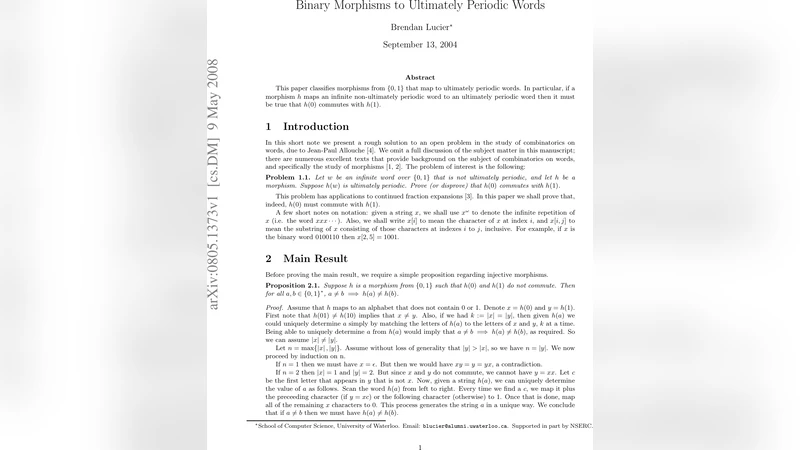
This paper classifies binary morphisms that map to ultimately periodic words. In particular, if a morphism h maps an infinite non-ultimately periodic word to an ultimately periodic word then it must be true that h(0) commutes with h(1).
💡 Research Summary
The paper addresses a problem posed by J‑P Allouche concerning binary morphisms (homomorphisms) from the alphabet {0,1}. The question is whether a morphism h that maps an infinite, non‑ultimately‑periodic binary word w to an ultimately periodic word must satisfy the commutation condition h(0) h(1) = h(1) h(0). The author provides a positive answer and supplies a concise proof.
First, the author establishes a basic property (Proposition 2.1): if the images of 0 and 1 under h do not commute, then h is injective on all finite binary strings. The proof distinguishes two cases. If the lengths of h(0) and h(1) differ, the length pattern uniquely determines the pre‑image. If the lengths are equal, a more delicate argument using the first differing character in the longer image shows that any two distinct binary strings produce distinct images. This injectivity will be crucial later.
The main theorem (Theorem 2.2) assumes, for contradiction, that h(0) and h(1) do not commute while h(w) is ultimately periodic. By definition of ultimate periodicity, there exist finite words y and z such that h(w) = y z^ω. Every prefix of w must map to a prefix of y z^ω, which forces infinitely many prefixes of w to have images of the form y z^* z₁, where z₁ is a fixed prefix of z. Selecting a minimal such prefix z₁, the author constructs an infinite sequence of distinct prefixes a₁, a₂, … of w, each chosen with minimal length, satisfying
h(a_i) = z₂ z^{p_i} z₁ for some p_i ≥ 0.
Two scenarios are examined.
-
All exponents p_i are equal. In this case all h(a_i) coincide, contradicting Proposition 2.1 because the a_i are distinct. Consequently w would have to be ultimately periodic, violating the hypothesis.
-
The exponents are not all equal. Then there exist i with p_i ≠ p_{i+1}. The author shows that h(a_i a_{i+1}) = h(a_{i+1} a_i). By Proposition 2.1 this forces a_i a_{i+1} = a_{i+1} a_i, i.e., the two prefixes commute as words. The classical Lyndon‑Schützenberger theorem then implies that a_i = b^k and a_{i+1} = b^ℓ for some primitive word b and integers k, ℓ ≥ 1. Since p_i ≠ p_{i+1}, we must have k ≠ ℓ, which yields a strict length inequality between a_i and a_{i+1}. This contradicts the minimality condition imposed on the sequence of prefixes.
Both possibilities lead to contradictions, so the original assumption that h(0) and h(1) fail to commute cannot hold. Hence any binary morphism that sends a non‑ultimately‑periodic infinite word to an ultimately periodic word must satisfy h(0) h(1) = h(1) h(0).
The paper’s contribution is twofold. It resolves a specific open problem in combinatorics on words, and it illustrates how elementary properties of morphisms (injectivity when images do not commute) together with classical word equations (Lyndon‑Schützenberger) can be leveraged to obtain structural constraints. The result has implications for the study of automatic sequences, continued‑fraction expansions, and more generally for understanding how morphic images can simplify the combinatorial complexity of infinite words.
Comments & Academic Discussion
Loading comments...
Leave a Comment