On the Relation Between the Index Coding and the Network Coding Problems
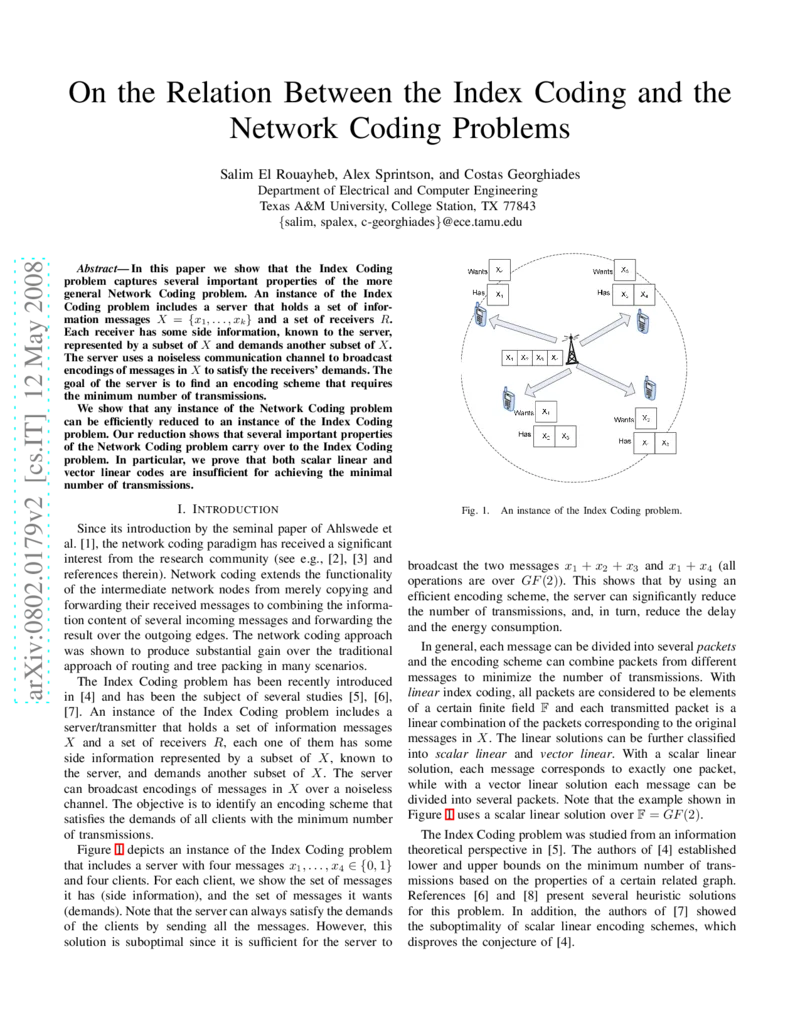
In this paper we show that the Index Coding problem captures several important properties of the more general Network Coding problem. An instance of the Index Coding problem includes a server that holds a set of information messages $X={x_1,…,x_k}$ and a set of receivers $R$. Each receiver has some side information, known to the server, represented by a subset of $X$ and demands another subset of $X$. The server uses a noiseless communication channel to broadcast encodings of messages in $X$ to satisfy the receivers’ demands. The goal of the server is to find an encoding scheme that requires the minimum number of transmissions. We show that any instance of the Network Coding problem can be efficiently reduced to an instance of the Index Coding problem. Our reduction shows that several important properties of the Network Coding problem carry over to the Index Coding problem. In particular, we prove that both scalar linear and vector linear codes are insufficient for achieving the minimal number of transmissions.
💡 Research Summary
The paper establishes a rigorous connection between the Index Coding problem and the more general Network Coding problem by presenting an efficient polynomial‑time reduction that maps any network coding instance to an equivalent index coding instance. The authors first formalize the network coding model as a directed acyclic graph G(V,E) with a set of source messages X, a set of input edges S (zero indegree) and output edges D (zero outdegree). Each edge carries a vector of n packets, and a network code consists of global encoding functions f_e together with local linear combinations φ_e at interior nodes. Scalar codes correspond to n=1, while vector (or block) codes correspond to n>1. Linear codes are those where all functions are linear over a finite field F_q.
The index coding model is then defined as a server holding messages X and a collection of receivers R, each receiver demanding a single message x while possessing a side‑information set H⊆X. An (n,q) index code is a function f:(F_q^n)^k→F_q^ℓ that, together with decoding functions ψ_r, enables every receiver to recover its demand. The transmission rate is λ=ℓ/n, and the trivial lower bound µ(I) (the maximum number of distinct demanded messages sharing the same side‑information) satisfies λ≥µ(I).
The core contribution is a constructive reduction: for a given network instance N(G,X,δ) with m=|E| edges, the authors create an index coding instance I_N with a message y_e for each edge e and retain the original source messages. Five families of receivers (R₁–R₅) are introduced:
- R₁: each input edge’s original source message x_i is demanded, side‑information {y_i}.
- R₂: each y_i is demanded, side‑information {x_i}.
- R₃: for any interior edge e, y_e is demanded, side‑information consisting of the y‑messages of its parent edges.
- R₄: each output edge’s demanded source message δ(e) is demanded, side‑information {y_e}.
- R₅: each y_e is demanded, side‑information consisting of all source messages X.
By construction, µ(I_N)=m. Theorem 5 proves that a linear (n,q) index code for I_N achieving λ* = µ(I_N) exists if and only if a linear (n,q) network code for N exists. The proof proceeds in two directions. Starting from a network code, the authors define a broadcast function g that adds each y_e to the corresponding network encoding f_e(X); decoding functions ψ_r are then explicitly given for each receiver class, showing that all demands are satisfied. Conversely, given a linear index code with transmission matrix M, the invertibility of M (forced by the R₅ receivers) allows the construction of h = g·M⁻¹, which yields linear expressions of the form y_e + linear combination of source messages. From these expressions the authors extract global encoding functions f_e that satisfy the network’s local coding constraints, thereby reconstructing a valid network code.
Using this reduction, the paper demonstrates several fundamental limitations of linear coding. First, it exhibits two network topologies—the M‑Network and a non‑Pappus network—where scalar linear codes do not exist but vector linear codes of block length 2 do. Translating these networks yields index coding instances where a vector linear index code (block length 2) strictly outperforms any scalar linear index code in terms of transmission count. Second, by invoking a known non‑linear network coding construction (reference
Comments & Academic Discussion
Loading comments...
Leave a Comment