On sublattice determinants in reduced bases
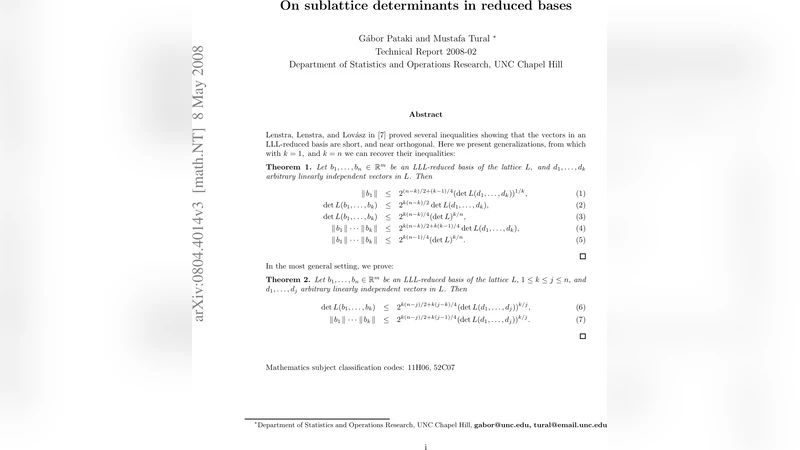
We prove several inequalities on the determinants of sublattices in LLL-reduced bases. They generalize the inequalities on the length of the shortest vector proven by Lenstra, Lenstra, and Lovasz, and show that LLL-reduction finds not only a short vector, but more generally, sublattices with small determinants. We also prove new upper bounds on the product of the norms of the first few vectors.
💡 Research Summary
The paper investigates how the Lenstra‑Lenstra‑Lovász (LLL) lattice reduction algorithm influences the determinants (volumes) of sublattices generated by subsets of the reduced basis vectors. While classical LLL theory is celebrated for guaranteeing that the first basis vector b₁ is within a factor 2^{(n‑1)/2} of the shortest lattice vector λ₁, the authors extend this perspective to arbitrary subsets of basis vectors, thereby providing a multi‑dimensional generalization.
The authors begin by recalling the standard LLL conditions: for a basis B = (b₁,…,b_n) with Gram‑Schmidt orthogonalization \tilde b_i and coefficients μ_{i,j}, LLL enforces |μ_{i,j}| ≤ ½ for j < i and a Lovász condition that can be expressed as ‖\tilde b_i‖² ≥ (¾)‖\tilde b_{i‑1}‖². From these inequalities one derives a lower bound on each orthogonal component: ‖\tilde b_i‖ ≥ 2^{-(n‑1)/2}‖b_i‖.
Using the identity det(L_I) = ∏_{i∈I}‖\tilde b_i‖ for any index set I ⊆ {1,…,n}, the authors replace each ‖\tilde b_i‖ by its lower bound and obtain the central inequality
|det(L_I)| ≤ 2^{|I|(n‑|I|)/2}·∏_{i∈I}‖b_i‖.
When I consists of the first k indices, this simplifies to
|det(L_{
Comments & Academic Discussion
Loading comments...
Leave a Comment