Cascaded Orthogonal Space-Time Block Codes for Wireless Multi-Hop Relay Networks
Distributed space-time block coding is a diversity technique to mitigate the effects of fading in multi-hop wireless networks, where multiple relay stages are used by a source to communicate with its destination. This paper proposes a new distributed…
Authors: Rahul Vaze, Robert W. Heath Jr
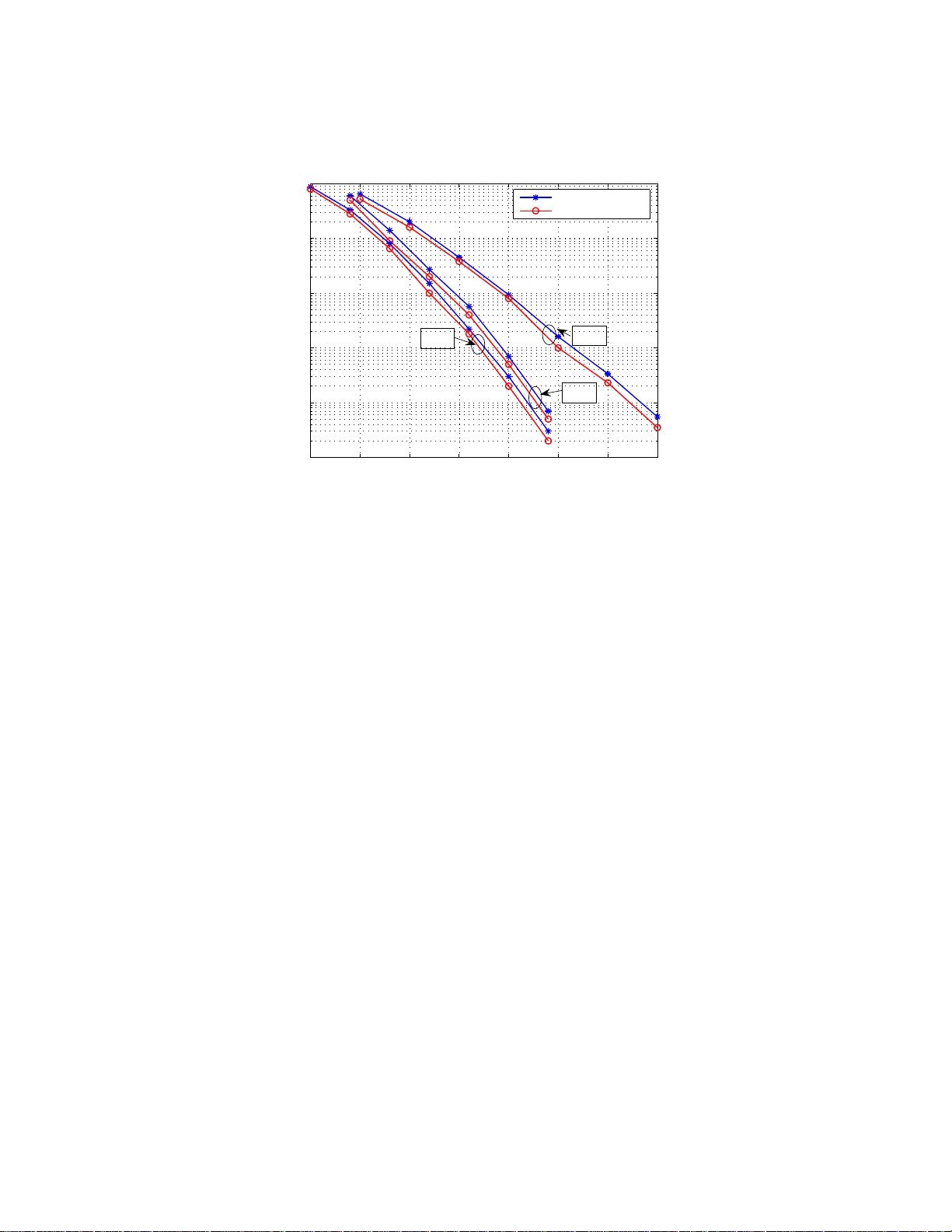
1 Cascaded Orthogonal Space-T ime Block Codes for W ire less Multi-Hop Relay Netw orks Rahul V aze and Robert W . Heath Jr . The University of T exas at Austi n Department of El ectrical and Computer Engi neering W ireless Networking and Communications Group 1 University Station C0803 Austin, TX 787 12-0240 email: vaze@ece.ute xas.edu, rheath@ece.utexas.edu Abstract Distributed space-tim e blo ck coding is a diversity techn ique to mitigate the effects o f fading in multi-hop wireless networks, where multiple relay stag es are used by a sou rce to commu nicate with its destination. This paper proposes a new distributed space-time bloc k cod e ca lled th e cascaded orthog onal space-time block cod e (COSTBC) fo r th e case wh ere th e sou rce a nd destinatio n ar e equipp ed with multiple anten nas an d ea ch re lay stage has one or more sin gle antenna relays. E ach r elay stage is assumed to hav e receiv e chann el state in formation ( CSI) for all the channels from the source to itself, while the destination is assumed to have re ceiv e CSI fo r all the channels. T o con struct the COSTBC, multiple or thogon al space-time block cod es are used in ca scade b y the sourc e and each relay stag e. In the COSTBC, each relay stage separates the constellation symb ols of the orth ogonal space-time block code sent by th e preceding relay stag e using its CSI, an d then transm its an other or thogon al spa ce-time b lock code to the next relay stage. COSTBCs are shown to achieve the max imum diversity gain in a multi-h op wireless network with flat Rayleig h fading chan nels. Sev eral explicit constru ctions o f COSTBCs are also provided for two-hop wireless networks with two an d four source anten nas and relay nod es. It is also shown that COSTBCs r equire min imum dec oding co mplexity thanks to the con nection to or thogon al space-time block code s. This work was funded in part by Samsung Electronics and DARP A through IT -MANET grant no. W911NF-07-1-0028. 2 I . I N T R O D U C T I O N It is w ell k nown that for point-to-point multiple antenna wireless chan nels, s pace-time block c odes (STBCs) [1], [2] impro ve t he bit error rate performance by intr oducing redunda ncy across multiple antennas a nd time. Throug h spe cial design s, STBCs increa se the diversity g ain, defi ned as the negati ve of the expon ent of the s ignal-to-noise ratio (SNR) in the p airwise error probab ility expre ssion at high SNR [2]. Recently , the c oncep t of S TBC has be en extended to wireless n etworks, where the a ntennas of other no des in the network (called relay s) are u sed to construct STBC in a d istrib u ted man ner to improve the diversity gain between a pa rticular source and its destination [3]–[10]. Prior work on DSTBC [3], [5]–[8] conside rs a two-hop wireless network, wh ere in the firs t hop the source transmits the s ignal to all the relays and in the next hop, all relays simultaneous ly transmit a function of the received signal to the des tination. If a dec ode and forward (DF) strategy is use d, e ach relay dec odes the incoming signal from the source and then transmits a vector o r a ma trix depe nding on whether it ha s on e or more tha n o ne anten na [3], [4], [11]. Th e matrix obtained by s tacking a ll the vectors or matrices trans mitted by the relays is ca lled a DSTBC. Since eac h relay decod es the received signal, the criteria for designing a DST BC with DF is same as the criteria for designing STBCs in point-to-point channe ls [2]. Due to ind epende nt decod ing at each relay , howe ver , the d i versity ga in of DSTBC with DF is limited by the minimum of the diversit y gains between the source a nd all the dif ferent relays. If a n amplify and forward (AF) strategy is us ed, each relay is on ly allowed to transmit a function of the receiv ed signal without any de coding, subject to its power constraint. A DSTBC design is propo sed in [5], [7] us ing an AF s trategy , where ea ch relay transmits a relay spe cific unitary transformation of the rec eiv ed signal. This DSTBC construction, h owe ver , is limited to two-hop wireless networks where each relay is e quipped with a sing le antenna. It was shown in [5], [7], tha t to maximize the d i versity gain, the DSTBC transmitted by all relays using a unitary transformation s hould be a full-rank STBC. Algebraic constructions of maximum di versity gain a chieving DSTB C for the two-hop wireless network are provided in [12]–[15]. Recently , there h as been growing interest in multi-hop wireless ne tworks, where more than two hops are required for a source signal to reach its destination. Consequen tly , the re is a strong ca se to c onstruct DSTBCs tha t ca n achieve maximum di versity gain i n a large wireles s networks wi th mu ltiple h ops. Unfortunately , most p rior work on cons tructing DSTBC for maximizing the diversit y ga in only c onsiders a two-hop wireless network [3]–[5], [7], [11] an d does not readily extend s to more than two-hops. In this p aper we design max imum d i versity gain ac hieving DSTBC’ s for multi-hop wireless networks. 3 W e ass ume that the source and the des tination terminals ha ve multiple antennas while t he r elays i n each stage have a s ingle antenn a. W e a lso a ssume that all the n odes in the network (source , relays a nd destination) ca n only work in half-duplex mode (can not transmit a nd rece i ve at the same time) and each relay and the de stination has perfect receive chan nel s tate information (CSI). W e propos e an AF bas ed multi-hop DSTBC, c alled the ca scaded orthogonal spac e-time b lock cod e (COSTBC), where an orthogo nal spac e-time c ode (OSTBC) [16] is used b y the s ource and each relay stage to c ommunicate wit h its adja cent relay stage. OSTBCs a re considered bec ause of their single symbol dec odable p roperty [1], [16], i.e. e ach co nstellation s ymbol o f the OSTBC can be separated at the receiv er with indep endent no ise terms. T o construct COSTBCs the single symbo l de codab le property of OSTBC is u sed by each relay stage to sepa rate the cons tellation symbols of the OSTBC transmitted by the prece ding stage and transmit ano ther OSTBC to the next relay stage. W ith our proposed COSTBC d esign, in the first time slot the s ource transmits an OST BC to the fi rst relay stage. Using the single s ymbol dec odable property of the OS TBC, each relay of the fi rst relay stag e separates the d if feren t OSTBC constellation symbols from the received s ignal a nd transmits a codeword vector in the next time slot, such that the ma trix obtaine d by s tacking all the c odeword vectors transmitted by the dif ferent relays of the first relay stage is an OSTBC. Th ese op erations a re repeated by subseq uent relay s tages. It is worth n oting tha t with COSTBC, no s ignal is dec oded at any of the relays, there fore COSTBC c onstruction with single a ntenna relay s is equ i v alent to COST BC con struction with multiple antenna relays. Thus without loss o f generality in this pa per we only consider COSTBC construction for single antenna relays. The d i versity gain a nalysis p resented in this paper for COSTBC, howe ver , is very general and ap plies to the multiple antenn a relay case as well. W e prove that the COSTBCs achieve the maximum div ersity gain in two or more hop wireles s networks when CSI is available at ea ch relay an d the de stination in the receive mode. W e first sh ow this for a two-hop wireless network a nd then using mathema tical ind uction generalize it to the multi-hop cas e. W e also giv e a n explicit con struction o f COSTBCs for different so urce antenna s and relay co nfigurations. W e prove that the COSTBCs have the single symbol deco dable p roperty similar to OSTBCs. W e also s how that casc ading multiple OSTBCs to co nstruct COSTBC preserves the single symb ol decodab le prope rty of OSTBCs and a s a result COSTBCs require minimum decoding complexity . During the p reparation of this manuscript we ca me across three related papers on DS TBC construction for multi-hop wireless networks [17]–[19] 1 . W e briefly revie w this work and comp are them with the 1 A conference version of our paper was presented in IT A San Diego, Jan. 2008 together with [19]. 4 proposed COSTBCs. Maximum diversity ga in achieving DSTBCs are constructed in [17] for sing le antenna multi-hop wireless network, where e ach node (the s ource, eac h relay an d the de stination) h as s ingle an tenna, by extending the AF strategy with u nitary transformation for two-hop wireles s ne tworks [5]. It can be shown, howe ver , that the AF strategy with unitary transformation to con struct DSTBC does not extend eas ily to multi-hop wireless ne tworks with multiple source o r des tination antenna s. Thus, COSTBC is a more general solution than the one proposed in [17]. Moreover , to achieve the ma ximum div ersity gain with the s trategy proposed in [17], the coding block length, the time a cross which coding needs to be done, is proportional to the product of the numb er of relay nod es, wherea s with COS TBC it is p roportional to the numb er of relay nodes. This ma kes COSTBC more suited for low-latency applications, e .g. v oice communication. The focus of [18], [ 19] is on the construction of DSTBCs that can achie ve the optimal di versity multiplexing (DM) tradeo f f [20] in a multi-hop wireless network. In [18 ] a full-duplex multi-hop wireless network (each no de can transmit and receiv e at the same time) i s considered, whereas [19 ] mainly considers a half du plex multi-hop wireless network. In [18] a parallel AF strategy is p roposed which divi des the total number of paths from the source to the de stination into non-overlapping groups a nd transmits an STBC with non-vanishing determinant p roperty [21] throu gh e ach group s imultaneously . It is shown tha t this strategy ac hiev es the maximum diversity ga in and maximum multiplexing gain points of the optimal DM-tradeoff in a multi-hop wireless n etwork for some spec ial c ases. An AF strategy similar to delay div ersity s trategy of [2] is propo sed in [19] to achieve the DM-tradeoff for the half-duplex multi- hop wireless ne twork where b oth the so urce an d the destination a re e quipped with single anten na. In comparison to the strategies of [18], [19], COSTB C only ach ie ves the maximum d i versity gain and not the maximum multiplexing g ain. Due to the use of OSTBCs , howe ver , the decoding co mplexity o f COS TBC is s ignificantly less tha n the s trategies of [18], [19] whe re STBCs w ith high decoding co mplexity are used. Thus COSTBCs a re more suited for practical impleme ntation than the strategies of [18], [19]. Notation: Let A denote a matrix, a a vector a nd a i the i th element of a . The i th eigen value of A is de noted by λ i ( A ) and the maximum and minimum e igen value of A b y λ max ( A ) an d λ min ( A ) , respectively , if the eigenv alues o f A are real. The d eterminant a nd trace of matrix A are denoted by det( A ) an d tr ( A ) , while A 1 2 denotes the eleme nt wise squa re root of matrix A with all non -negati ve entries. The fi eld of real a nd complex numbers is denoted by R a nd C , res pectiv ely . T he spa ce o f M × N matrices with complex entries is denoted b y C M × N . The Eu clidean norm of a vec tor a is de noted by | a | . An m × m identity matrix is de noted by I m and 0 m is as an all z ero m × m matrix. The superscripts 5 Stage N−1 Relay 1 00 11 00 11 00 11 Relay 2 M 0 Relay Relay 2 M 1 h 1 0 0 1 1 0 1 00 00 11 11 0 1 00 11 00 11 Relay 1 Relay j Relay Relay M s M s+1 Relay 1 f ij s Relay i Source Relay 1 0 0 1 1 0 1 0 0 1 1 M N Relay M N−1 Relay p g p Destination 0000 0000 1111 1111 0000 0000 0000 0000 1111 1111 1111 1111 000000 000000 000000 000000 000000 000000 000000 000000 000000 000000 000000 111111 111111 111111 111111 111111 111111 111111 111111 111111 111111 111111 000 000 000 000 000 000 111 111 111 111 111 111 0000 1111 Stage 1 1 2 Stage s Stage s+1 1 2 Relay 1 Fig. 1. System Block Diagram of a N-hop Wireless Network T , ∗ , † represent the transpose , transpos e conjug ate and element wise conjuga te. For matrices A , B by A ≤ B , A , B ∈ C m × m we me an xAx ∗ ≤ xBx ∗ , ∀ x ∈ C 1 × m . The expectation of function f ( x ) with respect to x is d enoted by E { x } f ( x ) . The maximum and minimum value of the set { a 1 , a 2 , . . . , a m } where a i ∈ R , i = 1 , 2 , . . . , m are de noted by max { a 1 , a 2 , . . . , a m } and m in { a 1 , a 2 , . . . , a m } . A circularly symmetric co mplex Gau ssian random variable x with ze ro mean and variance σ 2 is den oted as x ∼ C N (0 , σ ) . W e use the symbol . = to represent exponential eq uality i.e., let f ( x ) be a function of x , then f ( x ) . = x a if lim x →∞ log( f ( x )) log x = a and similarly . ≤ a nd . ≥ d enote the exponential less tha n o r equ al to and greater than o r equal to relation, respe cti vely . T o define a vari able we use the s ymbol := . Or ganization: The rest of the p aper is o r ganized as follows. In Section II, we d escribe the sys tem model for the multi-hop wireless network a nd re view the key as sumptions. In S ection III, CO STBC construction is des cribed. A diversity gain analys is o f COSTBCs is presented in Section IV for the 2 -hop case and generalized to N -hop ne twork case in S ection V. In Se ction VI, explicit co nstructions of COSTBCs are provided which a chieve maximum diversity gain for dif ferent number of source antenna and relay node configurations . Some numerical results are p rovided in Section VII. Final conclus ions are made in Section VIII. I I . S Y S T E M M O D E L W e c onsider a multi-hop wireless n etwork wh ere a source terminal w ith M 0 antennas wants to communicate with a de stination te rminal with M N antennas via N − 1 relay stages as shown in Fig. 1. Each relay in any relay stage has a single an tenna; M n denotes the n umber of relays in the n th relay 6 stage. It is as sumed tha t the relays do no t generate their own data an d only operate in ha lf-duplex mode. A ha lf-duplex assumption is mad e since full-duplex nodes are difficult to realize in practice . Similar to the model c onsidered in [18], we ass ume that any relay o f relay sta ge n c an o nly rece i ve the signal from any relay of relay stage n − 1 , i.e. we cons ider a directed multi-hop wireless network. In a practical system this ass umption c an be realized by allowing every third relay stage to be active (transmit or receiv e) at the same time. T o keep the relay functionality an d relaying strategy s imple we do not allow relay node s to c ooperate among the mselves. W e assume that there is no direct pa th betwee n the s ource and the des tination. This is a reason able ass umption for the ca se when relay stages a re use d for coverage improvement and the signa l strength on the direct path is very weak. Throughout this paper we refer to this multi-hop wireless network with N − 1 relay sta ges as an N - hop ne twork. As sho wn in Fig. 1, the chann el between t he source and the i th relay of the first stage of relays is denoted by h i = [ h 1 i h 2 i . . . h M 0 i ] T , i = 1 , 2 , . . . , M 1 , between the j th relay o f relay stage s and the k th relay of relay stage s + 1 by f s j k , s = 0 , 1 , . . . , N − 2 , j = 1 , 2 , . . . , M s , k = 1 , 2 , . . . , M s +1 and the chan nel between the relay stag e N − 1 an d the ℓ th antenna of the des tination by g ℓ = [ g 1 ℓ g 2 ℓ . . . g M N − 1 ℓ ] T , ℓ = 1 , 2 , . . . , M N . W e assu me tha t h i ∈ C M 0 × 1 , f s j k ∈ C 1 × 1 , g l ∈ C M N − 1 × 1 with independe nt and iden tically distrib uted (i.i.d.) C N (0 , 1) e ntries for a ll i, j, k , ℓ, s . W e assume that the m th relay of n th stage knows h i , f s j k , ∀ i, j, k , s = 1 , 2 , . . . , n − 2 , f n − 1 j m ∀ j and the destination kn ows h i , f s j k , g l , ∀ i, j, k, l , s . W e further assume that all these chann els are frequency fla t a nd block fading, wh ere the channe l coefficients remain constant in a b lock o f time duration T c and c hange inde pende ntly from block to b lock. W e assu me that the T c is at leas t m ax { M 0 , M 1 , . . . , M N − 1 } . A. Pr ob lem F ormulation Definition 1: (STBC) [22] A rate- L/T T × N t design D is a T × N t matrix with e ntries tha t are complex linear combinations of L complex vari ables s 1 , s 2 , . . . , s L and the ir comp lex co njugates. A rate- L/T T × N t STBC S is a s et of T × N t matrices that are obta ined by allowing the L variables s 1 , s 2 , . . . , s L of the rate- L/T T × N t design D to take values from a finite s ubset C f of the c omplex field C . The cardinality of S = | C f | L , wh ere | C f | is the c ardinality of C . W e refer to s 1 , s 2 , . . . , s L as the cons tituent sy mbols of the STBC. Definition 2: A DSTBC C for a N - hop network is a collection of cod es { S 0 , S 1 , . . . , S N − 1 } , where S 0 is the STBC transmitted by the so urce and S n = [ f 1 n ( S n − 1 ) . . . f M n n ( S n − 1 )] is the STBC transmitted by relay stage n , where f j n ( S n − 1 ) is the vector transmitted by the j th relay of s tage n which is a function of S n − 1 , j = 0 , . . . , M n , n = 1 , . . . , N − 1 . An example of a DSTBC is illustrated in Fig. 2. 7 S S S Relay M 2 Relay M 1 function of S n 1 Source Destination Relay 1 2 Relay 1 Relay 1 S 0 f 1 1 f 1 M 1 f M 2 2 2 (S ) Stage 1 Stage 2 Relay M N−1 Stage N−1 N−1 f (S ) 0 1 1 f i j n (S ) is a f 1 N−1 (S ) 0 (S ) 1 f M N−1 N−1 (S ) N−2 (S ) N−2 Fig. 2. An Illustration Of The DST BC Design Problem Definition 3: The diversity ga in [2], [5] of a DSTBC C is defin ed as d C = − lim E → ∞ log P e ( E ) log E , P e ( E ) is the p airwise e rror probability (PEP) us ing coding s trategy C , and E is the su m of the trans mit power us ed by each node in the n etwork. The prob lem we co nsider is in this pape r is to des ign DSTBCs that a chieve the ma ximum diversit y gain in a N - hop network. T o identify the limits on the ma ximum poss ible diversity gain in a N -hop ne twork, an upper boun d o n the diversit y gain achiev able with any DSTBC is p resented next. Theorem 1: The diversity gain d C of DSTBC C for an N - hop ne twork is u pper bounde d by min { M n M n +1 } n = 0 , 1 , . . . , N − 1 . Pr oo f: Let d C be the di versity gain of co ding strategy C for a n N -hop network. Let d n be the di versity gain of the best po ssible DSTBC C opt that can be used betwe en relay stage n an d n + 1 when all the relays in relay stage n a nd relay stage n + 1 are a llo wed to c ollaborate, respec ti vely , and the s ource messag e is known to all the relay s of re lay stag e n without any error and a ll the relays of the relay stage n + 1 c an s end the received s ignal to the destination error free. Then, c learly , d C ≤ d n . Since the chan nel between the relay stage n a nd n + 1 is a multiple antenna channel with M n transmit and M n +1 receiv e 8 antennas , d n ≤ M n M n +1 . Hence d C ≤ M n M n +1 . Since this is true for every n = 0 , 1 , . . . , N − 1 , it follo ws that d C ≤ min { M n M n +1 } , n = 0 , 1 , . . . , N − 1 . Thus, Theorem 1 implies that the ma ximum diversity gain a chiev a ble in a N -hop network is equ al to the minimum of the ma ximum diversity gain ac hiev a ble between any two relay s tages, wh en all the relay s in ea ch relay stage are allowed to collaborate. In our sys tem mo del we d o not a llo w any cooperation between relays , and hence d esigning a DS TBC that ac hiev es the diversity gain upper bound without any cooperation is difficult. For the case of 2 -hop networks, DSTBCs have been propos ed to achieve the maximum d i versity gain [5], [7]. It is worth noting that d esigning DSTBCs that achiev e the maximum d i versity gain in a N -hop network is a dif ficult problem. The dif ficulty is two-f old: propo sing a “good” DSTBC and analyzing its div e rsity gain. In the next se ction we describe our novel COSTBC con struction and prove tha t it ach iev es the ma ximum di versity gain in a N -ho p n etwork. As it will be cle ar in the next s ection, u sing OSTBCs to cons truct COS TBC simplifies the diversity gain analysis, significa ntly . I I I . C A S C A D E D O RT H O G O N A L S P AC E - T I M E C O D E In this section we introduce the COSTBC design for a N -hop ne twork. Be fore introducing COSTBC we need the following definitions. Definition 4: W ith T ≥ N t , a rate L/T T × N t STBC S is ca lled full-rank or fully-di verse or is said to achieve maximum diversity gain if the d if fe rence of any two matrices M 1 , M 2 ∈ S is full-rank, min M 1 6 = M 2 , M 1 , M 2 ∈ S r ank ( M 1 − M 2 ) = N t . Definition 5: (OSTBC) A rate- L/K K × K STBC S is c alled an orthogona l spa ce-time block c ode (OSTBC) if the des ign D from which it is d eri ved is orthogonal i.e. DD ∗ = ( | s 1 | 2 + . . . + | s L | 2 ) I K . Definition 6: Let S be a rate- L/K K × K STBC. Then , using CSI, if e ach of the cons tituent symbo ls s i , i = 1 , . . . , L of S can be s eparated/de coded inde pende ntly of s j ∀ i 6 = j i, j = 1 , . . . , L with independ ent noise terms, then S is ca lled a single symbo l d ecoda ble STBC. Remark 1: OSTBCs a re single symbol deco dable STBCs [16]. W ith thes e definitions we are now ready to desc ribe COST BC for a N -hop network. COSTBC is a DSTBC where eac h S n , n = 0 , 1 , . . . , N − 1 is an OSTBC. Thus , with COST BC the s ource trans mits a rate- L/ M 0 M 0 × M 0 OSTBC S 0 in time slot of duration M 0 . How to c onstruct OSTBCs S n , n = 1 , . . . , N − 1 is de tailed in the following. Let S 0 be a rate- L/ M 0 M 0 × M 0 OSTBC transmitted by the s ource OSTBC S 0 ∈ C M 0 × M 0 to all the relays of relay stage 1 . Then the rece i ved 9 signal r 1 k ∈ C M 0 × 1 at relay k of relay stage 1 ca n be written as r 1 k = p E 0 S 0 h k + n 1 k (1) where E tr ( S ∗ 0 S 0 ) = M 0 and E 0 is the power tr ansmitted by the sou rce at each time instant. The noise n 1 k is the M 0 × 1 spatio-temporal wh ite complex Gaus sian noise indepen dent acros s relays with E n 1 k n 1 ∗ k = I M 0 . S ince S 0 is an OSTBC , using CS I, the rec ei ved signa l r 1 k can be trans formed into ˜ r 1 k ∈ C L × 1 , where ˜ r 1 k = p E 0 P M 0 m =1 | h mk | 2 0 0 0 . . . 0 0 0 P M 0 m =1 | h mk | 2 | {z } H s + ˜ n 1 k (2) and s = [ s 1 , s 2 , . . . , s L ] T is the vector of the c onstituent symbols of the OSTBC S 0 , H is an L × L matrix and ˜ n 1 k is an L × 1 vector with entries that are unco rrelated an d C N (0 , M 0 ) distrib uted. This property is illustrated in the Ap pendix I for the c ase of the Alamouti c ode [1] which is a n OST BC for M 0 = 2 . Then we normalize ˜ r 1 k by H − 1 2 to obtain ˆ r 1 k , where ˆ r 1 k := H − 1 2 ˜ r 1 k = p E 0 H 1 2 s + H − 1 2 ˜ n 1 k | {z } ˆ n 1 k , (3) where ˆ n 1 k is an L × 1 vec tor with e ntries that are unc orrelated and C N (0 , 1) distributed. Then, in the se cond time slot of duration M 1 , relay k of relay s tage 1 transmits t 1 k , cons tructed from the signa l (3) t 1 k = s E 1 M 1 Lγ A k ˆ r 1 k + B k ˆ r 1 † k , (4) where γ = E ˆ r 1 ∗ k ˆ r 1 k to ensure that the a verage power transmitted by each relay at any time instant is E 1 , i.e. E t 1 k † t 1 k = E 1 and A k , B k are M 1 × L matrices su ch that A ∗ k B k = − B ∗ k A k and tr ( A ∗ k ( l ) A k ( l ) + B ∗ k ( l ) B k ( l )) = 1 ∀ k = 1 , 2 . . . , M 1 , l = 1 , 2 , . . . L, (5) where A k ( l ) a nd B k ( l ) denote the l th column of A k and B k , respec ti vely and S 1 := [ A 1 s + B 1 s † . . . A M 1 s + B M 1 s † ] 10 is an OSTBC. Under thes e a ssumptions, the M 1 × 1 received signal at the i th relay of relay stag e 2 is y i = M 1 X k =1 t k g k i + z i = s E 0 E 1 M 1 Lγ [ A 1 s + B 1 s † A 2 s + B 2 s † . . . A M 1 s + B M 1 s † ] | {z } S 1 ˆ H 1 2 g i + s E 1 M 1 Lγ [ A 1 ˆ n 1 1 + B 1 ˆ n 1 † 1 . . . A M 1 ˆ n 1 M 1 + B M 1 ˆ n 1 † M 1 ] g i + z i for i = 1 , 2 , . . . M 2 , where z i is the M 1 × 1 spatio-temporal white co mplex Gaus sian no ise independ ent across M 2 receiv e a ntennas with i.i.d. C N (0 , 1) entries and ˆ H 1 2 = q P M 0 m =1 | h m 1 | 2 0 0 0 0 q P M 0 m =1 | h m 2 | 2 0 0 0 0 . . . 0 0 0 0 q P M 0 m =1 | h mM 1 | 2 . Thus, an OSTBC S 1 is transmitted by relay stage 1 to the relay stage 2 in a distributed manner . T o construct the COSTBC, the strategy of transmitting an OSTBC from relay s tage 1 is rep eated at each relay stage, i.e. eac h relay of relay stag e n transforms the rec eiv e d s ignal as in (3) for the OSTBC transmitted from the relay stage n − 1 and transmits an OST BC in time duration M n using A k , B k , k = 1 , . . . , M n together with all the other relays in relay stage n to the relay stage n + 1 . The power us ed up at each relay of relay stage n is E n such that E 0 + P N − 1 n =1 M n E n = E , where E is the total power av a ilable in the network. In the N th time slot of duration M N − 1 the receiver receiv es an OSTBC from relay stage N − 1 . The properties of the COSTBC are summa rized in the next two Theorems. Theorem 2: COSTBCs achieve the max imum diversity g ain in a N -hop network given by Theorem 1. W e p rove this The orem in the next two s ections. W e s tart with the N = 2 cas e and show that the COSTBCs achieve the ma ximum diversit y gain for 2 -hop network in Section IV and then gen eralize the result to an arbitrary N -ho p network using mathematica l ind uction in Section V. Theorem 3: COSTBCs are single symbol deco dable ST BCs. The Theorem is proved in Append ix I for a s pecial ca se of M n = 2 , n = 1 , 2 , . . . , N − 1 and in Appendix II for the general case. Rec all that with COSTBCs, OST BCs are trans mitted in casc ade by each relay stage, thus the single symbo l dec odable property of the COSTBCs implies that by cascad ing 11 OSTBCs, the s ingle symbo l de codab le prope rty of OSTBC is p reserved. W e als o make use of the single symbol de codable property of COSTBC to show that it a chieves the maximum div ersity gain for N -hop networks. I V . D I V E R S I T Y G A I N A N A L Y S I S O F C O S T B C F O R 2 - H O P N E T W O R K In this sec tion we prove that the COSTBCs ach iev e the maximum di versity g ain in a 2 -hop network. Theorem 4: COSTBCs ac hiev e a d i versity ga in of min { M 0 M 1 , M 1 M 2 } in a 2 -hop network. Pr oo f: Us ing a COSTBC i n a 2 -hop netw ork, from (7), t he receiv ed signal at the i th antenna of destination is y i = M 1 X k =1 t k g k i + z i . (6) Then the received signal Y := [ y 1 . . . y M 2 ] at the destination, receiv ed in time slots M 0 + 1 to M 0 + M 1 + 1 can be written as Y = s E 0 E 1 M 1 Lγ [ A 1 s + B 1 s † A 2 s + B 2 s † . . . A M 1 s + B M 1 s † ] | {z } S 1 ˆ HG + s E 1 M 1 Lγ [ A 1 ˆ n 1 1 + B 1 ˆ n 1 † 1 . . . A M 1 ˆ n 1 M 1 + B M 1 ˆ n 1 † M 1 ] G + Z | {z } W where G = [ g 1 . . . g M 2 ] = g 11 g 12 . . . g 1 M 2 g 21 g 22 . . . g 2 M 2 . . . . . . . . . . . . g M 1 1 g M 1 2 . . . g M 1 M 2 and the noise Z = [ z 1 z 2 . . . z M 2 ] . Concisely , we can write Y = s E 0 E 1 M 1 Lγ S 1 ˆ H 1 2 G + W . (7) W ith chann el coefficients h k and g k known at the rece i ver ∀ k = 1 , 2 , . . . , M 1 , W is Gau ssian distributed with an all zero mean vector and entries of Y a re Ga ussian distrib u ted. Mo reover it ca n be shown that any two ro ws of Y are unc orrelated and hence indepen dent. Using the definition of A k and B k and the fact that ˆ n 1 k is L × 1 vectors with C N 0 , P M 0 i =1 | h im | 2 entries ∀ k = 1 , 2 , . . . , M 1 , it ca n be shown that the c ov ariance matrix R W of each row of W is R W = E 1 M 1 γ G ∗ G + I M 2 . 12 Defining Φ = ˆ H 1 2 G , P Y | S 1 ˆ H , G = M 1 Y t =1 P [ Y ] t | S 1 ˆ H , G = 1 (2 π ) M 2 det ( R W ) ! M 1 2 e − tr “h Y − q E 0 E 1 M 1 Lγ S 1 Φ i R − 1 W h Y − q E 0 E 1 M 1 Lγ S 1 Φ i ∗ ” where P ( Y | S 1 , ˆ H , G ) is the conditional probability of Y gi ven S 1 , ˆ H , G and P ([ Y ] t | S 1 , ˆ H , G ) is the conditional probability of t th row of Y giv en S 1 , ˆ H , G . Assuming S 1 l is the transmitted cod ew ord, then for any λ > 0 , the PEP P ( S 1 l → S 1 m ) of deco ding a codeword S 1 m , m 6 = l , has the Ch ernoff bound [23] P ( S 1 l → S 1 m ) ≤ E { ˆ H , G , W } e λ ( log P ( Y | S 1 l , ˆ H , G ) − log P ( Y | S 1 m , ˆ H , G ) ) . Since S 1 l is the co rrect transmitted codeword, Y = s E 0 E 1 M 1 Lγ S 1 l Φ + W and log P ( Y | S 1 l , ˆ H , G ) − log P ( Y | S 1 m , ˆ H , G ) = − tr E 0 E 1 M 1 Lγ ( S 1 l − S 1 m ) Φ R − 1 W Φ ∗ ( S 1 l − S 1 m ) + s E 0 E 1 M 1 Lγ ( S 1 l − S 1 m ) Φ R − 1 W W ∗ + s E 0 E 1 M 1 Lγ WR − 1 W Φ ∗ ( S 1 l − S 1 m ) ∗ # . Therefore, P ( S 1 l → S 1 m ) ≤ E { ˆ H , G W } e − λ tr “ E 0 E 1 M 1 Lγ ( S 1 l − S 1 m )Φ R − 1 W Φ ∗ ( S 1 l − S 1 m )+ q E 0 E 1 M 1 Lγ ( S 1 l − S 1 m )Φ R − 1 W W ∗ + q E 0 E 1 M 1 Lγ WR − 1 W Φ ∗ ( S 1 l − S 1 m ) ∗ ” ≤ E { ˆ H , G } e − λ (1 − λ ) E 0 E 1 M 1 Lγ tr ( ( S 1 l − S 1 m )Φ R − 1 W Φ ∗ ( S 1 l − S 1 m ) ∗ ) Z e − tr ““ λ q E 0 E 1 M 1 Lγ ( S 1 l − S 1 m )Φ+ W ” R − 1 W “ λ q E 0 E 1 M 1 Lγ ( S 1 l − S 1 m )Φ+ W ” ∗ ” π M 2 T det − 1 ( R W ) d W ≤ E { ˆ H , G } e − λ (1 − λ ) E 0 E 1 M 1 Lγ tr ( ( S 1 l − S 1 m )( S 1 l − S 1 m ) ∗ Φ R − 1 W Φ ∗ ) . (8) Clearly λ = 1 2 maximizes λ (1 − λ ) for λ > 0 , and therefore minimizes the above express ion and it follo ws that P ( S 1 l → S 1 m ) ≤ E { ˆ H , G } e − E 0 E 1 M 1 4 Lγ tr [ ( S 1 l − S 1 m )( S 1 l − S 1 m ) ∗ Φ R − 1 W Φ ∗ ] . (9) 13 The dif ficulty in evaluating the expec tation in (9) is the fact that the noise covariance matrix R W is not d iagonal. T o simplify the PEP an alysis we use an upper bo und on the eigen values of R W , deriv ed in the next lemma. Lemma 1: R W ≤ 1 + E 1 M 2 1 γ λ max G ∗ G M 1 I M 2 . Pr oo f: Recall that R W = I M 2 + E 1 M 1 γ G ∗ G . Thus the eigen values λ i ( R W ) = 1 + E 1 M 2 1 γ λ i G ∗ G M 1 , ∀ i = 1 , 2 . . . , M 2 and clearly R W ≤ 1 + E 1 M 2 1 γ λ max G ∗ G M 1 I M 2 . From here on in this paper we refer to λ max G ∗ G M 1 as λ G for notational simplicity . Using Le mma 1, (9) simplifies to P ( S 1 l → S 1 m | λ G = λ 0 ) ≤ E { ˆ H , G } e − E 0 E 1 M 1 4 M 0 L ( γ + E 1 M 2 1 λ 0 ) tr [ ( S 1 l − S 1 m )( S 1 l − S 1 m ) ∗ ΦΦ ∗ ] , (10) where P ( S 1 l → S 1 m ) = E { λ G } P ( S 1 l → S 1 m | λ G = λ 0 ) . Recall that there is a p ower constraint of E 0 + E 1 M 1 = E . Therefore to minimize the upper bound on the PEP (10), the term E 0 E 1 M 1 4 M 0 L ( γ + E 1 M 2 1 λ 0 ) should be max imized over E 0 , E 1 satisfying the power cons traint. The optimal values of E 0 and E 1 to maximize E 0 E 1 M 1 4 M 0 L ( γ + E 1 M 2 1 λ 0 ) can be fou nd explicitly , howev er , they can complicate the diversity ga in analysis. T o simplify the di versity ga in analysis of COSTBC, we conside r a p articular cho ice of E 0 = E 2 and E 1 = E 2 M 1 (half the total po wer is used by the transmitter and h alf is equally distributed amo ng all the relays). In the following, we sh ow that with this power allocation, the div e rsity g ain of COST BC is equal to the upper bo und (Theorem 1 ) and thus we do n ot lose any diversity gain by restricting the calculation to this pa rticular power allocation. Moreover , this power alloca tion a lso satisfies the power cons traint a nd the refore provides u s with a upper boun d on the PEP . Using this power allocation and the value of γ = E 0 M 0 L + L , E 0 E 1 M 1 4 M 0 L γ + E 1 M 2 1 λ 0 ≥ E 8 M 1 M 0 L ( L ( M 0 +1) M 1 + λ 0 )) for E > 1 , wh ich implies P ( S 1 l → S 1 m | λ G = λ 0 ) ≤ E { ˆ H , G } e − E 8 M 1 M 0 L ( µ + λ 0 ) tr ( ( S 1 l − S 1 m )( S 1 l − S 1 m ) ∗ ΦΦ ∗ ) (11) where µ = L ( M 0 +1) M 1 . 14 Recall that Φ = ˆ H 1 2 G . Let φ j be the j th column of Φ , then tr (( S 1 l − S 1 m ) ( S 1 l − S 1 m ) ∗ ΦΦ ∗ ) = tr (Φ ∗ ( S 1 l − S 1 m ) ∗ ( S 1 m − S 1 l ) Φ) = M 2 X j =1 φ ∗ j ( S 1 l − S 1 m ) ∗ ( S 1 l − S 1 m ) φ j . Thus, from (11) P ( S 1 l → S 1 m | λ G = λ 0 ) ≤ E { ˆ H , G } e − E 8 M 1 M 0 L ( µ + λ 0 ) P M 2 j =1 φ ∗ j ( S 1 l − S 1 m ) ∗ ( S 1 l − S 1 m ) φ j ≤ E { ˆ H , G } e − E 8 M 1 M 0 L ( µ + λ 0 ) P M 2 j =1 g ∗ j ˆ H 1 2 ∗ ( S 1 l − S 1 m ) ∗ ( S 1 l − S 1 m ) ˆ H 1 2 g j ≤ E { ˆ H , G } M 2 Y j =1 e − E 8 M 1 M 0 L ( µ + λ 0 ) g ∗ j ˆ H 1 2 ∗ ( S 1 l − S 1 m ) ∗ ( S 1 l − S 1 m ) ˆ H 1 2 g j where g j is the j th column of G . S ince g j is a M 1 dimensional G aussian vector ∀ j = 1 , 2 , . . . , M 2 , it follo ws that P ( S 1 l → S 1 m | λ G = λ 0 ) ≤ E { ˆ H } det I M 1 + E 8 M 1 M 0 L ( µ + λ 0 ) ˆ H 1 2 ∗ ∆ S 1 lm ˆ H 1 2 − M 2 where ∆ S 1 lm := ( S 1 l − S 1 m ) ∗ ( S 1 l − S 1 m ) . Since S 1 is an OSTBC the minimum singular value σ min of ∆ S 1 lm is > 0 , which implies P ( S 1 l → S 1 m | λ G = λ 0 ) ≤ E { ˆ H } det I M 1 + E σ min 8 M 1 M 0 L ( µ + λ 0 ) ˆ H − M 2 . (12) Now we a re left with compu ting the expectation in (12) with respec t to ˆ H . T owards that end, recall that ˆ H is a diagonal matrix with each entry P M 0 m =1 | h mk | 2 , which is ga mma d istrib u ted with probability density function PDF 1 ( M 0 − 1)! x M 0 − 1 e − x . Therefore, P ( S 1 l → S 1 m | λ G = λ 0 ) ≤ 1 ( M 0 − 1)! " Z ∞ 0 1 + E σ min 8 M 1 M 0 L ( µ + λ 0 ) x − M 2 x M 0 − 1 e − x dx # M 1 . Using an integration result from The orem 3 [5], it follows tha t P ( S 1 l → S 1 m | λ G = λ 0 ) ≤ 1 ( M 0 − 1)! 8 M 1 M 0 L ( µ + λ 0 ) σ min min { M 0 ,M 2 } M 1 × (2 M 0 − 1) M 2 − M 0 E − M 0 M 1 if M 2 ≥ M 0 log E 1 M 0 E − M 0 M 1 if M 2 = M 0 ( M 0 − M 2 − 1) M 1 E − M 2 M 1 if M 2 ≤ M 0 (13) for lar ge transmit power E an d considering only the highe st o rder terms of E . Rec all that P ( S 1 l → S 1 m ) = E { λ G } P ( S 1 l → S 1 m | λ G = λ 0 ) . (14) 15 T o evaluate this expectation we need to find the PDF of λ G . It turns out that explicitly finding the PD F of λ G is quite difficult. T o simplify the prob lem we u se a n upper bound on the PDF of λ G which is summarized in the next lemma. Lemma 2: For M 1 ≥ M 2 , the PD F of the maximum e igen value λ G of 1 M 1 G ∗ G c an be u pper bounded as f λ G ( λ 0 ) ≤ k 1 λ M 1 M 2 − 1 0 e − M 1 λ 0 where k 1 = 2 M 2 − 1 M M 1 M 2 1 Q M 2 j =1 Γ( M 1 − M 2 + 1)Γ( j ) Q M 2 j =1 ( M 1 − M 2 + 2 j − 1)( M 1 − M 2 + 2 j ( M 1 − M 2 + 2 j + 1)) . Pr oo f: Follows from Corollary 1 [5]. Remark 2: From here on we evaluate the expectation in PEP upper bou nd for the case o f M 1 ≥ M 2 only . For the other ca se, the analysis follows similarly , sinc e the PDF of λ max G ∗ G M 1 , for M 2 < M 1 , ca n be obtained from Lemma 2 by switching the roles o f M 1 and M 2 and using the fact that λ max G ∗ G M 1 = λ max GG ∗ M 1 . From (14), P ( S 1 l → S 1 m ) = Z ∞ 0 P ( S 1 l → S 1 m | λ G = λ 0 ) f λ G ( λ 0 ) dλ 0 . Using Lemma 2 a nd (13), P ( S 1 l → S 1 m ) ≤ Z ∞ 0 8 M 1 M 0 L ( µ + λ 0 ) σ min min { M 0 ,M 2 } M 1 λ M 1 M 2 − 1 0 e − M 1 λ 0 dλ 0 × (2 M 0 − 1) M 2 − M 0 E − M 0 M 1 if M 2 ≥ M 0 log E 1 M 0 E − M 0 M 1 if M 2 = M 0 ( M 0 − M 2 − 1) M 1 E − M 2 M 1 if M 2 ≤ M 0 . (15) Moreover , defining k 2 := Z ∞ 0 ( µ + λ 0 ) min { M 0 ,M 2 } M 1 λ M 1 M 2 − 1 0 e − M 1 λ 0 dλ 0 = c i P min { M 0 ,M 2 } M 1 i =0 min { M 0 ,M 2 } M 1 i (min { M 0 , M 2 } M 1 + M 0 − ( i + 1))! M − (min { M 0 ,M 2 } M 1 + M 2 M 1 − i ) 1 the uppe r bou nd on PEP (15) simplifies to P ( S 1 l → S 1 m ) ≤ k 3 × (2 M 0 − 1) M 2 − M 0 E − M 0 M 1 if M 2 ≥ M 0 log E 1 M 0 E − M 0 M 1 if M 2 = M 0 ( M 0 − M 2 − 1) M 1 E − M 2 M 1 if M 2 ≤ M 0 , (16) 16 where k 3 = k 1 k 2 (( M 0 − 1)!) 8 M 1 M 0 L σ min min { M 0 ,M 2 } M 1 . By the defin ition of diversity gain, from (16) it is clear that div ersity gain of COS TBC is min { M 0 , M 2 } M 1 , which equals the upp er b ound from Theorem 1. Next we provide an alternate a nd simpler proof of Theorem 4. The outage probability formulation [20] and the single symbo l decod able p roperty of COSTBCs is used to deri ve this proof. The purpose of this alternati ve proof is to highlight the fact that the single s ymbol d ecodab le prop erty of COST BCs no t o nly minimizes the dec oding complexity but also improves analytica l tracta bility . Pr oo f: (Th eorem 4) The outag e probability P out ( R ) is de fined as P out ( R ) := P ( I ( s ; r ) ≤ R ) , where s is the input an d r is the output of the c hanne l a nd I ( s ; r ) is the mutua l information between s and r [24]. Let S NR := E σ 2 . Following [20], let C ( SNR ) be a family of codes o ne for each SNR . W e define r as the spatial multiplexing gain of C ( SNR ) if the data rate R ( SNR ) scales as r with resp ect to log SNR , i.e . lim SNR →∞ R ( SNR ) log SNR = r and d as the rate of fall of probability of error P e of C ( SNR ) with res pect to SNR , i.e. P e ( SNR ) . = SNR − d . Let d out ( r ) be the S NR exponent of P out with rate o f transmission R sc aling as r lo g SNR , i.e. log P out ( r log SNR ) . = SNR − d out ( r ) , then it is s hown in [20] that P e ( SNR ) . = P out ( r log SNR ) . = SNR − d out ( r ) . Thus, to compute the diversity gain of any cod ing sche me it is sufficient to compute d out ( r ) . In the follo wing we compute d out ( r ) for the COST BC with a 2 -hop ne twork. For the 2 -hop network, using the s ingle s ymbol decodab le property of COSTBCs (Appendix II), the receiv ed s ignal can be separated in terms of the individual c onstituent s ymbols of the OSTBC transmitted by the sou rce. Therefore, the receiv ed signal can be written as r l = √ θ E M 2 X j =1 M 1 X k =1 | g k j | 2 M 0 X m =1 | h mk | 2 ! s l + z l (17) 17 where θ is the normalization co nstant s o as to e nsure the total p ower constraint of E in the network, s l is the l th , l = 1 , 2 , . . . , L sy mbol transmitted from the source and z l is the add iti ve white Gaussian noise (A WGN) with variance σ 2 . Let SNR := θ E σ 2 , then P out ( r log SNR ) = P 1 + SNR M 2 X j =1 M 1 X k =1 | g k j | 2 M 0 X m =1 | h mk | 2 ! ≤ r log S NR . ≤ P M 1 X k =1 min { M 0 ,M 2 } X j =1 | g k j | 2 | h j k | 2 ≤ SNR − (1 − r ) ≤ P max { j = 1 , ..., min { M 0 ,M 2 } , k =1 , ...,M 1 } | g k j | 2 | h j k | 2 ≤ SNR − (1 − r ) . Since | g k j | 2 | h j k | 2 are i.i.d. for j = 1 , . . . , min { M 0 , M 2 } , k = 1 , . . . , M 1 and the total number of terms are min { M 0 M 1 , M 1 M 2 } , P out ( r log S NR ) . = P | g 11 | 2 | h 11 | 2 ≤ SNR − (1 − r ) min { M 0 M 1 , M 1 M 2 } . Note that P | g 11 | 2 | h 11 | 2 ≤ SNR − (1 − r ) is the outage probability of a s ingle input single output s ystem which can be co mputed easily using [20] and is gi ven by P | g 11 | 2 | h 11 | 2 ≤ SNR − (1 − r ) . = SNR − (1 − r ) , r ≤ 1 . Thus, P out ( r log SNR ) . = SNR − mi n { M 0 M 1 , M 1 M 2 } (1 − r ) , r ≤ 1 , and we have s hown that d out ( r ) = min { M 0 M 1 , M 1 M 2 } (1 − r ) , r ≤ 1 , from which it follows that the div e rsity gain of COSTBC is d out (0) = min { M 0 M 1 , M 1 M 2 } as required. Discussion : In this s ection w e deri ved an upper bound on the PEP of COSTBCs for a 2 -hop network from which we lower bo unded the div e rsity gain of COSTBCs for a 2 -hop ne twork. W e showed that the lower b ound on the div ersity g ain of COSTB Cs e quals the u pper bound from Theorem 1 a nd thus conclude d that COSTB Cs achieve the maximum div ersity gain in a 2 -hop network. W e p resented two diff erent p roofs that show the optimality o f COSTBCs in the sens e of achieving the maximum d i versity gain in 2 -hop network. In the fi rst proof we directly worked with the PEP using maximum likelihood detection while in the sec ond proof we used the outag e prob ability formulation [20]. The pu rpose of giving two proofs is to highlight the dif feren t ideas o ne ca n use to upper bound the PEP of multi-antenna multi-hop c ommunication systems for possible extens ions to more co mplex channels. The main difficulty in uppe r bounding the PEP of COSTBC s was due to the fact that the covariance matrix R W of no ise rec eiv ed at the destination is n ot a diagona l matrix. In the first proof we simplified 18 the problem by uppe r boun ding the maximum eigen value of R W by the eigenv alue s of GG ∗ M and then used s tandard tec hniques to upper bound the PE P . In the sec ond proof we used the outag e probability formulation [20] to lower bo und the diversity gain of COSTBCs for 2 -hop network. T o uppe r bound the o utage probab ility , we used the single s ymbol dec odable property of COSTBCs and showed that the exponent of the o utage probability with COSTBCs is min { M 0 M 1 , M 1 M 2 } times the expone nt of the outage probability of SISO sys tem who se di versity gain is 1 . Thus we c oncluded that the div ersity ga in of COSTBCs is m in { M 0 M 1 , M 1 M 2 } . V . D I V E R S I T Y G A I N A N A L Y S I S O F C O S T B C F O R M U LT I - H O P C A S E In this s ection we show that COS TBCs achieve the ma ximum div ersity for a N -hop network where N ≥ 2 . Recall tha t with COSTBC the source and ea ch relay stag e use an OSTBC to c ommunicate with the following relay stage. W ith CSI available a t each relay , in Ap pendix II we show that COSTBCs have the single symbo l decod ability property s imilar to OSTB C. Th us, with the COSTBCs each of the constituent symbols of the OSTBC transmitted by the source can be d ecode d independ ently of all the other symb ols at any re lay of a ny relay s tage or a t the destination without an y loss in performance compared to joint dec oding. W e use this prop erty to sh ow tha t the COST BCs ach iev e the up per bo und on the diversity gain of a n N -hop network gi ven by Theorem 1. Theorem 5: W ith COST BCs, a div ersity gain of min { M n M n +1 } n = 0 , 1 , . . . , N − 1 is achiev able for a N -hop ne twork. Pr oo f: W e use indu ction to prov e the Th eorem. From Section IV the res ult is true for a 2 -hop network, and hen ce we can start the induction. Now as sume that the res ult is true for a k -hop network ( k ≥ 2) and we will prove that it is true for a k + 1 -hop network. For a k -hop network using the single sy mbol deco dable prope rty of COSTBCs as shown in Ap pendix II, at the de stination the received s ignal can be se parated in terms of the individual constituent symbols of the OSTBC transmitted by the source . Th us the received signal can be w ritten as r ℓ = √ θ E M k X i =1 c i s ℓ + z ℓ , (18) where θ is the normalization co nstant so a s to ensure the total power constraint of E in the network, s ℓ is the ℓ th , ℓ = 1 , 2 , . . . , L symbol transmitted from the source, c i is the channel gain experienced by s ℓ at the i th antenna of the des tination, an d z l is the ad diti ve white Gaussian no ise (A WGN) with vari ance σ 2 k . 19 Now we extend the k -hop n etwork to a k + 1 -hop network by a ssuming that the actual destination to b e on e more hop away and using the des tination of the k -hop case as the k th relay stag e with M k relays by s eparating the M k antennas into M k relays with sing le antenna eac h. Again using the s ingle symbol decoda ble prope rty o f COSTBCs for the k + 1 -hop network, as shown in the Appendix II, the receiv ed s ignal at the de stination can be s eparated in terms o f individual con stituent symbols of the OSTBC transmitted by the s ource, which is given by y ℓ = √ κE M k X i =1 c i M k +1 X j =1 | g ij | 2 s ℓ + n ℓ , ℓ = 1 , . . . , L where κ is a constan t to ens ure the p ower c onstraint of E in the k + 1 -hop network, g ij is the channe l between the i th relay of relay stage k and the j th antenna of the de stination and n l is the A WGN w ith variance σ 2 k +1 . Defining q := P M k i =1 q i and q i := c i P M k +1 j =1 | g ij | 2 , we can write y ℓ = √ κE q s ℓ + n ℓ (19) and y ℓi = √ κE q i s ℓ + n ℓi (20) for each ℓ = 1 , . . . , L , where y ℓ = P M k i =1 y ℓi and n ℓi = n ℓ / M k . Recall from indu ction hy pothesis that the d i versity gain of COSTBCs with c hanne l c i , ∀ i (18) is α := min { min { M n M n +1 } , M k − 1 } , n = 0 , 1 , . . . , k − 2 , by restricting the destination of the k -ho p network to hav e only s ingle a ntenna, an d with channe l P M k i =1 c i is min { M n M n +1 } , n = 0 , 1 , . . . , k − 1 , respec - ti vely . Thus , if the di versity gain of COSTBCs with channel q i (20) i s min { min { M n M n +1 } , M k − 1 , M k +1 } n = 0 , 1 , . . . , k − 2 , then, sinc e P M k +1 j =1 | g ij | 2 are independ ent ∀ i , it follows that the diversit y gain of COSTBCs with c hannel P M k i =1 q i is min { M n M n +1 } , n = 0 , 1 , . . . , k . Next, we s how that the div ersity gain of COSTBCs with c hannel q i is min { min { M n M n +1 } , M k − 1 , M k +1 } , n = 0 , 1 , . . . , k − 2 . T o compute the di versity gain of COSTBCs with channel q i (20), we use the outage probability formulation [20] as follo ws . Le t σ 2 be the variance o f n ℓi (20), σ 2 = σ 2 k +1 M 2 k , a nd a s before S NR := κE σ 2 , then the outag e p robability of (20) is P out ( r log SNR ) := P log 1 + SNR c i M k +1 X j =1 | g ij | 2 ≤ r log S NR ) . 20 P out ( r log SNR ) . = P c i M k +1 X j =1 | g ij | 2 ≤ SNR − (1 − r ) = P M k +1 X j =1 | g ij | 2 ≤ SNR − (1 − r ) P c i M k +1 X j =1 | g ij | 2 ≤ SNR − (1 − r ) | M k +1 X j =1 | g ij | 2 ≤ SNR − (1 − r ) + P M k +1 X j =1 | g ij | 2 > SNR − (1 − r ) P c i M k +1 X j =1 | g ij | 2 ≤ SNR − (1 − r ) | M k +1 X j =1 | g ij | 2 > SNR − (1 − r ) ≤ P M k +1 X j =1 | g ij | 2 ≤ SNR − (1 − r ) + P c i M k +1 X j =1 | g ij | 2 ≤ SNR − (1 − r ) | M k +1 X j =1 | g ij | 2 > SNR − (1 − r ) . Let Z := P M k +1 j =1 | g ij | 2 . Then P out ( r log SNR ) . ≤ P Z ≤ SNR − (1 − r ) + Z ∞ SNR − (1 − r ) Z SNR − (1 − r ) /z 0 f c i ( y ) dy f Z ( z ) dz . By induction hypothe sis, the di versity gain of COSTB Cs with c i is α , i.e., P c i ≤ SNR − (1 − r ) z ! = Z SNR − (1 − r ) /z 0 f c i ( y ) dy ≤ k 4 SNR − (1 − r ) z ! α where k 4 is a cons tant. Th us, P out ( r log SNR ) ≤ P Z ≤ SNR − (1 − r ) + Z ∞ SNR − (1 − r ) k 4 SNR − α (1 − r ) 1 z α f Z ( z ) dz . (21) Since Z is a g amma distrib uted random variable with PDF e − z z M k +1 − 1 M k +1 − 1! , the first te rm in P out ( r log SNR ) expression c an be found in [20] a nd is given by P Z ≤ SNR − (1 − r ) . = SNR − M k +1 (1 − r ) . Now we a re left with compu ting the second term which can be do ne as follows. Z ∞ SNR − (1 − r ) k 4 SNR − α (1 − r ) 1 z α f Z ( z ) dz = k 4 SNR − α (1 − r ) Z ∞ SNR − (1 − r ) z − α e − z z M k +1 − 1 M k +1 − 1! dz = k 4 M k +1 − 1! SNR − α (1 − r ) c 5 , where c 5 ≤ M k +1 − α − 1! if α < M k +1 ( − 1) α − M k +1 +1 E i ( − SNR − (1 − r ) ) α − M k +1 + P α − M k +1 − 1 k =0 ( − 1) k exp ( − SNR − (1 − r ) ) SNR − k (1 − r ) ( α − M k +1 )( α − M k +1 − 1) ... ( α − M k +1 − k ) if α ≥ M k +1 from [25]. Thus, from (21) it follo ws that P out ( r log SNR ) . = SNR − M k +1 (1 − r ) + SNR − α (1 − r ) . which implies that P out ( r log S NR ) . = SNR − min { M k +1 ,α } (1 − r ) . 21 Using the definition of diversit y g ain, it follows that the diversity gain o f COSTBCs with channe l q i is equa l to min { α, M k +1 } , which implies tha t the diversity ga in o f COSTBCs with chan nel q (19) is min { αM k , M k M k +1 } . Note that the upper bound on the di versity gain (Theorem 1) is also min { αM k , M k M k +1 } and we conc lude that the COSTBCs achieve the maximum diversity gain in a N -hop network. Discussion : In this se ction we showed that COST BCs ach iev e a div e rsity gain of min { M n M n +1 } n = 0 , 1 , . . . , N − 1 in an N -hop network which equals the upp er bound obtained in Theorem 1 for arbitrary integer N . Thus we showed tha t the COSTBCs are o ptimal in terms of achieving the ma ximum diversity gain of N -hop ne twork. T o obtain this result w e used the sing le s ymbol d ecodab le property of C OSTBCs a nd ma thematical induction. Using the single symb ol d ecoda ble prope rty we we re able to d ecouple the different constituent symbols of the OSTBC trans mitted by the source, at the destination which made the div ersity gain analysis easy . V I . C O D E D E S I G N In this se ction, we explicitly cons truct COSTBCs that ach iev e maximum di versity gain in N -hop networks. W e present examples of COSTB Cs for N = 2 , M 0 = M 1 = 2 us ing the Alamouti code [1], N = 2 , M 0 = M 1 = 4 us ing the rate- 3 / 4 4 ante nna OSTBC [16] and N = 2 , M 0 = M 1 = 4 us ing the rate- 3 / 4 4 anten na OSTBC and the Alamouti co de. Example 1: (Cas caded Alamouti C ode) W e conside r N = 2 , M 0 = M 1 = 2 ca se and let S 0 be the Alamouti code giv en by: s 1 s 2 − s ∗ 2 s ∗ 1 where s 1 and s 2 are cons tituent symbo ls of the A lamouti code . The 2 × 1 rec eiv ed s ignal at relay m is r 1 m r 2 m = p E 0 s 1 s 2 − s ∗ 2 s ∗ 1 h 1 m h 2 m + n 1 m n 2 m for m = 1 , 2 . T rans forming this in the usua l way r 1 m − r ∗ 2 m = p E 0 h 1 m h 2 m − h ∗ 2 m h ∗ 1 m | {z } ˜ H m s 1 s 2 + n 1 m − n ∗ 2 m for m = 1 , 2 . W e de fine ˜ h m := | h 1 m | 2 + | h 2 m | 2 , η 1 m := ( n 1 m h ∗ 1 m + n ∗ 2 m h 2 m ) , and η 2 m := ( n 1 m h ∗ 2 m − n ∗ 2 m h 1 m ) . Pre-multiplying by ˜ H ∗ m , ˆ r 1 m ˆ r ∗ 2 m := ˜ H ∗ m ˆ r 1 m ˆ r ∗ 2 m = p E 0 ˜ h m s 1 ˜ h m s 2 + η 1 m η 2 m 22 for m = 1 , 2 . Now using A 1 = 1 0 0 1 , B 1 = 0 2 , A 2 = 0 2 , B 2 = 0 − 1 1 0 the STBC S 1 formed by the two relays is of the form s 1 − s ∗ 2 s 2 s ∗ 1 which is a n Alamouti co de and hence an OS TBC as required. Note that A i , B i i = 1 , 2 satisfy the requirements of (5). W e call this the cascad ed Alamou ti code . Example 2: In this example we conside r the case N = 2 , M 0 = 4 , M 1 = 4 . W e ch oose S 0 to be the rate- 3 / 4 OSTBC for 4 transmit antennas given by s 1 s 2 s 3 0 − s ∗ 2 s ∗ 1 0 s 3 s ∗ 3 0 − s ∗ 1 s 2 0 s ∗ 3 − s ∗ 2 − s 1 and use A 1 = 1 0 0 0 0 0 0 0 0 0 0 0 , A 2 = 0 1 0 0 0 0 0 0 0 0 0 0 , A 3 = 0 0 1 0 0 0 0 0 0 0 0 0 , A 4 = 0 0 0 0 0 1 0 1 0 − 1 0 0 and B 1 = 0 0 0 0 − 1 0 0 0 1 0 0 0 , B 2 = 0 0 0 1 0 0 0 0 0 0 0 1 , B 3 = 0 0 0 0 0 0 − 1 0 0 0 − 1 0 , B 4 = 0 0 0 0 0 0 0 0 0 0 0 0 . It is e asy to verify that tr ( A ∗ i A i + B ∗ i B i ) = 3 and A ∗ i B i = − B ∗ i A i , i = 1 , 2 , 3 , 4 as required. The STBC S 1 using these A i , B i i = 1 , 2 , 3 , 4 is s 1 s 2 s 3 0 − s ∗ 2 s ∗ 1 0 s 3 − s ∗ 3 0 s ∗ 1 s 2 0 − s ∗ 3 s ∗ 2 − s 1 which is a rate- 3 / 4 OS TBC as des cribed ab ove. 23 In bo th the previous examples we c onstructed COSTBC for N = 2 -hop case by repeated ly u sing the same OSTBC at bo th the source a nd the relay stage . Using a similar proce dure, it is eas y to s ee that when M i = M j ∀ i, j = 0 , 1 , . . . , N − 1 , i 6 = j we can construct COSTBCs b y u sing particular OSTBC for M 0 antennas at the so urce and each relay stage, e .g. if O is an OS TBC for M 0 antennas , the n by using S n = O , n = 0 , 1 , . . . , N − 1 we obtain a maximum diversity g ain a chieving COST BCs. OSTBC constructions for diff erent n umber of antenna s ca n be found in [16]. In the n ext example we construct COST BC for M 0 = 4 a nd M 1 = 2 by c ascad ing the rate- 3 / 4 4 antenna OSTBC with the Alamo uti code. Example 3: Le t N = 2 , M 0 = 4 a nd M 1 = 2 . W e ch oose S 0 to be the rate- 3 / 4 4 antenn a OSTBC. In this example each relay no de accumulates 6 con stituent sy mbols from 2 blocks of S 0 and transmits them in 3 bloc ks of Alamouti code to the de stination as follows. Let S t 0 be the transmitted rate- 3 / 4 4 ante nna OSTBC at time t, t = 1 , 5 , 11 , 14 , 20 , 24 , . . . from the source and s t j , j = 1 , 2 , 3 be the j th constituent symbo l o f S t 0 , i.e. S t 0 = s t 1 s t 2 s t 3 0 − s t ∗ 2 s t ∗ 1 0 s t 3 − s t ∗ 3 0 s t ∗ 1 s t 2 0 − s t ∗ 3 s t ∗ 2 − s t 1 . Then the received signa l a t relay node m, m = 1 , 2 at time t = 1 , 5 , 11 , 14 , 20 , 24 , . . . is r t = p E 0 S t 0 h 1 m h 2 m h 3 m h 4 m + n t 1 n t 2 n t 3 n t 4 . Using CSI the rec eiv e d signa l r t can be transformed into ˆ r t , where ˆ r t := ˆ r t 1 ˆ r t 2 ˆ r t 3 = p E 0 ˆ h m s t 1 ˆ h m s t 2 ˆ h m s t 3 + ˆ n t 1 ˆ n t 2 ˆ n t 3 and ˆ h m = q P M 0 i =1 | h im | 2 . Then as d escribed before, e ach relay ac cumulates 6 cons tituent symbols from 2 cons ecutiv e transmissions of S 0 from the s ource, i.e. from S 1 0 and S 5 0 . The n a t time t = 9 , the relay m, m = 1 , 2 transmits A m ˆ r 1 1 ˆ r 1 2 + B m ˆ r 1 1 ˆ r 1 2 † 24 where A 1 = 1 0 0 1 , B 1 = 0 2 , A 2 = 0 2 , B 2 = 0 − 1 1 0 . Thus at time t = 9 , S 1 = s 1 1 − s 1 ∗ 2 s 1 2 s 1 ∗ 1 which is an Alamo uti code trans mitted from the relay stage 1 to the de stination. Similarly , at time t = 11 , the relay m trans mits A m ˆ r 1 3 ˆ r 5 1 + B m ˆ r 1 3 ˆ r 5 1 † , and at time t = 13 , the relay m transmits A m ˆ r 5 2 ˆ r 5 3 + B m ˆ r 5 2 ˆ r 5 3 † . These o perations are repeated at the s ource an d each relay stage in s ubsequ ent time slots. Clea rly , the relay stage trans mits an Alamou ti code which is an OSTBC and hence we ge t an COSTB C c onstruction for M 0 = 4 , M 1 = 2 . Using a similar techniqu e as illustrated in this example, COSTBCs can be constructe d for dif ferent number of sou rce a ntenna and relay no de configurations by suitably ada pting dif feren t OSTBCs. V I I . S I M U L A T I O N R E S U LT S In this sec tion we provide some simulation res ults to illustrate the bit error rates (BER) of COST BCs for 2 and 3 -hop networks. In all the simulation plots, E d enotes the total power used by all node s in the n etwork, i.e. E 0 + P N − 1 n =1 M n E n = E and the additiv e n oise at e ach relay and the des tination is complex Gaussian with zero mean a nd unit vari ance. By equal p ower allocation be tween the source an d each relay stage we mean E 0 = M n E n = E N , ∀ n = 1 , . . . , N − 1 . In Fig. 3 we plot the bit error rates of a c ascad ed Alamouti code and the comparab le DSTB C from [5] with 4 QAM modulation for N = 2 , M 0 = M 1 = 2 and M 2 = 1 , 2 , 3 with e qual power alloca tion between the sou rce an d all the relays . It is easy to see tha t both the cas caded Alamouti c ode and the DSTBC from [5] a chieves t he maximum di versity gain of the 2 -hop n etwork, h owe ver , COS TBCs req uire 1 dB les s power than the DSTBCs from [5], to achiev e the same BER. The improved BER performance of COSTBCs over DSTBCs from [5], is due to fact that with COST BCs, eac h relay c oherently co mbines 25 the signal received from the previous relay s tage before forwarding it to the n ext relay stage, while no such combining is do ne in [5]. T o unde rstand the ef fect of power allocation between the so urce and the relay s on the BER performance of cas caded Alamouti co de, Fig. 4 compares the BE R performanc e of c ascade d Alamouti code for N = 2 , M 0 = M 1 = 2 an d M 2 = 1 with equal power allocation and with power alloca tion of E 0 = E / 4 at the source and E 1 = 3 E / 8 at e ach relay . It is clear that with une qual p ower a llocation there is a gain of around 1 dB but no extra d i versity gain. It turns out that it is dif fic ult to explicitly d eri ve the bes t power allocation policy in terms of optimizing the BER . Next we plot the BER curves for N = 2 , M 0 = M 1 = 4 , and N = 2 , M 0 = 4 , M 1 = 2 configu rations in Figs. 5 and 6 with dif ferent M 2 and using equal po wer allocation between the source and t he relay stage. For the M 0 = M 1 = 4 cas e we use the casca ded rate- 3 / 4 4 a ntenna OSTBC an d for the M 0 = 4 , M 1 = 2 case we u se a rate- 3 / 4 4 antenn a OSTBC at the s ource and the Alamouti code a cross both the relays as discuss ed in Se ction VI. In the M 0 = 4 , M 1 = 2 case , both relays accumu late 6 s ymbols from two blocks o f rate- 3 / 4 4 a ntenna OSTBC and then relay these 6 symbo ls in three bloc ks of Alamo uti c ode to the destination. From Figs. 5 and 6 it is clear that both the se cod es achieve maximum diversity gain for the respe cti ve network configu rations. Finally , in Fig. 7 we plot the bit e rror rates of a c ascad ed Alamou ti cod e with N = 3 -hop network where M 0 = M 1 = M 2 = 2 with M 3 = 1 , 2 , 3 , and the casc aded Alamouti code is gen erated by rep eated use of the Alamouti code by each relay stage with equa l power a llocation between the sou rce a nd the relay sta ges. In this cas e also it is clear tha t the cascad ed Alamo uti code achieves the maximum diversity gain but there is a SNR loss compa red to N = 2 case, b ecaus e of the no ise a dded by o ne extra relay stage. From all t he simulation plots, i t is clear that COSTBCs r equire lar ge tr ansmit power to obtain reasonable BER’ s with multi-hop wireless networks. This is a common phen omenon across all the maximum di versity gain ac hieving DS TBC’ s for multi-hop wireless ne tworks that use AF [5], [7], [12]. W ith AF , the noise received at each relay ge ts forwarded tow a rds the des tination and limits the received SNR at the destination, h owe ver , without u sing AF it is difficult to achieve maximum diversity gain in a multi-hop wireless network. V I I I . C O N C L U S I O N In this pap er we designe d DSTBC’ s for multi-hop wireless ne twork and analyze d their d i versity gain. W e assume d tha t receiv e CSI is known at eac h relay and the des tination. W e propose d a n AF strategy 26 10 15 20 25 30 35 40 45 10 −6 10 −5 10 −4 10 −3 10 −2 10 −1 E (dB) BER 10 15 20 25 30 35 40 45 10 −6 10 −5 10 −4 10 −3 10 −2 10 −1 BER N=2, M 1 =M 2 =2, 4 QAM JingHassibi Code Cascaded Alamouti M 3 =3 M 3 =1 M 3 =2 Fig. 3. BER comparison of Cascaded Alamouti code wi th JingHassibi code for N = 2 -hop network called COSTBC to design DST BC using OSTBC to co mmunicate between adjac ent relay stage s wh en CSI is av ailable at each relay . W e showed tha t the COSTBCs achiev e the maximum di versity gain in a multi-hop wireless network. W e also showed that COSTBCs a re single symbol decoda ble similar to OSTBC and thus incur minimum decod ing complexity . W e then gav e an explicit con struction of COSTBCs for various nu mbers of source , d estination, and relay anten nas that were shown to ac hieve maximum di versity g ain with minimal enc oding complexity . The only res triction that COSTBCs impo se is that the source a nd a ll the relay stages have to use an OSTBC. It is well known that high rate OSTBC do not exist, therefore the C OSTBCs have rate limitations. For future work it will b e interesting to s ee whether the OSTBC requirement c an b e relaxed without s acrificing the max imum diversity g ain an d minimum decod ing c omplexity o f the COSTBCs. A P P E N D I X I S I N G L E S Y M B O L D E C O D A B L E P RO P E RT Y O F C A S C A D E D A L A M O U T I C O D E In this se ction of the Ap pendix we show that COS TBCs (cas caded Alamou ti code , Example 1) have the single sy mbol d ecodab le property for a N -hop network when M 0 = . . . = M N − 1 = 2 . W e first establish this for N = 2 and then ge neralize it to arbitrary N us ing mathematical induction. 27 15 20 25 30 35 40 45 10 −6 10 −5 10 −4 10 −3 10 −2 10 −1 E (dB) BER Cascaded Alamouti Code N 0 =2, M 1 =2, M 2 =1, 4QAM Unequal Power Allocation Equal Power Allocation Fig. 4. Performance of cascaded Alamouti wit h v arying po wer allocation T o construct COSTBC for N = 2 , M 0 = M 1 = 2 , let S 0 be the Alamouti code wh ich is giv en by: s 1 s 2 − s ∗ 2 s ∗ 1 where s 1 and s 2 are constituent symbo ls. Th en the 2 × 1 receiv ed signa l at each relay is r 1 m r 2 m = p E 0 s 1 s 2 − s ∗ 2 s ∗ 1 h 1 m h 2 m + n 1 m n 2 m for m = 1 , 2 . T rans forming r 1 m − r 2 ∗ m = p E 0 h 1 m h 2 m − h ∗ 2 m h ∗ 1 m | {z } ˜ H m s 1 s 2 + n 1 m − n 2 ∗ m for m = 1 , 2 . Premultiplying by ˜ H ∗ m ˜ r 1 m ˜ r 2 ∗ m = p E 0 | h 1 m | 2 + | h 2 m | 2 0 0 | h 1 m | 2 + | h 2 m | 2 | {z } H m s 1 s 2 + n 1 m h ∗ 1 m + n 2 ∗ m h 2 m n 1 m h ∗ 2 m − n 2 ∗ m h 1 m | {z } ˜ n m (22) 28 4 6 8 10 12 14 16 18 20 22 10 −5 10 −4 10 −3 10 −2 10 −1 10 0 E (dB) BER Cascaded rate 3/4 OSTBC M 0 =4, M 1 =4, 4QAM M 2 =1 M 2 =2 Fig. 5. Cascaded rate 3/4 4 antenna OSTB C for M 0 = M 1 = 4 for m = 1 , 2 . Now premultiplying by H − 1 2 m ˆ r 1 m ˆ r 2 ∗ m = p E 0 p | h 1 m | 2 + | h 2 m | 2 0 0 p | h 1 m | 2 + | h 2 m | 2 | {z } ˆ H m s 1 s 2 + 1 p | h 1 m | 2 + | h 2 m | 2 n 1 m h ∗ 1 m + n 2 ∗ m h 2 m n 1 m h ∗ 2 m − n 2 ∗ m h 1 m | {z } ˆ n m (23) for m = 1 , 2 . It is e asy to ch eck that the entries of vector ˆ n m are C N (0 , 1) d istrib u ted and uncorrelated with each othe r from which it follows tha t entries of vec tor ˆ n m are indep endent. U sing A 1 = 1 0 0 1 , B 1 = 0 2 , A 2 = 0 2 , B 2 = 0 − 1 1 0 the 2 × 1 transmitted signal from relay 1 a nd 2 is given by t 1 = θ 1 p | h 11 | 2 + | h 21 | 2 s 1 p | h 11 | 2 + | h 21 | 2 s 2 + θ 2 p | h 11 | 2 + | h 21 | 2 n 1 1 h ∗ 11 + n 2 ∗ 1 h 21 n 1 1 h ∗ 21 − n 2 ∗ 1 h 11 t 2 = θ 1 − p | h 12 | 2 + | h 22 | 2 s ∗ 2 p | h 12 | 2 + | h 22 | 2 s ∗ 1 + θ 2 p | h 12 | 2 + | h 22 | 2 − ( n 1 2 h ∗ 22 − n 2 ∗ 2 h 12 ) ∗ ( n 1 2 h ∗ 12 + n 2 ∗ 2 h 22 ) ∗ , (24) 29 12 14 16 18 20 22 24 26 28 30 10 −5 10 −4 10 −3 10 −2 10 −1 E (dB) BER Cascaded rate 3/4 OSTBC with Alamouti M 0 =4, M 1 =2, 4QAM M 2 =1 M 2 =2 Fig. 6. Cascaded rate 3/4 4 antenna OSTB C wit h Alamouti Code for M 0 = M 1 = 4 where θ 1 and θ 2 are the sca ling factors s o that the power transmitted by each relay is E 1 , E t ∗ m t m = E 1 M 1 , m = 1 , 2 . Recall from the COSTBC construction that S 1 := [ A 1 s + B 1 s † A 2 s + B 2 s † ] , where s = [ s 1 , s 2 , . . . , s L ] is the vec tor of the constituent symbols of S 0 . In this c ase s = [ s 1 , s 2 ] and S 1 is s 1 − s ∗ 2 s 2 s ∗ 1 which is the Alamo uti code and henc e an OSTBC as required. The 2 × 1 rec eiv ed s ignal at the j th receiv e a ntenna of the de stination is given by y 1 j y 2 j = θ 1 g 1 j p | h 11 | 2 + | h 21 | 2 s 1 − g 2 j p | h 12 | 2 + | h 22 | 2 s ∗ 2 g 1 j p | h 11 | 2 + | h 21 | 2 s 2 + g 2 j p | h 12 | 2 + | h 22 | 2 s ∗ 1 + θ 2 g 1 j ( n 1 1 h ∗ 11 + n 2 ∗ 1 h 21 ) √ | h 11 | 2 + | h 21 | 2 − g 2 j ( n 1 2 h ∗ 22 − n 2 ∗ 2 h 12 ) ∗ √ | h 12 | 2 + | h 22 | 2 g 1 j ( n 1 1 h ∗ 21 − n 2 ∗ 1 h 11 ) √ | h 11 | 2 + | h 21 | 2 + g 2 j ( n 1 2 h ∗ 12 + n 2 ∗ 2 h 22 ) ∗ √ | h 12 | 2 + | h 22 | 2 + z 1 j z 2 j for j = 1 , 2 . W e denote η 1 = ( n 1 1 h ∗ 11 + n 2 ∗ 1 h 21 ) √ | h 11 | 2 + | h 21 | 2 , η 2 = ( n 1 1 h ∗ 21 − n 2 ∗ 1 h 11 ) √ | h 11 | 2 + | h 21 | 2 , η 3 = ( n 1 2 h ∗ 22 − n 2 ∗ 2 h 12 ) √ | h 12 | 2 + | h 22 | 2 η 4 = ( n 1 2 h ∗ 12 + n 2 ∗ 2 h 22 ) √ | h 12 | 2 + | h 22 | 2 . 30 20 25 30 35 40 45 50 55 10 −6 10 −5 10 −4 10 −3 10 −2 10 −1 E (dB) BER Cascaded Alamouti Code M 0 =2, M 1 =2, M 2 =2, 4QAM M 3 =1 M 3 =2 M 3 =3 Fig. 7. Cascaded Alamouti Code for N = 3 -hop network Note that E η i η ∗ j = 0 , ∀ i, j = 1 , 2 , 3 , 4 i 6 = j . Rewriting, y 1 j y 2 ∗ j = θ 1 g 1 j p | h 11 | 2 + | h 21 | 2 − g 2 j p | h 12 | 2 + | h 22 | 2 g ∗ 2 j p | h 12 | 2 + | h 22 | 2 g ∗ 1 j p | h 11 | 2 + | h 21 | 2 | {z } Φ j s 1 s ∗ 2 + θ 2 g 1 j η 1 − g 2 j η ∗ 3 ( g 1 j η 2 + g 2 j η ∗ 4 ) ∗ + z 1 j z 2 ∗ j Denoting ˜ h 1 = | h 11 | 2 + | h 21 | 2 and ˜ h 2 = | h 12 | 2 + | h 22 | 2 , premultiplying by Φ ∗ j , it follows tha t Φ ∗ j y 1 j y 2 ∗ j = θ 1 ( | g 1 j | 2 ˜ h 1 + | g 2 j | 2 ˜ h 2 ) s 1 ( | g 1 j | 2 ˜ h 1 + | g 2 j | 2 ˜ h 2 ) s 2 + θ 2 Φ ∗ j g 1 j η 1 − g 2 j η ∗ 3 ( g 1 j η 2 + g 2 j η ∗ 4 ) ∗ + Φ ∗ j z 1 j z 2 ∗ j | {z } v j Expanding v j , we h av e v j = θ 2 | g 1 j | 2 p ˜ h 1 η 1 − g ∗ 1 j g 2 j p ˜ h 1 η ∗ 3 + g ∗ 1 j g 2 j p ˜ h 2 η ∗ 2 + | g 2 j | 2 p ˜ h 2 η 4 − g 1 j g ∗ 2 j p ˜ h 2 η 1 + | g 2 j | 2 p ˜ h 2 η ∗ 3 + | g 1 j | 2 p ˜ h 1 η ∗ 2 + g 1 j g ∗ 2 j p ˜ h 1 η 4 + g ∗ 1 j p ˜ h 1 z 1 j + g ∗ 2 j p ˜ h 2 z 2 ∗ j − g ∗ 2 j p ˜ h 2 z 1 j + g ∗ 1 j p ˜ h 1 z 2 ∗ j 31 It is ea sy to c heck that E v j 1 v ∗ j 2 = 0 , E P M 2 j =1 v j 1 P M 2 j =1 v j 2 ∗ = 0 a nd v j i , i = 1 , 2 is circularly symmetric complex Ga ussian whic h implies that P M 2 j =1 v j 1 and P M 2 j =1 v j 2 are independ ent and thus bo th s 1 and s 2 can be decoded indepen dently o f eac h o ther without any los s in pe rformance compared to joint decoding . Thus we conclude that cas caded Alamou ti c ode ha s the single symbol decoda ble property for N = 2 , M 0 = M 1 = 2 . T o extend this res ult to the N -hop ca se we us e mathematical indu ction where M n = 2 ∀ n = 0 , 1 . . . , N − 1 . W e have shown the resu lt for N = 2 , thus we ca n start the induction. Let u s assume that the re sult is true for k -hop network. From the induction h ypothesis, the cas caded Alamou ti code has the single symbol decoda ble property for k -hop network, which mean s that at the j th receiv e an tenna j = 1 , 2 of the de stination of k -hop network, u sing CSI, the rec eiv ed s ignal y j can be transformed into ˆ y j , where ˆ y j = α c j s 1 c j s 2 + β z j 1 z j 2 c j is the ch annel gain, α and β a re the scaling factors an d z j 1 , z j 2 are noise terms wh ich are complex Gaussian distributed with zero mean a nd σ 2 k variance and a re indepe ndent of each other . W e extend the k -hop network to k + 1 n etwork by assu ming that the actua l destination is one more hop away and u sing the d estination of the k -ho p n etwork as the k th relay s tage with 2 relays with a single an tenna each . Then using A 1 = 1 0 0 1 , B 1 = 0 2 , A 2 = 0 2 , B 2 = 0 − 1 1 0 at the two relays of the k th relay s tage, the 2 × 1 trans mitted signals t 1 and t 2 from the relay 1 a nd 2 of the k th relay stage , res pectiv ely , are giv e n b y t 1 = ˆ α c 1 s 1 c 1 s 2 + ˆ β z 11 z 12 t 2 = ˆ α − c 2 s ∗ 2 c 2 s ∗ 1 + ˆ β − z ∗ 21 z ∗ 22 where ˆ α and ˆ β are such that E t ∗ j t j = E k M k . Re call that these transmitted signals are similar to the transmitted signals by casc aded Alamouti code in the N = 2 case (24) where c 1 = p | h 11 | 2 + | h 21 | 2 , c 2 = p | h 12 | 2 + | h 22 | 2 , z 11 = n 1 1 h ∗ 11 + n 2 ∗ 1 h 21 √ | h 11 | 2 + | h 21 | 2 , z 12 = n 1 1 h ∗ 21 − n 2 ∗ 1 h 11 √ | h 11 | 2 + | h 21 | 2 , z 21 = n 1 2 h ∗ 22 − n 2 ∗ 2 h 12 √ | h 12 | 2 + | h 22 | 2 , z 22 = n 1 2 h ∗ 12 + n 2 ∗ 2 h 22 √ | h 12 | 2 + | h 22 | 2 . Using similar arguments a s in the N = 2 case , it easily follo ws that casc aded Alamo uti co de has the single symb ol de codable property for k + 1 -hop ne twork from which we ca n c onclude that casc aded 32 Alamouti code has the single symbol decoda ble property for arbitrary N -ho p ne tworks with M 0 = . . . = M N − 1 = 2 . In the next s ection we sh ow that COSTB Cs have the single sy mbol decodab le prop erty for an arbitrary N -ho p network. A P P E N D I X I I S I N G L E S Y M B O L D E C O D A B L E P RO P E RT Y O F C O S T B C In this section we show that COSTBCs have the single symbol dec odable property . W e first s how this for 2 -hop ne tworks and then ge neralize it to N -hop ne tworks where N i s any arbitrary integer . Let S 0 be the transmitted OSTBC from the source an d s = [ s 1 , . . . , s L ] T be the vector of the cons tituent symbols o f S 0 . Th en from (3), us ing CSI, the rece i ved s ignal r 1 k at the k th relay o f relay stage 1 can be transformed into ˆ r 1 k where ˆ r 1 k = p E 0 q P M 0 m =1 | h mk | 2 0 0 0 0 q P M 0 m =1 | h mk | 2 0 0 0 0 . . . 0 0 0 0 q P M 0 m =1 | h mk | 2 | {z } H 1 2 s + ˆ n k and the entries of ˆ n k are indep endent and C N (0 , 1) distrib uted . For N = 2 , from (6) the rec eiv e d s ignal at the j th antenna of the d estination can be written as y j = [ t 1 1 t 1 2 . . . t 1 M 1 ] g j + z j for j = 1 , 2 , . . . M 2 , where t 1 k is the transmitted vector from relay k (4) of relay s tage 1 . T he receiv ed signal y j can also be written as y j = s E 0 E 1 M Lγ S 1 q P M 0 m =1 | h m 1 | 2 g 1 j q P M 0 m =1 | h m 2 | 2 g 2 j . . . q P M 0 m =1 | h mM 1 | 2 g M 1 j + s E 1 M 1 Lγ [ A 1 ˆ n 1 + B 1 ˆ n † 1 A 2 ˆ n 2 + B 2 ˆ n † 2 . . . A M 1 ˆ n M 1 + B M 1 ˆ n † M 1 ] g j + z j | {z } w j where S 1 = [ A 1 s + B 1 s † A 2 s + B 2 s † . . . A M 1 s + B M 1 s † ] . 33 Since S 1 is an OSTBC, in voking the single symbo l decodable property of OSTBC (2) and using the fact that entries of w j are ind epende nt, it follo ws that, using CSI, the rec eiv e d signa l y j can be transformed into ˆ y j , where ˆ y j = s E 0 E 1 M 1 Lγ P M 1 k =1 | g k j | 2 P M 0 m =1 | h mk | 2 0 0 0 . . . 0 0 0 P M 1 k =1 | g k j | 2 P M 0 m =1 | h mk | 2 s + ˆ w j and the entries of ˆ w j are inde penden t. Thus, it is c lear that a ll the c onstituent symbo ls s 1 , . . . , s L can be se parated with independent noise t erms a nd we conclude that COSTBCs have the single symbol decoda ble prope rty for a 2 -hop n etwork. Us ing mathematical ind uction, similar to the Append ix I, it can be e asily shown that COSTBCs also have the s ingle symbo l decoda ble prop erty for arbitrary N -hop network and for brevity we o mit it he re. R E F E R E N C E S [1] S. Alamouti, “ A simple transmit diversity t echnique f or wireless communications, ” IEEE J . Sel. Ar eas Commun. , vo l. 16, no. 8, pp. 1451–145 8, Oct. 1998. [2] V . T arokh, H. Jafarkhani, and A. Cal derbank, “Space-time block coding for wireless communications: performance results, ” IEEE J. Sel. Areas Commun. , vol. 17, no. 3, pp. 451–460, March 1999. [3] J. Laneman and G. W ornell, “Distributed space-time-coded protocols for exploiting cooperati ve div ersity in wireless networks, ” IEE E Tr ans. Inf. Theory , vol. 49, no. 10, pp. 2415–2425 , Oct. 2003. [4] J. Laneman, D. Tse, and G. W ornell, “Coop erativ e di versity in wireless netw orks: Efficient protocols and outag e beha vior , ” IEEE T rans. Inf. Theory , vol. 50, no. 12, pp. 3062–3080, Dec. 2004. [5] J. Y indi and B . Hassibi, “Distr ibuted space-time coding in wi reless relay networks with multiple-antenna nodes, submitted, ” IEEE T rans. Signal Pr ocess. , 2004. [6] R. Nabar , H. Bolcskei, and F . Kneub uhler , “Fading relay channels: performance limits and space-time signal design, ” IEEE J . Sel. Ar eas Commun. , vol. 22, no. 6, pp. 1099–110 9, Aug. 2004. [7] J. Yind i and B. Hassibi, “Distributed space-time coding i n wi reless relay networks, ” I EEE T ran s. W i r eless Commun. , vol. 5, no. 12, pp. 3524–3536, Dec. 2006. [8] C. Y ang and J. -C. Belfiore, “Optimal space time codes for the MIMO amplify-and-forward cooperativ e channel, ” IEEE T rans. Inf. T heory , vol. 53, no. 2, pp. 647–6 63, F eb . 2007. [9] G. Susinder Rajan and B. Sundar Rajan, “ A non-orthogonal distributed space-time coded protocol, Part-I: Signal model and design criteria, ” in Pro ceedings of IEEE Information Theory W orkshop , Oct. 22-26 2006, pp. 385–389 . [10] ——, “ A no n-orthogon al distributed space-time coded protocol, Part-II: Code construction and DM-G tradeoff, ” i n Pr oceedings of IEEE Information Theory W orkshop , Oct. 22-26 2006, pp. 488–4 92. [11] M. Damen and R. Hammon s, “Distributed space-time codes: relays delays and code word ove rlays, ” in ACM Internationa l Confer ence On Communications And Mobile Computing 2007, Honolulu, Hawaii, USA , 12-16 Aug. 2007, pp. 354–357. [12] F . Oggier and B. Hassibi, “ An algebraic family of distributed space-time codes for wireless relay networks, ” in IEEE International Symposium on Information Theory , 2006 , July 2006, pp. 538–541 . 34 [13] T . K iran and B. Rajan, “Distributed space-time codes wit h reduced decoding complexity , ” i n IEEE International Symposium on Information Theory , 2006 , July 2006, pp. 542–54 6. [14] P . E lia and P . V ijay Kumar , “ Approximately univ ersal optimality ov er sev eral dynamic and non-dynamic cooperati ve di versity schemes for wireless networks, ” available at http://arxiv .or g/pdf/cs.it/051202 8 , Dec 7, 2005. [15] J. Y indi and B. Hassibi, “Using orthogonal and quasi-orthogo nal designs in wireless relay networks, ” IEE E Tr ans. Inf. Theory , vol. 53, no. 11, pp. 4106–411 8, Nov . 2007. [16] V . T arokh, H. Jafarkh ani, and A. Calderbank, “Space-time block codes from orthogonal designs, ” IEE E T rans. Inf. Theory , vol. 45, no. 5, pp. 1456–14 67, July 1999. [17] F . Oggier and B. Hassibi, “Code design for multihop wireless relay networks, ” Oct. 2007, av ailable on www .hindawi.com. [18] S. Y ang and J. Belfi ore, “Div ersity of MIMO multihop relay channels, ” Aug. 2007, av ailable on http://arxiv .org/PScache/arxi v/pdf/0708/0708. 0386v1.pdf. [19] K. Sreeram, S . Birenjith, and P . V ijay Kumar , “Multi-hop cooperati ve wireless networks: Dive rsity multiplexing tradeof f and optimal code design, ” in ITA W orksh op, 27 J an.-1 F eb . 2008. U.C. San Diego , 2008 available on http://ita.ucsd.edu/worksh op/08. [20] L. Zheng and D. T se, “Di versity and multiplexing: A fundamental tradeoff in multiple-antenna channels, ” IEEE T rans. Inf. Theory , vol. 49, no. 5, pp. 1073–1 096, May 2003. [21] P . Elia, K. Kumar , S. Paw ar , P . Kumar , and H.-F . Lu, “Explicit space-time codes achiev ing the div ersity-multiplexing gain tradeof f, ” IEEE T rans. Inf. Theory , vo l. 52, no. 9, pp. 3869–3884 , S ept. 2006. [22] B. Sethuraman, B. Rajan, and V . S hashidhar , “Full-dive rsity , high-rate space-time block codes fr om di vision algebras, ” IEEE T rans. Inf. Theory , vol. 49, no. 10, pp. 2596–2616, Oct. 2003. [23] H. L. V . T rees, Detection, Estimation, and Modulation Theory - P art I . New Y ork: Wile y , 1968. [24] T . C ov er and J. Thomas, Elements of I nformation Theory . John W i ley and Sons, 2004. [25] I. Gradshteyn and I. Ryzhik, T able of Integr als, Series, and Pr oducts . Academic Press, 1994.
Original Paper
Loading high-quality paper...
Comments & Academic Discussion
Loading comments...
Leave a Comment