The Classification Theorem for Compact Surfaces And A Detour On Fractals
The purpose of these notes is to present a fairly complete proof of the classification Theorem for compact surfaces. Other presentations are often quite informal (see the references in Chapter V) and we have tried to be more rigorous. Our main source…
Authors: Jean Gallier
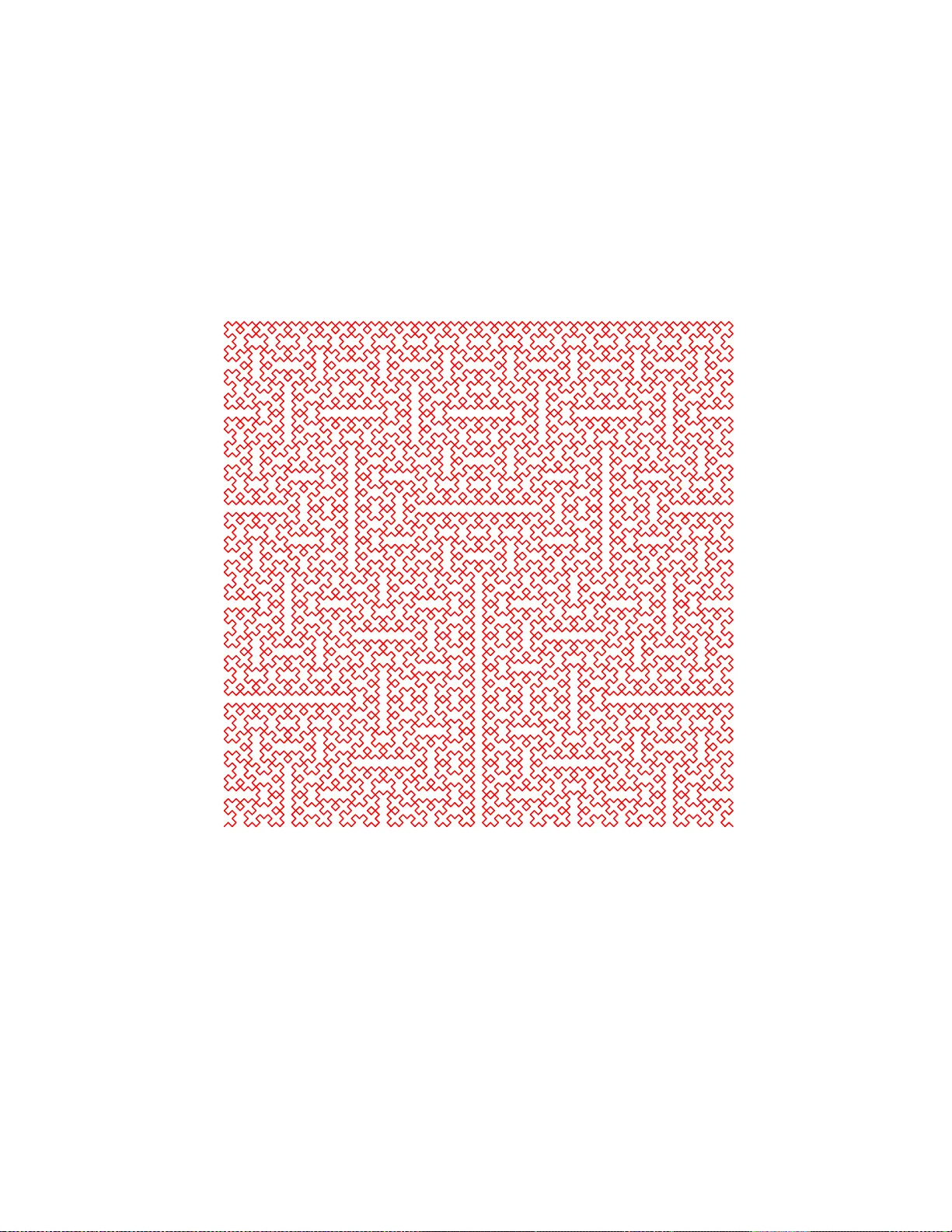
The Classification Theorem for Compact Surfaces And A Detour On F ractals Jean Galli er Department of Computer and Informa tion Science Universit y of P ennsylv ania Phila delphia, P A 1 9 104, USA e-mail : jean@sau l.cis .upenn.edu c Jea n Ga llier Please, do not r ep r o duce without p ermission of the author No vem b er 12, 2018 2 3 The Classi fication Theorem for Compact Surfaces And A Detour On F ractals Jean Gallier Abstract . In the w ords of Milnor himself, the classification theorem for compact surfaces is a formidable result. According to Massey , this result w as o btained in the early 19 20’s and w a s t he culmination of the work o f many . Indeed, a rigorous pro of requires, among other things, a precise definition of a surface and of orien tability , a precise notion of triangulation, and a precise w ay of determining whether t w o surfaces are homeomorphic o r not. This requires some notions of algebraic top o lo gy suc h as, fundamen tal g roups, homology groups, and the Euler-P oincar´ e c haracteristic. Most steps o f the pro of are rather in v olv ed and it is easy to lo ose trac k. The purp ose o f these notes is to presen t a fairly complete pro of of the classification The- orem for compact surfaces. Other presen tations are often quite informal (see the references in Chapter V) and w e ha v e tried t o b e more rigorous. Our main source of inspiration is the b eautiful b o ok on Riemann Surfaces b y Ahlfors and Sario. Ho wev er, Ahlfors and Sario’s presen tation is v ery formal and quite compact. As a result, uninitiated readers will probably ha v e a hard time reading this b o ok. Our g oal is t o help the reader reac h the top of the mountain and help him not to get lost or discouraged to o early . This is not an easy task! W e provide quite a bit of top ological bac kground material and the basic f a cts of algebraic top ology needed for understanding how the pro of go es, with more t han an impressionistic feeling. W e hop e that these notes will b e helpful to readers intereste d in geometry , and who still b eliev e in the rewards of serious hiking! 4 Con ten ts 1 Surfaces 7 1.1 In t r o duction . . . . . . . . . . . . . . . . . . . . . . . . . . . . . . . . . . . . 7 1.2 The Quotien t T op ology . . . . . . . . . . . . . . . . . . . . . . . . . . . . . . 8 1.3 Surfaces: A F ormal Definition . . . . . . . . . . . . . . . . . . . . . . . . . . 10 2 Simplices, Complexes, and T riangulations 13 2.1 Simplices and Complexes . . . . . . . . . . . . . . . . . . . . . . . . . . . . . 13 2.2 T ria ng ulations . . . . . . . . . . . . . . . . . . . . . . . . . . . . . . . . . . . 18 3 The F undamen tal Group, Orientabi lity 23 3.1 The F undamental Group . . . . . . . . . . . . . . . . . . . . . . . . . . . . . 23 3.2 The Winding Num b er of a Closed Plane Curv e . . . . . . . . . . . . . . . . . 27 3.3 The F undamental Group of the Punctured Plane . . . . . . . . . . . . . . . 28 3.4 The Degree of a Map in the Plane . . . . . . . . . . . . . . . . . . . . . . . . 29 3.5 Orien tabilit y of a Surface . . . . . . . . . . . . . . . . . . . . . . . . . . . . . 30 3.6 Bordered Surfaces . . . . . . . . . . . . . . . . . . . . . . . . . . . . . . . . . 31 4 Homology Groups 35 4.1 Finitely Generated Ab elian Groups . . . . . . . . . . . . . . . . . . . . . . . 35 4.2 Simplicial and Singular Homology . . . . . . . . . . . . . . . . . . . . . . . . 40 4.3 Homology Groups of the Finite P olyhedras . . . . . . . . . . . . . . . . . . . 48 5 The Classification Theorem for Compact Surfaces 53 5.1 Cell Complexes . . . . . . . . . . . . . . . . . . . . . . . . . . . . . . . . . . 53 5.2 Normal F orm for Cell Complexes . . . . . . . . . . . . . . . . . . . . . . . . 56 5.3 Pro of of the Classification Theorem . . . . . . . . . . . . . . . . . . . . . . . 65 5.4 Application of the Main Theorem . . . . . . . . . . . . . . . . . . . . . . . . 67 6 T op ological Preliminaries 71 6.1 Metric Spaces and Normed V ector Space s . . . . . . . . . . . . . . . . . . . . 71 6.2 T op ological Spaces, Con tin uous F unctions, Limits . . . . . . . . . . . . . . . 75 6.3 Connected Sets . . . . . . . . . . . . . . . . . . . . . . . . . . . . . . . . . . 84 6.4 Compact Sets . . . . . . . . . . . . . . . . . . . . . . . . . . . . . . . . . . . 90 5 6 CONTENTS 7 A Detour On F ractals 105 7.1 Iterated F unction Systems and F ractals . . . . . . . . . . . . . . . . . . . . . 105 Chapter 1 Surfaces 1.1 In tr o du c t ion F ew things are as rew arding as finally stum bling upon the view of a breath taking landscap e at the t urn of a path after a long hike . Similar exp eriences o ccur in mathematics, music , art, etc. When I first read ab out t he classification of the compact surfaces, I sens ed that if I prepared my self fo r a long hik e, I could probably enjoy the same kind of exhilarating feeling. In the words of Milnor himself, the classification theorem for compact surfaces is a formidable result. According to Massey [1 1 ], this result w as obtained in the early 1920’s, and w a s t he culmination of the work o f many . Indeed, a rigorous pro of requires, among other things, a precise definition of a surface and of orientabilit y , a precise no t ion of tria ng ulation, and a precise w a y of determining whether t w o surfaces are homeomorphic or not. This re- quires some notions of alg ebraic top ology suc h as, fundamen tal groups, homolog y groups, and the Euler-P oincar´ e c haracteristic. Most s teps of the pro of are rather in v olv ed and it is easy to lo ose trac k. One asp ect of the pro of that I find pa rticularly fascin ating is the use of certain kinds of graphs ( cell complexes) and of some kinds of rewrite rules on these graphs, to show that ev ery triangulated surface is equiv alen t to some cell complex in normal form . This presen ts a challenge to researc hers in t erested in rew riting, as the ob jects are un usual (neither terms nor graphs), and rewriting is really mo dulo cyclic p erm utations (in the case of b o undar ies). W e hop e that these not es will inspire some o f the researc hers in the field of rewriting to in v estigate these m ysterious rew riting sy stems. Our goa l is to help the reader reach the top o f the moun ta in (the classification theorem for compact surfa ces, with or without b o undaries (also called b orders)), and help him not to get lost or discouraged to o early . This is not an easy t a sk! On the w a y , w e will tak e a glimpse at fractals defined in terms of iterated function systems. W e provide quite a bit of top ological bac kground material and the basic f a cts of algebraic top ology needed for understanding how the pro of go es, with more t han an impressionistic feeling. Ha ving r eview ed some material o n complete and compact metric spaces, w e indulge 7 8 CHAPTER 1. SURF A CES in a short digression on the Hausdorff distance b etw een compact sets, and the definition of fractals in t erms of iterated function systems. Ho w ev er, this is just a pleasan t in terlude, our main goal b eing the classification theorem for compact surfaces. W e also review abelian groups, and presen t a pro of o f the structure t heorem for finitely generated a b elian groups due to Pierre Samuel. Readers with a go o d mathematical bac k- ground should pro ceed directly to Section 1.3, or eve n t o Section 2.1. W e hop e that these notes will b e helpful to readers in terested in geometry , and who still b eliev e in the rewards of serious hiking! A cknow le dgem ent : I w ould like to thank Alexandre Kirillov for inspiring me to le arn ab out fractals, thro ugh his exc ellen t lectures on fractal geometry given in the Spring of 199 5. Also man y thanks to Chris Croke , Ron D onagi, Dav id Harbat er, Herman Gluc k, and Stev e Shatz, from whom I learned most of my top ology a nd geometry . Finally , sp ecial thanks to Eugenio Calabi and Marcel Berger, for giving fascinating c ourses in the F all o f 1994, whic h c hanged m y scie ntific life irrev o cably (for the b est!). Basic top olo g ical notions are g iven in Chapter 6. In this c ha pter, w e simply review quotien t spaces . 1.2 The Quoti en t T o p ol o gy Ultimately , surfaces will b e view ed as spaces obtained by iden tifying (or gluing) edges of plane p olygons and to define this pro cess rigorously , w e need the concept o f quotien t top o logy . This section is in tended as a revie w and it is far from b eing complete . F o r more details, consult Munkres [13], Massey [11, 12], Amstrong [2], or Kinsey [9]. Definition 1.2.1 G iv en an y top ological space X and an y set Y , f or an y surjectiv e function f : X → Y , w e define the quotient top olo gy on Y determine d by f (also called the identific a- tion top olo gy on Y de termi n e d by f ), b y requiring a subset V of Y to b e op en if f − 1 ( V ) is an op en se t in X . Giv en an equiv alence relation R on a top ological sp ace X , if π : X → X/R is the pro jection sending ev ery x ∈ X to its equiv alence class [ x ] in X/R , the space X/R equipped with the quotien t top ology determined by π is called the quotient sp ac e of X m o d- ulo R . Thus a set V of equiv alence classes in X/R is op en iff π − 1 ( V ) is op en in X , which is equiv alent to the fact that S [ x ] ∈ V [ x ] is op en in X . It is immediately v erified that Definition 1.2.1 defines top olo gies, and that f : X → Y and π : X → X/R are con t inuous when Y and X/R are giv en these quotien t t op ologies. One should b e careful that if X a nd Y ar e top olo gical spaces and f : X → Y is a con tin uous surjectiv e map, Y do es not necess arily hav e the quotien t top olo gy determine d b y f . Indeed, it ma y not b e true that a subset V of Y is op en when f − 1 ( V ) is op en. Ho we v er, this will b e true in t w o imp ortant cases . 1.2. THE QUOTIENT TOPOLOGY 9 Definition 1.2.2 A con tin uous map f : X → Y is an op en map (o r simply op en ) if f ( U ) is op en in Y whenev er U is op en in X , and similarly , f : X → Y is a close d map (or simply close d ) if f ( F ) is closed in Y whenev er F is closed in X . Then, Y has the quotien t top ology induced b y the contin uous surjec tiv e map f if either f is op en or f is closed. Indeed, if f is op en, t hen assuming that f − 1 ( V ) is op en in X , we ha v e f ( f − 1 ( V )) = V op en in Y . No w, since f − 1 ( Y − B ) = X − f − 1 ( B ), for an y subs et B of Y , a subset V of Y is op en in the quotien t topo lo gy iff f − 1 ( Y − V ) is closed in X . F rom this, w e can deduce tha t if f is a closed map, then V is op en in Y iff f − 1 ( V ) is op en in X . Among the des irable features of the quotient top olog y , we w ould like compactness, con- nectedness , arcwise connec tedness, o r the Hausdorff separation pro p ert y , to b e prese rv ed. Since f : X → Y and π : X → X/R are con t inuous, by Prop osition 6.3.4, its vers ion for arcwise connectedness, and Prop osition 6.4.8, compactness, connectedness, and arcwise con- nectedness , are indeed preserv ed. Unfor tunately , t he Hausdorff separation prop erty is not necessarily preserv ed. Nev ertheless, it is preserv ed in s ome sp ecial imp o rtan t cases. Prop osition 1.2.3 L et X and Y b e top o l o gic al sp ac es, f : X → Y a c ontinuous surje c tive map, and assume that X is c omp act, and that Y has the quotient top olo gy determine d by f . Then Y is H ausdorff iff f is a cl o se d ma p. Pr o of . If Y is Hausdorff, b ecause X is compact a nd f is con tinuous , since ev ery closed set F in X is compact, b y Prop osition 6.4.8, f ( F ) is compact, and sin ce Y is Hausdorff, f ( F ) is closed, and f is a closed map. F or the con v erse, w e us e Prop osition 6.4.5 . Since X is Hausdorff, eve ry set { a } consisting of a single elemen t a ∈ X is clos ed, and since f is a closed map, { f ( a ) } is also closed in Y . Since f is surjectiv e, ev ery set { b } consisting o f a single elemen t b ∈ Y is close d. If b 1 , b 2 ∈ Y and b 1 6 = b 2 , since { b 1 } and { b 2 } are closed in Y and f is contin uous, the sets f − 1 ( b 1 ) and f − 1 ( b 2 ) are closed in X , and thu s compact, a nd b y Prop osition 6.4.5, there exists some disjoin t op en sets U 1 and U 2 suc h that f − 1 ( b 1 ) ⊆ U 1 and f − 1 ( b 2 ) ⊆ U 2 . Since f is closed, the sets f ( X − U 1 ) and f ( X − U 2 ) are closed, and th us the sets V 1 = Y − f ( X − U 1 ) V 2 = Y − f ( X − U 2 ) are op en, and it is immediately v erified that V 1 ∩ V 2 = ∅ , b 1 ∈ V 1 , and b 2 ∈ V 2 . This prov es that Y is Hausdorff. Remark: It is easily shown that ano t her equiv alen t condition for Y b eing Hausdorff is that { ( x 1 , x 2 ) ∈ X × X | f ( x 1 ) = f ( x 2 ) } is closed in X × X . Another useful prop osition deals with subspaces and the quotient top ology . 10 CHAPTER 1. SURF A CES Prop osition 1.2.4 L et X and Y b e top o l o gic al sp ac es, f : X → Y a c ontinuous surje c tive map, and assume that Y has the quotient top olo gy determine d by f . I f A is a close d subset (r esp. op en subse t) of X and f is a close d map (r esp. is an op en ma p ) , then B = f ( A ) has the same top olo gy c onsider e d a s a subsp ac e of Y , or as having the quotient top olo gy induc e d by f . Pr o of . Assume that A is op en and that f is an op en map. Assuming that B = f ( A ) ha s the subs pace top olo g y , whic h means that the op en sets of B are the sets of the form B ∩ U , where U ⊆ Y is an op en set of Y , b ecause f is op en, B is op en in Y , and it is immediate that f | A : A → B is an op en map. But then, by a previous observ a tion, B has the quotien t top ology induced b y f . The pro of when A is closed and f is a closed map is similar. W e now define (abstract) surfaces. 1.3 Surfaces: A F ormal Defi n ition In t uitively , what distinguishes a surface from a n ar bitr ary to p ological space, is that a surface has the property that for ev ery p oint on the surface, there is a small neigh b orho o d that lo oks like a little planar region. More precisely , a surface is a top ological space that can b e co v ered b y op en sets that can b e mapp ed homeomorphically on to op en s ets o f the pla ne. Giv en suc h an o p en set U on the surface S , there is an op en se t Ω of the plane R 2 , and a homeomorphism ϕ : U → Ω. The pair ( U, ϕ ) is usually called a c o or dinate system , o r chart , of S , a nd ϕ − 1 : Ω → U is called a p ar ameteriza tion of U . W e c an think of the maps ϕ : U → Ω as defining small planar maps of small regio ns on S , similar to geographical maps. This idea can b e extended to higher dimensions, and leads to the notio n of a top ological manifold. Definition 1.3.1 F or an y m ≥ 1, a (top olo gic al) m -manifold is a second-coun table, top o- logical Hausdorff space M , to gether with an op en co v er ( U i ) i ∈ I and a family ( ϕ i ) i ∈ I of home- omorphisms ϕ i : U i → Ω i , where each Ω i is some op en subset of R m . Eac h pair ( U i , ϕ i ) is called a c o or dinate system , or chart (or lo cal c ha r t) o f M , each homeomorphism ϕ i : U i → Ω i is called a c o o r dinate map , and its in ve rse ϕ − 1 i : Ω i → U i is called a p ar am eterization of U i . F or any p oin t p ∈ M , for an y co ordinate system ( U, ϕ ) with ϕ : U → Ω, if p ∈ U , we sa y that (Ω , ϕ − 1 ) is a p ar am eterization of M at p . The family ( U i , ϕ i ) i ∈ I is o ften called a n a tlas for M . A (top o l o gic al) surfac e is a connected 2- ma nif o ld. Remarks: (1) The terminology is not univ ersally ag r eed up on. F or example, some a ut ho rs (including F ulton [7]) call the maps ϕ − 1 i : Ω i → U i c ha r t s! Alw a ys c hec k the direction o f the homeomorphisms inv olv ed in the definition o f a manifold (from M to R m , or the other w ay around). 1.3. SURF A CES: A F ORMAL DEFINITION 11 (2) Some authors define a surface as a 2-manifold, i.e., they do not require a surface to b e connected. F ollowin g Ahlfors a nd Sario [1], we find it mor e con venie nt to assume that surfaces are connected. (3) According to Definition 1.3 .1 , m -manifolds (o r surfaces) do not hav e an y differen tial structure. This is usually emphasized b y calling suc h ob jects top olo gic al m -manifolds (or top olo gic al surfaces). Rather than b eing p edantic , until sp ecified otherwise, we will simply use the term m -manifold (or surface). A 1-manifold is also called a curv e. One may w onder whethe r it is p o ssible that a top o logical manifold M b e b oth an m - manifold a nd an n -manifold for m 6 = n . F or example, could a surface also b e a curve ? F ortunately , for connected manifolds, this is not the case. By a deep theorem of Brouw er (the in v ariance of dimension theorem), it can b e sho wn that a connected m -manifold is not an n -manifold for n 6 = m . Some readers man y find the definition of a surface quite abstract. Indeed, the definition do es not assume that a surface is a subspace o f any give n am bien t space, sa y R n , for some n . P erhaps, suc h surfaces should b e called “abstract surfaces”. In fa ct, it can b e sho wn that ev ery surface can b e em b edded in R 4 , whic h is somewhat dis turbing, since R 4 is hard to visualize! F or tunately , orien t a ble surfaces can b e embedded in R 3 . Ho w ev er, it is not necessary to use these em b eddings to understand the to p ological structure of surfaces. In fact, when it comes to higher-order manifolds, ( m -manifolds for m ≥ 3), and suc h manif o lds do arise naturally in mec hanics, rob o tics and computer vision, ev en though it can b e sho wn that an m - manif old can b e em b edded in R 2 m (a hard theorem due to Whitney), this usually do es not help in understanding its structure. In the case m = 1 (curv es), it is not to o difficult to prov e that a 1-manifo ld is homeomorphic to either a circle or an op en line segmen t (in terv al). Since an m -manifold M has an op en cov er of sets homeomorphic with open se ts of R m , an m -manifold is lo cally arcwise connected and lo cally compact. By Theorem 6.3.14, the connected comp onen ts of an m -manifold are ar cwise connected, and in particular, a surface is arcwise connected. An op en subset U on a surface S is called a Jor dan r e gion if its closure U can b e mapp ed homeomorphically onto a clos ed disk of R 2 , in suc h a w ay that U is mapp ed on to the op en disk, and th us, that the b oundary of U is mapped homeomorphically onto the circle, the b oundary of the op en disk. This means that the b oundary of U is a Jordan curv e. Since ev ery p oint in an op en set of the plane R 2 is the cen ter of a closed disk contained in that op en set, w e note that ev ery surface has an op en cov er by Jordan regions. T ria ng ulations are a fundamen tal to ol to obtain a deep understanding of the top ology of surfaces. Roug hly speaking, a triangulation of a surface is a wa y of cutting up the surface in to triangula r r egio ns, suc h tha t these triangles a re the ima g es of triangles in the plane, a nd the edges of these planar triangles form a graph with certain prop erties. T o form ulate this notion precisely , w e need to define simp lices and simplicial complexes. This can be done in the con t ext of an y affine space. 12 CHAPTER 1. SURF A CES Chapter 2 Simplices , Complexes, and T riangulations 2.1 Simplices and Complexes A simplex is just the conv ex hull of a finite num b er of affinely indep enden t p oints, but w e also need to define faces, the b oundary , and the in terior, o f a simplex. Definition 2.1.1 Let E be an y normed affine space. G iv en an y n + 1 affinely indep enden t p oin ts a 0 , . . . , a n in E , the n -simplex (or simplex) σ d efine d by a 0 , . . . , a n is the con vex hull of the p oin ts a 0 , . . . , a n , that is, t he set of all con vex com binations λ 0 a 0 + · · · + λ n a n , where λ 0 + · · · + λ n = 1, and λ i ≥ 0 for a ll i , 0 ≤ i ≤ n . W e call n the dimension of the n -simplex σ , and the p oints a 0 , . . . , a n are the v e rtic es of σ . Giv en any subset { a i 0 , . . . , a i k } of { a 0 , . . . , a n } (where 0 ≤ k ≤ n ), the k -simplex gene rated b y a i 0 , . . . , a i k is called a fac e of σ . A fa ce s of σ is a pr op er fac e if s 6 = σ (w e agree that the empt y set is a f ace of an y simplex). F or a n y v ertex a i , the face generated by a 0 , . . . , a i − 1 , a i +1 , . . . , a n (i.e., omitting a i ) is called the fa c e opp osite a i . Ev ery face whic h is a ( n − 1)-simplex is called a b oundary fac e . The union of the b oundary faces is the b oundary of σ , denoted as ∂ σ , and the complemen t of ∂ σ in σ is the interior Int σ = σ − ∂ σ of σ . The in terior In t σ of σ is sometimes called an o p en simplex . It should b e noted that for a 0-simplex consis ting o f a single p oint { a 0 } , ∂ { a 0 } = ∅ , and Int { a 0 } = { a 0 } . Of course, a 0- simplex is a single p oint, a 1 -simplex is the line segmen t ( a 0 , a 1 ), a 2-simplex is a triangle ( a 0 , a 1 , a 2 ) (with its interior), and a 3- simplex is a tetrahedron ( a 0 , a 1 , a 2 , a 3 ) (with its in terior), as illustrated in F igure 2.1. W e now state a n umber of prop erties of simplices, whose pro ofs are left as an exercis e. Clearly , a p oin t x b elongs to t he b oundary ∂ σ of σ iff at least one of its barycen tric co- ordinates ( λ 0 , . . . , λ n ) is zero, and a p oin t x b elongs to the in terior Int σ of σ iff a ll of its barycen tric co ordinates ( λ 0 , . . . , λ n ) are p ositiv e, i.e., λ i > 0 for a ll i, 0 ≤ i ≤ n . Then, for ev ery x ∈ σ , there is a unique fa ce s such that x ∈ In t s , the face generated b y t ho se p o in ts a i for whic h λ i > 0, where ( λ 0 , . . . , λ n ) are the barycen tric co ordinates of x . 13 14 CHAPTER 2. SIMPLICES, COMPLEXES, AND TRIANGULA TIONS b c b c b c b c b c b c b c b c b c b c a 0 a 0 a 1 a 0 a 1 a 2 a 0 a 3 a 2 a 1 Figure 2.1: Examples of simplices A simplex σ is con v ex, arcwise connec ted, compact, and closed. The in terior Int σ of a simplex is con v ex, arwise connected, op en, a nd σ is the closure of In t σ . F or the last prop erty , w e recall the follo wing definitions. The unit n -b al l B n is the set of p oin ts in A n suc h that x 2 1 + · · · + x 2 n ≤ 1 . The unit n -spher e S n − 1 is the set of p oin ts in A n suc h that x 2 1 + · · · + x 2 n = 1. Giv en a p oint a ∈ A n and a nonn ull v ector u ∈ R n , the set of all p o ints { a + λu | λ ≥ 0 } is called a r ay emanating fr om a . Then, ev ery n -simplex is homeomorphic to the unit ball B n , in suc h a w ay tha t its b oundary ∂ σ is homeomorphic to the n -sphere S n − 1 . W e will pro v e a sligh tly more general result ab out conv ex sets, but first, we need a simple prop osition. Prop osition 2.1.2 Given a norme d a ffi n e sp ac e E , for any nonempty c onve x set C , the top olo gic al closur e C of C is al s o c o n vex. F urthermor e, if C is b ounde d, then C i s also b ounde d. Pr o of . F irst, w e sho w the follo wing simple inequalit y . F or a ny four p oin ts a, b, a ′ , b ′ ∈ E , for an y ǫ > 0, for an y λ suc h that 0 ≤ λ ≤ 1, letting c = (1 − λ ) a + λb and c ′ = (1 − λ ) a ′ + λb ′ , if k aa ′ k ≤ ǫ and k bb ′ k ≤ ǫ , then k cc ′ k ≤ ǫ . This is b ecause cc ′ = (1 − λ ) aa ′ + λ bb ′ , and th us k cc ′ k ≤ (1 − λ ) k aa ′ k + λ k bb ′ k ≤ (1 − λ ) ǫ + λǫ = ǫ. 2.1. SIMPLICES AND COMPLEXES 15 No w, if a, b ∈ C , by the definition of closure, for ev ery ǫ > 0, the op en ball B 0 ( a, ǫ/ 2) m ust in tersect C in some p oint a ′ , the op en ball B 0 ( b, ǫ/ 2 ) m ust in tersect C in some p oin t b ′ , and b y t he ab ov e inequalit y , c ′ = (1 − λ ) a ′ + λb ′ b elongs to the op en ball B 0 ( c, ǫ ). Since C is con v ex, c ′ = (1 − λ ) a ′ + λb ′ b elongs to C , and c ′ = (1 − λ ) a ′ + λb ′ also b elongs t o the op en ball B o ( c, ǫ ), whic h sho ws that for ev ery ǫ > 0, the op en ba ll B 0 ( c, ǫ ) in tersects C , whic h means that c ∈ C , and th us that C is conv ex. F inally , if C is con tained in some ball of radius δ , b y the previous discussion, it is clear that C is con tained in a ball of ra dius δ + ǫ , for any ǫ > 0. The fo llo wing pro p osition sho ws that top ologically , closed b o unded conv ex sets in A n are equiv alent to closed balls. W e will need this prop o sition in de aling with tria ngulations. Prop osition 2.1.3 If C is a ny nonem p ty b ounde d and c onve x op en set in A n , for any p oint a ∈ C , a n y r a y emanating fr om a interse cts ∂ C = C − C in exactly one p oint. F urthermor e, ther e is a home om o rphism of C onto the (close d) unit b al l B n , which m aps ∂ C o n to the n -spher e S n − 1 . Pr o of . Since C is conv ex and b ounded, by Prop osition 2.1.2, C is also con v ex and b ounded. Giv en a n y ra y R = { a + λu | λ ≥ 0 } , sinc e R is ob viously con v ex, the set R ∩ C is con v ex, b ounded, and closed in R , whic h means t ha t R ∩ C is a closed s egmen t R ∩ C = { a + λu | 0 ≤ λ ≤ µ } , for some µ > 0. Clearly , a + µu ∈ ∂ C . If the ray R inters ects ∂ C in a no ther p oint c , w e ha v e c = a + ν u for some ν > µ , and since C is con v ex, { a + λu | 0 ≤ λ ≤ ν } is contained in R ∩ C fo r ν > µ , whic h is absu rd. Thus , ev ery ra y emanating fro m a in tersects ∂ C in a single p oint. Then, the map f : A n − { a } → S n − 1 defined suc h that f ( x ) = ax / k ax k is con tin uous. By the first pa r t, the r estriction f b : ∂ C → S n − 1 of f to ∂ C is a bijection (since ev ery p o in t on S n − 1 corresp onds to a unique ra y emanating from a ). Since ∂ C is a closed and b ounded subset of A n , it is compact, and thu s f b is a homeomorphism. Consider the in v erse g : S n − 1 → ∂ C of f b , w hic h is a lso a homeomorphism. W e nee d to extend g to a homeomorphism betw een B n and C . Since B n is compact, it is enough to extend g to a con tinuous bijection. This is done b y defining h : B n → C , suc h that: h ( u ) = n (1 − k u k ) a + k u k g ( u/ k u k ) if u 6 = 0; a if u = 0. It is clear that h is bijec tiv e and con tinuous for u 6 = 0. Since S n − 1 is compact and g is con tin uous on S n − 1 , there is some M > 0 suc h that k ag ( u ) k ≤ M f or all u ∈ S n − 1 , and if k u k ≤ δ , then k ah ( u ) k ≤ δ M , whic h sh ow s tha t h is also contin uous for u = 0. Remark: It is useful to note that the second part of the prop osition prov es that if C is a b ounded con v ex op en subset of A n , then a n y ho meomorphism g : S n − 1 → ∂ C can b e 16 CHAPTER 2. SIMPLICES, COMPLEXES, AND TRIANGULA TIONS extended to a homeomorphism h : B n → C . By Prop osition 2.1.3, w e o btain the fact that if C is a b ounded con v ex open s ubset of A n , then an y homeomorphism g : ∂ C → ∂ C can b e extended to a homeomorphism h : C → C . W e will need this fact later on (dealing with triangulations). W e now need to put simplices together to form more complex shap es. F ollowing Ahlfors and Sario [1], w e define abstract complexes and their geometric realizations. This seems easier than defining simplicial complexes directly , as for example, in Munkres [14]. Definition 2.1.4 An abstr act c omplex (fo r s hort c omple x ) is a pair K = ( V , S ) consisting of a (finite or infinite) nonempt y set V of vertic es , together with a family S of finite subsets of V called abstr act simplic es (for short simpl i c es ), and satisfying the following conditions: (A1) Ev ery x ∈ V b elongs to at least one and at most a finite n um b er o f simplice s in S . (A2) Ev ery subset of a simplex σ ∈ S is also a simplex in S . If σ ∈ S is a nonempt y simplex o f n + 1 v ertices, then its dimension is n , and it is called an n -simp lex . A 0-simplex { x } is iden tified with the v ertex x ∈ V . The dime nsion of an abstr act c om plex is the maxim um dimens ion of its simplices if finite, a nd ∞ ot herwise. W e will use t he abbreviation complex for abstract complex, and simplex for abstract simplex. Also, giv en a simplex s ∈ S , w e will o f ten use the abuse o f notation s ∈ K . The purp ose of condition (A1) is to insure that the geometric realization of a complex is lo cally compact. R ecall t ha t giv en any set I , the real v ector space R ( I ) freely generated b y I is defined as the subset of the cart esian pro duct R I consisting of fa milies ( λ i ) i ∈ I of elemen ts of R with finite s upp ort (where R I denotes the set o f all functions fro m I to R ). Then, ev ery abstract complex ( V , S ) has a geometric realization as a t o p ological subspace of the normed v ector space R ( V ) . Ob viously , R ( I ) can b e view ed as a normed affine space (under the norm k x k = max i ∈ I { x i } ) denoted as A ( I ) . Definition 2.1.5 G iv en an abstract complex K = ( V , S ), its ge ometric r e alization (also called the p olytop e of K = ( V , S )) is the subspace K g of A ( V ) defined as follo ws: K g is the set of all families λ = ( λ a ) a ∈ V with finite suppo rt, suc h that: (B1) λ a ≥ 0, for all a ∈ V ; (B2) The set { a ∈ V | λ a > 0 } is a simplex in S ; (B3) P a ∈ V λ a = 1. F or ev ery simplex s ∈ S , we obta in a subset s g of K g b y considering those families λ = ( λ a ) a ∈ V in K g suc h that λ a = 0 for all a / ∈ s . Then, b y (B2), w e not e that K g = [ s ∈S s g . 2.1. SIMPLICES AND COMPLEXES 17 It is also clear that for ev ery n -simplex s , its geometric realization s g can b e iden tified with an n -simplex in A n . Giv en a v ertex a ∈ V , we define the star of a , denoted a s St a , as the finite union of the in teriors ◦ s g of the geometric simplices s g suc h that a ∈ s . Clearly , a ∈ St a . The close d star of a , denoted as St a , is the finite union of the geometric simplices s g suc h that a ∈ s . W e define a top ology on K g b y defining a subset F o f K g to b e closed if F ∩ s g is closed in s g for all s ∈ S . It is immediately v erified that the axioms of a top olog ical space are indeed v erified. Actually , w e can find a nice basis for this top olog y , as sho wn in the next prop osition. Prop osition 2.1.6 The family of subsets U of K g such that U ∩ s g = ∅ for al l by finitely many s ∈ S , and such that U ∩ s g is op en in s g when U ∩ s g 6 = ∅ , forms a b asis of op en sets for the top olo gy of K g . F or any a ∈ V , the star St a o f a is op en , the close d star St a is the closur e of St a and is c om p act, and b oth St a and St a ar e ar cwise c o n ne cte d. The sp ac e K g is lo c al ly c omp act, lo c a l ly ar cwise c onne cte d, and Hausdorff. Pr o of . T o see that a set U as defined ab ov e is op en, consider the complemen t F = K g − U o f U . W e need to sho w that F ∩ s g is closed in s g for all s ∈ S . But F ∩ s g = ( K g − U ) ∩ s g = s g − U , and if s g ∩ U 6 = ∅ , then U ∩ s g is op en in s g , and t hus s g − U is closed in s g . Next, given any op en sub set V of K g , s ince b y ( A 1), ev ery a ∈ V belongs to finitely man y simplices s ∈ S , letting U a b e the union o f t he in teriors of t he finitely many s g suc h that a ∈ s , it is clear that U a is o p en in K g , and tha t V is the union of the op en sets of the form U a ∩ V , whic h sho ws that the sets U of the prop osition fo rm a basis of the top o logy of K g . F o r ev ery a ∈ V , the star St a of a has a no nempty interse ction with only finitely man y simplice s s g , and St a ∩ s g is t he in terior of s g (in s g ), whic h is op en in s g , and St a is op en. That St a is the closure of St a is obv ious, and sin ce eac h simple x s g is compact, and St a is a finite union of compact simplices, it is compact. Thus , K g is lo cally compact. Since s g is arcwise connected, for ev ery op en set U in the basis, if U ∩ s g 6 = ∅ , U ∩ s g is an open se t in s g that con tains some arcwise connected set V s con taining a , and the union of these arcwise connected sets V s is arcwise connected, and clearly an op en set of K g . Th us, K g is lo cally arcwise connected. It is also immediate that St a and St a are a r cwise connected. Let a, b ∈ K g , and a ssume that a 6 = b . If a, b ∈ s g for some s ∈ S , sinc e s g is Hausdorff, there are disjoint op en sets U, V ⊆ s g suc h that a ∈ U and b ∈ V . If a and b do not belong to the same simplex, then St a and St b are disjoint op en sets such that a ∈ St a a nd b ∈ St b . W e a lso note that for any tw o simplices s 1 , s 2 of S , we ha ve ( s 1 ∩ s 2 ) g = ( s 1 ) g ∩ ( s 2 ) g . W e sa y that a complex K = ( V , S ) is connected if it is not the union of t w o complexes ( V 1 , S 1 ) and ( V 2 , S 2 ), where V = V 1 ∪ V 2 with V 1 and V 2 disjoin t, and S = S 1 ∪ S 2 with S 1 and S 2 disjoin t. The next prop osition sho ws tha t a connected complex con ta ins coun ta bly man y simplices. Th is is an imp ortan t f act, since it implies t ha t if a surface can b e triangulated, then its top ology m ust b e second-coun table. 18 CHAPTER 2. SIMPLICES, COMPLEXES, AND TRIANGULA TIONS Prop osition 2.1.7 If K = ( V , S ) is a c on n e cte d c omplex, then S and V ar e c ountable. Pr o of . The pro of is very similar to that of the second part of Theorem 6.3.14. The t r ic k consists in defining the right notion of arcwise connectedness. W e sa y that tw o v ertices a, b ∈ V are p ath-c onne c te d, or that ther e is a p ath fr om a to b if there is a sequence ( x 0 , . . . , x n ) of v ertices x i ∈ V , suc h that x 0 = a , x n = b , and { x i , x i +1 } , is a simplex in S , for all i, 0 ≤ i ≤ n − 1. Obse rv e that ev ery simplex s ∈ S is path-connected. Then, the pro of consists in show ing that if ( V , S ) is a connected complex, then it is path- connected. Fix an y v ertex a ∈ V , and let V a b e the set of all v ertices that are pat h- connected to a . W e claim that fo r an y simplex s ∈ S , if s ∩ V a 6 = ∅ , the n s ⊆ V a , w hic h sho ws that if S a is the subset of S consisting of all simplice s ha ving some vertex in V a , then ( V a , S a ) is a complex. Indee d, if b ∈ s ∩ V a , there is a path from a t o b . F or an y c ∈ s , since b and c are path-connected, then there is a path fro m a to c , and c ∈ V a , whic h sho ws that s ⊆ V a . A sim ilar reasoning applies to the complemen t V − V a of V a , and w e obta in a complex ( V − V a , S − S a ). But ( V a , S a ) and ( V − V a , S − S a ) are disjoin t complexes, con tradicting the fact tha t ( V , S ) is connected. Then, since ev ery simplex s ∈ S is finite and ev ery path is finite, the n um b er o f path from a is countable, and b ecause ( V , S ) is path-connected, there are at most countably man y v ertices in V and at most coun tably many simplices s ∈ S . 2.2 T riangulation s W e no w return to surfaces and define the no t ion of triangula tion. T riangula tions are sp ecial kinds of complexes of dimension 2, whic h means that the simplices in v olv ed are p oin ts, line segmen ts, and tria ngles. Definition 2.2.1 G iv en a surface M , a triangulation of M is a pair ( K , σ ) consisting of a 2-dimensional complex K = ( V , S ) and of a map σ : S → 2 M assigning a close d s ubset σ ( s ) of M to ev ery simplex s ∈ S , satisfying the follow ing conditions: (C1) σ ( s 1 ∩ s 2 ) = σ ( s 1 ) ∩ σ ( s 2 ), for all s 1 , s 2 ∈ S . (C2) F or ev ery s ∈ S , there is a homeomorphism ϕ s from the geometric realization s g of s to σ ( s ), suc h tha t ϕ s ( s ′ g ) = σ ( s ′ ), for ev ery s ′ ⊆ s . (C3) S s ∈S σ ( s ) = M , that is, the sets σ ( s ) co v er M . (C4) F or ev ery p oint x ∈ M , there is some neigh b orho o d of x whic h meets only finitely man y of the σ ( s ) . If ( K, σ ) is a triangulation of M , we also refer to the map σ : S → 2 M as a triangulatio n of M and w e also say that K is a tr ia ngulation σ : S → 2 M of M . As ex p ected, giv en a triangulation ( K , σ ) of a surface M , the geometric realization K g of K is homeomorphic to the surface M , as shown by the follo wing prop osition. 2.2. TRIANGULA TIONS 19 b c b c b c b c b c b c d d d a b c Figure 2.2: A triangulation of the sphere Prop osition 2.2.2 Given any triangulation σ : S → 2 M of a surfac e M , ther e is a home- omorphism h : K g → M fr o m the ge om etric r e alization K g of the c omplex K = ( V , S ) onto the surfac e M , such that e ach g e ometric si m plex s g is map p e d o nto σ ( s ) . Pr o of . O b viously , for ev ery v ertex x ∈ V , we let h ( x g ) = σ ( x ). If s is a 1-simplex, w e define h on s g using an y of the homeomorphisms whose existence is asserted b y (C1). Having defined h on the b oundary of eac h 2-simplex s , we need to extend h to the en tire 2 -simplex s . How ev er, b y (C2), there is some homeomorphism ϕ from s g to σ ( s ), and if it do es not agree with h on the boundary of s g , whic h is a triangle, by the remark after Prop osition 2.1.3, since the restriction of ϕ − 1 ◦ h to the boundary of s g is a homeomorphism, it can b e extended to a homeomorphism ψ of s g in to itself, and then ϕ ◦ ψ is a homeomorphism of s g on to σ ( s ) that agrees with h on the b oundary of s g . This w a y , h is no w defined on the en tire K g . Giv en any closed set F in M , for ev ery simplex s ∈ S , h − 1 ( F ) ∩ s g = h − 1 | s g ( F ) , where h − 1 | s g ( F ) is the restriction of h to s g , whic h is contin uous by construction, and th us, h − 1 ( F ) ∩ s g is closed for all s ∈ S , whic h sho ws that h is contin uous. The map h is injectiv e b ecause of (C1), surjectiv e b ecause of (C3), and its inv erse is con tinuous b ecause of (C4). Th us, h is indeed a homeomorphism mapping s g on to σ ( s ). Figure 2.2 sho ws a triangula t ion of the s pher e . The geometric realization of the a b o v e triangulation is obtained b y pasting together the pairs of edges lab eled ( a, d ), ( b, d ), ( c, d ). The geometric realization is a tetrahedron. 20 CHAPTER 2. SIMPLICES, COMPLEXES, AND TRIANGULA TIONS b c b c b c b c b c b c b c b c b c b c b c b c b c b c b c b c a e d a b i f b c j g c a e d a Figure 2.3: A triangulation of the torus Figure 2.3 sho ws a triangula t ion of a surface called a torus . The geometric realization of the a b o v e triangulation is obtained b y pasting together the pairs of edges lab eled ( a, d ), ( d, e ), ( e, a ), and the pairs of edges lab eled ( a, b ), ( b, c ), ( c, a ). Figure 2.4 sho ws a triangula t ion of a surface called the pr oje ctive pl a ne . b c b c b c b c b c b c b c b c b c b c b c b c b c b c b c b c d e f a c j g b b k h c a f e d Figure 2.4: A triangulation of the pro jectiv e pla ne The geometric realization of the a b o v e triangulation is obtained b y pasting together the pairs of edges lab eled ( a, f ), ( f , e ), ( e, d ), and the pairs of edges lab eled ( a, b ), ( b, c ), ( c, d ). 2.2. TRIANGULA TIONS 21 b c b c b c b c b c b c b c b c b c b c b c b c b c b c b c b c a e d a b i f b c j g c a d e a Figure 2.5: A triangulation of the Klein b ottle This time, the g luing requires a “t wist”, since the the pa ir ed edges ha v e opp osite orien tation. Visualizing this surface in A 3 is actually non trivial. Figure 2.5 sho ws a triangula t ion of a surface called the Klein b ottle . The geometric realization of the ab ov e triangulatio n is obtained b y pasting together the pairs of edges lab eled ( a, d ), ( d, e ), ( e, a ), and the pair s of edges lab eled ( a, b ), ( b, c ), ( c, a ). Again, some of the g luing requires a “t wist”, since some paired edges hav e opp osite orien tation. Visualizing this surface in A 3 not to o difficult, but self-inters ection cannnot b e a v oided. W e a re no w going to state a prop osition characterizin g the complexes K that cor r esp ond to triangulatio ns of surfaces. The followin g notational conv en tio ns will b e used: v ertices (or no des, i.e., 0-simplices) will b e denoted as α , edges (1-simplices) will be denoted as a , and triangles (2- simplices) will b e denoted as A . W e will also denote an edge as a = ( α 1 α 2 ), and a triangle as A = ( a 1 a 2 a 3 ), or as A = ( α 1 α 2 α 3 ), whe n w e are inte rested in its ve rtices. F or the momen t, w e do not care ab out the order. Prop osition 2.2.3 A 2 -c omplex K = ( V , S ) is a triang ulation σ : S → 2 M of a surfac e M such that σ ( s ) = s g for al l s ∈ S iff the fol lowing pr op erties hold: (D1) Every e dge a is c ontaine d in exactly two triangles A . (D2) F or every vertex α , the e dges a a n d triangles A c ontaining α c a n b e arr ange d a s a cyclic se quenc e a 1 , A 1 , a 2 , A 2 , . . . , A m − 1 , a m , A m , in the sense that a i = A i − 1 ∩ A i for al l i , 2 ≤ i ≤ m , and a 1 = A m ∩ A 1 , with m ≥ 3 . (D3) K is c on n e cte d, in the sense that it c anno t b e written as the union of two disjoint nonempty c omplexes. 22 CHAPTER 2. SIMPLICES, COMPLEXES, AND TRIANGULA TIONS Pr o of . A pro of can b e found in Ahlfors and Sario [1]. The pr o of requires the notion o f the winding n umber of a clos ed curve in the plane with resp ect to a p oint, and the concept of homotop y . A 2- complex K whic h satisfies the conditions of Prop osition 2.2 .3 will be called a tri- angulate d c omp lex , and its geometric realization is calle d a p olyhe dr on . Th us, triangulat ed complexes are the complexes that corresp ond to triangulated surfaces. Actually , it can b e sho wn tha t ev ery surface admits some triangulation, and th us the class of g eometric re- alizations of the t r iangulated complexes is the class of all surfaces. W e now giv e a quic k presen tation of homotop y , the fundamental group, and homology groups. Chapter 3 The F undamen tal Group, Orien tabili t y 3.1 The F undamental Grou p If we w a n t to someho w classify surfaces, w e ha v e to deal with the issue of deciding when w e consider t w o surfaces to be equiv alen t. It s eems r easonable to treat homeomorphic surfaces as equiv alen t , but this leads to the problem of deciding when tw o surfaces are not homeomor- phic, whic h is a v ery diffic ult problem. One wa y to approac h this problem is to fo r get some of the top ological structure o f a surface, and lo ok for more a lg ebraic ob jects that can b e asso- ciated with a surface. F or example, w e can consider closed curv es on a surface, and see ho w they can b e deformed. It is a lso fruitful to giv e an algebraic structure to appropriate sets of closed curv es on a surface, for example, a gro up structure. Tw o imp o r t a n t to ols for studying surfaces w ere in v en ted b y P o incar´ e, the fundamen ta l g roup, and t he homology g r oups. In this section, w e take a lo ok at the fundamen t a l group. Roughly sp eaking, give n a top ological space E and s ome c ho sen p o int a ∈ E , a group π ( E , a ) c alled the fundame ntal group of E based at a is associat ed with ( E , a ), and t o eve ry contin uous map f : ( X , x ) → ( Y , y ) suc h that f ( x ) = y , is asso ciated a g roup homomorphism f ∗ : π ( X, x ) → π ( Y , y ). Th us, certain top ological questions a b out the space E can translated in to algebraic questions ab out t he group π ( E , a ). This is the paradigm of algebraic topolo gy . In this sec tion, w e will fo cus on the concepts rather than dw elv e in to tec hnical details. F or a thoro ugh presen tatio n of the fundamen ta l group and related concepts, the reader is referred to Massey [11, 12], Munkres [13], Bredon [3], Dold [5], F ulton [7], Rotman [15]. W e also recomm end Sato [16] for a n informal and y et v ery clear presen tation. The in tuitiv e idea b ehind the fundamen tal g r o up is that closed paths on a surface r eflect some of the main to p ological properties of the surface. Actually , the idea applies to an y top ological space E . Let us c ho ose some p oin t a in E (a b ase p oint ), and consider all closed curv es γ : [0 , 1] → E based at a , that is, such that γ (0) = γ (1) = a . W e can c omp ose clos ed curv es γ 1 , γ 2 based at a , and conside r the in v erse γ − 1 of a closed curv e, but unfortunately , the op eration of comp o sition of closed curv es is not associat ive, and γ γ − 1 is not the identit y 23 24 CHAPTER 3. THE FUND AMENT AL GR OUP , ORIENT ABILITY in general. In order to obtain a group structure, w e define a notion of equiv alence of closed curv es under con tin uous deformations. Actually , suc h a notion can b e defined fo r an y tw o paths with the same origin and extremit y , and ev en fo r con tinuous maps. Definition 3.1.1 G iv en an y t w o paths γ 1 : [0 , 1] → E and γ 2 : [0 , 1 ] → E with the same in tial point a and the same terminal p oin t b , i.e., suc h that γ 1 (0) = γ 2 (0) = a , and γ 1 (1) = γ 2 (1) = b , a map F : [0 , 1] × [0 , 1 ] → E is a (p ath) ho motopy b et w een γ 1 and γ 2 if F is con tin uous, and if F ( t, 0 ) = γ 1 ( t ) , F ( t, 1 ) = γ 2 ( t ) , for all t ∈ [0 , 1], and F (0 , u ) = a, F (1 , u ) = b, for all u ∈ [0 , 1]. In this case, w e sa y tha t γ 1 and γ 2 are homotopic , and this is denoted as γ 1 ≈ γ 2 . Giv en any tw o contin uous maps f 1 : X → Y and f 2 : X → Y betw een t w o top ological spaces X and Y , a map F : X × [0 , 1 ] → Y is a homotopy b etw een f 1 and f 2 iff F is con tinuous and F ( t, 0 ) = f 1 ( t ) , F ( t, 1 ) = f 2 ( t ) , for all t ∈ X . W e sa y that f 1 and f 2 are homotopic, and this is denoted as f 1 ≈ f 2 . In t uitively , a (path) homo t o p y F betw een tw o paths γ 1 and γ 2 from a t o b is a con tin uous family of paths F ( t, u ) from a to b , giving a deformatio n o f the path γ 1 in to the path γ 2 . It is easily sho wn that homotop y is an eq uiv alence relation on the set of paths from a to b . A simple example of homotopy is giv en b y reparameterizations. A con tinuous nondecreasing function τ : [0 , 1 ] → [0 , 1] suc h tha t τ (0) = 0 and τ (1) = 1 is called a r ep ar ameterization . Then, give n a path γ : [0 , 1] → E , the path γ ◦ τ : [0 , 1] → E is homotopic to γ : [0 , 1 ] → E , under the homotop y ( t, u ) 7→ γ ((1 − u ) t + uτ ( t )) . As another example, an y tw o contin uous maps f 1 : X → A 2 and f 2 : X → A 2 with range the affine plane A 2 are homotopic under the homotopy defined suc h tha t F ( t, u ) = ( 1 − u ) f 1 ( t ) + uf 2 ( t ) . Ho w ev er, if we remov e the o rigin from the plane A 2 , w e can find paths γ 1 and γ 2 from ( − 1 , 0) to (1 , 0) tha t are not homotopic. F or example, we can consider the upp er half unit circle, 3.1. THE FUNDAM ENT AL GROUP 25 and the lo w er half unit circle. The problem is that the “hole” created by the missing o r ig in prev ents con tinuous deformatio n of one path in to the other. Th us, w e should exp ect that homotop y classes of closed curv es on a s urface con tain infor ma t io n ab out the presence or absence of “holes” in a surface. It is e asily v erified that if γ 1 ≈ γ ′ 1 and γ 2 ≈ γ ′ 2 , then γ 1 γ 2 ≈ γ ′ 1 γ ′ 2 , and that γ − 1 1 ≈ γ ′− 1 1 . Th us, it mak es sense to define the comp osition and the in v erse of homotopy classes . Definition 3.1.2 G iv en any top ological space E , for an y ch oice of a p oint a ∈ E (a b ase p oint ), the fundam ental gr oup (or Poinc ar´ e gr oup) π ( E , a ) a t the b ase p oint a is the set of homotop y classes of closed curv es γ : [0 , 1] → E suc h that γ (0) = γ (1) = a , under the m ult iplicatio n o p eration [ γ 1 ][ γ 2 ] = [ γ 1 γ 2 ], induced b y the comp osition of closed paths based at a . One actually needs to prov e that the ab ov e multiplic ation op eratio n is associative, has the homotopy class of the constant path equal to a as an identit y , and that the inv erse of the homotop y class [ γ ] is the class [ γ − 1 ]. The first t w o prop erties are left as an exerc ise, and the third prop erty uses the homotopy F ( t, u ) = γ (2 t ) if 0 ≤ t ≤ (1 − u ) / 2; γ (1 − u ) if (1 − u ) / 2 ≤ t ≤ (1 + u ) / 2; γ (2 − 2 t ) if (1 + u ) / 2 ≤ t ≤ 1. As defined, the fundamen tal group depends on the choice of a base p oin t. Let us now assume that E is ar cwise connected (whic h is the case for surfaces). Let a and b b e an y t w o distinct base p oin ts. Since E is arcwise connected, there is some path α fro m a to b . Then, to ev ery closed curv e γ based at a cor r esp onds a close curv e γ ′ = α − 1 γ α base d at b . It is easily verifie d that this map induces a homomorphism ϕ : π ( E , a ) → π ( E , b ) b et w een t he groups π ( E , a ) and π ( E , b ). The path α − 1 from b to a induces a homomorphism ψ : π ( E , b ) → π ( E , a ) b et wee n the groups π ( E , b ) and π ( E , a ). Now, it is immediately v erified that ϕ ◦ ψ and ψ ◦ ϕ are b oth the iden tity , whic h s how s that the groups π ( E , a ) and π ( E , b ) are isomorphic. Th us, when the space E is arcwise connected, the fundamen tal groups π ( E , a ) and π ( E , b ) are isomorphic for an y tw o p oints a, b ∈ E . Remarks: (1) The isomorphism ϕ : π ( E , a ) → π ( E , b ) is not canonical, tha t is, it depends on the c ho sen path α from a to b . (2) In general, the f undamental group π ( E , a ) is not comm uta tiv e. 26 CHAPTER 3. THE FUND AMENT AL GR OUP , ORIENT ABILITY When E is arcwise connected, w e allo w ourselv es to refer to any of the isomorphic groups π ( E , a ) as the fundamen tal g r o up o f E , and w e denote any of these groups as π ( E ). The fundamen tal group π ( E , a ) is in fact one of sev eral homotop y groups π n ( E , a ) asso- ciated with a space E , and π ( E , a ) is often denoted as π 1 ( E , a ). How ev er, w e w on’t hav e an y use for the more general homotopy gro ups. If E is an arcwise connected top o logical space, it ma y happ en that some fundamental groups π ( E , a ) is reduced to the tr ivial group { 1 } consisting o f the iden tity elemen t. It is easy to see t ha t this is equiv alen t to t he f act that for an y t w o p oints a, b ∈ E , a n y tw o paths from a to b are homotopic, and thus , the fundamen ta l g roups π ( E , a ) are trivial for a ll a ∈ E . This is an imp ortan t case, whic h mot iv a t es the follo wing definition. Definition 3.1.3 A top o lo gical sp ace E is simpl y-c onne cte d if it is arcwise connected and for ev ery a ∈ E , t he fundamental group π ( E , a ) is the trivial one-elemen t group. F or example, the plane and the sphere are simply connected, but the torus is not simply connected (due to its hole). W e now show that a contin uous map b et w een top olog ical spaces (with base p oints ) induces a homomorphism of fundamental groups. Giv en t w o top ological spaces X and Y , giv en a ba se p oin t x in X and a base p oin t y in Y , for any con tin uous map f : ( X , x ) → ( Y , y ) suc h that f ( x ) = y , w e can define a map f ∗ : π ( X , x ) → π ( Y , y ) as fo llo ws: f ∗ ([ γ ]) = [ f ◦ γ ] , for ev ery ho motop y class [ γ ] ∈ π ( X , x ), where γ : [0 , 1] → X is a closed path based at x . It is easily v erified that f ∗ is well defined, that is, do es not dep end on the c hoice of the closed curv e γ in the homotopy class [ γ ]. It is also easily v erified that f ∗ : π ( X , x ) → π ( Y , y ) is a homomorphism of g roups. The map f 7→ f ∗ also has the follow ing imp ortant tw o prop erties. F or an y tw o con tin uous maps f : ( X , x ) → ( Y , y ) and g : ( Y , y ) → ( Z , z ), suc h that f ( x ) = y and g ( y ) = z , w e hav e ( g ◦ f ) ∗ = g ∗ ◦ f ∗ , and if I d : ( X , x ) → ( X , x ) is the iden tit y map, then I d ∗ : π ( X , x ) → π ( X , x ) is the iden tity homomorphism. As a consequence, if f : ( X , x ) → ( Y , y ) is a homeomorphism suc h that f ( x ) = y , then f ∗ : π ( X , x ) → π ( Y , y ) is a g roup isomorphism. This giv es us a w ay of proving that tw o spaces are not homeomorphic: sho w that f or some appropriate base p o in ts x ∈ X and y ∈ Y , the fundamen ta l groups π ( X , x ) and π ( Y , y ) are not isomorphic. In general, it is difficult t o determine the fundame ntal group of a space. W e will determine the f undamental group of A n and of the punctured plane. F or this, w e need the concep t of the winding n um b er of a closed curve in the plane. 3.2. THE WINDING NUMBER OF A CLOSED PLANE CUR VE 27 3.2 The Wind ing Num b er o f a Closed Plane Cur ve Consider a closed curv e γ : [0 , 1] → A 2 in the plane, and let z 0 b e a p oin t not on γ . In what follo ws, it is conv enien t to iden tif y the plane A 2 with the set C of complex num b ers. W e wish to define a num b er n ( γ , z 0 ) whic h coun ts ho w man y times the closed curv e γ winds around z 0 . W e claim that there is some real n umber ρ > 0 suc h tha t | γ ( t ) − z 0 | > ρ for all t ∈ [0 , 1]. If not, then f or ev ery in t eger n ≥ 0, there is some t n ∈ [0 , 1] suc h that | γ ( t n ) − z 0 | ≤ 1 /n . Since [0 , 1] is compact, the sequence ( t n ) has some conv ergen t subsequence ( t n p ) ha ving some limit l ∈ [0 , 1]. But then, b y con tinuit y of γ , w e ha v e γ ( l ) = z 0 , con tradicting the fact that z 0 is not on γ . No w, ag ain since [0 , 1] is compact and γ is contin uous, γ is actually uniformly con tin uous. Th us, there is some ǫ > 0 suc h that | γ ( t ) − γ ( u ) | ≤ ρ for all t, u ∈ [0 , 1 ], with | u − t | ≤ ǫ . Letting n b e t he s mallest in teger suc h that nǫ > 1, and letting t i = i/n , for 0 ≤ i ≤ n , we get a sub division of [0 , 1] into subin terv als [ t i , t i +1 ], suc h that | γ ( t ) − γ ( t i ) | ≤ ρ for all t ∈ [ t i , t i +1 ], with 0 ≤ i ≤ n − 1. F or ev ery i, 0 ≤ i ≤ n − 1, if we let w i = γ ( t i +1 ) − z 0 γ ( t i ) − z 0 , it is immediately ve rified t ha t | w i − 1 | < 1, and thus , w i has a p o sitive real part. Th us, there is a unique angle θ i with − π 2 < θ i < π 2 , suc h that w i = λ i (cos θ i + i sin θ i ), where λ i > 0. F urthermore, b ecause γ is a closed curv e, n − 1 Y i =0 w i = n − 1 Y i =0 γ ( t i +1 ) − z 0 γ ( t i ) − z 0 = γ ( t n ) − z 0 γ ( t 0 ) − z 0 = γ (1) − z 0 γ (0) − z 0 = 1 , and the angle P θ i is a n in tegral m ultiple of 2 π . Th us, for ev ery sub division of [0 , 1] in to in terv als [ t i , t i +1 ] suc h that | w i − 1 | < 1, with 0 ≤ i ≤ n − 1 , w e define the w inding numb er n ( γ , z 0 ) , or index, of γ with r esp e ct to z 0 , as n ( γ , z 0 ) = 1 2 π i = n − 1 X i =0 θ i . Actually , in order for n ( γ , z 0 ) to b e w ell defined, w e need to show that it do es not dep end on the sub division of [0 , 1] into in terv als [ t i , t i +1 ] (suc h that | w i − 1 | < 1). Since an y tw o sub divisions o f [0 , 1] in to in terv als [ t i , t i +1 ] can b e refined into a common sub division, it is enough to show that nothing is c hanged is w e replace an y in terv al [ t i , t i +1 ] b y the t w o interv als [ t i , τ ] and [ τ , t i +1 ]. No w, if θ ′ i and θ ′′ i are the angles associated with γ ( t i +1 ) − z 0 γ ( τ ) − z 0 , 28 CHAPTER 3. THE FUND AMENT AL GR OUP , ORIENT ABILITY and γ ( τ ) − z 0 γ ( t i ) − z 0 , w e ha v e θ i = θ ′ i + θ ′′ i + k 2 π , where k is some in teger. Ho w ev er, since − π 2 < θ i < π 2 , − π 2 < θ ′ i < π 2 , and − π 2 < θ ′′ i < π 2 , w e m ust ha ve | k | < 3 4 , whic h implies that k = 0, since k is an integer. This show s that n ( γ , z 0 ) is w ell define d. The next tw o propositions a r e easily sho wn using the ab o v e tec hnique. Pro ofs can b e found in Ahlfors and Sario [1]. Prop osition 3.2.1 F or every pla n e close d curve γ : [0 , 1 ] → A 2 , for every z 0 not on γ , the index n ( γ , z 0 ) is c ontinuous on the c ompl e ment of γ in A 2 , and in fact c onstant in e ach c onne cte d c o m p onent of the c omplement of γ . We have n ( γ , z 0 ) = 0 in the unb o und e d c omp onen t of the c o mplement o f γ . Prop osition 3.2.2 F or any two plane close d curve γ 1 : [0 , 1] → A 2 and γ 2 : [0 , 1] → A 2 , for every hom o topy F : [0 , 1 ] × [0 , 1] → A 2 b etwe en γ 1 and γ 2 , for every z 0 not on any F ( t, u ) , for al l t, u ∈ [0 , 1] , we have n ( γ 1 , z 0 ) = n ( γ 2 , z 0 ) . Prop osition 3.2.2 sho ws that the index of a closed plane curv e is not c hanged under homotop y (pro vided that none the curv es inv olv ed go through z 0 ). W e can no w compute the fundamen ta l group of the punctured plane, i.e., the plane fr o m which a p oin t is deleted. 3.3 The F undamental Grou p o f the Punctured Plane First, w e note that the fundamental gr o up o f A n is the trivial group. Indeed, consider an y closed curv e γ : [0 , 1] → A n through a = γ (0) = γ (1) , tak e a as base p o int, and let a be the constan t close d curve reduced to a . Note that the map ( t, u ) 7→ (1 − u ) γ ( t ) is a homotop y betw een γ and a . Thus, there is a single homotopy class [ a ], and π ( A n , a ) = { 1 } . The ab o v e reasoning also sho ws that the fundamen t a l group of an op en ball, or a closed ball, is trivial. Ho w ev er, the next pro p osition shows that the fundamental gro up of the punctured plane is the infinite cyclic group Z . Prop osition 3.3.1 The fundamen tal gr oup of the punctur e d pl a ne is the infin ite cyclic gr oup Z . 3.4. THE DEGREE OF A MAP IN THE PLANE 29 Pr o of . Assume that the origin z = 0 is deleted fr o m A 2 = C , and take z = 1 as base p oin t. The unit circle can b e parameterized as t 7→ cos t + i sin t , and let α b e the corresp onding closed curv e. First o f all, no te that for ev ery closed curve γ : [0 , 1] → A 2 based at 1, there is a homotop y (cen tral pro j ection) F : [0 , 1 ] × [0 , 1] → A 2 deforming γ in to a curv e β lying on the unit circle. By uniform con tinuit y , an y suc h curv e β can b e decomp osed as β = β 1 β 2 · · · β n , where eac h β k either do es not pass through z = 1, or do es not pass through z = − 1. It is also easy to see that β k can deformed in to one of the circular arcs δ k b et w een its endpo ints. F or a ll k , 2 ≤ k ≤ n , let σ k b e one of the circular arcs from z = 1 to the initial p o in t of δ k , and let σ 1 = σ n +1 = 1. W e ha v e γ ≈ ( σ 1 δ 1 σ − 1 2 ) · · · ( σ n δ n σ − 1 n +1 ) , and it is easily seen that eac h arc σ k δ k σ − 1 k +1 is homo t opic either to α , or α − 1 , or 1. Th us, γ ≈ α m , for some in teger m ∈ Z . It remains to prov e that α m is not homotopic to 1 f o r m 6 = 0. This is where we use Prop osition 3.2.2. Indeed, it is immediate tha t n ( α m , 0) = m , a nd n (1 , 0) = 0, and th us α m and 1 are not homotopic when m 6 = 0. But then, w e hav e sho wn that the homot o p y class es are in bijection with the set of in tegers. The ab o v e proo f also applies to a cic ular ann ulus, closed or op en, and to a circle. In particular, the circle is not simply connected. W e will need t o define what it means for a surface to b e orien table. P erhaps surprisingly , a rigorous definition is not so easy to obtain, but can b e giv en using the notion of degree of a homeomorphism from a plane region. F irst, w e need to define the degree of a map in the plane. 3.4 The Deg ree of a Map in the Plane Let ϕ : D → C be a con tin uous function to t he plane, where the plane is view ed as the set C of complex num b ers, and with domain some op en set D in C . W e sa y that ϕ is r e gular at z 0 ∈ D if there is some op en set V ⊆ D con taining z 0 suc h that ϕ ( z ) 6 = ϕ ( z 0 ), for all z ∈ V . Assuming that ϕ is regular at z 0 , w e will define the de g r e e o f ϕ at z 0 . Let Ω b e a punctured op en disk { z ∈ V | | z − z 0 | < r } contained in V . Since ϕ is regular at z 0 , it maps Ω in to the punctured plane Ω ′ obtained b y deleting w 0 = ϕ ( z 0 ). Now, ϕ induces a ho momorphism ϕ ∗ : π (Ω) → π ( Ω ′ ). F rom Prop osition 3.3.1, b oth groups π (Ω) and π (Ω ′ ) are isomorphic to Z . Th us, it is easy to determine exactly what the homorphism ϕ ∗ is. W e kno w that π (Ω) is generated by the homotop y class of some circle α in Ω with cen ter a , and that π (Ω ′ ) is generated b y the homotop y class of some circle β in Ω ′ with cen ter ϕ ( a ). If ϕ ∗ ([ α ]) = [ β d ], then the homomorphism ϕ ∗ is completely determined. If d = 0, then π (Ω ′ ) = 1, and if d 6 = 0, then π (Ω ′ ) is the infinite cyclic subgroup g enerated by the c lass of β d . W e let d be the de gr e e of ϕ at z 0 , and w e denote it as d ( ϕ ) z 0 . It is easy to see that this 30 CHAPTER 3. THE FUND AMENT AL GR OUP , ORIENT ABILITY definition do es not dep end on the choice o f a (the cen t er of the circle α ) in Ω, and thus, do es not depend on Ω. Next, if we ha v e a second mapping ψ regular at w 0 = ϕ ( z 0 ), then ψ ◦ ϕ is regular at z 0 , and it is immediately v erified that d ( ψ ◦ ϕ ) z 0 = d ( ψ ) w 0 d ( ϕ ) z 0 . Let us now assume that D is a region (a connected o p en set), and that ϕ is a homeomor- phism b et w een D and ϕ ( D ). By a theorem of Brouw er (the in v ariance of domain), it turns out that ϕ ( D ) is also open, and th us, w e can define the degree of the in v erse mapping ϕ − 1 , and since the iden tit y clearly has degree 1, we get that d ( ϕ ) d ( ϕ − 1 ) = 1, whic h sho ws t ha t d ( ϕ ) z 0 = ± 1. In fact, Ahlfors and Sario [1] prov e that if ϕ ( D ) has a nonempt y in terior, then the degree of ϕ is constan t on D . The pro of is not difficult, but not v ery instructiv e. Prop osition 3.4.1 Given a r e gion D in the plane, for every home om o rphism ϕ b etwe en D and ϕ ( D ) , if ϕ ( D ) has a nonemp ty interior, t hen the de gr e e d ( ϕ ) z is c onstant for al l z ∈ D , and in fact, d ( ϕ ) = ± 1 . When d ( ϕ ) = 1 in Prop osition 3.4.1 , w e sa y that ϕ is s e n se-pr eserving , and when d ( ϕ ) = − 1, w e say that ϕ is sense-r eversing . W e can now define the notion of orientabilit y . 3.5 Orien tabilit y of a S u rface Giv en a surface F , w e will call a region V o n F a p l a nar r e gion if t here is a homeomorphism h : V → U from V on to an op en set in the plane. F rom Prop osition 3.4 .1, the homeomor- phisms h : V → U can b e divided into t w o classes, by defining tw o suc h homeomorphisms h 1 , h 2 as equiv alen t iff h 1 ◦ h − 1 2 has degree 1, i.e., is sens e-preserving. Observ e that for an y h as ab ov e, if h is obtained fro m h by conjugation (i.e., fo r ev ery z ∈ V , h ( z ) = h ( z ), the complex conjugate o f h ( z )), then d ( h ◦ h − 1 ) = − 1, and thus h and h are in different classes. F or a n y other suc h map g , either h ◦ g − 1 or h ◦ g − 1 is sense-preserving, and th us, there are exactly t w o equiv alence classes. The c hoice of one of the t w o classes of homeomorphims h as ab ov e, constitutes an ori- entation of V . An orien tation of V induces an o r ientation on any subregion W of V , by restriction. If V 1 and V 2 are t w o pla na r regions, and these regions hav e receiv ed a n orien ta- tion, w e say tha t these o rien ta t io ns a re c omp atible if they induce t he same orien ta tion o n all common subregions of V 1 and V 2 . Definition 3.5.1 A surface F is orientable if it is p ossible to assign an orien t a tion to all planar r egio ns in such a w ay that the orien tations o f an y t wo o v erlapping planar regio ns are compatible. 3.6. BORD ERED SURF A CES 31 Clearly , orien t a bilit y is pres erv ed b y homeomorphisms. Thu s, there are t w o classe s of surfaces, the orien t a ble surfaces, and the nono r ientable surfaces. An example of a nonori- en ta ble surface is the Klein b ottle. Because w e defined a surface as b eing connected, no te that an orien table surface has exactly tw o orien tations. It is also easy to see that to orien t a surface, it is enough to orien t all planar regions in some op en co v ering of the surface b y planar regions. W e will also need to consider b ordered surfaces. 3.6 Bordere d Surfaces Consider a torus, and cut out a finite num b er of small disks from its surface. The resulting space is no longer a surface, but certainly of geometric in terest. It is a surface with b o undar y , or b ordered surface. In this section, we exten d our concept of surface to ha ndle this more general class of b ordered surfaces. In order to do so, w e ne ed to allo w cov erings of surfaces using a r icher class of op en sets. This is achiev ed b y conside ring the op en subsets of the half-space, in the subset top ology . Definition 3.6.1 The half-sp ac e H m is the subset of R m defined as the set { ( x 1 , . . . , x m ) | x i ∈ R , x m ≥ 0 } . F or an y m ≥ 1, a (top olo gic al) m -mani f o ld with b oundary is a second-coun table, top ological Hausdorff space M , together with an o p en cov er ( U i ) i ∈ I of op en sets a nd a fa mily ( ϕ i ) i ∈ I of homeomorphisms ϕ i : U i → Ω i , where each Ω i is some op en subset of H m in the subset top ology . Each pair ( U, ϕ ) is called a c o or dinate system , or chart , o f M , eac h homeomor- phism ϕ i : U i → Ω i is called a c o or din ate map , and its in v erse ϕ − 1 i : Ω i → U i is called a p ar ameterization of U i . The family ( U i , ϕ i ) i ∈ I is o ften called an atlas for M . A (top olo gic al) b or der e d surfac e is a connected 2-manifold with b oundar y . Note that an m -manifold is also an m -manifold with b oundary . If ϕ i : U i → Ω i is some homeomorphism on to some op en set Ω i of H m in the subset top ology , some p ∈ U i ma y b e mapp ed into R m − 1 × R + , or in to the “b oundary” R m − 1 × { 0 } of H m . Letting ∂ H m = R m − 1 × { 0 } , it can b e sho wn using homology , that if some co o rdinate map ϕ defined on p maps p into ∂ H m , then ev ery co ordinat e map ψ defined on p maps p in to ∂ H m . F or m = 2, Ahlfors and Sario prov e it using Prop osition 3.4.1 . Th us, M is the disjoint union of t w o sets ∂ M and In t M , where ∂ M is the s ubset consisting of all p oin ts p ∈ M that ar e mapp ed by some (in fact, all) co o rdinate map ϕ defined on p in to ∂ H m , and where Int M = M − ∂ M . Th e set ∂ M is called the b oundary of M , and the set In t M is called the interior o f M , ev en tho ug h this terminology clashes with some prior top ological definitions. A go o d example of a b ordered surface is the M¨ obius strip. The b oundary of the M¨ obius strip is a circle. 32 CHAPTER 3. THE FUND AMENT AL GR OUP , ORIENT ABILITY The boundary ∂ M of M ma y b e em pty , but In t M is nonempt y . Also, it can b e sho wn using homology , that the inte ger m is unique. It is clear that In t M is op en, and a n m - manifold, and that ∂ M is closed. If p ∈ ∂ M , and ϕ is some co ordinate map defined on p , since Ω = ϕ ( U ) is a n op en subset of ∂ H m , there is some op en half ball B m o + cen tered at ϕ ( p ) and con tained in Ω whic h in tersects ∂ H m along an op en ball B m − 1 o , and if w e consider W = ϕ − 1 ( B m o + ), we ha v e an op en subset of M con ta ining p whic h is mapp ed homeomorphically on to B m o + in suc h that wa y that ev ery p oint in W ∩ ∂ M is mapped on to the op en ball B m − 1 o . Th us, it is easy to see that ∂ M is an ( m − 1)-manifold. In particular, in the case m = 2, the b o undary ∂ M is a union of curv es homeomorphic either to circle s of to op en line segmen ts. In this case, if M is connected but not a s urface, it is easy to see that M is the top ological closure of Int M . W e also claim tha t In t M is connected, i.e. a surface. Indeed, if this was not so, w e could write In t M = M 1 ∪ M 2 , for t w o nonempt y disjoin t sets M 1 and M 2 . But then, w e ha v e M = M 1 ∪ M 2 , and since M is connected, t here is some a ∈ ∂ M a lso in M 1 ∩ M 2 6 = ∅ . How ev er, there is some op en set V con taining a whose in tersection with M is homeomorphic with an open half-disk, and thus connected. Then, w e hav e V ∩ M = ( V ∩ M 1 ) ∪ ( V ∩ M 2 ) , with V ∩ M 1 and V ∩ M 2 op en in V , con tradicting the fact that M ∩ V is connected. Th us, In t M is a surface. When the b oundary ∂ M of a b ordered surface M is empt y , M is just a surface. T ypically , when w e refer to a b ordered surface, w e me an a b ordered s urface with a nonempt y b order, and otherwise, w e just sa y surface. A b o rdered surface M is orien table iff its interior In t M is orien ta ble. It is no t difficult to sho w that an orien tation of Int M induces a n orientation of the b oundary ∂ M . The comp onen ts of the b oundary ∂ M are called c o n tours . The concept of t r iangulation of a b ordered surface is iden tical to the concept defined for a surface in Definition 2.2.1, and Prop o sition 2.2 .2 also holds. Ho wev er, a small c ha ng e needs to made to Prop osition 2.2.3, see Ahlfors and Sario [1]. Prop osition 3.6.2 A 2 -c omplex K = ( V , S ) is a triangulation σ : S → 2 M of a b or der e d surfac e M such that σ ( s ) = s g for al l s ∈ S iff the fol lowing pr op erties hold: (D1) Every e dge a such that a g c ontains some p oint in the interior In t M of M is c o n taine d in exactly two triangles A . Every e dge a such that a g is inside the b or der ∂ M of M is c o ntaine d in exac tly one triangle A . The b or der ∂ M of M c onsists of those a g which b elong to only one A g . A b or der vertex or b or der e dge is a simplex σ such that σ g ⊆ ∂ M . (D2) F or every non-b or der ve rtex α , the e dges a and triangles A c ontaining α c an b e arr a n ge d as a cyclic se quenc e a 1 , A 1 , a 2 , A 2 , . . . , A m − 1 , a m , A m , in the sense that a i = A i − 1 ∩ A i for al l i , with 2 ≤ i ≤ m , and a 1 = A m ∩ A 1 , with m ≥ 3 . 3.6. BORD ERED SURF A CES 33 (D3) F or every b or der vertex α , the e dg e s a and triangle s A c ontaini n g α c an b e arr ange d in a se quenc e a 1 , A 1 , a 2 , A 2 , . . . , A m − 1 , a m , A m , a m +1 , with a i = A i ∩ A i − 1 for of al l i , with 2 ≤ i ≤ m , wher e a 1 and a m +1 ar e b or der vertic es only c ontaine d in A 1 and A m r esp e ctively. (D4) K is c on n e cte d, in the sense that it c anno t b e written as the union of two disjoint nonempty c omplexes. A 2-complex K whic h satisfies the conditions of Prop osition 3.6.2 will also b e called a b or der e d triangulate d 2 -c omplex , and its geometric realization a b o r der e d p olyhe dr on . Th us, b ordered triangulated 2- complexes are the complexes that corresp ond t o triangulated b or- dered surfaces. Actually , it can b e sho wn tha t ev ery b o r dered surface a dmits some triangu- lation, a nd th us the class of g eometric realizations of t he b ordered triangula t ed 2 -complexes is the class of all b ordered surfaces. W e will now giv e a brief presen tation of simplicial and singular homology , but first, we need to review some facts ab out finitely generated ab elian groups. 34 CHAPTER 3. THE FUND AMENT AL GR OUP , ORIENT ABILITY Chapter 4 Homology Groups 4.1 Finitely Ge nerated Ab elian Groups An ab elian group is a comm utativ e group. W e will denote the iden tity elemen t o f a n ab elian group a s 0, and the in vers e of a n elemen t a as − a . Give n an y nat ura l num b er n ∈ N , w e denote a + · · · + a | {z } n as na , a nd let ( − n ) a be define d as n ( − a ) (with 0 a = 0). Thus , w e can mak e sense of finite sums of the form P n i a i , where n i ∈ Z . Giv en an a b elian group G a nd a family A = ( a j ) j ∈ J of elemen ts a j ∈ G , we sa y that G is gener ate d by A if ev ery a ∈ G can b e written (in p ossibly more than one w a y) as a = X i ∈ I n i a i , for some finite subset I of J , and some n i ∈ Z . If J is finite, w e say that G is finitely gener ate d by A . If ev ery a ∈ G can b e written in a unique manner as a = X i ∈ I n i a i as ab o v e, we sa y that G is fr e ely gener a te d by A , and w e call A a b a sis of G . In this case, it is clear that the a j are all distinct. W e also ha v e the following f amiliar prop ert y . If G is a free ab elian group g enerated b y A = ( a j ) j ∈ J , for ev ery ab elian gr o up H , for ev ery function f : A → H , there is a unique homomorphism b f : G → H , suc h that b f ( a j ) = f ( a j ), for all j ∈ J . Remark: If G is a free ab elian g r oup, one can show that the cardinality of all ba ses is the same. When G is free and finitely generated b y ( a 1 , . . . , a n ), this can b e pro ve d as follo ws. Consider the quotien t of the group G mo dulo the subgroup 2 G consisting of all elemen ts of 35 36 CHAPTER 4. HOMOLOGY GROUPS the form g + g , where g ∈ G . It is immediately ve rified that eac h coset of G/ 2 G is of the form ǫ 1 a 1 + · · · + ǫ n a n + 2 G, where ǫ i = 0 or ǫ i = 1, and thus, G/ 2 G has 2 n elemen ts. Thu s, n o nly dep ends on G . The n um b er n is called the dimensio n of G . Giv en a family A = ( a j ) j ∈ J , w e will need to construct a free ab elian gr o up generated b y A . This can b e do ne easily as f o llo ws. Consider the set F ( A ) of all functions ϕ : A → Z , suc h tha t ϕ ( a ) 6 = 0 fo r only finitely many a ∈ A . W e define addition on F ( A ) p oint wise, that is, ϕ + ψ is the function such that ( ϕ + ψ ) ( a ) = ϕ ( a ) + ψ ( a ), for all a ∈ A . It is immediately v erified that F ( A ) is an a b elian group, and if w e identify eac h a j with the f unction ϕ j : A → Z , suc h that ϕ j ( a j ) = 1, and ϕ j ( a i ) = 0 for all i 6 = j , it is c lear that F ( A ) is freely generated b y A . It is also clear that ev ery ϕ ∈ F ( A ) can b e uniquely written as ϕ = X i ∈ I n i ϕ i , for some finite subset I of J suc h that n i = ϕ ( a i ) 6 = 0 . F o r notational simplicit y , w e write ϕ as ϕ = X i ∈ I n i a i . Giv en an ab elian group G , for an y a ∈ G , w e sa y that a has fi nite or der if there is some n 6 = 0 in N suc h that na = 0. If a ∈ G has finite order, there is a least n 6 = 0 in N suc h that na = 0, called the or der of a . It is immediately ve rified that the subset T of G consisting of all elemen ts of finite order is a subroup of G , called the torsion sub gr oup of G . When T = { 0 } , we sa y that G is torsion - fr e e . One should b e careful that a torsion-free ab elian group is not neces sarily free. F or example, t he field Q of rationa ls is torsion-free, but not a free ab elian group. Clearly , the map ( n, a ) 7→ na from Z × G to G satisfies the pro p erties ( m + n ) a = ma + na, m ( a + b ) = ma + nb, ( mn ) a = m ( na ) , 1 a = a, whic h hold in ve ctor spaces. Ho w ev er, Z is not a field. The ab elian group G is just what is called a Z -mo dule . Nev ertheless, many conc epts defined for v ector spaces transfer to Z - mo dules. F or example, giv en an a b elian group G and some subgroups H 1 , . . . , H n , w e can define the (internal) sum H 1 + · · · + H n 4.1. FINITEL Y GENERA TED ABELIAN GROUPS 37 of the H i as the ab elian g roup consisting of all sums o f the f orm a 1 + · · · + a n , where a i ∈ H i . If in addition, G = H 1 + · · · + H n and H i ∩ H j = { 0 } for all i, j , with i 6 = j , w e sa y that G is the dir e ct sum of the H i , and this is denoted as G = H 1 ⊕ · · · ⊕ H n . When H 1 = . . . = H n = H , we abbreviate H ⊕ · · · ⊕ H as H n . Homomorphims b et w een ab elian groups are Z -linear maps. W e can a lso talk ab out linearly indep enden t families in G , except that the scalars are in Z . The r ank of an ab elian group is the maximum of the sizes of linearly indep enden t families in G . W e can also define (ex ternal) direct s ums. Giv en a family ( G i ) i ∈ I of ab elian groups, the (external) dir e ct sum L i ∈ I G i is the se t of all function f : I → S i ∈ I G i suc h that f ( i ) ∈ G i , for all ∈ I , and f ( i ) = 0 for a ll but finitely man y i ∈ I . An elemen t f ∈ L i ∈ I G i is usually denoted as ( f i ) i ∈ I . Addition is defined comp onen t-wise, that is, giv en t w o functions f = ( f i ) i ∈ I and g = ( g i ) i ∈ I in L i ∈ I G i , w e define ( f + g ) suc h that ( f + g ) i = f i + g i , for all i ∈ I . It is immediately v erified that L i ∈ I G i is an ab elian group. F or ev ery i ∈ I , there is an injectiv e homomorphism in i : G i → L i ∈ I G i , defined suc h that for ev ery x ∈ G i , in i ( x )( i ) = x , and in i ( x )( j ) = 0 iff j 6 = i . If G = L i ∈ I G i is a n external direct sum, it is immediately v erified that G = L i ∈ I in i ( G i ), as an internal direct sum. The difference is that G m ust ha v e been a lr eady define d for an in ternal dire ct sum to mak e s ense. F or notational simplicit y , w e will usually iden tify in i ( G i ) with G i . The structure of finitely generated ab elian groups can b e completely describ ed. Actually , the follo wing result is a sp ecial case of the structure theorem fo r finitely generated mo dules o v er a principal ring. Recall that Z is a principal ring, which means tha t ev ery ideal I in Z is of the fo rm d Z , for some d ∈ N . F or the sak e of completeness , w e presen t the following result, whose neat pro of is due to Pierre Sam uel. Prop osition 4.1.1 L et G b e a fr e e ab elian gr oup finitely g e ner ate d by ( a 1 , . . . , a n ) , and let H b e an y subr oup of G . Then, H is a fr e e ab elian gr oup, and ther e is a b asis ( e 1 , ..., e n ) of G , some q ≤ n , and some p os i tive natur al n umb ers n 1 , . . . , n q , such that ( n 1 e 1 , . . . , n q e q ) is a b asi s of H , and n i divides n i +1 for al l i , w i th 1 ≤ i ≤ q − 1 . Pr o of . The proposition is trivial when H = { 0 } , and thus , w e a ssume that H is non trivial. Let L ( G, Z ) we the set of homomorphisms from G to Z . F or a n y f ∈ L ( G, Z ), it is immedi- ately v erified that f ( H ) is an ideal in Z . Thus , f ( H ) = n h Z , for some n h ∈ N , since ev ery ideal in Z is a principal ideal. Since Z is finitely generated, an y nonempt y family of ideals has a maximal elemen t, and let f b e a homomorphism suc h that n h Z is a maximal ideal in Z . Let π : G → Z b e the i - t h pro jection, i.e., π i is defined suc h that π i ( m 1 a 1 + · · · + m n a n ) = m i . It is clear that π i is a ho momorphism, and since H is no n tr ivial, one of the π i ( H ) is nontrivial, and n h 6 = 0. There is some b ∈ H suc h that f ( b ) = n h . 38 CHAPTER 4. HOMOLOGY GROUPS W e claim that for ev ery g ∈ L ( G, Z ), the n umber n h divides g ( b ). Indeed, if d is the gcd of n h and g ( b ), by the Bezout iden tity , we can write d = r n h + sg ( b ) , for some r , s ∈ Z , and thu s d = r f ( b ) + sg ( b ) = ( r f + sg )( b ) . Ho w ev er, r f + sg ∈ L ( G, Z ), and th us, n h Z ⊆ d Z ⊆ ( r f + sg )( H ) , since d divides n h , and b y maximalit y of n h Z , we m ust ha ve n h Z = d Z , which implies that d = n h , and th us, n h divides g ( b ). In particular, n h divides eac h π i ( b ), and let π i ( b ) = n h p i , with p i ∈ Z . Let a = p 1 a 1 + · · · + p n a n . Note that b = π 1 ( b ) a 1 + · · · + π n ( b ) a n = n h p 1 a 1 + · · · + n h p n a n , and thus , b = n h a . Since n h = f ( b ) = f ( n h a ) = n h f ( a ), and since n h 6 = 0, w e must hav e f ( a ) = 1 . Next, w e claim that G = a Z ⊕ f − 1 (0) , and H = b Z ⊕ ( H ∩ f − 1 (0)) , with b = n h a . Indeed, ev ery x ∈ G can b e written as x = f ( x ) a + ( x − f ( x ) a ) , and since f ( a ) = 1 , w e ha ve f ( x − f ( x ) a ) = f ( x ) − f ( x ) f ( a ) = f ( x ) − f ( x ) = 0. Th us, G = a Z + f − 1 (0). Similarly , for any x ∈ H , we ha ve f ( x ) = r n h , for some r ∈ Z , and thu s, x = f ( x ) a + ( x − f ( x ) a ) = r n h a + ( x − f ( x ) a ) = r b + ( x − f ( x ) a ) , w e still hav e x − f ( x ) a ∈ f − 1 (0), and clearly , x − f ( x ) a = x − r n h a = x − r b ∈ H , since b ∈ H . Th us, H = b Z + ( H ∩ f − 1 (0)). T o pro v e that w e ha ve a direct sum , it is enough to pro v e that a Z ∩ f − 1 (0) = { 0 } . F or an y x = r a ∈ a Z , if f ( x ) = 0, then f ( r a ) = r f ( a ) = r = 0, since f ( a ) = 1, and thu s, x = 0. Therefore, the sums are direct sums. 4.1. FINITEL Y GENERA TED ABELIAN GROUPS 39 W e can now prov e that H is a free ab elian group b y induction on the size q of a maximal linearly indep enden t family for H . If q = 0, the result is trivial. Ot herwise, since H = b Z ⊕ ( H ∩ f − 1 (0)) , it is clear that H ∩ f − 1 (0) is a subgroup of G and that ev ery maximal linearly independen t family in H ∩ f − 1 (0) has a t most q − 1 elemen ts. By the induction h yp o thesis, H ∩ f − 1 (0) is a free ab elian group, a nd by adding b to a basis o f H ∩ f − 1 (0), w e obtain a bas is for H , since the sum is direct. The sec ond part is sho wn by induction on the dimens ion n of G . The case n = 0 is trivial. Otherwise, since G = a Z ⊕ f − 1 (0) , and since b y the previous argumen t, f − 1 (0) is also free, it is easy to see that f − 1 (0) has dimension n − 1 . By the induction h yp othesis applied to its subgroup H ∩ f − 1 (0), t here is a basis ( e 2 , . . . , e n ) of f − 1 (0), some q ≤ n , and some p ositiv e natural num b ers n 2 , . . . , n q , suc h that, ( n 2 e 2 , . . . , n q e q ) is a basis of H ∩ f − 1 (0), and n i divides n i +1 for all i , with 2 ≤ i ≤ q − 1. Let e 1 = a , and n 1 = n h , as ab ov e. It is clear that ( e 1 , . . . , e n ) is a basis of G , and that t hat ( n 1 e 1 , . . . , n q e q ) is a basis of H , since the sums are direct, a nd b = n 1 e 1 = n h a . It remains t o sho w that n 1 divides n 2 . Consider the homomorphism g : G → Z suc h that g ( e 1 ) = g ( e 2 ) = 1, and g ( e i ) = 0, for all i , with 3 ≤ i ≤ n . W e hav e n h = n 1 = g ( n 1 e 1 ) = g ( b ) ∈ g ( H ), and th us, n h Z ⊆ g ( H ). Since n h Z is maximal, we mus t ha v e g ( H ) = n h Z = n 1 Z . Since n 2 = g ( n 2 e 2 ) ∈ g ( H ), we ha ve n 2 ∈ n 1 Z , whic h sho ws that n 1 divides n 2 . Using Prop osition 4.1.1, we can also show the fo llo wing useful result. Prop osition 4.1.2 L et G b e a finitely gene r ate d ab elian gr oup. Ther e is some natur a l num- b er m ≥ 0 and some p ositive n a tur a l numb ers n 1 , . . . , n q , such that H is isomorphic to the dir e ct sum Z m ⊕ Z /n 1 Z ⊕ · · · ⊕ Z /n q Z , and w h e r e n i divides n i +1 for al l i , with 1 ≤ i ≤ q − 1 . Pr o of . Assume that G is generated b y A = ( a 1 , . . . , a n ), and let F ( A ) b e the free ab elian group generated by A . The inclusion map i : A → G can b e extended to a unique homo- morphism f : F ( A ) → G whic h is surjectiv e sinc e A g enerates G , and th us, G is isomorphic to F ( A ) /f − 1 (0). By Prop osition 4.1 .1, H = f − 1 (0) is a free ab elian gro up, and there is a basis ( e 1 , ..., e n ) of G , some p ≤ n , and some p o sitiv e natural n um b ers k 1 , . . . , k p , s uc h that ( k 1 e 1 , . . . , k p e p ) is a basis of H , and k i divides k i +1 for all i , with 1 ≤ i ≤ p − 1. L et r , 0 ≤ r ≤ p , b e the largest natural n um b er suc h t hat k 1 = . . . = k r = 1, r ename k r + i as n i , where 1 ≤ i ≤ p − r , and let q = p − r . Then, w e can write H = Z p − q ⊕ n 1 Z ⊕ · · · ⊕ n q Z , and since F ( A ) is isomorphic to Z n , it is easy to v erify that F ( A ) /H is isomorphic to Z n − p ⊕ Z /n 1 Z ⊕ · · · ⊕ Z /n q Z , 40 CHAPTER 4. HOMOLOGY GROUPS whic h pro v es the prop osition. Observ e that Z /n 1 Z ⊕ · · · ⊕ Z /n q Z is the torsion subgroup of G . Th us, a s a corollary of Prop osition 4.1.2, we obtain the fact t ha t ev ery finitely generated ab elian group G is a direct sum G = Z m ⊕ T , where T is the torsion subroup of G , a nd Z m is the free a b elian group of dimension m . It is easy to v erify that m is the rank (the maximal dimension o f linearly indep enden t sets in G ) of G , and it is called the Betti numb er o f G . It can also b e sho wn that q , and the n i , only depend on G . One more result will b e needed to compute the homology g roups o f (tw o-dimensional) p olyhedras. The pro of is not difficult and can b e found in most bo oks (a vers ion is giv en in Ahlfors and Sario [1]). Let us denote the rank of an ab elian gro up G as r ( G ). Prop osition 4.1.3 If 0 − → E f − → F g − → G − → 0 is a short ex act s e quenc e of homomorph isms of ab elian gr oups and F has finite r ank, then r ( F ) = r ( E ) + r ( G ) . In p articular, if G is an ab elian gr oup of fin ite r ank and H is a s ubr oup of G , then r ( G ) = r ( H ) + r ( G/H ) . W e a r e no w ready to defin e the simplicial and the singular homolog y g r oups. 4.2 Simplicial and Singul ar Homology There are sev eral kinds of homology theories. In this section, w e tak e a quic k lo ok at t w o suc h theories, simplicial ho mo lo gy , one of the most computational theories, and singular homology theory , one of the most g eneral a nd y et fairly intuitiv e. F or a comprehensiv e treatmen t of homology and algebraic top ology in general, w e refer the reader to Massey [12], Munkres [14], Bredon [3], F ulto n [7], D old [5], Rotman [1 5], Amstrong [2], and Kinsey [9]. An excellen t o v erview of algebraic top ology , follo wing a more intuitiv e approach, is presen ted in Sato [16]. Let K = ( V , S ) b e a complex. Th e essence o f simplicial homology is to asso ciate some ab elian g r o ups H p ( K ) with K . This is done b y first defining some f r ee ab elian groups C p ( K ) made out of orien ted p -simplices. One of the main new ing r edients is that ev ery orien ted p -simplex σ is assigned a b o undary ∂ p σ . T ech nically , this is ac hiev ed b y defining homomorphisms ∂ p : C p ( K ) → C p − 1 ( K ) , with the prop ert y that ∂ p − 1 ◦ ∂ p = 0. Letting Z p ( K ) b e t he k ernel of ∂ p , and B p ( K ) = ∂ p +1 ( C p +1 ( K )) b e the image of ∂ p +1 in C p ( K ), since ∂ p ◦ ∂ p +1 = 0, the group B p ( K ) is a subgroup of the group Z p ( K ), and w e define the homolog y g r o up H p ( K ) a s the quotient group H p ( K ) = Z p ( K ) /B p ( K ) . 4.2. SIMPLICIAL AND SINGULAR HOMOLOGY 41 What make s the ho mology gro ups of a complex in teresting, is that they only dep end on the geometric realization K g of the complex K , and not on t he v arious complexe s represen ting K g . Pro ving this fact requires relativ ely hard w ork, and w e refer the reader to Munkres [1 4] or Rotman [15], for a pro of. The first step in defining simplicial homology gro ups is to define o r iented simplices. Giv en a complex K = ( V , S ), recall that an n -simplex is a subset σ = { α 0 , . . . , α n } of V that b elongs to the family S . Th us, the set σ corresp onds to ( n + 1)! linearly ordered sequence s s : { 1 , 2 , . . . , n + 1 } → σ , where each s is a bijection. W e define an equiv alence relation on these sequences b y sa ying that t w o sequence s s 1 : { 1 , 2 , . . . , n + 1 } → σ and s 2 : { 1 , 2 , . . . , n + 1 } → σ are equiv alent iff π = s − 1 2 ◦ s 1 is a permu tation of e v en signature ( π is the pro duct of an ev en n um b er of transp o sitions) The t w o equiv alence classes associat ed with σ are called oriente d sim p lic es , and if σ = { α 0 , . . . , α n } , w e denote the equiv alence class of s as [ s (1) , . . . , s ( n + 1)], where s is one of the sequence s s : { 1 , 2 , . . . , n + 1 } → σ . W e also sa y that the t w o classes associated with σ are the orientations of σ . Tw o oriente d simplices σ 1 and σ 2 are said to ha v e opp osite o rie ntation if they are the tw o classes asso ciated with some simplex σ . Giv en a n orien ted simplex σ , w e denote the orien ted simplex having the opp osite o r ientation as − σ , with the con v en tion that − ( − σ ) = σ . F or example, if σ = { a 1 , a 2 , a 3 } is a 3-simplex (a t riangle), there are six ordered se- quences, the sequences h a 3 , a 2 , a 1 i , h a 2 , a 1 , a 3 i , and h a 1 , a 3 , a 2 i , are equiv alen t, and the se- quences h a 1 , a 2 , a 3 i , h a 2 , a 3 , a 1 i , and h a 3 , a 1 , a 2 i , are a lso equiv alen t. Thus , w e ha v e t he t w o orien ted simplices, [ a 1 , a 2 , a 3 ] and [ a 3 , a 2 , a 1 ]. W e now define p -c ha ins. Definition 4.2.1 G iv en a complex K = ( V , S ), a p -chain on K is a function c from the set of orien t ed p -simplices to Z , suc h that, (1) c ( − σ ) = − c ( σ ), iff σ and − σ hav e opp osite orientation; (2) c ( σ ) = 0, for all but finitely man y simplices σ . W e define addition of p -c hains po int wise, i.e., c 1 + c 2 is t he p - c hain suc h that ( c 1 + c 2 )( σ ) = c 1 ( σ ) + c 2 ( σ ), for eve ry orien ted p -simplex σ . The gro up of p -c hains is denoted a s C p ( K ). If p < 0 or p > dim( K ), w e set C p ( K ) = { 0 } . T o ev ery orien ted p - simplex σ is associated a n elementary p -chain c , defined suc h that, c ( σ ) = 1, c ( − σ ) = − 1, where − σ is the opp osite orien tation of σ , and c ( σ ′ ) = 0, for all other orien ted simplices σ ′ . W e will often denote the elemen tary p -chain asso ciated with t he orien ted p -simplex σ also as σ . The follow ing prop o sition is obv ious, and simply c onfirms the fact that C p ( K ) is indeed a free ab elian group. 42 CHAPTER 4. HOMOLOGY GROUPS Prop osition 4.2.2 F or every c omplex K = ( V , S ) , for every p , the gr oup C p ( K ) is a fr e e ab elian gr oup. F or every choic e of an orientation for every p -simplex, the c orr esp onding elementary ch a ins form a b asis f o r C p ( K ) . The only point w orth elabora t ing is that except for C 0 ( K ), where no choic e is in v olv ed, there is no canonical basis for C p ( K ) for p ≥ 1, since differen t c hoices for t he orien tations of the simplices yield differen t bases. If there are m p p -simplices in K , the ab o v e prop o sition shows that C p ( K ) = Z m p . As an immediate consequence of Prop osition 4 .2 .2, for any ab elian group G and any function f mapping the oriented p -simplices of a complex K to G , and suc h that f ( − σ ) = − f ( σ ) for ev ery oriented p -simplex σ , there is a unique homomorphism b f : C p ( K ) → G extending f . W e now define the bo undary maps ∂ p : C p ( K ) → C p − 1 ( K ). Definition 4.2.3 G iv en a complex K = ( V , S ) , for ev ery orien ted p -simplex σ = [ α 0 , . . . , α p ] , w e define the b ounda y ∂ p σ o f σ as ∂ p σ = p X i =0 ( − 1) i [ α 0 , . . . , b α i , . . . , α p ] , where [ α 0 , . . . , b α i , . . . , α p ] denotes the o rien ted p − 1-simplex obtained by deleting v ertex α i . The b o undary map ∂ p : C p ( K ) → C p − 1 ( K ) is the unique homomorphism extending ∂ p on orien ted p -simplices. F o r p ≤ 0, ∂ p is the n ull homomorphism . One m ust v erify that ∂ p ( − σ ) = − ∂ p σ , but this is immediate. If σ = [ α 0 , α 1 ], then ∂ 1 σ = α 1 − α 0 . If σ = [ α 0 , α 1 , α 2 ], then ∂ 2 σ = [ α 1 , α 2 ] − [ α 0 , α 2 ] + [ α 0 , α 1 ] = [ α 1 , α 2 ] + [ α 2 , α 0 ] + [ α 0 , α 1 ] . If σ = [ α 0 , α 1 , α 2 , α 3 ], then ∂ 3 σ = [ α 1 , α 2 , α 3 ] − [ α 0 , α 2 , α 3 ] + [ α 0 , α 1 , α 3 ] − [ α 0 , α 1 , α 2 ] . W e hav e the fo llo wing fundamen t al prop erty . Prop osition 4.2.4 F or every c omple x K = ( V , S ) , fo r every p , w e have ∂ p − 1 ◦ ∂ p = 0 . 4.2. SIMPLICIAL AND SINGULAR HOMOLOGY 43 Pr o of . F or any orien ted p - simplex σ = [ α 0 , . . . , α p ], w e hav e ∂ p − 1 ◦ ∂ p σ = p X i =0 ( − 1) i ∂ p − 1 [ α 0 , . . . , b α i , . . . , α p ] , = p X i =0 i − 1 X j = 0 ( − 1) i ( − 1) j [ α 0 , . . . , b α j , . . . , b α i , . . . , α p ] + p X i =0 p X j = i +1 ( − 1) i ( − 1) j − 1 [ α 0 , . . . , b α i , . . . , b α j , . . . , α p ] = 0 . The rest of the pro of follo ws from the fact that ∂ p : C p ( K ) → C p − 1 ( K ) is the unique homo- morphism extending ∂ p on orien ted p -simplices . In view of Prop osition 4.2.4, the image ∂ p +1 ( C p +1 ( K )) of ∂ p +1 : C p +1 ( K ) → C p ( K ) is a subgroup of the kerne l ∂ − 1 p (0) of ∂ p : C p ( K ) → C p − 1 ( K ). This motiv ates the follo wing definition. Definition 4.2.5 G iv en a complex K = ( V , S ), the k ernel ∂ − 1 p (0) of the homomor phism ∂ p : C p ( K ) → C p − 1 ( K ) is denoted as Z p ( K ), and the elemen t s of Z p ( K ) are called p -cycles . The image ∂ p +1 ( C p +1 ) of the homomorphism ∂ p +1 : C p +1 ( K ) → C p ( K ) is denoted as B p ( K ), and the ele men ts of B p ( K ) are called p -b oundaries . The p -th hom o lo gy gr oup H p ( K ) is the quotien t group H p ( K ) = Z p ( K ) /B p ( K ) . Tw o p - c hains c, c ′ are said to b e homolo gous if there is some ( p + 1)- c hain d suc h that c = c ′ + ∂ p +1 d . W e will often omit the subscript p in ∂ p . A t this stage, we could determine the homology groups of the finite (tw o-dimensional) p olyhedras. How ev er, w e a re really in terested in the homology groups of geometric realiza- tions of complexes, in particular, compact surfaces, and so far, we ha v e not defined homo lo gy groups for top ological spaces. It is p ossible to define homology groups fo r arbitra r y top olog ical spaces, using what is called singular homolo gy . Then, it can b e sho wn, although this requires some hard w ork, that the homology groups of a space X whic h is the geometric realization of some complex K are indep enden t of the complex K suc h that X = K g , and equal to the homolog y gr o ups of an y suc h comple x. The idea b ehind singular homology is to define a more general notion of an n -simplex asso ciated with a to p ological space X , and it is natural to consider contin uous maps from some standard simplices to X . Recall that g iv en any set I , we defined the real vec tor 44 CHAPTER 4. HOMOLOGY GROUPS space R ( I ) freely generated by I (j ust befor e D efinition 2.1.5) . In particular, fo r I = N (the natural n um b ers), w e obtain an infinite dimensional v ector space R ( N ) , whose elemen ts are the coun t a bly infinite seque nces ( λ i ) i ∈ N of reals, with λ i = 0 for all but finitely man y i ∈ N . F or an y p ∈ N , w e let e i ∈ R ( N ) b e the sequence suc h that e i ( i ) = 1 and e i ( j ) = 0 fo r all j 6 = i , and w e let ∆ p b e the p -simplex spanned b y ( e 0 , . . . , e p ), that is, the subset of R ( N ) consisting of all p oin ts of the form p X i =0 λ i e i , with p X i =0 λ i = 1 , and λ i ≥ 0 . W e call ∆ p the standar d p -simplex . Note that ∆ p − 1 is a face of ∆ p . Definition 4.2.6 G iv en a top o logical space X , a singular p -simplex is an y contin uous map T : ∆ p → X . The free ab elian group generated b y the singular p -simplices is called the p -th singular ch a in gr oup , and is denoted as S p ( X ). Giv en any p + 1 p oin ts a 0 , . . . , a p in R ( N ) , there is a unique affine map f : ∆ p → R ( N ) , suc h that f ( e i ) = a i , for all i , 0 ≤ i ≤ p , namely the map such that f ( p X i =0 λ i e i ) = p X i =0 λ i a i , for a ll λ i suc h that P p i =0 λ i = 1, and λ i ≥ 0. This map is called the affine singular simplex determined b y a 0 , . . . , a p , and it is denoted as l ( a 0 , . . . , a p ). In particular, the map l ( e 0 , . . . , b e i , . . . , e p ) , where the hat o v er e i means that e i is omited, is a map from ∆ p − 1 on to a face of ∆ p . W e can consider it as a map from ∆ p − 1 to ∆ p (although it is defined as a map f rom ∆ p − 1 to R ( N ) ), and call it the i -th face of ∆ p . Then, if T : ∆ p → X is a singular p -simplex, we can form the map T ◦ l ( e 0 , . . . , b e i , . . . , e p ) : ∆ p − 1 → X , whic h is a singular p − 1- simplex, whic h we think of as the i -th face o f T . Actually , for p = 1, a singular p -simplex T : ∆ p → X can be vie w ed as curv e on X , and its faces are its t w o endp oin ts. F or p = 2, a singular p - simplex T : ∆ p → X can b e view ed as triangular surface patc h on X , a nd it s f aces are its three b oundary curv es. F or p = 3, a singular p -simplex T : ∆ p → X can b e view ed as tetrahedral “v olume patch” on X , and its faces are its four b oundary surface patc hes. W e can give similar higher-order descriptions when p > 3. W e can now define the b o undary maps ∂ p : S p ( X ) → S p − 1 ( X ). 4.2. SIMPLICIAL AND SINGULAR HOMOLOGY 45 Definition 4.2.7 G iv en a top ological space X , for eve ry singular p - simplex T : ∆ p → X , w e define the b ounda y ∂ p T of T as ∂ p T = p X i =0 ( − 1) i T ◦ l ( e 0 , . . . , b e i , . . . , e p ) . The b oundary map ∂ p : S p ( X ) → S p − 1 ( X ) is the unique homomorphism extending ∂ p on singular p -simplices. F or p ≤ 0 , ∂ p is the null homomo r phism. G iven a con tin uous map f : X → Y b etw een t w o to p ological spaces X and Y , the homomorphism f ♯,p : S p ( X ) → S p ( Y ) is defined suc h that f ♯,p ( T ) = f ◦ T , for ev ery singular p -simplex T : ∆ p → X . The next easy prop osition gives t he main prop erties of ∂ . Prop osition 4.2.8 F or every c ontinuous map f : X → Y b etwe en two top ol o gic al sp ac es X and Y , the maps f ♯,p and ∂ p c ommute for every p , i.e., ∂ p ◦ f ♯,p = f ♯,p − 1 ◦ ∂ p . We also have ∂ p − 1 ◦ ∂ p = 0 . Pr o of . F or any singular p -simplex T : ∆ p → X , w e ha v e ∂ p f ♯,p ( T ) = p X i =0 ( − 1) i ( f ◦ T ) ◦ l ( e 0 , . . . , b e i , . . . , e p ) , and f ♯,p − 1 ( ∂ p T ) = p X i =0 ( − 1) i f ◦ ( T ◦ l ( e 0 , . . . , b e i , . . . , e p )) , and the equalit y follows by associativity of composition. W e also ha v e ∂ p l ( a 0 , . . . , a p ) = p X i =0 ( − 1) i l ( a 0 , . . . , a p ) ◦ l ( e 0 , . . . , b e i , . . . , e p ) = p X i =0 ( − 1) i l ( a 0 , . . . , b a i , . . . , a p ) , since t he composition of a ffine maps is affine. Then, w e can compute ∂ p − 1 ∂ p l ( a 0 , . . . , a p ) as w e did in Prop osition 4.2.4, and the pro of is similar, except that w e hav e to insert an l at appropriate places. The rest of the pro of follows from the fact that ∂ p − 1 ∂ p T = ∂ p − 1 ∂ p ( T ♯ ( l ( e 0 , . . . , e p ))) , 46 CHAPTER 4. HOMOLOGY GROUPS since l ( e 0 , . . . , e p ) is simply the inclusion of ∆ p in R ( N ) , and that ∂ comm utes with T ♯ . In view of Prop osition 4.2.8, the imag e ∂ p +1 ( S p +1 ( X )) of ∂ p +1 : S p +1 ( X ) → S p ( X ) is a subgroup of the k ernel ∂ − 1 p (0) of ∂ p : S p ( X ) → S p − 1 ( X ). This motiv ates the fo llo wing definition. Definition 4.2.9 G iv en a top o logical space X , the k ernel ∂ − 1 p (0) of t he ho mo mo r phism ∂ p : S p ( X ) → S p − 1 ( X ) is denoted as Z p ( X ), and the elemen ts of Z p ( X ) are called singular p -cycles . The image ∂ p +1 ( S p +1 ) of the homomorphism ∂ p +1 : S p +1 ( X ) → S p ( X ) is denoted as B p ( X ), and the elemen ts of B p ( X ) a r e called sin gular p -b oundaries . The p -th singular homolo gy gr oup H p ( X ) is the quotient group H p ( X ) = Z p ( X ) /B p ( X ) . If f : X → Y is a contin uous map, t he fa ct that ∂ p ◦ f ♯,p = f ♯,p − 1 ◦ ∂ p allo ws us to define homomorphisms f ∗ ,p : H p ( X ) → H p ( Y ), and it it easily v erified that ( g ◦ f ) ∗ ,p = g ∗ ,p ◦ f ∗ ,p , and that I d ∗ ,p : H p ( X ) → H p ( Y ) is the identit y homomorphism, when I d : X → Y is the iden tity . As a corollary , if f : X → Y is a homeomorphism, then eac h f ∗ ,p : H p ( X ) → H p ( Y ) is a group isomorphism. This gives us a w a y of sho wing that t wo spaces are not homeomor- phic, b y sho wing tha t some homology gr o ups H p ( X ) a nd H p ( Y ) are not isomorphic. It is fairly easy to show that H 0 ( X ) is a free ab elian group, a nd that if the path comp o- nen ts of X are the family ( X i ) i ∈ I , then H 0 ( X ) is isomorphic to the direct sum L i ∈ I Z . In particular, if X is arcwise connected, H 0 ( X ) = Z . The following impor t an t theorem sho ws the relatio nship b et w een simplicial homology and singular homology . The pro of is fairly in v olv ed, and can b e found in Munkres [14], or Rotman [15]. Theorem 4.2.10 Given any p olytop e X , if X = K g = K ′ g is the ge om etric r e alization of any two c omplex es K and K ′ , then H p ( X ) = H p ( K ) = H p ( K ′ ) , for al l p ≥ 0 . Theorem 4.2.1 0 implies that H p ( X ) is finitely generated for all p ≥ 0. It is immediate that if K has dimension m , then H p ( X ) = 0 for p > m , and it can b e sho wn that H m ( X ) is a free ab elian group. A fundamen t a l inv ariant of finite complexes is the Euler-Poincar ´ e c haracteristic. 4.2. SIMPLICIAL AND SINGULAR HOMOLOGY 47 Definition 4.2.11 G iv en a finite complex K = ( V , S ) of dimension m , letting m p b e the n um b er of p -simplices in K , w e de fine the Euler-Poin c ar´ e char acteristic χ ( K ) of K as χ ( K ) = m X p =0 ( − 1) p m p . The follow ing remark able theorem holds. Theorem 4.2.12 Given a finite c omplex K = ( V , S ) of dimension m , we have χ ( K ) = m X p =0 ( − 1) p r ( H p ( K )) , the alternating sum of the Betti numb ers (the r anks ) of the h o molo gy gr oups of K . Pr o of . W e kno w that C p ( K ) is a free group of rank m p . Since H p ( K ) = Z p ( K ) /B p ( K ), b y Prop osition 4.1.3, w e hav e r ( H p ( K )) = r ( Z p ( K )) − r ( B p ( K )) . Since w e ha v e a short exact sequence 0 − → Z p ( K ) − → C p ( K ) ∂ p − → B p − 1 ( K ) − → 0 , again, b y Prop osition 4 .1 .3, w e hav e r ( C p ( K )) = m p = r ( Z p ( K )) + r ( B p − 1 ( K )) . Also, note that B m ( K ) = 0, a nd B − 1 ( K ) = 0. Then, we ha ve χ ( K ) = m X p =0 ( − 1) p m p = m X p =0 ( − 1) p ( r ( Z p ( K )) + r ( B p − 1 ( K ))) = m X p =0 ( − 1) p r ( Z p ( K )) + m X p =0 ( − 1) p r ( B p − 1 ( K )) . Using the fact that B m ( K ) = 0, and B − 1 ( K ) = 0, w e get χ ( K ) = m X p =0 ( − 1) p r ( Z p ( K )) + m X p =0 ( − 1) p +1 r ( B p ( K )) = m X p =0 ( − 1) p ( r ( Z p ( K )) − r ( B p ( K ))) = m X p =0 ( − 1) p r ( H p ( K )) . 48 CHAPTER 4. HOMOLOGY GROUPS A striking coro llary of Theorem 4.2.12 (together with Theorem 4.2.10), is that t he Euler- P o incar ´ e characteristic χ ( K ) of a complex of finite dimension m only dep ends on the geo- metric realizatio n K g of K , since it only depends on the homology groups H p ( K ) = H p ( K g ) of the p olytop e K g . Thus , the Euler-P o incar ´ e c haracteristic is an in v ariant of all the finite complexes corresp onding to the same p olytop e X = K g , and w e can say that it is the Euler- P o incar ´ e c ha r a cteristic o f the p olytop e X = K g , and denote it a s χ ( X ). In particular, this is true of surfaces that admit a triangulation, and as w e shall see shortly , the Euler-P oincar ´ e c ha r a cteristic in one of the ma jor ing r edients in the classification of t he compact surfaces. In this case, χ ( K ) = m 0 − m 1 + m 2 , where m 0 is the n um b er of v ertices, m 1 the n um b er of edges, and m 2 the nu m b er of triangles, in K . W e warn the reader that Ahlfo rs and Sario ha v e flipp ed the signs, and define the Euler-P oincar´ e characteristic as − m 0 + m 1 − m 2 . Going bac k to the t riangulations of the sphere, the tor us, the pro jectiv e space, and the Klein b ottle, it is easy to see that their Euler-P o incar ´ e c haracteristic is 2 (sphere), 0 (torus), 1 (pro jectiv e space), and 0 (Klein bo ttle). A t this p oint, w e are ready to compute the homolo gy groups of finite (t w o-dimensional) p olyhedras. 4.3 Homology Gro ups of the Finite P ol yh edras Since a p o lyhedron is the geometric realization of a triang ula ted 2-complex, it is p ossible to determine the homology groups of the (finite) p olyhedras. W e sa y that a triangulated 2-complex K is orientable if its geometric realization K g is orien t able. W e will consider the finite, bordered, orien ta ble, a nd nonorien table, triangulated 2-complexes. First, note that C p ( K ) is the trivial group for p < 0 a nd p > 2, and th us, we just hav e to consider the cases where p = 0 , 1 , 2. W e will use the notation c ∼ c ′ , to denote that t w o p -c hains are homologous, whic h means that c = c ′ + ∂ p +1 d , for some ( p + 1)-c hain d . The first prop osition is ve ry easy , and is just a sp ecial case of the fact that H 0 ( X ) = Z for an arcwise connected space X . Prop osition 4.3.1 F or every triang ulate d 2 -c omplex (fin i te or not) K , we have H 0 ( K ) = Z . Pr o of . When p = 0, w e ha v e Z 0 ( K ) = C 0 ( K ), and thus, H 0 ( K ) = C 0 ( K ) /B 0 ( K ). Thus , w e ha v e t o figure out what the 0-b oundaries ar e. If c = P x i ∂ a i is a 0- b oundary , each a i is an orien ted edge [ α i , β i ], and w e ha v e c = X x i ∂ a i = X x i β i − X x i α i , whic h sho ws that t he sum of all the co efficien ts of the v ertices is 0. Th us, it is imp ossible for a 0-c hain of the form xα , w here x 6 = 0, to b e homologous to 0. On the other hand, w e 4.3. HOMOLOGY GROUPS O F THE F INITE POL YHEDRAS 49 claim t ha t α ∼ β for an y t w o v ertices α, β . Indeed, sinc e w e assumed that K is connected, there is a path from α to β consisting o f edges [ α, α 1 ] , . . . , [ α n , β ] , and the 1-c hain c = [ α, α 1 ] + . . . + [ α n , β ] has b oundary ∂ c = β − α, whic h sho ws that α ∼ β . But then, H 0 ( K ) is t he infinite cyclic group generated by an y v ertex. Next, w e determine the groups H 2 ( K ). Prop osition 4.3.2 F or every triangulate d 2 -c omplex (finite or no t) K , either H 2 ( K ) = Z or H 2 ( K ) = 0 . F urthermor e, H 2 ( K ) = Z iff K is finite, has no b or der and is orientabl e , else H 2 ( K ) = 0 . Pr o of . When p = 2, we hav e B 2 ( K ) = 0, and H 2 ( K ) = Z 2 ( K ). Thus , w e hav e to figure o ut what the 2- cycles are. Consider a 2-c hain c = P x i A i , where each A i is a n orien ted triangle [ α 0 , α 1 , α 2 ], and assume that c is a cycle, whic h means that ∂ c = X x i ∂ A i = 0 . Whenev er A i and A j ha v e an edge a in common, the con tribution of a to ∂ c is either x i a + x j a , or x i a − x j a , or − x i a + x j a , or − x i a − x j a , whic h implies that x i = ǫx j , with ǫ = ± 1. Consequen tly , if A i and A j are joined b y a pa th of pairwise adjacent tria ngles, A k , all in c , then | x i | = | x j | . Ho w ev er, Proposition 2 .2.3 and Prop osition 3.6.2 imply tha t any t w o triangles A i and A j in K are connected b y a sequence of pairwise adjacen t triang les. If some triangle in the path do es not b elong to c , then there are tw o adjacen t t r iangles in the path, A h and A k , w ith A h in c and A k not in c suc h that all the triangles in the path from A i to A h b elong to c . But then, A h has a n edge not adjacent to an y other triangle in c , so x h = 0 and th us, x i = 0. The same r easoning applied to A j sho ws that x j = 0. If all triangles in the path from A i to A j b elong to c , t hen we already kno w that | x i | = | x j | . Therefore, all x i ’s hav e the same absolute v alue. If K is infinite, there m ust be some A i in the finite sum whic h is a dj a cen t to some triangle A j not in the finite sum, and t he contribution o f the edge common to A i and A j to ∂ c must b e zero, whic h implies that x i = 0 for all i . Similarly , the co efficien t o f ev ery triangle with an edge in the b order m ust b e zero. Thus , in these case s, c ∼ 0, and H 2 ( K ) = 0. Let us now a ssume that K is a finite triangulated 2- complex without a b order. The ab ov e reasoning sho wed that an y nonzero 2- cycle, c , can be written as c = X ǫ i xA i , 50 CHAPTER 4. HOMOLOGY GROUPS where x = | x i | > 0 for all i , and ǫ i = ± 1. Since ∂ c = 0, P ǫ i A i is also a 2-cycle. F or any other nonzero 2 - cycle, P y i A i , w e can subtract ǫ 1 y 1 ( P ǫ i A i ) from P y i A i , and we get the cycle X i 6 =1 ( y i − ǫ 1 ǫ i y 1 ) A i , in whic h A 1 has co efficien t 0. But then, since all the co efficien ts hav e the same absolute v alue, w e m ust ha v e y i = ǫ 1 ǫ i y 1 for all i 6 = 1, and th us, X y i A i = ǫ 1 y 1 ( X ǫ i A i ) . This sho ws that either H 2 ( K ) = 0, o r H 2 ( K ) = Z . It remains to prov e t ha t K is orien table iff H 2 ( K ) = Z . The idea is that in this case, w e can c ho ose an orien tation suc h that P A i is a 2-cycle. The pro of is no t really difficult, but a little in volv ed, and the r eader is referred to Ahlfors and Sario [1] for details. Finally , we need to determine H 1 ( K ). W e will o nly do so f o r finite t riangulated 2- complexes, and refer the reader to Ahlfors and Sario [1] for the infinite case. Prop osition 4.3.3 F or every finite triang ulate d 2 -c omplex K , either H 1 ( K ) = Z m 1 , or H 1 ( K ) = Z m 1 ⊕ Z / 2 Z , the se c o n d c ase o c curring iff K has no b or der and is nonorientable. Pr o of . The first step is t o determine the torsion subgroup of H 1 ( K ). Let c be a 1 -cycle, and assume that mc ∼ 0 fo r some m > 0, i.e., there is some 2-chain P x i A i suc h that mc = P x i ∂ A i . If A i and A j ha v e a common edge a , the con tributio n of a to P x i ∂ A i is either x i a + x j a , or x i a − x j a , or − x i a + x j a , or − x i a − x j a , whic h implie s tha t either x i ≡ x j (mo d m ), or x i ≡ − x j (mo d m ). Because of the connectedness of K , the ab ov e actually holds for all i, j . If K is b ordered, there is some A i whic h con ta ins a b o rder edge not adjacen t to an y other triangle, and th us x i m ust b e divisible by m , whic h implies that ev ery x i is divisible b y m . Th us, c ∼ 0. Note that a similar reasoning applies when K is infinite, but w e are not considering this case. If K has no b o rder and is o r ientable, b y a previous remark, w e can assume that P A i is a cycle. Then, P ∂ A i = 0, and w e can write mc = X ( x i − x 1 ) ∂ A i . Due to the connectness of K , the ab ov e arg umen t shows that ev ery x i − x 1 is divisible b y m , whic h sho ws that c ∼ 0 . Th us, the t o rsion group is 0. Let us no w assume that K has no border and is nonorien table. Then, b y a previous remark, there are no 2- cycles except 0. Th us, the coefficien ts in P ∂ A i m ust b e either 0 or ± 2. Let P ∂ A i = 2 z . Then, 2 z ∼ 0, but z is not homologo us to 0, since from z = P x i ∂ A i , w e w ould get P (2 x i − 1) ∂ A i ∼ 0, con tra r y to the fact that there are no 2-cycle s except 0. Th us, z is of order 2. 4.3. HOMOLOGY GROUPS O F THE F INITE POL YHEDRAS 51 Consider again mc = P x i ∂ A i . Since x i ≡ x j (mo d m ), or x i ≡ − x j (mo d m ), for all i, j , w e can write mc = x 1 X ǫ i ∂ A i + m X t i ∂ A i , with ǫ i = ± 1, and at least some co efficien t of P ǫ i ∂ A i is ± 2, since o therwise P ǫ i A i w o uld b e a nonn ull 2-cycle. But then, 2 x 1 is divisible by m , and this implies that 2 c ∼ 0. If 2 c = P u i ∂ A i , the u i are either all o dd or all ev en. If they are all ev en, w e get c ∼ 0, and if they are a ll o dd, w e get c ∼ z . Hence, z is the only elemen t of finite order, and the torsion group if Z / 2 Z . Finally , ha ving determined the torsion group of H 1 ( K ), b y the corollary of Prop osition 4.1.2, w e know that H 1 ( K ) = Z m 1 ⊕ T , where m 1 is the rank of H 1 ( K ), and the prop osition follo ws. Recalling Prop osition 4.2.12 , the Euler-P oincar´ e c haracteristic χ ( K ) is giv en b y χ ( K ) = r ( H 0 ( K )) − r ( H 1 ( K )) + r ( H 2 ( K )) , and w e ha v e determined that r ( H 0 ( K )) = 1 and either r ( H 2 ( K )) = 0 when K ha s a bo rder or has no b o rder and is nonorien table, or r ( H 2 ( K )) = 1 when K has no b order and is orien table. Th us, the rank m 1 of H 1 ( K ) is either m 1 = 2 − χ ( K ) if K has no b order and is orien table, and m 1 = 1 − χ ( K ) otherwise. This implies that χ ( K ) ≤ 2. W e will no w prov e the classifi cation theorem for compact (t w o -dimensional) p olyhedras. 52 CHAPTER 4. HOMOLOGY GROUPS Chapter 5 The Classification Theorem for Compact Surfaces 5.1 Cell Comple xes It is remark able that the compact (tw o-dimensional) polyhedras can b e c har acterized up to homeomorphism. This situatio n is exceptional, as suc h a result is kno wn to b e essen tially imp ossible for compact m -manifolds for m ≥ 4, and still op en for c ompact 3-manifolds. In fact, it is p ossible to c haracterize the compact (tw o-dimensional) p olyhedras in terms of a simple extension of the no t io n of a complex, called cell complex by Ahlfors and Sario. What happ ens is that it is p ossible to define an equiv alence relation on cell complexes, and it can b e sho wn that ev ery cell complex is equiv alen t to some sp ecific normal form. F urthermore, ev ery cell comple x has a geometric realization whic h is a surface, and equiv alent cell complexes ha v e homeomorphic geometric realizations. Also, ev ery cell complex is equiv alent to a triangulated 2-complex. Finally , w e can show that the geometric realizations of distinct normal forms a re not homeomorphic. The classification theorem for compact surfaces is presen ted (in slightly differen t wa ys) in Massey [11] Amstrong [2], and Kinsey [9 ]. In the ab o v e references, the presen tation is sometimes quite informal. The classific ation theorem is also presen ted in Ahlfors and Sa r io [1], and there, the presen tation is formal a nd no t alwa ys easy to follow . W e tried to strik e a middle ground in the degree of formality . It should b e noted that the comb inatorial part of the pro of (Section 5 .2) is hea vily inspired by the pro of giv en in Seifert and Threlfall [18]. One should also ta k e a lo ok at Chapter 1 of Th urston [20], especially Problem 1.3.12. Th urston’s b o ok is also highly recommended as a wonderful and insighful introduction to the top ology and geometry of three-dimensional manifolds, but tha t’s another story . The first step is to define cell complexes. The intuitiv e idea is to generalize a little bit the notion of a triangulation, and consider ob jects made of orien ted faces, eac h face having some bo undar y . A b oundary is a cyclically ordered list of orien ted edges. W e can think of each face as a circular closed disk, and of the edges in a b oundary as circular arcs o n 53 54 CHAPTER 5. THE CLASSIFICA TION THEOREM F OR COMP A CT SURF AC ES the bo undar ies of these disks. A cell complex represen ts the surface obtained b y iden tifying iden tical bo undary edges. T echn ically , in order t o deal with the notion of orientation, give n an y set X , it is con- v enient to in tro duce the set X − 1 = { x − 1 | x ∈ X } of formal inv erses of elemen ts in X . W e will sa y that the elemen ts of X ∪ X − 1 are oriente d . It is also con v enien t to assume that ( x − 1 ) − 1 = x , fo r ev ery x ∈ X . It turns out that cell complexes can b e defined using only faces and b o undaries, and that the notio n of a ve rtex can be defined from the w ay edges o ccur in b oundaries. This wa y of dealing with v ertices is a bit counterin tuitiv e, but w e hav en’t found a b etter w ay to presen t cell complexes. W e no w giv e precise definitions. Definition 5.1.1 A c el l c om p lex K consists of a triple K = ( F , E , B ), where F is a finite nonempt y set of fac es , E is a finite set o f e dges , and B : ( F ∪ F − 1 ) → ( E ∪ E − 1 ) ∗ is the b oundary function , wh ic h assigns t o each orien ted face A ∈ F ∪ F − 1 a cyclically ordered sequence a 1 . . . a n of orien t ed edges in E ∪ E − 1 , the b oundary of A , in suc h a w a y that B ( A − 1 ) = a − 1 n . . . a − 1 1 (the rev ersal of the sequence a − 1 1 . . . a − 1 n ). By a cyclically o r dered sequence , we mean that w e do not distinguish betw een the sequence a 1 . . . a n and an y se- quence obtained fro m it by a cyclic p erm utation. In particular, the succes sor of a n is a 1 . F urthermore, the follow ing conditions m ust hold: (1) Eve ry or iented edge a ∈ E ∪ E − 1 o ccurs either once or tw ice as an elemen t of a b oundary . In pa rticular, this means that if a occurs t wice in some b oundary , then it do es not o ccur in an y other b oundary . (2) K is connected. This means that K is not the union of t w o disjoin t system s satisfying the conditions. It is p ossible that F = { A } and E = ∅ , in whic h case B ( A ) = B ( A − 1 ) = ǫ , the empt y sequence . F or short, w e will often sa y face and edge, rather than or ien ted face or orien ted edge. As w e said earlier, the notion of a v ertex is define d in terms of faces and b oundaries. The in tuition is that a vertex is adjacen t to pairs of incoming and outgo ing edges. Using inv erses of edges , w e can de fine a v ertex as the sequenc e o f incoming edges in to that v ertex. When the v ertex is not a b oundary v ertex, these edges form a cyclic sequence, and when the v ertex is a b order v ertex, suc h a sequence has tw o endp oints with no suc cessors. Definition 5.1.2 G iv en a cell complex K = ( F , E , B ), for any edge a ∈ E ∪ E − 1 , a suc c essor of a is a n edge b such that b is the succe ssor of a in some b oundary B ( A ). If a o ccurs in t w o places in the set of b oundaries, it has a a p air of suc c e s s ors (p o ssibly iden tical), and otherwise it has a single suc c essor . A cyclic ally ordered seq uence α = ( a 1 , . . . , a n ) is called an inner vertex if ev ery a i has a − 1 i − 1 and a − 1 i +1 as pair of successors (note tha t a 1 has a − 1 n and a − 1 2 as pair o f successors, and a n has a − 1 n − 1 and a − 1 1 as pair o f successors). A b or de r ve rtex is a cyclically ordered sequence α = ( a 1 , . . . , a n ) suc h that the abov e condition holds for all i , 5.1. CELL COMPLEXES 55 2 ≤ i ≤ n − 1, while a 1 has a − 1 2 as only successor, and a n has a − 1 n − 1 as only succe ssor. An edge a ∈ E ∪ E − 1 is a b or der e dge if it o ccurs o nce in a single b oundary , and otherwise an inner e dge . Giv en an y edge a ∈ E ∪ E − 1 , w e can determine a unique vertex α as fo llows: the neigh b ors of a in the v ertex α ar e the in v erses of its succe ssor(s). R ep eat this step in bot h directions un t il either t he cycle closes, or w e hit sides with only o ne successor. The v ertex α in question is the list of the incoming edges into it. F or this reason, w e sa y that a le ads to α . Note that when a v ertex α = ( a ) con ta ins a single edge a , there mus t b e an o ccurrence of the form aa − 1 in some b oundary . Also, note that if ( a, a − 1 ) is a v ertex, t hen it is an inner v ertex, and if ( a, b − 1 ) is a v ertex with a 6 = b , then it is a b order ve rtex. V ertices can also c haracterized in ano t her w ay whic h will b e useful later on. Intuitiv ely , t w o edges a and b are equiv alen t iff they ha ve the same terminal v ertex. W e define a relation λ on edges as follo ws: aλb iff b − 1 is the success or of a in some b oundary . Note that this relation is symmetric. Indeed, if ab − 1 app ears in the boundary o f some face A , then ba − 1 app ears in the b oundar y of A − 1 . Let Λ b e t he reflexiv e and transitiv e closure o f λ . Since λ is symmetric, Λ is an equiv alence relation. W e lea v e as an easy exercise to prov e that the equiv alence class of a n edge a is the v ertex α that a leads t o . Th us, v ertices induce a partition of E ∪ E − 1 . W e say that an edge a is an edge from a v ertex α to a v ertex β if a − 1 ∈ α and a ∈ β . Then, b y a familiar reasoning, w e can show that the fact that K is connected implies that there is a path b et w een an y t w o v ertices. Figure 5 .1 sho ws a cell complex with b order. The cell complex has three faces with b oundaries abc , bed − 1 , and ad f − 1 . It has one inner v ertex b − 1 ad − 1 and three b order v ertices ed f , c − 1 be − 1 , and ca − 1 f − 1 . If w e f o ld the a b o v e cell complex b y iden tifying the t w o edges lab eled d , we get a tetra- hedron with one face omitted, the face opp osite the inner v ertex, the endp oint of edge a . There is a natural w ay to view a triangulated complex as a cell complex, and it is not hard to see that the follo wing conditions allow us to view a cell complex as a triangulated complex. (C1) If a, b are distinct edges leading to the same v ertex, then a − 1 and b − 1 lead to distinct v ertices. (C2) The b oundary of ev ery face is a triple abc . (C3) Different f a ces ha ve differen t b oundaries. It is e asy to see that a and a − 1 cannot lead to the same v ertex, and that in a face abc , the edges a, b, c are distinct. 56 CHAPTER 5. THE CLASSIFICA TION THEOREM F OR COMP A CT SURF AC ES a b c d d f e Figure 5.1: A cell complex with b order 5.2 Normal F orm for Cell Comple xe s W e no w introduce a notion o f elemen tary sub division of cell complexes whic h is crucial in obtaining the classification theorem. Definition 5.2.1 G iv en any t w o cells complexes K and K ′ , w e sa y that K ′ is an elementary sub division of K if K ′ is obtained from K b y one of the following t w o op erations: (P1) Any tw o edges a and a − 1 in K are replaced b y bc and c − 1 b − 1 in all b oundaries, where b, c are distinct edges of K ′ not in K . (P2) Any face A in K with b oundar y a 1 . . . a p a p +1 . . . a n is r eplaced by t w o faces A ′ and A ′′ in K ′ , with b o undar ies a 1 . . . a p d and d − 1 a p +1 . . . a n , where d is an edge in K ′ not in K . Of course , the corresp onding replace men t is a pplied to A − 1 . W e sa y that a cell complex K ′ is a r efinement of a cell complex K if K and K ′ are related in the reflexiv e a nd transitive closure of the elemen tary sub division relation, and w e sa y that K and K ′ are e quivale nt if they are related in t he least equiv alence relation containing the elemen tary subdivision relation. As we will see shortly , ev ery cell complex is equiv alen t to some special cell complex in normal form. First, w e sho w that a top ological space | K | can b e asso ciated with a cell 5.2. NORMAL FORM FOR CELL COMPLEXES 57 complex K , that this space is the same for all cell complexes equiv alent to K , and that it is a surface. Giv en a cell complex K , we asso ciate with K a topo logical space | K | as follows . Let us first assume that no face has the empt y sequence as a b oundar y . Then, w e assign to each face A a circular disk, and if the b oundary of A is a 1 . . . a m , w e divide the b oundary of the disk in to m orien t ed a r cs. The se arcs, in clo c kwise order are named a 1 . . . a m , while the opp osite arcs a re named a − 1 1 . . . a − 1 m . W e then form t he quotien t space obtained b y iden tifying arcs ha ving the same name in the v ario us disks (this r equires using homeomorphisms b et wee n arcs named iden tically , etc). W e lea v e as an exercise to pr ov e that equiv alen t cell complexes are mapp ed to homeo- morphic spaces, and that if K represen ts a tria ng ulated complex, then | K | is homeomorphic to K g . When K has a single face A with the n ull b oundary , b y (P2), K is equiv alen t to the cell complex with tw o faces A ′ , A ′′ , where A ′ has b oundary d , and A ′′ has bo undar y d − 1 . In this case, | K | must b e homeomorphic to a sphere. In order to sho w that the space | K | asso ciated with a cell complex is a surface, w e pro ve that ev ery cell complex can b e refined to a triangulated 2-complex. Prop osition 5.2.2 Every c el l c omplex K c an b e r efine d to a tr iangulate d 2 -c omplex . Pr o of . D etails are giv en in Ahlfors and Sar io [1], and we only indicate the main steps. The idea is to sub divide the cell complex b y adding new edges. Informally , it is helpful to view the pro cess as adding ne w vertice s and new edges, but since v ertices are not primitiv e ob jects, this mus t b e do ne via the refinemen t op erations (P1) and (P2). The first step is to split ev ery edge a in to t w o edges b and c where b 6 = c , using (P1), introducing new b order v ertices ( b, c − 1 ). The effect is tha t for ev ery edge a (old or new), a and a − 1 lead to distinct ve rtices. Then, for ev ery b oundar y B = a 1 . . . a n , w e ha ve n ≥ 2, and in tuitiv ely , w e create a “cen tral v ertex” β = ( d 1 , . . . , d n ), and w e join this v ertex β to eve ry v ertex including the newly created v ertices (except β itself ) . This is done as follo ws: first, using (P2), split the b oundary B = a 1 . . . a n in to a 1 d and d − 1 a 2 . . . a n , and then using (P1), split d in to d 1 d − 1 n , getting b oundaries d − 1 n a 1 d 1 and d − 1 1 a 2 . . . a n d n . Applying (P2) to the boundary d − 1 1 a 2 . . . a n d n , w e g et the bo undar ies d − 1 1 a 2 d 2 , d − 1 2 a 3 d 3 , . . . , d − 1 n − 1 a n d n , and β = ( d 1 , . . . , d n ) is indeed an inner v ertex. At the end of this step, it is easy to v erify that (C2) and ( C3) are satisfied, but (C1) ma y not. Finally , w e split eac h new triangular b oundary a 1 a 2 a 3 in to four subtriangles, b y jo ining t he middles of its three sides. This is done b y getting b 1 c 1 b 2 c 2 b 3 c 3 , using (P1), and then c 1 b 2 d 3 , c 2 b 3 d 1 , c 3 b 1 d 2 , and d − 1 1 d − 1 2 d − 1 3 , using (P2). The resulting cell complex also satisfies (C1), and in fact, what w e ha v e done is to provide a triangulation. Next, we need t o define cell complexes in normal form. First, w e need to define what w e mean by orien tability of a cell c omplex, and to explain how w e compute its Euler-Poincar ´ e c ha r a cteristic. 58 CHAPTER 5. THE CLASSIFICA TION THEOREM F OR COMP A CT SURF AC ES Definition 5.2.3 G iv en a cell complex K = ( F , E , B ) , an orientation of K is the choice of one of the t w o orien ted faces A, A − 1 for ev ery face A ∈ F . An orien tatio n is c oher ent if for ev ery edge a , if a o ccurs twic e in the b oundaries, t hen a o ccurs in the b o undary of a face A 1 and in the b oundary of a face A − 1 2 , where A 1 6 = A 2 . A cell complex K is orientable if is has some coheren t orien ta t io n. A c ontour of a ce ll comple x is a cyclically ordered sequence ( a 1 , . . . , a n ) of edges suc h that a i and a − 1 i +1 lead to the same v ertex, and the a i b elong to a single b oundary . It is easily seen that equiv alence of cell complexes preserv es orien t a bilit y . In coun ting con tours, w e do not distinguish b et w een ( a 1 , . . . , a n ) and ( a − 1 n , . . . , a − 1 1 ). It is easily v erified that (P1) and (P2) do not c ha nge the n umber of con tours. Giv en a cell complex K = ( F , E , B ), the num b er of v ertices is denoted as n 0 , the num b er n 1 of edges is the n um b er of elemen ts in E , and the num b er n 2 of faces is the num b er of elemen ts in F . The Euler-P o incar´ e c haracteristic of K is n 0 − n 1 + n 2 . It is easily se en that (P1) inc reases n 1 b y 1, creates o ne more vertex , a nd lea v es n 2 unc hang ed. Also, (P2) increases n 1 and n 2 b y 1 and leav es n 0 unc hang ed. Th us, equiv alence preserv es the Euler- P o incar ´ e c haracteristic. How ev er, w e need a small adjustmen t in the case where K has a single face A with t he n ull b oundary . In this case, w e agree that K has the “n ull v ertex ” ǫ . W e no w define the normal forms of cell complexes. As w e shall see, these normal forms ha v e a single face and a single inner v ertex. Definition 5.2.4 A c el l c omplex in normal fo rm , o r c anonic al c el l c o mplex , is a cell complex K = ( F , E , B ), where F = { A } is a singleton set, and either (I) E = { a 1 , . . . , a p , b 1 , . . . , b p , c 1 , . . . , c q , h 1 , . . . , h q } , and B ( A ) = a 1 b 1 a − 1 1 b − 1 1 · · · a p b p a − 1 p b − 1 p c 1 h 1 c − 1 1 · · · c q h q c − 1 q , where p ≥ 0, q ≥ 0, or (I I) E = { a 1 , . . . , a p , c 1 , . . . , c q , h 1 , . . . , h q } , and B ( A ) = a 1 a 1 · · · a p a p c 1 h 1 c − 1 1 · · · c q h q c − 1 q , where p ≥ 1, q ≥ 0. Observ e that canonical complexes of ty p e (I) are or ien table, whereas canonical complexes of ty p e (I I) a re not. The sequences c i h i c − 1 i yield q b order v ertices ( h i , c i , h − 1 i ), and th us q con tours ( h i ), and in case (I), the single inner v ertex ( a − 1 1 , b 1 , a 1 , b − 1 1 . . . , a − 1 p , b p , a p , b − 1 p , c − 1 1 , . . . , c − 1 q ) , and in case (I I), the single inner v ertex ( a − 1 1 , a 1 , . . . , a − 1 p , a p , c − 1 1 , . . . , c − 1 q ) . 5.2. NORMAL FORM FOR CELL COMPLEXES 59 a 1 b 1 a 1 b 1 Figure 5.2: A cell complex corresp onding to a torus Th us, in case ( I), there are q + 1 ve rtices, 2 p + 2 q sides, and one fa ce, a nd the Euler-Poincar ´ e c ha r a cteristic is q + 1 − (2 p + 2 q ) + 1 = 2 − 2 p − q , that is χ ( K ) = 2 − 2 p − q , and in case (I I), there are q + 1 v ertices, p + 2 q sides, and one face, and the Euler-P oincar´ e c ha r a cteristic is q + 1 − ( p + 2 q ) + 1 = 2 − p − q , that is χ ( K ) = 2 − p − q . Note that when p = q = 0, we do get χ ( K ) = 2, whic h agrees with the fact that in this case, w e assumed the existence of a null v ertex, and there is one face. This is the case of the sphere. The ab o v e sho ws that distinct canonical complexes K 1 and K 2 are inequiv alen t, since otherwise | K 1 | and | K 2 | would b e homeomorphic, whic h w ould imply that K 1 and K 2 ha v e the same n um b er of con tours, the same kind of orien tability , and the same Euler-P oincar ´ e c ha r a cteristic. It remains to pro ve that ev ery cell complex is equiv alen t to a canonical cell complex, but first, it is helpful to giv e more in tuition rega rding the nature of the canonical complexes. If a canonical cell complex has the b order B ( A ) = a 1 b 1 a − 1 1 b − 1 1 , w e can think of the f a ce A as a square whose oppo site edges a re orien ted the same wa y , a nd lab eled the same w ay , so that b y iden tification of the opp osite edges lab eled a 1 and then of the edges labeled b 1 , w e get a surface homeomorphic to a torus. Fig ure 5 .2 sho ws suc h a cell comple x. If w e start with a s phere a nd glue a torus o n t o the surfa ce of the s phere by remo ving some small disk from b oth the sphere and the to rus and gluing along the b o undaries of the holes, it is as if we had added a handle to the sphere . F or this reason, the string a 1 b 1 a − 1 1 b − 1 1 is called a han d le . A canonical cell complex with b oundary a 1 b 1 a − 1 1 b − 1 1 · · · a p b p a − 1 p b − 1 p can b e view ed as the result o f att a c hing p handles to a s phere. If a canonical cell complex has the b o r der B ( A ) = a 1 a 1 , w e can think of the face A as a circular disk whose b o undary is divide d in to tw o semi-circles b oth lab eled a 1 . The corre- sp onding surface is obtained b y identifying diametrically opp o sed p o in t s on the b o undary , and th us it is homeomorphic to the pro jectiv e plane. Figure 5.3 illustrates this situation. 60 CHAPTER 5. THE CLASSIFICA TION THEOREM F OR COMP A CT SURF AC ES b c b c a 1 a 1 Figure 5.3: A cell complex corresp o nding to a pro jectiv e pla ne There is a w ay of p erfo r ming suc h an iden tificatio n resulting in a surface with self- in tersection, sometimes called a cr oss-c ap . A nice description of the pro cess o f getting a cross-cap is giv en in Hilb ert and Cohn-V ossen [8 ]. A string o f the form aa is called a cr oss- c ap . Generally , a canonical cell complex with b oundary a 1 a 1 · · · a p a p can b e view ed as the result of fo rming p ≥ 1 cross-caps, starting from a circular disk with p − 1 circular holes, and p erforming the cross-cap iden tifications on all p b oundaries, including the original disk itself. A string of the form c 1 h 1 c − 1 1 o ccurring in a b order can b e inte rpreted as a hole with b oundary h 1 . F or instance, if the b oundary of a canonical cell complex is c 1 h 1 c − 1 1 , splitting the face A in to the t wo faces A ′ and A ′′ with b oundaries c 1 h 1 c − 1 1 d a nd d − 1 , w e can view the face A ′ as a disk with b oundary d in whic h a small circular disk has b een remov ed. Cho osing an y p o in t on the b oundary d o f A ′ , w e can join t his p oint to the boundary h 1 of the small circle b y an edge c 1 , and w e get a path c 1 h 1 c − 1 1 d . The path is a closed lo op, and a string of the form c 1 h 1 c − 1 1 is called a lo op . Fig ure 5 .4 illustrates this situation. W e no w prov e a com binatorial lemma whic h is the k ey to the classification o f the compact surfaces. First, note that the in v erse of the reduction step (P1), denoted as (P1) − 1 , applies to a s tring of edges bc provided that b 6 = c and ( b, c − 1 ) is a vertex . The result is tha t suc h a b order v ertex is eliminated. The inv erse of the reduction step (P2), denoted as (P2) − 1 , applies to t w o faces A 1 and A 2 suc h that A 1 6 = A 2 , A 1 6 = A − 1 2 , and B ( A 1 ) con ta ins some edge d and B ( A 2 ) con tains the edge d − 1 . The result is that d (and d − 1 ) is eliminated. As a preview of the pro o f, we sho w that the follo wing cell complex, ob viously corresp onding to a M¨ obius strip, is equiv alen t to the cell complex of t yp e (I I) with b oundary aachc − 1 . The b oundary of the cell complex sho wn in Figure 5.5 is abac . First using (P2), we split abac in to abd and d − 1 ac . Since abd = bda a nd the in verse face of d − 1 ac is c − 1 a − 1 d = a − 1 dc − 1 , by applying (P2) − 1 , w e get bddc − 1 = ddc − 1 b . W e can now apply (P1) − 1 , getting ddk . W e are almost there, except that the complex with b o undary ddk has no inner v ertex. W e can intro duce one as f ollo ws. Split d into bc , getting bcbck = cbck b . Next, apply (P2), getting cba and a − 1 ck b . Since cba = bac a nd the in v erse face of a − 1 ck b is b − 1 k − 1 c − 1 a = c − 1 ab − 1 k − 1 , by applying (P2) − 1 again, we g et baab − 1 k − 1 = aab − 1 k − 1 b , whic h is of the form aachc − 1 , with c = b − 1 and h = k − 1 . Thus , the canonical cell complex 5.2. NORMAL FORM FOR CELL COMPLEXES 61 b c b c h 1 c − 1 1 c 1 d Figure 5.4: A disk with a hole a b a c Figure 5.5: A cell complex corresp onding to a M¨ obius strip 62 CHAPTER 5. THE CLASSIFICA TION THEOREM F OR COMP A CT SURF AC ES with b oundary aachc − 1 has t he M¨ obius strip as its geometric realization. Intuitiv ely , this corresp onds to cutting out a small circular disk in a pro jectiv e plane. This pro cess is v ery nicely described in Hilbert a nd Cohn-V o ssen [8]. Lemma 5.2.5 Eve ry c e l l c omplex K is e quivalent to some c anonic al c el l c om plex. Pr o of . All the steps are given in Ahlfors and Sario [1], and in a sligh tly differen t and more informal manner in Massey [11 ]. W e will o nly g iv e the k eys steps, referring the reader to the ab ov e sources for details. The pro of pro ceeds b y steps that bring the orig inal cell complex closer to normal form. Step 1. Elimination of strings aa − 1 in b oundaries. Giv en a b oundary of the form aa − 1 X , where X denotes some string of edges (p ossibly empt y), we can use (P2) to replace aa − 1 X b y the tw o b oundaries ad and d − 1 a − 1 X , where d is new. But then, using (P1), w e can contract ad t o a new edge c (a nd d − 1 a − 1 to c − 1 ). But no w, using (P2) − 1 , w e can eliminate c . The net result is the elimination of aa − 1 . Step 2. V ertex Reduc tion. If p = 0 , q = 0, there is o nly the empt y v ertex, and there is nothing to do. Otherwise, the purp ose of this step is to obtain a cell complex with a single inner v ertex, and where b order v ertices corresp ond to lo ops. First, w e p erform step 1 un til all o ccurrences of the form aa − 1 ha v e b een eliminated. Consider an inner v ertex α = ( b 1 , . . . , b m ). If b − 1 i also belongs to α for all i , 1 ≤ i ≤ m , and there is another inner v ertex β , since all v ertices a r e connected , there is some inner v ertex δ 6 = α directly connected to α , whic h means that either some b i or b − 1 i b elongs to δ . But since the v ertices form a partition of E ∪ E − 1 , α = δ , a con tr a diction. Th us, if α = ( b 1 , . . . , b m ) is not the only inner v ertex, w e can assume b y relab eling tha t b − 1 1 do es not b elong to α . Also, we m ust hav e m ≥ 2, since otherwise there w ould b e a string b 1 b − 1 1 in some b oundary , con trary to the fact that we p erformed step 1 all the w ay . Th us, there is a string b 1 b − 1 2 in some boundar y . W e claim that w e can eliminate b 2 . Indeed, since α is an inner v ertex, b 2 m ust o ccur t wice in the set of b oundaries, and thus , since b − 1 2 is a success or of b 1 , there are b oundaries of the fo r m b 1 b − 1 2 X 1 and b 2 X 2 , and using (P2), we can split b 1 b − 1 2 X 1 in to b 1 b − 1 2 c and c − 1 X 1 , where c is new. Since b 2 differs from b 1 , b − 1 1 , c, c − 1 , w e can eliminate b 2 b y (P2) − 1 applied to b 2 X 2 = X 2 b 2 and b 1 b − 1 2 c = b − 1 2 cb 1 , getting X 2 cb 1 = cb 1 X 2 . This has the effect of shrinking α . Indeed, the existence o f the b oundary cb 1 X 2 implies that c and b − 1 1 lead to the same v ertex, and the existence of the b oundary b 1 b − 1 2 c implies that c − 1 and b − 1 2 lead to the same ve rtex, a nd if b − 1 2 do es not belong to α , then b 2 is dropped, or if b − 1 2 b elongs to α , then c − 1 is added to α , but b oth b 2 and b − 1 2 are dropp ed. This pro cess can b e rep eated until α = ( b 1 ), at whic h stage b 1 is eliminated using step 1. Th us, it is p ossible to eliminate all inner vertice s except one. In the ev en t that there was no inner v ertex, w e can alw ays create one using (P1) and (P2) as in the pro of of Prop osition 5.2.2. Th us, from now on, w e will assume that there is a single inner ve rtex. 5.2. NORMAL FORM FOR CELL COMPLEXES 63 W e no w sho w that b order v ertices can b e reduced to the form ( h, c, h − 1 ). The previous argumen t sho ws that w e can assume that there is a single inner v ertex α . A b order v ertex is of the form β = ( h, b 1 , . . . , b m , k ), where h, k are b order edges, and the b i are inner edges. W e claim that there is some bo r der ve rtex β = ( h, b 1 , . . . , b m , k ) w here some b − 1 i b elongs to the inner v ertex α . Indeed, since K is connected, ev ery b order verte x is connected to α , and th us, there is a least one b order v ertex β = ( h, b 1 , . . . , b m , k ) directly connected to α by some edge. Observ e that h − 1 and b − 1 1 lead to the same v ertex, and similarly , b − 1 m and k − 1 lead to the same ve rtex. Thus , if no b − 1 i b elongs to α , either h − 1 or k − 1 b elongs to α , wh ic h w ould imply that either b − 1 1 or b − 1 m is in α . Th us, suc h an edge from β to α mus t b e one of the b − 1 i . Then b y the reasoning used in the case of an inner vertex , w e can eliminate all b j except b i , and the resulting v ertex is of the form ( h, b i , k ). If h 6 = k − 1 , w e can also eliminate b i since h − 1 do es not b elong to ( h, b i , k ), and the v ertex ( h, k ) can b e eliminated using (P1) − 1 . One can v erify that reducing a b order v ertex to the form ( h, c, h − 1 ) do es not undo the reductions a lr eady p erformed, and th us, at the end of step 2, we either obtain a cell complex with a n ull inner no de and lo op v ertices, or a single inner v ertex and lo op v ertices. Step 3. In tro duction of cross-caps. W e ma y still ha ve sev eral faces. W e claim that if there are at least tw o faces, t hen f o r ev ery face A , there is some fa ce B suc h that B 6 = A , B 6 = A − 1 , and there is some edge a b o th in the b oundary of A and in the b oundary of B . In this w as not the case, there w ould b e some face A suc h that for ev ery f ace B such that B 6 = A and B 6 = A − 1 , ev ery edge a in the b oundary of B do es no t b elong to the b oundary of A . Then, ev ery inner edge a o ccurring in the bo undary of A m ust hav e b oth of its o ccurrences in the b oundary of A , and of course, ev ery b o rder edge in the b oundary of A o ccurs once in the b oundary of A alo ne. But then, the cell complex consisting o f the fa ce A alone and the edges o ccurring in its b oundary w ould form a prop er subsyste m of K , con tradicting the fact that K is connected. Th us, if there are at least t w o faces, from the ab o v e claim and using (P2) − 1 , w e can reduce the nu m b er of faces do wn to one. It it easy to c heck that no new v ertices ar e in tro duced, and lo ops are unaffected. Next, if some b oundary contains t w o o ccurrences of the same edge a , i.e., it is of the form aX aY , where X, Y denote strings of edges, with X, Y 6 = ǫ , we sho w ho w to mak e t he t w o o ccurrences o f a adja cent. Sym b olically , we sho w that the follo wing pseudo-rewrite rule is admissible: aX aY ≃ bbY − 1 X , or aaX Y ≃ bY bX − 1 . Indeed, aX aY can b e split into aX b and b − 1 aY , and since w e also hav e the b oundary ( b − 1 aY ) − 1 = Y − 1 a − 1 b = a − 1 bY − 1 , together with aX b = X ba , w e can apply (P2) − 1 to X ba and a − 1 bY − 1 , obtaining X bbY − 1 = bbY − 1 X , as claimed. Thus , w e can introduce cross-caps. Using the formal rule aX aY ≃ bbY − 1 X a gain do es not a lter the previous lo o ps and cross-caps. By repeating step 3, w e con v ert b oundaries of the fo r m aX aY to b oundaries with cross-caps. 64 CHAPTER 5. THE CLASSIFICA TION THEOREM F OR COMP A CT SURF AC ES Step 4. In tro duction of handles. The purp ose o f this step is to conv ert b oundaries of the form aU bV a − 1 X b − 1 Y to b ound- aries cdc − 1 d − 1 Y X V U con taining handles. F irst, w e prov e the pseudo-rewrite r ule aU V a − 1 X ≃ bV U b − 1 X . First, w e s plit aU V a − 1 X in to aU c = U ca and c − 1 V a − 1 X = a − 1 X c − 1 V , and then we apply (P2) − 1 to U ca and a − 1 X c − 1 V , getting U cX c − 1 V = c − 1 V U cX . Letting b = c − 1 , the rule follo ws. No w w e apply the r ule to aU bV a − 1 X b − 1 Y , and w e get aU bV a − 1 X b − 1 Y ≃ a 1 bV U a − 1 1 X b − 1 Y ≃ a 1 b 1 a − 1 1 X V U b − 1 1 Y = a − 1 1 X V U b − 1 1 Y a 1 b 1 ≃ a − 1 2 b − 1 1 Y X V U a 2 b 1 = a 2 b 1 a − 1 2 b − 1 1 Y X V U. Iteration of this step preserv es existing lo ops, cross-caps and handles. A t this p oin t, one of the obstacle to the canonical form is that we ma y still ha v e a mixture of handles a nd cross-caps. W e no w sho w that a handle and a cross-cap is equiv alen t to three cross-caps. F or this, w e apply the pseudo-rewrite rule aaX Y ≃ bY bX − 1 . W e hav e aaX bcb − 1 c − 1 Y ≃ a 1 b − 1 c − 1 Y a 1 c − 1 b − 1 X − 1 = b − 1 c − 1 Y a 1 c − 1 b − 1 X − 1 a 1 ≃ b − 1 1 b − 1 1 a − 1 1 X c − 1 Y a 1 c − 1 = c − 1 Y a 1 c − 1 b − 1 1 b − 1 1 a − 1 1 X ≃ c − 1 1 c − 1 1 X − 1 a 1 b 1 b 1 Y a 1 = a 1 b 1 b 1 Y a 1 c − 1 1 c − 1 1 X − 1 ≃ a 2 a 2 X c 1 c 1 b 1 b 1 Y . A t this stage, w e can pro v e tha t all b oundaries consist o f lo ops, cross-caps, or handles. The details can b e found in Ahlfors and Sario [1]. Finally , w e ha v e to group the lo ops tog ether. This can b e done using the pseudo-rewrite rule aU V a − 1 X ≃ bV U b − 1 X . Indeed, w e can write chc − 1 X dk d − 1 Y = c − 1 X dk d − 1 Y ch ≃ c − 1 1 dk d − 1 Y X c 1 h = c 1 hc − 1 1 dk d − 1 Y X , sho wing that an y t w o lo ops can b e brough t next to eac h other, without altering other suc- cessions. When all this is done, w e ha v e obtained a canonical fo rm, and the pro of is complete. Readers familiar with formal grammars or rewrite rules ma y b e in trigued b y the use of the “rewrite rules” aX aY ≃ bbY − 1 X 5.3. PROOF OF THE CLASSIFICA TION THEOREM 65 or aU V a − 1 X ≃ bV U b − 1 X . These rules a re con text-sensitiv e, since X and Y stand for part s of b oundaries, but they also apply to ob jects not traditionally found in f ormal language theory or rewrite rule theory . Indeed, the ob jects b eing rewritten are cell complexes , whic h can b e view ed as certain kinds of graphs. F urthermore, since b oundaries a r e in v ariant under cyclic p ermutations, t hese rewrite rules apply mo dulo cyclic p erm utations, something that I hav e nev er encoun tered in the r ewrite rule literature. Th us, it app ears that a formal treatmen t of suc h rewrite rules has not been g iv en y et, whic h p oses an interes ting c ha llenge to researc hers in the field of rewrite rule theory . F or example, are suc h r ewrite systems confluen t, can normal forms be easily found? W e ha v e already observ ed tha t iden tification of the edges in the b oundary aba − 1 b − 1 yields a torus. W e ha ve also noted that iden tification of the t w o edges in the b oundary aa yields the pro jective plane. Lemma 5.2.5 implies that the cell comple x consisting of a single face A and the b oundary abab − 1 is equiv a lent to the canonical cell complex ccbb . This follows immediately from the pseudo-rewrite rule aX aY ≃ bbY − 1 X . How ev er, it is easily seen that iden tification o f edges in the b oundary abab − 1 yields the Klein bo t t le. The lemma also sho wed that the cell complex with b o undar y aabbcc is equiv alen t to the cell complex with b oundary aabcb − 1 c − 1 . Th us, intuitiv ely , it seems tha t the corresp onding space is a simple com bina t io n of a pro jectiv e plane a nd a torus, o r of three pro jectiv e planes. W e will see shortly that there is an op eration on surfa ces (the connected sum ) whic h allo ws us to in terpret t he canonical cell complexes as com binations of elemen tar y surfaces, the sphere, the torus, and the pro jectiv e plane. 5.3 Pro o f of the Classi fi cation Theore m Ha ving the k ey Lemma 5.2.5 at hand, we can finally prov e the fundamen tal theorem of the classification of triangulated compact surfaces and compact b ordered surfaces. Theorem 5.3.1 T w o (two-di m ensional) c omp act p o lyhe dr a or c omp act b or der e d p olyhe dr a (triangulate d c omp act surfac es or c omp act b or der e d surfac es) ar e hom e omorphic iff they a gr e e in char acter of orientability, numb er of c o ntours, a n d Euler-Poinc a r ´ e cha r acteristic. Pr o of . If M 1 = ( K 1 ) g and M 2 = ( K 2 ) g are homeomorphic, w e kno w that M 1 is orien table iff M 2 is orien table, and the restriction of the homeomorphism b et wee n M 1 and M 2 to the b oundaries ∂ M 1 and ∂ M 2 , is a homeomorphism, whic h implies that ∂ M 1 and ∂ M 2 ha v e the same n umber of arcwise comp onen ts, that is, the same n um b er of con tours. Also, w e hav e stated that homeomorphic spaces ha v e isomorphic homology gr o ups, and b y Theorem 4.2.12, they hav e the same Euler-P oincar´ e c haracteristic. Con v ersely , by Lemma 5.2.5, since a n y cell complex is equiv alen t to a canonical cell complex, the triangulated 2-complexes K 1 and K 2 , view ed as cell complexes , are equiv alen t to canonical cell complexes C 1 and C 2 . Ho we v er, 66 CHAPTER 5. THE CLASSIFICA TION THEOREM F OR COMP A CT SURF AC ES w e know that equiv alence preserv es orien tabilit y , the n um b er of con tour s, and the Euler- P o incar ´ e c ha r a cteristic, whic h implies that C 1 and C 2 are iden tical. But then, M 1 = ( K 1 ) g and M 2 = ( K 2 ) g are b oth homeomorphic to | C 1 | = | C 2 | . In order to finally get a v ersion o f T heorem 5.3.1 for compact surfaces or compact b or- dered surfaces (not necessarily triangulated), w e need to prov e that ev ery surface and ev ery b ordered su rface can b e triangulated. This is indeed true, but the pro of is far from trivial, and it in v olv es a strong ve rsion of the Jordan curv e theorem due to Sc ho enflies. A t this stage, w e b eliev e tha t our readers will b e reliev ed if we omit this pro of, and refer them once again to Alhfors and Sario [1]. It is intere sting to kno w tha t 3-manifolds can b e triangulated, but that Mark ov sho wed that deciding whether t wo triangulat ed 4-manifolds a r e homeomorphic is undecidable (1 958). F or the r ecord, w e s tate the follo wing theorem putting all the piec es of the puzzle together. Theorem 5.3.2 T w o c omp act surfac es or c o mp act b or der e d surfac es ar e home omorphic iff they agr e e in char ac ter of orientability, numb er of c ontours, and Euler-Poinc ar´ e char acter- istic. W e no w explain somewhat informally what is the connected sum operatio n, a nd how it can b e used to in terpret the canonical cell complexes. W e will also indicate how the canonical cell complexes can b e used to determine the fundamen tal groups of the compact surfaces and compact b ordered surfaces. Definition 5.3.3 G iv en t w o surfaces S 1 and S 2 , their c onne cte d sum S 1 ♯S 2 is the surface obtained by c ho osing t w o small regions D 1 and D 2 on S 1 and S 2 b oth homeomorphic to some disk in the plane, and letting h b e a homeomorphism b etw een the b oundary circ les C 1 and C 2 of D 1 and D 2 , b y for ming the quotien t space of ( S 1 − ◦ D 1 ) ∪ ( S 2 − ◦ D 2 ), b y the equiv alence relation defined b y the relation { ( a, h ( a )) | a ∈ C 1 } . In t uitively , S 1 ♯S 2 is fo rmed b y cutting out some small circular hole in eac h su rface, and gluing the tw o surfaces along the b oundaries of thes e holes. It can be sho wn that S 1 ♯S 2 is a surface, and that it do es not dep end on the c hoice of D 1 , D 2 , and h . Also, if S 2 is a sphere, then S 1 ♯S 2 is homeomorphic to S 1 . It can also b e show n that the Euler-P oincar´ e c ha r a cteristic of S 1 ♯S 2 is giv en b y the formula χ ( S 1 ♯S 2 ) = χ ( S 1 ) + χ ( S 2 ) − 2 . Then, we can giv e an in terpretation of the geometric realization of a canonical cell complex. It turns out to b e the connected sum of some elemen tary surfaces . Ignoring b orders for the time b eing, assume that w e hav e tw o canonical cell complexes S 1 and S 2 represen ted b y circular disks with b orders B 1 = a 1 b 1 a − 1 1 b − 1 1 · · · a p 1 b p 1 a − 1 p 1 b − 1 p 1 5.4. APPLICA TION OF THE MAIN THEOREM 67 and B 2 = c 1 d 1 c − 1 1 d − 1 1 · · · c p 2 d p 2 c − 1 p 2 d − 1 p 2 . Cutting a small hole with b oundary h 1 in S 1 amoun ts to forming the new b oundary B ′ 1 = a 1 b 1 a − 1 1 b − 1 1 · · · a p 1 b p 1 a − 1 p 1 b − 1 p 1 h 1 , and similarly , cutting a small hole with b oundary h 2 in S 2 amoun ts to fo rming the new b oundary B ′ 2 = c 1 d 1 c − 1 1 d − 1 1 · · · c p 2 d p 2 c − 1 p 2 d − 1 p 2 h − 1 2 . If we no w glue S 1 and S 2 along h 1 and h 2 (note how w e first need to rev erse B ′ 2 so that h 1 and h 2 can b e glued together), w e get a figure lo oking lik e t wo conv ex polygons glued together along one edge, and b y deformation, we get a circular dis k with b o undary B = a 1 b 1 a − 1 1 b − 1 1 · · · a p 1 b p 1 a − 1 p 1 b − 1 p 1 c 1 d 1 c − 1 1 d − 1 1 · · · c p 2 d p 2 c − 1 p 2 d − 1 p 2 . A similar reasoning applies to cell complexes of t yp e (I I). As a consequence, the g eometric realization of a cell complex of type (I) is either a sphere, or the connected sum of p ≥ 1 tori, and the geometric realization of a cell comple x of type (I I) is the connected sum of p ≥ 1 pro jectiv e planes . F urthermore, the equiv alence of the cell complexes consisting of a single face A and the b oundaries abab − 1 and aabb , show s that the connected sum of t w o pro jectiv e planes is homeomorphic to the Klein b ottle. Also, the equiv alence of the cell complexes with b oundaries aabbcc a nd aabcb − 1 c − 1 sho ws that the connected sum o f a pro jectiv e pla ne and a torus is equiv a len t to the connected sum of three pro jectiv e planes. Th us, w e obtain a no ther form of the classification theorem for compact surfaces. Theorem 5.3.4 Eve ry orientabl e c omp act surfac e is home omorph ic either to a spher e or to a c onne cte d sum of tori. Every nonorientable c omp act surfac e is home omorphic either to a pr o j e ctive plane, or a Klein b ottle, or the c onne cte d sum of a pr oje ctive plane or a Klein b ottle with some tori. If bordered compact surfaces are considered, a similar theorem holds, but holes ha v e to b e made in the v arious spaces forming t he connected sum. F or more details, the reader is referred to Massey [1 1], in whic h it is also sho wn ho w to build mo dels of b ordered su rfaces b y gluing strips to a circular disk. 5.4 Applicatio n of the Main Theorem: Determinin g the F undamen tal Gro u ps of C ompact Surfaces W e no w ex plain briefly ho w the canonical forms can be use d to determine the f undamen tal groups of the compact (bo rdered) surfa ces. This is done in tw o steps. The first step consists 68 CHAPTER 5. THE CLASSIFICA TION THEOREM F OR COMP A CT SURF AC ES in definin g a g r o up structure on certain closed paths in a cell complex. The second ste p consists in sho wing that t his group is isomorphic to the fundamen tal g r o up of | K | . Giv en a cell complex K = ( F , E , B ), recall that a v ertex α is an equiv alence class of edges, under the equiv alence relation Λ induced b y the relat io n λ defined suc h that, aλb iff b − 1 is the succ essor of a in some b oundary . Ev ery inner v ertex α = ( b 1 , . . . , b m ) can b e cyclically ordered suc h that b i has b − 1 i − 1 and b − 1 i +1 as successors, and for a b order verte x α = ( b 1 , . . . , b m ), the same is true for 2 ≤ i ≤ m − 1, but b 1 only has b − 1 2 as successor, a nd b m only has b − 1 m − 1 as success or. An edge from α to β is an y edge a ∈ β suc h that a − 1 ∈ α . F or ev ery edge a , w e will call the v ertex that a defines the tar get of a , and the verte x tha t a − 1 defines the s o ur c e of a . Clearly , a is a n edge b et w een its source and its target. W e no w define certain paths in a cell complex, and a notion of deformation of paths. Definition 5.4.1 G iv en a cell complex K = ( F , E , B ), a p olygon in K is an y nonempt y string a 1 . . . a m of edges suc h that a i and a − 1 i +1 lead to the same v ertex, or equiv alen tly , suc h that the target of a i is equal to the source o f a i +1 . The source o f the path a 1 . . . a m is the source of a 1 (i.e., the ve rtex that a − 1 1 leads to), and the target of the path a 1 . . . a m is the target of a m (i.e., the verte x that a m leads to). The p olygon is close d if its source and target coincide. The pro duct of t w o paths a 1 . . . a m and b 1 . . . b n is defined if the targ et o f a m is equal to the source o f b 1 , and is the path a 1 . . . a m b 1 . . . b n . Given t w o paths p 1 = a 1 . . . a m and p 2 = b 1 . . . b n with the same source and the same t arget, w e sa y that p 2 is an imme diate deformation of p 1 if p 2 is obtained from p 1 b y either deleting some subsequence of the form aa − 1 , or deleting some subseq uence X whic h is the b oundary o f some face. The smallest equiv alence relation containing the immediate deformation relat io n is called p ath-hom otopy . It is easily v erified that path-homotopy is compatible with the comp osition of paths. Then, for any v ertex α 0 , the set of equiv alence classes of path-homotopic po lygo ns forms a group π ( K , α 0 ). It is also easy to see that any t w o groups π ( K , α 0 ) and π ( K, α 1 ) are iso- morphic, and that if K 1 and K 2 are equiv alen t cell complexes, then π ( K 1 , α 0 ) and π ( K 2 , α 0 ) are isomorphic. Th us, the group π ( K , α 0 ) only depends on the equiv alence clas s of the cell complex K . F urthermore, it can b e prov ed that the group π ( K , α 0 ) is isomorphic t o the fundamen ta l group π ( | K | , ( α 0 ) g ) asso ciated with the geometric realization | K | of K (this is pro v ed in Ahlfors and Sa rio [1]). It is then p ossible to dete rmine what these groups are, b y considering the canonical cell complexes. Let us first a ssume that there are no b orders, w hic h corresp onds to q = 0. In this case, there is only one (inner) v ertex, and all p olygons are close d. F o r an orien table cell complex (of t yp e (I)), the fundamen t a l group is the group presen ted b y the generators { a 1 , b 1 , . . . , a p , b p } , and satisfying the single equation a 1 b 1 a − 1 1 b − 1 1 · · · a p b p a − 1 p b − 1 p = 1 . When p = 0, it is the trivial group reduced to 1. F or a nonorien table cell complex (o f t yp e (I I)), the fundamental gro up is the group presen ted b y the g enerato r s { a 1 , . . . , a p } , and 5.4. APPLICA TION OF THE MAIN THEOREM 69 satisfying the single equation a 1 a 1 · · · a p a p = 1 . In t he presence of b orders, whic h corresp onds to q ≥ 1, it is easy t o see tha t the close d p olygons are pro ducts of a i , b i , and the d i = c i h i c − 1 i . F or cell complexes of t yp e ( I), these generators satisfy the single equation a 1 b 1 a − 1 1 b − 1 1 · · · a p b p a − 1 p b − 1 p d 1 · · · d q = 1 , and for cell complexes of t yp e (I I), these generators satisfy the single equation a 1 a 1 · · · a p a p d 1 · · · d q = 1 . Using these equations, d q can b e expressed in terms of the other generators, and w e get a free group. In the or ientable case, we get a f ree group with 2 q + p − 1 generators, and in the nonorien table case, w e get a free gro up with p + q − 1 generators. The ab o v e result show s that there are only t w o kinds of complexes ha ving a trivial group, namely for orien table complexes for whic h p = q = 0, or p = 0 and q = 1. The corresp onding (b ordered) surfaces are a spher e , and a close d disk ( a b o rdered surface). W e can also figure out for which other su rfaces the fundamen tal group is ab elian. This happ ens in the orien ta ble case when p = 1 and q = 0, a torus , or p = 0 and q = 2, an annulus , and in the no no rien ta ble case when p = 1 and q = 0, a pr oje ctive plan e , or p = 1 and q = 1, a M¨ obius strip . It is a lso p ossible to use the ab ov e results to determine the homolog y groups H 1 ( K ) of the (b ordered) surfaces, since it can b e sho wn that H 1 ( K ) = π ( K , a ) / [ π ( K , a ) , π ( K , a )], where [ π ( K , a ) , π ( K, a )] is the c ommutator s ub gr oup of π ( K , a ) (see Ahlfors and Sario [1]). Recall that for a n y gr o up G , the comm utator subgroup is the subgroup of G generated by all elemen ts of the form aba − 1 b − 1 (the c om m utators ). It is a normal subgroup of G , since for an y h ∈ G and a ny d ∈ [ G, G ], w e hav e hdh − 1 = ( hdh − 1 d − 1 ) d , whic h is also in G . Then, G/ [ G, G ] is ab elian, and [ G, G ] is the smalles t su bgroup of G for whic h G/ [ G, G ] is ab elian. Applying the a b o v e to the fundamen tal groups of the surfaces, in the orien table case, w e see that the comm utat o rs cause a lot of cancellation, and w e get the equation d 1 + · · · + d q = 0 , whereas in the nonorien table case, w e get the equation 2 a 1 + · · · + 2 a p + d 1 + · · · + d q = 0 . If q > 0 , we can express d q in terms of the other generators, and in the orien table case w e get a fr ee ab elian gro up with 2 p + q − 1 generators, and in the nonor ientable case a free ab elian group with p + q − 1 gene rators. When q = 0, in the orien table case , w e get a free abelian group with 2 p generators, and in the nonorien table case, since we hav e the equation 2( a 1 + · · · + a p ) = 0 , 70 CHAPTER 5. THE CLASSIFICA TION THEOREM F OR COMP A CT SURF AC ES there is an elemen t of o rder 2 , a nd w e get the direct sum of a fr ee ab elian group of order p − 1 with Z / 2 Z . Inciden tally , the n um b er p is called t he genus of a surface. In tuitiv ely , it coun ts the n um b er of holes in the surface, whic h is certainly the case in t he orien ta ble case, but in the nonorien table case, it is considered that the pro jective plane has one hole and the Klein b ottle has t w o holes. Of course, the gen us of a surface is the n um b er of copies o f tori o ccurring in the cano nical connected s um of the surface when o r ientable (which, when p = 0 , yields the sphere), or the num b er of copies of pro jectiv e planes o ccurring in the canonical connected sum of the surface when nonorientable. In terms of t he Euler-P oincar´ e c haracteristic, for an orien table surface, the gen us g is give n by the form ula g = (2 − χ − q ) / 2 , and for a nonorien table surface, the gen us g is give n by t he fo rm ula g = 2 − χ − q, where q is the n umber o f con tours. It is rather curious that b ordered surfaces, orien table or not, ha v e free groups as fun- damen ta l groups (free ab elian groups for the homolo g y gr o ups H 1 ( K )). It is a lso sho wn in Massey [11] that e v ery bordered su rface, orien table o r not, can b e embedded in R 3 . This is not the case for nonorien table surfaces (with an empt y b o rder). Finally , w e conclude with a few w ords ab o ut the P oincar´ e conjecture. W e observ ed that the only surface whic h is simply connected ( with a trivial fundamen tal group) is the sphere. P o incar ´ e conjectured in the early 1900’s that the same thing holds for compact simply- connected 3-manifo lds, that is, an y compact simply-connecte d 3-manif o ld is homeomorphic to the 3-sphere S 3 . This famous pro blem is still op en! One of the fascinating asp ects o f the P oincar´ e conjec- ture is that one cannot hop e to hav e a classification theory of compact 3- manifolds until it is solv ed (recall that 3-manifolds can b e triangulated, a result of E. Moise, 1952, see Masse y [11]). What mak es the P o incar´ e conjecture ev en more c hallenging is that a generalization of it w as sho wn to b e tr ue b y Smale for m > 4 in 1960, and true for m = 4 by Mic hael F reedman in 1982. Go o d luck, and let me kno w if y ou crack it! Chapter 6 T op ological Prel i minaries 6.1 Metric Spaces and Normed V ec t or Spaces This C hapter pro vides a review of basic top ological notions. F or a comprehensiv e account, w e highly recommend Munkres [13], Amstrong [2 ], Dixmier [4], Singer and Thorp e [19], Lang [10], or Sch w artz [17 ]. Most spaces considered will hav e a top o logical structure giv en by a metric or a norm, and w e first review these notio ns. W e b egin with metric spaces. Definition 6.1.1 A metric sp ac e is a set E to g ether with a function d : E × E → R + , called a metric, or distanc e , assigning a nonnegativ e real n um b er d ( x, y ) to an y tw o p oints x, y ∈ E , and satisfying the fo llowing conditions for all x, y , z ∈ E : (D1) d ( x, y ) = d ( y , x ) . (symmetry) (D2) d ( x, y ) ≥ 0, and d ( x, y ) = 0 iff x = y . (p o sitivit y) (D3) d ( x, z ) ≤ d ( x, y ) + d ( y , z ) . (triangular inequalit y) Geometrically , condition (D3) expresses the fact that in a tria ng le with v ertices x, y , z , the length of any side is b ounded b y the sum of the lengths of the other tw o sides. F ro m (D3), w e immediately get | d ( x, y ) − d ( y , z ) | ≤ d ( x, z ) . Let us giv e some examples of me tric spaces. Recall that the absolute value | x | o f a real n um b er x ∈ R is de fined suc h that | x | = x if x ≥ 0, | x | = − x if x < 0, and f o r a complex n um b er x = a + ib , as | x | = √ a 2 + b 2 . Example 6.1 Let E = R , and d ( x, y ) = | x − y | , the absolute v alue of x − y . This is the so-called natural metric on R . 71 72 CHAPTER 6. TOPOLOGICAL PRELIMINARIES Example 6.2 Let E = R n (or E = C n ). W e ha v e the Euclidean metric d 2 ( x, y ) = | x 1 − y 1 | 2 + · · · + | x n − y n | 2 1 2 , the distance b et w een the p oin ts ( x 1 , . . . , x n ) and ( y 1 , . . . , y n ). Example 6.3 F o r eve ry set E , w e can define the disc r ete metric , define d suc h that d ( x, y ) = 1 iff x 6 = y and d ( x, x ) = 0. Example 6.4 F o r an y a, b ∈ R suc h that a < b , w e define the follow ing sets: 1. [ a, b ] = { x ∈ R | a ≤ x ≤ b } , (closed in terv al) 2. ] a, b [ = { x ∈ R | a < x < b } , (op en interv al) 3. [ a, b [ = { x ∈ R | a ≤ x < b } , (interv al closed o n the left, op en on the righ t) 4. ] a, b ] = { x ∈ R | a < x ≤ b } , ( interv al open on the left, closed on the right) Let E = [ a, b ], and d ( x, y ) = | x − y | . Then, ([ a, b ] , d ) is a metric space. W e will need to define the notion of pro ximit y in order to define con vergence o f limits and con tin uit y of functions. F or this, w e in tro duce some standard “small neigh b orho o ds”. Definition 6.1.2 G iv en a metric space E with metric d , for ev ery a ∈ E , for eve ry ρ ∈ R , with ρ > 0, the set B ( a, ρ ) = { x ∈ E | d ( a, x ) ≤ ρ } is called the close d b al l of c enter a and r adius ρ , the set B 0 ( a, ρ ) = { x ∈ E | d ( a, x ) < ρ } is called the op en b al l of c enter a and r ad i us ρ , and the set S ( a, ρ ) = { x ∈ E | d ( a, x ) = ρ } is called the spher e o f c enter a and r adi us ρ . It should b e noted that ρ is finite (i.e. not + ∞ ). A subset X of a metric space E is b ounde d if there is a closed ball B ( a, ρ ) suc h that X ⊆ B ( a, ρ ). Clearly , B ( a, ρ ) = B 0 ( a, ρ ) ∪ S ( a, ρ ). In E = R with the distance | x − y | , an op en ball of cen ter a and radius ρ is the op en in terv al ] a − ρ, a + ρ [. In E = R 2 with the Euclidean metric, an op en ball of cen ter a and radius ρ is the set of p oin ts inside the disk of cen ter a and radius ρ , exclu ding the b oundary p oin ts o n the circle. In E = R 3 with the Euclidean metric, a n op en ball of cen ter a and radius ρ is the set of p oints ins ide the sphere of cen ter a and radius ρ , excluding the b oundary p oin ts on the sphere. One should b e a w are that in tuitio n can b e misleading in for ming a g eometric image of a closed (or op en) ball. F or ex ample, if d is the discrete metric, a closed ball of cente r a and radius ρ < 1 consists only of its cen ter a , and a closed ba ll of cen ter a a nd radius ρ ≥ 1 consists of the en tire space ! 6.1. METRIC SP A CES AND NORMED VECTOR SP AC ES 73 If E = [ a, b ], a nd d ( x, y ) = | x − y | , as in example 4, an op en ball B 0 ( a, ρ ), with ρ < b − a , is in fact the in terv al [ a, a + ρ [, whic h is closed o n the left. W e now consider a v ery important sp ecial cas e of metric spaces, normed v ector spaces. Definition 6.1.3 Let E b e a ve ctor space o v er a field K , where K is either the field R o f reals, or the field C of complex n um b ers. A norm on E is a f unction k k : E → R + , assigning a nonnegativ e real num b er k u k to an y v ector u ∈ E , and satisfying the follow ing conditions for all x, y , z ∈ E : (N1) k x k ≥ 0, and k x k = 0 iff x = 0 . (p ositivit y) (N2) k λx k = | λ | k x k . (scaling) (N3) k x + y k ≤ k x k + k y k . (con v exity inequalit y) A v ector s pace E together with a norm k k is called a norme d ve ctor sp ac e . F rom (N3), w e easily get |k x k − k y k| ≤ k x − y k . Giv en a normed v ector space E , if we define d suc h tha t d ( x, y ) = k x − y k , it is easily seen that d is a metric. Th us, ev ery normed ve ctor space is immediately a metric space. Note that the metric asso ciated with a norm is inv ariant under tra nslatio n, that is, d ( x + u, y + u ) = d ( x, y ) . F or this reason, w e can restrict o urselv es to op en o r closed balls of cen ter 0 . Let us giv e some examples of normed ve ctor sp aces. Example 6.5 Let E = R , and k x k = | x | , the absolute v alue of x . The asso ciated me tric is | x − y | , as in example 1. Example 6.6 Let E = R n (or E = C n ). There are thr ee standard norms. F or ev ery ( x 1 , . . . , x n ) ∈ E , we ha ve the norm k x k 1 , defined suc h t ha t, k x k 1 = | x 1 | + · · · + | x n | , w e ha v e t he Euclidean no rm k x k 2 , defined suc h that, k x k 2 = | x 1 | 2 + · · · + | x n | 2 1 2 , and the sup -no r m k x k ∞ , defined suc h t ha t, k x k ∞ = max {| x i | | 1 ≤ i ≤ n } . 74 CHAPTER 6. TOPOLOGICAL PRELIMINARIES Some w or k is required to sho w the con v exit y inequality fo r the Euclidean norm, but this can b e found in any standard text. Note t hat the Euclidean distance is the dis tance asso ciated with the Euclidean norm. The following prop osition is easy to sho w. Prop osition 6.1.4 The fol lowin g ine q uali ties hold for al l x ∈ R n (or x ∈ C n ): k x k ∞ ≤ k x k 1 ≤ n k x k ∞ , k x k ∞ ≤ k x k 2 ≤ √ n k x k ∞ , k x k 2 ≤ k x k 1 ≤ √ n k x k 2 . In a normed ve ctor space, w e define a closed ball or an op en ball of radius ρ as a closed ball or an op en ball of cen ter 0. W e may use the notat io n B ( ρ ) and B 0 ( ρ ). W e will no w define the crucial notions of open sets and closed sets, and of a top ological space. Definition 6.1.5 Let E b e a metric space with metric d . A subset U ⊆ E is an o p en set in E if eithe r U = ∅ , or f or ev ery a ∈ U , there is some op en ball B 0 ( a, ρ ) suc h that, B 0 ( a, ρ ) ⊆ U . 1 A subset F ⊆ E is a close d set in E if its complemen t E − F is op en in E . The set E itself is o p en, since for ev ery a ∈ E , eve ry op en ba ll of cen ter a is contained in E . In E = R n , given n in terv als [ a i , b i ], with a i < b i , it is easy to sho w that the op en n -cub e { ( x 1 , . . . , x n ) ∈ E | a i < x i < b i , 1 ≤ i ≤ n } is an open se t. In fact, it is po ssible to find a metric for which suc h open n -cubes are op en balls! Similarly , we can define the closed n - cub e { ( x 1 , . . . , x n ) ∈ E | a i ≤ x i ≤ b i , 1 ≤ i ≤ n } , whic h is a closed set. The open sets satisfy some imp o r t a n t prop erties that lead to the definition of a topolo gical space. Prop osition 6.1.6 Given a metric sp ac e E with metric d , the family O of op en sets define d in Definition 6.1.5 satisfies the fol lowi n g pr op erties: (O1) F or every finite family ( U i ) 1 ≤ i ≤ n of sets U i ∈ O , we have U 1 ∩ · · · ∩ U n ∈ O , i.e. O is close d under finite interse c tions. (O2) F or every arbitr a ry family ( U i ) i ∈ I of sets U i ∈ O , we have S i ∈ I U i ∈ O , i.e. O is close d under arbitr ary unions. 1 Recall that ρ > 0. 6.2. TOPOLOGICAL SP A CES, CONTINUOUS FUNCTIONS, LIMITS 75 (O3) ∅ ∈ O , and E ∈ O , i.e. ∅ and E b elong to O . F urthermor e, for any two distinct p o i n ts a 6 = b in E , ther e exist two o p en s ets U a and U b such that, a ∈ U a , b ∈ U b , and U a ∩ U b = ∅ . Pr o of . It is straigh tforward. F or the last p oint, letting ρ = d ( a, b ) / 3 (in fact ρ = d ( a, b ) / 2 w o r ks to o), w e can pick U a = B 0 ( a, ρ ) and U b = B 0 ( b, ρ ). By the tr ia ngle inequalit y , w e m ust ha ve U a ∩ U b = ∅ . The ab ov e prop osition leads to the ve ry g eneral concept of a topo logical space. One should b e careful that in general, the family of op en sets is not closed under infinite in tersections. F or example, in R under the metric | x − y | , letting U n =] − 1 /n, +1 /n [, eac h U n is op en, but T n U n = { 0 } , whic h is not op en. 6.2 T op ological Space s, Con tin uous F un ctions, Limits Motiv ated b y Prop osition 6.1.6, a top olog ical space is defined in terms of a family of sets satisfing the prop erties of op en sets stated in that prop o sition. Definition 6.2.1 G iv en a set E , a top olo gy on E (or a top olo g i c al structur e on E ), is defined as a family O of subsets of E called op en sets , and satisfying the follow ing three prop erties: (1) F or ev ery finite family ( U i ) 1 ≤ i ≤ n of sets U i ∈ O , w e ha v e U 1 ∩ · · · ∩ U n ∈ O , i.e. O is closed under finite in tersections. (2) F or ev ery arbitrary f a mily ( U i ) i ∈ I of sets U i ∈ O , we hav e S i ∈ I U i ∈ O , i.e. O is closed under arbitrary unions. (3) ∅ ∈ O , and E ∈ O , i.e. ∅ and E b elong to O . A set E t o gether with a top ology O on E is called a top olo gic al sp ac e . Giv en a top ological space ( E , O ), a subset F of E is a close d set if F = E − U for some op en set U ∈ O , i.e. F is the complemen t of some op en set. It is p ossible that an op en set is also a closed s et. F or example, ∅ and E are b oth op en and closed. When a top olog ical space con tains a pro p er nonempt y subset U whic h is b oth op en and closed, the space E is said to be disc onn e cte d . Connected spaces will b e studied in Section 6.3. A top ological space ( E , O ) is said to satisfy the Hausdorff sep ar ation axi o m (or T 2 - sep ar ation axiom) if for a ny tw o distinct p oin ts a 6 = b in E , there exist tw o op en sets U a and U b suc h that, a ∈ U a , b ∈ U b , and U a ∩ U b = ∅ . When the T 2 -separation axiom is satisfied, w e also say that ( E , O ) is a Hausdorff sp ac e . 76 CHAPTER 6. TOPOLOGICAL PRELIMINARIES As sho wn by Prop osition 6 .1.6, any metric space is a top ological Hausdorff space, the family of op en sets b eing in fact the family of arbitrary unions of op en balls. Similarly , an y normed v ector space is a top olo g ical Hausdorff space, the family of op en sets b eing the family of arbitrary unions of op en balls. The top olog y O cons isting of all subsets of E is called the discr ete top ol o gy . Remark: Most (if not a ll) space s used in analysis are Hausdorff spaces. In t uitively , the Hausdorff separation axiom sa ys that there ar e enough “small” op en sets. Without this axiom, some coun ter-intuitiv e b eha viors ma y arise. F or example, a sequence ma y hav e more than one limit p oin t (or a compact set may not b e closed). Nev ertheless, non-Hausdorff top ological spaces arise naturally in algebraic g eometry . But ev en there, some substitute f or separation is used. One of the reasons wh y top o lo gical spaces are imp ortant is that the definition of a top ol- ogy only in v o lv es a certain family O of sets, and not ho w suc h family is generated from a metric or a norm. F or example, differen t metrics or differen t norms can define the same family of op en sets. Many top o logical prop erties only dep end on the family O and no t on the sp ecific metric or norm. But the fact that a t op ology is definable from a metric or a norm is imp ortant, because it usually implies nice prop erties of a space. All our examples will b e spaces whose top ology is defined b y a metric or a norm. By taking complemen ts, we can state prop erties o f the close d sets dual to those of Defi- nition 6 .2.1. Thus , ∅ and E are closed sets, and the closed sets are closed under finite unions and arbitrary in tersections. It is also worth noting that the Hausdorff separation axiom implies that f o r ev ery a ∈ E , the set { a } is closed. Indeed, if x ∈ E − { a } , then x 6 = a , and so there exist op en sets U a and U x suc h that a ∈ U a , x ∈ U x , and U a ∩ U x = ∅ . Th us, for ev ery x ∈ E − { a } , there is an op en set U x con taining x and con tained in E − { a } , sho wing b y (O3) that E − { a } is op en, a nd th us that the set { a } is closed. Giv en a top ological space ( E , O ), giv en an y subset A of E , since E ∈ O a nd E is a closed set, the family C A = { F | A ⊆ F , F a closed set } of closed sets con taining A is nonempt y , and since an y arbitrary in tersection of closed sets is a closed set, the interse ction T C A of the sets in the fa mily C A is the smalles t closed set con taining A . By a similar reasoning, the union of all the op en subsets con tained in A is the largest op en set contained in A . Definition 6.2.2 G iv en a top ological space ( E , O ), giv en an y subset A of E , the smalles t closed set con ta ining A is denoted as A , and is called the closur e, or adher enc e of A . A subset A of E is dense in E if A = E . The largest op en set con ta ined in A is denoted a s ◦ A , and is called the interior of A . The set F r A = A ∩ E − A , is called the b oundary (or fr ontier) of A . W e also denote the b oundary of A as ∂ A . Remark: The notation A for the closure o f a subset A of E is somewhat unfortunate, since A is often used to denote the set complemen t of A in E . Still, w e prefer it to mo r e cum b ersome notations suc h a s clo( A ), and w e denote t he complemen t of A in E as E − A . 6.2. TOPOLOGICAL SP A CES, CONTINUOUS FUNCTIONS, LIMITS 77 By definition, it is clear that a subset A of E is closed iff A = A . The set Q of rationals is dense in R . It is easily sho wn tha t A = ◦ A ∪ ∂ A and ◦ A ∩ ∂ A = ∅ . Anot her useful c ha r a cterization of A is giv en b y the fo llowing prop osition. Prop osition 6.2.3 Given a top olo gic al sp ac e ( E , O ) , given any subset A of E , the closur e A of A is the set of al l p oints x ∈ E such that for every o p en set U c o n taining x , then U ∩ A 6 = ∅ . Pr o of . If A = ∅ , since ∅ is closed, the prop osition holds trivially . Th us, assume that A 6 = ∅ . First, assume that x ∈ A . Let U b e an y op en set suc h that x ∈ U . If U ∩ A = ∅ , since U is op en, then E − U is a close d set con ta ining A , and since A is the in tersection of all closed sets con taining A , we m ust hav e x ∈ E − U , which is imp ossible. Con v ersely , assume that x ∈ E is a p oint suc h that fo r ev ery op en set U containing x , then U ∩ A 6 = ∅ . Let F b e an y closed subset containing A . If x / ∈ F , since F is close d, t hen U = E − F is an op en set suc h that x ∈ U , and U ∩ A = ∅ , a con tradiction. Th us, we ha ve x ∈ F for ev ery closed set con taining A , that is, x ∈ A . Often, it is necessary to consider a subset A of a top ological space E , and to view the subset A as a to p ological s pace. The follo wing proposition sho ws ho w to define a top ology on a subset. Prop osition 6.2.4 Given a top olo gic al sp ac e ( E , O ) , given any subset A of E , let U = { U ∩ A | U ∈ O } b e the family of al l subsets of A obtaine d as the interse ction of any op en set in O with A . The fo l lowing pr op erties hold. (1) The sp a c e ( A, U ) is a top olo gic al sp ac e. (2) If E is a metric sp ac e with metric d , then the r estriction d A : A × A → R + of the metric d to A defines a metric sp ac e. F urthermor e, the top olo gy induc e d b y the metric d A agr e es with the top olo gy define d by U , as ab ove. Pr o of . L eft as an exercise. Prop osition 6.2.4 suggests the following definition. Definition 6.2.5 G iv en a top o logical space ( E , O ), giv en an y subse t A of E , the subsp ac e top olo gy on A induc e d by O is the fa mily U of op en sets defined suc h that U = { U ∩ A | U ∈ O } is the family of all subsets of A obtained as the in tersection of any op en set in O with A . W e sa y that ( A, U ) has the subsp ac e top olo gy . If ( E , d ) is a metric space, the res triction d A : A × A → R + of the metric d to A is called the subsp ac e metric . 78 CHAPTER 6. TOPOLOGICAL PRELIMINARIES F or example, if E = R n and d is the Euclidean metric, w e obta in the subspace top ology on the closed n -cub e { ( x 1 , . . . , x n ) ∈ E | a i ≤ x i ≤ b i , 1 ≤ i ≤ n } . One should realize that ev ery op en set U ∈ O whic h is en tirely con tained in A is also in the family U , but U ma y contain op en sets that ar e no t in O . F or example, if E = R with | x − y | , and A = [ a, b ], then sets of the form [ a, c [, with a < c < b b elong to U , but they are not o p en sets f or R under | x − y | . How ev er, there is ag reemen t in t he following situation. Prop osition 6.2.6 Given a top olo gic al sp ac e ( E , O ) , giv e n any subset A of E , if U is the subsp ac e top olo gy, then the fol lowin g pr op erties h old. (1) If A is an op en set A ∈ O , then every op en s et U ∈ U is an o p en se t U ∈ O . (2) If A is a close d set in E , then every close d set w.r.t. the subsp ac e top olo gy is a close d set w.r.t. O . Pr o of . L eft as an exercise. The concept of pro duct top ology is also useful. W e hav e the following prop osition. Prop osition 6.2.7 Given n top olo gic al sp ac es ( E i , O i ) , let B b e the family of subsets o f E 1 × · · · × E n define d as fol lo w s: B = { U 1 × · · · × U n | U i ∈ O i , 1 ≤ i ≤ n } , and let P b e the family c o n sisting of arbitr ary unions of sets in B , including ∅ . Then, P is a top olo gy on E 1 × · · · × E n . Pr o of . L eft as an exercise. Definition 6.2.8 G iv en n top ological spaces ( E i , O i ), the pr o duct top olo gy on E 1 × · · · × E n is the family P of subsets of E 1 × · · · × E n defined as follow s: if B = { U 1 × · · · × U n | U i ∈ O i , 1 ≤ i ≤ n } , then P is the family consisting of arbitra ry unions of sets in B , including ∅ . If each ( E i , k k i ) is a normed v ector space, there are three natural norms that can be defined on E 1 × · · · × E n : k ( x 1 , . . . , x n ) k 1 = k x 1 k 1 + · · · + k x n k n , k ( x 1 , . . . , x n ) k 2 = k x 1 k 2 1 + · · · + k x n k 2 n 1 2 , k ( x 1 , . . . , x n ) k ∞ = max {k x 1 k 1 , . . . , k x n k n } . It is easy to sho w that they all define the same top ology , whic h is the pro duct top ology . One can also v erify that w hen E i = R , with the standar d top ology induce d by | x − y | , the top ology pro duct on R n is the standard top ology induced b y the Euclidean no r m. 6.2. TOPOLOGICAL SP A CES, CONTINUOUS FUNCTIONS, LIMITS 79 Definition 6.2.9 Two metrics d 1 and d 2 on a space E are e quivalent if they induce the same top olo g y O on E (i.e., they define the same family O o f op en sets). Similarly , tw o norms k k 1 and k k 2 on a space E are e quivalent if t hey induce the same topolo gy O on E . Remark: Giv en a top o logical space ( E , O ), it is often useful, as in Prop osition 6.2.7 , to define the top ology O in terms of a subfamily B of subse ts o f E . W e sa y that a family B of subsets of E is a b asis for the top olo gy O if B is a subset of O and if ev ery op en set U in O can b e obt a ined as some union (p ossibly infinite) of sets in B (agreeing that the empt y union is the empt y set). It is immediately v erified that if a family B = ( U i ) i ∈ I is a basis for the top ology of ( E , O ), then E = S i ∈ I U i , and the in tersection o f an y t w o sets U i , U j ∈ B is the union of some sets in the family B (again, agreeing that the empt y union is the empt y set). Con v ersely , a fa mily B with these prop erties is the basis of the top olog y obtained by forming arbitrary unions of sets in B . A subb asis for O is a family S of subsets of E , suc h that the family B o f all finite in tersections of sets in S (including E it self, in case of the empt y in tersection) is a ba sis of O . W e now consider the fundamen tal property o f con tinuit y . Definition 6.2.10 Let ( E , O E ) and ( F , O F ) b e to p ological spaces, a nd let f : E → F b e a function. F or ev ery a ∈ E , w e sa y tha t f is c ontinuous a t a if for ev ery op en set V ∈ O F con taining f ( a ), there is some op en set U ∈ O E con taining a , suc h that f ( U ) ⊆ V . W e sa y that f is c on tinuous if it is con tinuous at ev ery a ∈ E . Define a neig hb orho o d of a ∈ E as any subset N of E con taining some op en set O ∈ O suc h that a ∈ O . Now, if f is con tin uous at a and N is an y neigh b orho o d of f ( a ), the re is some op en set V ⊆ N con taining f ( a ), a nd since f is contin uous at a , there is some op en set U containing a , suc h that f ( U ) ⊆ V . Since V ⊆ N , the op en set U is a subset of f − 1 ( N ) con taining a , and f − 1 ( N ) is a neigh b orho o d o f a . Con v ersely , if f − 1 ( N ) is a neigh b orho o d o f a whenev er N is any neighborho o d of f ( a ), it is immediate that f is con tin uous at a . Th us, w e can restate D efinition 6.2.10 as follo ws: The function f is con tin uous at a ∈ E iff for ev ery neigh b orho o d N of f ( a ) ∈ F , then f − 1 ( N ) is a neigh b orho o d of a . It is also easy to chec k t ha t f is con tin uous on E iff f − 1 ( V ) is an op en set in O E for ev ery open set V ∈ O F . If E and F are metric spaces defined b y metrics d 1 and d 2 , w e can sho w easily that f is con tin uous at a iff for ev ery ǫ > 0, there is some η > 0, suc h that, f o r ev ery x ∈ E , if d 1 ( a, x ) ≤ η , then d 2 ( f ( a ) , f ( x )) ≤ ǫ. 80 CHAPTER 6. TOPOLOGICAL PRELIMINARIES Similarly , if E and F a r e normed ve ctor spaces defined b y no r ms k k 1 and k k 2 , w e can sho w easily that f is contin uous at a iff for ev ery ǫ > 0, there is some η > 0, suc h that, f o r ev ery x ∈ E , if k x − a k 1 ≤ η , then k f ( x ) − f ( a ) k 2 ≤ ǫ. It is w orth noting that contin uity is a top ological notion, in the sense t hat equiv alen t metrics (or equiv a lent norms) define exactly the same notion of con tin uit y . If ( E , O E ) and ( F, O F ) are top o logical spaces, and f : E → F is a function, for ev ery nonempt y subs et A ⊆ E of E , w e sa y tha t f is c ontinuous on A if the restriction of f to A is con tinuous with respect to ( A, U ) and ( F , O F ), where U is the subspace top ology induced b y O E on A . Giv en a pro duct E 1 × · · · × E n of top ological spaces , as usual, w e let π i : E 1 × · · · × E n → E i b e the pro j ection function suc h tha t , π i ( x 1 , . . . , x n ) = x i . It is immediately v erified that eac h π i is con tinuous. Giv en a to p ological space ( E , O ), w e say that a p oin t a ∈ E is isolate d if { a } is an op en set in O . Then, if ( E , O E ) and ( F , O F ) are to p ological spaces, any function f : E → F is con tin uous at ev ery isolated p oint a ∈ E . In the discrete top ology , ev ery p oin t is isolated. In a non t r ivial normed v ector space ( E , k k ) (with E 6 = { 0 } ), no p oin t is isolated. T o sho w this, w e show that ev ery op en ball B 0 ( u, ρ, ) con ta ins some v ectors differen t fro m u . Indeed, since E is non trivial, there is some v ∈ E suc h that v 6 = 0 , and th us λ = k v k > 0 (b y (N1)). Let w = u + ρ λ + 1 v . Since v 6 = 0 and ρ > 0, w e hav e w 6 = u . Then, k w − u k = ρ λ + 1 v = ρλ λ + 1 < ρ, whic h sho ws that k w − u k < ρ , fo r w 6 = u . The follow ing prop o sition is easily s how n. Prop osition 6.2.11 Given top olo gic al sp ac es ( E , O E ) , ( F , O F ) , and ( G, O G ) , and two func- tions f : E → F and g : F → G , if f is c ontinuous at a ∈ E and g is c o ntinuous at f ( a ) ∈ F , then g ◦ f : E → G i s c o ntinuous at a ∈ E . Given n top olo gic al sp ac es ( F i , O i ) , for every function f : E → F 1 × · · · × F n , then f is c ontinuous a t a ∈ E iff ev e ry f i : E → F i is c ontinuous at a , wher e f i = π i ◦ f . One can also show that in a metric space ( E , d ), the norm d : E × E → R is contin uous, where E × E has the product t op ology , and that f or a normed v ector s pace ( E , k k ), the norm k k : E → R is con tinuous . 6.2. TOPOLOGICAL SP A CES, CONTINUOUS FUNCTIONS, LIMITS 81 Giv en a function f : E 1 × · · · × E n → F , w e can fix n − 1 of the arguments, sa y a 1 , . . . , a i − 1 , a i +1 , . . . , a n , and view f as a function of the remaining argumen t, x i 7→ f ( a 1 , . . . , a i − 1 , x i , a i +1 , . . . , a n ) , where x i ∈ E i . If f is con tinuous, it is clear that eac h f i is con tinuous. One should b e careful that the conv erse is false! F or example, consider the function f : R × R → R , defined suc h that, f ( x, y ) = xy x 2 + y 2 if ( x, y ) 6 = (0 , 0 ) , and f (0 , 0) = 0 . The function f is contin uous on R × R − { (0 , 0 ) } , but on the line y = mx , with m 6 = 0, w e ha v e f ( x, y ) = m 1+ m 2 6 = 0, and th us, on this line, f ( x, y ) do es not approac h 0 whe n ( x, y ) approac hes (0 , 0). The fo llo wing pro p osition is useful for showing that real-v alued f unctions are con tin uous. Prop osition 6.2.12 If E is a top olo gic al s p ac e, and ( R , | x − y | ) the r e als under the standa r d top olo gy, for any two functions f : E → R and g : E → R , for any a ∈ E , for any λ ∈ R , if f and g ar e c ontinuous at a , then f + g , λf , f · g , ar e c ontinuous at a , and f /g is c ontinuous at a if g ( a ) 6 = 0 . Pr o of . L eft as an exercise. Using Prop osition 6.2.12, w e can sho w easily that ev ery real p olynomial function is con- tin uous. The notion of isomorphism of top o logical spaces is defined as follo ws. Definition 6.2.13 Let ( E , O E ) and ( F , O F ) b e to p ological spaces, a nd let f : E → F b e a function. W e say that f is a ho m e omorphism b etwe e n E and F if f is bijectiv e, and b oth f : E → F and f − 1 : F → E are con tin uous. One should be careful that a bijectiv e con tinuous function f : E → F is not necessarily an homeomorphism. F o r example, if E = R with the discrete top ology , and F = R with the standard topo lo gy , the iden tity is not a homeomorphism. Another in teresting example in v o lving a parametric curv e is give n b elow. Let L : R → R 2 b e the function, defined suc h that, L 1 ( t ) = t (1 + t 2 ) 1 + t 4 , L 2 ( t ) = t (1 − t 2 ) 1 + t 4 . If w e think of ( x ( t ) , y ( t )) = ( L 1 ( t ) , L 2 ( t )) as a geometric p oin t in R 2 , the set of p oin ts ( x ( t ) , y ( t )) obtained by letting t v ary in R from −∞ to + ∞ , defines a curv e having the shap e 82 CHAPTER 6. TOPOLOGICAL PRELIMINARIES of a “figure eigh t” , with self-in tersection at the origin, called the “ lemniscate of Bernoulli”. The map L is con tin uous, and in fact bijectiv e, but its inv erse L − 1 is not con tin uous. Indeed, when we approac h the origin o n the bra nc h of the curv e in the upp er left quadran t (i.e., p oin ts suc h that, x ≤ 0, y ≥ 0), t hen t go es to −∞ , and when we approach the origin on the branc h of the curv e in the lo w er rig h t quadrant ( i.e., p oints suc h that, x ≥ 0, y ≤ 0), then t go es to + ∞ . W e also review the concept of limit of a sequence. Giv en any set E , a se quenc e is any function x : N → E , usually denoted as ( x n ) n ∈ N , or ( x n ) n ≥ 0 , or ev en as ( x n ). Definition 6.2.14 G iv en a top ological space ( E , O ), w e say that a se quenc e ( x n ) n ∈ N c on- ver ges to some a ∈ E if for ev ery op en set U con taining a , there is s ome n 0 ≥ 0, suc h that, x n ∈ U , for all n ≥ n 0 . W e also say tha t a is a limit of ( x n ) n ∈ N . When E is a metric space with metric d , it is easy to show that this is equiv a lent to the fact that, for ev ery ǫ > 0 , there is some n 0 ≥ 0, suc h that, d ( x n , a ) ≤ ǫ , for all n ≥ n 0 . When E is a normed vec tor space with norm k k , it is easy to show that this is equiv alen t to the fact that, for ev ery ǫ > 0 , there is some n 0 ≥ 0, suc h that, k x n − a k ≤ ǫ , for all n ≥ n 0 . The follow ing prop o sition sho ws the imp or t ance of the Hausdorff separation axiom. Prop osition 6.2.15 Given a top olo g i c al sp a c e ( E , O ) , if the Hausdorff sep ar ation axiom holds, t hen every se quen c e ha s at most one limit. Pr o of . L eft as an exercise. It is worth noting that the notion of limit is top o lo gical, in t he sense tha t a sequence con v erge to a limit b iff it con ve rges to the same limit b in any equiv alen t metric (and similarly for equiv alent norms). W e still need one more concept of limit for functions. Definition 6.2.16 Let ( E , O E ) and ( F , O F ) b e top ological spaces, let A b e some nonempt y subset of E , and let f : A → F b e a function. F or any a ∈ A a nd an y b ∈ F , w e sa y that f ( x ) appr o aches b as x appr o aches a with values in A if for eve ry op en set V ∈ O F con taining b , there is some op en set U ∈ O E con taining a , suc h that, f ( U ∩ A ) ⊆ V . This is denoted as lim x → a,x ∈ A f ( x ) = b. 6.2. TOPOLOGICAL SP A CES, CONTINUOUS FUNCTIONS, LIMITS 83 First, note that b y Proposition 6.2.3, since a ∈ A , for ev ery op en set U con ta ining a , we ha v e U ∩ A 6 = ∅ , and the definition is non trivial. Also, eve n if a ∈ A , the v a lue f ( a ) of f at a plays no role in this definition. When E and F are metric space with metrics d 1 and d 2 , it can b e sho wn easily that the definition can be stated as follows : for ev ery ǫ > 0 , there is some η > 0, suc h that, fo r ev ery x ∈ A , if d 1 ( x, a ) ≤ η , then d 2 ( f ( x ) , b ) ≤ ǫ. When E and F are normed v ector spaces with nor ms k k 1 and k k 2 , it can b e shown easily that the definition can b e stated as follo ws: for ev ery ǫ > 0 , there is some η > 0, suc h that, fo r ev ery x ∈ A , if k x − a k 1 ≤ η , then k f ( x ) − b k 2 ≤ ǫ. W e hav e the fo llo wing result relating con tin uit y at a p oint and the previous notion. Prop osition 6.2.17 L et ( E , O E ) and ( F, O F ) b e two top olo gic al sp ac es, and let f : E → F b e a function . F or any a ∈ E , the function f is c ontinuous at a iff f ( x ) a p pr o aches f ( a ) when x appr o aches a (with values in E ). Pr o of . L eft as a trivial exercise. Another important prop o sition relating the notion of con v ergence of a sequenc e to con- tin uit y , is stated without pro o f. Prop osition 6.2.18 L et ( E , O E ) and ( F, O F ) b e two top olo gic al sp ac es, and let f : E → F b e a function. (1) If f is c ontinuous, then for every se quenc e ( x n ) n ∈ N in E , i f ( x n ) c onver ge s to a , then ( f ( x n )) c on ver ges to f ( a ) . (2) If E i s a metric sp ac e, and ( f ( x n )) c onver ges to f ( a ) whenever ( x n ) c onver g es to a , for every se quenc e ( x n ) n ∈ N in E , then f is c ontinuous. Remark: A sp ecial case of Definition 6.2.16 sho ws up in the following case: E = R , and F is some arbitrary to p ological space. Let A b e some nonempt y subset o f R , and let f : A → F b e some function. F or an y a ∈ A , we sa y that f is c ontinuous on the right at a if lim x → a,x ∈ A ∩ [ a, + ∞ [ f ( x ) = f ( a ) . W e can define con tin uit y on the left at a in a similar fashion. W e now turn to connectivit y prop erties of top ological spaces. 84 CHAPTER 6. TOPOLOGICAL PRELIMINARIES 6.3 Connec ted Sets Connectivit y prop erties of top olog ical space s pla y a very imp ortan t role in understanding the top ology of surfaces. This section gathers the f acts needed to ha ve a go o d understanding o f the classifi cation theorem for compact (b ordered) surfaces. The main references are Ahlfors and Sario [1] and Massey [11, 12]. F or general backgroud on to p ology , geometry , and algebraic top ology , w e also highly recommend Bredon [3] and F ulto n [7]. Definition 6.3.1 A t o p ological space ( E , O ) is c on n e cte d if the only subsets of E that are b oth op en and closed ar e the empt y set and E itself. Equiv alently , ( E , O ) is connected if E cannot b e written as the union E = U ∪ V of tw o disjoint nonempt y op en sets U, V , if E cannot be written as the union E = U ∪ V of t w o disjoin t nonempty closed sets. A subse t S ⊆ E is c o nne cte d if it is connected in the subs pace top olo g y on S induced b y ( E , O ). A connected op en set is called a r e gion , and a closed set is a close d r e gion if its interior is a connected (op en) set. In t uitively , if a space is not connected, it is p ossible to define a con tinuous function whic h is constant on disjoint “connected comp onen ts” and which tak es p o ssibly distinct v alues on disjoin t components . This can b e stated in terms of the concept of a lo cally constant function. G iv en t w o topolog ical spaces X, Y , a function f : X → Y is lo c al ly c onstant if for ev ery x ∈ X , there is an o p en set U ⊆ X suc h that x ∈ X and f is constan t on U . W e claim that a lo cally constant function is con tin uous. In fact, we will prov e tha t f − 1 ( V ) is open for ev ery subset V ⊆ Y (not j ust for an op en set V ). It is enough to sho w that f − 1 ( y ) is op en fo r ev ery y ∈ Y , since for ev ery subset V ⊆ Y , f − 1 ( V ) = [ y ∈ V f − 1 ( y ) , and op en sets are closed under arbitra r y unions. Ho w ev er, either f − 1 ( y ) = ∅ if y ∈ Y − f ( X ) or f is constan t on U = f − 1 ( y ) if y ∈ f ( X ) (with v alue y ), and since f is lo cally constan t, for eve ry x ∈ U , there is some op en set W ⊆ X suc h that x ∈ W and f is cons tant on W , whic h implies that f ( w ) = y for all w ∈ W , a nd thus that W ⊆ U , sho wing that U is a unio n of op en sets, and th us is op en. The f ollo wing prop osition sho ws that a space is connected iff ev ery locally constant function is constan t. Prop osition 6.3.2 A top olo gic al sp ac e is c onne cte d iff every lo c al ly c onstant function is c onstant. Pr o of . F irst, assume that X is connected. L et f : X → Y be a lo cally constan t function to some space Y , and assume that f is not constan t. Pic k any y ∈ f ( Y ). Since f is not constan t , U 1 = f − 1 ( y ) 6 = X , and o f course U 1 6 = ∅ . W e pro v ed just b efore Prop osition 6.3.2 that f − 1 ( V ) is op en for ev ery subset V ⊆ Y , and thus U 1 = f − 1 ( y ) = f − 1 ( { y } ) and 6.3. CONNECTED SETS 85 U 2 = f − 1 ( Y − { y } ) are b o th open, nonempt y , and clearly X = U 1 ∪ U 2 and U 1 and U 2 are disjoin t. This contradicts the fact tha t X is connected, and f must b e constan t. Assume that ev ery lo cally constan t function f : X → Y to a Hausdorff space Y is con- stan t. If X is not connected, w e can write X = U 1 ∪ U 2 , where b ot h U 1 , U 2 are op en, disjoin t, and nonempt y . W e can define t he function f : X → R suc h that f ( x ) = 1 on U 1 and f ( x ) = 0 on U 2 . Since U 1 and U 2 are op en, the function f is lo cally constan t, and y et not constan t, a con tradiction. The follow ing standard prop osition c haracterizing the connected subsets of R can b e found in most top ology texts (f o r example, Munkres [13], Sc hw artz [17]). F or the sake of completeness , w e g iv e a pro of. Prop osition 6.3.3 A subset of the r e a l line R is c onne cte d iff it is an interval, i.e., of the form [ a, b ] , ] a, b ] , wher e a = −∞ is p ossible, [ a, b [ , wher e b = + ∞ is p os s ible, or ] a, b [ , wher e a = −∞ o r b = + ∞ is p ossible. Pr o of . Assume that A is a connected nonempty subset of R . The cases where A = ∅ o r A consists of a single p oin t ar e trivial. W e sho w that whenev er a, b ∈ A , a < b , then the en tir e in terv al [ a, b ] is a subset of A . Indeed, if this w as not the case, there w ould b e some c ∈ ] a, b [ suc h that c / ∈ A , and then w e could write A = ( ] − ∞ , c [ ∩ A ) ∪ ( ] c + ∞ [ ∩ A ), where ] − ∞ , c [ ∩ A and ] c + ∞ [ ∩ A are nonempt y and disjoint op en subsets of A , con tradicting the fact that A is connected. It follo ws easily that A m ust b e an inte rv al. Con verse ly , w e sho w that an in terv al I m ust b e connected. Let A b e any nonemp ty subs et of I whic h is b oth op en and closed in I . W e sho w tha t I = A . Fix an y x ∈ A , and consider the set R x of a ll y suc h that [ x, y ] ⊆ A . If the set R x is unbounded, then R x = [ x, + ∞ [ . Otherwise, if this set is b ounded, let b b e its least upp er b o und. W e claim that b is the right b oundary of the in terv al I . Because A is close d in I , unless I is op en on the right and b is its r ig h t b oundary , w e m ust ha v e b ∈ A . In the first case, A ∩ [ x, b [ = I ∩ [ x, b [ = [ x, b [ . In the sec ond case, b ecause A is also o p en in I , unless b is the righ t b oundary of the in terv al I (closed o n the right), there is some op en set ] b − η , b + η [ contained in A , whic h implies that [ x, b + η / 2] ⊆ A , contradicting the fact that b is the least upp er b ound of the set R x . Th us, b m ust b e the right b oundary of the in terv al I (closed on the righ t). A similar argument applies t o the set L y of all x suc h tha t [ x, y ] ⊆ A , and either L y is unbounded, o r its g reatest lo w er b ound a is the left b oundar y of I (op en or closed on the left). In all cases, w e show ed that A = I , and the in terv al m ust b e connected. A c haracterization on the connected subsets of R n is harder, and requires the notio n of arcwise connected ness. One of the most imp ortan t prop erties of connected sets is that they are preserv ed b y contin uous maps. Prop osition 6.3.4 Given any c ontinuous map f : E → F , if A ⊆ E i s c onne c te d , then f ( A ) is c onne cte d. 86 CHAPTER 6. TOPOLOGICAL PRELIMINARIES Pr o of . If f ( A ) is not connec ted, then there exist some nonemp ty op en sets U, V in F suc h that f ( A ) ∩ U and f ( A ) ∩ V are nonempt y and disjoint, and f ( A ) = ( f ( A ) ∩ U ) ∪ ( f ( A ) ∩ V ) . Then, f − 1 ( U ) and f − 1 ( V ) are nonempt y and op en since f is con tinuous, and A = ( A ∩ f − 1 ( U )) ∪ ( A ∩ f − 1 ( V )) , with A ∩ f − 1 ( U ) and A ∩ f − 1 ( V ) nonempt y , disjoint, and op en in A , con tradicting the fact that A is connected. An imp ortant corolla ry of Prop osition 6.3.4 is that f o r every contin uous function f : E → R , where E is a connected space, then f ( E ) is an in terv al. Indeed, this follow s from Prop o- sition 6.3.3. Th us, if f takes the v alues a and b where a < b , then f takes all v alues c ∈ [ a, b ]. This is a v ery important prop ert y . Ev en if a top ological sp ace is not conne cted, it turns out that it is the disjoin t union of maximal connected subsets , and these connected comp onents are closed in E . In or der to obtain this result, w e need a few lemmas. Lemma 6.3.5 Given a top olo gic al sp ac e E , for any fami l y ( A i ) i ∈ I of (nonempty) c onne cte d subsets of E , if A i ∩ A j 6 = ∅ for al l i, j ∈ I , then the union A = S i ∈ I A i of the family ( A i ) i ∈ I is also c onne c te d . Pr o of . Assume that S i ∈ I A i is not connected. Then, there exists tw o nonempt y op en subsets U and V of E suc h that A ∩ U and A ∩ V are disjoin t and nonempt y , and s uc h tha t A = ( A ∩ U ) ∪ ( A ∩ V ) . No w, for ev ery i ∈ I , we can write A i = ( A i ∩ U ) ∪ ( A i ∩ V ) , where A i ∩ U a nd A i ∩ V ar e disjoin t , since A i ⊆ A and A ∩ U and A ∩ V are disjoint. Since A i is connecte d, either A i ∩ U = ∅ or A i ∩ V = ∅ . This implies that either A i ⊆ A ∩ U o r A i ⊆ A ∩ V . Ho we v er, by assumption, A i ∩ A j 6 = ∅ , for all i, j ∈ I , and thus, either b o t h A i ⊆ A ∩ U and A j ⊆ A ∩ U , or b oth A i ⊆ A ∩ V and A j ⊆ A ∩ V , since A ∩ U and A ∩ V are dis joint. Thus , w e conclude that either A i ⊆ A ∩ U for all i ∈ I , or A i ⊆ A ∩ V f o r all i ∈ I . But this pro v es that either A = [ i ∈ I A i ⊆ A ∩ U, or A = [ i ∈ I A i ⊆ A ∩ V , 6.3. CONNECTED SETS 87 con tradicting the fact that b o th A ∩ U and A ∩ V are disjoin t and nonempt y . Th us, A m ust b e connected. In particular, the ab o v e lemma applies when the connected sets in a family ( A i ) i ∈ I ha v e a p oin t in common. Lemma 6.3.6 I f A is a c onne cte d subset of a top olo gic al sp ac e E , then for every subset B such that A ⊆ B ⊆ A , wher e A is the closur e of A in E , t he set B is c onne cte d. Pr o of . If B is not connected, then there are tw o nonempty op en subsets U, V of E suc h that B ∩ U and B ∩ V are disjoin t a nd no nempty , and B = ( B ∩ U ) ∪ ( B ∩ V ) . Since A ⊆ B , the ab ov e implies that A = ( A ∩ U ) ∪ ( A ∩ V ) , and since A is connected, either A ∩ U = ∅ , or A ∩ V = ∅ . Without loss o f g eneralit y , a ssume that A ∩ V = ∅ , whic h implies that A ⊆ A ∩ U ⊆ B ∩ U . How ev er, B ∩ U is closed in the subspace top olo gy for B , and since B ⊆ A and A is closed in E , the closure of A in B w.r.t. the subspace top ology of B is clearly B ∩ A = B , whic h implies that B ⊆ B ∩ U (since the closure is the smallest closed set containing the giv en set). Th us, B ∩ V = ∅ , a contradiction. In particular, Lemma 6.3.6 show s that if A is a connected subset, then its closure A is also connected. W e are no w ready to in tro duce the connected comp onents of a space. Definition 6.3.7 G iv en a top ological space ( E , O ) w e say that tw o p oin ts a, b ∈ E are c onne cte d if there is some connected subset A of E suc h t ha t a ∈ A and b ∈ A . It is immediately v erified that the r elat io n “ a and b ar e connected in E ” is an equiv alence relation. Only transitivit y is not ob vious, but it follo ws immediately as a sp ecial case of Lemma 6.3.5. Th us, the ab o v e equiv alence relation defines a partition of E in t o nonempt y disjoin t c onne cte d c o m p onents . The fo llowing prop osition is easily prov ed using Lemma 6.3 .5 and Lemma 6.3.6. Prop osition 6.3.8 Given any top olo gic al sp ac e E , for any a ∈ E , the c onne cte d c omp onent c ontaining a is the la r gest c onne cte d set c ontaini n g a . The c o nne cte d c om p onents of E ar e close d. The notion of a lo cally connected space is also useful. Definition 6.3.9 A top ological space ( E , O ) is lo c al ly c on ne cte d if for ev ery a ∈ E , for ev ery ne ighborho o d V of a , there is a connected neigh b orho o d U of a suc h t ha t U ⊆ V . As we shall see in a moment, it would b e equiv alent t o require that E ha s a basis of connected op en sets. 88 CHAPTER 6. TOPOLOGICAL PRELIMINARIES There are connected spaces that a r e not lo cally connecte d, a nd there are locally connected spaces that are not connected. The t w o pro p erties are indep enden t. Prop osition 6.3.10 A top olo gic al sp ac e E is lo c al ly c onne cte d iff for every op en subset A of E , the c onne cte d c o m p onents o f A ar e op en. Pr o of . Assume that E is lo cally connected. Let A b e any op en subset of E , a nd let C b e one of the connected comp onen ts of A . F or any a ∈ C ⊆ A , there is some connected neigb orho o d U of a suc h tha t U ⊆ A , and since C is a connected comp onen t of A con taining a , w e m ust ha v e U ⊆ C . T his sho ws that for ev ery a ∈ C , there is some open subset con taining a con tained in C , and C is op en. Con verse ly , a ssume that for e v ery op en subs et A of E , the connected components of A are op en. Then, for ev ery a ∈ E and ev ery ne ighborho o d U of a , since U contains some op en set A con taining a , the inte rior ◦ U of U is an o p en set con taining a , and it s connecte d comp onen ts are op en. In particular, the connected comp onen t C containing a is a connected op en set con taining a and contained in U . Prop osition 6.3 .10 shows tha t in a lo cally connected space, the connected op en sets form a basis f or the top olog y . It is easily seen that R n is lo cally connected. Another v ery imp ortant prop erty of surfaces, and mor e generally manifolds, is to b e a rcwise connected. The intuition is that any tw o p oin ts can b e joined by a con tinu ous arc of curv e. This is formalized as follow s. Definition 6.3.11 G iv en a top ological space ( E , O ) , an ar c (or p ath) is a c ontin uous map γ : [ a, b ] → E , where [ a, b ] is a closed in terv al of the real line R . The p oin t γ ( a ) is the i n itial p oint o f the arc, and the p oint γ ( b ) is the terminal p oint of the arc. W e say that γ is an ar c joining γ ( a ) and γ ( b ). An arc is a close d curve if γ ( a ) = γ ( b ). The set γ ([ a, b ]) is the tr ac e of the arc γ . T ypically , a = 0 and b = 1. In the sequel, this will b e assumed. One should not confus e an a r c γ : [ a, b ] → E with its trace. F o r example, γ could be constan t , and thus, its trace reduced to a single p oin t. An arc is a Jor d an ar c if γ is a homeomorphism on to its t race. An arc γ : [ a, b ] → E is a Jor d a n curve if γ ( a ) = γ ( b ), and γ is injectiv e on [ a, b [ . Since [ a, b ] is connected, b y Prop osition 6.3.4, the trace γ ([ a, b ]) of an arc is a connected subset of E . Giv en t w o arcs γ : [0 , 1] → E and δ : [0 , 1] → E suc h that γ (1) = δ (0 ), we can form a new arc defined as follo ws. Definition 6.3.12 G iv en t w o arcs γ : [0 , 1] → E and δ : [0 , 1 ] → E such that γ (1) = δ (0), w e can form their c omp osition ( or p r o duct) γ δ , defined suc h that γ δ ( t ) = γ (2 t ) if 0 ≤ t ≤ 1 / 2; δ (2 t − 1) if 1 / 2 ≤ t ≤ 1. 6.3. CONNECTED SETS 89 The inverse γ − 1 of the ar c γ is the arc defined suc h that γ − 1 ( t ) = γ (1 − t ), for all t ∈ [0 , 1]. It is trivially v erified that Definition 6.3 .12 yields con tinuous arcs. Definition 6.3.13 A top olog ical space E is ar cwise c onne cte d if for an y tw o p oints a, b ∈ E , there is an arc γ : [0 , 1 ] → E joining a and b , i.e., suc h that γ (0) = a and γ (1) = b . A top ological space E is lo c al ly a r cwise c onn e cte d if for ev ery a ∈ E , for ev ery neigh b orho o d V of a , there is an arcwise connected neighborho o d U of a suc h tha t U ⊆ V . The space R n is lo cally a rcwise connected, since for any op en ball, an y tw o p oints in this ball are joined by a line segmen t. Manif o lds and surfaces are a lso lo cally arcwise connected. It is easy to v erify that Prop osition 6.3.4 also applies to arcwise connectedness . The fo llo wing theorem is crucial to the theory of manifolds and surfaces. Theorem 6.3.14 I f a top olo gic al sp ac e E is ar c w ise c onne cte d, then it is c onne cte d. If a top olo gic al sp ac e E is c onne cte d a nd lo c al ly ar c w ise c on ne cte d, t hen E is ar c w ise c o n ne cte d. Pr o of . F irst, assume that E is arcwise connected. Pic k an y p oin t a in E . Since E is arcwise connected, for ev ery b ∈ E , there is a path γ b : [0 , 1] → E from a to b , and so E = [ b ∈ E γ b ([0 , 1]) a union of connected subsets all con taining a . By Lemma 6.3 .5, E is connected. No w assume that E is connected and lo cally arcwise connected. F or any p oin t a ∈ E , let F a b e the set o f all p oints b suc h that there is an a rc γ b : [0 , 1] → E from a t o b . Clearly , F a con tains a . W e sh ow that F a is b oth op en and closed. F or an y b ∈ F a , since E is lo cally arcwise connected, there is an arcwise connected neighborho o d U containing b (b ecause E is a neigh b orho o d of b ). Th us, b can b e joined to ev ery p oin t c ∈ U b y an ar c, and since b y the definition of F a , there is a n arc fr o m a to b , the composition of thes e tw o arcs yields an arc from a to c , whic h sho ws that c ∈ F a . But then U ⊆ F a , and thus F a is op en. Now assume that b is in the complemen t of F a . As in the previous case, there is some arcwise connected neigh b orho o d U con taining b . Th us, eve ry p oint c ∈ U can be joined to b b y an arc. If there was a n arc joining a to c , w e would get an arc from a to b , con tradicting the fact that b is in t he complemen t of F a . Th us, ev ery p oin t c ∈ U is in the complemen t of F a , whic h sho ws that U is con tained in the complemen t of F a , and th us, that the the complemen t of F a is op en. Consequen tly , w e hav e sho wn tha t F a is b oth o p en and closed, and since it is nonempt y , w e mus t ha v e E = F a , whic h sho ws that E is arcwise connected. If E is lo cally a rcwise connected, the ab o v e argument shows that the connected comp o- nen ts of E are arcwise connected. 90 CHAPTER 6. TOPOLOGICAL PRELIMINARIES It is not true that a connected space is a rcwise connected. F o r example, the space consisting of the graph of the function f ( x ) = sin (1 /x ) , where x > 0, together with the por t io n of the y -a xis, for w hic h − 1 ≤ y ≤ 1, is connected , but not arcwise connected. A trivial mo dification of the pro of of Theorem 6.3.14 shows that in a normed v ector space E , a connected open set is arcwise connected b y p olygonal lines (i.e., arcs consisting of line segmen ts). This is b ecause in eve ry op en ball, an y tw o po ints are connected b y a line segmen t. F urthermore, if E is finite dimensional, these p o lygonal lines can b e forced to b e parallel to basis v ectors. W e now consider compactness . 6.4 Compact Se ts The prop ert y of compactness is very imp orta nt in top olo g y and analysis. W e pro vide a quic k review geared to w ards the study of surfaces, and for details, refer the reader to Munkres [13], Sc h w artz [17]. In this section, w e will need to assume that the top olog ical spaces are Hausdorff spaces. This is not a luxury , as man y of the results are false otherwise. There are v ario us equiv alen t w ays of defining compactness. F or our purp oses, the most con v enient w a y inv olv es the notio n of op en co v er. Definition 6.4.1 G iv en a top ological space E , for an y subset A of E , an op en c over ( U i ) i ∈ I of A is a family of open subse ts of E suc h that A ⊆ S i ∈ I U i . An op en sub c over of an op en co v er ( U i ) i ∈ I of A is an y subfamily ( U j ) j ∈ J whic h is an op en co v er of A , with J ⊆ I . An op en cov er ( U i ) i ∈ I of A is finite if I is finite. The top ological space E is c omp act if it is Hausdorff and fo r ev ery op en cov er ( U i ) i ∈ I of E , there is a finite op en sub cov er ( U j ) j ∈ J of E . Give n an y subset A of E , w e sa y that A is c omp act if it is compact with resp ect to the subspace top olog y . W e sa y that A is r e latively c omp act if its closure A is compact. It is immediately verifie d t ha t a subset A of E is compact in the subspace top ology relativ e to A iff f or eve ry op en co v er ( U i ) i ∈ I of A b y op en subsets of E , t here is a finite op en sub co ver ( U j ) j ∈ J of A . The prop erty that ev ery op en cov er con tains a finite op en subcov er is often called the Heine-Bo r el-L eb esgue prop ert y . By considering complemen ts, a Ha usdorff space is compact iff for ev ery family ( F i ) i ∈ I of closed sets, if T i ∈ I F i = ∅ , then T j ∈ J F j = ∅ for some finite subset J of I . Definition 6.4.1 requires that a compact space b e Hausdorff. There are b o oks in whic h a compact space is not necessarily required to b e Hausdorff. F ollo wing Sc h w a rtz, w e prefer calling suc h a space q uasi-c omp act . 6.4. COMP A CT SETS 91 Another equiv alen t and useful characterization can b e giv en in terms of families ha ving the finite intersec tion prop ert y . A family ( F i ) i ∈ I of sets ha s the finite interse ction pr op erty if T j ∈ J F j 6 = ∅ for ev ery finite subset J of I . W e hav e the following prop osition. Prop osition 6.4.2 A top olo gic al Hausdorff sp ac e E is c omp act iff for ev e ry family ( F i ) i ∈ I of close d sets having the finite interse ction pr op erty, then T i ∈ I F i 6 = ∅ . Pr o of . If E is compact and ( F i ) i ∈ I is a fa mily of closed sets hav ing the finite in t ersection prop ert y , then T i ∈ I F i cannot b e empty , since otherwise w e w ould ha v e T j ∈ J F j = ∅ for some finite subset J of I , a con tradiction. The con v erse is equally obvious. Another useful consequenc e of compactness is as follow s. F or any family ( F i ) i ∈ I of closed sets suc h that F i +1 ⊆ F i for all i ∈ I , if T i ∈ I F i = ∅ , then F i = ∅ for some i ∈ I . Indeed, there m ust b e some finite subset J of I suc h tha t T j ∈ J F j = ∅ , and since F i +1 ⊆ F i for all i ∈ I , we m ust ha ve F j = ∅ for the smallest F j in ( F j ) j ∈ J . Using this fact, w e note that R is not compact. Indeed, the family of closed sets ([ n, + ∞ [ ) n ≥ 0 is decreasing and has an empt y in tersection. Giv en a metric space, if w e define a b o unde d subset to b e a subset that can b e enclosed in some closed ball (of finite radius), an y nonbounded subset of a metric space is no t compact. Ho w ev er, a closed in terv al [ a, b ] of the real line is compact. Prop osition 6.4.3 Every close d interval [ a, b ] of the r e al line is c om p act. Pr o of . W e pro ceed by contradiction. Let ( U i ) i ∈ I b e any op en co ver of [ a, b ], and assume that there is no finite op en sub cov er. Let c = ( a + b ) / 2. If b oth [ a, c ] and [ c, b ] had some finite op en sub cov er, so w o uld [ a, b ], and th us, either [ a, c ] do es not hav e any finite sub co v er, or [ c, b ] do es not ha v e an y finite o p en sub co v er. Let [ a 1 , b 1 ] b e suc h a bad subin terv al. The same argumen t applies, and w e split [ a 1 , b 1 ] in to t wo equal subin terv als, one of which mus t b e bad. Th us, ha ving defined [ a n , b n ] of length ( b − a ) / 2 n as an in terv al ha ving no finite op en sub cov er, splitting [ a n , b n ] into tw o equal in terv als, w e know that at least one of the t w o has no finite op en sub co v er, and w e denote suc h a bad inte rv al as [ a n +1 , b n +1 ]. The sequence ( a n ) is nondecreasing and b o unded from abov e b y b , and th us, by a fundame ntal prop ert y of the real line, it conv erges to its least upp er b ound α . Similarly , the sequen ce ( b n ) is nonincreasing and b ounded from b elo w b y a , and t hus, it con verges to its greatest lo w est b ound β . Since [ a n , b n ] has length ( b − a ) / 2 n , w e mus t hav e α = β . How ev er, the common limit α = β of the seq uences ( a n ) and ( b n ) m ust belong to some op en set U i of the op en co ver, and since U i is o p en, it m ust con tain some in terv al [ c, d ] con taining α . Then, b ecause α is the common limit of the sequences ( a n ) and ( b n ), there is some N suc h that the in terv als [ a n , b n ] are all contained in the in terv al [ c, d ] for all n ≥ N , whic h con tra dicts the fact that none of the in terv als [ a n , b n ] has a finite op en subcov er. Th us, [ a, b ] is indeed compact. It is easy to adapt the argumen t of Prop osition 6.4.3 to show that in R m , ev ery closed set [ a 1 , b 1 ] × · · · × [ a m , b m ] is compact. At ev ery stage, w e need to divide into 2 m subpieces instead of 2. 92 CHAPTER 6. TOPOLOGICAL PRELIMINARIES The follo wing t wo propositions giv e v ery impor tan t properties of the compact sets, and they only hold for Hausdorff spaces. Prop osition 6.4.4 Given a top olo gic al Hausdorff s p ac e E , for every c omp act subset A and every p oint b not in A , ther e exist disjoint op en sets U and V such that A ⊆ U and b ∈ V . As a c onse q uen c e, every c omp act s ubse t is close d. Pr o of . Since E is Hausdorff, for ev ery a ∈ A , there are some disjoin t op en sets U a and V b con taining a a nd b resp ectiv ely . Th us, the fa mily ( U a ) a ∈ A forms an op en cov er of A . Since A is compact there is a finite op en sub co v er ( U j ) j ∈ J of A , where J ⊆ A , and then S j ∈ J U j is an open set con taining A disjoint fro m the op en set T j ∈ J V j con taining b . This sho ws that ev ery p oint b in the complemen t of A b elongs to some op en set in this complemen t, a nd th us that the complemen t is op en, i.e., tha t A is closed. Actually , the pro of of Prop o sition 6.4.4 can b e used to sho w the follow ing useful prop erty . Prop osition 6.4.5 Given a top olo gic al Hausdorff sp ac e E , for every p air of c omp a ct disjoint subsets A and B , ther e e x ist disjoint op en sets U a nd V such that A ⊆ U and B ⊆ V . Pr o of . W e rep eat the argumen t of Prop osition 6.4.4 with B pla ying the role o f b , and use Prop osition 6.4.4 to find disjoin t o p en sets U a con taining a ∈ A and V a con taining B . The follow ing prop o sition sho ws that in a compact to p ological space, ev ery close d s et is compact. Prop osition 6.4.6 Given a c omp a c t top o lo gic al sp a c e E , every close d set is c omp act. Pr o of . Since A is closed, E − A is op en, and from an y op en cov er ( U i ) i ∈ I of A , w e can form an op en cov er of E b y adding E − A to ( U i ) i ∈ I , and since E is compact, a finite sub co v er ( U j ) j ∈ J ∪ { E − A } of E can be extracted, suc h tha t ( U j ) j ∈ J is a finite sub co v er of A . Remark: Prop osition 6.4.6 a lso holds for quasi-compact space s, i.e., the Hausdorff separa- tion prop erty is not needed. Putting Prop osition 6.4.5 and Prop osition 6.4.6 together, w e note that if X is compact, then for ev ery pair of disjoin t closed sets A and B , there exist disjoint open sets U a nd V suc h that A ⊆ U and B ⊆ V . W e say t ha t X is a normal space. Prop osition 6.4.7 Given a c omp a c t top o lo gic al sp a c e E , for every a ∈ E , for ev e ry neigh- b orho o d V of a , ther e exists a c omp act neighb orho o d U of a such that U ⊆ V . Pr o of . Since V is a neigh b orho o d of a , there is some op en subset O of V containing a . The n the complemen t K = E − O of O is closed, and since E is compact, b y Prop osition 6.4.6, K is compact. No w, if we consider the family of all closed sets of the form K ∩ F , where F is any closed neighborho o d of a , since a / ∈ K , this family has an empty in tersection, a nd th us there is a finite n um b er of closed neighborho o d F 1 , . . . , F n of a , suc h that K ∩ F 1 ∩ · · · ∩ F n = ∅ . Then, U = F 1 ∩ · · · ∩ F n is a compact neigb o rho o d of a con tained in O ⊆ V . It can b e sho wn that in a normed v ector space of finite dimension, a subse t is compact iff it is closed and b ounded. F or R n , this is easy . 6.4. COMP A CT SETS 93 In a normed v ector space of infinite dimension, t here are closed and bounded sets that are not compact! More could b e said a b out compactness in metric spaces, but w e will only need the notion of Leb esgue n um b er, whic h will b e discussed a little later. Another crucial prop ert y of compactness is that it is preserv ed under con tinuit y . Prop osition 6.4.8 L et E b e a top olo gic al sp ac e, a nd F b e a top olo gi c al Hausdorff sp ac e. F or every c omp act subset A of E , f o r every c on tinuous map f : E → F , the subsp ac e f ( A ) is c om p act. Pr o of . L et ( U i ) i ∈ I b e an op en cov er of f ( A ). W e claim that ( f − 1 ( U i )) i ∈ I is an op en co v er of A , whic h is easily c hec k ed. Since A is compact, there is a finite op en sub co v er ( f − 1 ( U j )) j ∈ J of A , and th us, ( U j ) j ∈ J is an op en sub cov er of f ( A ). As a corollary of Prop osition 6.4.8, if E is compact, F is Hausdorff, and f : E → F is contin uous a nd bijectiv e, then f is a homeomorphism. Indeed, it is enough to sho w that f − 1 is con tinuous, whic h is equiv alent to sh ow ing that f maps closed se ts to closed sets. How ev er, closed sets are compac t, and Prop osition 6.4.8 shows that compact sets are mapp ed to compact sets, whic h, by Prop o sition 6.4.4, are closed. It can also be sho wn that if E is a compact nonempty space a nd f : E → R is a con tin uous function, then there ar e p oints a, b ∈ E suc h that f ( a ) is the minimum of f ( E ) and f ( b ) is the maxim um of f ( E ). Indeed, f ( E ) is a compact subset of R , a nd thus a closed and b ounded set whic h contains its greatest low er b o und and its least upp er b ound. Another useful not io n is that of lo cal compactness. Indeed, manifolds and surfaces are lo cally compact. Definition 6.4.9 A t op ological space E is lo c al ly c omp act if it is Hausdorff a nd for ev ery a ∈ E , there is some compact neighborho o d A of a . F rom Prop osition 6.4 .7, ev ery compact space is lo cally compact, but the con v erse is f a lse. It can b e sho wn that a no r med vec tor space of finite dimension is lo cally compact. Prop osition 6.4.10 Given a lo c al ly c omp ac t top olo gic al sp ac e E , f o r every a ∈ E , for every neighb orho o d N of a , ther e exists a c omp act neighb orho o d U of a , such that U ⊆ N . Pr o of . F or an y a ∈ E , there is some compact neigh b orho o d V of a . By Prop o sition 6.4.7, ev ery neigb orho o d of a relativ e to V contains some compact neighborho o d U of a relativ e to V . But every neighborho o d of a relativ e to V is a neighborho o d of a relativ e to E , and ev ery ne ighborho o d N of a in E yields a neigh b orho o d V ∩ N of a in V , and th us for ev ery neigh b orho o d N of a , there exists a compact neigh b orho o d U of a suc h that U ⊆ N . It is muc h harder to deal with noncompact surfaces (or manifolds) t ha n it is to deal with compact surfaces (or manifolds). Ho w ev er, surfaces (and manifolds) are lo cally compact, and 94 CHAPTER 6. TOPOLOGICAL PRELIMINARIES it turns out that there are v arious w ay s of em b edding a lo cally compact Hausdorff space in to a compact Hausdorff space. The most economical construction consists in adding just one p oin t. This construction, kno wn as the Alexandr off c omp actific ation , is techn ically us eful, and w e no w describ e it and sk etc h the pro of that it a c hiev es its goal. T o help the reader’s intuition, let us consider the case of the plane R 2 . If we view the plane R 2 as em b edded in 3- space R 3 , sa y as t he xO y plane of equation z = 0, we can consider the sphere Σ of ra dius 1 cen tered o n the z -axis at the p oint (0 , 0 , 1), and tangen t to the xO y plane at t he origin (sphere of equation x 2 + y 2 + ( z − 1) 2 = 1). If N denotes the nort h p o le on the sphere, i.e., the p oint of co o r dinates (0 , 0 , 2 ), then an y line D pa ssing through the north p ole and not tang en t to the sphe re (i.e., not parallel to the xO y plane), interse cts the xO y plane in a unique p oint M , and the sphere in a unique p o int P other than the north p ole N . This, w ay , w e obta in a bijection b et w een the xO y plane and the punctured sphere Σ, i.e., the sphere with the nort h p o le N deleted. This bijection is called a ster e o gr aphic pr oje ction . The Alexandroff compactification of the plane cons ists in putting the north pole bac k on the sphere , whic h amounts t o adding a single p o in t at infinit y ∞ to the plane. In tuitiv ely , as w e tra v el aw a y fro m the o rigin O to wards infinity ( in a n y direction!), we tend tow ards an ideal p oint at infinit y ∞ . Imagine that we “b end” the plane so that it gets wrapp ed around the sphere, according to stereographic pro jection. A simpler example consists in taking a line and getting a circle as its compactification. The Alexandroff compactification is a generalization of these simple constructions. Definition 6.4.11 Let ( E , O ) b e a lo cally compact space. Let ω b e any p oint not in E , and let E ω = E ∪ { ω } . Define the family O ω as follo ws: O ω = O ∪ { ( E − K ) ∪ { ω } | K compact in E } . The pair ( E ω , O ω ) is called the A le x andr off c omp actific ation (or one p oin t c omp actific a tion) of ( E , O ). The follo wing theorem show s that ( E ω , O ω ) is indeed a top ological space, and that it is compact. Theorem 6.4.12 L et E b e a l o c al ly c om p act top olo gic al sp ac e . T h e A lexandr off c omp actifi- c ation E ω of E is a c omp act sp ac e such that E is a subsp ac e of E ω , and if E is not c omp act, then E = E ω . Pr o of . The verific ation that O ω is a family of op en sets is not difficult but a bit tedious . Details can b e found in Munkres [13] or Sc hw artz [17]. Let us sho w tha t E ω is compact. F o r ev ery open cov er ( U i ) i ∈ I of E ω , since ω m ust b e co vered , there is some U i 0 of the form U i 0 = ( E − K 0 ) ∪ { ω } 6.4. COMP A CT SETS 95 where K 0 is compact in E . Consider the family ( V i ) i ∈ I defined as follow s: V i = U i if U i ∈ O , V i = E − K if U i = ( E − K ) ∪ { ω } , where K is compact in E . Then, b ecause each K is compact and t h us close d in E (since E is Ha usdorff ), E − K is op en, a nd ev ery V i is a n op en subset of E . F urthermore, the family ( V i ) i ∈ ( I −{ i 0 } ) is an op en co v er of K 0 . Since K 0 is compact, there is a finite op en sub cov er ( V j ) j ∈ J of K 0 , and th us, ( U j ) j ∈ J ∪{ i 0 } is a finite op en co v er of E ω . Let us sho w that E ω is Hausdorff. Giv en an y t w o p oints a, b ∈ E ω , if b oth a, b ∈ E , since E is Haus dorff and e v ery op en set in O is an open se t in O ω , there exist dis joint op en sets U, V (in O ) suc h that a ∈ U and b ∈ V . If b = ω , since E is locally compact, there is some compact set K con taining an op en set U con taining a , and then, U and V = ( E − K ) ∪ { ω } are disjoin t op en sets (in O ω ) suc h t ha t a ∈ U and b ∈ V . The space E is a subspace of E ω b ecause for ev ery op en set U in O ω , either U ∈ O and E ∩ U = U is op en in E , or U = ( E − K ) ∪ { ω } where K is compact in E , and th us U ∩ E = E − K , whic h is op en in E , since K is compact in E , and th us closed (since E is Ha usdorff ). Finally , if E is not compact, for ev ery compact su bset K of E , E − K is nonempt y , a nd th us, fo r eve ry op en set U = ( E − K ) ∪ { ω } con taining ω , we hav e U ∩ E 6 = ∅ , whic h sho ws that ω ∈ E , and th us that E = E ω . Finally , in studying surfaces and manifolds, an imp or tan t property is the existence of a coun t a ble basis for the to p ology . Indeed, this prop erty guarantee s t he exis tence of triangua- tions of surfaces, a crucial prop erty . Definition 6.4.13 A t op ological space is called se c ond-c ountable if there is a coun table basis for its top ology , i.e., if there is a coun table family ( U i ) i ≥ 0 of op en sets suc h tha t ev ery op en set of E is a union of op en sets U i . It is easily seen that R n is second-coun table, and more generally , that ev ery normed v ector space of finite dimension is se cond-coun table. It can also be sho wn that if E is a lo cally compact space that has a coun table basis, then E ω also has a coun table basis (and in fact, is metrizable). W e ha v e the following prop erties. Prop osition 6.4.14 Given a se c ond-c o untable top ol o gic al sp ac e E , every op en c over ( U i ) i ∈ I of E c ontains some c ountable sub c over. Pr o of . L et ( O n ) n ≥ 0 b e a coun table basis fo r the top olo gy . Then, a ll sets O n con tained in some U i can b e arr a nged in t o a countable subseq uence (Ω m ) m ≥ 0 of ( O n ) n ≥ 0 , and for ev ery Ω m , there is some U i m suc h that Ω m ⊆ U i m . F urthermore, ev ery U i is some union of sets Ω j , and th us, ev ery a ∈ E b elongs to some Ω j , whic h sho ws that (Ω m ) m ≥ 0 is a coun table op en sub co ver of ( U i ) i ∈ I . 96 CHAPTER 6. TOPOLOGICAL PRELIMINARIES As an immediate corollary of Prop o sition 6.4.14, a lo cally connec ted second-coun table space has coun tably man y connected comp onents. In second-coun table Hausdorff spaces, compactnes s can b e c haracterized in terms of ac- cum ulatio n p oints (this is also true o f metric spaces). Definition 6.4.15 G iv en a top ological Hausdorff space E , given an y sequence ( x n ) of points in E , a p oin t l ∈ E is an ac cumulation p oint (or cluster p oint) of the sequenc e ( x n ) if every op en set U con taining l con tains x n for infinitely man y n . Clearly , if l is a limit of the sequence ( x n ), then it is an acc um ulation p oin t, since eve ry op en set U con taining a contains all x n except for finitely man y n . Prop osition 6.4.16 A se c ond-c ountable top olo gic al Hausdorff sp ac e E is c omp act iff every se quenc e ( x n ) has some ac cumulation p o i nt. Pr o of . Assume that ev ery sequence ( x n ) has some accum ulatio n p oin t. Let ( U i ) i ∈ I b e some op en co v er of E . By Proposition 6.4.14, there is a countable op en sub cov er ( O n ) n ≥ 0 for E . No w, if E is not co vered b y any finite subco v er of ( O n ) n ≥ 0 , w e can define a sequence ( x m ) b y induction as follows : Let x 0 b e ar bitrary , and for ev ery m ≥ 1, let x m b e some p oint in E not in O 1 ∪ · · · ∪ O m , whic h exists, since O 1 ∪ · · · ∪ O m is not an op en cov er of E . W e claim that the sequenc e ( x m ) do es not hav e any accum ulation p o in t. Indeed, fo r ev ery l ∈ E , since ( O n ) n ≥ 0 is a n op en co ver of E , there is some O m suc h tha t l ∈ O m , and by construction, ev ery x n with n ≥ m + 1 do es not b elong to O m , whic h means that x n ∈ O m for only finitely man y n , and l is not an accum ulation point. Con verse ly , assume t ha t E is compact, a nd let ( x n ) b e an y sequence. If l ∈ E is not an accum ulation p oin t o f the sequence, then there is some op en set U l suc h that l ∈ U l and x n ∈ U l for o nly finitely man y n . Th us, if ( x n ) does not hav e any accum ulation p oin t, the f amily ( U l ) l ∈ E is a n op en cov er of E , and since E is compact, it has some finite op en sub co ver ( U l ) l ∈ J , where J is a finite subset of E . But ev ery U l with l ∈ J is suc h that x n ∈ U l for o nly finitely man y n , and since J is finite, x n ∈ S l ∈ J U l for o nly finitely man y n , whic h con tradicts the fact that ( U l ) l ∈ J is an op en co v er of E , and th us con tains all the x n . Th us, ( x n ) has some accum ulatio n p o in t . Remark: It should b e noted that the pro of that if E is compact, then ev ery seque nce has some accum ulation p oin t, holds for any arbitrary compact space (the pro of do es not use a coun t a ble basis for the t op ology). The conv erse a lso holds for metric spaces. W e prov e this con v erse since it is a ma jor prop erty of metric spaces. It is also con ve nien t to ha ve suc h a c ha r a cterization of compactness when dealing with fractal g eometry . Giv en a metric space in whic h ev ery sequence has some accum ulation p oin t, w e first prov e the existence of a L eb esgue numb er . 6.4. COMP A CT SETS 97 Lemma 6.4.17 Given a metric sp ac e E , if every se quenc e ( x n ) has an ac cumulation p oint, for every op en c over ( U i ) i ∈ I of E , ther e i s some δ > 0 (a L eb esg ue numb er for ( U i ) i ∈ I ) such that, f o r every op en b al l B 0 ( a, ǫ ) of dia m eter ǫ ≤ δ , ther e is some op en subse t U i such that B 0 ( a, ǫ ) ⊆ U i . Pr o of . If there w as no δ with the ab ov e prop ert y , then, for ev ery natural n um b er n , there w o uld be some open ball B 0 ( a n , 1 /n ) whic h is no t con tained in a ny op en set U i of the op en co v er ( U i ) i ∈ I . Ho w ev er, the seque nce ( a n ) has some accum ulation point a , a nd since ( U i ) i ∈ I is a n op en cov er of E , there is some U i suc h tha t a ∈ U i . Since U i is o p en, t here is some op en ball o f cen ter a and radius ǫ con tained in U i . Now, since a is an accum ulation p o int of the seq uence ( a n ), ev ery o p en set containing a con tain a n for infinitely many n , and thus, there is some n large enough so that 1 /n ≤ ǫ/ 2 and a n ∈ B 0 ( a, ǫ/ 2) , whic h implies t ha t B 0 ( a n , 1 /n ) ⊆ B 0 ( a, ǫ ) ⊆ U i , a con tra diction. By a previous remark, sinc e the pro of of Prop osition 6.4.1 6 implies that in a compact top ological space, ev ery sequence has some accum ulation p o in t , by Lemma 6.4.17, in a compact metric space, ev ery op en cov er has a Leb esgue n umber. This fact can be used to pro v e a nother imp ortan t prop erty of compact metric spaces, the uniform con tin uit y theorem. Definition 6.4.18 G iv en tw o metric spaces ( E , d E ) and ( F , d F ), a function f : E → F is uniformly c on tinuous if for ev ery ǫ > 0, there is some η > 0 , suc h that , for all a, b ∈ E , if d E ( a, b ) ≤ η then d F ( f ( a ) , f ( b )) ≤ ǫ. The uniform c ontinuity the or em can b e stated as follows. Theorem 6.4.19 Given two metric sp ac es ( E , d E ) and ( F , d F ) , i f E is c omp act and f : E → F is a c ontinuous function, then it is uniformly c ontinuous. Pr o of . Consider any ǫ > 0, and let ( B 0 ( y , ǫ/ 2 )) y ∈ F b e the op en cov er of F consisting of op en balls of radius ǫ/ 2. Since f is con tin uous, the fa mily ( f − 1 ( B 0 ( y , ǫ/ 2 ))) y ∈ F is a n op en co v er of E . Since, E is compact, b y Lemma 6.4 .17, there is a Leb esgue n um b er δ suc h that for ev ery op en ball B 0 ( a, η ) of diameter η ≤ δ , then B 0 ( a, η ) ⊆ f − 1 ( B 0 ( y , ǫ/ 2 )), for some y ∈ F . In part icular, for an y a, b ∈ E suc h that d E ( a, b ) ≤ η = δ / 2, we ha v e a, b ∈ B 0 ( a, δ ), and thus a, b ∈ f − 1 ( B 0 ( y , ǫ/ 2 )), whic h implies that f ( a ) , f ( b ) ∈ B 0 ( y , ǫ/ 2 ). But then, d F ( f ( a ) , f ( b )) ≤ ǫ , as desired. W e no w pro v e another lemma needed to obtain the c haracterization of compactness in metric spaces in terms of accum ulatio n p oints. 98 CHAPTER 6. TOPOLOGICAL PRELIMINARIES Lemma 6.4.20 Given a metric sp ac e E , if every se quenc e ( x n ) has an ac cumulation p oint, then for every ǫ > 0 , ther e is a finite op en c over B 0 ( a 0 , ǫ ) ∪ · · · ∪ B 0 ( a n , ǫ ) of E by op en b al l s of r adi us ǫ . Pr o of . L et a 0 b e an y p oint in E . If B 0 ( a 0 , ǫ ) = E , the lemma is pro v ed. O t herwise, assume that a sequence ( a 0 , a 1 , . . . , a n ) has b een defined, such that B 0 ( a 0 , ǫ ) ∪ · · · ∪ B 0 ( a n , ǫ ) do es not co ver E . Then, there is some a n +1 not in B 0 ( a 0 , ǫ ) ∪ · · · ∪ B 0 ( a n , ǫ ), and either B 0 ( a 0 , ǫ ) ∪ · · · ∪ B 0 ( a n +1 , ǫ ) = E , in whic h case the lemma is prov ed, or we obtain a sequence ( a 0 , a 1 , . . . , a n +1 ) such that B 0 ( a 0 , ǫ ) ∪ · · · ∪ B 0 ( a n +1 , ǫ ) do es not cov er E . If this pro cess go es on forev er, w e obtain an infinite sequ ence ( a n ) suc h that d ( a m , a n ) > ǫ f o r all m 6 = n . Since ev ery sequence in E has some accum ulation p oint, the seq uence ( a n ) has some accum ulation p oin t a . Then, for infinitely man y n , w e m ust hav e d ( a n , a ) ≤ ǫ/ 3, and thus , for at least tw o distinct natural n um b ers p, q , w e m ust hav e d ( a p , a ) ≤ ǫ/ 3 and d ( a q , a ) ≤ ǫ/ 3, which implies d ( a p , a q ) ≤ 2 ǫ/ 3, con tradicting the fa ct that d ( a m , a n ) > ǫ for all m 6 = n . Thus , there m ust b e some n suc h that B 0 ( a 0 , ǫ ) ∪ · · · ∪ B 0 ( a n , ǫ ) = E . A metric space satisfying the condition of Lemma 6.4.20 is sometimes called pr e c omp ac t (or total l y b ounde d ). W e no w obtain the Weierstr ass-B o lzano prop erty . Theorem 6.4.21 A metric sp ac e E is c omp act iff every se quenc e ( x n ) has an ac cumulation p oint. Pr o of . W e already o bserv ed that the pr o of o f Pro p osition 6.4.16 sho ws that for any compact space (not neces sarily metric), ev ery seq uence ( x n ) has an accum ulatio n p oint. Conv ersely , let E b e a metric space, and assume that ev ery sequence ( x n ) has an accum ulat io n p oin t. Giv en an y op en co v er ( U i ) i ∈ I for E , w e m ust find a finite op en sub co v er of E . By Lemma 6.4.17, there is some δ > 0 (a Leb esgue n um b er for ( U i ) i ∈ I ) suc h that, f or ev ery op en ball B 0 ( a, ǫ ) of diameter ǫ ≤ δ , there is some op en subset U j suc h that B 0 ( a, ǫ ) ⊆ U j . By Lemma 6.4.20, for ev ery δ > 0, there is a finite open co v er B 0 ( a 0 , δ ) ∪ · · · ∪ B 0 ( a n , δ ) of E b y op en balls of r a dius δ . But from the previous statemen t, ev ery op en ball B 0 ( a i , δ ) is con tained in some op en set U j i , and th us, { U j 1 , . . . , U j n } is an op en co v er of E . Another v ery use ful c hara cterization of compact metric spaces is obtained in terms of Cauc hy sequences. Suc h a characterization is quite useful in fractal geometry (and else- where). First, recall the definition of a Cauc h y sequence, a nd o f a complete metric space. Definition 6.4.22 G iv en a metric space ( E , d ), a sequence ( x n ) n ∈ N in E is a Cauchy se- quenc e if the following condition holds : for ev ery ǫ > 0 , there is some p ≥ 0 , s uc h tha t, for all m, n ≥ p , then d ( x m , x n ) ≤ ǫ . If ev ery Cauch y sequence in ( E , d ) con verges , w e sa y that ( E , d ) is a c om plete metric sp ac e . 6.4. COMP A CT SETS 99 First, let us sho w the following easy prop o sition. Prop osition 6.4.23 Given a metric sp ac e E , if a Cauchy se quenc e ( x n ) has some ac cumu- lation p oint a , then a is the limit of the se quenc e ( x n ) . Pr o of . Since ( x n ) is a Cauc h y s equence, for ev ery ǫ > 0, there is s ome p ≥ 0, suc h that, fo r all m, n ≥ p , then d ( x m , x n ) ≤ ǫ/ 2 . Since a is an accum ulation p oin t for ( x n ), for infinitely man y n , w e ha ve d ( x n , a ) ≤ ǫ/ 2, and th us for a t least some n ≥ p , ha ve d ( x n , a ) ≤ ǫ/ 2. Then, for all m ≥ p , d ( x m , a ) ≤ d ( x m , x n ) + d ( x n , a ) ≤ ǫ, whic h sho ws that a is the limit of the sequence ( x n ). Recall that a metric space is pr e c om p act (o r total ly b ounde d ) if for ev ery ǫ > 0, there is a finite op en cov er B 0 ( a 0 , ǫ ) ∪ · · · ∪ B 0 ( a n , ǫ ) of E b y op en balls of radius ǫ . W e can now pro v e the follo wing theorem. Theorem 6.4.24 A metric sp a c e E is c omp act iff it i s pr e c om p act and c omplete. Pr o of . L et E be compact. F or ev ery ǫ > 0, the family of all op en balls of radius ǫ is an o p en co v er for E , and since E is compact, there is a finite subcov er B 0 ( a 0 , ǫ ) ∪ · · · ∪ B 0 ( a n , ǫ ) of E b y o p en balls of radius ǫ . Thus , E is precompact. Since E is compact, b y The orem 6.4.21, ev ery sequence ( x n ) has some accum ulation p oint. Th us, eve ry Cauc h y sequence ( x n ) has some accum ulation point a , and by Prop osition 6.4 .23, a is the limit of ( x n ). Thus , E is complete. No w, assu me that E is precompact and complete. W e prov e that ev ery sequence ( x n ) has an a ccum ulation p o in t. By the other direction of Theorem 6.4.21, this sho ws t ha t E is compact. G iven any sequence ( x n ), w e construct a Cauc h y s ubsequence ( y n ) of ( x n ) as follo ws: Since E is pr ecompact, letting ǫ = 1, there exists a finite cov er U 1 of E b y op en balls of radius 1. Thus , some op en ball B 1 o in the cov er U 1 con tains infinitely man y elemen ts from the sequence ( x n ). Let y 0 b e an y elemen t of ( x n ) in B 1 o . By induction, assume that a sequence of op en balls ( B i o ) 1 ≤ i ≤ m has b een defined, suc h that ev ery ball B i o has radius 1 2 i , con tains infinitely man y elemen ts from the sequence ( x n ), and contains some y i from ( x n ) suc h that d ( y i , y i +1 ) ≤ 1 2 i , for all i , 0 ≤ i ≤ m − 1. Then, letting ǫ = 1 2 m +1 , b ecause E is precompact, there is some finite co v er U m +1 of E by op en balls of radius ǫ , and th us of the op en ball B m o . Th us, some open ball B m +1 o in the cov er U m +1 con tains infinitely many elemen ts from the seq uence ( x n ), and w e let y m +1 b e an y elemen t of ( x n ) in B m +1 o . Th us, w e ha v e defined b y induction a sequence ( y n ) whic h is a subsequence of ( x n ), and suc h that d ( y i , y i +1 ) ≤ 1 2 i , 100 CHAPTER 6. TOPOLOGICAL PRELIMINARIES for all i . Ho w ever, for all m, n ≥ 1, w e hav e d ( y m , y n ) ≤ d ( y m , y m +1 ) + · · · + d ( y n − 1 , y n ) ≤ X i = m n 1 2 i ≤ 1 2 m − 1 , and thus, ( y n ) is a Cauch y sequence. Since E is complete, the sequence ( y n ) has a limit, and since it is a subsequ ence of ( x n ), the seque nce ( x n ) has some accum ulatio n point. If ( E , d ) is a nonempt y complete metric space , ev ery map f : E → E for w hic h there is some k suc h that 0 ≤ k < 1 a nd d ( f ( x ) , f ( y )) ≤ k d ( x, y ) for all x, y ∈ E , has the v ery imp ortan t prop ert y that it has a unique fixed p oin t, that is, there is a unique a ∈ E such that f ( a ) = a . A ma p as ab ov e is called a c ontr acting ma pping . F urthermore, the fixed point of a con tracting mapping can b e computed as the limit of a fast con v erging sequence. The fixed p oin t prop ert y of con tracting mappings is used to sho w some impo r tan t the- orems of analysis, suc h as the implicit function theorem, and the existence of solutions to certain differen tial equations. It can a lso b e used to sho w the existence of fractal sets defined in terms of iterated function sys tems, a topic that w e in tend to discuss later on. Since the pro of is quite simple, we pro v e the fixed p oint prop ert y of contracting mappings. First, observ e that a contracting mapping is (uniformly) con tinuous . Prop osition 6.4.25 If ( E , d ) is a nonempty c om plete metric sp ac e, every c ontr acting m a p- ping f : E → E has a unique fixe d p oint. F urthermor e, for every x 0 ∈ E , defining the se quenc e ( x n ) such that x n +1 = f ( x n ) , the se quenc e ( x n ) c onver ges to the unique fixe d p oint of f . Pr o of . F irst, w e pro v e that f has at most one fixed p o in t . Indeed, if f ( a ) = a and f ( b ) = b , since d ( a, b ) = d ( f ( a ) , f ( b )) ≤ k d ( a, b ) and 0 ≤ k < 1, w e m ust ha v e d ( a, b ) = 0, that is, a = b . Next, w e pro v e that ( x n ) is a Cauc hy sequ ence. Observ e that d ( x 2 , x 1 ) ≤ k d ( x 1 , x 0 ) , d ( x 3 , x 2 ) ≤ k d ( x 2 , x 1 ) ≤ k 2 d ( x 1 , x 0 ) , · · · · · · d ( x n +1 , x n ) ≤ k d ( x n , x n − 1 ) ≤ · · · ≤ k n d ( x 1 , x 0 ) . Th us, w e hav e d ( x n + p , x n ) ≤ d ( x n + p , x n + p − 1 ) + d ( x n + p − 1 , x n + p − 2 ) + · · · + d ( x n +1 , x n ) ≤ ( k p − 1 + k p − 2 + · · · + k + 1) k n d ( x 1 , x 0 ) ≤ k n 1 − k d ( x 1 , x 0 ) . 6.4. COMP A CT SETS 101 W e conclude that d ( x n + p , x n ) con v erges to 0 when n go es to infinit y , whic h shows that ( x n ) is a Cauc h y sequenc e. Since E is complete, the sequence ( x n ) has a limit a . Since f is con tin uous, the seque nce ( f ( x n )) conv erges to f ( a ). But x n +1 = f ( x n ) con v erges to a , and so f ( a ) = a , the unique fixed p oint o f f . Note that no matter how t he starting p oin t x 0 of the sequence ( x n ) is c hosen, ( x n ) con v erges to the unique fixed p oin t of f . Also, the con v ergence is fast, since d ( x n , a ) ≤ k n 1 − k d ( x 1 , x 0 ) . The Hausdorff distance b etw een compact subsets of a metric s pace pro vides a v ery nice illustration of some of the theorems on complete and compact metric spaces just presen ted. It can also b e used to de fine certain kinds of fractal sets , and th us, w e indulge into a short digression on the Hausdorff distance. Definition 6.4.26 G iv en a metric space ( X , d ), for an y subset A ⊆ X , for an y ǫ ≥ 0, define the ǫ -hul l of A , as the set V ǫ ( A ) = { x ∈ X , ∃ a ∈ A | d ( a, x ) ≤ ǫ } . Giv en a n y tw o nonempt y b ounded subsets A, B of X , define D ( A, B ), the Hausdorff distanc e b etwe en A and B , as D ( A, B ) = inf { ǫ ≥ 0 | A ⊆ V ǫ ( B ) and B ⊆ V ǫ ( A ) } . Note that since w e a re conside ring nonempt y b ounded subsets, D ( A, B ) is w ell defined (i.e., not infinite). Ho wev er, D is not necessarily a distance function. It is a distance function if we restrict our attention to nonempt y compact subsets o f X . W e let K ( X ) denote the set of all nonempt y compact subsets of X . The remark able fact is that D is a distance on K ( X ), and tha t if X is complete or compact, then so it K ( X ). The fo llowing theorem is tak en from Edgar [6]. Theorem 6.4.27 I f ( X, d ) is a metric sp ac e, then the Hausdorff distanc e D on the set K ( X ) of nonempty c omp act subsets of X is a distanc e. If ( X, d ) is c om plete, then ( K ( X ) , D ) is c omplete, and if ( X, d ) is c o mp act, then ( K ( X ) , D ) is c omp a ct. Pr o of . Since (nonempt y) compact se ts are b ounded, D ( A, B ) is w ell defined. Clearly , D is symmetric. Assume that D ( A, B ) = 0. Then , for ev ery ǫ > 0, A ⊆ V ǫ ( B ), whic h means that for eve ry a ∈ A , there is some b ∈ B suc h that d ( a, b ) ≤ ǫ , and th us, that A ⊆ B . Since B is close d, B = B , and w e hav e A ⊆ B . Similarly , B ⊆ A , and th us, A = B . Clearly , if A = B , w e hav e D ( A, B ) = 0. It remains to pro v e the triangle inequality . If B ⊆ V ǫ 1 ( A ) and C ⊆ V ǫ 2 ( B ), then V ǫ 2 ( B ) ⊆ V ǫ 2 ( V ǫ 1 ( A )) , 102 CHAPTER 6. TOPOLOGICAL PRELIMINARIES and since V ǫ 2 ( V ǫ 1 ( A )) ⊆ V ǫ 1 + ǫ 2 ( A ) , w e get C ⊆ V ǫ 2 ( B ) ⊆ V ǫ 1 + ǫ 2 ( A ) . Similarly , w e can prov e that A ⊆ V ǫ 1 + ǫ 2 ( C ) , and th us, the triangle inequalit y follo ws. Next, we need to prov e that if ( X , d ) is complete, then ( K ( X ) , D ) is also complete. First, w e sho w that if ( A n ) is a sequence of nonempt y compact sets con ve rging to a no nempty compact set A in the Hausdorff metric, then A = { x ∈ X | there is a sequence ( x n ) with x n ∈ A n con v erging to x } . Indeed, if ( x n ) is a sequence with x n ∈ A n con v erging to x and ( A n ) con v erges to A , then f o r ev ery ǫ > 0 , t here is some x n suc h that d ( x n , x ) ≤ ǫ/ 2, and there is some a n ∈ A s uc h that d ( a n , x n ) ≤ ǫ/ 2, and th us, d ( a n , x ) ≤ ǫ , whic h sho ws that x ∈ A . Since A is compact, it is closed, and x ∈ A . Conv ersely , since ( A n ) con v erges to A , for ev ery x ∈ A , for ev ery n ≥ 1, there is some x n ∈ A n suc h that d ( x n , x ) ≤ 1 /n , and the sequence ( x n ) con ve rges to x . No w, let ( A n ) be a Cauc h y sequence in K ( X ). It can b e pro ven that ( A n ) con v erges to the set A = { x ∈ X | there is a sequence ( x n ) with x n ∈ A n con v erging to x } , and that A is nonempt y a nd compact. T o prov e that A is compact, one prov es that it is totally b ounded and complete. Details are g iven in Edgar [6]. Finally , we need to pro v e that if ( X , d ) is compact, then ( K ( X ) , D ) is compact. Since we already k now that ( K ( X ) , D ) is complete if ( X , d ) is, it is enough to pro v e that ( K ( X ) , D ) is totally b ounded if ( X , d ) is, whic h is fairly easy . In view of Theorem 6.4.2 7 and Theorem 6.4.25, it is p ossible to define some nonempty compact subsets of X in terms of fixed p oints of contracting maps. W e will see later on how this can b e done in terms of iterated function systems, yielding a larg e class o f fractals. Finally , returning to second-coun t able spaces, w e giv e another c haracterization of accu- m ula tion p oin ts. Prop osition 6.4.28 Given a se c ond-c ountable top olo g ic al Hausdo rff sp ac e E , a p o i n t l is an ac cumulation p o i n t of the se quenc e ( x n ) iff l is the limit of some subse quenc e ( x n k ) of ( x n ) . 6.4. COMP A CT SETS 103 Pr o of . Clearly , if l is the limit of some subseque nce ( x n k ) of ( x n ), it is an accum ulatio n p oint of ( x n ). Con verse ly , let ( U k ) k ≥ 0 b e the sequence of op en sets con taining l , where eac h U k b elongs to a countable basis of E , and let V k = U 1 ∩ · · · ∩ U k . F or ev ery k ≥ 1, w e can find some n k > n k − 1 suc h tha t x n k ∈ V k , since l is an accumulation p oint of ( x n ). Now, since ev ery op en set containing l con tains some U k 0 , and since x n k ∈ U k 0 for all k ≥ 0, t he s equence ( x n k ) has limit l . Remark: Prop osition 6.4 .28 also holds for metric spaces. As promised, w e sho w how certain fractals can b e defined b y iterated function systems, using Theorem 6.4.27 and Theorem 6.4.25. 104 CHAPTER 6. TOPOLOGICAL PRELIMINARIES Chapter 7 A Detour O n F ractals 7.1 Iterated F unct ion Systems and F ractals A pleasan t application of the Hausdorff distance a nd of the fixed p oint theorem for con tract- ing mappings is a metho d for defining a class of “self-similar” fractals. F or this, w e can use iterated function systems. Definition 7.1.1 G iv en a metric space ( X , d ), an iter ate d function system , for short, an ifs , is a finite sequen ce o f functions ( f 1 , . . . , f n ), where eac h f i : X → X is a con tracting mapping. A nonempty compact subs et K of X is a n invariant set (or att r actor) for the ifs ( f 1 , . . . , f n ) if K = f 1 ( K ) ∪ · · · ∪ f n ( K ) . The ma jor result ab out ifs’s is the fo llo wing. Theorem 7.1.2 I f ( X, d ) is a nonempty c omplete metric sp ac e, every iter ate d function sys- tem ( f 1 , . . . , f n ) has a unique invariant set A which is a nonempty c omp a c t subset of X . F urthermor e, for every non empty c omp act subset A 0 of X , this invariant set A if the limi t of the se quenc e ( A m ) , wher e A m +1 = f 1 ( A m ) ∪ · · · ∪ f n ( A m ) . Pr o of . Since X is comple te, b y T heorem 6.4.27, the space ( K ( X ) , D ) is a complete met- ric space. The theorem will follow from Theorem 6 .4.25, if we can show that the map F : K ( X ) → K ( X ) defined suc h that F ( K ) = f 1 ( K ) ∪ · · · ∪ f n ( K ) , for ev ery nonempt y compact set K , is a con tracting mapping. Let A, B b e any t w o nonempt y compact subsets of X , and consider an y η ≥ D ( A, B ). Since eac h f i : X → X is a contracting mapping, there is some λ i , with 0 ≤ λ i < 1, suc h that d ( f i ( a ) , f i ( b )) ≤ λ i d ( a, b ) , 105 106 CHAPTER 7. A DETOUR ON FRAC T ALS for all a, b ∈ X . Let λ = max { λ 1 , . . . , λ n } . W e claim tha t D ( F ( A ) , F ( B ) ) ≤ λD ( A, B ) . F or any x ∈ F ( A ) = f 1 ( A ) ∪ · · · ∪ f n ( A ), there is some a i ∈ A i suc h that x = f i ( a i ), and since η = D ( A, B ), there is some b i ∈ B suc h that d ( a i , b i ) ≤ η , and th us, d ( x, f i ( b i )) = d ( f i ( a i ) , f i ( b i )) ≤ λ i d ( a i , b i ) ≤ λη . This sho w that F ( A ) ⊆ V λη ( F ( B )) . Similarly , w e can prov e that F ( B ) ⊆ V λη ( F ( A )) , and since this holds for all η ≥ D ( A, B ), w e pro ve d t ha t D ( F ( A ) , F ( B ) ) ≤ λD ( A, B ) where λ = max { λ 1 , . . . , λ n } . Since 0 ≤ λ i < 1, w e ha ve 0 ≤ λ < 1, and F is indeed a con tracting mapping. Theorem 7.1.2 justifies the existenc e of man y familiar “self-similar” fracta ls. One o f the b est kno wn fractals is the Sierpinski gasket . Example 7.1 Consider an equilateral triangle with v ertices a, b, c , and let f 1 , f 2 , f 3 b e the dilatations of cen ters a, b, c and ratio 1 / 2 . The Sierpinski gask et is the in v ariant se t of the ifs ( f 1 , f 2 , f 3 ). The dilat io ns f 1 , f 2 , f 3 can b e defined explicitly as follow s, assuming that a = ( − 1 / 2 , 0), b = (1 / 2 , 0), and c = (0 , √ 3 / 2). The con tractions f a , f b , f c are sp ecified b y x ′ = 1 2 x − 1 4 , y ′ = 1 2 y , x ′ = 1 2 x + 1 4 , y ′ = 1 2 y , and x ′ = 1 2 x, y ′ = 1 2 y + √ 3 4 . 7.1. ITERA TED FUNCTION SYSTEMS AND FRACT ALS 107 Figure 7.1: The Sierpinski gask et 108 CHAPTER 7. A DETOUR ON FRAC T ALS Figure 7.2: The Sierpinski gask et, v ersion 2 W e wrote a Mathematic a prog ram that iterates a n y finite n um b er of affine maps on an y input figure consis ting of com binations of p oin ts, line segmen t s, and p o lygo ns (with their in terior p o in t s). Starting with the edges o f the triangle a, b, c , after 6 iterations, w e get the picture sho wn in Figure 7.1. It is am using that the same f r a ctal is o bta ined no mat t er what the initial nonempt y compact figure is. It is interesting to see what happ ens if w e start with a solid triangle (with its in terior p oints ). The res ult after 6 iteratio ns is show n in Fig ure 7 .2 . The conv ergence tow ards the Sierpinski gask et is v ery fast. Incide n tly , there are many other w a ys of defining the Sierpinski gaske t. A nice v ariation on the theme of the Sierpinski gaske t is the Sierpins k i dr agon . 7.1. ITERA TED FUNCTION SYSTEMS AND FRACT ALS 109 Example 7.2 The Sierpinski dragon is sp ecified by the follo wing three con tractions: x ′ = − 1 4 x − √ 3 4 y + 3 4 , y ′ = √ 3 4 x − 1 4 y + √ 3 4 , x ′ = − 1 4 x + √ 3 4 y − 3 4 , y ′ = − √ 3 4 x − 1 4 y + √ 3 4 , x ′ = 1 2 x, y ′ = 1 2 y + √ 3 2 . The result of 7 iteratio ns starting from the line segmen t ( − 1 , 0 ) , ( 1 , 0 )), is sho wn in Figure 7.3. This curv e con v erges to the b oundary o f the Sierpinski gask et. A differen t kind of fr actal is the Heighway dr agon . Example 7.3 The Heighw a y dragon is sp ecified by the follo wing t w o contractions: x ′ = 1 2 x − 1 2 y , y ′ = 1 2 x + 1 2 y , x ′ = − 1 2 x − 1 2 y , y ′ = 1 2 x − 1 2 y + 1 . It can b e shown t hat for an y num b er of iterations, the p olygon do es not cross itself. This means that no edge is trav ersed twic e, and that if a p oin t is trav ersed t wice, then this p oint is t he endp oint of some edge. The result of 13 iterations, starting with the line segmen t ((0 , 0) , (0 , 1)), is sho wn in F igure 7.4. The Heigh w a y dragon turns out to fill a closed and b ounded set. It can also b e sho wn that the plane can b e tiled with copies of the Heigh wa y dragon. Another w ell kno wn example is the Ko ch curve . 110 CHAPTER 7. A DETOUR ON FRAC T ALS Figure 7.3: The Sierpinski dragon 7.1. ITERA TED FUNCTION SYSTEMS AND FRACT ALS 111 Figure 7.4: The Heigh w ay dragon 112 CHAPTER 7. A DETOUR ON FRAC T ALS Example 7.4 The K o c h curv e is sp ecified by the follo wing four con tractions: x ′ = 1 3 x − 2 3 , y ′ = 1 3 y , x ′ = 1 6 x − √ 3 6 y − 1 6 , y ′ = √ 3 6 x + 1 6 y + √ 3 6 , x ′ = 1 6 x + √ 3 6 y + 1 6 , y ′ = − √ 3 6 x + 1 6 y + √ 3 6 , x ′ = 1 3 x + 2 3 , y ′ = 1 3 y , The Ko ch curv e is an example of a con tinuous curv e whic h is now here differen tiable (b ecause it “wiggles” to o m uc h). It is a curv e of infinite length. The result o f 6 iterations, starting with the line segmen t (( − 1 , 0) , (1 , 0 )), is show n in F igure 7.5. The curv e o bt a ined b y putting three Ko ck curv es together on the sides of an equilateral triangle is kno wn as the snowflake curve ( for ob vious reasons, see b elow!). Example 7.5 The snowflak e cu rv e o btained after 5 iterations is sho wn in Figure 7.6. The sn owfl ak e curv e is an example o f a closed c urv e of infinite length bounding a finite area. W e conclude w ith another famous example, a v a rian t of the Hilb ert curve . Example 7.6 This v ersion of the Hilb ert curv e is defined b y the follo wing fo ur con tractions: x ′ = 1 2 x − 1 2 , y ′ = 1 2 y + 1 , 7.1. ITERA TED FUNCTION SYSTEMS AND FRACT ALS 113 Figure 7.5: The Ko c h curv e 114 CHAPTER 7. A DETOUR ON FRAC T ALS Figure 7.6: The sno wflak e curv e 7.1. ITERA TED FUNCTION SYSTEMS AND FRACT ALS 115 x ′ = 1 2 x + 1 2 , y ′ = 1 2 y + 1 , x ′ = − 1 2 y + 1 , y ′ = 1 2 x + 1 2 , x ′ = 1 2 y − 1 , y ′ = − 1 2 x + 1 2 , This contin uous curv e is a space-filling curv e, in the se nse that its image is the en tire unit square. The result of 6 iterations, s tarting with the tw o lines segmen ts (( − 1 , 0) , ( 0 , 1)) and ((0 , 1) , (1 , 0) ), is sho wn in Figure 7 .7 . F or more on iterated function systems and fractals, w e recommend Edgar [6 ]. 116 CHAPTER 7. A DETOUR ON FRAC T ALS Figure 7.7: A Hilb ert curv e Bibliograph y [1] Lars V. Ahlfors and Leo Sario. Riemann S urfac es . Prince ton Math. Series, No. 2. Princeton Univ ersit y Press, 1960. [2] Mark A. Amstrong. Basic T op olo gy . UTM . Springer, first edition, 19 83. [3] Glen E Bredon. T op ol o gy and Ge ome try . GTM No. 139. Springer V erlag, first edition, 1993. [4] Jacques Dixmier. Gener al T op olo gy . UTM. Springer V erlag, first edition, 198 4 . [5] Albrec h t Dold. L e ctur es on A lgebr ai c T op olo gy . Springer, second ed ition, 1980. [6] Gerald A. Edgar. Me as ur e, T op olo g y, and F r actal Ge ometry . Undergraduate T exts in Mathematics. Springer V erlag, first edition, 1992 . [7] William F ulton. A lg e br aic T op olo gy, A first c ourse . GTM No. 153. Springer V erla g , first edition, 1995. [8] D. Hilbert and S. Cohn-V ossen. Ge ometry and the I magination . Chelsea Publis hing Co., 1952. [9] L. Christine Kinsey . T op olo gy of Surfac es . UTM. Springer V erlag, first edition, 1993. [10] Serge Lang . Under gr aduate Analysis . UTM. Springer V erla g , second edition, 1997. [11] William S. Massey . A lge b r aic T op o lo gy: An Intr o duction . G TM No. 56. Springer V erlag, second edition, 1987. [12] William S. Massey . A Basic Course in A l g e br aic T op olo gy . G TM No. 127. Spring er V erla g , first edition, 1991. [13] James R. Munkres. T op olo gy, a First Course . Pren tice Hall, first edition, 1 975. [14] James R . Munkres. Elements of Algebr aic T op olo gy . Addison-W esley , first edition, 1984 . [15] Joseph J. Rotman. Intr o duction t o Algebr aic T op olo gy . GTM No. 119 . Springer V erlag, first edition, 1988. 117 118 BIBLIOGRAPHY [16] Ha j ime Sato. Algebr aic T op olo gy: A n I ntuitive Appr o ach . MMONO No. 183. AMS, first edition, 1999. [17] La urent Sch w artz. A nalyse I. Th´ eo rie des Ensembles et T op olo gie . Collec tion Enseigne- men t des Scie nces. Hermann, 19 91. [18] H. Seifert and W. Threlfall. A T extb o ok of T op olo gy . Academic Press, first edition, 1980. [19] Isadore M. Singer and John A. Thorp e. L e ctur e Notes on Elemen tary T op olo gy and Ge ometry . UTM. Springer V erlag, first edition, 1976. [20] Williams P . Th urston. Thr e e-Dimension al Ge ometry a nd T op olo gy . Princeton Math. Series, No. 35. Princeton Univ ersity Press, 1997.
Original Paper
Loading high-quality paper...
Comments & Academic Discussion
Loading comments...
Leave a Comment