Notes on algebra and geometry of polynomial representations
Consider a semi-algebraic set A in R^d constructed from the sets which are determined by inequalities p_i(x)>0, p_i(x)\ge 0, or p_i(x)=0 for a given list of polynomials p_1,...,p_m. We prove several statements that fit into the following template. As…
Authors: Gennadiy Averkov
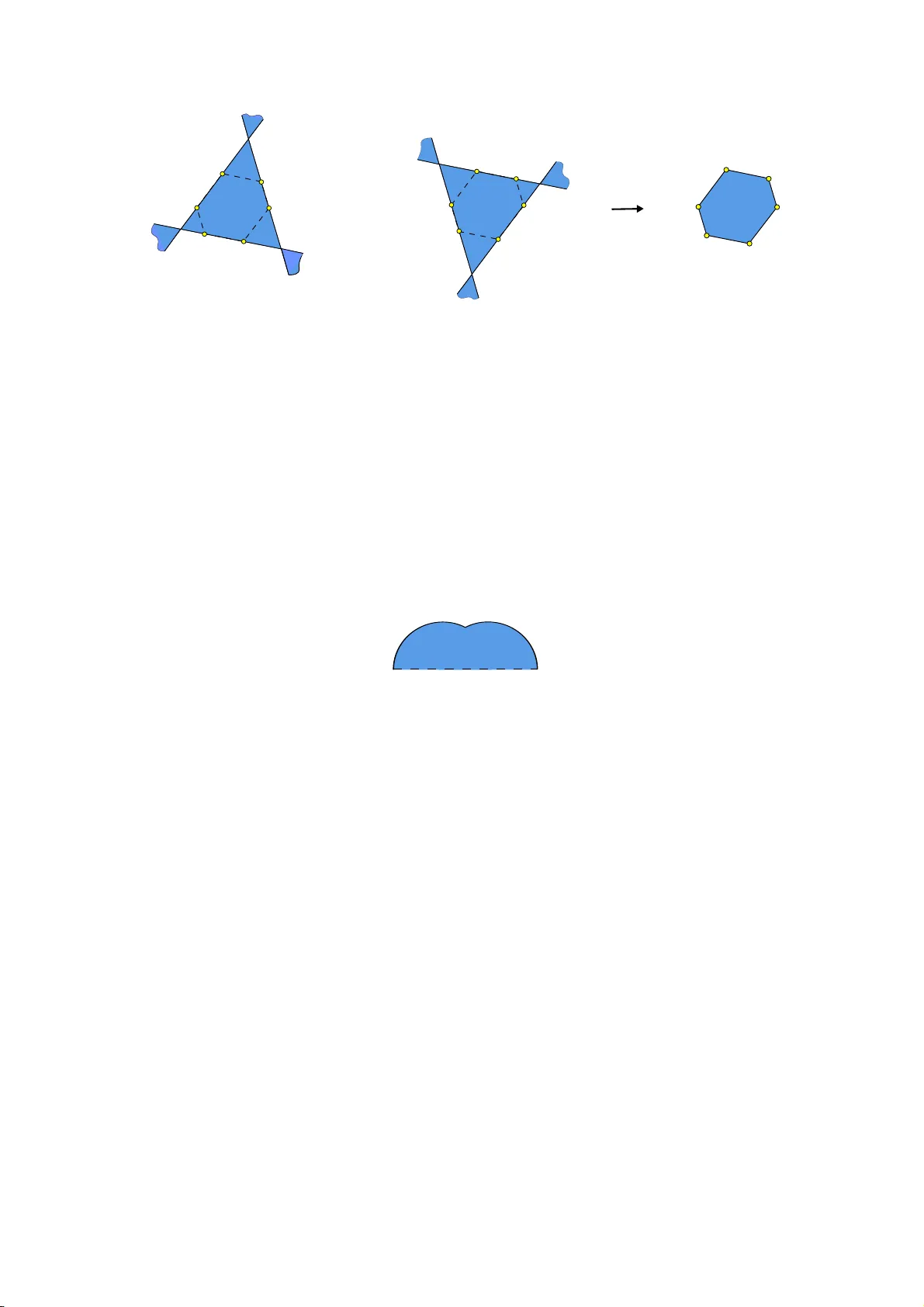
Notes on Algebra and Geometry o f P olynomia l Represen tations Gennadiy Averk ov ∗ August 23, 202 1 Abstract Consider a semi-algebr aic set A in R d constructed from the sets which are determined by inequalities p i ( x ) > 0, p i ( x ) ≥ 0, or p i ( x ) = 0 for a g iven list of p olynomials p 1 , . . . , p m . W e prov e sev eral statemen ts that fit into the following template. Assume that in a neighbor ho o d of a bounda ry point the semi-algebra ic set A can be descr ibe d b y an irre ducible p oly nomial f . Then f is a factor of a certain multiplicit y of some o f the po lynomials p 1 , . . . , p m . Sp ecial cases when A is elementary closed, elementary op en, a p olygo n, or a p olytop e ar e consider e d separately . 2000 M athematics Subje ct Classific ation. Primary: 14 P10, Secondary: 52B05 Key wor ds and phr ases. Irreducible polynomial, p olygon, p olytop e, p olynomial representa tion, real algebraic geometry , semi-algebraic set 1 In tro d uction In what follo ws x := ( x 1 , . . . , x d ) is a v ariable vecto r in R d ( d ∈ N ). The origin in R d is den oted b y o. Giv en c ∈ R d and ρ > 0 by B d ( c, ρ ) w e denote the op en Eu clidean ball w ith cen ter c and radius ρ. T h e abb reviations int and b d s tand s f or the interior and b oun dary , resp ectiv ely . By dim we d enote the dimens ion. As usual, R [ x ] := R [ x 1 , . . . , x d ] denotes the r ing of p olynomials in v ariables x 1 , . . . , x d and co efficien ts in R . A set A ⊆ R d whic h can b e represen ted by A = k [ i =1 n x ∈ R d : f i, 1 ( x ) > 0 , . . . , f i,s i ( x ) > 0 , g i ( x ) = 0 o , where i ∈ { 1 , . . . , k } , j ∈ { 1 , . . . , s i } and f i,j , g i ∈ R [ x ], is called semi-algebr aic . Information on semi-algebraic sets can b e found in [1], [7], and [5]. Obvio u s ly , every semi-algebraic set A can b e expressed by A = n x ∈ R d : Φ (sign p 1 ( x ) ∈ E 1 ) , . . . , (sign p m ( x ) ∈ E m ) o , (1.1) where Φ is a b o olean form ula, p 1 , . . . , p m ∈ R [ x ], and E 1 , . . . , E m are non-empt y su bsets o f { 0 , 1 } . Vice ve r sa, ev ery set A giv en b y (1.1) is semi-algebraic; see [7, Prop osition 2.2.4] and [5, ∗ W ork supp orted b y the German Researc h F oundation within the Research Unit 468 “Metho ds from D iscrete Mathematics for the Sy nthesis and Con trol of Chemical Processes” 1 Corollary 2.75]. W e call (1.1 ) a r epr esentation of A b y p olynomials p 1 , . . . , p m . W e distinguish sev eral particular t yp es of semi-algebraic sets. Let us in tro duce the follo wing n otations: ( p 1 , . . . , p m ) ≥ 0 := n x ∈ R d : p 1 ( x ) ≥ 0 , . . . , p m ( x ) ≥ 0 o , (1.2) ( p 1 , . . . , p s ) > 0 := n x ∈ R d : p 1 ( x ) > 0 , . . . , p m ( x ) > 0 o , (1.3) Z ( p 1 , . . . , p m ) := n x ∈ R d : p 1 ( x ) = 0 , . . . , p m ( x ) = 0 o . (1.4) Sets r ep resen table b y (1.2), (1.3), and (1.4) , resp ectiv ely , are calle d elementary close d semi- algebr aic , elementary op en semi-algebr aic , and algebr aic , resp ectiv ely . No w w e are ready to formulate our main r esults. First we give an inf ormal in terpr etation of Theorem 1.1. Let f be an irreducible p olynomial such that Z ( f ) is a ( d − 1)-dimensional algebraic sur face. Consider a semi-algebraic set A giv en b y (1.1). If th e b oundary of A coincides lo cally with a part of Z ( f ) , then f is a factor of some p i . If A coincides lo cally with a part of ( f ) ≥ 0 , then f is an o dd-multiplici ty factor of s ome p i . F u rthermore, if in a neigh b orho o d of a b ound ary p oin t the set A coincides lo cally with a part of Z ( f ), then f is a factor of at least t wo differen t p olynomials p i or an ev en-m u ltiplicit y factor of at least one p olynomial p i . Theorem 1.1. L et A b e a semi-algebr aic set in R d given by (1.1) and let f b e a p olynomial irr e ducible over R [ x ] . Then the fol lowing statements hold true. I. O ne has b d A ⊆ S m i =1 Z ( p i ) . II. If dim(b d A ∩ Z ( f )) = d − 1 , (1.5) then f is a f actor of p i for some i ∈ { 1 , . . . , m } . III. If ther e exist a ∈ Z ( f ) and ε > 0 such that dim( Z ( f ) ∩ B d ( a, ε )) = d − 1 , (1.6) ( f ) ≥ 0 ∩ B d ( a, ε ) = A ∩ B d ( a, ε ) , (1.7) then (1.5) is fulfil le d and, mor e over, f is an o dd-multiplicity factor of p i for some i ∈ { 1 , . . . , m } . IV. If ther e exist a ∈ Z ( f ) and ε > 0 such that dim( Z ( f ) ∩ B d ( a, ε )) = d − 1 , ( f ) > 0 ∩ B d ( a, ε ) = A ∩ B d ( a, ε ) , then (1.5) is fulfil le d and, mor e over, f is an o dd-multiplicity factor of p i for some i ∈ { 1 , . . . , m } . W e r emark that (1.6 ) cannot b e replaced b y the wea ker cond ition d im Z ( f ) = d − 1 and Z ( f ) ∩ B d ( a, ε ) 6 = ∅ , since the algebraic set Z ( f ) corresp ond ing to an irr ed ucible p olynomial f can hav e “parts” of d imensions strictly smaller than dim Z ( f ) . In fact, for d = 2 the irred ucible p olynomial f ( x ) := x 2 1 + x 2 2 − x 3 1 generates the cubic cur v e Z ( f ) w ith isolated p oin t at the origin. F or d = 3 , for the irreducible p olynomial f ( x ) = x 2 3 x 1 − x 2 2 the set Z ( f ) is the well- kno wn W hitney umbr el la , whic h is a t wo-dimensional algebraic sur face with the one-dimensional “handle” Z ( x 2 , x 3 ) . The rest of th e introduction is dev oted to statemen ts for some sp ecial semi-algebraic sets (and sp ecial representat ions of semi-algebraic sets). 2 Corollary 1.2. L et A b e a semi-algebr aic set given by A = n x ∈ R d : Φ ( p 1 ( x ) ≥ 0) , . . . , ( p m ( x ) ≥ 0) o , wher e Φ is a b o ole an formula and p 1 , . . . , p m ∈ R [ x ] \ { 0 } , and let f b e a p olynomial irr e ducible over R [ x ] . Then the fol lowing statements hold true. I. If ther e exist b ∈ Z ( f ) and ε > 0 such that dim( Z ( f ) ∩ B d ( b, ε )) = d − 1 , (1.8) Z ( f ) ∩ B d ( b, ε ) = A ∩ B d ( b, ε ) , (1.9) then (1.5 ) is fulfil le d, and furthermor e f is a factor of p i and p j for some i, j ∈ { 1 , . . . , m } with i 6 = j or f is an even- multiplicity factor of p i for some i ∈ { 1 , . . . , m } . II. If ther e exist a, b ∈ R d and ε > 0 such th at e qualities (1.6) , (1.7) , (1.8) , and (1.9) ar e fulfil le d, then f is a factor of p i and an o dd-multiplicity factor o f p j for some i, j ∈ { 1 , . . . , m } with i 6 = j . Corollary 1.3. L et p 1 , . . . , p m ∈ R [ x ] \ { 0 } and A := ( p 1 , . . . , p m ) ≥ 0 . L et f b e a p olynomial irr e ducible over R [ x ] . Assume that ther e exist b ∈ Z ( f ) and ε > 0 such that e qualities (1.8) and (1.9) ar e fulfil le d and additional ly dim(in t A ∩ Z ( f )) = d − 1 . (1.10) Then f is a factor of p i for some i ∈ { 1 , . . . , m } and, for every i ∈ { 1 , . . . , m } such that p i is divisible b y f , the factor f of p i has even multiplicity. Corollary 1.4. L et p 1 , . . . , p m ∈ R [ x ] \ { 0 } and A := ( p 1 , . . . , p m ) > 0 . L et f b e a p olynomial irr e ducible over R [ x ] . Assume that ther e exist b ∈ Z ( f ) and ε > 0 such that dim(b d A ∩ Z ( f ) ∩ B d ( b, ε )) = d − 1 , (1.11) B d ( b, ε ) \ Z ( f ) = A ∩ B d ( b, ε ) . (1.12) Then f is a factor of p i for some i ∈ { 1 , . . . , m } and, for every i ∈ { 1 , . . . , m } such that p i is divisible b y f , the factor f of p i has even multiplicity. A subset P of R d is said to b e a p olytop e if P is th e con ve x h u ll of a non-empty and finite set of p oin ts; see [12]. It is kno wn that a set P in R d is a p olytop e if and only if P is non-empty , b ound ed, and can b e r ep resen ted b y P = ( p 1 , . . . , p m ) ≥ 0 , wh ere p 1 , . . . , p m ∈ R [ x ] ( m ∈ N ) are of degree one (the so-called H -r epr esentation ). Th us, p olytop es are just sp ecial elemen tary closed semi-algebraic sets. The study of p olynomial repr esen tations of p olygons and p olytop es wa s initiated in [6 ] and [10]; see also the su rv ey [11]. In [10] it w as n oticed that, if a d -dimensional p olytop e P is represented by P = ( q 1 , . . . , q m ) ≥ 0 (1.13) with q 1 , . . . , q m ∈ R [ x ], then m ≥ d. In [8] it w as conjectured that ev er y d -dimens ional p olytop e in R d can b e r epresen ted by (1.13) with m = d . This conjecture w as confirmed in [4] for simple p olytop es (see also [3 ] for fur th er generalizations). W e recall that a d -dimensional p olytop e is called simple if eac h of its v ertices is cont ained in p r ecisely d facets. W e refer to [1, Chapter 5] and [7, § 6.5 and § 10.4] for results on minimal repr esen tations of general elemen tary semi-algebraic sets. W e are able to derive some necessary conditions on representat ions of p olytop es consisting of d p olynomials. 3 Corollary 1.5. L et P b e a d - dimensional p olytop e i n R d with m fac ets su c h that P = ( p 1 , . . . , p m ) ≥ 0 = ( q 1 , . . . , q d ) ≥ 0 , wher e p 1 , . . . , p m , q 1 , . . . , q d ∈ R [ x ] and p 1 , . . . , p m ar e of de g r e e one. Then every p i , i ∈ { 1 , . . . , m } , i s a factor of pr e cisely one p olynomial q j with j ∈ { 1 , . . . , d } . F urthermor e, for i and j as ab ove, the factor p i of p j is of o dd multiplicity. Corollary 1.5 impro ves Prop osition 2.1(i) from [10]. In [6] it was shown that ev ery con vex p olygon P in R 2 can b e represent ed by t wo p olynomials. W e are able to determine the p r ecise structure of suc h min imal representa tions. Corollary 1.6. L et P b e a c onvex p olygon in R 2 with m ≥ 7 e dges and let P = ( p 1 , . . . , p m ) ≥ 0 = ( q 1 , q 2 ) ≥ 0 , wher e p 1 , . . . , p m , q 1 , q 2 ∈ R [ x ] and p 1 , . . . , p m ar e of de gr e e one. Then ther e exist k 1 , . . . , k m ∈ N and g 1 , g 2 ∈ R [ x ] su c h that { q 1 , q 2 } = { p k 1 1 · . . . · p k m m g 1 , g 2 } and the fol lowing c onditions ar e fulfil le d: 1. k 1 , . . . , k m ar e o dd ; 2. g 1 , g 2 ar e not divisible by p i for every i ∈ { 1 , . . . , m } ; 3. g 2 ( y ) = 0 for every v ertex y of P . It is not hard to see that th e the s et ( q 1 , q 2 ) ≥ 0 in Corollary 1 .6 do es not d ep end on the concrete choice of o dd num b ers k 1 , . . . , k m . More precisely , for g 1 , g 2 as in Corollary 1.6 w e ha ve P = ( p 1 · . . . · p m g 1 , g 2 ) ≥ 0 . I n [6 ] the p olynomials q 1 , q 2 represent in g P w ere defin ed in suc h a wa y that g 1 = 1 and k 1 = · · · = k m = 1; see Fig. 1 for an illustration of this result and Corollary 1.6. W e also remark th at the assumption m ≥ 7 cannot b e relaxed in general, since Corollary 1.6 w ould not hold if P is a ce ntrally symmetric hexagon. In fact, assume that P is a cen trally symmetric hexagon and p 1 , . . . , p 6 are p olynomials of degree one such that Z ( p 1 ) ∩ P , . . . , Z ( p 6 ) ∩ P are consecutiv e edges of P . Then P = ( q 1 , q 2 ) ≥ 0 for q 1 := p 1 p 3 p 5 and q 2 := p 2 p 4 p 6 ; s ee Fig. 2. It will b e seen from th e p ro of of Corollary 1.6 that the assu m ption m ≥ 7 can b e relaxed to m ≥ 5 f or the case when P do es not ha ve parallel edges. ( q 1 ) ≥ 0 ( q 2 ) ≥ 0 P Figure 1. Illu s tration to Corollary 1.6 and the result on representat ion of con vex p olygons b y tw o p olynomials 4 ( q 1 ) ≥ 0 ( q 2 ) ≥ 0 P Figure 2. C en trally symmetric hexagon P r ep resen ted b y P = ( q 1 , q 2 ) ≥ 0 for q 1 = p 1 p 3 p 4 and q 2 = p 2 p 4 p 6 2 Examples W e wish to giv e sev eral examples illustrating the pr esen ted r esults. Eac h of the examples b elo w is supplied with a figure referring to the case d = 2 . Let A := x ∈ R d : x d > 0 and ( x 1 − 1) 2 + x 2 2 + · · · + x 2 d ≤ 1 or x 2 1 + x 2 2 + · · · + x 2 d ≤ 1 , see Fig. 3. By Theorem 1.1, if A is giv en b y (1.1), then the p olynomials x d , ( x 1 − 1) 2 + x 2 2 + · · · + x 2 d − 1, ( x 1 + 1) 2 + x 2 2 + · · · + x 2 d − 1 are factors of o d d multiplicit y of s ome of the p olynomials p 1 , . . . , p m . A Figure 3. Illu s tration to Theorem 1.1 The set A := x ∈ R d : (1 − x 2 1 − · · · − x 2 d ) ( x d + 2) 2 ≥ 0 , (2.1) = x ∈ R d : (1 − x 2 1 − · · · − x 2 d ) ( x d + 2) ≥ 0 , x d + 2 ≥ 0 , (2.2) depicted in Fig. 4 is th e disjoin t u nit of a closed un it ball centered at o and a hyp erplane given b y the equation x d + 2 = 0 . By Corollary 1.2(I), if A is giv en by (1.1), then x d + 2 is a factor of at least tw o p olynomials p i or a factor of ev en m ultiplicit y of at least one p olynomial p 1 , . . . , p m . F r om (2.1 ) and (2.2) we see that b oth of these p ossibilities are indeed r ealizable. Fig. 5 depicts the semi-algebraic set A := x ∈ R 2 : x d ≥ 0 , (1 − x 2 1 − · · · − x 2 d ) x d ≥ 0 , = x ∈ R 2 : x d ≥ 0 , (1 − x 2 1 − · · · − x 2 d ) x 2 d ≥ 0 , (2.3) By Corollary 1.2(I I), if A is giv en b y (1.1) with E 1 = . . . = E m = { 0 , 1 } , the p olynomial x d is a factor of at least t wo p olynomials p i and an o dd -m ultiplicit y factor of at least one p olynomial p i . By (2.3) we see th at th e ab o v e conclusion cannot b e strengthened . In fact, (2.3) pro vid es a representa tion A = ( p 1 , p 2 ) ≥ 0 suc h that x d is an o dd -m ultiplicit y factor of precisely one p olynomial p i . 5 A A A A B d ( a, ε ) B d ( b, ε ) Figure 4. Illu s tration to Corollary 1.2(I) Figure 5. Illustration to Corollary 1.2(I I) Fig. 6 presents the semi-algebraic set A := n x ∈ R d : (1 − x 2 1 − · · · − x 2 d ) x 2 d ≥ 0 o . whic h serves as an illustration of Corollary 1. 3 . By Corollary 1.3, if A = ( p 1 , . . . , p m ) ≥ 0 for p 1 , . . . , p m ∈ R [ x ], some of these p olynomials are divisible by x d , and furthermore, if p i is divisible by x d , the multiplic ity of the f actor x d of p i is ev en. Fig. 7 depicts the s emi-algebraic set A := x ∈ R 2 : (1 − x 2 1 − · · · − x 2 d ) x 2 d > 0 illustrating Corollary 1.4. By Corollary 1.4, if A = ( p 1 , . . . , p m ) > 0 for some p olynomials p 1 , . . . , p m ∈ R [ x ] , then x d is a factor of at least one p i and f cannot b e a factor of p i of o dd multiplicit y . W e notice that Corollary 1.4 is in a certain sense an analogue of C orollary 1.3 for element ary op en semi-algebraic sets (since the conclusions of b oth the corollaries are the same). A A A B d ( b, ε ) Figure 6. Illu s tration to Corollary 1.3 Figure 7. Illu s tration to Corollary 1.4 Finally , we pr esen t examples of s emi-algebraic sets for whic h we can verify that they are not elemen tary semi-algebraic (see also similar examples given in [1, p. 24]). W e d efi ne the closed semi-algebraic set A := x ∈ R d : x d = 0 or ( x 1 − 3) 2 + x 2 2 + · · · x 2 d ≤ 1 or x 2 1 + x 2 2 + · · · x 2 d ≤ 1 and x d ≥ 0 , see Fig. 8. W e can sh o w that A is not elemen tary closed. In fact, let us assume th e cont r ary , that is A = ( p 1 , . . . , p m ) ≥ 0 for some p olynomials p 1 , . . . , p m ∈ R [ x ] . Th en, by T heorem 1.1(I I I) applied for a = o and 0 < ε < 1 , we get that x d is a factor of o dd multiplic ity of p i for some i ∈ { 1 , . . . , m } . Since (1.10) is fu lfilled for f = x d , w e can apply Corollary 1.3 obtaining that x d is a factor of even m ultiplicit y of p i , a con tradiction. No w w e in tro duce the op en semi-algebraic set A := x ∈ R d : x 2 1 + x 2 2 + · · · x 2 d < 1 and x d > 0 or ( x 1 − 3) 2 + x 2 2 + · · · x 2 d < 1 and x d 6 = 0 , see Fig. 9. By Th eorem 1.1(IV) and Corollary 1.4 (applied for f ( x ) = x d ) A is not elementa r y op en. 6 A A A B d ( a, ε ) A A B d ( a, ε ) Figure 8. A closed semi-algebraic set whic h is not elemen tary closed Figure 9. An op en semi-algebraic set whic h is not elemen tary op en 3 Preliminaries and auxiliary statemen ts A p olynomial f ∈ R [ x ] is said to b e irr e ducible ov er R [ x ] if f is non-constant and f cannot b e represent ed as a p ro du ct of t wo non-constan t p olynomials o ve r R [ x ] . A p olynomial p is said to b e a factor of q if q = pg for some p olynomial g . An irreducible f actor f of p is said to ha ve multiplicity k ∈ N if f k is a factor of p but f k +1 is not a factor of p. Belo w w e giv e bac kground in formation on commutativ e algebra and algebraic geometry; s ee also [2] and [9]. Let R b e a comm u tative ring. Then a subset I of R is said to b e an ide al if I is an add itiv e group and for ev ery f ∈ I and g ∈ R one has f g ∈ I . An ideal I of R is s aid to b e prime if for eve r y pro du ct f g ∈ I with f , g ∈ R , one h as f ∈ I or g ∈ I . Th e (Krul l) dimension of a comm utativ e ring R is the maximal length of a sequence of prime ideals I 1 , . . . , I k satisfying I 1 I 1 · · · I k R. The factor ring R/I is d efined as the set { x + I : x ∈ R } with the addition and m ultiplication indu ced by R . Lemma 3.1. L et R b e a c ommutative ring and I , J b e ide als in R such that I is prime and I ⊆ J. Then dim( R /J ) ≤ dim( R/I ) with e quality if and only if I = J. Pr o of. It is kno w n th at ev ery ideal X of R/J has the form X = P /J := { x + I : x ∈ P } , wher e P is an ideal in R with J ⊆ P ; see [2, p . 9 of C h apter 2]. F ur thermore, X is pr ime in R/J if and on ly if P is pr ime in R. Using this ob s erv ation we readily get that the dimension of R /J is the maximal length of sequence of pr ime ideals I 1 , . . . , I k satisfying J ⊆ I 1 I 1 · · · I k R. If I is prop erly con tained in J, then I , I 1 , . . . , I k is the chain of p rime id eals con taining I , and w e get that the dimension of R/I is strictly larger than the dimension of R /J. An algebraic set V ⊆ R d is said to b e irr e ducible if wh enev er V is repr esen ted by V = V 1 ∪ V 2 , where V 1 , V 2 ⊆ R d are algebraic sets, it follo ws that V 1 = V or V 2 = V . Give n a set A ⊆ R d , w e in tro d uce the ideal I ( A ) := { p ∈ R [ x ] : p ( x ) = 0 for all x ∈ A } . It is kno wn that an algebraic set V in R d is irreducible if and only if the ideal I ( V ) of the r ing R [ x ] is pr ime; see [9, Prop osition 3, p. 195] and [7, Th eorem 2.8.3(ii)]. The notion of dim en sion of a (semi-algebraic) set can b e defi n ed in seve r al equiv alen t w ays; for details see [7, § 2.8]. W e shall employ th e follo wing algebraic defin ition. The dimension of a semi-algebraic set A ⊆ R d is defined as the dimens ion of the ring R [ x ] / I ( A ). Let A 1 , . . . , A m b e semi-algebraic sets in R d . Then dim( A 1 ∪ . . . ∪ A m ) = max { dim A i : 1 ≤ i ≤ m } , (3.1) see [7, Prop osition 2.8.5(i)]. W e pr esen t sev eral statemen ts devot ed to irr educible p olynomials o ver R [ x ] that defi ne ( d − 1)- dimensional algebraic sets. Giv en a p olynomial p ∈ R [ x ], by ∇ p we denote the gradien t of p. The follo wing statemen t can b e found in [7, Theorem 4.5.1]. Theorem 3.2. L et f b e a p olynomial irr e ducible over R [ x ] . Then the fol lowing c onditions ar e e q uivalent. 7 (i) I ( Z ( f )) = { f g : g ∈ R [ x ] } . (ii) The p olynomial f has a non-singu lar zero , i.e., for some y ∈ R d one has f ( y ) = 0 and ∇ f ( y ) 6 = o. (iii) d im Z ( f ) = d − 1 . Lemma 3.3. L et f , p ∈ R [ x ] . L et f b e irr e ducible over R [ x ] and let dim Z ( f ) = d − 1 . Then the fol lowing c onditions ar e e quivalent. (i) d im( Z ( f ) ∩ Z ( p )) = d − 1 . (ii) Z ( f ) ⊆ Z ( p ) . (iii) f is a factor of p. Pr o of. It su ffices to v erify (i) ⇒ (ii ) and (ii) ⇒ (iii), since the imp lications (iii) ⇒ (ii) ⇒ (i) are trivial. (i) ⇒ (ii): Assume that (i) is fulfi lled. The implication (iii) ⇒ (i) of Theorem 3.2 y ields I ( Z ( f )) = { f g : g ∈ R [ x ] } . Consequently , since f is irreducible, the ideal I ( Z ( f )) is prime. Ob v ious ly , I ( Z ( f )) ⊆ I ( Z ( f , p )) . F urthermore, dim R [ x ] / I ( Z ( f , p )) = dim Z ( f , p ) (i) = d − 1 = dim Z ( f ) = dim R [ x ] / I ( Z ( f )) and, by Lemma 3.1, it follo ws that I ( Z ( f )) = I ( Z ( f , p )) . The latter equ ality yields Z ( f ) = Z ( f , p ); see [9, Prop osition 8, p. 34]. Since Z ( f , p ) = Z ( f ) ∩ Z ( p ) , th e statement (ii) readily follo ws. (ii) ⇒ (iii): S ince Z ( f ) ⊆ Z ( p ) it follo ws that I ( Z ( p )) ⊆ I ( Z ( f )) and hence p ∈ I ( Z ( f )) . But then, by the implication (iii ) ⇒ (i) of Theorem 3.2, it follo ws that f is a factor of p. As a direct consequence of the implication (i ) ⇒ (iii) of Lemma 3.3 w e ob tain Lemma 3.4. L et f and g b e p olynomials irr e ducible over R [ x ] and let dim Z ( f ) = dim Z ( g ) = d − 1 . Then dim( Z ( f ) ∩ Z ( g )) = d − 1 if and only if f and g c oincide up to a c onstant multiple. Prop osition 3.5. L et f b e a p olynomial irr e ducible over R [ x ] and such that dim Z ( f ) = d − 1 . Then dim Z ( f , ∂ ∂ x 1 f , . . . , ∂ ∂ x d f ) ≤ d − 2 . Pr o of. Even though this stat ement is known (see [7 , Prop osition 3.3.14]), we wish to giv e a short p ro of. W e assume that dim Z ( f , ∂ ∂ x 1 f , . . . , ∂ ∂ x d f ) = d − 1 . Then , b y Lemma 3.3, one has Z ( f ) ⊆ Z ( ∂ ∂ x 1 f , . . . , ∂ ∂ x d f ), a con tradiction to the implication (iii) ⇒ (ii) of Theorem 3.2. 4 The pro ofs No w w e are ready to prov e the main result and its corollaries. In the pro ofs we shall deal with p olynomials p 1 , . . . , p m . Thr oughout the pro ofs f 1 , . . . , f n will d enote the p olynomials irreducible o v er R [ x ] whic h are inv olv ed in the prime factorization of the pro d u ct p 1 · . . . · p m (see [9, p. 149]), i.e. p 1 · . . . · p m = f s 1 1 · . . . · f s n n for s ome s 1 , . . . , s n ∈ N and f or every i, j ∈ { 1 , . . . , n } with i 6 = j the p olynomials f i and f j do not coincide up to a constan t m u ltiple. 8 Pr o of of The or e m 1.1. F or x ∈ R d w e d efine Ψ( x ) := Φ (sign p 1 ( x ) ∈ E 1 ) , . . . , (sign p m ( x ) ∈ E m ) . Part I: Let x 0 6∈ S m i =1 Z ( p i ) , that is p i ( x 0 ) 6 = 0 f or every i = 1 , . . . , m. Th en there exists an ε > 0 such th at the sign of ev ery p i ( x ) , i ∈ { 1 , . . . , m } , remains constan t on B d ( x 0 , ε ) . It follo ws that Ψ( x ) is constan t for x ∈ B d ( x 0 , ε ) . Consequen tly , either B d ( x 0 , ε ) ⊆ A or B d ( x 0 , ε ) ∩ A = ∅ . Hence x 0 is either an in terior or an exterior p oin t of A , and we get the conclusion of Part I. Part II: By P art I w e h a v e b d A ⊆ S n i =1 Z ( f i ) . Consequentl y d − 1 (1.5) = d im(b d A ∩ Z ( f )) ≤ dim m [ i =1 Z ( p i ) ! ∩ Z ( f ) ! (3.1) = max 1 ≤ i ≤ m dim( Z ( p i ) ∩ Z ( f )) ≤ d − 1 . Hence dim Z ( f ) = d − 1 and for some i ∈ { 1 , . . . , m } one h as dim( Z ( p i ) ∩ Z ( f )) = d − 1. T hen Lemma 3.3 yields the assertion of Part I I. Part III: Let a ∈ Z ( f ) and ε > 0 satisfy (1.6) and (1.7). F rom (1.6 ) it follo ws that dim Z ( f ) = d − 1. By Prop osition 3.5, there exists a ′ ∈ Z ( f ) ∩ B d ( a, ε ) su ch that ∇ f ( a ′ ) 6 = o. W e c ho ose ε ′ > 0 such that B d ( a ′ , ε ′ ) ⊆ B d ( a, ε ) and ∇ f ( x ) 6 = o for ev ery x ∈ B d ( a ′ , ε ′ ) . Let us sho w that Z ( f ) ∩ B d ( a ′ , ε ′ ) ⊆ b d A. (4.1) Consider an arbitrary p oin t x ∈ Z ( f ) ∩ B d ( a ′ , ε ′ ) . In view of (1.7) we hav e x ∈ A. O n the other han d , since f ( x ) = 0 and ∇ f ( x ) 6 = o, there exists a sequence x k + ∞ k =1 of p oints from B d ( a ′ , ε ′ ) su ch that f ( x k ) < 0 for ev ery k ∈ N and x k → x, as k → + ∞ . Since x k 6∈ ( f ) ≥ 0 and x k ∈ B d ( a, ε ), in view of (1.7) it follo ws th at x k 6∈ A for ev ery k ∈ N . Hence, x is a p oin t of A and is a limit of a sequen ce of p oints lyin g outside A. T he latter implies (4.1). Since f ( a ′ ) = 0 and ∇ f ( x ) 6 = o f or eve r y x ∈ Z ( f ) ∩ B d ( a ′ , ε ′ ) it follo ws that Z ( f ) ∩ B d ( a ′ , ε ′ ) is an in finitely differen tiable manifold of d imension d − 1 , w here th e n otion dimension is used in the sense of differen tial geometry . It is kno wn that in the ab o ve case the Krull dimension of Z ( f ) ∩ B d ( a ′ , ε ′ ) is also equal to d − 1; s ee [7, Prop osition 2.8.14]. Consequen tly , w e hav e d − 1 = dim( Z ( f ) ∩ B d ( a ′ , ε ′ )) (4.1) = d im( Z ( f ) ∩ b d A ∩ B d ( a ′ , ε ′ )) ≤ dim( Z ( f ) ∩ b d A ) ≤ d im( Z ( f )) = d − 1 Hence dim( Z ( f ) ∩ b d A ) = d − 1. By Pa r t I I, it follo ws that f coincides, up to a constan t multiple, with f i for some i ∈ { 1 , . . . , n } . Without loss of generalit y we assum e that f = f 1 . By Lemm a 3.4, w e can c ho ose a ′′ ∈ Z ( f ) ∩ B d ( a ′ , ε ′ ) suc h that f i ( a ′′ ) 6 = 0 for i ∈ { 2 , . . . , n } . This means the sign of the p olynomials f i , i = { 2 , . . . , n } , remains constan t on B d ( a ′′ , ε ′′ ) . W e prov e the statemen t of P art I I I b y con tradiction. Assume that whenev er f is factor of p i , i ∈ { 1 , . . . , m } , this factor is of even m u ltiplicit y . Since ∇ f ( a ′′ ) 6 = o, w e can c ho ose x 0 , y 0 ∈ B d ( a ′′ , ε ′′ ) suc h that f ( x 0 ) > 0 and f ( y 0 ) < 0 . Since th e signs of f 2 , . . . , f n do not c hange on B d ( a ′′ , ε ′′ ) and s ince f 1 = f app ears w ith an ev en m ultiplicit y only , w e obtain s ign p j ( x 0 ) = sign p j ( y 0 ) for eve r y j = 1 , . . . , m. Hence Ψ( x 0 ) = Ψ( y 0 ) . But b y (1.7 ), x 0 ∈ A and y 0 6∈ A, w hic h implies that Ψ( x 0 ) 6 = Ψ( y 0 ) , a con tradiction. The pro of of P art IV is omitted, since it is analogous to the p ro of of P art I I I. Pr o of of Cor ol lary 1.2 . Part I: Let b ∈ Z ( f ) a n d ε > 0 satisfy (1.8) and (1 .9 ). F r om (1.8) it follo ws that dim Z ( f ) = d − 1 . By P rop osition 3.5, there exists b ′ ∈ Z ( f ) ∩ B d ( b, ε ) suc h that ∇ f ( b ′ ) 6 = o. Cho ose ε ′ > 0 such that B d ( b ′ , ε ′ ) ⊆ B d ( b, ε ) and ∇ f ( x ) 6 = o for eve r y 9 x ∈ B d ( b ′ , ε ′ ) . Usin g argumen ts analogous to those from the pro of of Theorem 1.1(I I I) w e sh o w the inclusion Z ( f ) ∩ B d ( b ′ , ε ′ ) ⊆ b d A and (1.5). He n ce, b y Theorem 1.1(I I), f coincides, up to a constan t m u ltiple, with f i for some i ∈ { 1 , . . . , n } . Without loss of generalit y w e assume that f = f 1 . If f is a factor of p i and p j for some i, j ∈ { 1 , . . . , m } with i 6 = j, we are done. W e consider the opp osite case, that is, for some i ∈ { 1 , . . . , m } the p olynomial f is a factor of precisely one p olynomial p i with i ∈ { 1 , . . . , m } , s a y p 1 . W e show by con tradiction that in this case the factor f of p 1 has even m u ltiplicit y . Assum e the cont r ary , i.e., the f actor f of p 1 has o dd multi p licit y . Analogo u sly to the argum en ts fr om the pro of of Theorem 1.1, we c h o ose b ′′ ∈ Z ( f ) and ε ′′ > 0 such that B d ( b ′′ , ε ′′ ) ⊆ B d ( b ′ , ε ′ ) and f i ( x ) 6 = 0 for eve r y i ∈ { 2 , . . . , n } and every x ∈ B d ( b ′′ , ε ′′ ) . By th e choice of b ′′ and ε ′′ w e ha ve sign p i ( x ) = sign p i ( b ′′ ) for all i ∈ { 2 , . . . , m } and x ∈ B d ( b ′′ , ε ′′ ) . Since ∇ f ( b ′′ ) 6 = o , there exist p oints x 0 , y 0 ∈ B d ( b ′′ , ε ′′ ) suc h that f ( x 0 ) f ( y 0 ) < 0 . Th en p 1 ( x 0 ) p 1 ( y 0 ) < 0 . Consequ en tly , either p 1 ( x 0 ) > 0 or p 1 ( y 0 ) > 0 . Without loss of generalit y w e assume that p 1 ( x 0 ) > 0 . It follo w s that ( p i ( x 0 ) ≥ 0) ≡ ( p i ( b ′′ ) ≥ 0) for i = 1 , . . . , m. Hence x 0 ∈ A. But since f ( x 0 ) 6 = 0 , in v iew of (1.9 ), w e get x 0 6∈ A, a con tradiction. Part II: By Theorem 1.1(I I I) f is a factor of o dd multiplicit y of some p i with i ∈ { 1 , . . . , m } . F u rthermore, for some j ∈ { 1 , . . . , m } with i 6 = j the p olynomial f is a factor of p j , since otherwise we would get a con tr ad iction to P art I. Pr o of of Cor ol lary 1.3 . By Corollary 1.2(I), f is a factor of some p i , say p 1 . Without loss of generalit y we assum e that f 1 = f . Let us sho w that the factor f of p 1 is of eve n m ultiplicit y . Assume the contrary . In view of Pr op osition 3.5, we can c h o ose a ′ ∈ int A ∩ Z ( f ) such that ∇ f ( a ′ ) 6 = o . W e fix ε ′ > 0 such that ∇ f ( x ) 6 = o for ev ery x ∈ B d ( a ′ , ε ′ ) . By Lemma 3.4 w e can c ho ose a ′′ ∈ B d ( a ′ , ε ′ ) suc h that f i ( a ′′ ) 6 = 0 for ev ery i ∈ { 2 , . . . , n } . Fix ε ′′ > 0 su c h th at for ev ery i ∈ { 2 , . . . , n } the sign of f i remains constan t on B d ( a ′′ , ε ′′ ) . Since ∇ f ( a ′′ ) 6 = o, there exist x 0 and y 0 in B d ( a ′′ , ε ′′ ) with f ( x 0 ) f ( y 0 ) < 0 . Hence p 1 ( x 0 ) p 1 ( y 0 ) < 0 , and we get th at either x 0 or y 0 do es not b elong to A, a con tradiction. Pr o of of Cor ol lary 1.4 . Equalit y (1.11) implies (1.5 ), and hen ce, b y Theorem 1.1(I I), f is a factor of p i for some i ∈ { 1 , . . . , m } . The rest of the p ro of is analogous to the pro of of C orollary 1.3 . Pr o of of Cor ol lary 1.5 . Let us pro ve the first part of the assertion. Assume the con trary , sa y p 1 is a factor of b oth q 1 and q 2 . Then within the ( d − 1)-dimensional affine space Z ( p 1 ) the facet P ∩ Z ( p 1 ) of P is represent ed by d − 2 p olynomials q 3 , . . . , q d in the follo wing wa y P ∩ Z ( p 1 ) = { x ∈ Z ( p 1 ) : q 3 ( x ) ≥ 0 , . . . , q d ( x ) ≥ 0 } . This yields a contradicti on to the fact that a k -dimens ional conv ex p olytop e cannot b e repre- sen ted (in th e ab o ve f orm ) by less than k p olynomials; see [10, Corollary 2.2]. The second p art of the assertion follo ws directly from Theorem 1.1(I I I). Pr o of of Cor ol lary 1.6 . F or j ∈ { 1 , 2 } denote by I j the set of ind ices i ∈ { 1 , . . . , m } for wh ich p i is a factor of q j . By Corollary 1.3 it follo ws th at I 1 ∪ I 2 = { 1 , . . . , m } . F urthermore, I 1 ∩ I 2 = ∅ , b y Corollary 1.5. Let us show that either I 1 or I 2 is empt y . Assume the con trary . W e sho w that then there exist i ∈ I 1 and j ∈ I 2 suc h that the edges Z ( p i ) ∩ P and Z ( p j ) ∩ P of P are not adjacen t and not parallel. Since m ≥ 7, after p ossibly exc hanging the roles of q 1 and q 2 , w e ma y assume th at the cardinalit y of I 2 is at least four. Let us tak e an arbitrary i ∈ I 1 . Then ther e exist at least t w o sides of the form Z ( p j ) ∩ P , j ∈ I 2 , wh ic h are not adjacen t to Z ( p i ) ∩ P . One of these sides is not p arallel to Z ( p i ) ∩ P . The in tersection p oint y of Z ( p i ) and Z ( p j ) lies outside P and fulfills the equalities q 1 ( y ) = q 2 ( y ) = 0 , a contradicti on to the inclusion ( q 1 , q 2 ) ≥ 0 ⊆ P . Hence I 1 or I 2 is empt y . Wi th ou t loss of generalit y we assume that I 2 = ∅ . 10 F or i ∈ { 1 , . . . , m } let k i b e the m ultiplicit y of the factor p i of p 1 . Th en q 1 = p k 1 1 · . . . · p k m m g 1 for some p olynomial g 1 , and Statemen ts 1 and 2 follo w d irectly from Theorem 1.1(I I I). It remains to verify Cond ition 2 (which in volv es g 2 = q 2 ). This condition can b e deduced from Prop osition 2.1(ii) in [10], bu t b elo w we also give a short pro of. W e argue b y cont r adiction. Let y b e a v ertex of P w ith g 2 ( v ) > 0 . Up to reordering the sequence p 1 , . . . , p m w e ma y assume that p 1 ( v ) = 0 . Clearly , any p oin t y ′ lying in Z ( p 1 ) \ P and su ffi cien tly close to y fulfills the conditions q 1 ( y ′ ) = 0 and q 2 ( y ′ ) > 0 . Hence y ′ ∈ P , a cont r adiction to th e inclusion ( q 1 , q 2 ) ≥ 0 ⊆ P . References [1] C. An dradas, L. Br¨ oc k er, and J. M. Ruiz, Constructible sets in r e al ge ometry , Ergebnisse der Mathematik u nd ihrer Grenzgebiete (3) [Results in Mathematics and Related Areas (3)], v ol. 33, Springer-V erlag, Berlin, 1996. MR 98e:140 56 [2] R. B. Ash, Basic abstr act algebr a , Do v er Publications In c., Mineola, NY, 2007, F or graduate student s and adv an ced un dergraduates. MR 2007i :00001 [3] G. Av erko v, R epr esenting elementary semi-algebr aic sets by a few p olynomial ine qualities: A c onstructive appr o ach , 14pp., Preprint arXiv:0804.213 4 , 2008+. [4] G. Ave r k ov and M. Henk, R epr esenting simple d -dimensional p olytop es by d p olynomial ine qualities , submitted, 2007+. [5] S. Basu, R. Poll ack, and M.-F. Ro y , Algorithm s in Re al Algebr aic Ge ometry , second ed., Algorithms and Computation in Mathematics, v ol. 10, Spr inger-V erlag, Berlin, 2006. MR 2007b:14 125 [6] A. Bernig, Constructions for the the or em of Br¨ ocker and Scheider er , Master’s thesis, Uni- v ersit¨ at Dortmund, 1998. [7] J. Bo chnak, M. Coste, and M.-F. Ro y , R e al Algebr aic Ge ometry , Ergebnisse d er Mathe- matik u nd ihrer Grenzgebiete (3) [Results in Mathematics and Related Areas (3)], v ol. 36, Springer-V erlag, Be r lin, 19 98, T ranslated from the 1987 F renc h original, Revised by the authors. MR 2000a:1 4067 [8] H. Bosse, M. Gr¨ otsc hel, and M. Henk, Polynomial ine qualities r epr ese nting p olyhe dr a , Math. Program. 103 (2005), no. 1, Ser. A, 35–44. MR 2006k:5201 8 [9] D. Co x, J. Little, and D. O’Shea, Ide als, varieties, and algorithms , Un dergraduate T exts in Mathematics, Springer-V erlag, New Y ork, 1992, An int r o duction to computational algebraic geometry and comm utativ e algebra. MR 93j:1303 1 [10] M. Gr¨ otsc hel and M. Henk, The r e pr esentation of p olyhe dr a by p olynomial ine qualities , Discrete Comput. Geom. 29 (2003), no. 4, 485–504. MR 2004b:14098 [11] M. Henk, Polynomdarstel lungen v on P olye dern , Jb er. Deutsc h. Math.-V erein. 109 (2007), no. 2, 51–6 9. [12] G. M. Ziegler, L e ctur es on P olytop es , Gradu ate T exts in Mathematics, v ol. 152, Spr inger- V erlag, New Y ork, 1995. MR 96a:52 011 11 Gennadiy A verko v, Unive rsit ¨ atspla tz 2, Ins titute of Algebra and Geometr y, F a cu l ty of Ma the ma tics, Ott o-von-Guericke University o f Magdeburg, 39106 Magdeburg , Germany e-mail : gennadiy.a verkov@g ooglemail.com web : h ttp://fm a2.math. uni-mag deburg.de/ ∼ averkov 12
Original Paper
Loading high-quality paper...
Comments & Academic Discussion
Loading comments...
Leave a Comment