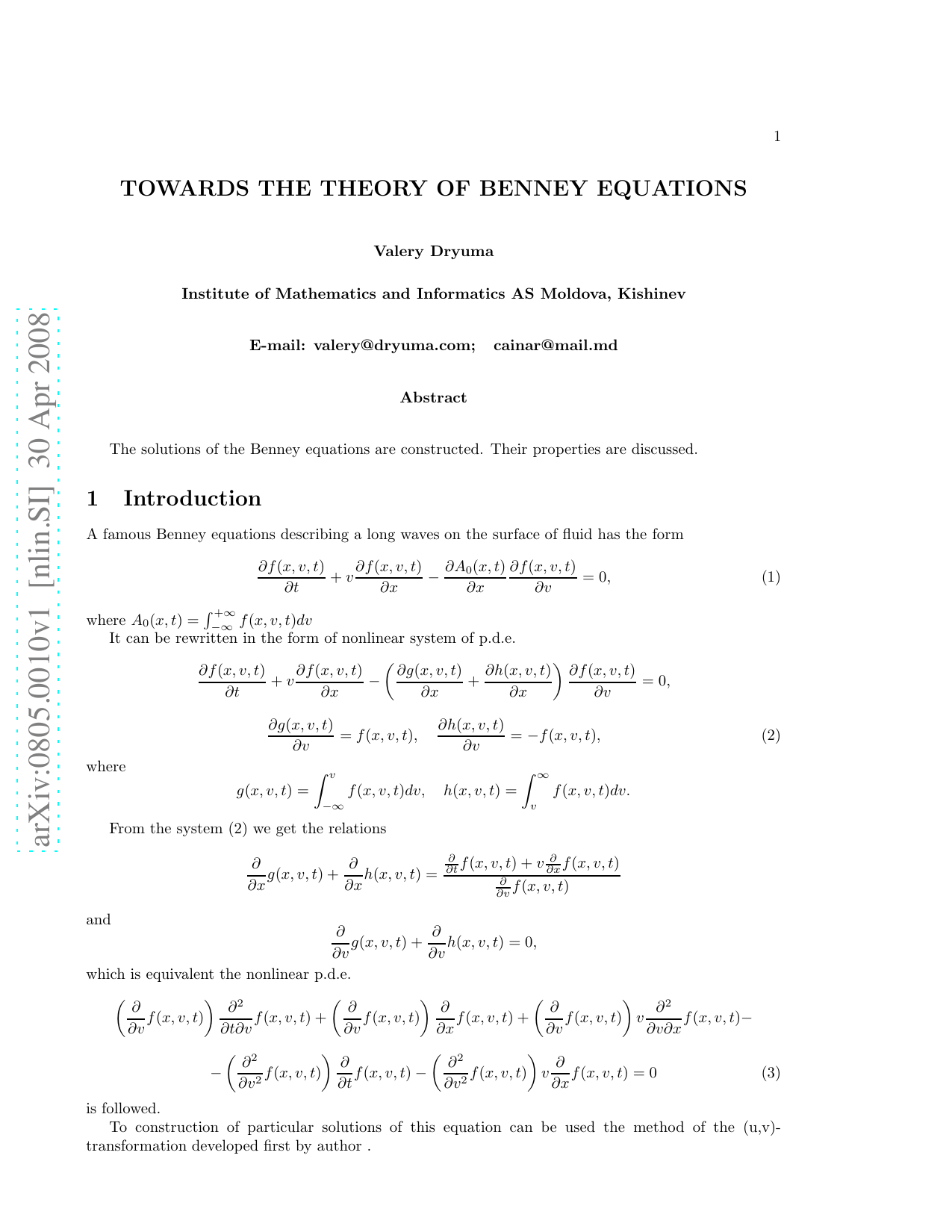
Towards the theory of Benney equations
📝 Original Info
- Title: Towards the theory of Benney equations
- ArXiv ID: 0805.0010
- Date: 2008-05-02
- Authors: Researchers from original ArXiv paper
📝 Abstract
Particular solutions of the Benney equations are constructed. Their properties are discussed.💡 Deep Analysis
Deep Dive into Towards the theory of Benney equations.Particular solutions of the Benney equations are constructed. Their properties are discussed.
📄 Full Content
where
where
From the system (2) we get the relations
and ∂ ∂v g(x, v, t) + ∂ ∂v h(x, v, t) = 0, which is equivalent the nonlinear p.d.e.
is followed.
To construction of particular solutions of this equation can be used the method of the (u,v)transformation developed first by author .
To integrate the partial nonlinear differential equation
can be applied a following method. We use the change of the functions and variables according to the rule
In result instead of the equation (4) one get the relation between the new variables u(x, t, z) and v(x, t, z) and their partial derivatives
In some cases the integration of the last equation is more simple problem than integration of the equation (4).
To illustrate this method let us consider some of examples.
The equation
is transformed into the following form
Using the substitution
we find the equation for ω(x, t) ∂ ∂x ω(x, t) + t 2 = 0.
Its integration lead to
where F 1 (t) is arbitrary function. Now with help of ω(x, t) we find the functions u(x, t) and v(x, t)
After the choice of arbitrary function F 1 (t) and elimination of the parameter t from these relations we get the function z(x, y), satisfying the equation (7).
The equation
is transformed into the following form
Using the substitution
we find the equation for ω(x, t)
Its integration give us the function
where F () is arbitrary function. Now with help of the function ω(x, t) we can find the functions u(x, t) and v(x, t). Then after the choice of arbitrary function F () and elimination of the parameter t from the relations
we can get the function z(x, y), satisfying the equation (8).
By analogy the substitution
into the equation for ω(x, t) lead to the equation
which also give us the solution of the equation (8).
The equation meeting in theory of the Benney equations
after the (u,v)-transformation with the change (y → t) takes the form
In result of substitution of the form
we get from this relation the linear p.d.e. with the respect of the function ω(x, t, z)
Its solutions can be obtained by the Laplace method and after elimination of the parameter t from the expressions for the function (f (x, y, z) → u(x, t, z)) and (y → v(x, t, z)) the solutions of initial equation ( 9) can be constructed.
By analogy this method can be applied to obtaining particular solutions of the equation (3).
3 The (u, v)-transformation of the equation ( 3)
For convenience we write the equation ( 3) in the form
where instead of the variables v and t we used the variables y and z.
After the (u, v)-transformation with the change of the variable y on parameter t the equation (10) takes the form of the relation between the functions u(x, t, z) and v(x, t, z) and their derivatives
There are a lot possibilities to bring this relation to one equation. Classification all types of reductions is open problem.
We use a simplest type of reductions.
As example after the substitution
this relation lead to the nonlinear partial differential equation
Its particular solutions can be used for construction of solutions of the equation (10). Let as consider some examples. Using the substitution ω(x, t, z) = A(t, z) + Bxt (13)
we get from the (12) the equation
with general solution
dependent from two arbitrary functions F2 (z) and F1 ( zB-ln(t)
). In particular case
B 2 with the help of the formulaes (11, 13) we find the relations
From last equation we get the expression for parameter t t = e -LambertW (1/2 B 2 (-y+ F2 (z)+Bx)e zB )+zB and after substitution its into the first one we find the function f (x, y, z)
which is solution of the equation (10
It has the particular solution defined by the expression ω(x, t, z) = P (t, z) + xe -z (16)
where the function P (t, z) satisfies the equation
having general solution dependent from two arbitrary functions
In particular case
we find the solution of the equation ( 10)
Remark 1 The equation ( 15) after the substitution
and can be solved exactly.
In fact, the function B(t, η) = A(t, η) + 1 satisfies the equation
which admits the first integral
where K(η) is arbitrary. Equation ( 18) is in form
After the (u, v) -transformation it is reduced to the relation
which is equivalent the first order nonlinear p.d.e. with respect to the function ω(x, t) at the substitution
Solutions of the equation ( 20) depend from the function K(ω t ).
As example in the case K(ω t ) = ∂ω(x, t) ∂t we get the linear equation
Remark 2 Legendre-transformation of the equation ( 19)
lead to the equation
which is reduced to the Bernoulli equation after application of the suitable Legendre transformation and so it is integrable.
With the help of solutions of the equation (19) the functions A(t, η) and ω(x, t, z) = A(t, xz) = A(t, η) can be determined.
Then after elimination of the parameter t from the expressions for the functions ω(x, t, z) and y(x, t, z) particular solutions of the e
…(Full text truncated)…
📸 Image Gallery