On the k-pairs problem
We consider network coding rates for directed and undirected $k$-pairs networks. For directed networks, meagerness is known to be an upper bound on network coding rates. We show that network coding rate can be $\Theta(|V|)$ multiplicative factor smal…
Authors: Ali Al-Bashabsheh, Abbas Yongacoglu
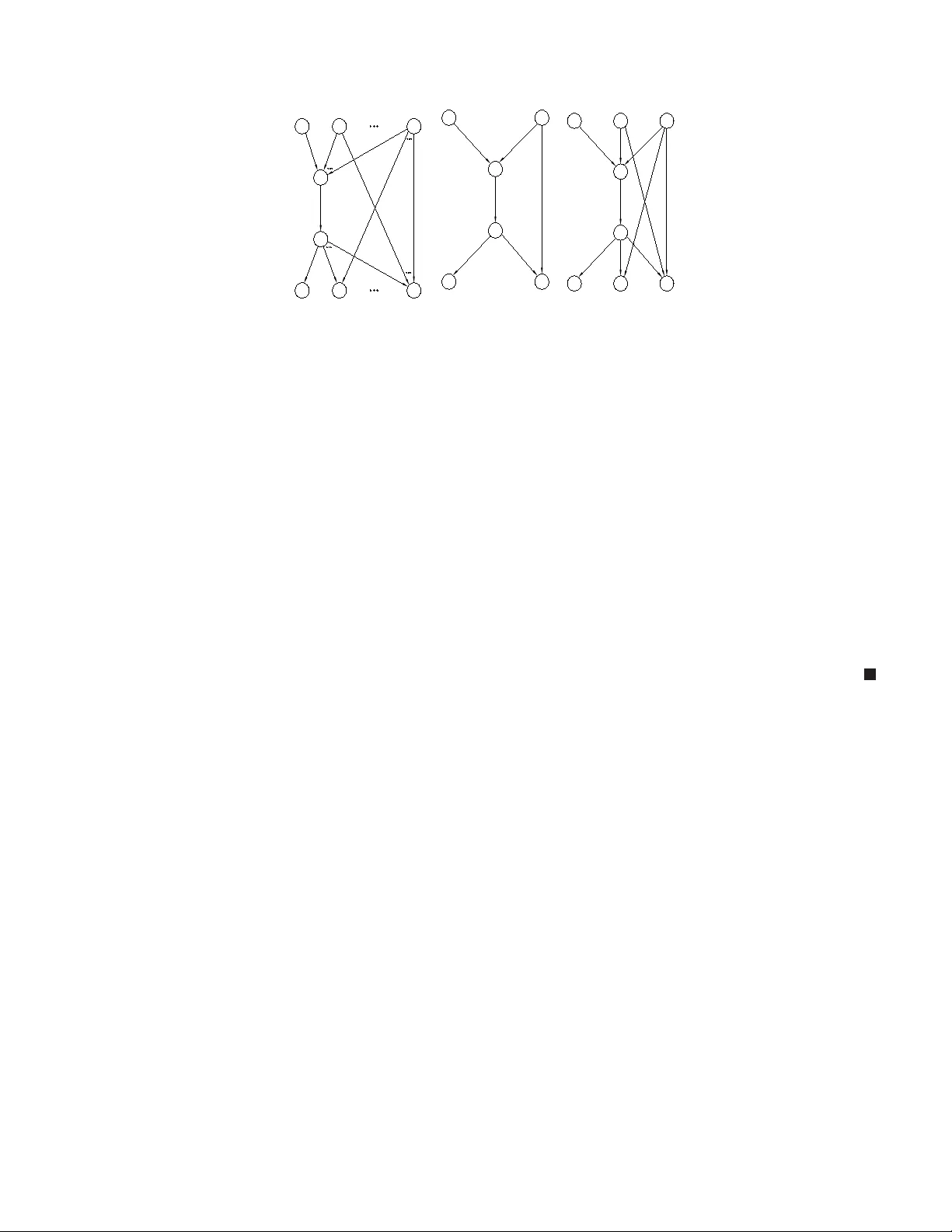
0 On the k -pairs problem Ali Al-Bashabsheh and Abbas Y ongacoglu School of Information T echnology and Engineering Uni v ersity of Ottaw a, Ottaw a, C anada { aalba059, yongacog } @site.uotta wa.ca Abstract W e consider network coding rates fo r dir ected an d u ndirected k -pairs networks. For directed networks, mea- gerness is known to be an upper bou nd on netw ork coding rates. W e s how that network cod ing rate can be Θ( | V | ) multiplicative factor smaller than meagerness. F or the un directed case, we show s ome progress in the direction of the k -pairs con jecture. I . I N T R O D U C T I O N It is known that the min-cut is a necessary and suffi cient condit ion for achiev able throughputs in multicast networks [1]. In g eneral networks, t he min-cut is not a s uf ficient condition and there is n o answer yet to what rates are a chiev able in such networks. In thi s w ork we consider the k - pairs pr oblem which is also re ferred to as the multiple unicast sessions prob lem. For directed networks, it is kno wn t hat network codin g may provide higher rates t han routing. On the other hand, for u ndirected k -pairs networks, Li and Li conjectured t hat network coding can not provide higher rates than fractional rout ing [2]. This conjecture has been verified to be true for fe w networks [2] [3] [4] [5]. I I . D E FI N I T I O N S A N D P RO B L E M F O R M U L A T I O N A directed graph G ( V , E ) is specified by a set of nodes V and a set of directed edges E (an incidence function is not necessary s ince in this work all graphs are assumed t o b e simpl e graphs). For any edge e = ( u, v ) we write head ( e ) = v and tail ( e ) = u . For a node v ∈ V we denot e by In ( v ) = { e ∈ E : head ( e ) = v } the s et of all edg es going int o v and by Out ( v ) = { e ∈ E : tail ( e ) = v } the set o f all edges departing from v . Moreover , for any U ⊆ V we use In ( U ) = { e ∈ E : head ( e ) ∈ U, tail ( e ) / ∈ U } t o indicate the set o f all edges enterin g U . Similarly , Out ( U ) = { e ∈ E : tail ( e ) ∈ U, head ( e ) / ∈ U } denotes the set o f edges outgoing from U . Similar to directed graphs, an un directed graph G ( V , E ) is specified by two s ets V and E where edges do not hav e a prespecified direction and can provide a bidirectional transportati on of info rmation. At some places, an un directed edge e between n odes u and v might be replaced with two d irected edges ( u , v ) and ( v , u ) whos e capacities sum to t he capacity of e . For notational ease, we m ight drop the parenthesis and use uv and v u to denote t he edges d irected from u to v and v to u , respecti vely , whil e preserving the not ation { u, v } for t he undirected edge between u and v . T he set of all directed edges obtained from 1 E wi ll be denoted E d , i.e., E d = { ( u, v ) : { u, v } ∈ E } . In this w ork, all edges are assumed to have unit capacity . A directed (undirected) k -pairs network consists of an underlying directed (undirected) graph, G ( V , E ) , and a set of k source-sink pairs. A source-sink pair uniquely identifies a commodit y to be com municated from the source to the sink. Let I = { 1 , 2 , . . . , k } be the set of commodi ties, t hen for a ny i ∈ I we use s ( i ) ∈ V and t ( i ) ∈ V to denot e the nodes wh ich (re spectively) g enerates and d emands commodity i . W e refer to s ( i ) as the sou r ce node and t ( i ) as t he sink node of i ∈ I and alw ays assum e s ( i ) 6 = t ( i ) . Note that a node v ∈ V can be a s ource node or a s ink node for more t han one commo dity . W e denote by S ( v ) the set of all commodities for which v i s a source node, i .e., S ( v ) = { i ∈ I : s ( i ) = v } . Similarly , let T ( v ) be the set of all commodit ies for which v is a sink node, i.e., T ( v ) = { i ∈ I : t ( i ) = v } . Also for a ny set of nodes U ⊆ V , let S ( U ) = { i ∈ I : s ( i ) ∈ U } be the set of all c omm odities whos e sources are in U and T ( U ) = { i ∈ I : t ( i ) ∈ U } be the set of all commoditi es whose sinks are in U . Giv en an undirected network, N , with an underlying graph G ( V , E ) and a set of commo dities I . A set of edges A ⊆ E is s aid to s eparate commodity i ∈ I if every path from s ( i ) to t ( i ) contains at least one edge from A . Let J b e the set of commodities separated by A , then sparsity [6] [7] of A is defined as S ( A ) = | A | / |J | . M oreove r , the sparsity of the graph is defined as S G = min A ⊆ E S ( A ) . It is clear that sparsity is a b ottleneck for the communication pairs (Indeed, s ome authors refer to S G as the m in-cut bound [6]). Thus, in undirected netw orks, s parsity is an upper bound on achie vable rates with or without network coding. Another bound on routing rates can be defined in t erms of the W iener index. For any pair o f nodes u 6 = v ∈ V let d ( u , v ) b e the num ber of edges in the shortest path between u and v in G . The wiener index [8] of a graph G i s defined as D G = P { u,v }⊆ V d ( u, v ) which is a commonly used quantity in chem ical literature. W e d efine the wiener index of the n etwork as D N = P i ∈I d ( s ( i ) , t ( i )) . Obviously , if their is a commodity between e very pair of dis tinct nodes in the network, i.e. |I | = | V | 2 , then the wiener indices of the graph and the network are equal. The wiener bound of the network N is defined as W N = | E | /D N . Clearly W N is an upper bound on achiev able routing rates in undirected k -pairs networks. This follows si nce in routing, if an edge is used to transpose a frac tion of comm odity i , then an equal fraction of t he edge capacity is exclusi vely used by such commodity , i.e, an edge does not carry a combi nation of messages from dif ferent commodities. For directed networks, sparsity is st ill an upper bound on routing rates but it i s not an upper bound on network coding rates. Meagerness was introdu ced in [7] to bound network coding rates in directed networks. For any s et A ⊆ E of edges and a set of commodities J ⊆ I we say A is olates J if e very path from s ( i ) to t ( j ) ∀ i, j ∈ J con tains at least one edge from A . The meagerness of set A is defined as M ( A ) = min J : A isolates J | A | |J | 2 and the m eagerness of t he netw ork N is defined as M N = min A ⊆ E M ( A ) . W ith each commo dity i ∈ I we associate a R.V . X i which represents a m essage genera ted at s ( i ) and to be correctly recov ered at t ( i ) . F or n otational con venience we might use set subscript. More specifically , let A be any set, then X A = { X a : a ∈ A } (if A is empty we set X A to be a constant). Also with each directed edge e = uv we associate a R.V . X uv which is a deterministi c funct ion of X S ( u ) and X In ( u ) . A sink node t ( i ) must be able to recover its message using only the in formation a vailable from In ( t ( i )) and { X j : j ∈ S ( t ( i )) } . In other words, each sink recov ers its m essage by computin g a function of X In ( t ( i )) and X S ( t ( i )) . The set of edg e functions and s ink functions d efines a network c ode . Such network code implies an achie vable rate tuple ( r 1 , . . . , r k ) where r i ≤ H ( X i ) is the rate at which the i th comm odity is communicated. Obviously , H ( X e ) must not exceed the edge capac ity ∀ e ∈ E . An achievable s ymmetric rate is the rate t uple ( r , r , . . . , r ) which can be uniquely ident ified with the scalar r . The network cod ing rate is defined as the s upremum of all achiev able symmetric rates with network coding. The condition that X uv is a function of X S ( u ) and X In ( u ) is equi valent t o H ( X In ( u ) , X S ( u ) , X uv ) = H ( X In ( u ) , X S ( u ) ) since H ( X uv | X In ( u ) , X S ( u ) ) = 0 . From monotonicity of entropy , th e previous equality can be writ ten as H ( X In ( u ) , X S ( u ) , X uv ) ≤ H ( X In ( u ) , X S ( u ) ) . This has m otiv ated the authors in [3] to define the input-output in equality which s tates that for any U ⊆ V , H ( X In ( U ) , X S ( U ) , X Out ( U ) , X T ( U ) ) ≤ H ( X In ( U ) , X S ( U ) ) . Finally , at some places we use the submodularit y of entropy which asserts that for any sets A 1 and A 2 we ha ve H ( X A 1 ) + H ( X A 2 ) ≥ H ( X A 1 ∪ A 2 ) + H ( X A 1 ∩ A 2 ) . I I I . D I R E C T E D N E T W O R K S Meagerness was introduced in [ 7] to bo und network coding r ates in directed networks. In the same work, the authors provided a network referred to as the spl it b utterfly to ill ustrate that the meagerness bound might not be ti ght. In this section we sho w that netw ork coding rate can be Θ( | V | ) m ultiplicative fa ctor smaller than meagerness. This sh ows that for s ome networks which exhibit some t opological asymmetries, meagerness may b ecome too l oose and t erribly f ails to tightly bo und such networks’ coding rates 1 . Let N 1 be a directed k -pairs network with a set of commodi ties I = { 1 , 2 , . . . , k } . The nodes of the underlying graph consist of k source nodes s (1) , . . . , s ( k ) , two intermediate nodes u, v , and k sink nodes t (1) , . . . , t ( k ) . Th e set of edges can be described as foll ows: Th ere is a n edge from ever y source node to the intermediate node u and t here is an edge from v t o e very sin k node. A s ingle edge connects u t o v . Finally , e very sink no de t ( i ) h as a n incoming edge fr om s ( j ) ∀ i < j . Fig.1 shows network N 1 . Lemma 1: The v alue of t he most meager cut in N 1 is 1 . Pr oo f: For any set of commodities J ⊆ I we determine the meagerness of the most meager set of edges that isolates J . First note that ∀ i ∈ I there exists a path from s ( i ) to t ( i ) passing through the edge 1 Recently , it was brought to our att ention (see ackno wl edgment) that a similar result was obtained in [9]. Howe ver , a different network topology w as used i n the proof. 3 s (1) s (2) u v t (2) t (1) (b) s (1) s (2) s (3) u v t (3) t (2) t (1) (c) s (1) s (2) s ( k ) u v t ( k ) t ( k − 1) t (1) (a) Fig. 1. Network N 1 : (a)-The network for any k , (b)- An instance of N 1 with k = 2 , (c)- An instance of N 1 with k = 3 e = ( u, v ) . Thus an y isolating s et A must contain e . No w consider t he follo wing two cases: • If |J | = 1 , then A = { e } and M ( A ) = 1 . • If | J | ≥ 2 . Let J = { i 1 , i 2 , . . . , i |J | } where withou t loss of generality 1 ≤ i 1 < i 2 < . . . < i |J | ≤ k . Since a cut A m ust isolate all the com modities in J , it must isolate s ( i |J | ) from all sinks t ( i 1 ) , t ( i 2 ) , . . . , t ( i |J | ) . From th e st ructure of N 1 , there exists an edge from s ( i |J | ) to every sink node t ( i ) , ∀ i ∈ J \{ i |J | } . Let F be the set of such edges, t hen | F | = |J | − 1 and f or any isolating set, A , we must hav e { e } ∪ F ⊆ A . Th erefore, the capacity of any isolating set A is at least | J | . Therefore, M ( A ) ≥ 1 . The lemma follo ws by not ing th at M N 1 = min A ⊆ E M ( A ) = 1 . Theor em 1: There exist unit capacity , directed acyclic k -pairs networks where the network coding rate is Θ( | V | ) mult iplicative factor smaller than meagerness. Pr oo f: Consider the network N 1 with k sou rces as in F ig.1. Note that t ( k ) must recov er t he message of s ( k ) , i.e. X k , from the information carried by e . Simi larly t ( k − 1) reco vers X k − 1 as a function of X k and X e and so on unt il t (1) where X 1 is computed as a function of X 2 , . . . , X k and X e . Thus we have t ( k ) giv es: H ( X k , X e ) ≤ H ( X e ) (1) t ( k − 1) : H ( X k − 1 , X k , X e ) ≤ H ( X k , X e ) (2) . . . t (2) : H ( X 2 , X 3 , . . . , X k , X e ) ≤ H ( X 3 , X 4 , . . . , X k , X e ) (3) t (1) : H ( X 1 , X 2 , . . . , X k , X e ) ≤ H ( X 2 , X 3 , . . . , X k , X e ) (4) 4 Applying forw ard substitut ion on the pre v ious set of inequaliti es we obtain H ( X e ) ≥ H ( X 1 , X 2 , . . . , X k , X e ) (5) ≥ H ( X 1 , X 2 , . . . , X k ) (6) = X i ∈I H ( X i ) (7) ≥ X i ∈I r i (8) = r k (9) where (6) follows since entropy is no n-decreasing and (7) is due to th e independence of sources. (8) and (9) follows from the definiti ons of rate and symmetric rate. Since edge e has unit capacity we ha ve H ( X e ) ≤ 1 . Thus, the network coding rate is upper bounded as r ≤ 1 k (10) The theorem fol lows from (10) and Lemma 1 by noting that k = Θ( | V | ) for N 1 . I V . U N D I R E C T E D N E T W O R K S Undirected k -pairs networks where considered in [2] where it was conjectured that network cod ing can not provide any rate im prove ment over routi ng. Since s parsity , S , is an u pper bound of both routing and network coding rates, the conjecture trivially hold s t rue if t he routing rate is equal t o S . Hence, to verify the validity o f the conj ecture, one must consi der networks whose rout ing rate is strictl y l ess than their sparsity . Hereafter we refer to such networks as gaped networks. One such network t hat has been extensiv ely considered is the Okamura-Seymour , OS, network [10]. The OS network is a 4 -pairs undirected network with | V | = 5 , | E | = 6 whose W einer bound W = 3 / 4 , sparsity S = 1 and routing rate equals W . It is not hard to verify that the underlying g raph, G , of the OS network e xhib its the small est number of vertices among all underly ing graphs, non-isomorphic to G , o f 4 -pai rs gaped networks (note that diff erent networks might ha ve the sam e unlabeled graph as t heir underlying graph). In [3] [4] [5] it was independently s hown that the network codin g ra te of the OS network is indeed equal to the r outi ng rate. Hence, m oving one step to ward t he k -pairs conjecture. Another class of networks for which t he conjecture has been verified is the s et of s pecial bi partite networks [4]. A summ ary of n etworks for which the conjecture hold s true (including the ones obt ained in the next two sub sections) i s listed below . Note that the classes in the list are not disjoint and might greatly intersect. • k -pairs n etworks whose maximum achiev able rates are equal to t heir sparsity . An undi rect k -pairs network N is known to belong to th is class of networks if – N has one commodit y [11]. 5 – N has two commodities, i.e. k = 2 , [12]. – N has an underlying planar graph, G , that can be drawn such that all source and sink nodes l ay on the o uter f ace of G [ 10]. • N is the Okamura-Se ymou r net work [3] [4] [5]. • N is a special bipartite network [4], [13]. • N is the three commodity network in figure 2. • N is a T ype-I b ipartite network, corollary 1. • N is a T ype-II bipartite network, corollary 2. A. A T hr ee-Commodity Network In this subsection we consider a three commodi ty network N 2 , Fig.2. It is k nown that routing can not achie ve the s parsity (min-cut) of this network [12]. T o see this, consider all possible cuts in the network. It can be seen t hat sparsity is 4 / 3 . But the W iener bound asserts that the routing rate can not exceed 8 / 7 . It is easy to advise a routing scheme achieving rate 8 / 7 for N 2 . In the foll owing we s how that network coding does not have any rate advantages over routing and thus confirm t he k -pairs conjecture over this network. Network N 2 was considered in [5] when all edges have capacity 2. The aut hors used an algorithm called p r ogr essive d -separating edge-set or PdE to show that network coding can not achiev e the rate tuple ( r a , r b , r g ) = (1 , 4 , 2) in N 2 . g s ( g ) a s ( a ) b s ( b ) c t ( a ) h t ( g ) f t ( b ) Fig. 2. Network N 2 Theor em 2: The network coding rate for N 2 is 8 / 7 . Pr oo f: Applying the input-out put i nequality at nod e g we obtain H ( X g ,X ag ,X bg ,X cg ,X g a ,X g b ,X g c ) ≤ H ( X g ,X ag ,X bg ,X cg ) (11) and at node h we obtain H ( X g , X ah , X bh , X ch , X ha , X hb , X hc ) ≤ H ( X ah , X bh , X ch ) (12) 6 adding (11) a nd (12) and using sub modularity i n the LHS and the union bound in the RHS w e obtain H ( X g , X E ′ ) ≤ H ( X ag , X bg , X cg ) + H ( X ah , X bh , X ch ) (13) where X E ′ = X E d \{ X af , X f a , X cf , X f c } and E d is t he set o f d irected edges ob tained from E . Now consider node b and note that X b must be deli vered through the directed edges bh and bg , i.e., X b is a function of X bg and X bh . S ince X bg , X bh ∈ X E ′ , then from (13) we can write H ( X b , X g , X E ′ ) ≤ H ( X ag , X bg , X cg ) + H ( X ah , X bh , X ch ) (14) The input -output inequality at f gives H ( X b , X af , X cf , X f a , X f c ) ≤ H ( X af , X cf ) . Addin g this to (14) and using submodularity at t he LHS we obtain H ( X b ) + H ( X b , X g , X E ) ≤ H ( X af , X cf ) + H ( X ag , X bg , X cg ) + H ( X ah , X bh , X ch ) . From node c , we kno w X a must be recovered f rom X g c , X hc , X f c ∈ X E and thus we can write H ( X b ) + H ( X a , X b , X g , X E ) ≤ H ( X ag , X bg , X cg ) + H ( X ah , X bh , X ch ) + H ( X af , X cf ) (15) ≤ H ( X ag ) + H ( X bg ) + H ( X cg ) + H ( X ah ) + H ( X bh ) + H ( X ch ) + H ( X af ) + H ( X cf ) (16) Since the sources are independent and H ( X a , X b , X g ) ≤ H ( X a , X b , X g , X E ) , (16) gi ves H ( X a ) + 2 H ( X b ) + H ( X g ) ≤ H ( X ag ) + H ( X bg ) + H ( X cg ) + H ( X ah ) + H ( X bh ) + H ( X ch ) + H ( X af ) + H ( X cf ) (17) Now we apply the i nput-output i nequality at nod e a and write H ( X a , X g a , X ha , X f a , X ag , X ah , X af ) ≤ H ( X a , X g a , X ha , X f a ) (18) and at node c we obtain H ( X a , X g c , X hc , X f c , X cg , X ch , X cf ) ≤ H ( X g c , X hc , X f c ) (19) computing (18) + (19) and using s ubmodularity we get H ( X a , X E ′′ ) ≤ H ( X g a , X ha , X f a ) + H ( X g c , X hc , X f c ) (20) where X E ′′ = X E d \{ X g b , X bg , X bh , X hb } . Since node f demands X b , X b must be a function of X af , X cf ∈ X E ′′ . Therefore, H ( X a ,X b ,X E ′′ ) ≤ H ( X g a ,X ha ,X f a ) + H ( X g c ,X hc ,X f c ) (21) Applying input-ou tput inequality at no de b gives H ( X b , X g b , X hb , X bg , X bh ) ≤ H ( X b , X g b , X hb ) . Addi ng this to (21) and using submodularity we get H ( X a , X b , X E ) ≤ H ( X g a , X ha , X f a ) + H ( X g c , X hc , X f c ) + H ( X g b , X hb ) . Since X g is recov erable from X bh , X ah , X ch ∈ X E , we ca n write H ( X a , X b , X g , X E ) ≤ H ( X g a , X ha , X f a ) + H ( X g c , X hc , X f c ) + H ( X g b , X hb ) (22) 7 Thus, using independence of sources on t he LHS and the union bound o n the RHS we obtain H ( X a ) + H ( X b ) + H ( X g ) ≤ H ( X g a ) + H ( X ha ) + H ( X f a ) + H ( X g c ) + H ( X hc ) + H ( X f c ) + H ( X g b ) + H ( X hb ) (23) Adding (17) and (23) and noting t hat H ( X ij ) + H ( X j i ) ≤ 1 we obtain 2 r a + 3 r b + 2 r g ≤ 2 H ( X a ) + 3 H ( X b ) + 2 H ( X g ) ≤ 8 (24) The theorem follows by setting r a = r b = r g = r and noting that there e xist a fractional routing scheme achie ving rate 8 / 7 . B. Networks on Bipar tite Graphs In this subsection we consider un directed k -pairs networks wit h underlying bi partite graphs. Let N be a k -pairs undirected network with a set of com modities I and an underlying bipartite graph G ( V ∪ W , E ) . This p roblem was cons idered in [4] for the case when each commodity i ∈ I i s such that s ( i ) and t ( i ) are located in the same parti tion V or W . In this section we extend this study to any bipartite k -pairs network. Let I V V = { i ∈ S ( V ) : t ( i ) ∈ V } be the set of all commodit ies whose sources and sinks are in V , also let I V W = { i ∈ S ( V ) : t ( i ) ∈ W } be the set of all commodities whose sources are in V and sinks are in W . On the other hand, let I W W = { i ∈ S ( W ) : t ( i ) ∈ W } be the set of all commodit ies whose sou rces and sinks are in W and I W V = { i ∈ S ( W ) : t ( i ) ∈ V } be the set of commodities from W to V . The following i s a L emma required in proving the ne xt th eorem. W e present the lemma without a proof and refer the interested reader to [4] where a stronger r esult was pro ven. Lemma 2: For any collection of sets A 1 , . . . , A n n X i =1 H ( X A i ) ≥ H ( X S n i =1 A i ) + H ( X S n 1 ≤ i
Original Paper
Loading high-quality paper...
Comments & Academic Discussion
Loading comments...
Leave a Comment