Rateless Coding for MIMO Block Fading Channels
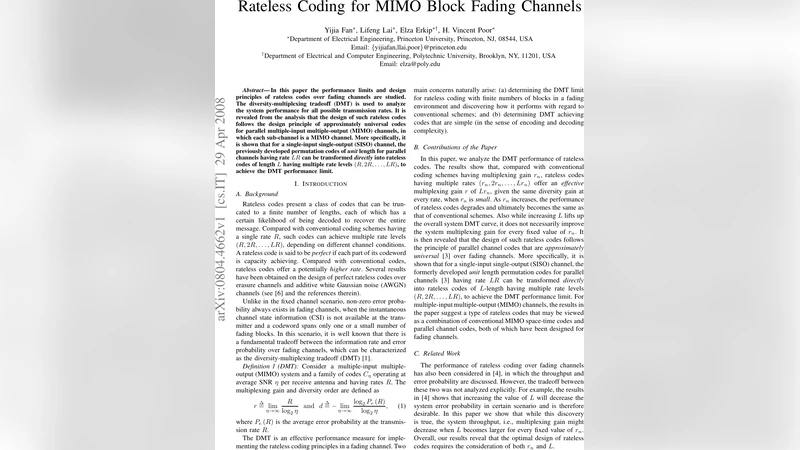
In this paper the performance limits and design principles of rateless codes over fading channels are studied. The diversity-multiplexing tradeoff (DMT) is used to analyze the system performance for all possible transmission rates. It is revealed from the analysis that the design of such rateless codes follows the design principle of approximately universal codes for parallel multiple-input multiple-output (MIMO) channels, in which each sub-channel is a MIMO channel. More specifically, it is shown that for a single-input single-output (SISO) channel, the previously developed permutation codes of unit length for parallel channels having rate LR can be transformed directly into rateless codes of length L having multiple rate levels (R, 2R, . . ., LR), to achieve the DMT performance limit.
💡 Research Summary
The paper investigates the fundamental limits and design principles of rateless coding over fading channels, focusing on multiple‑input multiple‑output (MIMO) block‑fading environments. Using the diversity‑multiplexing tradeoff (DMT) as the performance metric, the authors analyze how rateless codes behave across all possible transmission rates.
A system model is introduced where a transmitter with M antennas sends a codeword composed of L blocks, each occupying T channel uses, over a frequency‑flat fading channel that remains static for the entire codeword. The receiver, lacking instantaneous CSI at the transmitter, measures the accumulated mutual information I after each block. If I is still below the target R·L·T, the receiver waits for the next block; otherwise it decodes the received portion, sends a one‑bit positive feedback, and the transmitter stops sending the remaining blocks. Consequently, a single rateless code can support multiple rate levels (R, 2R, …, LR).
The authors define the effective multiplexing gain r as the high‑SNR limit of the average transmitted bits per channel use, and the diversity order d as the negative high‑SNR slope of the error probability. For a conventional fixed‑rate MIMO scheme with multiplexing gain rₙ, the DMT curve is d = f(rₙ), where f(k) is the piecewise‑linear function connecting points (k,(M−k)(N−k)).
Theorem 1 shows that, provided the block length T is sufficiently large, a rateless code with rate levels (rₙ, 2rₙ, …, Lrₙ) achieves the DMT pair
r = L·rₙ and d = f(rₙ) for 0 ≤ rₙ < min(M,N)/L.
Thus, in the low‑rate regime rateless coding can increase the multiplexing gain up to L‑fold while preserving the same diversity order as a conventional scheme. When rₙ ≥ min(M,N)/L, the advantage disappears and the rateless code’s DMT coincides with that of the fixed‑rate system. The intuition is that the first block can no longer carry the required information once the per‑block rate exceeds the channel’s spatial degrees of freedom.
The paper then connects rateless coding to the well‑studied problem of coding for parallel MIMO channels. By viewing the L blocks as L parallel sub‑channels (each a MIMO link), the authors argue that any code that is “approximately universal” for the parallel channel—i.e., its error probability decays exponentially with SNR for every non‑outage fading realization—will also achieve the DMT of Theorem 1 when applied sequentially to the rateless channel.
Theorem 2 formalizes this: if a code {X₁,…,X_L} is approximately universal for the parallel channel (with independent fading matrices H₁,…,H_L) and attains the DMT points (L·rₙ, L·f(rₙ)) for 0 ≤ rₙ ≤ min(M,N), then its sequential use as a rateless code yields exactly the DMT described in Theorem 1.
For the single‑input single‑output (SISO) case, the authors point out that previously developed unit‑length permutation codes for parallel channels satisfy the approximate universality condition. These codes are built from QAM constellations where each sub‑channel uses a permutation of the same symbol set, optimized to maximize the minimum codeword distance. By simply mapping the L permutations to the L blocks, a rateless code of length L is obtained that achieves the optimal DMT without any additional complexity.
Numerical examples illustrate the theoretical findings. With M = N = 2 and L = 2, the DMT curve of rateless coding coincides with the conventional curve for rₙ ≥ 0.5, but for rₙ < 0.5 the rateless scheme attains a multiplexing gain twice as large while keeping the same diversity. A second example with M = N = 3, L = 4 shows that increasing L lifts the overall DMT envelope but does not guarantee a higher multiplexing gain for every fixed rₙ; in some intervals the gain even drops, emphasizing the need to choose L relative to rₙ (ideally L < min(M,N)/rₙ).
The paper also revisits prior work on Hybrid‑ARQ DMT analysis, noting that earlier results only covered the low‑rate region (rₙ < min(M,N)/L). By providing the complete DMT curve for all rₙ, the authors fill this gap and clarify the trade‑off between throughput and reliability for rateless schemes.
In conclusion, rateless coding over MIMO block‑fading channels can dramatically improve spectral efficiency in the low‑rate regime without sacrificing diversity, provided the underlying code is approximately universal for the corresponding parallel channel. For SISO systems, permutation codes of unit length give a concrete, low‑complexity construction. The results suggest that, even without transmitter CSI, carefully designed rateless codes can achieve the same fundamental limits as optimal fixed‑rate codes while offering flexible rate adaptation, making them attractive for practical wireless systems where channel conditions vary unpredictably.
Comments & Academic Discussion
Loading comments...
Leave a Comment