Introducing a Probabilistic Structure on Sequential Dynamical Systems, Simulation and Reduction of Probabilistic Sequential Networks
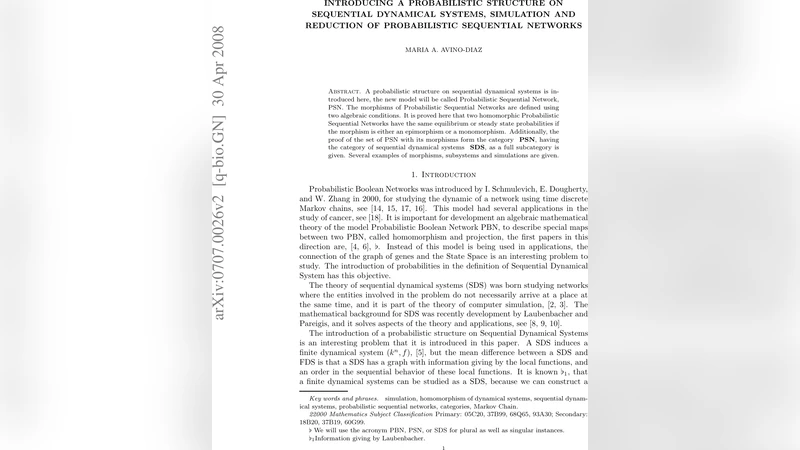
A probabilistic structure on sequential dynamical systems is introduced here, the new model will be called Probabilistic Sequential Network, PSN. The morphisms of Probabilistic Sequential Networks are defined using two algebraic conditions. It is proved here that two homomorphic Probabilistic Sequential Networks have the same equilibrium or steady state probabilities if the morphism is either an epimorphism or a monomorphism. Additionally, the proof of the set of PSN with its morphisms form the category PSN, having the category of sequential dynamical systems SDS, as a full subcategory is given. Several examples of morphisms, subsystems and simulations are given.
💡 Research Summary
The paper introduces a novel mathematical framework called Probabilistic Sequential Network (PSN) that enriches the classical Sequential Dynamical Systems (SDS) with stochastic elements. In an SDS, each vertex of a finite directed graph carries a deterministic local update function, and a global update is performed according to a fixed sequential order. While this model captures many discrete dynamical phenomena, it fails to represent inherent randomness present in biological, social, or engineered systems. To address this limitation, the authors attach to every vertex a finite set of local functions together with a probability distribution over that set. A global update proceeds by selecting, for each vertex, one of its local functions according to the prescribed probabilities and then applying them in the given sequential order. The resulting state transition is a Markov chain on the product state space, and the probability of moving from one global configuration to another is the product of the probabilities of the locally chosen functions.
A central contribution of the paper is the definition of morphisms between PSNs. A morphism consists of two components: (i) a graph homomorphism φ that maps vertices of the source network to vertices of the target network while preserving adjacency, and (ii) a family of function maps ψ_i that send each local function of a source vertex to a local function of its image vertex, preserving the associated probabilities. Formally, for each vertex v_i, ψ_i(f_i^j) = f’{φ(v_i)}^{k} and the weight w_i^j equals w’{φ(v_i)}^{k}. These two algebraic conditions guarantee that the stochastic dynamics of the source network are faithfully represented in the target network.
The authors prove two fundamental theorems concerning epimorphisms (surjective morphisms) and monomorphisms (injective morphisms). If a morphism is an epimorphism, the target PSN can be regarded as a reduction of the source PSN; the steady‑state (equilibrium) distribution of the source projects onto the steady‑state distribution of the target, meaning that reduction does not alter long‑run probabilistic behavior. Dually, if a morphism is a monomorphism, the source PSN embeds into the target PSN as a subsystem, and the embedded subsystem retains the same equilibrium probabilities as it would have in isolation. Consequently, homomorphic PSNs related by either an epimorphism or a monomorphism share identical equilibrium distributions.
From a categorical perspective, the collection of PSNs together with their morphisms forms a category, denoted PSN. The authors show that the classical SDS category embeds as a full subcategory of PSN: an SDS is simply a PSN in which each vertex’s probability distribution is degenerate (all weight on a single deterministic function). This embedding preserves objects and morphisms, establishing that PSN genuinely extends the existing theory without breaking compatibility.
To illustrate the abstract constructions, the paper presents several concrete examples. One example demonstrates a surjective morphism that collapses a larger network onto a smaller one, thereby achieving model reduction while preserving the stationary distribution. Another example constructs an injective morphism that embeds a small network into a larger one, showing that the embedded part behaves exactly as before. A third example uses a morphism to simulate one PSN by another, highlighting the potential for model verification and substitution. Finally, a case study on a gene‑regulatory network shows how a realistic biological system can be modeled as a PSN and then reduced to a core subnetwork via an epimorphism, facilitating analysis.
The paper also sketches algorithmic considerations. Computing the transition matrix of a PSN involves enumerating the product of local function choices, which can be optimized by exploiting sparsity and independence. Verifying a morphism reduces to checking graph homomorphism and equality of probability weights, tasks for which standard graph‑theoretic and linear‑algebraic tools apply. The authors suggest future work on efficient discovery of epimorphisms/monomorphisms, extensions to continuous‑time stochastic updates, and a systematic classification of PSN homomorphisms.
In summary, this work provides a rigorous algebraic and categorical foundation for incorporating stochasticity into sequential dynamical systems. By defining PSNs, establishing morphisms with clear preservation properties, and proving that equilibrium behavior is invariant under epimorphic and monomorphic transformations, the authors open new avenues for model reduction, simulation, and analysis of complex stochastic networks across disciplines.
Comments & Academic Discussion
Loading comments...
Leave a Comment