Reductions of Multicomponent mKdV Equations on Symmetric Spaces of DIII-Type
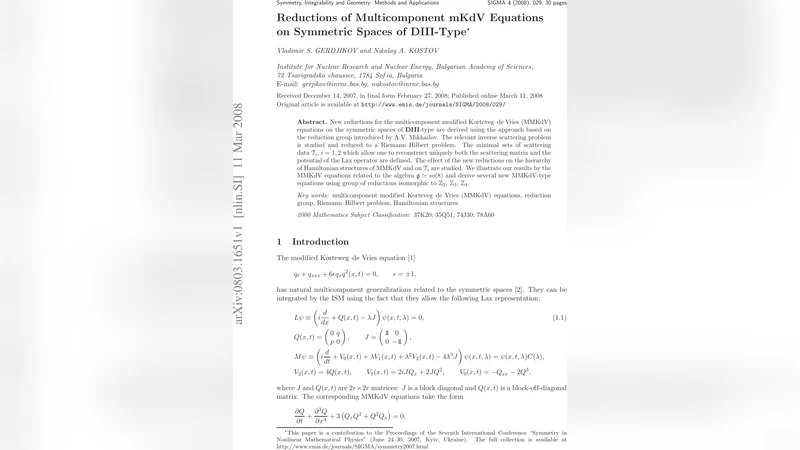
New reductions for the multicomponent modified Korteveg-de Vries (MMKdV) equations on the symmetric spaces of {\bf DIII}-type are derived using the approach based on the reduction group introduced by A.V. Mikhailov. The relevant inverse scattering problem is studied and reduced to a Riemann-Hilbert problem. The minimal sets of scattering data $\mathcal{T}i$, $i=1,2$ which allow one to reconstruct uniquely both the scattering matrix and the potential of the Lax operator are defined. The effect of the new reductions on the hierarchy of Hamiltonian structures of MMKdV and on $\mathcal{T}i$ are studied. We illustrate our results by the MMKdV equations related to the algebra $\mathfrak{g}\simeq so(8)$ and derive several new MMKdV-type equations using group of reductions isomorphic to ${\mathbb Z}{2}$, ${\mathbb Z}{3}$, ${\mathbb Z}_{4}$.
💡 Research Summary
The paper investigates multicomponent modified Korteweg‑de Vries (MMKdV) equations defined on symmetric spaces of DIII‑type, i.e., on the Lie algebra so(2r). Using the reduction group method introduced by A.V. Mikhailov, the authors systematically construct new algebraic reductions that are compatible with the Lax representation of the MMKdV hierarchy. The key idea is to consider finite‑order automorphisms C of so(2r) that either preserve the grading element J or map J to −J. These automorphisms generate finite groups (isomorphic to ℤ₂, ℤ₃, ℤ₄, etc.) which act on the potential Q(x,t) and enforce symmetry constraints on the Lax pair.
The inverse scattering method (ISM) for the Lax operator L is reformulated as a Riemann–Hilbert (RH) problem. The authors introduce a modified definition of the fundamental analytic solutions (FAS) χ⁺(x,λ) and χ⁻(x,λ) so that they belong to SO(2r). By factorising the scattering matrix T(λ) into generalized Gauss components S⁺, T⁻, D⁺ (and their counterparts), they obtain two minimal sets of scattering data, denoted 𝒯₁ and 𝒯₂. Each set consists of block‑diagonal analytic functions (e.g., a⁺(λ), c⁻(λ) for 𝒯₁) and is sufficient to reconstruct uniquely both the full scattering matrix and the potential Q(x,t). This minimal data formulation is essential for handling reductions, because the symmetry constraints translate into simple algebraic relations among the components of 𝒯_i.
A detailed example is worked out for r=4, i.e., so(8). Two families of reductions are considered. The first family uses automorphisms that leave J invariant; these lead to reductions associated with the groups ℤ₂, ℤ₃, ℤ₄. For each group the authors write down the explicit constraints on the matrix entries of Q, derive the resulting reduced MMKdV equations, and compute the corresponding reduced Hamiltonians and symplectic forms. The second family employs automorphisms that send J to −J. In this case half of the Hamiltonian hierarchy degenerates (e.g., odd‑order Hamiltonians vanish), producing a different class of reduced equations that have no analogue in the first family.
The paper also analyses the impact of reductions on the hierarchy of Hamiltonian structures. The generic MMKdV hierarchy possesses an infinite sequence of compatible Poisson brackets, each generated by a trace functional Tr (Q^{2n+1}). Under the reductions, many of these brackets become dependent or trivial, and the authors explicitly list the surviving brackets for each reduction group.
In Section 6 the classical r‑matrix associated with the Lax pair is examined. The authors show that the reduction constraints preserve the fundamental r‑matrix commutation relation
Comments & Academic Discussion
Loading comments...
Leave a Comment