Do All Integrable Evolution Equations Have the Painleve Property?
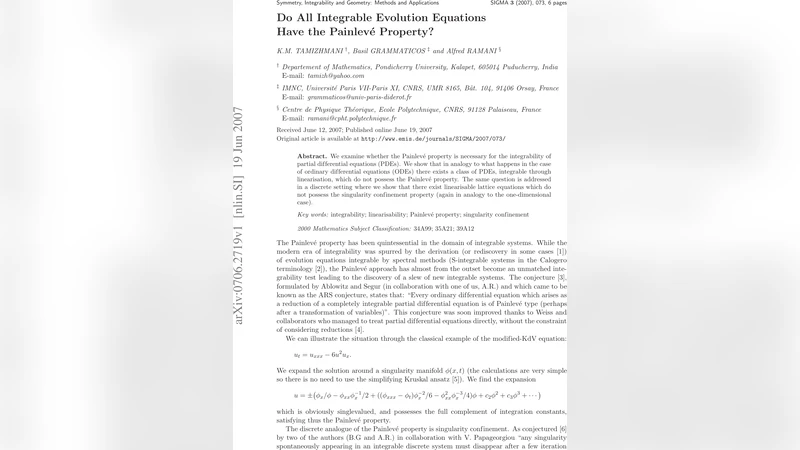
We examine whether the Painleve property is necessary for the integrability of partial differential equations (PDEs). We show that in analogy to what happens in the case of ordinary differential equations (ODEs) there exists a class of PDEs, integrable through linearisation, which do not possess the Painleve property. The same question is addressed in a discrete setting where we show that there exist linearisable lattice equations which do not possess the singularity confinement property (again in analogy to the one-dimensional case).
💡 Research Summary
The paper tackles a fundamental question in the theory of integrable nonlinear evolution equations: is the Painlevé property a necessary condition for integrability? While the Painlevé property—requiring that all movable singularities of a solution be poles—has long been recognized as a powerful sufficient test for integrability of ordinary differential equations (ODEs), the converse implication has never been rigorously established. The authors first recall the classical situation for ODEs, where many integrable equations (e.g., the Korteweg‑de Vries, sine‑Gordon, and nonlinear Schrödinger equations) pass the Painlevé test, and they note that the test is closely linked to the existence of a Lax pair, infinite hierarchies of conserved quantities, and the inverse scattering transform. However, they also point out that certain ODEs that are trivially linearizable, such as the Riccati equation, fail the Painlevé test because their general solution contains movable branch points or logarithmic terms. Despite this failure, these equations are integrable by a simple change of variables that reduces them to a linear first‑order ODE.
Motivated by this ODE counter‑example, the authors extend the analysis to partial differential equations (PDEs). They examine several well‑known evolution equations that are integrable through linearisation, most prominently the Burgers equation. Using the Cole‑Hopf transformation, the Burgers equation is mapped to the linear heat equation. When subjected to the Painlevé test, the Burgers equation exhibits movable logarithmic singularities, violating the Painlevé property. Similar behaviour is observed for certain modified KdV‑type equations and nonlinear diffusion‑reaction systems that admit linearising transformations. In each case, the failure of the Painlevé test does not preclude integrability: the existence of an explicit linearising map guarantees exact solvability, the presence of infinite symmetries, and the possibility of constructing exact solutions via the linear counterpart.
The paper then turns to the discrete realm, where the analogue of the Painlevé property is the singularity confinement (SC) criterion. SC requires that any singularity arising from generic initial data be “confined” to a finite number of lattice steps, after which the evolution regains regularity. The authors present linearisable lattice equations, notably discrete Riccati‑type recurrences and their multi‑component extensions, which do not satisfy SC: singularities persist indefinitely. Nevertheless, these lattice equations can be transformed into linear difference equations (e.g., discrete heat equations) through suitable Möbius or gauge transformations, thereby establishing their integrability despite the lack of confinement.
The main conclusions are threefold. First, the Painlevé property (or its discrete counterpart, singularity confinement) is a sufficient but not necessary condition for integrability of both continuous and discrete evolution equations. Second, the class of linearisable equations provides a systematic source of counter‑examples: they are integrable by construction yet often fail the Painlevé/SC tests because the linearising transformation introduces non‑pole movable singularities. Third, a robust assessment of integrability must go beyond singularity analysis and incorporate additional hallmarks such as the existence of a Lax pair, bi‑Hamiltonian structures, infinite hierarchies of conserved quantities, and, crucially, the possibility of an explicit linearising map.
The authors suggest that future work should catalogue further linearisable PDEs and lattice equations, explore the interplay between linearisation and other integrability structures, and perhaps develop a refined singularity framework that can accommodate the peculiar behaviour of linearisable systems. Their results broaden the understanding of what it means for a nonlinear evolution equation to be integrable and caution against an over‑reliance on the Painlevé test as a universal diagnostic tool.
Comments & Academic Discussion
Loading comments...
Leave a Comment