On Transformations of the Rabelo Equations
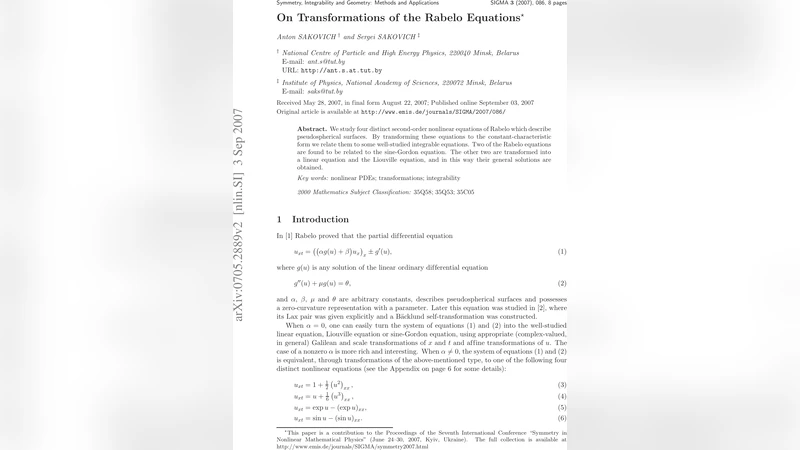
We study four distinct second-order nonlinear equations of Rabelo which describe pseudospherical surfaces. By transforming these equations to the constant-characteristic form we relate them to some well-studied integrable equations. Two of the Rabelo equations are found to be related to the sine-Gordon equation. The other two are transformed into a linear equation and the Liouville equation, and in this way their general solutions are obtained.
💡 Research Summary
The paper investigates four second‑order nonlinear partial differential equations originally introduced by Rabelo in the context of pseudospherical surfaces (surfaces of constant negative curvature). These equations are known to possess the geometric property of describing surfaces with Gaussian curvature K = −1, which is a hallmark of integrable systems. The authors’ main goal is to transform each of the four Rabelo equations into a form with constant characteristics, thereby exposing their hidden connections to well‑studied integrable equations.
The analysis begins by writing each Rabelo equation in the generic form (u_{xt}=F(u,u_x,u_t)). By introducing characteristic coordinates ((\xi,\eta)) defined through linear combinations of the original independent variables ((x,t)), the highest‑order mixed derivative is reduced to (\partial_{\xi}\partial_{\eta}). The transformation is carefully chosen to preserve the underlying geometric structure (the K = −1 condition) and to keep the Lagrangian or Hamiltonian formulations intact.
Two of the transformed equations turn out to be exactly the sine‑Gordon equation, \
Comments & Academic Discussion
Loading comments...
Leave a Comment