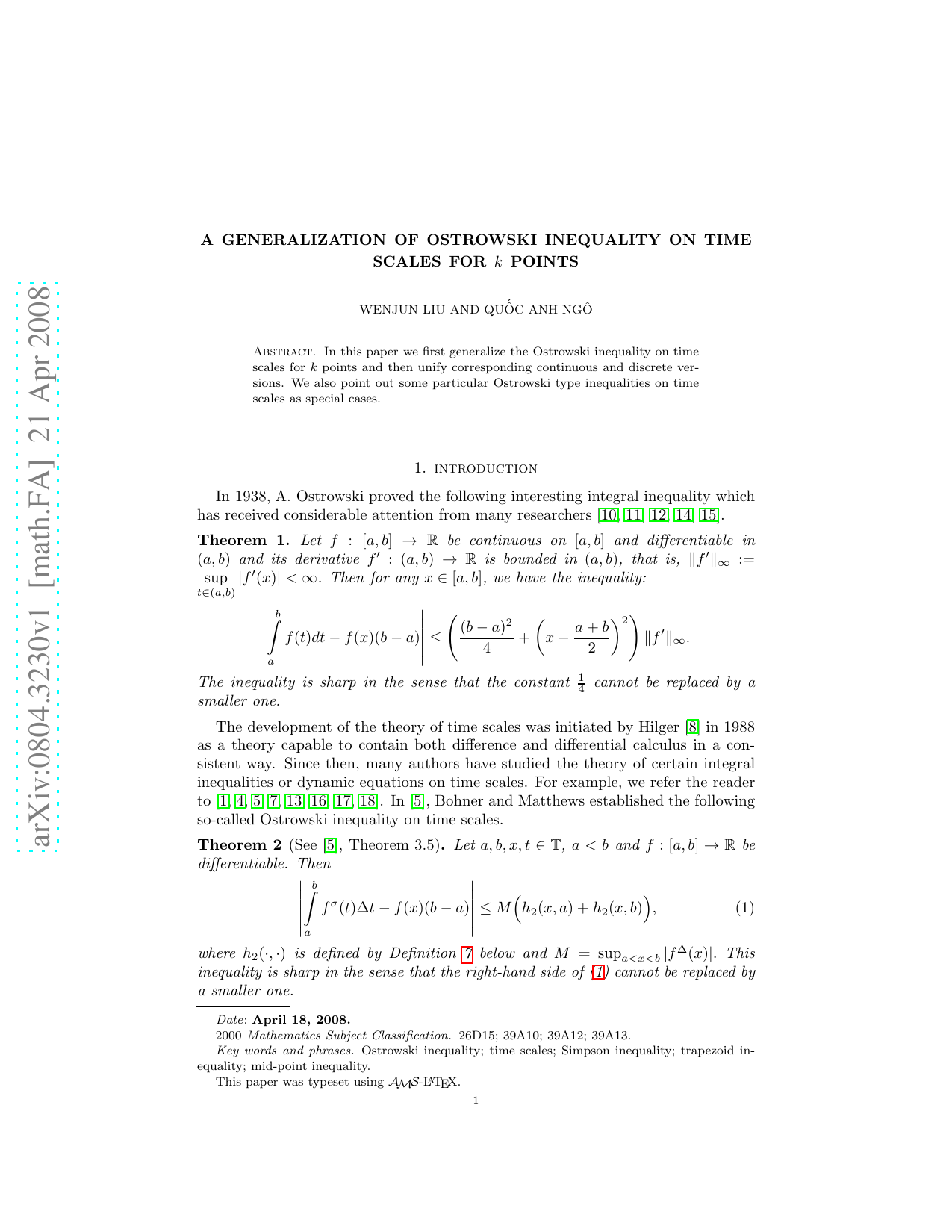
In this paper we first generalize the Ostrowski inequality on time scales for k points and then unify corresponding continuous and discrete versions. We also point out some particular Ostrowski type inequalities on time scales as special cases.
Deep Dive into A generalization of Ostrowski inequality on time scales for k points.
In this paper we first generalize the Ostrowski inequality on time scales for k points and then unify corresponding continuous and discrete versions. We also point out some particular Ostrowski type inequalities on time scales as special cases.
In 1938, A. Ostrowski proved the following interesting integral inequality which has received considerable attention from many researchers [10,11,12,14,15]. The inequality is sharp in the sense that the constant 1 4 cannot be replaced by a smaller one.
The development of the theory of time scales was initiated by Hilger [8] in 1988 as a theory capable to contain both difference and differential calculus in a consistent way. Since then, many authors have studied the theory of certain integral inequalities or dynamic equations on time scales. For example, we refer the reader to [1,4,5,7,13,16,17,18]. In [5], Bohner and Matthews established the following so-called Ostrowski inequality on time scales.
Theorem 2 (See [5], Theorem 3.5). Let a, b, x, t ∈ T, a < b and f :
where h 2 (•, •) is defined by Definition 7 below and M = sup a<x<b |f ∆ (x)|. This inequality is sharp in the sense that the right-hand side of (1) cannot be replaced by a smaller one.
In the present paper we shall first generalize the above Ostrowski inequality on time scales for k points x 1 , x 2 , • • • , x k and then unify corresponding continuous and discrete versions. We also point out some particular Ostrowski type inequalities on time scales as special cases.
Now we briefly introduce the time scales theory and refer the reader to Hilger [8] and the books [2,3,9] for further details. Definition 1. A time scale T is an arbitrary nonempty closed subset of real numbers.
Definition 2. For t ∈ T, we define the forward jump operator σ : T → T by σ(t) = inf {s ∈ T : s > t} , while the backward jump operator ρ : T → T is defined by ρ(t) = sup {s ∈ T : s < t} . If σ(t) > t, then we say that t is right-scattered, while if ρ(t) < t then we say that t is left-scattered.
Points that are right-scattered and left-scattered at the same time are called isolated. If σ(t) = t, the t is called right-dense, and if ρ(t) = t then t is called left-dense. Points that are both right-dense and left-dense are called dense. Definition 3. Let t ∈ T, then two mappings µ, ν : T → (0, +∞) satisfying
are called the graininess functions.
We now introduce the set T κ which is derived from the time scales T as follows.
If T has a left-scattered maximum t, then T κ := T -{t}, otherwise T κ := T. Furthermore for a function f : T → R, we define the function f σ : T → R by f σ (t) = f (σ(t)) for all t ∈ T. Definition 4. Let f : T → R be a function on time scales. Then for t ∈ T κ , we define f ∆ (t) to be the number, if one exists, such that for all ε > 0 there is a neighborhood U of t such that for all s ∈ U
We say that f is ∆-differentiable on T κ provided f ∆ (t) exists for all t ∈ T κ .
(1) f is continuous at each right-dense point or maximal element of T.
(2) The left-sided limit lim s→t-
Remark 1. It follows from Theorem 1.74 of Bohner and Peterson [2] that every rd-continuous function has an anti-derivative.
and then recursively by
Throughout this section, we suppose that T is a time scale and an interval means the intersection of real interval with the given time scale. We are in a position to state our main result.
This inequality is sharp in the sense that the right-hand side of (2) cannot be replaced by a smaller one.
To prove Theorem 3, we need the following Generalized Montgomery Identity.
Lemma 1 (Generalized Montgomery Identity). Under the assumptions of Theorem 3, we have
where
Proof. Integrating by parts and applying Proposition 1, we have b a
Proof of Theorem 3. By applying Lemma 1, we get
To prove the sharpness of this inequality, let f (t) = t, x 0 = a, x 1 = b, α 0 = a, α 1 = b, α 2 = b. It follows that M = 1. Starting with the left-hand side of (2), we have
Starting with the right-hand side of (2), we have
and by (2) also
So the sharpness of the inequality (2) is shown.
If we apply the inequality (2) to different time scales, we will get some well-known and some new results.
Corollary 1 (Continuous case). Let T = R. Then our delta integral is the usual Riemann integral from calculus. Hence,
, for all t, s ∈ R.
This leads us to state the following inequality
where M = sup a<x<b |f ′ (x)| and the constant 1 4 in the right-hand side is the best possible.
Remark 2. The inequality ( 5) is exactly the generalized Ostrowski inequality shown in [6].
|∆x i | and the constant 1 4 in the right-hand side is the best possible.
Therefore,
The conclusion is obtained by some easy calculation.
Corollary 3 (Quantum calculus case). Let T = q N0 , q > 1, a = q m , b = q n with m < n. Suppose that (1) I k : q m = q j0 < q j1 < • • • < q j k-1 < q j k = q n is a division of [q m , q n ] ∩ q N0 for j 0 , k 1 , . . . , j k ∈ N 0 ; (2) q pi ∈ q N0 (i = 0, . . . , k + 1) is “k + 2” points so that q p0 = q m , q pi ∈ [q ji-1 , q ji ] ∩ q N0 (i = 1, . . . , k) and q p k+1 = q m ; (3) f : [q m , q n ] → R is differentiable.
Then, we have
where
and the constant 1 4 in the right-hand side is the best possible. Proof. In this situation, one has
, f
…(Full text truncated)…
This content is AI-processed based on ArXiv data.