Identifying Hidden Communities of Practice within Electronic Networks: Some Preliminary Premises
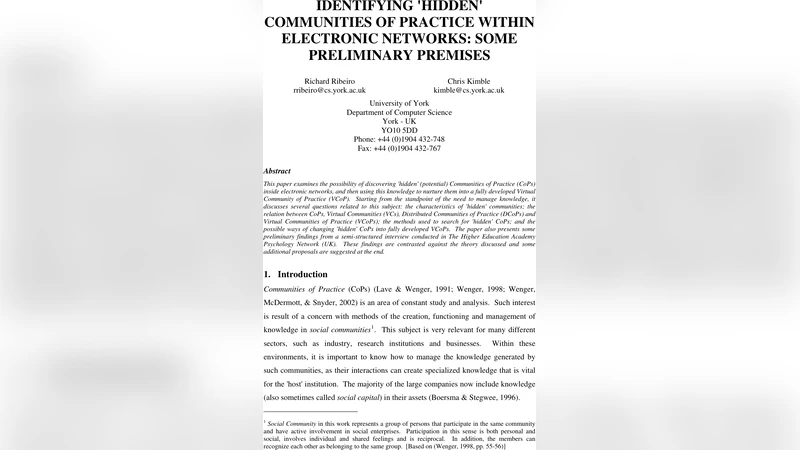
This paper examines the possibility of discovering ‘hidden’ (potential) Communities of Practice (CoPs) inside electronic networks, and then using this knowledge to nurture them into a fully developed Virtual Community of Practice (VCoP). Starting from the standpoint of the need to manage knowledge, it discusses several questions related to this subject: the characteristics of ‘hidden’ communities; the relation between CoPs, Virtual Communities (VCs), Distributed Communities of Practice (DCoPs) and Virtual Communities of Practice (VCoPs); the methods used to search for ‘hidden’ CoPs; and the possible ways of changing ‘hidden’ CoPs into fully developed VCoPs. The paper also presents some preliminary findings from a semi-structured interview conducted in The Higher Education Academy Psychology Network (UK). These findings are contrasted against the theory discussed and some additional proposals are suggested at the end.
💡 Research Summary
The paper investigates how “hidden” Communities of Practice (CoPs)—groups of individuals who share a common domain of interest and tacit knowledge but whose interactions are not yet visible—can be identified within electronic networks and subsequently nurtured into fully fledged Virtual Communities of Practice (VCoPs). Beginning with a knowledge‑management perspective, the authors first clarify terminology, distinguishing traditional CoPs, Virtual Communities (VCs), Distributed Communities of Practice (DCoPs), and VCoPs, and then propose a “latent‑to‑manifest” model that outlines three stages: (1) detection of latent participants and shared interests, (2) stimulation of initial interaction, and (3) formal structuring of a VCoP.
Methodologically, the study adopts a mixed‑methods approach. Network analysis is applied to email lists, discussion forums, and collaboration tools (e.g., Slack, Teams) to compute centrality, density, and clustering coefficients, thereby surfacing sub‑graphs that may correspond to hidden CoPs. Text‑mining techniques—including keyword extraction, topic modeling with Latent Dirichlet Allocation, and sentiment analysis—are used on posts, comments, and attached documents to uncover recurring thematic clusters. Finally, semi‑structured interviews with members of identified clusters provide qualitative insight into their learning goals, knowledge‑sharing practices, and perceived organizational support needs.
The empirical component focuses on the Higher Education Academy (HEA) Psychology Network in the United Kingdom. Network metrics reveal that roughly 15 % of the overall membership forms two densely connected clusters. Topic modeling highlights recurring themes such as “research methodology,” “statistical analysis,” and “educational design,” suggesting that these clusters are already engaged in substantive knowledge exchange despite lacking an explicit community label. Interviews with twelve participants confirm that informal case discussions, ad‑hoc mentoring, and resource sharing occur regularly, and that digital platforms enable sustained collaboration across geographic and temporal boundaries.
Based on these findings, the authors propose three strategic interventions to convert hidden CoPs into robust VCoPs. First, platform enhancement: integrate formal discussion boards with informal chat channels and deploy automated tagging and recommendation engines to surface relevant content and connect participants. Second, organizational scaffolding: appoint “coach‑mentors,” schedule periodic webinars and workshops, and deliberately cultivate a shared identity through branding and storytelling. Third, performance measurement: establish metrics such as knowledge reuse frequency, participation rates, and learning outcomes, and create a continuous feedback loop for iterative improvement.
The discussion acknowledges limitations, notably the single‑case design and the need for higher precision in automated detection algorithms. Future research directions include testing the latent‑to‑manifest framework across multiple institutions and cultural contexts, and developing AI‑driven tools that combine network topology, natural‑language processing, and behavioral analytics for real‑time hidden CoP discovery.
In sum, the paper makes a substantive contribution by offering both a theoretical model and a practical roadmap for surfacing latent knowledge communities within digital environments and deliberately guiding them toward mature, self‑sustaining virtual practice networks.
Comments & Academic Discussion
Loading comments...
Leave a Comment