Analytical correlation of routing table length index and routing path length index in hierarchical routing model
In Kleinrock and Kamoun's paper, the inverse relation of routing table length index and routing path length index in hierarchical routing model is illustrated. In this paper we give the analytical correlation of routing table length index and routing…
Authors: Tingrong Lu
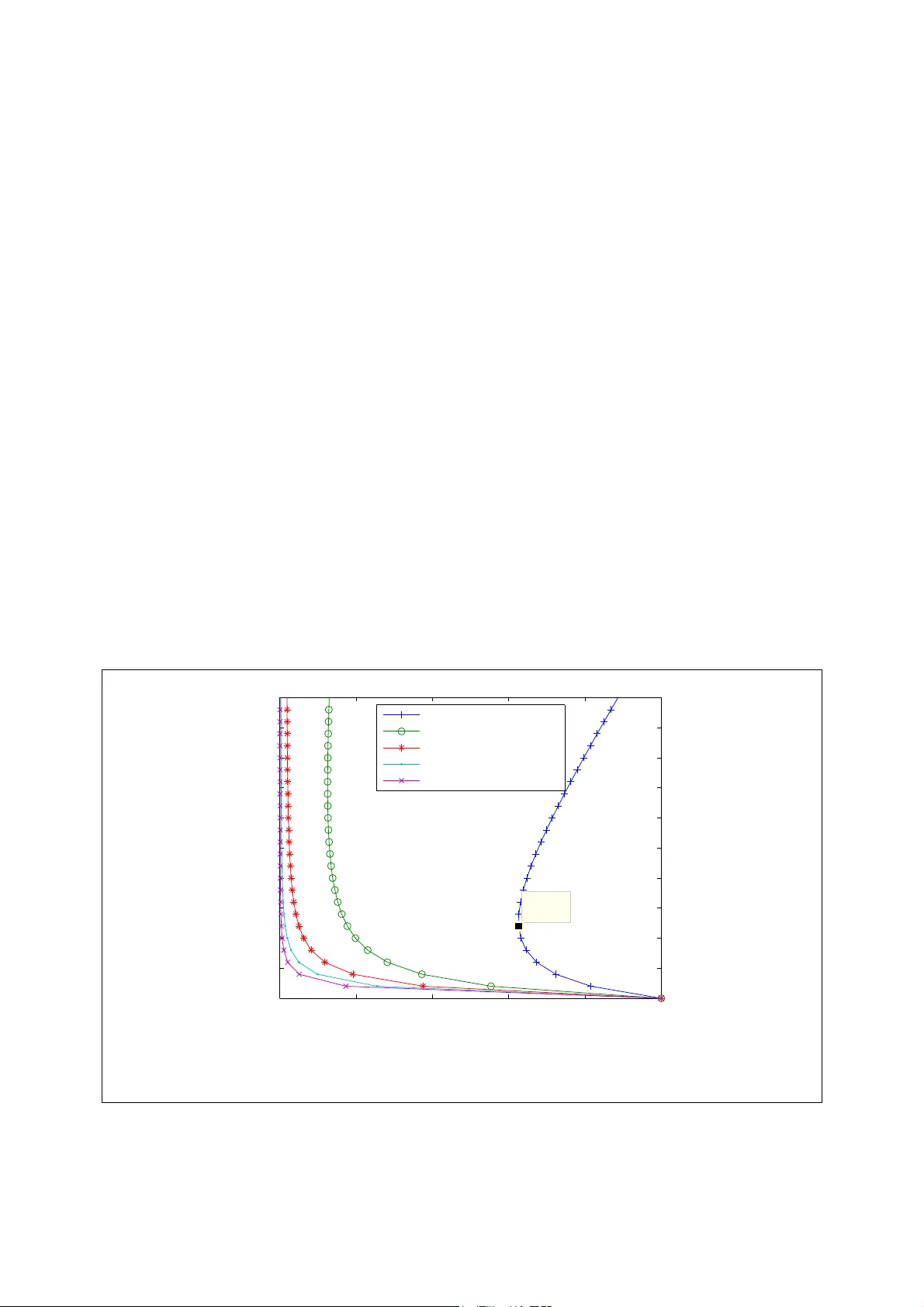
1 Analytical correlation of routing table length index and routing path length index in hierarchical routing model Tingrong Lu Dept. computer science, CIDST, Beijing, 102206, China lutingrong@hrbeu.edu.cn Abstract. In Kleinrock and Kamoun’s paper, the inverse relation of routing table length index and routing path length index in hierarchical routing model is illustra ted. In this paper we give the analytical correlation of routing table length index and routing path length index in hierarchical routing model. Keywords. Hierarchical routi ng model; rout ing table lengt h index; routing path length index; analy tical correlation 1 Introduction Kleinrock and Kamoun analy zed the balance of performance param eters in hi erarchical routing model [1]. Ac- cording to their resu lt, in hierarchical rou ting, the rou ting table length i s reduced significantl y with m ild routing path length increase. Shorter routing ta ble length results in less comm unication overhead. The aggregat ion of the routing inform ation reduces routing table, meanwhil e reduces the precision of the rout ing informat ion, which makes hierarchical routing path longer than shortest routing path. Two inversely correla ted paramet ers, routing table l ength and routing path lengt h are analyzed [1]. In the opti - mal hierarchi cal structure, the routing t able length is reduced from N (the number of nodes in the network) to elnN. The upper limi t of the increase of the routing pat h length is given. Literature [1] supposes that the routing table length is equivalent on each node. For fixed level number, m , the optimal routing table l ength is 1/ m mN . With variable level num ber, the optim al routing t able length is ln eN . Though the fact of the inverse relat ion of the routing path lengt h and the routing table length is well-known, to the best of the author’s knowledge, t here is no analytical correl ation between the two param eters shown in the literature. In this paper, we give the analyti cal correlation of the routing path l ength index and the routing t able length index. 2 Analytical correlation of the routing path length index and the routing table length index Theorem 1. In hierarchical struct ure, average routing path l ength stretch fact or (relative lengt h)[1], (1 ) pp ss ≥ , is linear to the number of lev els of the hierarchical structure, (1 ) hh ≥ . 1( 1 ) p sh α = +− , in which 0 α > , is a constant decided by t he rank (the number of nodes in the network) and t he structure of the hierarchy. Proof. The distance between 2 nodes equals to the sum of distance in the clusters and the distance between clus- ters. Assume each cluster has the sam e rank, the distances in the clusters are averagel y the sam e, denoted by di. As there is only 1 hop between the adj acent clusters, the distance between 2 nodes is (1+di)*k-1, in which k is the number of clusters t he path trespasses. In a tree structure, comm unication between any 2 nodes has to take 2 pass on a comm on parent node. Denote the depth of 2 nodes, v1, v2, to t heir comm on parent node by h1, h2, the distance between v1 and v2 is d1,2=h1(di+1)+h2(di+1)-2. The di ameter of the original graph, i.e. the longest distance in the graph, is 2h*(di+1)+di , in which h is the hei ght of the tree. Assume the average path length in the original graph is d, the av erage path length i n the hi erarchical structure is d+ α *(h-1), in whic h α >0, is a constant decided by the rank and the structure of the hierarchy. Then th e average routing path le ngth stretch factor is ( ( 1 ) )/ 1 * ( 1 )/ 1 * ( 1 ) dh d h d h α αβ + ∗ −= +− = + − , i.e. the average routing path l ength stretch factor is linear to the height of the hierarchy. From theorem 1, when h=1, the hierarchy degenerates to the original input graph, 1( 1 1 ) 1 p s α = +− = , which satisfies the boundary condition. Theorem 2. In IPEA m odel[2], the average routing path length stretch factor s p and the average routing table length stretch fact or s t are in such correlation, t p s s log 1 α − = in which α >0, is a constant decided by the rank and structure of the original graph and the hierarchy . Proof. Graph G(V, E) is devided to p clust ers with sam e rank c, n=|V|, then /1 / t sc n p = = , in which 1, 1, 1 t np n c s ≥≥ ≥ ≥ ≤ . The height of p-cluste r hierarchy is 1l o g, 1 hp h = +≥ . According to theorem 1, When the hierarchy degenerates to non-hierarchical st ructure, s t =1 , 1l o g 1 1 p s α = −= , which satisfies the boundary condition. In Kleinrock-Karmon m odel, the height of hierarchi cal structure is m , 1 m ≥ , optimi zed routing table l ength is 1/ m lm N = , in which N is the rank of the i nput graph, (1) 1 / 1 − = m t mN s According to theorem 1, 1( 1 ) p sm α =+ − , we have (2) ) 1 ( * / 1 1 − + = p s m α When m =1 , 1/1 1 1* 1 , 1 ( 1 1 ) 1 tp sN s α − == = + − = , which satisfies the boundary condition. Substitute eq(1) with eq(2), (3) )) 1 ( * / 1 1 ( 1 )) 1 ( * / 1 1 /( 1 1 / 1 − − + − − + = = p s p m t N s mN s α α Theorem 3. In Kleinrock-Karm on model, the average routi ng path length stretc h factor and the average routing table length stret ch factor are in such correlation, (3) )) 1 ( * / 1 1 ( 1 )) 1 ( * / 1 1 /( 1 1 / 1 − − + − − + = = p s p m t N s mN s α α in which α >0, is a constant decided by the rank and the st ructure of the original graph and the hierarchy. 1( 1 ) 1( 1 l o g 1 ) 1 * l og( 1 / ) 1* l o g p t t sh p s s α α α α =+ ∗ − =+ ∗ + − =+ =− 3 3 Correlation results In Eq(3), when α =0.987, N takes 10, 10 2 , 10 3 , 10 4 , 10 5 , the respective figures are show n in Fig.1. The figures are perfectly fit to Fig.8[1]. For N=10, when s p =2.2, s t =0.6264, reaches the minim um. As s p increases further, s t stops decrease but begins to increase. This sounds contradictory to our empirical expectation. This is because in Kleinrock-Karmon optim al model, for N=10, s t =0.6264, reaches the minim um and cannot decr ease any m ore. In Kleinrock-Karmon optimal model, as the routi ng table must keep routing informat ion of all ancestor nodes and the sub-trees of all ancestor nodes, the s t cannot decrease arbitrarily on the increase of s p . 4 Conclusions Eq(3) demonstrates perfectl y the inverse relation between t he average routing path length stretch fact or and the average routing table lengt h stretch factor in Klei nrock-Karmon hierarchical rout ing model, explains the data in Kleinrock-Karmon hi erarchical routing m odel. References 1. L. Kleinrock and F. Kamoun, Hierar chical Routing for large networks; perfo rmance evaluation and optimization. Com- puter Networks, Vol.1, pages 155-174, 1977 2. T. Lu, C. Sui, Y. Ma, et al. Extending Address Space of IP Networks with Hierarchical Addr essing. In Proc. Advances in Computer Systems Architecture: 10th Asia-Pacific Confer ence, ACSAC 2005. Singapore, October 24-26, 2005. Lecture Notes in Computer Science 3740, Springer-Verlag GmbH. p.499-508 Fig. 1 St retch factor of routing t able length vs. stret ch factor of routing path le ngth in Kleinrock-Karm on model 0 0.2 0.4 0.6 0.8 1 1 1.5 2 2.5 3 3.5 4 4.5 5 5.5 6 X: 0.6264 Y: 2.2 Strech factor of routing table length Strech factor of routing path length Number of nodes =10 Number of nodes =100 Number of nodes =1000 Number of nodes =10000 Number of nodes =100000
Original Paper
Loading high-quality paper...
Comments & Academic Discussion
Loading comments...
Leave a Comment